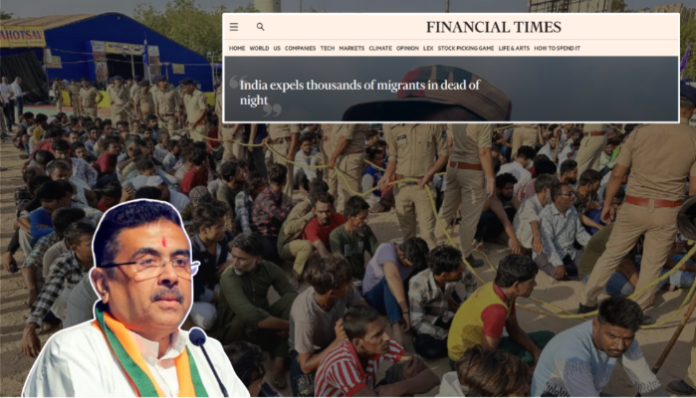
The Bharatiya Janata Party’s monumental success in the West Bengal assembly election, surpassing the 200-seat threshold to unseat Mamata Banerjee’s All India Trinamool Congress (AITC or TMC) signified an extraordinary political transformation and heralded a new era in governance. This included the crucial task of securing the porous India-Bangladesh border and implementing a strong policy against illegal immigration, which was previously handled with undue indulgence by the former government.
In fact, the TMC engaged in a relentless struggle with the central government to maintain the influx of Bangladeshi intruders in the state, with its leaders even boasting about facilitating the same, all to the detriment of national security and interests. However, this dangerous strategy for the aim of vote bank politics has been shut down by the Suvendu Adhikari government, which seems to have deeply frustrated the usual suspects.
The art of defending the intruders
On 1st July (Wednesday), Financial Times carried out a column, “India expels thousands of migrants in dead of night,” written by Andres Schipani to protests against the decisions of an elected state government of a sovereign nation that has taken crucial steps in the larger interest of its voters by making an effort to put a lid on the unlawful intrusions from the neighbouring country. The publication even opted for a sensational headline to provoke the readers, suggesting that a serious aggression is being inflicted upon legitimate citizens rather than on those who enter India in violation of its laws.
In a desperate bid to convey a dramatic narrative of supposed state brutality and injustice, the publication claimed, “Bangladeshi border guards use megaphones to tell their Indian counterparts not to push people across the border.” It referenced Bangladeshi officials who stated that the Indian side utilises darkness as a shield to advance its agenda which has only escalated after the saffron party stormed to power in West Bengal in May.
“They wait until it is dark to switch off the spotlights and for the right opportunity,” mentioned Lance Corporal Mahmud Masud. “They open the gates on the Indian fence and push people into the darkness. There are women, there are children and these poor people get stranded in the middle,” insisted Mohammad Ashrafuzzaman Siddiqui, director-general of the Border Guard Bangladesh.
The piece outlined that the state “has deported thousands of people, mostly Muslims of Bengali heritage, to Bangladesh, according to Indian and Bangladeshi officials.” It asserted that Bangladesh authorities complained about “dozens of people stuck in the zero line a narrow no man’s land between the Indian and Bangladeshi borders.”
It is apparent that instead of scrutinising Dhaka for denying the return of its own individuals, the media organisation cleverly tries to cast India as the antagonist for maintaining the laws of the land and added, “The deportation push has worsened fragile relations between the two countries, underscored fears about Hindu nationalism and heightened the sense of precarity for millions of Muslims in West Bengal and other border states.”
Of course, FT swiftly turned to “Hindu nationalism” otherwise it would have contradicted the fundamental principle for liberals to invoke Hindus, Hindutva or Hinduism to attack the Modi government merely for taking a stand for India, rather than succumbing to the victimhood propaganda peddled for even illegal residents because of their religion.
The effort to insert a religious element
Doubling down on his intentions, the author discussed the historical links between Dhaka and New Delhi along with the common language spoken in West Bengal and Bangladesh, to argue that the government should have allowed the rapidly increasing presence of illicit Bangladeshis in the country, essentially in “honour” of this background. India is effectively being called upon to accommodate them while Bangladesh just needs to remain passive as its people flood into its neighbourhood.
The unregulated and large-scale flow of Bangladeshis into states like Assam is depicted as a sentimental “history of migration” that lacks any foundation in either history or reality. Afterwards, the article reiterated its displeasure with the BJP for their actions against unlicensed Bangladeshi or Rohingya Muslims after achieving success in West Bengal.
It highlighted that the state has 30% Muslim population, implying that these actions could potentially affect them, echoing the conspiracy circulated during the anti-CAA (Citizenship Amendment Act) agitation, which declared that the law would be weaponised against the second largest majority. However, no such matter surfaced following its implementation.
Similarly, law abiding Indian citizens are immune to deportation irrespective of their religion, but the truth is conveniently masked by such rhetoric to diminish the government’s credibility and instigate doubt and division, ultimately leading to the incitement of violence.
FT stressed, “Critics say the deportation push reflects the BJP’s desire to turn India into a Hindu nation at the expense of its Muslim minority.” It then proceeded to quote Meenakshi Ganguly who is Human Rights Watch’s deputy Asia chief and “accused Indian authorities of cruelly dumping mostly Muslim families into Bangladesh or leaving them stranded at the border” as well as asked to “end this dismaying animosity towards Muslims.”
The government’s strategy to secure its borders and address elements that could endanger national security is labelled as a ploy to create a “Hindu nation” by the FT, indirectly insinuating that India should quietly observe while Bangladeshis and Rohingyas not only burden the nation’s economy but also infringe upon the rights of rightful citizens, including Muslims.
There is no such requirement imposed on Bangladesh, which not only refuses to accept its citizens but also has a disgraceful record of oppression against its minorities, especially Hindus. However, this faction’s warped ideology sees atrocities that do not exist and ignore them when the victims are Hindus.
The attack on BJP governments for executing laws, respecting judicial mandates
Schipani pointed to the “detect, delete and deport” approach of West Bengal government and mentioned Chief Minister Suvendu Adhikari’s statement where he informed that around “10,000 illegal Bangladeshi immigrants have been expelled since he took office, while another 1,800 await deportation.”
Unsurprisingly, the platform also hit out at Assam Chief Minister Himanta Biswa Sarma for his unwavering approach towards the issue. It referred to his remarks that highlighted the policies of his government to tackle intruders who could instigate severe demographic changes in India and therefore, he intends to send them back to their homeland.
Notably, the precarious nature of demographic shift due to the significant figures of illegal immigration has been consistently emphasised by the Indian judiciary, ranging from high courts to the Supreme Court. Last year, the Gauhati High Court pronounced that Assam is experiencing a “silent and invidious demographic invasion” and conveyed that the central government possesses “absolute and unfettered discretion to expel foreigners from Indian territory,” while “the state has unfettered power to cause expulsion of a declared foreign national.”
Sarma has been pivotal in guaranteeing that intruders do not find refuge in Assam and has carried out a rigorous policy for their regular deportation. The matter was an integral part of his party’s manifesto that was launched ahead of the assembly polls in the state and vowed to take action against those recognised as foreigners by the Foreigners Tribunal. He has also liberated acres of public properties, including forest and agricultural lands, from their occupation.
The unashamed duplicity
The government that complied with the court orders was bound to irritate FT because it was at odds with its agenda which was reinforced by highlighting the anger of Prime Minister Tarique Rahman over the developments in India as Bangladeshi officials expressed the failure to accept their citizens, given that they were already grappling with “1 million Rohingya refugees.”
Evidently, Bangladesh has the authority to reject its own citizens to mitigate a crisis, but India, the most populous country worldwide must overburden itself and permit the abuse of its resources by non-Indians.
The article outlined that Shama Obaed Islam, state minister for foreign affairs warned that the relationship would continue to be “strained” if New Delhi doesn’t alter its stance while his country has announced that it would not welcome even a single Rohingya, serving as a clear illustration of “have your cake and eat it too.”
On the other hand, India’s foreign ministry spokesperson, Randhir Jaiswal, maintained that illegal immigrants in India would be treated legally and New Delhi had sent more than 2,680 cases to Bangladeshi authorities for nationality verification. However, “this verification has been pending for more than five years” in multiple cases.
“Deportation is summary expulsion, but it requires co-operation from the country to which we are deporting. Unfortunately, that co-operation is never forthcoming in Bangladesh,” a senior Indian official disclosed to the FT and remarked that the country “was left with no choice but to push back the migrants.”
The article made yet another move to infuse sentimental value into their propaganda, ultimately concluding with the account of an intruder who had to surrender after living in the country for over a decade.
Conclusion
The article showed little concern for the truth and was dedicated to furthering a malicious agenda. Bangladesh has shown reluctance to cooperate with the Indian authorities. As a result, what alternatives do the latter have? The FT will predictably endorse inaction.
However, no rational government would or could keep its borders open for anyone to enter its country. Open borders are impractical for any nation, including India and Bangladesh. There is a reason why nations like Egypt and Jordan resolutely refuse to accept displaced Palestinians, despite their overwhelming support for them.
Even developed Western powers, including many in Europe and the United States, oppose such unrestricted immigration because they prioritise their interests. However, this sovereign right should not be exercised by India, according to Financial Times and risk everything from its stability to security.
Furthermore, India has been partitioned along religious lines, resulting in the Hindu community being persecuted for their faith in adjacent Islamic nations. Most importantly, the repercussions of major demographic modifications have been prominently visible from Kashmir to Murshidabad.
However, for organisations akin to FT, Hindus should be stripped of their rights to safeguard their culture and future similar to how India should not have the autonomy to set its own policies. These freedoms must only be bestowed upon those considered suitable by this Islamo-leftist lobby.