

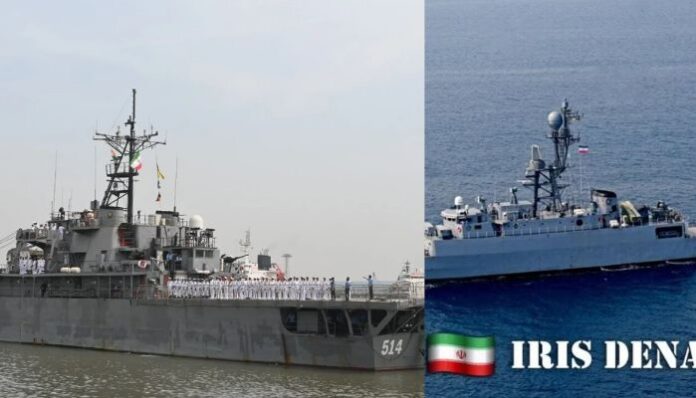
The US-Iran war has already claimed one Navy vessel outside of the Persian Gulf, in the Indian Ocean Region, when a US submarine torpedoed and sank the IRIS Dena on March 4. In the latest development, Sri Lanka has taken control of an Iranian warship, the IRIS Bushehr, on late Thursday, 5th March, after the vessel sought emergency assistance while anchored outside the nation’s territorial waters.
Sri Lanka takes control of another Iranian Navy vessel, IRIS Bushehr taken to Trincomalee after evacuating crew at Colombohttps://t.co/9FMcJ2Pzq4
— OpIndia.com (@OpIndia_com) March 6, 2026
The move came just a day after a US submarine sank another Iranian warship, IRIS Dena, on Wednesday, 4th March, in the same region, resulting in the deaths of at least 32 crew members.
Sri Lankan Navy officials started transferring more than 200 crew members from the seized IRIS Bushehr to the mainland on Friday, 6th March. Navy spokesman Commander Buddhika Sampath stated that the crew members were first transferred to the port city of Colombo before being taken to a naval base located at Welisara, 20 km north of the capital, after medical checks and immigration procedures.
“The disembarkation is in progress,” Sampath said while confirming the operation.
Sri Lankan authorities said the ship had initially requested permission to dock on Wednesday, 4th March, after one of the engines on the ship had malfunctioned. However, after several hours of negotiations with the Iranians and the captain of the ship, Sri Lankan President Anura Kumara Dissanayake granted permission for the ship to dock at the eastern port of Trincomalee instead of the commercial port in Colombo.
In a statement on the matter, the President said, “Our position has been to safeguard our neutrality while demonstrating our humanitarian values.”
He added that Sri Lanka had intervened to protect lives while following international maritime conventions. “SriLanka intervened in a way that demonstrated our commitment to international conventions, protecting the reputation and dignity of our country, and protecting human lives,” he said.
There are 53 officers, 84 cadet officers, 48 senior sailors, and 23 sailors on the Bushehr ship. Some of the crew will remain on the ship while it is being taken to Trincomalee by the Sri Lankan authorities, while the rest will be hosted at naval facilities.
India shelters Iranian ship IRIS Lavan at Kochi
Another Iranian naval vessel had already received assistance from India earlier in the week.
Days before the sinking of IRIS Dena, Iran approached India requesting urgent docking permission for another ship, IRIS Lavan, which had also been present in the region for the International Fleet Review and the MILAN-2026 naval exercise hosted by India.
According to media reports, Iran sent the request on 28th February, the same day that the United States and Israel launched the first wave of strikes on Iran under their “Epic Fury” offensive, killing Supreme Leader Ayatollah Ali Khamenei.
BREAKING: Iranian Navy warship IRIS Lavan docked in Kochi with its 183 member crew on March 4, the same day that IRIS Dena was torpedoed. The ship had requested accommodation on Feb 28 and received permission on March 1. The crew is being accommodated in Indian Navy facilities. pic.twitter.com/yLVwPvu54L
— Shiv Aroor (@ShivAroor) March 6, 2026
Iran told Indian authorities that the ship had developed “technical” issues and needed immediate docking. India approved the request on the next day on 1st March, allowing the vessel to enter Kochi port.
Government Sources- "Days before the IRIS Dena incident south of Sri Lanka, India was approached by Iran to take in the Iranian Ship IRIS Lavan, which was also in the region for the International Fleet Review. This request was received on 28 February 2026, indicating that a… pic.twitter.com/ZHVfKXRDJv
— ANI (@ANI) March 6, 2026
The IRIS Lavan eventually docked at Kochi on Wednesday, 4th March. Its crew of 183 sailors has since been accommodated at naval facilities in the city.
As per reports, India’s decision may have saved the ship and its crew from the fate that later befell IRIS Dena. While the Lavan was safely docked in Kochi, the Dena was torpedoed by a US submarine in international waters south of Sri Lanka.
Iran’s Foreign Minister Seyed Abbas Araghchi later said that IRIS Dena had been a “guest of the Indian Navy” before it was attacked.
Iran’s Foreign Minister Seyed Abbas Araghchi condemned the United States after a US submarine sank the Iranian frigate IRIS Dena in the Indian Ocean, saying the vessel had been a guest of the Indian Navy and was struck without warning in international waters, and warning… pic.twitter.com/WpBz78GSju
— India Today Global (@ITGGlobal) March 5, 2026
IRIS Dena was offered safe harbour too, says report
The Iranian frigate had participated in the MILAN multilateral naval exercise organised by India and attended by warships from dozens of countries.
The warship had left Visakhapatnam after taking part in the International Fleet Review and the MILAN-2026 naval exercise, which concluded on 25th February. The ship then headed towards international waters on its way back to Iran.
According to a report by the Indian Express, New Delhi had offered the vessel shelter at one of its ports as the situation in the region became increasingly tense after the first round of US-Israeli strikes on Iran on 28th February.
However, the Dena continued its journey instead of taking shelter.
IRIS Dena was made to wait hours in Galle, Opposition asks the Lankan govt ‘why’?
On the early morning of Wednesday, 4th March, the frigate was sailing about 20 nautical miles off the coast of Galle, in Sri Lankan waters, when it was attacked.
A US submarine torpedoed the vessel, sinking it in one of the rare instances since the Second World War where a submarine destroyed a surface warship. The ship was carrying around 180 crew members.
Reports suggest that Iran has asked Sri Lanka to allow it to move the war vessel to a safer location. The Sri Lankan President, Anura Kumara Dissanayake, was holding talks with his team to decide the response to the request. The ship stayed about 40 nautical miles off Sri Lanka’s southern coast for “nearly 11 hours” awaiting clearance.
The attack occurred hundreds of miles from the Gulf region, where both US and Israeli forces are conducting attacks on Iran.
Sri Lankan naval authorities launched a search and rescue mission as soon as they received a distress call at about 5:30 am.
The Sri Lankan Navy managed to rescue 32 sailors from the sea. However, military rescuers later recovered 87 bodies from the wreckage. Around 60 people were believed to have gone missing following the attack.
Officials in the southern Sri Lankan city of Galle confirmed that the survivors were being treated in the hospital for serious injuries.
The Indian Navy aids in the search and rescue operation
After receiving the distress call from IRIS Dena on Thursday, 4th March, India initiated search and rescue operations in the area.
The Indian Navy deployed a P-8i long-range maritime patrol aircraft and INS Tarangini, a ship, for rescue operations. Additionally, another ship, INS Ikshak, also set off from Kochi towards the search operation for the missing crew members.
Indian officials stated that more aircraft with air-droppable life rafts were kept on standby in case they were needed for rescue operations.
Meanwhile, Sri Lankan Navy ships were scanning the waters for any signs of the missing crew members.
The sinking of IRIS Dena was a major escalation of the conflict between Iran, the US, and Israel.
Iran’s Foreign Minister Araghchi condemned the attack and described it as an “atrocity at sea”. He warned that the United States would “bitterly regret” the strike.
The incidents involving the Bushehr, Lavan and Dena illustrate how the ongoing conflict involving Iran is now spreading far beyond the Middle East.
The Indian Ocean, which is one of the busiest waterways in the world for international trade, has suddenly emerged as an important strategic area where many nations have to walk a tightrope between politics, humanitarian crises, and national security concerns.
The decision of India to allow IRIS Lavan to dock at Kochi was clearly an effort by India to prevent any further escalation of the conflict and protect life in the region.
Sri Lanka, meanwhile, has attempted to maintain its policy of neutrality even as it responded to humanitarian crises in the Indian Ocean. Sri Lankan President Dissanayake made this position clear when he said, “We have followed a very clear stance. We will not be biased to any state, nor will we be submissive to any state.”
It is not clear why there was a delay in response from the Sri Lankan government when IRIS Dena requested to berth at Galle Port, though port berthing permission is usually subject to multiple factors.
Lankan leader Namal Rajapaksa has stated that the government should make its position clear on the issue. Speaking to the media, Namal referred to an instance during the Bangladesh Liberation War in 1971, when the Sirimavo Bandaranaike government in the island nation had allowed refuelling for a Pakistani aircraft on humanitarian grounds after India closed its airspace.


