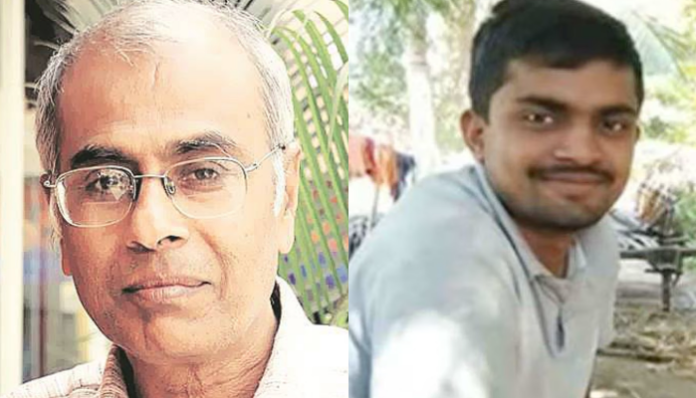
On 29th April (Wednesday), 29-year-old Sharad Kalaskar was granted bail by the Bombay High Court in the murder case of atheist, rationalist and anti-superstition “activist” Dr Narendra Dabholkar. Notably, the move transpired after the court highlighted his extended incarceration and cited prima facie suspicions regarding his identity as one of the attackers. He is directed to provide a ₹50,000 bail bond.
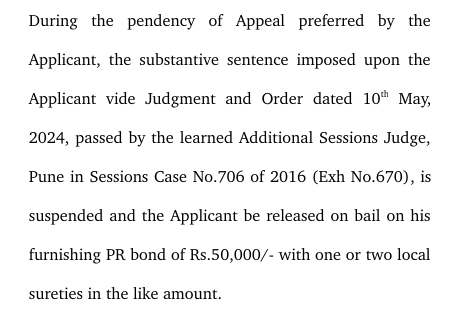
The pronouncement had been made by a division bench consisting of Justices Ajay Gadkari and Ranjitsinha Bhonsale. The Central Bureau of Investigation (CBI) wanted the decision to be stayed for 4 weeks, but was denied, and Justice Gadkari further countered, “Since we have already raised doubts over the identity of the applicant Kalaskar as the assailant, there is no question of staying this order.”
The court points out the flawed inquiry
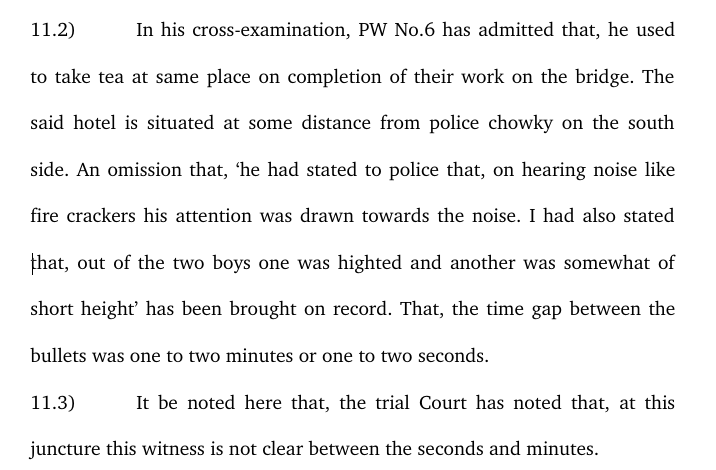
The court outlined the testimony of a key prosecution witness, Kiran Kamble, who reported being alerted by sounds resembling firecrackers but expressed uncertainty regarding the interval between gunshots during his cross-examination. The trial court also documented that he was “not clear between the seconds and minutes.”
“An omission that, ‘he had stated to police that, on hearing noise like firecrackers his attention was drawn towards the noise. I had also stated that, out of the two boys one was heighted and another was somewhat of short height’ has been brought on record. That, the time gap between the bullets was one to two minutes or one to two seconds,” the division bench conveyed.
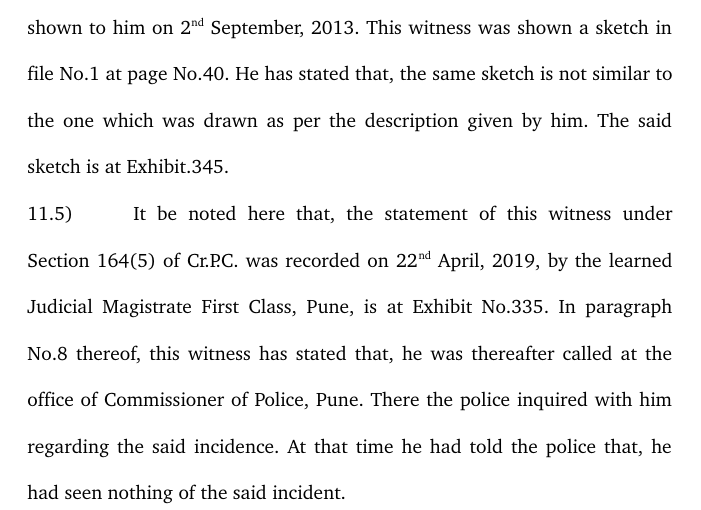
Kamble had recognised the palm-sized photographs. The images depicted two individuals, with two photographs of each. However, he acknowledged that he could not discern the identifying marks on the faces of those individuals. He asserted that they had moustaches, and the fleeing boys were approximately 60 feet away from the deceased. He observed them from a distance of about 15 feet.
The court conveyed, “The police had shown him sketches of persons in addition to the sketch drawn as per the description by him. This witness has admitted that he did not remember whether the sketch was shown to him on 2nd September 2013.” More importantly, Kamble was presented with another sketch, however, he remarked that this did not resemble the one that was created according to his description.
His statement was recorded by the Judicial Magistrate First Class in Pune on 12th April 2019. Subsequently, he was summoned to the office of the Commissioner of Police in Pune to provide information regarding the occurrence. “At that time, he had told the police that, he had seen nothing of the said incident,” the court highlighted.
Glaring shortcomings command the bench’s attention
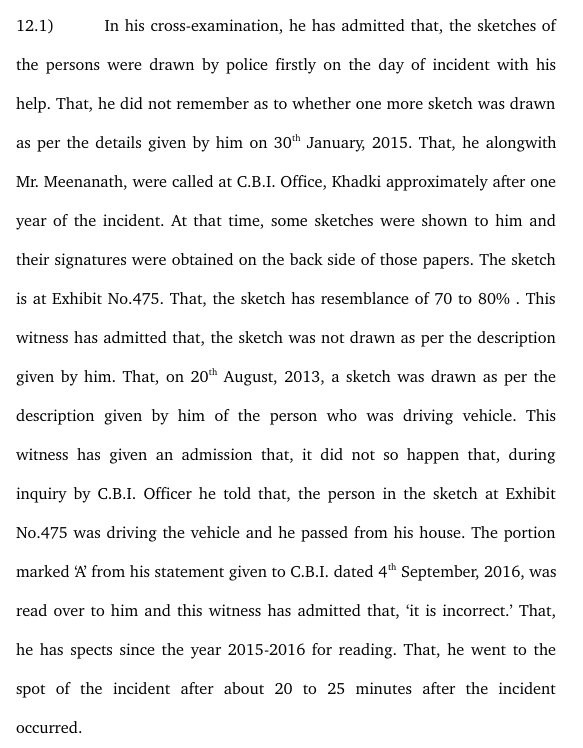
The second prime witness Vinay Kelkar was called to the CBI Office situated in Khadki, where he was shown a number of photographs. He selected 2 images from a group of 10 to 12, which he expressed were of the people he spotted at the time of the incident. He assured that the faces in the pictures matched to an extent of 80 to 85%.
During his cross-examination, he disclosed that the police had initially sketched the persons on the day of the instance with his aide. However, Kelkar was unable to recall if a second sketch had been produced on the basis of his information on 30th January 2015. He, along with a man named Meenanath, was invited to the CBI Office in Khadki about a year after the incident where they were shown some sketches.
Their signatures were collected on the reverse side of the papers and Kelkar stated that the resemblance was estimated to be between 70 to 80%. Nevertheless, he revealed that the sketch did not accurately reflect the details he offered. On 20th August 2013, a drawing was made following his account of the person who was behind the wheel.
The court mentioned, “This witness has given an admission that, it did not so happen that, during inquiry by CBI Officer he told that, the person in the sketch was driving the vehicle and he passed from his house.” The statement provided to the investigating agency on 4th September 2016 was read to him and he responded that it was incorrect.
Moreover, he has had spectacles since the year 2015-2016 for reading purposes and went to the crime scene nearly 20 to 25 minutes after the occurrence following a bath. He was even planning to visit his office, which is next to his residence.
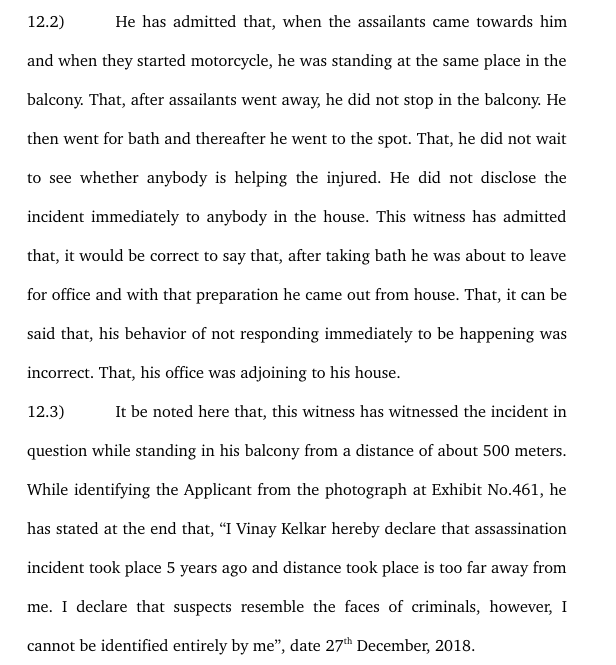
“He did not wait to see whether anybody is helping the injured. He did not disclose the incident immediately to anybody in the house. This witness has admitted that it would be correct to say that, after taking bath he was about to leave for office and with that preparation he came out of the house,” the court observed. Kelkar was in the same position on the balcony as the assailants proceeded towards him and started the two-wheeler. The bench also termed his inability to react swiftly after the incident as inappropriate.
It reiterated that he saw the instance from his balcony, around 500 metres away. “I, Vinay Kelkar, hereby declare that assassination incident took place 5 years ago and the distance it took place is too far away from me. I declare that suspects resemble the faces of criminals, however, I cannot be identified entirely by me,” the court then quoted his statement delivered on 27th December 2018 after identifying Kalaskar’s picture.
The court reprimands the CBI and decides in favour of the applicant
The court mentioned that the prosecution had extensively relied on two eyewitnesses to establish his identity as an attacker, which was an essential concern in the application. They characterised them as chance witnesses whose actions following their purported observation of the shooting were at odds with usual human behaviour after carefully reviewing their testimony and cross-examinations.
“Though they (witnesses) had seen the ghastly assault on the deceased (Dabholkar), both the witnesses chose to give preference and complete their daily chores of life and thereafter leisurely approached the police to give information. According to us, the conduct of these two witnesses is not of the men of common prudence and raises doubt in the mind of the court about their witnessing the incident,” the bench declared.
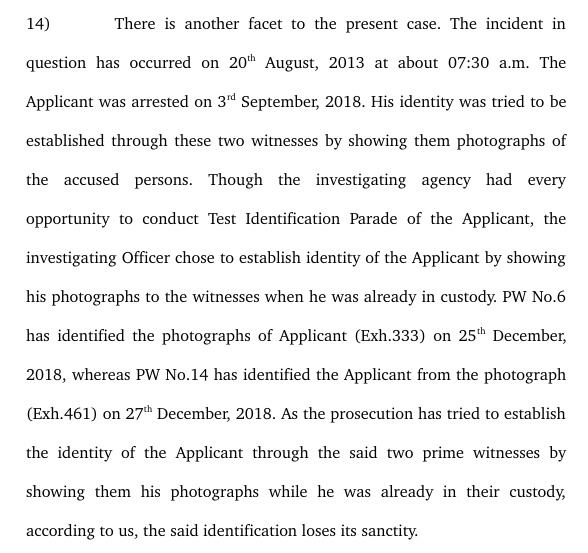
It was pointed out that the murder transpired on 20th August 2013, while Kalaskar was arrested on 3rd September 2018. The court also criticised the CBI’s attempt to use photo identification instead of a Test Identification Parade (TIP) to fix identify and observed, “Though the investigating agency had every opportunity to conduct Test Identification Parade of Kalaskar, the investigating officer chose to establish identity by showing his photographs to the witnesses when he was already in custody,” the court emphasised, holding that such identification loses its sanctity.”
The bench invoked a previous judgement of the Supreme Court and mentioned that “an identification parade is not mandatory, nor can it be claimed by the suspect as a matter of right. That, purpose of pre-trial identification evidence is to assure the investigating agency that the investigation is going on in the right direction and to provide corroboration of the evidence to be given by the witness or victim later in court at the trial. That, if the suspect is a complete stranger to the witness or victim, then an identification parade is desirable unless the suspect has been seen by the witness or victim for some length of time.”
The court also noted that Kalaskar has been behind bars since 3rd September 2018 and has endured more than 7 and a half years of imprisonment at both the pretrial and post-conviction stages. It added that the probability of his petition being addressed for a final hearing soon is unlikely in light of the ongoing appeals.
“After taking into consideration the overall view of the application, we are of the opinion that, during the pendency of his appeal, the substantive sentence imposed upon him can be suspended and the applicant be released on bail,” the bench declared.
Background of the case
Dabholkar (67), who ran an organisation, “Maharashtra Andhashraddha Nirmoolan Samiti,” was shot and killed by two bike-borne men while he was on a morning walk in Pune. Sachin Andure and Kalaskar were declared perpetrators by the CBI which took up the case in 2014 after a Bombay High Court ruling. The matter was being looked into by the Pune Police initially.
A Pune sessions court sentenced them to life in prison and a fine of ₹5 lakh each on 10th May 2024. However, it cleared three other defendants, Dr Virendrasinh Tawade, Vikram Bhave and Sanjeev Punalekar, on the grounds of insufficient proof to connect them to the incident.
Afterwards, Kalaskar initiated a motion with the high court in 2024, contesting the judgment and requesting bail until the submission was eventually heard and concluded.
It is noteworthy that the complete case was overshadowed by a persistent media trial, including a sting operation led by Ashish Khetan, former leader of the Aam Aadmi Party (AAP), including a planchette session intended to communicate with Dabholkar’s spirit to uncover the identities of his killers.
“Sanatan Sanstha” became the primary focus of the media trial because it had opposed Dabholkar’s 2003 anti-superstition bill, which sought to criminalise acts of black magic, sacrifices and other actions classified as religious rituals.
Meanwhile, multiple procedural errors occurred during the inquiry, such as incorrect evidence management and the agency’s failure to perform the required identification parades in accordance with its manual. Likewise, critical questions remained unanswered as the investigators mismanaged or disregarded several leads and pieces of evidence.
The first two arrests made in the case were those of Vikas Khandelwal and Manish Nagori based on ballistic evidence that linked the two to the murder weapon which was allegedly discovered in their custody. However, the development was later deemed inconclusive and the witnesses present at the scene of the crime failed to identify the two leading to their release.
Similarly, the mysterious presence of foreign materials at the crime scene and the final disposal of the murder weapon were never determined conclusively. There were significant gaps in the probe which implied that either incompetence or intentional obstruction had occurred.