

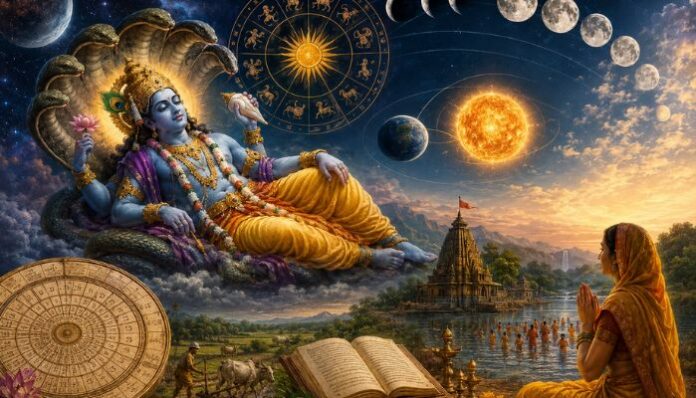
The Indian calendar has never been only about fixing festival dates. For thousands of years, it has also been a system to understand time, changing seasons, the movement of the Sun and Moon, and their effect on life. While most of the world today follows the Gregorian calendar, India’s traditional Panchang developed a different way of measuring time by combining both lunar and solar movements.
This is why the Indian calendar is called a lunisolar system. One of the most interesting results of this system is Adhik Maas, also known as Purushottam Maas, an extra month that appears after some years to maintain balance in the calendar.
The Adhik Jyeshtha month has begun this year, and once again, people have started discussing why this extra month comes, why it does not appear every year, why it is sometimes linked with Jyeshtha and sometimes with Shravan, and why many auspicious events are usually avoided during this period, even though it is considered spiritually important. The answer lies not only in mythology but also in astronomy and calendar mathematics.
How the Indian panchang works differently from the Western calendar
The Gregorian calendar used worldwide is based only on the solar cycle. The Earth takes around 365 days and nearly six hours to complete one orbit around the Sun. To adjust this extra time, one additional day is added every four years as a leap year.
The Indian Panchang follows a different method. It gives importance to both the Sun and the Moon. Months are mainly calculated according to the Moon’s cycle, while the Sun’s movement keeps the calendar connected with seasons. Because of this combination, the Panchang includes not just dates but also Tithi, Var, Nakshatra, Yoga and Karan, which together form the five parts of the Panchang.
In this system, the Moon decides the months while the Sun helps maintain seasonal balance. Ancient Indian scholars understood that if only lunar months were followed, festivals and seasons would slowly move out of sync. Therefore, a correction system was needed.
The difference between lunar and solar years created the need for Adhik Maas
The Moon takes around 29.5 days to complete one cycle from full moon to full moon. Twelve such lunar months together make a lunar year of about 354 days.
On the other hand, the solar year is around 365 days long.
This creates a yearly gap of around 11 days between the lunar and solar years. If this difference continued without adjustment, the calendar would slowly move away from the seasonal cycle. Over time, festivals linked to particular seasons would shift completely. A situation could arise where winter festivals appear in summer or harvest festivals move to different seasons.
Ancient Indian astronomers noticed this issue long ago and developed a solution, adding an entire extra month after the difference became large enough.
Why Adhik Maas appears after around 32 months and not every year
Since the gap between lunar and solar years is about eleven days each year, after nearly three years, the accumulated difference becomes around 33 days, which is almost equal to one lunar month.
Because of this, an additional month is inserted after approximately 32 months, 16 days and a few hours. This becomes Adhik Maas.
This is different from the Western leap year system. In the Gregorian calendar, only one day is added every four years. In the Indian calendar, a full month is added because the issue is not simply adjusting days but balancing the entire lunar and solar cycles together.
This arrangement reflects the depth of ancient Indian timekeeping methods. Without modern instruments, scholars created a system that kept festivals, seasons and celestial cycles connected.
How is it decided which month will become Adhik Maas?
Many people think Adhik Maas is simply a fixed extra month arriving every three years, but its calculation is more detailed.
Its determination depends on Sankranti, which means the Sun entering a new zodiac sign. Normally, during every lunar month, the Sun changes one zodiac sign, and a Sankranti occurs.
However, if a lunar month passes without any Sankranti, meaning the Sun does not move into a new zodiac sign during that period, that month becomes Adhik Maas. This rule is the reason why the extra month does not always have the same name.
If this condition happens during Jyeshtha, it becomes Adhik Jyeshtha. If it happens during Shravan, it becomes Adhik Shravan. Similarly, Ashwin or other months can also become Adhik.
This year, the extra month has appeared in Jyeshtha, so it is called Adhik Jyeshtha.
Why does Adhik Maas sometimes fall in Jyeshtha and sometimes in Shravan?
This is one of the most common questions among people because many associate Adhik Maas mainly with Shravan.
The answer again lies in the movement of the Sun and Moon. The lunar months keep moving according to the Moon’s cycle. Meanwhile, the Sun moves through zodiac signs at its own pace. Sometimes, during the lunar month of Jyeshtha, the Sun may not change its zodiac sign at all. In such a case, Jyeshtha becomes Adhik Jyeshtha.
At another time, the same condition may occur during Shravan. Then Shravan becomes Adhik Shravan. So the extra month is not fixed to any one month. Its occurrence depends completely on celestial calculations and Sankranti rules.
This is why people may see Adhik Jyeshtha in one cycle and Adhik Shravan in another.
Why Adhik Shravan gets more attention among people
Even though any month can become Adhik, people usually remember Adhik Shravan more.
The reason is social and religious rather than astronomical. Shravan or Sawan holds a special place in Hindu tradition. It is strongly connected with the worship of Lord Shiva. Kanwar Yatra, Monday fasts, Shiva temples and various religious practices make this month highly visible in public life.
When an extra Shravan appears, the number of Mondays and religious observances increases, making it more noticeable among devotees.
For example, during Adhik Shravan years, devotees may observe eight Shravan Mondays and nine Tuesdays, making the period longer than usual. Because of such occasions, many people started believing that Adhik Maas always means extra Shravan, though this is not correct.
Shravan, Chaturmas, and extended worship during Adhik Shravan
Shravan is considered the first month of Chaturmas, the four holy months consisting of Shravan, Bhadrapada, Ashwin and Kartik.
According to traditions, Goddess Parvati performed strict penance and fasting during Shravan to obtain Lord Shiva as her husband. Pleased with her devotion, Lord Shiva accepted her wish. Because of this belief, Shravan became especially important for Shiva and Parvati worship.
During Adhik Shravan years, the month becomes longer due to the extra lunar month. Devotees often keep fasts on Mondays for Lord Shiva and on Tuesdays for Goddess Parvati.
Women observe Tuesday fasts seeking well-being and long life for their families. Wednesdays are linked with Lord Vitthal, Thursdays with Gurus, Fridays with Goddess Lakshmi and Tulsi, Saturdays with Lord Shani and Sundays with Surya Dev.
Devotees also perform Abhishek, offering Panchamrit made from milk, honey, curd, sugar and ghee to Lord Shiva. Bilva leaves are offered, and mantras like Mahamrityunjaya Mantra, Gayatri Mantra and Rudra Gayatri are recited.
Many followers also adopt a Sattvic lifestyle, avoiding non-vegetarian food, alcohol and tobacco during this period.
Different calendar systems also affect the Shravan dates
Another reason behind confusion regarding Shravan is the existence of two lunar calendar traditions in India.
Northern states such as Haryana, Punjab, Uttar Pradesh, Rajasthan, Madhya Pradesh and Himachal Pradesh generally follow the Purnimanta calendar, where the month ends on the full moon.
States including Maharashtra, Gujarat, Karnataka, Goa, Andhra Pradesh and Tamil Nadu largely follow the Amanta system, where the month ends on the new moon.
Because of this difference, Shravan dates may vary across regions even though the religious significance remains similar.
From Malmas to Purushottam Maas: The mythological story
Adhik Maas also has an important place in mythology. Stories from the Padma Purana and Skanda Purana explain how the extra month was earlier called Malmas.
According to tradition, when this additional month was created, the other twelve months refused to accept it because it was not linked with any Sankranti. It was seen as neglected and without importance.
The word Mal here was not used in the sense of dirt but in the meaning of abandoned or ignored. Feeling insulted, the month approached Lord Vishnu and expressed its sorrow.
Lord Vishnu then accepted it and gave it the name Purushottam, one of His sacred names, meaning the Supreme Being. From that point, Malmas became Purushottam Maas and gained special spiritual importance.
The story also carries a social message that something once ignored can later receive honour and value.
Why lord Vishnu is closely linked with Purushottam Maas
Purushottam Maas is especially important in the Vaishnava tradition.
During this period, worship of Lord Vishnu, Lord Krishna and their different forms receives special attention. Devotees read scriptures such as the Bhagavad Gita, Shrimad Bhagavatam, and chant Vishnu Sahasranama.
Many temples organise katha sessions, bhajans and religious gatherings.
Tradition says that during Chaturmas, Lord Vishnu enters Yoga Nidra on Adi Shesha in the cosmic ocean, while Lord Shiva takes charge of cosmic activities. This is symbolically seen as the cycle where old patterns make space for renewal and change.
Why marriages and new beginnings are usually avoided
Even though Purushottam Maas is considered sacred, many families avoid marriages, housewarming ceremonies, idol installations and starting new businesses during this period.
Traditionally, the month was viewed as a time for inner reflection rather than social celebrations. It was considered a pause within the yearly cycle, a period dedicated to prayer, charity, meditation and devotion. People focused more on spiritual activities instead of worldly events.
This explains why the month is respected yet often separated from major ceremonies.
Adhik maas was also important in social life and agriculture
Historically, Panchang was not limited to temples or rituals.
It influenced farming seasons, pilgrimage schedules, festivals and daily life. Therefore, systems like Adhik Maas helped maintain harmony between seasonal cycles and social activities.
Different regions developed their own traditions during this month. Some focused on donations and charity, some organised Bhagavad Katha events, while others gave more importance to Vishnu worship.
This made Adhik Maas not just a mathematical adjustment but a part of cultural life.
Adhik Maas shows the meeting point of science and faith
Modern discussions often place science and faith on opposite sides, but Adhik Maas presents a different picture. Its origin lies in solving an astronomical problem, balancing the lunar and solar years.
Later, religious meaning and cultural practices became attached to it. As a result, Adhik Maas today stands at the meeting point of astronomy, calendar science, mythology and social traditions.
The month reminds people that Indian timekeeping was not limited to counting days. It tried to connect celestial movement, seasons, agriculture, festivals and human life into one system.
This is perhaps why Adhik Maas, despite being thousands of years old, continues to remain relevant even today.


