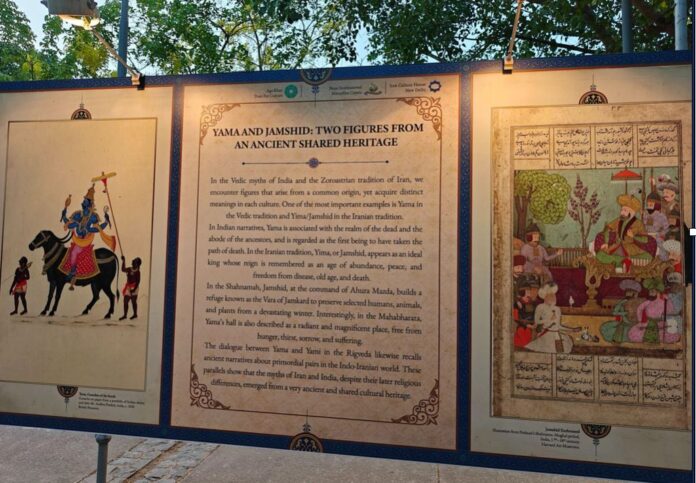
In the Delhi summer heat and a toned-down evening, a team of Young Thinkers Forum Delhi visited an exhibition, “Shared Epic Worlds: The Shahnameh, the Mahabharata, and the Indo-Persian Imagination”. Curated by the Aga Khan Trust for Culture, the Noor International Microfilm Centre, and the Iran Culture House, New Delhi, the outdoor exhibit displays reproductions of exquisite manuscripts mounted on industrial scaffolding.
While the initiative is a visually striking and praiseworthy attempt to map the literary, artistic, and cultural connections between Iran and India, a critical examination of the presented panels reveals significant scholarly gaps. What could have been a profound exploration of philosophical dialogue often devolves into comparative simplifications, revealing a curatorial bias that occasionally misrepresents Bharatiya epistemology.
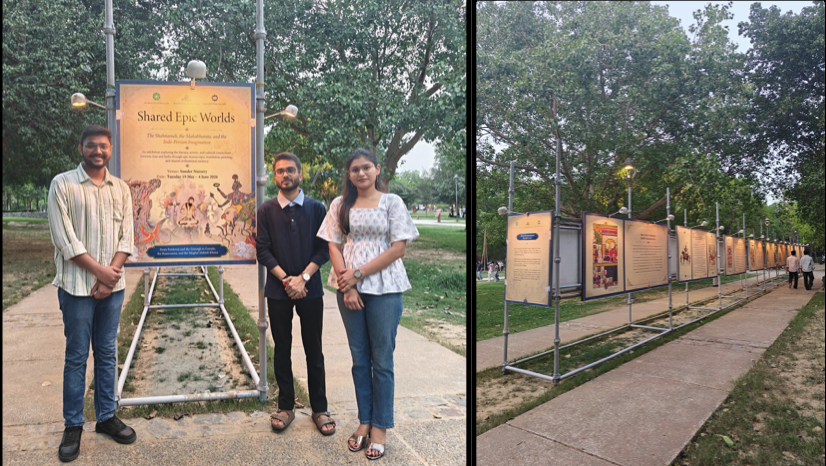
The trap of superficial equivalencies
A recurring curatorial choice throughout the exhibition is to draw direct parallels between concepts and figures that do not necessarily share the same philosophical bedrock. The panels frequently juxtapose elements like the celestial birds Garuda and the Simurgh, the heroic journeys of Arjuna and Rustam, and the life-giving remedies of Sanjivani and Nush-Daru.
While these comparisons create an accessible narrative framework, they risk creating false equivalencies. The most concerning example of this is the exhibition’s interpretation of Yama alongside the Iranian king Yima/Jamshid. The panel describes Jamshid as an “ideal king whose reign is remembered as an age of abundance, peace, and freedom from disease”. It then conceptually links him to the Vedic Yama, attributing their distinct meanings to an “ancient shared heritage”.
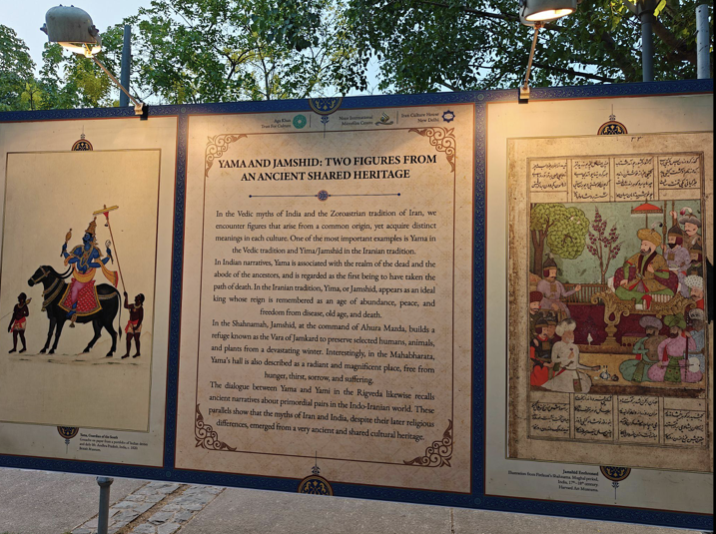
However, in Bharatiya philosophical and spiritual traditions, Yama is not a historical, benevolent human king providing for his people. He is primarily revered as the God of Death and the cosmic regulator of dharma related to mortality. Presenting Yama in a comparative framework with a political, human ruler, without sufficient contextual explanation of his profound metaphysical role in the Indian knowledge system, misrepresents and dilutes a complex philosophical concept.
The Maktab Khana and the devaluation of dharma
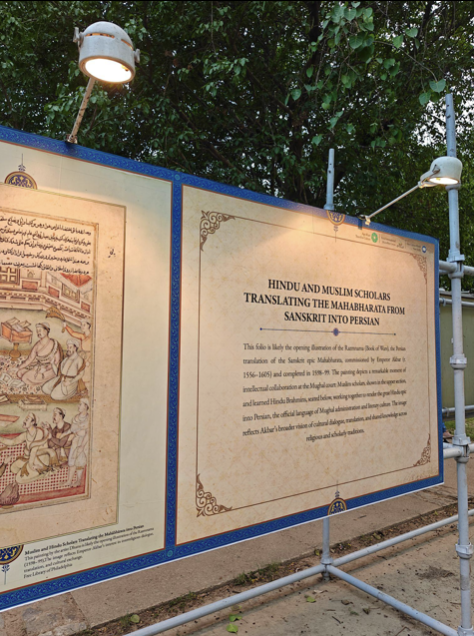
The exhibition notes that the formal fusion of these cultures peaked during the Mughal Empire, particularly when Emperor Akbar established the Maktab Khana (House of Translation) at Fatehpur Sikri around 1574. A centrepiece of this era is the Razmnama (The Book of War), the Persian translation of the Mahabharata. The exhibition praises this as an exercise in “imperial inclusion” and a “broader vision of intellectual dialogue”, prominently featuring a folio where Hindu and Muslim scholars are seated together, translating the Sanskrit epic.
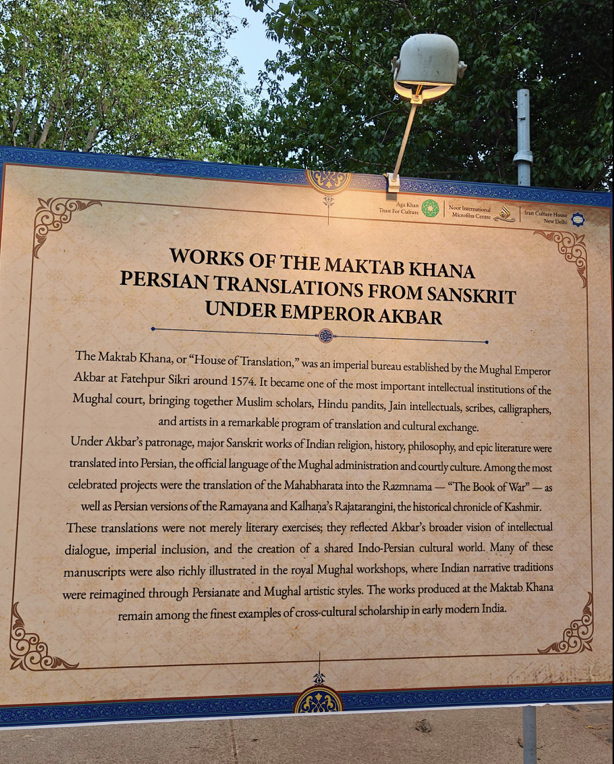
While the collaborative effort between Hindu Brahmins and Muslim scholars is historically significant, the exhibition fails to critique the fundamental premise of this translation project. The Persian title Razmnama, literally ‘Book of War’, is deeply misleading. As the traditional Bharatiya saying goes: “What is found here may be found elsewhere; what is not found here is nowhere.”
The Mahabharata is not merely a manual of warfare; its central theme is the exploration of Dharma, encompassing duty, righteousness, cosmic order, and ethics. It houses the Bhagavad Gita, delivering profound spiritual teachings and philosophies on justice and spiritual liberation. Naming the epic solely from the perspective of ‘war’ strips it of its civilizational essence, suggesting the Mughal court may have been primarily interested in extracting martial strategy and statecraft rather than genuinely engaging with its spiritual depth. While the Shahnameh performed a vital cultural function in codifying statecraft for the Persianate world, the Mahabharata and Ramayana rely fundamentally on spirituality, a distinction the exhibition overlooks.
A Persian-centric narrative imbalance
Across the exhibition panels, a substantial portion of the narrative focuses predominantly on the Iranian and Persian legacy. Panels detailing Safavid courtly art, Persian romances like Bijan and Manijeh, the trial of Siyavash, the birth of Rostam, and the Persian origins of Polo (Chogan) dominate the visual space.
Even when exploring Indian epics, the lens is filtered almost exclusively through Persian and Mughal patronage. The exhibit highlights the Jahangiri Shahnama, noting the collaborative visual interpretation by Hindu and Muslim painters like Banwari, Bola, Bhagwati, and Qasim. The magnificent “Court of Ravana” panel, commissioned by the Mughal courtier Bir Singh Deo around 1605, is celebrated precisely because it reimagines the Ramayana through a “sophisticated fusion” where the demons of Lanka are styled strikingly like Safavid divs. Furthermore, an entire panel is dedicated to the royal seals of Babur, Humayun, Akbar, Jahangir, and Shah Jahan on a single Shahnama manuscript.
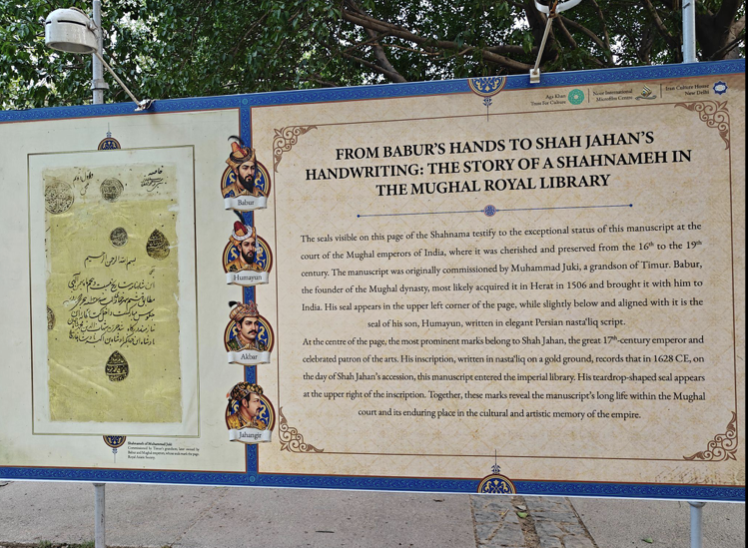
While these artworks are masterpieces of Indo-Islamic fusion, the exhibition heavily tilts toward showcasing Persian soft power. It functions less as a balanced civilizational dialogue and more as a chronicle of how Persian aesthetics and literature influenced Indian courts, offering minimal insight into the profound originality and continuity of Bharatiya civilisation itself.
Conclusion
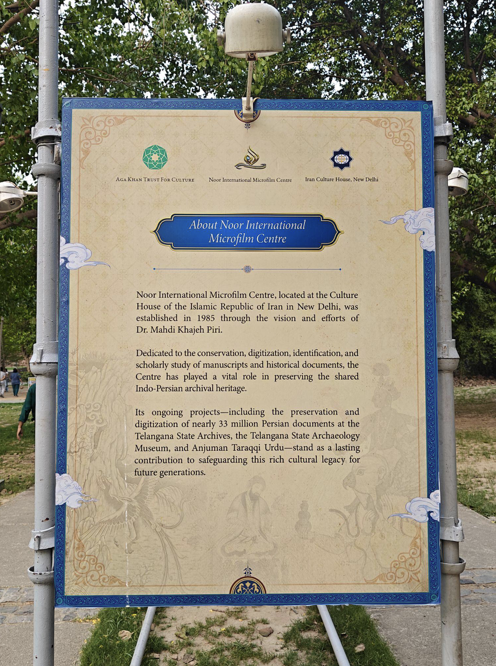
The “Shared Epic Worlds” exhibition is an inspiring visual endeavour, and institutions like the Noor International Microfilm Centre must be commended for their monumental work in preserving and digitising nearly 33 million Indo-Persian archival documents.
However, if the objective is to genuinely strengthen Indo-Iranian cultural understanding, future exhibitions must transcend superficial comparative mythology and the elite confines of royal courts. Cultural integration must emerge from a genuine respect for differing philosophical traditions rather than the shaping of selective, heavily Persian-centric narratives. A true exploration of these shared worlds must balance the material statecraft of the Shahnameh with the spiritual Dharma of the Mahabharata, honouring the deep, parallel roots that connect both civilisations beyond the borders of empires.
(Anshika Agrawal is a core member, and Aditya Trivedi is the Coordinator of Young Thinkers Forum Delhi)
(Note: The insights regarding architecture, music, and linguistics draw on independent historical research discussed previously, extending beyond the exhibition’s provided texts.)