

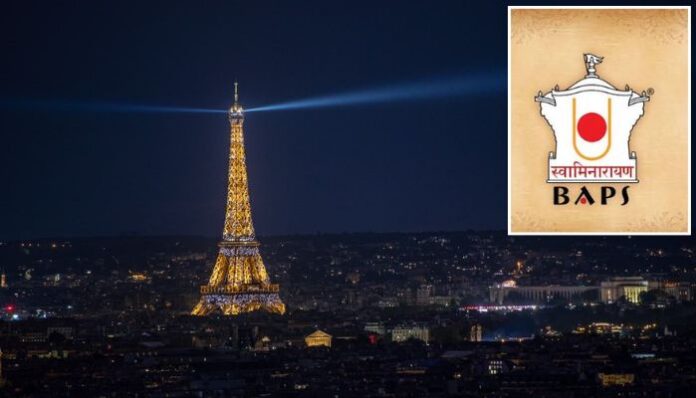
The Eiffel Tower in Paris was closed on Monday, 7th September, after staff members went on strike, following allegations that female employees were asked to stay away from certain areas during a private visit by a Hindu religious group. The dispute stems from a visit last week by a delegation of around 100 people linked to BAPS (Bochasanwasi Akshar Purushottam Swaminarayan Sanstha). The group was in France for events connected to the inauguration of a major Hindu temple near Paris.
Tour Eiffel fermée à Paris : en colère, les salariés dénoncent la mise à l’écart du personnel féminin lors d’une visite privée
— Le Parisien | Paris (@LeParisien_75) September 7, 2026
➡️ https://t.co/9vHNxohs5m pic.twitter.com/U8v4wtYby1
Eiffel Tower employees criticised the instructions they said were given during the visit, alleging that female workers were sidelined because of their gender. In a statement, staff members condemned “professional instructions that led to female employees being sidelined, replaced, and rendered invisible based on their gender.”
The employees said they were shocked by the situation. “Instructions were given to female employees of the Eiffel Tower and to female employees of contractors to make themselves invisible to welcome this delegation,” they said.
Eiffel Tower operator admits visit conditions were wrong
SETE, the company that operates the Eiffel Tower, acknowledged that the Hindu delegation had requested arrangements that would limit “interactions with women” during the visit.
However, the company said it should never have accepted such conditions. SETE said the arrangements were “not in line with SETE’s values, nor with the principles of equality between men and women” and said it would accept the consequences of what happened.
SETE president Ariel Weil also condemned the incident. “It is clearly not an acceptable practice. I restate the Eiffel Tower’s commitment to republican values and to the equality of men and women,” Weil told AFP.
BAPS policy for its Swamis
The reported request also needs to be viewed in the context of BAPS’s own religious rules for its sadhus. On its website, BAPS explains that celibacy, or nishkam dharma, is the most important of the five vows prescribed by Bhagwan Swaminarayan to his sadhu disciples. It says the vow means that “a Swaminarayan sadhu could never talk, touch or associate with women.”
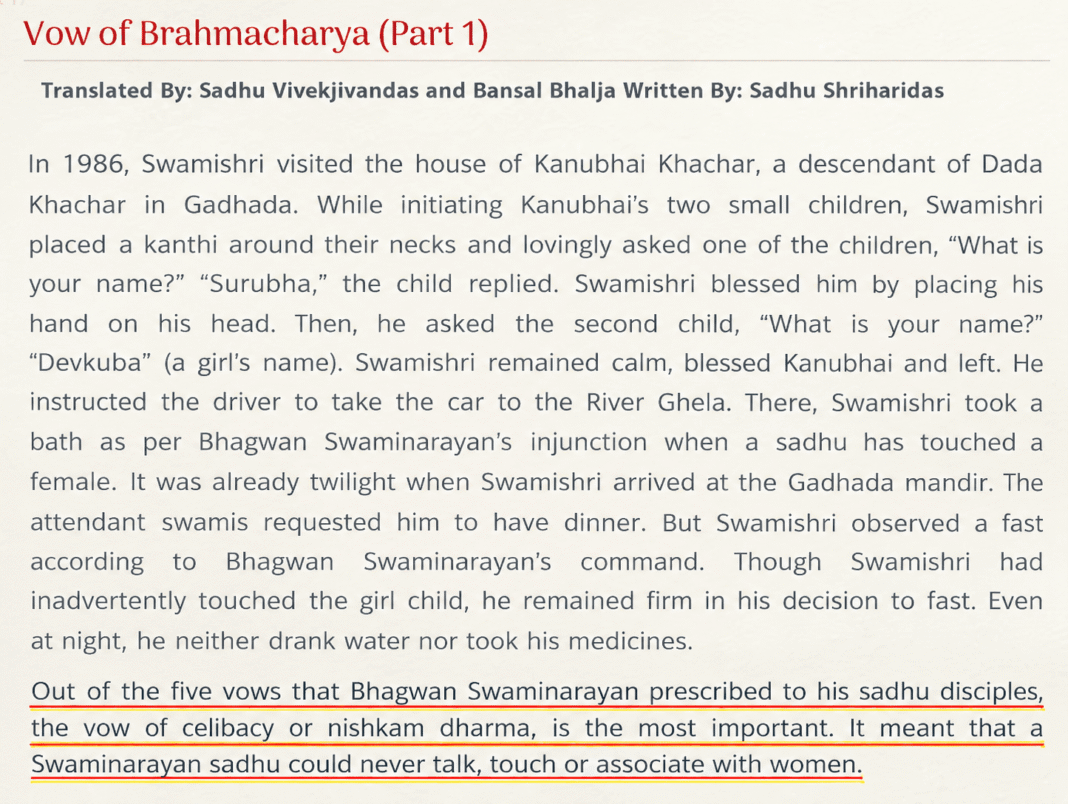
BAPS also describes this as a personal spiritual discipline rather than a rejection of women, and says its sadhus are taught to respect women. Its published material provides examples of sadhus avoiding situations in which their religious vows could not be maintained.
That religious practice, however, does not necessarily justify shifting the burden of those restrictions onto employees at a public workplace. If a visiting delegation requires its religious representatives to avoid interacting with women, the more appropriate solution would be to organise the visit so that those representatives can follow their vows without asking female employees to leave their posts or avoid particular areas.
The Eiffel Tower is the workplace of its staff, and asking women to step aside or making them effectively invisible because of their gender raises a separate issue of workplace equality. The concern, therefore, is not about mocking or attacking a religious practice, but about whether that practice was allowed to dictate how local employees could perform their jobs.
BAPS responds to allegations
BAPS, which consecrated its first major temple in France near Paris on Sunday, 6th September, responded after the staff protest. The organisation said it respected the concerns raised by the Eiffel Tower employees and was taking them seriously.
BAPS said the visit had been planned in coordination with Eiffel Tower staff because of the size of its delegation and was scheduled at the beginning of normal opening hours to reduce disruption to other visitors.
Nous comprenons les préoccupations exprimées et les prenons très au sérieux.
— BAPS Mandir Swaminarayan Hindou de Paris (@BAPSParis) September 7, 2026
Compte tenu de la taille de notre délégation, la visite a été organisée en coordination avec les équipes de la tour Eiffel, au début des horaires habituels d’ouverture, afin de limiter autant que… pic.twitter.com/gyiwzmh6Jv
“To our knowledge, at no time was access to the Eiffel Tower denied to anyone,” the organisation said.
It added, “Nevertheless, we wish to offer our sincere apologies to anyone who may have been hurt or inconvenienced by this situation. We are deeply committed to the universal values of mutual respect and service to others.”
French leaders demand investigation
The incident has also triggered a strong political reaction in France. Paris Mayor Emmanuel Gregoire said an investigation would be launched “as soon as possible” and said he understood the anger among Eiffel Tower employees.
Je prends connaissance du mouvement de colère des salarié·es de la tour Eiffel et je veux leur dire que leur mécontentement est légitime.
— Emmanuel Grégoire (@egregoire) September 7, 2026
Il n’est pas acceptable que de telles conditions puissent être tolérées. Ce ne sont ni mes valeurs, ni celles que doit porter la tour Eiffel,… https://t.co/3srttJpxPo
“All light must be shed on the facts that led to this protest,” Gregoire wrote on X.
French Equality Minister Aurore Berge also criticised the reported instructions, saying, “In France, we do not ask women to erase themselves. No dogma, no religion is above the laws of the Republic.”
The incident has therefore raised a difficult but important question: religious groups should be free to follow their own beliefs, but when those beliefs are being accommodated in a public workplace, that accommodation should not come at the cost of treating employees differently because they are women.


