

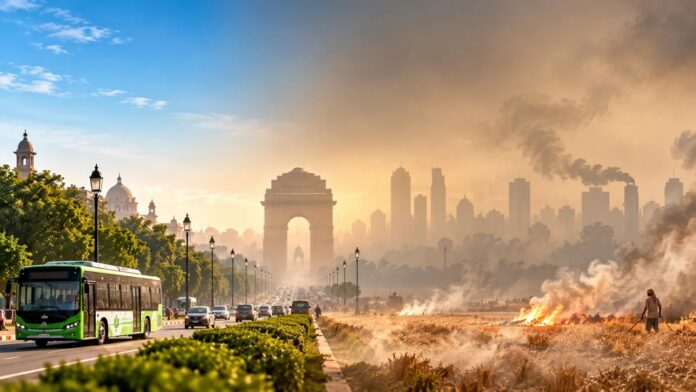
Every winter, as a thick, toxic blanket of smog descends upon New Delhi, the public narrative quickly shifts to a familiar scapegoat: agricultural stubble burning in the neighbouring states of Punjab and Haryana. While the seasonal burning of crop residue undeniably spikes the city’s Air Quality Index (AQI) to hazardous levels between October and November, it represents only a fraction of a much larger problem. Looking “beyond the burn” reveals a complex web of year-round, systemic pollutants that are genuinely responsible for choking the capital of India.
First and foremost are vehicular emissions, which act as the most persistent and significant contributor to Delhi’s poor air quality. Depending on the time of year, vehicular exhaust accounts for roughly 40% of the city’s total air pollution. With millions of registered cars, trucks, and two-wheelers navigating the congested streets daily, the city’s atmosphere is constantly pumped with carbon monoxide, nitrogen dioxide, and deadly PM2.5 particles. Despite the introduction of stricter BS-VI emission standards and a push toward electric vehicles, the sheer volume of daily traffic and the lingering presence of older, heavily polluting diesel engines continue to overwhelm the environment.
Secondly, the region’s booming infrastructure comes at a steep environmental cost. Dust from poorly regulated construction sites and unpaved roads contributes to over 20% of the particulate matter in the air. When vehicles speed down the city’s vast road network, they continuously kick up settled dust, re-suspending it into the air people breathe. This man-made dust is heavily compounded by Delhi’s unique geography. Being entirely landlocked, the city acts as a natural sink. Northwesterly winds transport dust from Rajasthan, while the imposing Himalayas to the north trap the escaping air, creating a confined “airshed” that locks pollutants in. During winter, temperature inversion—where cold air traps warmer, polluted air close to the ground—creates the dreaded “winter syndrome,” halting the dispersion of toxins entirely.
Industrial emissions and urban waste management failures form another critical pillar of the crisis. The National Capital Region (NCR) is surrounded by numerous industrial clusters, many of which operate with minimal environmental oversight. Coal-fired thermal power plants and unregulated factories emit massive amounts of sulfur dioxide and industrial soot. Furthermore, Delhi is home to towering landfill mountains, such as the Bhalswa landfill. These massive garbage dumps frequently catch fire, releasing highly toxic and carcinogenic fumes. Additionally, the burning of localized garbage and biomass by vulnerable populations seeking warmth during the cold months significantly increases localized pollution.
In conclusion, fixing Delhi’s air pollution crisis requires moving beyond the seasonal panic over farm fires. While offering farmers viable alternatives to stubble burning is necessary, it will not cure the capital’s year-round respiratory crisis. True relief demands stringent, year-round enforcement of industrial regulations, sweeping improvements to public mass transit networks, strict dust-control measures at construction sites, and scientific waste management. Until policymakers collectively address these foundational issues, residents will continue to choke on the byproducts of unchecked growth.
Read the full article on Chapter 1 Magazine.


