

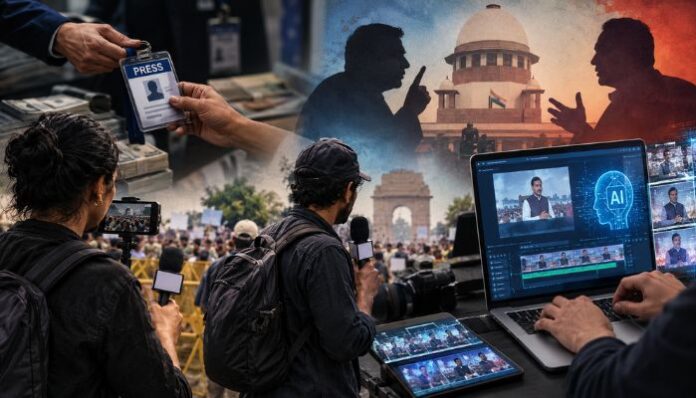
The recent protests organised by Cockroach Janata Party (CJP) and the opposition against the Election Commission’s Special Intensive Revision (SIR) exercise have shed light on the dubious methods being used to mobilise public opinion and attack the government. What was projected as a grassroots movement demanding accountability from the Election Commission has been exposed to be coordinated by political messaging, online propaganda and attempts to discredit the authorities.
From organising demonstrations on the ground to amplifying anti-government narratives on the internet, the controversy has brought attention to the opposition ecosystem’s desperation to shape public perception in its favour.
सिर्फ ₹599 में फर्जी पत्रकारिता का Sponsored ड्रामा! 🚨 इंडिया टुडे की रिपोर्ट ने CJP और विपक्ष के आंदोलन पर सवाल खड़े किए हैं। रिपोर्ट के मुताबिक, इंडियन प्रेस यूनियन जैसी संस्थाओं के जरिए ₹599 से ₹1799 में प्रेस कार्ड, फर्जी प्रोफाइल और माइक बांटे गए, बिना किसी मीडिया अनुभव के। दंगों को भड़काने और दिल्ली पुलिस व सरकार को बदनाम करने के लिए एडिटेड CCTV फुटेज और भाड़े के पत्रकारों के इस्तेमाल का भी दावा है। मकसद कानून-व्यवस्था को नुकसान पहुंचाना और CJP व उसके राजनीतिक आकाओं के नैरेटिव को सोशल मीडिया पर ट्रेंड कराना था। ❌
— BJP (@BJP4India) October 24, 2026
One particularly disturbing aspect of these allegations concerns the sale of press cards and journalist credentials by organisations to represent the media. An investigation by India Today found that several websites and organisations were offering press IDs, membership certificates and other journalist-related credentials for a fee. The report has uncovered a deeply disturbing pattern where fake narratives are manufactured, funded, and weaponised under the guise of independent journalism. This engineered network goes far beyond depicting purported spontaneous public outrage, pointing toward a calculated design to target the government, mislead citizens, and manufacture artificial unrest.
The business of fake news: How self-styled “journalists” turned protests into a propaganda battlefield
The report revealed that the recent protests involved not just hired crowds, but also paid journalists deployed to build a narrative against the government and the Delhi Police. To mislead the public, a fake outfit called the “Indian Press Union” was set up. Press cards, fake profiles, microphones, and vehicle passes were distributed for prices ranging from just ₹599 to ₹1,799. There was no experience and no media background required, you could simply hang a ₹599 card around your neck and become an “independent journalist” for CJP.
The report highlighted that many of these individuals possessed press ID cards, microphones, and logos of suspicious, newly-emerged news websites created between February and March of this year. Organisations like the Indian Press Union (IPU), NEED24, and FNF were front and centre.
While the IPU claimed operational history dating back to 2016, India Today found no supporting evidence. Further investigations revealed that these websites sold journalistic credentials for as low as ₹599, featuring AI-generated interview videos to create an illusion of authentic, established media houses.
Websites like Hind Media Network advertised press IDs and reporter profiles for ₹599 alongside microphone kits for ₹3,500. NEED24 News offered reporter profiles for ₹999 and State Bureau Chief designations for a ₹25,000 annual subscription. Similarly, the Indian Press Union offered printed press IDs and car stickers for ₹1,799.
OpIndia earlier reported how an undercover operation exposed these “independent journalists” who were ready to peddle Samajwadi Party (SP) propaganda for a few thousand. Similarly, a clip of an online chat group recently went viral on social media, showing its members discussing the media strategy to remove the democratically elected Modi government.
During the discussion, it was disclosed that about 5000 influencers, YouTubers, and content creators form part of their group, which also included “independent journalists.” Internet Freedom Foundation’s Founder Trustee, Apar Gupta, was part of the conversation. Interestingly, IFF has CJP leader Ashutosh Ranka’s sister, Khushboo Ranka, as a Trustee.
Delhi Police arrests “independent journalist” over AI-Generated Video
The gravity of this manufactured propaganda hit harder when Delhi Police arrested a 24-year-old “independent journalist” over an AI-generated video showing Assistant Commissioner of Police (ACP) Vivek Bhagat allegedly misbehaving with a woman protester. Delhi Police had detained one such “independent journalist,” who stated that CCTV footage was being edited and fabricated to portray the Delhi Police and the government negatively.
The fabricated video was circulated through an Instagram account, @news_aaina0776, presented as genuine CCTV footage. It showed an officer in inappropriate conduct with a woman while displaying a photograph, name, and designation of ACP Bhagat to falsely implicate him. The police social media monitoring unit flagged the reel on October 4, resulting in an FIR at the Cyber Police Station under multiple sections of the Bharatiya Nyaya Sanhita.
Investigators traced the account to Nadeem Ahmed Ameen, a 24-year-old resident of Palwal, Haryana, who ran the Instagram news handle “News Aina Today” and was apprehended from Mewat on 5th October.
During questioning, Ameen confessed that he created the video using AI tools on 3rd October to defame the Delhi Police, provoke protesters, and create unrest, having launched his handle in April and actively posting during the CJP protests at Jantar Mantar. Additional DCP Manjeet Sheoran noted that the deliberate goal was to spread anarchy and trigger riots.
The exposed agenda: Not an “independent journalist,” but an active CJP worker
Adding another layer of deception, the woman who claimed to be an independent journalist and accused ACP Vivek Bhagat was also not an independent journalist, but a CJP worker. The accusations had been under probe, but Rosy was revealed to be an active CJP worker.
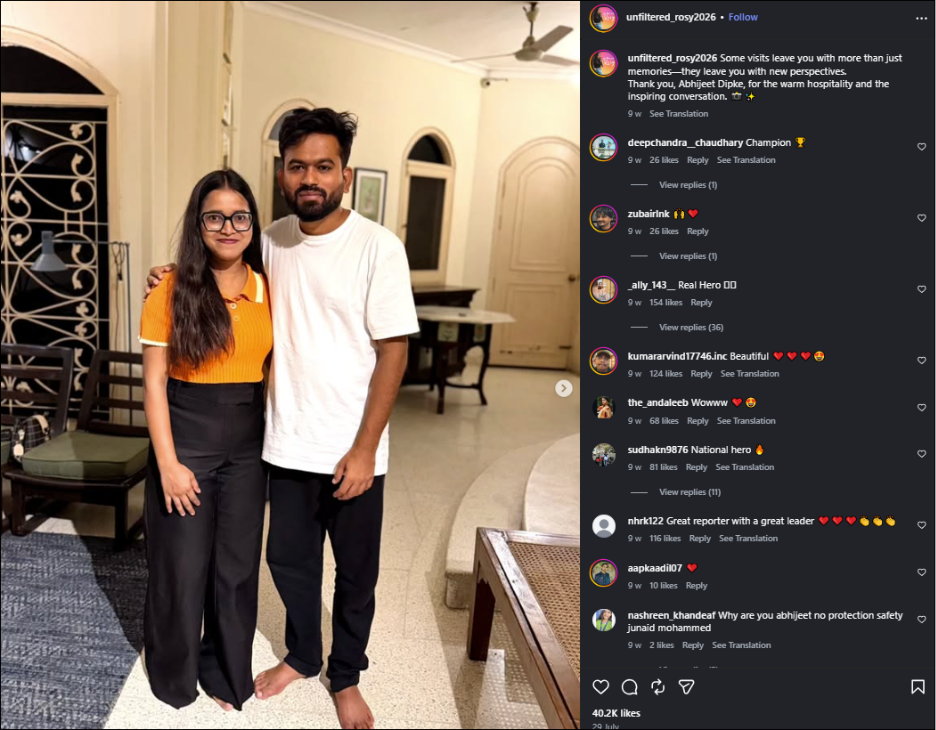
She is an Instagram influencer with over 61k followers and a known CJP supporter, masquerading as an “independent journalist” while accusing ACP Bhagat of molesting her during the detention of AISA activist Neha Bora on 3rd October. Afterwards, CJP founder Abhijeet Dipke and co-convenor Saurav Das rushed to social media to label ACP Bhagat as a “sexual predator” and “Amit Shah’s blue-eyed boy.”
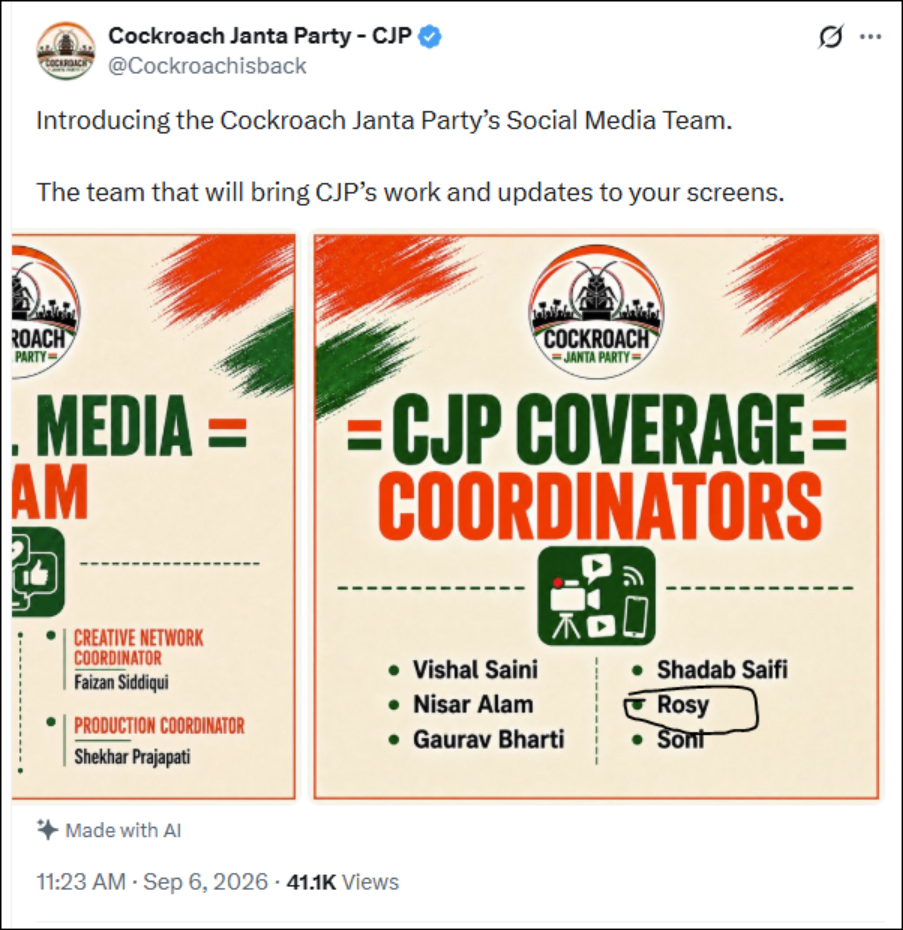
In a 6th September post introducing the CJP’s social media team, Rosy was listed as a coverage coordinator. Her feed is replete with pro-CJP propaganda, celebrating Abhijeet Dipke’s return, and even justifying offensive social media remarks against Hindu deities by figures like Nishu Azad. Far from being a neutral reporter exposing “Godi media,” she was a partisan influencer weaponising a false narrative.
A scary reminder of the anti-CAA protests and 2020 Delhi riots
It was all planned to fuel unrest and defame the government and Delhi Police, and serves as a scary reminder of the anti-CAA protests, which later converted into anti-Hindu riots.
Rather than a sudden outbreak, the events followed a deliberate trajectory. It began with intense university protests and provocative speeches, creating a perilous environment of extreme hostility in the name of an anti-government movement. This momentum was then channelled into localised sit-in demonstrations across several areas, turning those locations into active mobilisation zones. Over time, these protest sites incorporated speeches to target Hindus.
Eventually, the strategy shifted toward a much more sinister objective. Protesters began blocking major traffic corridors, creating widespread disruption for both the administration and common people. Police were targeted when they intervened to clear the blockades and restore order. The most horrifying culmination of these protests came in the form of anti-Hindu riots carried out by the Islamo-leftist faction.
During this orchestrated violence, IB staffer Ankit Sharma and Constable Ratan Lal lost their lives, and DCP Amit Sharma suffered severe injuries in targeted attacks. The mayhem left 53 people dead and hundreds injured.
The riots left large parts of Northeast Delhi under fear for days before normalcy returned. The Crime Branch of Delhi Police registered FIR No. 52/2020 to probe the larger conspiracy behind the violence. According to the prosecution, the riots were not spontaneous, but part of a deep-rooted conspiracy carried out under the cover of protests against CAA and NRC.
Umar Khalid, Sharjeel Imam, Tahir Hussain, Khalid Saifi, Ishrat Jahan, Gulfisha Fatima, Natasha Narwal, Devangana Kalita, Athar Khan, Safoora Zargar, and others were named in the FIR. Today, a similar playbook is being deployed, using digital deception and fabricated narratives to incite street-level conflict. Furthermore, CJP leaders have also been vocal in their support for these accused, including Umar Khalid.
When the ‘fourth pillar of democracy’ is made into a tool for political propaganda
The most worrying aspect of this controversy is the misuse of journalism itself. Journalists are widely regarded as the fourth pillar of democracy because they inform the public, question those in power and hold institutions accountable. Their credibility depends on accuracy, transparency and independence.
This is precisely why the sale of press credentials and the use of fabricated videos are so concerning. When almost anyone can purchase a press card and present themselves as an independent journalist, the public may struggle to distinguish genuine reporting from politically motivated content.
People often trust someone who identifies as an independent journalist because they assume that the person has no political affiliation and is reporting events impartially. That trust can be exploited if an individual conceals their political connections or circulates unverified claims as facts. The danger becomes even greater when AI-generated videos are presented as authentic evidence. The aim is evidently to sneak into restricted areas, flout the law, and forcibly push CJP and its political backers’ failed narrative into trending discussions on social media.
When trusted titles like “independent journalist” are sold for a few hundred rupees and handed to internet influencers with no media background, accountability vanishes. The rise of these seasonal, paid propagandists creates a profound crisis for authorities and ordinary citizens trying to separate factual reporting from orchestrated subversion. Safeguarding the nation requires recognising that these tactics are not freedom of expression; they are a calculated conspiracy designed to burn cities for political gains.
OpIndia earlier reported how some social media influencers and content creators turned into self-styled, ‘independent’ journalists overnight, driven by a desire to go viral and gain followers and views by covering the CJP-led protests. This sudden change was also triggered by the Delhi Police’s order making press accreditation mandatory for journalists covering the latest CJP demonstrations.


