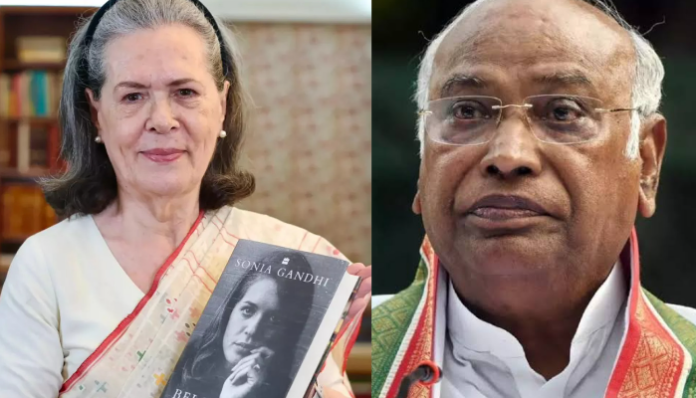
Former Indian National Congress chief Sonia Gandhi’s memoir “Belonging: A Journey of Love” hit the stands on 10th November (Tuesday) and has courted controversy ever since, including over its distortion of historical facts and attempts to shift the blame for the violence unleashed by her party members. Now, the book has sparked another row after she attributed the killings of family members of senior Congress leader Mallikarjun Kharge to “caste riots.” However, Kharge has previously mentioned that the massacre was carried out by the Razakars.
In her book, Sonia Gandhi first credited the Congress party with making Kharge its national president and then wrote, “When he was just seven years old, his home and family had been set on fire in caste riots, leaving him and his father.” This sheer falsification of the circumstances in which their lives were lost not only contradicted the actual account but also disrespected the victims of Islamist violence.
Poisonous Hindu hating radical Christians like Sonia Gandhi are shameless Mallikarjun Kharge’s family was burnt alive by Muslim Razakars Sonia Gandhi calls it "caste riots" because Eradicate Sanatan + not hurting Muslim sentiments is everything to her. Thoo! https://t.co/76XqbTeyh3
— Eminent Intellectual (@total_woke_) November 12, 2026
More importantly, the claim had already been debunked by Kharge himself, who just a few months earlier had recounted how the Hyderabad Nizam’s volunteers, infamously known as Razakars, had butchered his family members. On 13th June, he sat for a conversation with former Congress leader Kapil Sibal and revisited the traumatic episode.
The Congress veteran recounted, “The modus operandi of the Razakars was to arrive on 20 to 25 horses, enter a village to beat and murder people. A massive tragedy happened in a village right next to ours, where at least 780 people were killed. That village was hardly six kilometres away.”
“Naturally, they headed towards our side too. They would set fire to every home they came across. They attacked our house as well because it was near the road. My mother was killed when they set fire to our place. My brother died, my sister died, and my uncle passed away too. My father was working in the fields, the small plot of land we had, about seven or eight acres. He got very disturbed hearing the shouting around him,” he further disclosed.
Kharge added that someone told his father, Mapanna, “Anna, your house is on fire. We don’t know if anyone survived, but your child is playing with other kids under a tree, so at least go and save him.”
अपने जीवन के उतार-चढ़ाव की कहानी…#DilsewithKapilSibal में साझा की है। @KapilSibal https://t.co/KbIGQRq0Pj
— Mallikarjun Kharge (@kharge) June 13, 2026
Kharge was born in Varvatti in the Karnataka district of Bidar into a Dalit family. When India attained freedom in 1947, the village was ruled by the Nizam of Hyderabad, who was considered to be the richest man in the world.
He had obstinately refused to become a part of India, and his Razakars visited different hamlets demanding written statements from the locals proclaiming their desire to maintain their alleged independence. The countryside was looted and terrorised to ensure compliance. Kharge was only 6 years old at the time and had witnessed these atrocities firsthand.
However, the horrors did not end there. Fearful neighbours and relatives hesitated to offer shelter to Kharge and his father as Razakars continued the rampage. The two had to escape to the Sendhi (toddy palm) groves, where they took refuge for a full month.
The Rajya Sabha MP recalled that he had to sleep in the forest, sharing, “In a dense jungle area where a little water was flowing, he (Mapanna) spread his blanket that night and made me sleep. Today, I walk on carpets, but at that time, he used to make me even sleep on leaves, weaving them together.” His father would venture out at night to beg for food from friends and relatives, returning home before dawn.
After losing their family members, the pair had to endure such hardships because of the Razakars, but Sonia Gandhi chose to divert the responsibility for these heinous acts to imaginary caste violence, essentially exploiting fault lines within the Hindu community while completely absolving the actual jihadi perpetrators.
The Nizam and his Razakars: A reign of terror
Kharge’s ordeal was far from an isolated instance, as several other documented incidents shed light on the widespread suppression of Hindus by the Nizam and his Razakars. The Hindu population faced systematic persecution and discrimination, extending to virtually every sphere of life, including appointments to government positions.
The extent of this disparity was evident in the composition of the state army, which had 1,268 Muslim officers, compared to just 421 Hindus and 121 personnel belonging to other communities, including Christians, Parsis and Sikhs, out of a total strength of 1,765. The salary gap was just as pronounced: 59 Muslim officials earned between Rs. 600 and Rs. 1,200 a month while only 5 Hindus and 38 officials from other communities received salaries in the same range.
40% of the state’s land was owned by the Nizam and his largely Muslim nobles, demonstrating the extreme disparity in wealth distribution.
The Hyderabad State Conference, the Arya Samaj, and the Hindu Mahasabha organised protests against the Nizam and his nobles in 1936 over the discrimination against Hindus in government employment and the social boycott by the Muslim community. The uprising alarmed him, and he decided to quell their rising voices.
Hence, he ordered the creation of a semi-private army, “Razakars,” which was a wing of the Majlis-e-Itihadul Muslimeen (MIM), at present known as All India Majlis-e-Ittehadul Muslimeen (AIMIM), headed by Lok Sabha MP Asaduddin Owaisi.
The Razakars had raised an army of one lakh radicals within days. Hindus, particularly in Telangana, were subjected to mass bloodshed, rape and kidnappings as the group sought to uphold Hyderabad’s Islamic dominance. The militia was led by Qasim Razvi.
By 1948, the Nizam had instructed them to crush the Hindu community by any means necessary, apprehensive that growing public support for Hyderabad’s integration with India would gain ground in the state. The Razakars assembled a legion of 2 lakh jihadis and raided Telangana villages with a mainly Hindu population.
“From the beginning of 1948, the Razakars had extended their activities from Hyderabad city into the towns and rural areas, murdering Hindus, abducting women, pillaging houses and fields, and looting non-Muslim property in a widespread reign of terror,” highlighted historian Frank Moraes.
More than 40,000 Hindu residents left Telangana and moved to the Central Provinces of India after more than 150 hamlets in rural Telangana had been exposed to Islamic violence. Thousands were jailed by the tyrannical administration, while others had no choice but to flee their homes to protect their lives and dignity.
The Razakars forced girls to strip and paraded them naked before making them dance to their tunes as a display of submission to their Islamic supremacy. Hindu women were hunted down and sexually violated, whereas the men were executed. The Razakars rounded up their targets and shot them dead after lining them up to save bullets.
Several villagers even jumped into open wells in agricultural fields in a final bid to get away from the agony. The Razakars also plundered numerous temples.
As Kharge unveiled, the situation was equally dire in other parts of the Nizam-controlled territory, including his home district. In a Lingayat-dominated village in Basavakalyan taluk of Bidar district, 200 Hindus were slain, women endured sexual abuse, and widespread looting unfolded. “A saying was popular among the Razakars then: Bamman ko looto, Baniye ko kaato, Aapas mein sab baato (Loot the Brahmin, kill the trader, and share in the spoils),” a local narrated the occurrence in an interview with Frontline.
This barbaric campaign had become a grim reality for countless Hindu families, including Kharge’s, until the Indian Army eventually intervened, following Sardar Vallabhbhai Patel’s insistence because Jawaharlal Nehru was reluctant, wary of retaliation from East and West Pakistan.
Conclusion
This was the fate inflicted by the Razakars on innumerable Hindu families, including that of the Congress head himself. However, the compulsions of vote-bank politics seem to have clouded Sonia Gandhi’s vision to the point where she appeared unable to see the facts and tried to exonerate the Razakars while unnecessarily invoking caste, even at the cost of denying the lived experience of her own party’s leader.