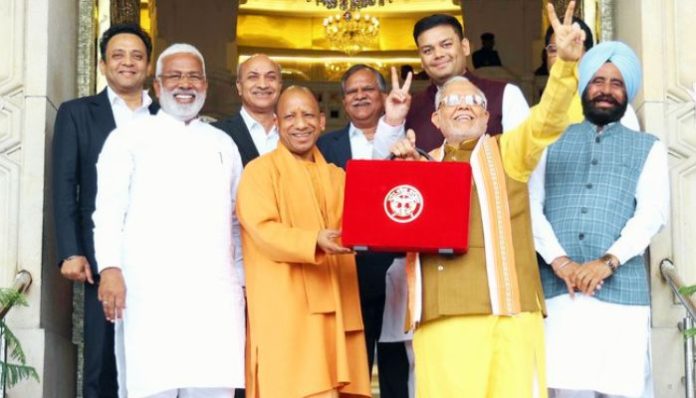
On Thursday (20th February), the Finance Minister of Uttar Pradesh, Suresh Kumar Khanna presented the state’s Rs 8,08,736 crore budget for the Financial Year 2025-26 on Thursday, marking a 9.8 per cent increase from the previous fiscal. Touted as Uttar Pradesh’s biggest budget ever, this budget is also reported to be the highest ever for any state in the country. For the fiscal year 2024-25, the Maharashtra government had presented a budget of Rs.6,12,293 crore.
#Budget2025
— The Uttar Pradesh Index (@theupindex) February 20, 2025
UP becomes FIRST state to breach 100 billion dollars budget size.
With more than 8 lakh crores for FY 2025-26, this is the BIGGEST ever budget presented not just for UP, but for any state. pic.twitter.com/TNAScb2yL1
Uttar Pradesh’s budget for the fiscal year 2025-26 prioritizes infrastructure development, technology, education, healthcare, and social welfare, aiming to accelerate economic growth and improve public services across the state.
The budget’s capital expenditures are 20.5 per cent of the total allocation, highlighting the government’s emphasis on industrial expansion, transportation, and investment-driven projects.
उत्तर प्रदेश विधान सभा में वित्तीय वर्ष (2025-26) के बजट का प्रस्तुतीकरण…@SureshKKhanna https://t.co/SolDALOS1P
— Yogi Adityanath (@myogiadityanath) February 20, 2025
Among sectoral allocations, 22 per cent has been earmarked for infrastructure, 13 per cent for education, 11 per cent for agriculture and allied services, 6 per cent for medical and health sectors, and 4 per cent for social security programs
Additionally, a special provision has been made to equip the Legislative Assembly with modern IT systems, reinforcing the government’s focus on digital governance.
A key highlight of the budget is the establishment of an “Artificial Intelligence City” to position Uttar Pradesh as a leading hub for AI-based innovations and technology-driven enterprises. To further support this, the government has proposed the creation of a Technology Research Translation Park in Cybersecurity.
मुख्यमंत्री श्री @myogiadityanath जी महाराज के नेतृत्व में ‘नया उत्तर प्रदेश’ विकास और समृद्धि के सुपथ पर गतिमान है। pic.twitter.com/kBbJxIfDgj
— Yogi Adityanath Office (@myogioffice) February 20, 2025
In the education sector, a significant push has been made to integrate technology into learning. Plans are in place to establish ICT labs and smart classrooms in primary and higher secondary schools across the state.
Additionally, government polytechnics will be upgraded with smart classrooms and fully digital libraries, ensuring students have access to modern learning tools. Furthermore, a Centre of Excellence has been proposed to promote Artificial Intelligence and emerging technologies.
The budget also emphasizes urban development, with 58 urban local bodies at district headquarters set to be transformed into model smart urban bodies through the convergence of various schemes.
A total allocation of Rs 145 crore has been made for this initiative, with Rs 2.50 crore assigned to each urban body.
Moreover, the government plans to establish and renovate Science City, Science Parks, and Planetariums, fostering a culture of scientific curiosity and innovation among students and researchers.
Uttar Pradesh’s budget also includes a range of social welfare measures aimed at improving the quality of life for its citizens. The Uttar Pradesh Building and Other Construction Workers Welfare Board has announced a new scheme to establish labour hubs at district headquarters, equipped with canteens, drinking water facilities, bathing areas, and toilets to improve living conditions for workers.
To encourage higher education among women, the government has introduced a new scheme to provide scooters to meritorious female students, ensuring ease of mobility and greater access to educational institutions.
The Uttar Pradesh government has also focused on strengthening forensic and medical infrastructure. Six new forensic science laboratories are being set up in Ayodhya, Basti, Banda, Azamgarh, Mirzapur, and Saharanpur, enhancing the state’s forensic capabilities to improve criminal investigations and law enforcement.
In the healthcare sector, the government has proposed an allocated Rs27 crore for the establishment of an autonomous medical college in Ballia and Rs25 crore for a similar institution in Balrampur.
These investments are expected to increase medical seats, improve healthcare access, and strengthen Uttar Pradesh’s medical education system.
Lauding the budget during a press conference, Uttar Pradesh Chief Minister Yogi Adityanath said, “This budget is over 8,08,736 crore Rs, which is 9.8 per cent higher than the 2024-25 budget. On one hand, the growth in the budget size reflects the state’s strength, while on the other hand, it also shows the commitment of the double-engine government.”
#WATCH | UP Budget | Uttar Pradesh Chief Minister Yogi Adityanath says, "… 22% of the total budget has been allocated to infrastructure development… 13% of the total budget has been allocated to education. 11% of the total budget has been allocated to the agriculture sector.… pic.twitter.com/Tl0sWIh9rs
— ANI (@ANI) February 20, 2025
He added that while UP’s economy was previously ranked 6th-7th in the country, it is now the second-largest economy in India.