

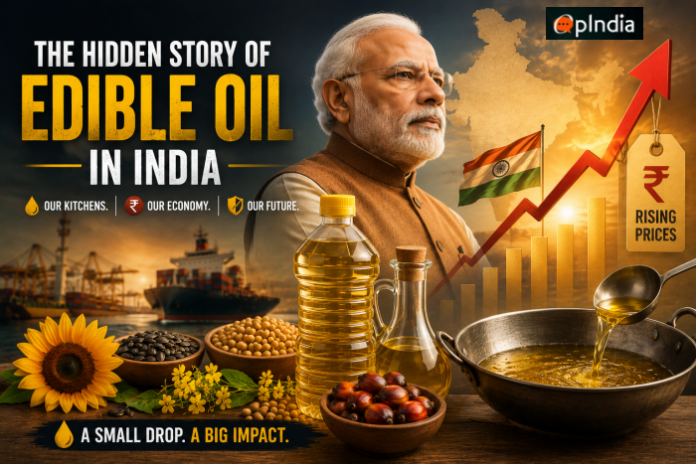
Whenever we discuss India’s oil, we mainly focus on crude oil, but another imported commodity quietly enters almost every Indian household every single day: edible oil.
From street food stalls to luxury restaurants, from packaged foods to home kitchens, edible oil has become essential for Indian consumers. But why are we discussing this today? The answers lie in the series of events over the last three years that exposed how fragile India’s edible oil sector truly is.
In February 2022, Russia launched a full-scale invasion of Ukraine. Within weeks, the import of sunflower oil from these two countries was entirely disrupted, making it unaffordable. Barely two months later, in April 2022, Indonesia, one of the largest exporters of palm oil, suddenly imposed an export ban to protect its own supplies. Since India relies on Indonesia for palm oil imports, the decision immediately drove up prices. Now, fresh geopolitical tensions in the Middle East and concerns around the Strait of Hormuz, through which one-third of global seaborne crude oil trade passes, have also raised concerns about shipping disruptions and freight charges. Both these events exposed the harsh reality that India’s Kitchens are deeply vulnerable to global conflicts, export bans, shipping disruptions, and geopolitical instability.
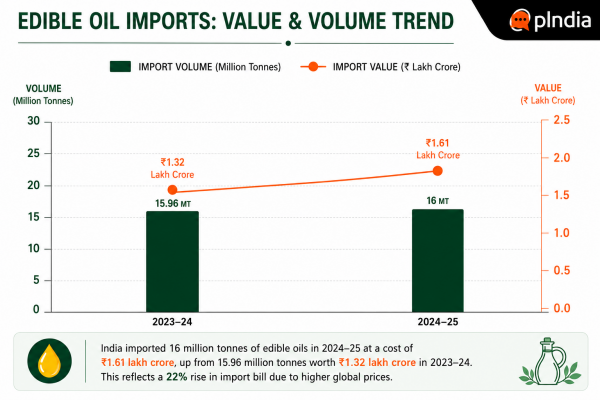
Today, India imports nearly 60% of its edible oil requirement. India is among the world’s largest edible oil economies, after countries such as the USA, China, and Brazil. The import bill is estimated to cost the country approximately USD 18.3 billion (around ₹1.61 lakh crore) in 2024–25.
Palm oil, which is used in processed foods, snacks, and bakery products, is largely imported from Indonesia and Malaysia. Soybean oil is largely imported from Argentina and Brazil, while Sunflower oil is supplied from Russia and Ukraine.
At the same time, edible oil consumption in India has exploded over the last two decades. The rising oil consumption is now linked not just to imports but also to obesity, diabetes, cardiovascular disease and fatty liver across the urban and smaller cities. In this article, we will discuss how what appears to be a simple kitchen ingredient has now become connected not just to public health, foreign dependence and economic security.
India’s total consumption vs. production
Today, India is one of the world’s largest consumers and importers of edible oil. More than 25-26 million tonnes of edible oil are consumed by Indians each year, but India produces only around 11-12 million tonnes.
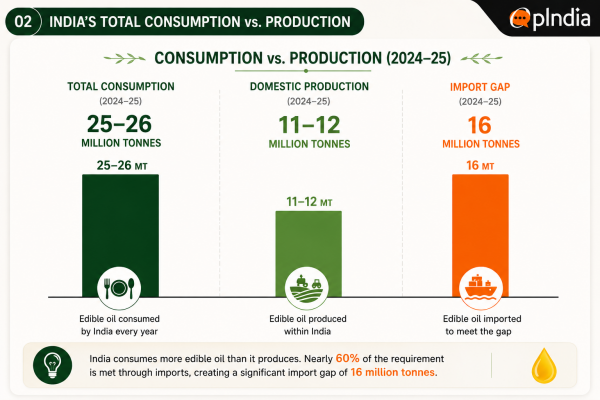
Nearly 60% of India’s consumption requirements are met by foreign countries. As a result, India spent nearly Rs. 1.61 lakh crore (USD 18.3 billion) to import 16 million tonnes of edible oils in 2024-25. This is not a new pattern; in previous years, such as 2023-24, it spent around Rs. 1.32 lakh crore on 15.96 million tonnes of edible oils. It was a nearly 22% jump in value due to higher global prices.
Growing demand vs slow domestic production
Due to rising population, increasing urbanisation, fast-food consumption, and a growing restaurant culture, edible oil consumption has risen. However, the domestic production has failed to keep pace. Despite a heavy reliance on imports, India’s self-sufficiency in edible oil has gradually improved over the last decade.
Improvement in self-sufficiency
According to government data, self-sufficiency increased from nearly 36.8% in 2015 to around 44% by 2024, driven by higher domestic oilseed production and policy support.
Due to rising population, increasing urbanisation, fast-food consumption, and a growing restaurant culture, edible oil consumption in India has increased rapidly. However, domestic production has failed to keep pace with this growing demand.
Why is India dependent on imported edible oils
Despite being an agriculture-driven economy with vast cultivable land, India continues to struggle to achieve self-sufficiency in edible oil. A major reason behind this imbalance is the use of traditional crops. In India, farmers prefer to grow wheat and rice because they provide greater security through the MSP procurement, irrigation facilities, and subsidies. Meanwhile, oilseed crops are often riskier due to unstable prices, pest attacks and dependence on erratic rainfall.
Oilseed crops such as soybean, sunflower, mustard and groundnut did not receive the same level of support. Unlike rice and wheat farmers, oilseed farmers also face volatile market prices and weaker procurement systems, which discourage large-scale cultivation.
Another major issue is the low productivity. In many parts of India, oilseed crops are grown on marginal lands with poor soil quality and limited irrigation, resulting in lower yields than those of global producers. Countries such as Indonesia and Malaysia developed highly efficient palm oil industries over time, while India lagged in achieving large-scale self-sufficiency in edible oils.
Rising consumption and lifestyle changes
Another reason for the imbalance is the high consumption of fried, packaged, snack, bakery, restaurant, and fast food. As cities grow and food delivery apps become normal, edible oil consumption also increases. If we talk about data, in 2001, the average Indian consumed 8.2kg of edible oil per person annually, but it had increased to 23.5kg per person in 2023-24. Oil consumption increased by around 15kg per person over a few years. The growing gap between India’s edible oil consumption and domestic production has transformed cooking oil from a simple kitchen commodity into a major economic and strategic concern.
As the population grew, this widening gap between rising demand and slow production growth forced India to rely heavily on imports from countries such as Indonesia, Malaysia, Argentina, Brazil, Russia, and Ukraine.
Which oils India imports
India depends on different countries for different edible oils used in household cooking, packaged foods, restaurants, and the processed food industry. Palm oil is the most widely consumed edible oil in India and is primarily imported from Indonesia and Malaysia. Due to its low cost and long shelf life, palm oil is extensively used in processed foods, chips, biscuits, and bakery products. It accounts for over one-third of India’s edible oil consumption basket, making it the country’s most consumed edible oil.
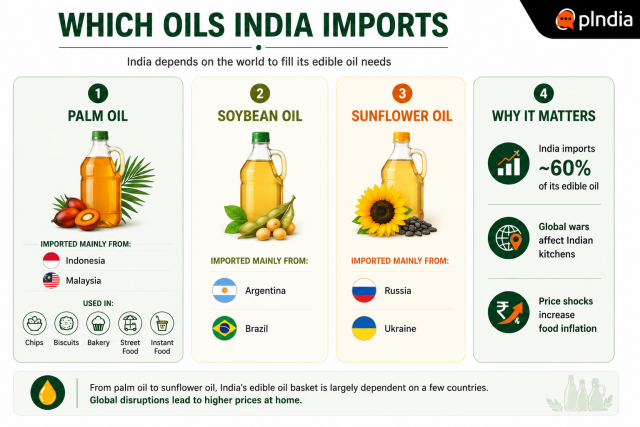
India also imports large quantities of soybean oil, mainly from Argentina and Brazil, while sunflower oil is largely sourced from Russia and Ukraine. The Russia–Ukraine war exposed India’s vulnerability to global supply disruptions, as edible oil prices surged amid disruptions to sunflower oil exports. Although India produces oils such as mustard and groundnut domestically, domestic production remains insufficient to meet the country’s rapidly growing edible oil demand. As a result, India remains heavily dependent on imported edible oils.
The 1998 mustard oil scandal
One of the biggest turning points in India’s edible oil history was the 1998 mustard oil scandal. There was a time when mustard oil was widely used as a traditional cooking oil in North India. It was found to be adulterated with argemone oil, a toxic substance linked to epidemic dropsy. It is a serious disease causing swelling, breathing problems and heart complications. More than 60 people were killed, and around 3000 fell sick, creating widespread panic across the country. The incident severely damaged public trust in loose and locally sold mustard oil. As a result of the scandal, stricter government regulations and food safety checks were introduced. With time, branded refined oils and cheaper imported palm oils gained greater acceptance among consumers, restaurants, and food manufacturers. Many experts believe that this incident indirectly accelerated India’s shift towards refined and imported edible oils, permanently changing the country’s consumption patterns.
The Vanaspati story
Long before refined oil became common in Indian kitchens, Vanaspati was one of the country’s most widely used cooking fats. It was introduced as a cheaper substitute for desi ghee, vanaspati quickly became popular in sweets, bakery products, restaurants and street food. It was low-cost, had a long shelf life, and was easily available. One of the most recognised brands was Dalda, which eventually became almost synonymous with vanaspati in India. With time, hydrogenated fats became deeply embedded in Indian food culture, especially in commercial cooking and processed foods. However, Vanaspati contains high levels of trans fats, which are strongly linked to heart disease and obesity. As processed food industries expanded, cheap imported palm oil gradually began replacing vanaspati in many products because it was easier to import, cheaper for large-scale commercial use, and suitable for repeated frying. The shift led to an increase in dependence on imported palm oil and highly processed edible oils, thereby changing the country’s cooking and consumption patterns.
Economics of cheap palm oil: How palm oil became dominant
Today, India’s edible oil market is largely dominated by palm oil, which holds the single largest share at over 37% of total edible oil consumption. For decades, palm oil was among the cheapest edible oils available globally, a cost advantage built on the exceptional yield efficiency of oil palm trees, which produce nearly 3.3 tonnes of oil per hectare compared to just 0.4 tonnes for soybean and 0.7 tonnes for sunflower. However, by 2024, this price advantage had narrowed significantly, with palm oil prices rising 10% while soybean oil prices fell 9%, marking a rare shift in which palm oil was no longer the cheapest option in global markets. Despite this, its low cost, long shelf life, and high heat stability continue to make it highly attractive to food companies, snack manufacturers, bakeries, restaurants, and street food vendors. It is widely used in biscuits, chips, instant foods, frozen foods, and bakery items because it remains cost-competitive and helps lower production costs at scale. Due to its affordability over several decades, palm oil gradually became deeply embedded in India’s processed food industry and commercial cooking sector.
Health concerns around palm oil
India imports most of its palm oil from Indonesia and Malaysia, which together account for around 85% of the global palm oil supply, making palm oil one of India’s largest imported commodities by volume. Over time, cheap imported palm oil began replacing several traditional oils in large-scale food production because it was easier to source and more economically viable for the industry. Many blended and refined oils sold in Indian markets also contain palm oil, often without consumers realising it. However, excessive palm oil consumption has raised serious health concerns. At nearly 50% saturated fat, palm oil is linked to higher LDL cholesterol levels and an increased risk of cardiovascular disease, according to the WHO and multiple independent studies. Despite these concerns, key industries, including cookie manufacturers, restaurants, and hotel chains, continue to rely heavily on palm oil due to its price and availability, further deepening India’s reliance on imported edible oils.
The health crisis behind rising oil consumption
The rising oil consumption is not only an economic issue but also, over time, becoming a health emergency. Over the last two decades, the consumption of edible oil in India has grown rapidly, which we already discussed in the previous section. In previous years, changing food habits and modern lifestyles have sharply increased oil intake across India. From fried street food to fast food, and from processed snacks to bakery products, each meal requires a large amount of edible oil. And in recent times, Food delivery apps and restaurant culture have accelerated the consumption of oily food. We have discussed the economic impacts of large oil consumption, but what about the health of Indians?
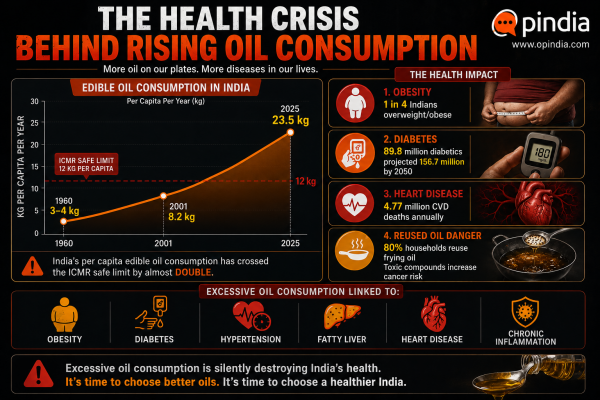
It has become clear that consuming large amounts of oil can lead to health issues and diseases. Let’s talk about the per capita edible oil consumption. In the 1960s, India’s per capita edible oil consumption was just 3-4kg annually, which has increased to nearly 25.3kg in 2024-25 and is projected to increase to 40kg by 2030-31. In just 60 years, India’s oil consumption has grown nearly 7 times. If we go more precisely, the data shows that in 2001, the average edible consumption was around 8.2 kg per person per year. This data also showed that consumption has almost tripled over the last two decades.
It becomes more concerning if we check the ICMR-recommended limit. Indian Council of Medical Research, the apex body in India for the formulation, coordination, and promotion of biomedical research, recommends a daily intake of 20–30 grams of visible edible oil per person, which translates to a maximum of roughly 12 kg per year. Currently, Indians are consuming almost twice as much edible oil. Overconsumption of oils leads to different health diseases like Diabetes, obesity and Hypertension.
Reused cooking oil and hidden risks
According to the NFHS-5 Data, Nearly 24% Women and 23% men are considered overweight or obese. India ranks among countries with rapidly rising obesity rates. According to the World Obesity Atlas, India has the second-highest number of overweight and obese children globally. By 2040, it is projected that nearly 56 million Indian children may become obese. And it is not limited to obesity, but it is also true for other diseases like diabetes. According to the diabetes, India currently has around 89.8 million adults with diabetes, and by 2050, India’s diabetes cases may reach 156.7 million, which is huge in numbers. If we look at the data, diabetes cases in India increased massively over time.
Diabetes prevalence in India had nearly doubled over the last three decades, rising from around 3% in 1990 to nearly 6% by 2021. According to doctors and researchers, unhealthy diets, excessive oil consumption, processed foods, and obesity are mainly the reasons for the increase in diabetes cases. India is also witnessing a sharp increase in heart disease and cardiovascular diseases, which are linked to unhealthy dietary habits and excessive oil consumption. Cardiovascular disease (CVD) is a broad term for conditions affecting the heart or blood vessels. It has now become one of the leading causes of death in the country, accounting for nearly 28% of all deaths in India as of 2016, according to the Global Burden of Disease study, and responsible for 45% of all deaths in the 40–69 age group, according to WHO India data. For the last few decades, the number of cardiovascular disease deaths in India has exploded. In 1990, there were around 2.26 million CVD deaths annually, which had nearly doubled to 4.77 million by 2020. According to health experts, this rise is strongly linked to overconsumption of oily and processed foods.
At the same time, hypertension, or high blood pressure, has become increasingly common across the country. More than one in four Indians now suffers from hypertension, but a large number of cases remain undiagnosed, untreated, or poorly controlled. According to the reports, nearly 80% of Indian households reuse frying oil multiple times. The reheated oil generates harmful trans fats, free radicals and toxic compounds that can increase inflammation inside the body and raise the risk of heart disease, fatty liver disease and even certain cancers.
How global events affect Indian kitchens
In India, the sheer size of the population dictates our import dependency and in effect, is vulnerable to supply shocks due to global events. India is heavily dependent on imported edible oil, making it vulnerable to global geopolitical crises. As India imports a large quantity of edible oil, international conflicts directly affect Indian households. For instance, the Russia-Ukraine war clearly exposed this vulnerability. India imports large quantities of sunflower oil from Russia and Ukraine. Due to the war, global supply chains were disrupted, leading to higher edible oil prices in India. Since India depends heavily on Indonesia and Malaysia for palm oil imports, export restrictions immediately increased prices. Global fluctuations in palm oil, soybean oil, and sunflower oil prices can quickly affect the prices of packaged foods, restaurants, and household cooking across the country.
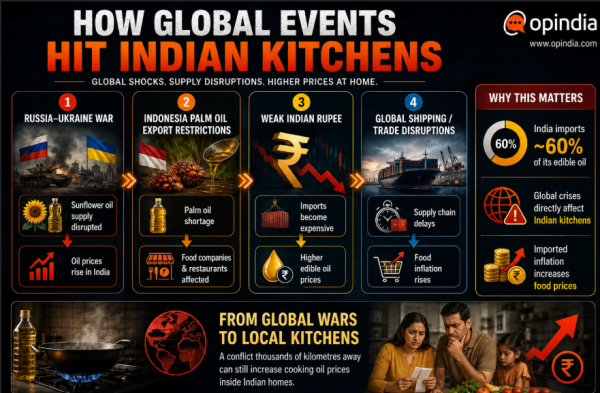
Currency fluctuations further worsen the problem. Since edible oils are purchased in dollars, a weaker Indian rupee increases import costs even if international prices remain stable. Basically, the rising dependence on imported cooking oil means Indians kitchens are closely linked to global wars, export bans, and shipping disruptions. As a result, even geopolitical conflicts thousands of kilometres away can directly raise cooking oil prices for Indian consumers. This growing dependence has transformed edible oil from a basic kitchen commodity into a major strategic and economic concern for India.
Government response and PM Modi’s appeal
The rise of imported edible oil and the rapid increase in lifestyle diseases have also prompted government intervention. PM Narendra Modi has repeatedly urged Indians to reduce their oil consumption. Recently, he urged reducing oil consumption by 10% and said, “Isse desh seva bhi hogi aur deh seva bhi hogi,” meaning it would serve both the nation and the body.
First, he highlighted this issue on Independence Day, while addressing the nation, warning that obesity and lifestyle diseases could become major challenges for India in the coming years. Later, on World Health Day, he again stressed that reducing excessive oil consumption is not merely a personal health choice but also a social responsibility.
According to health experts, excessive edible oil consumption is directly linked to rising obesity, diabetes, hypertension, fatty liver disease, and cardiovascular problems across the country. Therefore, reducing excessive oil consumption can improve public health while lowering import dependence and reducing pressure on the import bill. Alongside public awareness campaigns, the government has also launched initiatives such as the National Mission on Edible Oils–Oilseeds (NMEO-OS) and the National Mission on Edible Oils–Oil Palm (NMEO-OP). These missions aim to increase domestic oilseed production, improve farmers’ incentives, strengthen self-sufficiency in edible oils, and reduce India’s long-term dependence on imports. The government’s approach now treats edible oil not just as a food commodity, but also as an issue connected to economic security, public health, and national self-reliance.
What you can do: Practical steps to reduce excessive oil consumption
According to health experts, reducing oil consumption requires both individual self-awareness and long-term lifestyle changes. One of the simplest steps one can take is to measure daily oil consumption rather than pouring it freely during cooking. Doctors also suggest that reusing or reheating the cooking oil can lead to many diseases, as reheating generates harmful trans fats, free radicals and toxic compounds that can increase the risk of heart attack, diabetes, fatty liver and certain cancers. Moreover, experts recommend switching to less-processed, cross-pressed oils wherever possible and rotating among different oils rather than relying on a single type for all cooking.
To make your life easier, you must start reading labels on packaged foods, as many processed foods contain hidden fats and refined oils. Reducing the consumption of deep-fried snacks, fast food, bakery products and heavily processed foods can significantly lower long-term health risks. At the same time, healthier cooking methods such as steaming, grilling, roasting, and air frying can help reduce unnecessary oil intake. It is also important to teach healthier eating habits to children from an early age, especially as obesity and lifestyle diseases are rising in the younger population. According to doctors, balanced diets, moderation, and home-cooked food remain among the most effective ways to improve long-term health and reduce excessive reliance on edible oils.
Conclusion
Cooking oil may seem like an ordinary kitchen ingredient, but behind every bottle lies a much larger story of foreign dependence, changing food habits, rising health risks, and economic vulnerability. Today, India imports a large share of its edible oil requirements. Despite being an agriculture-driven country, India leaves Indian households increasingly vulnerable to global wars, export restrictions, supply chain disruptions, and international price shocks. At the same time, excessive edible oil consumption has contributed to rising obesity, diabetes, hypertension, cardiovascular disease, and other lifestyle-related illnesses across the country. Therefore, it is no longer limited to agriculture or food consumption alone. It has become deeply connected to public health, economic security, food inflation, and national self-reliance. While government missions and policy reforms aim to improve domestic oilseed production and reduce import dependence, long-term change will also require healthier food habits, balanced consumption, stronger support for farmers, and greater public awareness. The future of India’s edible oil challenge will depend not only on increasing domestic production but also on changing how the country consumes food.


