

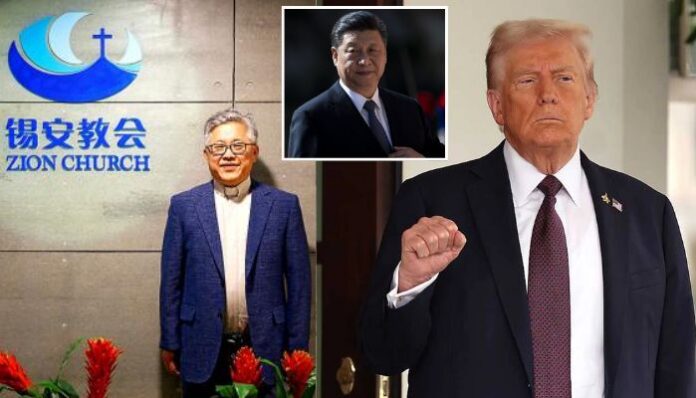
Atheist China released Pastor Ezra Jin Mingri, one of the country’s most prominent underground Christian leaders, after more than 250 days in detention. His release came less than two months after US President Donald Trump publicly said that he had personally raised Jin’s case with Chinese President Xi Jinping during a summit in Beijing, putting fresh international attention on China’s treatment of independent religious groups.
Pastor Ezra Jin Mingri freed from prison in China weeks after Trump requested his release https://t.co/nC3zS2zeG2 pic.twitter.com/yiDx1YQGh3
— New York Post (@nypost) July 5, 2026
According to US-based religious freedom organisation ChinaAid, Jin has now arrived safely in Los Angeles on Sunday, 4th July, after being released from prison. His detention had become one of the most closely watched religious freedom cases in China, with governments, lawmakers and human rights organisations repeatedly calling for his release.
Speaking to reporters aboard Air Force One after he met with Xi in May, Trump had said, “I think he’s giving very serious consideration to the pastor,” while also mentioning the case of Hong Kong pro-democracy activist Jimmy Lai. Trump noted that Lai’s case appeared to be “a tough one.”
WATCH | President Trump tells reporters he discussed Pastor Ezra Jin and Jimmy Lai with President Xi:
— VOZ (@Voz_US) May 15, 2026
"I think he's giving very serious consideration to the pastor… he said Jimmy Lai is a tough one for him to do." pic.twitter.com/UJerLDn9Wm
Jin’s family welcomed his release and directly credited the diplomatic intervention. In a statement, they thanked “President Trump and his administration for their tremendous leadership” and added, “We know that this could not have happened without the direct intervention from Chairman Xi Jinping.” The family also expressed hope that the development would mark “a positive turn for people of faith in China and relations between our two nations.”
Human rights advocates celebrated the release but stressed that the wider crackdown remains unchanged. Brian Tronic of Freedom House said, “While his release will bring much-needed comfort to his family, friends and many supporters, we cannot forget the leaders and members of Zion Church who remain detained.” ChinaAid founder Bob Fu similarly urged Washington to continue making “religious freedom and the release of all prisoners of faith a top priority in every engagement with Beijing.”
Who is Pastor Ezra Jin Mingri?
Ezra Jin Mingri, 57, is the founder and senior pastor of Beijing’s Zion Church, one of China’s largest independent Protestant congregations. He established the church in 2007 with only around 20 worshippers, but over the following decade it grew into a congregation serving thousands of believers and became one of the best-known house churches in China.
Ezra Jin, the founder of one of China’s most prominent underground churches, has been released from prison and reunited with his family in the United States.
— Spotlight on China (@spotlightoncn) July 6, 2026
The Zion Church leader arrived on Friday, having been among dozens detained during an October crackdown on Chinese… pic.twitter.com/kZoUaPWufn
Unlike state-approved churches, Zion Church refused to register under China’s official religious system, insisting on remaining independent from government control. That position eventually brought it into direct conflict with Chinese authorities.
The Zion Church is among the largest underground or house churches in China that are unregistered with authorities. They defy a requirement that believers worship only in registered congregations.
In 2018, officials shut down the church’s physical headquarters in Beijing. Instead of ending its activities, Jin shifted the church online, livestreaming sermons and Bible teachings over the internet. According to his daughter, Grace Jin Drexel, those broadcasts attracted an estimated 10,000 viewers from across China.
Despite increasing surveillance and harassment, Jin continued his ministry. Although he had earlier moved his family to the United States for safety, he himself chose to return to China despite the growing risks. Before his arrest, authorities had already barred him from leaving the country to visit his wife, daughter and two sons in America.
China’s underground churches and why they operate outside the system
Jin’s case has also renewed attention on China’s vast network of underground or “house” churches.
China officially recognises Protestantism and several other religions, but all religious organisations are required to operate under state-approved institutions that remain subject to Communist Party supervision. Protestant churches are expected to register under the government-controlled Three-Self Patriotic Movement, where sermons and religious activities are closely monitored.
Many Christians reject this system, arguing that state oversight compromises religious independence. Instead, they choose to worship in private homes, rented apartments or office buildings through informal congregations commonly known as underground or house churches.
Researchers estimate that China has more than 68 million Christians, with roughly half worshipping outside the official state system. China could eventually become home to the world’s largest Christian population.
However, the government has steadily tightened restrictions on these independent congregations. In recent years, authorities have removed thousands of church crosses, demolished churches, restricted Bible distribution, banned religious apps and introduced regulations requiring religious groups to register with the state. Those who refuse registration risk arrests, property confiscation and criminal prosecution. Authorities have forcibly removed thousands of crosses from steeples, demolished megachurches using dynamite, and banned the online sale of Bibles outside of official bookstores.
The ruling Communist Party, which is officially atheist, views organised religion as a potential threat to its hold on power. Xi Jinping‘s government has also promoted the policy of “Sinicisation” of religion, arguing that religious practice should align with Chinese socialist values and Communist Party leadership. During a 2016 speech on religion, Xi declared, “We must resolutely guard against overseas infiltrations via religious means and prevent ideological infringement by extremists.”
Despite repeated crackdowns, many underground Christians continue to gather secretly.
How Pastor Jin was arrested and why the crackdown intensified
The latest crackdown began on 10th and 11th October, 2025, when Chinese authorities arrested nearly 30 pastors, preachers and church members linked to Zion Church across seven cities, including Beijing, Shanghai and Zhejiang. Pastor Ezra Jin was detained in Beihai, Guangxi province, along with several other church leaders.
Human Rights Watch described the operation as one of the country’s largest coordinated actions against a single unofficial Protestant congregation in decades. Jin and several fellow pastors were taken to Beihai City No. 2 Detention Centre, while the whereabouts of several detainees initially remained unknown.
Authorities charged Jin with “illegal use of information networks,” accusing him of violating new online religious regulations introduced shortly before the arrests. The rules effectively prohibited the circulation of unauthorised religious content outside Communist Party control.
Human Rights Watch argued that the arrests reflected a broader campaign to tighten ideological control over religion. China researcher Yalkun Uluyol said, “The Chinese government’s arbitrary detention of dozens of people affiliated with Zion Church reflects an escalating crackdown on religious freedom.” He added that “President Xi Jinping’s government appears intent on reshaping religious practice to serve the Chinese Communist Party’s interests.”
The crackdown against Zion Church fits into a wider pattern. Since Xi launched his campaign to “Sinicise” religion, authorities have shut down influential house churches, imprisoned prominent pastors, demolished church buildings and prosecuted church leaders on charges ranging from illegal business operations to fraud.
Despite U.S. diplomacy securing the release of Pastor Ezra Jin, eight other members of China's Zion Church remain detained. Sky News has been looking into the swathe of arrests which targeted the church last October, and the growing fear among Chinese Christians.
— Sky News (@SkyNews) July 5, 2026
Asia… pic.twitter.com/0QbKYMNCVI
Although Pastor Ezra Jin has now regained his freedom, many of Zion Church’s pastors and members remain in detention.


