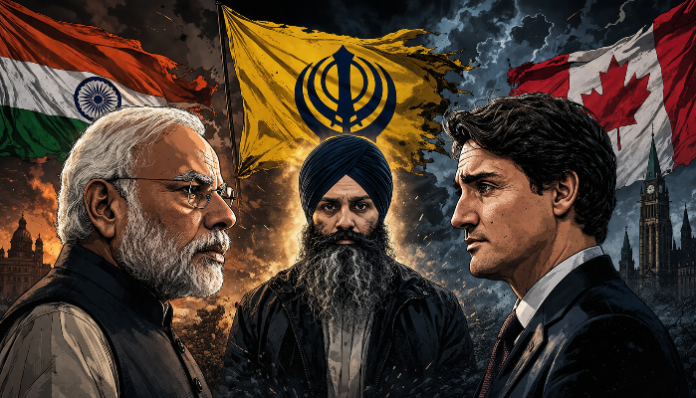
The prolonged geopolitical witch hunt against India, which was unleashed in the wake of the assassination of Khalistani terrorist Hardeep Singh Nijjar in Burnaby, has recently been exposed after Canada accepted that “no evidence” was discovered to substantiate the claims pertaining to the Modi government’s role in the incident.
“There is no evidence to suggest that, through this organised crime syndicate investigation and the charges laid forward, that Indian government officials would be charged or involved in this. Nothing has come out to link the Indian government,” highlighted Royal Canadian Mounted Police (RCMP) Deputy Commissioner, Lisa Moreland.
The admission took place after the officials in the United States released an indictment accusing imprisoned gangster Lawrence Bishnoi and his North American accomplice Goldy Brar of planning Nijjar’s murder. The case is part of a larger action on organised criminal networks in the United States, Canada and Europe. However, the charges made by the US personnel did not point to any involvement of New Delhi in the matter.
Operation Hardball: Indian agencies help the US
On the contrary, India even cooperated in the probe. US law enforcement officers met with many central agencies in the Asian nation prior to “Operation Hardball” exchanging and confirming intelligence about mobsters Bishnoi, Brar, Rohit Godara, Jaggu Bhagwanpuria and their allies, reported The Indian Express. The operation is a multinational offensive led by federal prosecutors and the Federal Bureau of Investigation (FBI) in Los Angeles, in collaboration with the RCMP and European authorities.
Insiders revealed, “After the deportation of gangster Anmol Bishnoi from the US (in November last year), who is wanted as the main plotter in the murder of NCP (Nationalist Congress Party) leader Baba Siddique, coordination between India’s central agencies and US law enforcement agencies improved significantly.”
They are reported to have given US officials access to a list of aides of Bishnoi and Brar alongside information about potential hiding places, during their latest communications. The sources mentioned, “In the last five years, several of their associates have been arrested here, and, during questioning, many of them unveiled details about Lawrence Bishnoi, his partners and their activities abroad. On the basis of their disclosures and technical surveillance, evidence was gathered against them.”
US authorities even visited the National Investigation Agency (NIA) headquarters in Delhi last year. The former discussed about connections between Indian-origin mafia and US drug cartels. They also requested for help in taking action against these culprits and offered a compilation of names. According to a central agency officer, inquiries into many cases had shown that the majority of these gangsters in US were in contact with smugglers in Pakistan for both targeted killings and the transportation of massive amounts of drugs into India through sea and drones.
Sources stated, “They are currently using VPNs (Virtual Private Networks) to mask their locations and encrypt communication, making it difficult to trace them. They also use encrypted messaging apps for secure communication, and it is difficult to track their channels.”
The United States had aligned itself with Canada in its debunked opposition of India. An indictment submitted by Damian Williams, the former counsel for the Southern District of New York asserted that Nikhil Gupta, who was apprehended in a so-called conspiracy to eliminate banned Sikhs for Justice supremo Gurpatwant Singh Pannun, reportedly recognised that he was also involved in Nijjar’s murder and there were multiple other targets.
Now, the current legal breakthroughs have turned the original political narrative on its head which was built on dubious confessions and ludicrous charges of “transnational repression” against New Delhi.
When the Canadian government used “credible allegations” to attack India
Former Canadian Prime Minister Justin Trudeau undertook a deliberate effort to attack India shortly after 45-year-old Nijjar’s death in 2023. Interestingly, the accusations were founded on “credible allegations” rather than empirical proof, terming it as a breach of his nation’s sovereignty. RCMP Commissioner Mike Duheme announced that evidence has been uncovered tying the “agents of the Modi government” to homicides and other violent acts in the country.
However, India firmly denied the outrageous allegations and maintained that Canada has failed to back the same with evidence. It retorted that human traffickers and murderers have been granted refuge in the country. David Cohen, the American ambassador to Canada, conveyed that “shared intelligence among Five Eyes partners,” including Australia, Canada, New Zealand, the United Kingdom and the United States, was the basis of the charges.
Afterwards, a series of tit-for-tat diplomatic expulsions unfolded as Ottawa was forced to withdraw 41 diplomats and their families after New Delhi threatened to revoke their diplomatic immunity, as the row resulted in a fast deterioration of ties. Canada temporarily stopped conducting in-person operations at its consulates in Bengaluru, Chandigarh and Mumbai.
The entire Canadian government rallied together to consistently criticise the Modi government, even going so far as to directly accuse the Minister of Home Affairs, Amit Shah, of orchestrating plots against Sikh separatists on Canadian territory. Deputy Foreign Affairs Minister David Morrison took his name while talking to “The Washington Post” and verified it before a parliamentary panel.
He and National Security Adviser Nathalie Drouin had revealed sensitive intelligence in relation to India’s “criminal activities” on Canadian soil with the media outlet. Moreover, the then Indian High Commissioner, Sanjay Verma, was identified as a person of interest in the investigation.
He and five other diplomats and consular officials were expelled as well as labelled as “persona non grata.” Canada had formally requested India to waive their diplomatic immunity in order to interrogate them over their supposed participation in violent criminal activity.
However, the submission was rejected. Indian officials were reduced to the position of criminals by the Trudeau government for political interests and to cater to the Khalistani voting bloc in the country. The Modi government also emphasised that it was necessary to repatriate them as it had lost confidence in the Canadian government’s commitment to their security, citing its support for extremism, violence and separatism against India.
It told Canada to withdraw several diplomatic staff and suspend visa services. India directed six Canadian diplomats, including acting High Commissioner Stewart Ross Wheeler, to leave the country.
Duheme argued that there had been “over a dozen credible and imminent threats to life” which were “specifically” targeting individuals linked to Khalistan movement. Hence, RCMP’s public intervention was needed and they “reached a point where we felt it was imperative to confront the government of India.”
Canada even released a report blaming “pro-Modi media” and “social media handles” for attacking Trudeau, the country’s high commissioner and its Sikh community. It contended that “propaganda” and “disinformation” about Nijjar’s murder were propagated by these media outlets. However, India remained firm on its stand and repeatedly rubbished all these remarks as “absurd, motivated and baseless.”
India-Canada relations were essentially in a state of free fall due to the policies of the Trudeau government, and began to mend only after Mark Carney replaced him last year, including the appointment of new high commissioners. The Free Trade Agreement (FTA) negotiations, which were also halted during this period, have been resumed at the G20 Summit in November.
“In the files that we have that involve transnational repression, we’re not seeing any connection right now with any foreign entity, based on the criminal information, the investigations that we have presently,” Duheme underscored in a startling confession in March.
USCIRF invokes “transnational repression of religious minorities”
How could the global anti-India coalition miss any chance to portray the country negatively, and they certainly did not disappoint. The United States Commission on International Religious Freedom (USCIRF) was “alarmed by India’s increased transnational targeting of religious minorities and those advocating on their behalf.”
Its Commissioner Stephen Schneck stressed that India’s purported part “in the killing of Sikh activist Hardeep Singh Nijjar in Canada and the plot to kill Gurpatwant Singh Pannun in the United States was deeply troubling” in 2023. He added, “We call on the Biden administration to acknowledge the Indian government’s perpetration of particularly severe religious freedom violations and designate it as a country of particular concern (CPC).”
USCIRF has already gained notoriety for its hostility towards India and has repeatedly wanted the latter to be regarded as a “country of particular concern.” It also demanded a ban on the Rashtriya Swayamsevak Sangh (RSS) and Research & Analysis Wing (R&AW). Gunisha Kaur, a fan girl of Jarnail Singh Bhindranwale has been appointed to the commission in May. Hence, it is not surprising that they do not bother themselves with minor details like evidence to endorse their propaganda against India which has been disproven time and again.
Liberal media’s campaign to demean India
The liberal media, an inseparable element of this nexus, capitalised on the prime opportunity to assail India and commenced to portray the country as culpable in their articles. Hannah Ellis-Petersen of The Guardian, infamous for her hit jobs on the Modi government, Aakash Hassan and Shah Meer Baloch, authored an “investigative piece” insisting that the Indian government had been orchestrating the eliminations of terrorists outside its borders.
However, the article itself was discovered to contain glaring inaccuracies, which appear to stem not only from gross negligence but also from a perverse desire to depict the nation as a violator of international norms and standards. Pannun was not only declared deceased similar to Nijjar, but the responsibility was attributed to a “rogue agent” of R&AW by the British daily.
“Both men had been major advocates of the Khalistan movement, which seeks to create an independent Sikh state and is illegal in India. India denied any involvement in the killing of Nijjar, while according to a recent report, India’s own investigation into Pannun’s death concluded that it had been carried out by a rogue agent who was no longer working for Raw,” the article read.
Bloomberg also projected Nijjar and Pannun as “campaigners for Khalistan” in a dramatic article as if they had committed their lives to a for higher purpose, rather than being associated with terror conspiracies that seek to create bloodshed and challenge India’s integrity. The article functioned as a means of image rehabilitation, striving to reframe those accused of terrorism into icons of dissent while depicting India as a repressive entity trying to stifle their voices.
The Atlantic categorised Nijjar and Pannun as “Sikh nationalists” who are just against Prime Minister Narendra Modi and suggested that India’s potential hand in neutralising terrorists in other countries might please his admirers, but he cannot afford to damage ties with Canada and US. The burden of fostering these diplomatic links apparently lies exclusively with India as other nations can open aggressive diplomatic front without any credible proof.
The New York Post described the demand for the balkanisation of a nation which was divided on religious lines as “freedom” while admonishing India for branding Khalistanis as terrorists. It stated that the movement has “largely fizzled out decades ago” but the government continues to consider it “as a threat to national security – for reasons more mundane but no easier to weed out.”
Nijjar was just presented as a Sikh leader involved in “extortion schemes and other gang-related activities” as his profound history of terror was conveniently masked. The column then quoted Gunisha Kaur who also serves as the medical director of the Weill Cornell Center for Human Rights.
She claimed, “The threat of terrorism is used to exploit fear and justify the suppression and silencing of minorities,” remarking that the community has been targeted with “impunity” triggering the demand for an independent state. It even gave space to Pannun who also cried about “transnational terrorism.”
Pointing fingers at India and R&AW while providing cover for Khalistani terrorists
The Washington Post facilitated pro-Khalistan “journalists” such as Gerry Shih who utilised their pen as tool for their agenda in addition to whitewashing separatists. He was the New Delhi Bureau Chief for the media company before he was kicked out when over 300 staff members were laid off in February.
Shih and Greg Miller were behind the article on Canada’s allegations dragging Amit Shah and Verma following a tip-off from Drouin and Morrison. “We know they are involved in the Nijjar killing, in other murders and in ongoing violence – actual violence – in Canada,” it read, citing a senior Canadian official.
According to WaPo’s sources, India was running a coercive plot to press people of Indian origin to “act as informants” against “Sikh activists” and threatening them with deny visas as well as “physical threats to them and their families in India.” It added that “the information is being sent to India at almost the highest level.”
The article blamed “a senior official in India and a senior official in RAW,” for authorising attacks on Khalistanis. Canada used WaPo fundamentally as a shoulder to fire shots at India, but there was a complete dearth of proof from the two as their only goal was to spread propaganda much farther from the truth.
CNN host Fareed Zakaria, who advocated for US interference in India, downplayed Khalistani terrorism and criticised India for engaging in jingoism regarding the allegations from Canada. The son of former Congress Minister Rafiq Zakari insinuated that the subject of Khalistani terrorism was being overstated for political advantage by PM Modi and the Bharatiya Janata Party (BJP) as the 2024 Lok Sabha elections approached.
These media organisations persistently tried to imply that government might be involved in Nijjar’s assassination and even implied that R&AW could be expanding its strategies for operations in Western countries and using criminal networks to carry out such assaults, all without any proof. India was unequivocally blamed while the Khalistanis were represented as activists, leaders and dissenters despite the substantial evidence to the contrary.
The brown sepoys of Indian media were equally active, as “The Quint” applied the charges made against Nikhil Gupta in the US as a mark of Canada’s vindication.
“How credible this is would eventually depend on the extent to which Gupta’s collusion with Indian officials gets established. The proof or the lack of it regarding India’s alleged involvement in Nijjar’s killing would be clear only when the evidence is presented when the case comes up in a court in Canada,” it conveyed since such claims have to be proved beyond a shadow of a doubt, but the misleading headline was intentionally placed to deceive the readers.
Islamo-leftist propaganda portal “The Wire” also referenced the same premises to attack the Modi government arguing that its “recklessness” was detrimental to the national interest. The article stated that the conversation between Gupta and Indian government official Vikash Yadav which were conducted through encrypted messages but were accessed by the US investigators could possibly represent the “credible allegations” referred by Trudeau, drawing such a preposterous link where none exists and would never have been even considered by him.
It mocked Indian intelligence agencies for failing to cover their tracks and asserted that Yadav provided incriminating evidence regarding the murder of Nijjar.
Conclusion
India has been consistently targeted by Canada and its allies, including the United States, who were resolutely over Nijjar’s demise. Media outlets, which already harbour significant bias against New Delhi and the Modi government, eagerly participated in the narrative, producing numerous articles insisting that India landed in diplomatic trouble owing to assassination attempts in other countries.
Trudeau severely compromised his country’s ties with India in his blind pursuit to appease Khalistanis for short-term political goals. He never supplied any convincing facts to corroborate his comments nor did those who backed the same. The entire foundation was constituted on dramatics, sensationalism and ambiguity.
The stark lack of evidence was conveniently brushed aside in favour of anti-India rhetoric as the nation was judged and convicted without proof while the terrorists were depicted as victims suffering because of the Modi government’s oppression. Canada and the US, known for its history of eliminating threats to its national security, saw detractors of India exercising their “freedom of speech” in separatists and extremists.
Their heinous actions were glossed over by this entire faction. Furthermore, this very cabal chooses to maintain a defensive silence when Khalistanis frequently attack not only Hindus and their places of worship but also Indian high commissions and diplomatic missions, which are just as vulnerable to their violent antics.
A bogus narrative was constructed on these falsehoods which has eventually collapsed under the weight of the truth. Of course, no one from Trudeau to the media houses or the US will be willing to acknowledge their grave errors and offer an apology. However, they might very well be devising another scheme against India as this specific effort has proven unsuccessful obviously with the unwavering support of Islamo-leftists and those whose resentment for PM Modi has morphed into a broader contempt for India.