

The release and subsequent removal of the Diljit Dosanjh-starrer ‘Satluj’ from the OTT platform Zee5 has once again brought the darkest years of Punjab’s insurgency into public discussion. As usual, the narratives are being discussed from two different points of view. One, where all victims are being discussed, including Sikhs and Hindus who suffered losses during the insurgency, and second, where pro-Khalistanis are using it to push their own separatist agenda. The former, unfortunately, is lacking.
Originally titled ‘Ghallughara’ (which means holocaust, massacre, or genocide), the movie was first renamed ‘Punjab ’95’ and subsequently released as ‘Satluj’. The film is based on Jaswant Singh Khalra and his investigation into alleged extrajudicial killings, disappearances and secret cremations carried out during the counterterrorism campaign in Punjab.
After the film disappeared from the streaming platform in India, Sikh organisations and local activists began holding community screenings in villages and gurdwara compounds. The film has been projected as a suppressed account of police brutality and the suffering endured by families during the insurgency. According to the Associated Press, these screenings have moved elderly viewers to tears and introduced younger Punjabis to a period they know only through fragmented stories told by their elders.
The story of illegal killings, if established through evidence, deserves to be told. Khalra’s abduction and murder were crimes, and police personnel were convicted in the case. No account of Punjab’s history can demand that such crimes be ignored. However, ‘Satluj’ also demonstrates how a historical narrative can be factually significant and yet incomplete.
The film projects the Punjab insurgency as the “main story” of that period. A story of police officers killing suspected terrorists and civilians. Khalistani terrorism, without saying “Khalistani terrorism”, has been shown as if it was resistance, not militancy. On the contrary, it was a period when Khalistani terrorists stopped buses and trains, identified Hindu passengers and shot them. Sikh leaders seeking peace were assassinated. Editors and broadcasters were murdered for refusing to accept militant diktats. Police personnel were bombed inside secured offices, ambushed on roads and killed outside places of worship.
These victims do not get their stories told through films or any other possible medium. There are no “screenings” or prolonged discussions about their lost futures. They generally survive as numbers in old newspaper archives, and even if they are talked about by media houses in current times, they get space somewhere inside the newspaper, in an easy-to-forget or easy-to-miss corner.
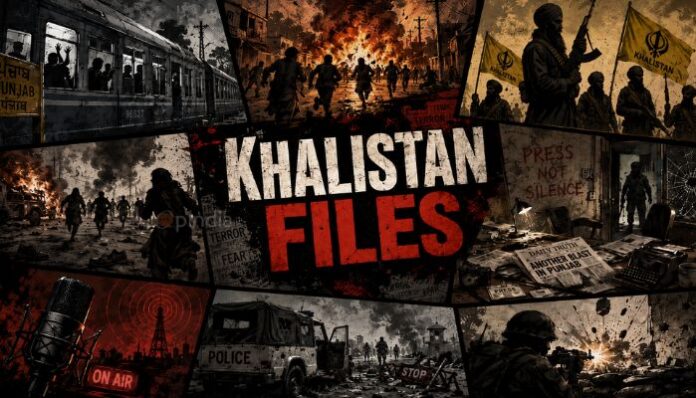
That gap is what OpIndia is trying to fill.
The victims left outside the frame
Popular narratives surrounding the Punjab insurgency increasingly begin with Operation Blue Star, move to the anti-Sikh violence following the assassination of then Prime Minister Indira Gandhi and then concentrate on the counterterrorism campaign that followed.
All three subjects require scrutiny. The anti-Sikh violence that stemmed from Gandhi’s assassination was a national disgrace. Allegations of unlawful police killings cannot be dismissed merely because Punjab was facing terrorism.
However, the insurgency did not begin with the police crackdown, and it cannot be understood by beginning the story after Khalistani terrorism had already torn through Punjab.
There was another Punjab in which terrorists checked the identities of passengers on buses and trains before deciding who would live. There were markets where gunmen fired at Hindu shopkeepers. There were Sikh politicians who were labelled traitors for negotiating peace. There were newspaper offices operating under armed protection because editors, reporters, agents, distributors and even hawkers had been marked for death. There were also policemen whose families did not know whether they would return from work.
The victims of the insurgency were Hindus and Sikhs. They included civilians, political leaders, journalists, police officers, government employees and villagers suspected of helping the state. What united them was that they had either been selected for their identity or had become obstacles to the Khalistani terrorist project.
The initial years of the insurgency were marred by mass murders
There are so many stories of massacres that happened during the insurgency period that everyone should know about. A lot of people think that Khalistani terrorism and the period of insurgency stemmed from Operation Blue Star, the Indian Army operation at the Golden Temple in Amritsar launched to wipe out terrorists hiding inside the complex. However, targeted killings had begun much earlier. Lala Jagat Narain was assassinated in 1981 for opposing separatism.
In October 1983, militants hijacked a bus near Dhilwan, separated six Hindu passengers and shot them dead. Four more Hindus were killed in a similar bus attack in Kapurthala the next month. DIG Avtar Singh Atwal was murdered outside the Golden Temple in April 1983, while police personnel and journalists continued to be targeted through 1984. These killings show that terrorism was already entrenched before Operation Blue Star.
This is only an overview of what had happened before Operation Blue Star and cannot describe the horrifying spread of terrorism in the state.
Hindus identified and massacred
On 30 November 1986, armed Khalistani terrorists stopped a bus near Khuda in Hoshiarpur district. The Hindu passengers were ordered to get off. As they descended, the terrorists opened fire. Twenty-four Hindus were killed and seven were wounded.
According to a report in the Los Angeles Times, the passengers had been deliberately separated before being shot. It also recalled a similar bus attack near Muktsar earlier that year, where Sikh passengers were allowed to leave before the remaining passengers were brutally murdered.
These were not deaths caused by an exchange of fire between terrorists and security forces. They were not accidental casualties of a conflict. The victims were identified, separated and executed.
In June 1989, terrorists attacked an RSS gathering at Nehru Park in Moga. Gunmen fired at participants attending the morning shakha. Bombs left at the location caused further casualties when police and rescuers reached the park. It was the modus operandi of Khalistani terrorists at that time. There have been several recorded cases where terrorists would initially open fire and then a series of bomb blasts would take place during rescue operations.
At least 24 people were reported killed in the initial contemporary account. The Union Home Minister described the massacre as a serious attempt to whip up communal tension.
That was the objective behind several such attacks. By killing Hindus in buses, trains, markets and public gatherings, Khalistani groups sought to spread fear among Punjab’s Hindu population. They also hoped to trigger retaliatory violence against Sikhs outside Punjab, deepening the communal divide that separatists needed for their political project.
The killings were therefore not simply acts of rage. They were instruments of demographic and political intimidation.
Even the most conservative list of major attacks contains repeated instances of Hindu passengers being selected before being killed. Dhilwan, Muktsar, Hoshiarpur, Lalru, Fatehabad, Abohar, Moga and the Punjab train massacres were not isolated aberrations. They formed a clear pattern.
Yet when the insurgency is revisited today, the Hindu passenger ordered to step out of a bus or train is often absent. The terrorist is given political context. The policeman is placed on trial. The passenger becomes a statistic.
Sikhs killed for opposing Khalistan
Khalistani terrorism was not a war between Sikhs and Hindus. To describe it in those terms would erase the large number of Sikhs murdered by Khalistani groups. Sikh politicians, police officers, journalists, religious figures and villagers were killed for opposing separatism, cooperating with the government or refusing to follow militant instructions.
Sant Harchand Singh Longowal remains one of the most prominent examples. Longowal, then president of the Shiromani Akali Dal, signed the Punjab Accord with Prime Minister Rajiv Gandhi on 24th July 1985. The agreement was an effort to resolve political disputes and bring Punjab back towards normal democratic functioning.
Less than a month later, on 20th August 1985, Longowal was shot while addressing a gathering at a gurdwara in Sherpur. His assassination came amid militant opposition to the accord and his peace initiative. Four decades later, Punjab’s political parties continue to remember him as a leader who prioritised peace and communal unity.
Longowal’s murder exposed the intolerance at the heart of the armed separatist campaign. A Sikh leader could support Sikh political demands and still be killed if he rejected terrorism or attempted a settlement within India.
The same threat extended to ordinary Sikhs. Villagers were punished for providing information to the police. Families were targeted because a relative had joined the force. Political workers were killed for participating in elections. Journalists were assassinated because their criticism weakened the claim that Khalistan represented all Sikhs.
This distinction is essential. Criticism of Khalistani terrorism is not criticism of Sikhs. In fact, any narrative that treats Khalistanis and Sikhs as interchangeable ends up erasing the Sikh victims of Khalistani violence. Even today, when pro-Khalistanis are raising their voices again, demanding a separate nation, a large proportion of Sikhs do not identify themselves as one of them.
Journalists marked for death
The campaign against the press began early, and the list of casualties is remarkably long. One of the most prominent personalities in the press at that time, Lala Jagat Narain, founder of the Hind Samachar group and editor of Punjab Kesari, was assassinated in September 1981. He was vocal against Khalistani terrorism and wrote extensively against the movement. He had consistently criticised separatist politics and militant violence. His son and successor, Romesh Chandra, was killed in May 1984.
The attack on the group did not end with its owners. Editors, reporters, news agents, hawkers and others associated with newspaper distribution were threatened and killed. The objective was not difficult to understand. If a newspaper could not be silenced by killing its editor, its entire network would be terrorised.
The murder of journalists was not limited to one publication or one religious community. Sikh writers and left-wing activists who opposed Khalistani extremism were also killed. The case of All India Radio station director ML Manchanda showed how far terrorist organisations were prepared to go to control the media.
Manchanda was abducted in May 1992. The Khalistani terrorist group Babbar Khalsa demanded that All India Radio change the language and terminology used in its broadcasts. When the demands were not accepted, Manchanda was beheaded. His body was recovered in separate parts. The Committee to Protect Journalists records that the killing followed the Khalistani terrorists’ attempt to impose a so-called code of conduct on broadcasters.
This was not merely an attack on an individual. It was an attempt to establish that terrorists possessed the authority to decide what language could be spoken, how news could be presented and which political vocabulary was permissible.
The killing of journalists also exposes the false claim that Khalistani groups were engaged only in armed confrontation with the state. They were equally willing to murder unarmed civilians who challenged their propaganda. A journalist did not need to carry a weapon to become an enemy. A newspaper column was enough.
Nearly 1,800 police personnel killed
The strictness of Punjab Police during the later years of the insurgency is frequently discussed. The policemen killed before and during that transformation receive far less attention.
A widely cited Punjab Police figure records 1,784 police officers and personnel killed during the terrorism period. In 2016, Punjab Police began preparing individual citations documenting their service because, according to a senior officer quoted by the Hindustan Times, there was no adequate written record telling their stories.
The number is staggering, but even that figure conceals the nature of the attacks. On 25 April 1983, Deputy Inspector General (DIG) Avtar Singh Atwal visited the Golden Temple and offered prayers. As he emerged from the complex, he was shot dead.
His body reportedly remained near the entrance while fear paralysed those present. Reports from that time described the assassination as a moment that exposed the government’s inability to confront growing militant violence. Later accounts noted the severe effect the killing had on police morale. Atwal was not killed in a raid. He was not leading an armed operation at the time. He had just emerged after offering prayers.
In January 1990, a bomb exploded inside the office of Punjab Armed Police Commandant Gobind Ram at the PAP headquarters in Jalandhar. Gobind Ram and three other police personnel were killed.
Other officers were assassinated outside their homes, attacked while travelling and ambushed during patrols. Police stations and posts were targeted. Guards and drivers died alongside senior officers. Special Police Officers recruited locally were killed for assisting regular forces.
Militants also threatened police families. The intended message was that joining the force could bring death not only to an officer but also to those around him. It is impossible to explain the later conduct of Punjab Police while treating this sustained assault as a footnote.
Why the police response hardened
None of this provides a blanket defence for illegal police action. A policeman does not acquire the right to kill an innocent person because another policeman was murdered. Allegations of fake encounters, unlawful detention, torture and secret cremations must be examined on the strength of evidence. The conviction of police personnel in Khalra’s murder itself demonstrates that state authority cannot place an officer above the law.
But there is a difference between examining police crimes and pretending that the police response developed without a cause.
By the late 1980s and early 1990s, Punjab Police was not dealing with occasional political violence. Its officers were being killed systematically. Informers and witnesses faced execution. Terrorists had access to automatic weapons, explosives, safe houses and cross-border support. Public officials could be attacked inside secured compounds.
The force was also fighting militants who understood the psychological value of spectacular assassinations. Killing a DIG outside the Golden Temple did more than eliminate one officer. It told every constable that terrorists could strike at a location where the state was hesitant to respond.
Killing a journalist did more than silence one voice. It warned the entire press.
Separating Hindu passengers before shooting them did more than produce casualties. It generated communal fear far beyond the scene of the attack.
Punjab Police eventually adopted a counterterrorism strategy built around aggressive operations, intelligence networks and the relentless pursuit of militant groups. That campaign broke the operational capacity of Khalistani organisations, but it also produced allegations of serious excesses.
Both facts can exist together. The police response became severe because the violence it confronted was severe. Explaining that progression is not equivalent to approving every action taken in the name of counterterrorism. Removing the first fact while repeating only the second is not history. It is advocacy.
How selective memory changes history
The most effective propaganda does not always invent events. It selects them. A terrorist is shown as a son, a brother, a believer or a product of injustice. His grievance is explained. His speeches are repeated. His photograph is preserved. The victim is described as one of 15, 24 or 38 people killed.
This method is not exclusive to Khalistani propaganda. The same formula appears in narratives constructed around Islamist terrorism. The terrorist’s radicalisation is examined at length. His ideological commitment is reframed as anger, alienation or resistance. The security response becomes the centre of the story. Those killed in bombings, shootings or communal massacres are reduced to an introductory paragraph before the narrative returns to the perpetrator.
Over time, the perpetrator acquires a biography. The victim retains only a death toll. Selective storytelling also relies on presenting every state action as proof of collective persecution while treating terrorist crimes as reactions that require context. This reverses the moral order of events. Terror becomes understandable. Counterterrorism alone becomes unforgivable. Punjab’s history deserves better than this binary.
The anti-Sikh violence of 1984 cannot be justified by Khalistani terrorism. Khalistani massacres cannot be erased by citing police excesses. Khalra’s murder cannot be defended because terrorists killed policemen. The killing of policemen cannot be ignored because some officers committed crimes. A complete account must have room for all these truths.
A selective film cannot become the complete history
‘Satluj’ has the artistic freedom to tell the story its makers chose. It may focus on Khalra, police abuses and families searching for men who disappeared. Those subjects are legitimate. But artistic freedom does not make a selective account complete.
The Hindu passenger ordered off a bus before being shot also belongs to Punjab’s history. So does the Sikh leader killed for making peace. So does the editor murdered for criticising terrorists. So does the constable whose name survives only on a police memorial page.
While the film can choose its frame, calling it “freedom of expression” and “freedom of storytelling”, journalism must show what remains outside it. In the coming days, OpIndia will discuss the stories of the forgotten ones from the dark decades of the Punjab insurgency.



