

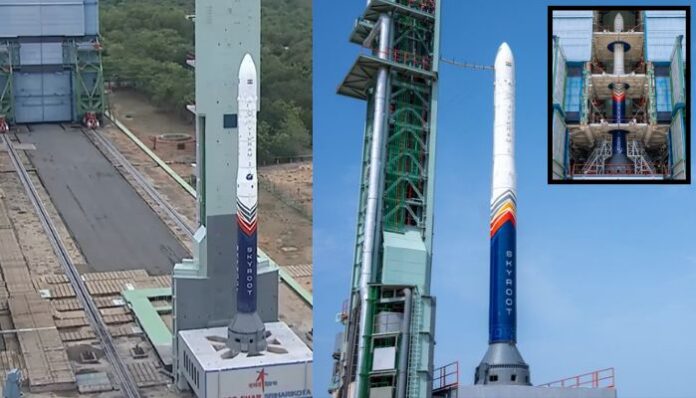
India’s rise as a global space power has largely been driven by the Indian Space Research Organisation (ISRO), whose achievements, from launching cost-effective satellites to successfully reaching the Moon, Mars and the Sun, have earned worldwide recognition. Now, the country’s private space sector has scripted a milestone of its own. On Saturday, 18th July, Hyderabad-based Skyroot Aerospace made the maiden orbital flight of Vikram-1, India’s first privately developed orbital launch vehicle, marking what could become a defining moment in the evolution of India’s commercial space ecosystem.
The four-stage launch vehicle lifted off at 11:30 am from the Satish Dhawan Space Centre in Sriharikota under Mission Aagaman. With the liftoff successful, Skyroot Aerospace has become the first Indian private company to place payloads into Low Earth Orbit (LEO) using a launch vehicle designed and built independently. The mission also represents a major milestone since the Centre opened India’s space sector to private participation in 2020.
We'll be going live for India's first private orbital launch. 🚀
— Skyroot Aerospace (@SkyrootA) July 18, 2026
Watch Vikram-1's Test Flight-1 — Mission Aagaman — live on YouTube today.
Set your reminder and fly with us. ▶️🔗https://t.co/xNes7DbvcM #Vikram1 #MissionAagaman #SkyrootAerospace #OpeningSpaceForAll pic.twitter.com/dp9ofq5uTc
Prime Minister Narendra Modi hailed the launch as “a historic new frontier for India’s space journey.” In a post on X, he wrote, “At 11:30 AM today, Skyroot Aerospace will undertake the maiden orbital launch of Vikram-1, India’s first privately developed launch vehicle. This four-stage rocket is designed to provide rapid and on-demand launch services.”
Vikram-1 Test Flight-1's journey from lift-off at the historic first launch pad in Sriharikota 🚀#Vikram1 #OpeningSpaceForAll #SkyrootAerospace pic.twitter.com/DNMOyrdLjF
— Skyroot Aerospace (@SkyrootA) July 18, 2026
Highlighting the significance of the mission, the Prime Minister said it showcased the talent and entrepreneurial spirit of India’s youth and reflected the success of India’s space sector reforms. “My best wishes to the entire Skyroot Aerospace team for a successful launch. May Vikram-1 soar high, create history and inspire a generation of innovators,” he added while urging citizens to follow the mission using the hashtag #IndiaWithVikram1.
A historic new frontier for India’s space journey!
— Narendra Modi (@narendramodi) July 18, 2026
At 11:30 AM today, Skyroot Aerospace will undertake the maiden orbital launch of Vikram-1, India’s first privately developed launch vehicle.
This four-stage rocket is designed to provide rapid and on-demand launch services.… pic.twitter.com/1qFVTwNOuZ
Former ISRO Chairman S. Somanath also congratulated the company, describing the mission as much more than a rocket launch. “This is far more than the maiden orbital flight of a rocket; it marks the arrival of India’s private rocket-building capability,” he said, calling it a landmark moment for the country’s growing commercial space industry.
Skyroot Aerospace: The startup aiming to become India’s ‘cab service to space’
Founded in 2018, Skyroot Aerospace has rapidly emerged as the face of India’s private space revolution. The Hyderabad-based company recently became India’s first space-tech unicorn after crossing a valuation of $1.1 billion, making it the country’s most valuable private space startup.
The company was established by Pawan Kumar Chandana and Naga Bharath Daka, both former ISRO engineers who left the national space agency with the vision of building India’s first private orbital launch vehicles. At a time when only government agencies were allowed to undertake space launches, the duo believed India possessed both the engineering talent and manufacturing ecosystem needed to compete globally in the small satellite launch market.
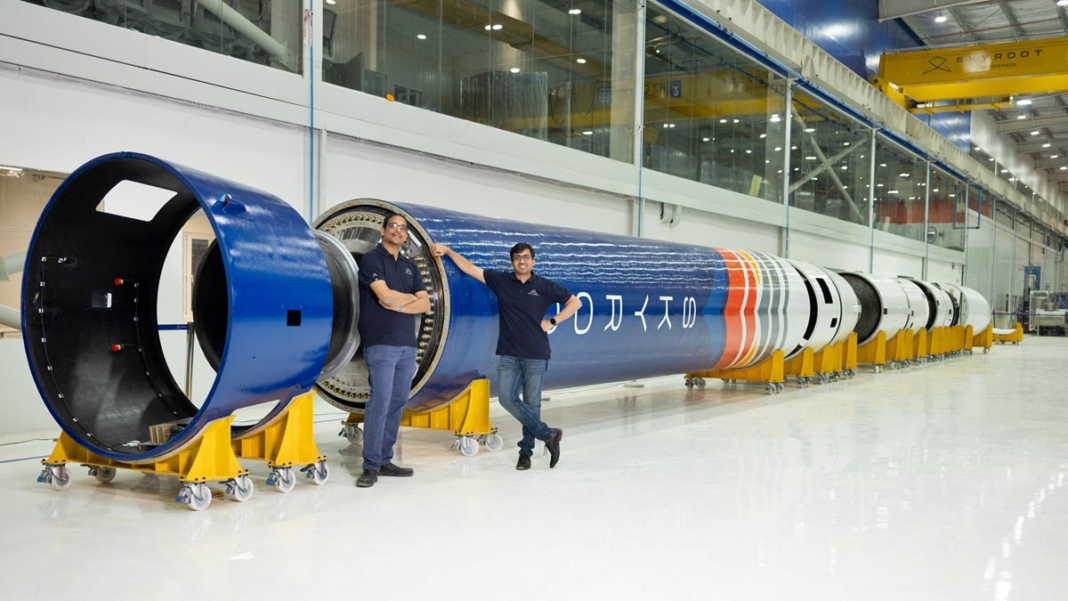
Skyroot’s larger vision goes beyond simply launching rockets. The company wants to offer dedicated launch services for small satellites, allowing customers to book missions based on their own timelines and orbital requirements rather than waiting months or years for a launch aboard larger launch vehicles.
Explaining the idea, co-founder and CEO Pawan Chandana compared the company’s business model to ride-hailing services.
“If you want to just go to a friend’s house, you don’t need a train; you book a cab, an Uber. What we are offering is a cab service to space, which can be used to ride to a unique location in orbit to place a satellite or visit a station,” Chandana toldthe BBC.
He noted that satellite operators today often face long waiting periods before securing launch opportunities, and Skyroot aims to reduce that bottleneck through dedicated, on-demand launch services.
From two ISRO engineers to India’s first space-tech unicorn
The story of Skyroot Aerospace began inside ISRO itself.
Both Chandana and Bharath Daka worked on India’s heavy-lift launch vehicle programme, which eventually evolved into the LVM3, the rocket that later carried the Chandrayaan-3 mission to the Moon.
While working on the programme, the two engineers closely followed developments in the global private space industry, particularly companies such as Rocket Lab, which demonstrated that private firms could successfully develop and operate orbital launch vehicles.
Inspired by these developments, the duo left ISRO in 2018 and founded Skyroot Aerospace with the goal of developing launch vehicles specifically designed for small satellite missions.
Their timing proved significant. In 2020, the Government of India announced sweeping reforms opening the country’s space sector to private companies, allowing them to build rockets and satellites while accessing ISRO’s launch infrastructure through the newly created regulatory framework.
The reforms triggered an explosion in India’s commercial space ecosystem. According to IN-SPACe, the number of Indian space startups has grown from fewer than half a dozen before the reforms to more than 400 startups today.
Skyroot was also the first private Indian company to launch a rocket when it successfully flew the Vikram-S suborbital launch vehicle in November 2022. The mission validated several indigenous technologies and laid the foundation for the company’s orbital launch ambitions.
Today, Skyroot operates from its massive Infinity Campus and Max-Q manufacturing facility in Hyderabad, where nearly 1,000 employees work across three shifts. The company aims to manufacture one rocket every month, with a long-term goal of integrating and preparing a launch vehicle for flight within 72 hours of demand.
Vikram-1: The rocket that created history
Named after Dr Vikram Sarabhai, regarded as the father of India’s space programme, Vikram-1 is a 24-metre-tall, four-stage launch vehicle built primarily using lightweight carbon-composite materials.
The rocket employs solid-fuel propulsion during its first three stages, followed by a liquid-fuel orbital adjustment module that enables precise satellite deployment. It is capable of placing payloads weighing up to 350 kilograms into a 450-kilometre Low Earth Orbit.
#WATCH | Andhra Pradesh: Visuals from the Satish Dhawan Space Centre in Sriharikota; India's first privately developed orbital-class rocket, Vikram-1, will be launched from here shortly
— ANI (@ANI) July 18, 2026
Built by Hyderabad-based Skyroot Aerospace, Vikram-1 is powered by three solid-fuel stages… pic.twitter.com/f0ch6KvahX
Mission Aagaman carried multiple technology demonstration payloads from Indian and international customers, including Grahaa Space, Cosmoserve, DCubed and Skyroot’s own SCOPE platform.
Among the most talked-about payloads are Bengaluru-based Cosmos Diamonds’ “Diamond Lotus”, a micro-art installation paying tribute to India’s creativity, and miniature sculptures honouring Dr Vikram Sarabhai, Dr A.P.J. Abdul Kalam and Nobel laureate Sir C.V. Raman.
The mission also carried a handwritten postcard by Prime Minister Narendra Modi bearing the message “Vande Mataram,” alongside handwritten notes from Indian scientists, engineers and astronauts.
Apart from demonstrating payload deployment, the mission will validate Vikram-1’s guidance, navigation and flight systems while generating engineering data that will help refine the rocket ahead of future commercial launches.
Looking beyond Mission Aagaman
For Skyroot Aerospace, Mission Aagaman represents only the beginning. The company plans to conduct another test flight before entering commercial operations, after which it intends to provide dedicated launch services for customers from India and abroad.
The startup is already developing Vikram-II, a more powerful launch vehicle capable of carrying heavier payloads into higher orbits. In the long run, the company also hopes to explore reusable launch vehicle technologies similar to those pioneered by companies such as SpaceX.
As India prepares for ambitious missions, including Gaganyaan, an Indian space station by 2035 and a crewed lunar mission by 2040, companies like Skyroot are expected to complement ISRO by handling a growing share of commercial satellite launches.
Whether Mission Aagaman achieves all of its objectives or not, Vikram-1 already represents a watershed moment for India’s private space industry. Seven years after two ISRO engineers left secure government careers to pursue an ambitious dream, Skyroot Aerospace now stands on the launchpad, ready to test whether India’s next great leap into space can come not only from a government agency but also from a homegrown private enterprise.


