

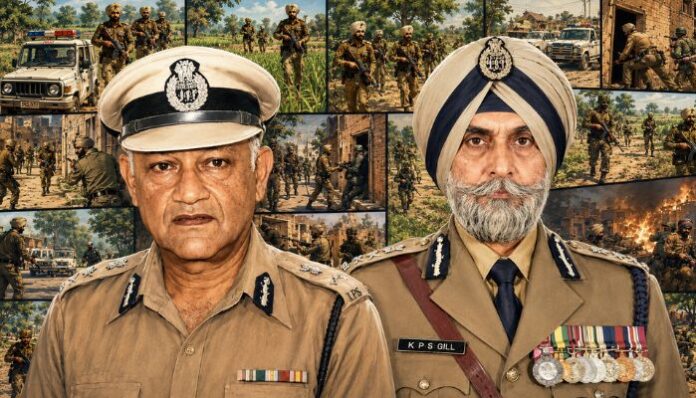
The Punjab Police that eventually dismantled organised Khalistani terrorism did not begin the insurgency as a dominant force. Terrorists assassinated officers, attacked police posts, killed suspected informers and operated across district boundaries using safe houses and automatic weapons. By the time Julio Ribeiro and later KPS Gill took command, conventional policing had become inadequate for an armed campaign that had weakened both state authority and local intelligence networks.
Ribeiro, who became Punjab Police chief in 1986, focused first on restoring morale and convincing personnel that the force would fight back. The phrase “bullet for bullet” became associated with him, although Ribeiro later said those were not his precise words. Police stations were fortified, weapons and vehicles improved, and commanders received greater operational freedom. Ribeiro himself narrowly survived a terrorist attack on the Punjab Armed Police headquarters in Jalandhar in October 1986.
Under Gill, the transformation became systematic. Punjab Police moved personnel away from static pickets towards mobile patrols, expanded from roughly 35,000 to around 60,000 personnel and increasingly relied on intelligence-led operations. “Focal point patrolling” and later “Operation Night Dominance” were designed to increase mobility, reclaim areas after dark and make it harder for terrorist groups to move, reorganise or intimidate villagers.
Local intelligence became the centre of the strategy. Punjab Police knew village geography, family networks, transport routes and local relationships in ways outside forces could not quickly replicate. Informers, spotters, surrendered cadres and joint interrogation teams helped identify commanders, couriers, safe houses and weapons routes. Intelligence was increasingly shared across districts and with agencies including the IB, R&AW, CBI and central security forces.
Gill’s model targeted not only individual gunmen but the ecosystem that allowed terrorist organisations to function: leadership, financiers, extortion networks, couriers, shelter providers and arms routes. Sustained pressure, factionalism, leadership losses, declining civilian cooperation with terrorists and the restoration of elections gradually produced what the article describes as organisational suffocation.
The campaign was effective in restoring state control, but its legacy remains contested. Allegations of torture, disappearances and staged encounters cannot be dismissed, and courts have convicted police personnel in specific cases. At the same time, those crimes do not establish that every encounter was fabricated. Punjab’s counterterrorism model emerged from an extraordinary security crisis, succeeded in destroying the organisational strength of Khalistani terrorism, and left behind difficult questions about effectiveness, legality and accountability.
Read the full article on Chapter One Magazine.


