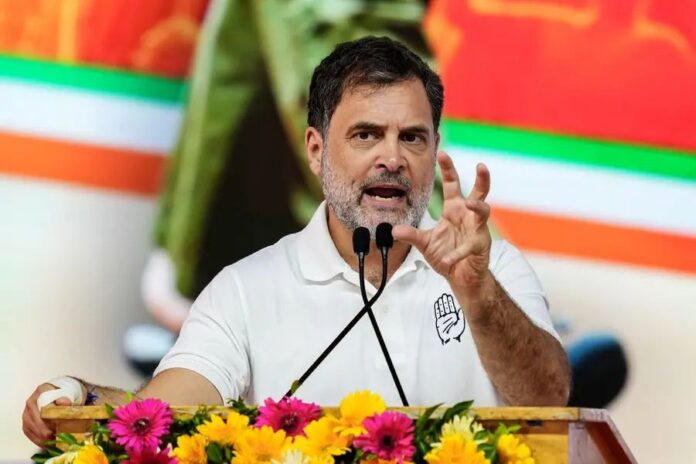
There is perhaps no better illustration of the Congress party’s politics than its newfound concern for students.
For weeks, Opposition leaders have been making dramatic speeches about students, examination irregularities, NEET paper leaks and alleged police action against protesters. Rahul Gandhi has demanded answers. Mallikarjun Kharge has demanded answers. Congress MPs have demanded answers. They have demanded the Home Minister’s presence in Parliament, demanded his resignation and repeatedly accused the government of being indifferent to the plight of students.
The rhetoric is loud. The outrage is theatrical.
The concern, however, appears to have a rather convenient expiry date.
Because when Parliament actually gets down to doing something about examination-related malpractice, the same Opposition that claims to be fighting for students suddenly discovers the exit door. Last month, Congress leaders staged a walkout during the passage of the paper leak Bill.
This is the fundamental problem with the Congress’ politics on student issues.
It does not appear to be interested in solving the problem as much as it is interested in owning the protest
Across the country, students are protesting against examination irregularities and administrative failures. What began with demonstrations in Delhi over the NEET paper leak has expanded into protests in other states, including Jharkhand and Kerala, as students and aspirants demand transparency, accountability and fairness in examinations.
These students have every reason to be angry.
For an aspirant, an examination is not merely a date printed on a calendar. It represents months and often years of preparation. Parents spend their savings. Students sacrifice social lives, employment opportunities and precious years of their youth. A paper leak or serious examination irregularity does not merely inconvenience them. It can destroy their plans.
The issue therefore deserves serious politics.
Unfortunately, serious politics is precisely what the Congress appears incapable of offering.
Instead, it has perfected a formula that can be described in four words:
Shooting and scooting.
Make an allegation.
Create a ruckus.
Demand a resignation.
Then run away when the other side starts answering.
On Monday, Union Parliamentary Affairs Minister Kiren Rijiju made the government’s position abundantly clear. He said the government was ready for a comprehensive discussion on the student movement and the issues surrounding the protests. He said Home Minister Amit Shah would make a statement and respond to the debate concerning the police action against protesters.
#WATCH | Delhi | Union Parliamentary Affairs Minister Kiren Rijiju says, "Rahul Gandhi had demanded that Home Minister Amit Shah make a statement in Parliament regarding the student protests. We have made it very clear that Home Minister Amit Shah will not only make a statement… pic.twitter.com/A0Ea7QANGd
— ANI (@ANI) August 10, 2026
The government, in other words, put the ball squarely in the Opposition’s court.
The Opposition had been demanding a discussion.
The government said: Fine. Let us discuss it.
One would imagine that this would be precisely what the Opposition wanted.
Apparently not.
Rijiju also warned that the Opposition should not disrupt proceedings, indulge in sloganeering and walk out after the government begins responding.
Why would he have to say that?
Because this is not a hypothetical concern. It is a pattern.
The Congress and its allies have repeatedly demonstrated that they are far more comfortable making allegations than listening to the answers to those allegations.
They want the Prime Minister to answer. They want the Home Minister to answer. They want the Education Minister to answer.
But when those ministers actually stand up to respond, suddenly Parliament becomes an unacceptable place for debate.
This is not parliamentary accountability.
Parliamentary heckling masquerading as accountability
And the Opposition’s conduct over the examination reform legislation exposes the contradiction even more brutally.
Parliament recently passed the Public Examinations (Prevention of Unfair Means) Amendment Bill, 2026. The legislation is aimed at strengthening the framework against examination malpractice and addressing organised unfair means that threaten the credibility of public examinations.
Now, there can certainly be legitimate criticism of the Bill.
The Opposition could have argued that the provisions are inadequate.
It could have demanded stronger safeguards.
It could have proposed amendments.
It could have questioned the government’s implementation record.
It could have voted against the legislation.
That is what a parliamentary Opposition is supposed to do.
Instead, Opposition MPs walked out.
Read that again.
The same Opposition that spends days telling the country that students are suffering because of examination malpractice walked out when Parliament was debating legislation dealing with examination malpractice.
You couldn’t write a more perfect parody of Congress politics if you tried.
Outside Parliament:
“Save the students!”
Inside Parliament when a law addressing examination malpractice is debated:
Walk out.
Outside Parliament:
“Why isn’t the government answering?”
Inside Parliament when the government is ready to answer:
Create a ruckus.
Outside Parliament:
“We want accountability!”
Inside Parliament:
Demand resignation and leave.
This is not concern for students.
This is concern for the next political headline.
And the Congress’ problem is not merely that it walks out. The deeper problem is that it has conditioned itself to view every public grievance primarily through the prism of electoral politics.
Students are useful when they can be converted into an anti-government spectacle. Their grievances become useful when they can be turned into a slogan. Their protests become useful when cameras are present.
But the moment the discussion moves towards legislation, institutional reform, examination architecture, enforcement mechanisms and actual governance, the political glamour disappears.
And so does the Congress.
This is precisely why the Congress’ outrage over the July 20 protest crackdown deserves scrutiny.
If there was excessive force against students, it must be investigated. But their conspicuous silence on the disproportionate force against peaceful students protesting in Jharkhand reveals their concern for students is limited to political convenience. The moment their government or alliance is in the state, Congress suddenly forgets raising issues of student concern and the use of “force” against students.
If police personnel acted unlawfully, they must be held accountable.
If students were mistreated, the government must answer.
There should be no ambiguity about that. But there shouldn’t be any hypocrisy about that as well.
However, there is an equally important question: Why does Congress believe that the only possible response is disruption and resignation demands?
The government has said the Home Minister is ready to make a statement.
Then let him speak.
Let the Opposition speak. Let the evidence be placed on the table. Let the allegations be answered. Let the public decide.
That is how parliamentary democracy is supposed to work.
But that would deprive the Opposition of something far more valuable than an answer: the outrage itself.
Because once the government answers, the political campaign has to confront facts.
And facts are inconvenient for politics built around perpetual outrage.
We have seen this movie before.
Rahul Gandhi and the Opposition have made explosive allegations in Parliament, only to become noticeably less enthusiastic when the government actually begins responding. The “vote chori” episode was another example of this politics of allegation followed by avoidance.
The Opposition wants its allegations to become headlines.
It does not always appear equally interested in allowing the government’s rebuttal to become one.
That is the essence of “shooting and scooting”.
And there is another standard that Congress needs to answer for.
If the party genuinely believes that ministers responsible for examination controversies must resign, then surely that principle cannot change depending on whether the minister belongs to the BJP or Congress.
But when controversies emerge under Congress governments, the vocabulary mysteriously changes.
Suddenly, there must be an inquiry. Suddenly, we must wait for facts. Suddenly, institutional processes must be respected. Suddenly, resignation is not the answer.
But when the same allegation is directed at the Centre, resignation becomes the first and last sentence in the Congress’ press release.
Students deserve consistency.
They deserve politicians who will demand accountability whether the government in question is run by the BJP, Congress or any of its allies.
Because a leaked paper does not ask the student whether the government responsible is saffron, green, red or blue.
A corrupt examination system does not care about the ideology of the ruling party.
An aspirant who loses a year because of an examination scandal does not get that year back because Rahul Gandhi held a press conference.
This is why reducing the student movement to another Congress-versus-BJP political battle is itself an insult to the students.
They are asking for something much more basic.
A fair examination.
A transparent process.
Competent examination agencies.
Accountability for leaks.
Punishment for those who cheat the system.
And assurance that honest students will not be punished for somebody else’s criminality or administrative incompetence.
That requires institutional reform. It requires laws. It requires enforcement. It requires governments to be held accountable.
And, yes, it requires an Opposition that does more than shout.
But that last requirement may be the most difficult one for Congress.
Because Congress has increasingly turned politics into a performance in which the volume of the accusation matters more than the seriousness of the solution.
Look at the larger pattern.
Every social group is turned into a political constituency.
Farmers.
Women.
Minorities.
Backward classes.
Dalits.
Youth.
Students.
Congress presents itself as the protector of whichever group happens to be politically useful at a particular moment.
Before the 2024 elections, Rahul Gandhi’s “Jiski Jitni Aabadi, Uska Utna Haq” slogan was presented as a political revolution for marginalised communities.
Now students are being presented as another constituency whose grievances can be weaponised against the Modi government.
But students are not pawns on a political chessboard. They are not Congress’ next votebank.
And their future cannot be reduced to a press conference outside Parliament.
If Congress really cares about students, it should stop asking them to become props in its political battles and start treating them as citizens whose problems require serious institutional solutions.
If Congress believes the government’s examination reforms are inadequate, attend the Parliament and debate with the Centre.
If it believes the government is wrong, vote against the Bill.
If it believes the Home Minister is responsible, listen to his statement and dismantle his arguments.
If it believes the police used excessive force, produce the evidence and demand accountability.
If it believes examination agencies are failing, propose a better architecture.
And if a Congress-ruled state faces an examination scandal, apply exactly the same standards there.
That would be an Opposition doing its job.
What Congress is doing instead is much easier.
Stand with protesters.
Give fiery speeches.
Demand resignations.
Slogan-shout in Parliament.
Walk out.
Hold another press conference.
Repeat.
It is activism as theatre and opposition as content creation.
The students protesting across India deserve better.
They deserve politicians who will fight for them when the cameras are switched off.
They deserve Parliamentarians who will stay inside the House when the legislation is being debated.
They deserve an Opposition that is prepared to hear answers to the questions it asks.
And most importantly, they deserve a political class that understands one simple truth:
A student’s ruined career cannot be repaired by a hashtag or selective outrage
Congress can continue using students as political ammunition. It can continue demanding resignations before investigations are complete. It can continue walking out when uncomfortable answers begin.
But sooner or later, students themselves will ask the question that Congress desperately wants to avoid:
If you were really fighting for us, why did you walk away when it was time to actually do something for us?
That is a question Rahul Gandhi and the Congress cannot answer by shouting louder.
They will have to stay in the room.