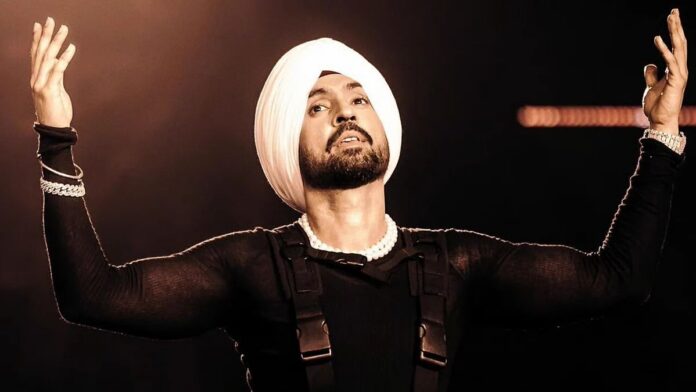
On Sunday night in Indore, Diljit Dosanjh did what celebrities increasingly do when confronted with accountability: turned a perfectly specific question into a sweeping sermon about freedom, identity, and the nation.
Four songs were restricted from his concert because authorities objected to lyrics glorifying alcohol, drugs and firearms. The concert itself was never banned. He was allowed to perform, thousands turned up, and the show went ahead.
Yet Dosanjh chose to make it sound as though someone had attempted to deny him entry into his own country.
Taking the stage, he invoked the late poet Rahat Indori and recited the now-famous couplet:
“Sabhi ka khoon hai shamil yahan ki mitti mein, kisi ke baap ka Hindustan thodi hai.” Diljit subsequently took to his Instagram to share the incident on social media.
A stirring couplet, no doubt. But what exactly was the occasion for this display of indignation?
Nobody had claimed that Hindustan belonged to anyone’s father. Nobody had cancelled his concert. The authorities had simply asked him to refrain from performing four specific songs.
Apparently, even that was too much to tolerate.
Four songs were restricted. The concert was never stopped.
On November 6, the Indore District Child Protection Officer directed the organisers to ensure that four songs were not included in Dosanjh’s setlist: Patiala Peg, 5 Taara Theeke, Jeeb Vicho Feem Labbiya (also known as Case) and Jatt Uthe Fire Karda Jithe Paabandi Hathiyara Di.
The objection was hardly difficult to understand. The songs contain references to alcohol, opium and firearms. The directive followed a complaint by Chandigarh-based professor Dr Panditrao Dharenavar and was rooted in concerns about children being exposed to content that glorifies intoxicants and violence.
This was not some arbitrary attempt to muzzle a Punjabi singer. It was a child-protection intervention.
The Punjab and Haryana High Court had already taken cognisance of the glorification of liquor, drugs and violence in songs back in 2019. It had directed police authorities in Punjab, Haryana and Chandigarh to ensure that songs glorifying these themes were not played at public events, including live performances.
The concern is particularly relevant when one considers Punjab’s long-running drug crisis. A 2015 AIIMS-led survey estimated that approximately 2.32 lakh people in Punjab were dependent on opioids.
In such circumstances, questioning the glorification of intoxicants in popular music is hardly an outrageous proposition.
But Dosanjh apparently believes that artistic freedom also means freedom from inconvenient questions.
The selective outrage over Hindustan
There is something particularly revealing about Dosanjh’s decision to invoke Rahat Indori’s couplet.
The poet was speaking about a shared nation, a country that belongs to everyone and cannot be claimed as private property. Dosanjh, however, deployed those words to manufacture a confrontation where none existed.
If Hindustan does not belong to anyone’s father, neither does it belong to a celebrity who believes his fame should place him above scrutiny.
The rules governing public performances do not become oppression simply because they inconvenience a superstar.
And this is where Dosanjh’s conduct becomes particularly interesting.
In April 2026, during his appearance on The Tonight Show Starring Jimmy Fallon, Dosanjh spoke about his signature slogans, including “Main hoon Punjab” and “Punjabi aa gaye”.
There is absolutely nothing wrong with taking pride in one’s Punjabi identity. Punjab’s culture, language and heritage deserve to be celebrated.
But when a public figure repeatedly foregrounds regional identity on international platforms while leaving the larger national identity conspicuously unmentioned, questions about the messaging are legitimate.
The contrast becomes even more striking when the same celebrity suddenly discovers the need to invoke Hindustan when a child-protection authority asks him not to perform four songs.
At home, Hindustan becomes a convenient shield against criticism. On an international stage, Punjab becomes the headline.
That is a rather convenient arrangement.
This is not the first time authorities have objected to his songs
The Indore episode did not emerge out of thin air.
In November 2024, ahead of his Hyderabad concert, authorities in Telangana issued a similar notice asking Dosanjh not to perform songs glorifying alcohol, drugs and violence. The notice also cautioned against involving children in performances featuring such content.
The same songs, the same objections and, now, another controversy.
Even after his December 2024 concert in Ludhiana, professor Dharenavar approached the Punjab and Haryana High Court, alleging that Dosanjh had performed songs in violation of its 2019 directions. The court issued notices on the contempt petition in January 2025. The issuance of notices should not be mistaken for a finding of guilt, but the episode demonstrates that these concerns have been raised repeatedly.
Dosanjh cannot keep treating every instance of scrutiny as a conspiracy against him.
Celebrity status does not place anyone above accountability
Nobody is asking Diljit Dosanjh to stop singing Punjabi music. Nobody is questioning his right to celebrate his culture or perform before packed stadiums.
The question is much simpler: why is it so difficult to accept a restriction on songs that glorify drugs, alcohol and firearms, particularly when children are part of the audience?
A celebrity with millions of followers has considerable cultural influence. With that influence comes the responsibility to recognise that entertainment does not exist in a vacuum.
He could have acknowledged the restriction, performed the rest of his repertoire and allowed the music to speak for itself.
Instead, he chose to turn a limited administrative directive into a grand political spectacle, complete with patriotic poetry and a defiant message about being stopped.
The irony is that the concert went ahead. The audience got its show. The only thing Dosanjh apparently could not do was accept that four songs were off limits.
There is a difference between artistic freedom and the entitlement to disregard every objection raised in the public interest.
And reciting Rahat Indori does not erase that difference.
Hindustan belongs to everyone. So do the laws and rules that govern it. A superstar’s ticket sales do not entitle him to a different set of rules.
Diljit Dosanjh seems to perpetually live in outrage mode, mistaking every instance of scrutiny for an attack on his freedom. Perhaps the adulation of thousands screaming his name at concerts gets to his head, making him believe that glorifying alcohol, drugs and firearms can be brushed aside with a few dramatic couplets and patriotic rhetoric. Celebrity status may give him a stage, but it does not place him above accountability.