

Russia is stepping up its defence push towards India, with the S-500 Prometheus air defence system and the Su-57 fifth-generation fighter at the centre of its latest offer. The move comes as India faces two major challenges: strengthening its air defence network and addressing the shortage of fighter aircraft in the Indian Air Force (IAF).
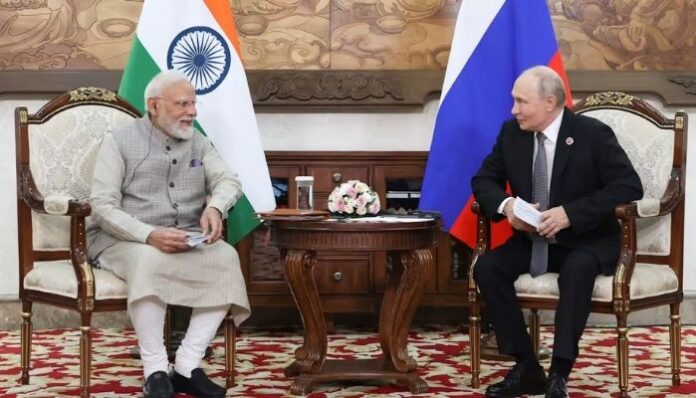
The renewed Russian pitch comes amid a fresh meeting between Prime Minister Narendra Modi and Russian President Vladimir Putin in Bishkek on Monday, 31st August, with the two leaders also expected to meet again in New Delhi. NDTV’s Shiv Aroor contends that, for Moscow, the discussions are an opportunity to build on decades of defence cooperation, even as India increasingly looks towards other suppliers and its own defence industry.
S-500 Prometheus
— Shiv Aroor (@ShivAroor) August 31, 2026
Su-57 Felon
Can confirm that Team Putin is pushing 2 big weapon packages as prestige projects to take India-Russia defence ties to the next level.
(Personal view: It would be a shame if either of them comes to fruition.) pic.twitter.com/Pvj5yYxCVy
Russia pushes S-500 after S-400 success
The S-500 Prometheus is being presented by Russia as the next major step in its air and missile defence cooperation with India. Moscow’s pitch comes after the S-400 systems already inducted by India gained significant attention during Operation Sindoor last year.
India deployed its Russian-made S-400 systems against Pakistani aerial threats during the operation. An S-400 system was also reported to have brought down a Pakistani airborne early warning and control aircraft from a very long range, further strengthening the system’s reputation within the Indian military.
Russia appears keen to build on that experience. Just a day before the Modi-Putin meeting in Bishkek, Moscow reportedly submitted a proposal to supply India with five additional S-400 squadrons. If accepted, the deal could potentially double the number of squadrons already contracted.
However, the S-500 proposal is not a straightforward decision for India. New Delhi is already working on its own long-range air defence capabilities. Project Kusha is being developed as an indigenous system in the S-400 class, while India’s ballistic missile defence programme is also at an advanced stage.
This means India will have to examine whether the S-500 would fill an actual capability gap or simply overlap with systems that the country is already developing. Any purchase would also have to be considered in the context of India’s growing push for defence self-reliance.
Su-57 offer comes amid IAF fighter shortage
The second offer from Moscow is even more complicated for India. Russia’s second offer is the Su-57 Felon, its fifth-generation stealth fighter. The proposal comes at a time when the IAF is struggling with a shortage of fighter squadrons and India’s indigenous Advanced Medium Combat Aircraft (AMCA) is still years away from becoming operational.
Russia has indicated that technology transfer, greater localisation and even production in India could be part of a potential Su-57 arrangement. The IAF has also considered the Russian offer, with the aircraft being viewed as a possible “stopgap” until the AMCA becomes available.
That, however, highlights the difficult choice facing India. If New Delhi waits for the AMCA, the IAF could be left without an indigenous fifth-generation fighter for several years. But importing the Su-57 would bring its own financial, logistical and strategic complications.
The urgency has increased because India’s neighbours are also moving ahead with stealth aircraft. China is believed to have more than 500 J-20 fighters, while Pakistan is expected to receive Chinese J-35 fifth-generation fighters. This leaves India facing a difficult question: should it wait for the AMCA or acquire a foreign stealth fighter as an interim solution?
Another fighter type could add to IAF’s burden
Introducing the Su-57 would also add another aircraft type to an already diverse IAF fleet. India’s frontline fighter inventory includes the Russian Su-30MKI and MiG-29, French Rafale and Mirage 2000, Anglo-French Jaguar and indigenous Tejas.
Every new aircraft comes with its own requirements for pilot training, maintenance, spare parts, weapons, infrastructure and logistics. The Su-57 could therefore increase the complexity of fleet management at a time when the IAF is already trying to simplify and modernise its combat aircraft inventory.
There is also an uncomfortable history behind Russia’s current offer. India and Russia had earlier worked on the Fifth Generation Fighter Aircraft (FGFA) programme, which was intended to develop an Indian version of the aircraft that eventually became the Su-57. The project was eventually abandoned.
Russia is nevertheless offering India a wider package of defence cooperation. This includes the Voronezh strategic early-warning radar, which is designed to detect ballistic missile launches and other threats over very long distances. Moscow is also looking at upgrades for India’s large fleet of Su-30MKIs in cooperation with Hindustan Aeronautics Limited (HAL), along with modernisation of India’s Russian-origin Kilo-class submarines.
Russia faces growing competition in India
Moscow’s renewed push comes as India has spent years deliberately reducing its dependence on a single defence supplier. The country is increasingly buying military equipment from the United States, France, Israel and other partners while also investing heavily in domestic production.
The recent move towards procuring American Javelin anti-tank guided missiles, following a process that has lasted around 16 years, is one example. India is also moving towards a major additional purchase of 114 Rafale fighters from France.
At the same time, India’s own defence industry is becoming a stronger competitor. Programmes such as Tejas, AMCA, Project Kusha and the indigenous ballistic missile defence system reflect New Delhi’s long-term effort to build critical military capabilities domestically.
Still, Russia has one major advantage that newer suppliers cannot easily match. Decades of military cooperation have left Russian-origin equipment deeply embedded in India’s armed forces. Russian fighters, tanks, submarines, helicopters, missiles and air defence systems continue to form a significant part of India’s military inventory. Their maintenance, upgrades and eventual replacement will continue to create opportunities for Moscow.
The final decisions on systems such as the S-500 or Su-57 will not be made personally by PM Modi and Putin. However, political direction from the two leaders has historically helped push major India-Russia defence projects forward.
The latest Modi-Putin engagement is therefore about more than the familiar display of close ties between the two countries. Russia is trying to retain its position in India’s changing defence landscape at a time when Western suppliers and India’s own defence industry are competing for a larger share.
For India, meanwhile, the choices are becoming increasingly difficult. It must decide how much more foreign air defence capability is required when indigenous systems are moving closer to deployment. At the same time, the IAF must determine whether it can afford to wait for the AMCA while China and Pakistan rapidly expand their fifth-generation fighter capabilities.


