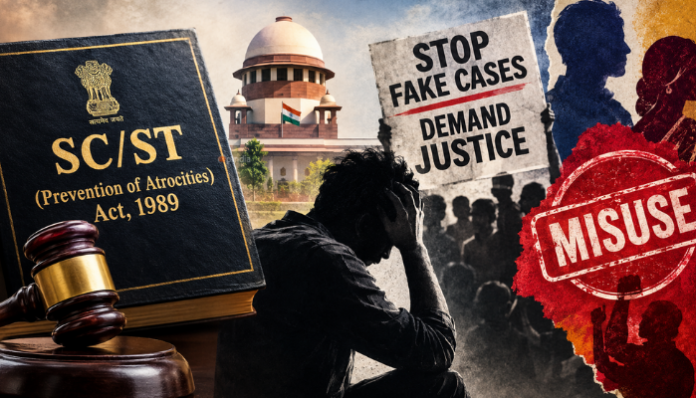
When laws encourage lawlessness and are turned into a means of destroying innocent lives and financial greed, they deserve serious scrutiny. In recent years, a debate has been going on over the gross misuse of the Scheduled Castes and Scheduled Tribes Prevention of Atrocities Act or the SC/ST Act of 1989. From ordinary citizens to the courts, concerns have been raised about fake SC/ST Act cases used to falsely implicate individuals belonging to the general and OBC categories for vengeance and to obtain financial compensation, diluting the law’s credibility.
The SC/ST Act was claimed to have been enacted to provide stronger protection against caste-based violence and discrimination. The law lists various offences relating to various patterns or behaviours inflicting criminal offences and breaking the self-respect and esteem of the Scheduled Castes and Scheduled Tribes community, which includes denial of economic, democratic, and social rights, discrimination, exploitation, and abuse of the legal process.
Under Section 18 of this Act, provision for anticipatory bail is not available to the offenders. Any public servant who deliberately neglects his duties under this Act is liable to punishment with imprisonment for up to 6 months. An amendment was added to the original Act in 2015 to make the Act more stringent by adding more instances of “atrocities” as crimes against SCs and STs.
However, over the years, a pattern of the weaponisation and misuse of the SC/ST Act has emerged. Those eligible to invoke the SC/ST Act are misusing the law in cases of personal disputes, property matters, or for financial compensation.
When the Supreme Court acknowledged the possibility of the misuse of the SC/ST Act
A major Supreme Court observation in this regard came in the 2018 Dr Subhash Kashinath Mahajan v. State of Maharashtra case, in which the court noted the possibility of the SC/ST Act being used for “extraneous considerations”.
The Supreme Court had ruled that additional safeguards must be provided to civil servants before arresting them under the SC/ST Act. The Court stated that the approval of an appointing authority or an S.S.P is required before arresting a public servant accused under the Act.
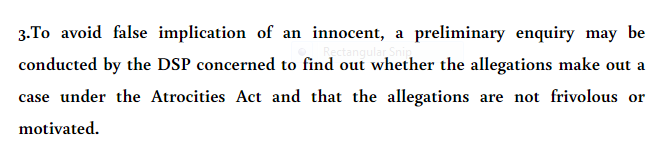
Those opposed to any scrutiny of the SC/ST Act also mentioned that to avoid false implications, a preliminary enquiry by the DSP must be conducted to find out whether the charges are correct and not frivolous.
The Central government had moved a review petition before the Supreme Court for this ruling. However, the court rejected the petition, stating that its judgment is not in conflict with the SC/ST Act and does not dilute it in any way. Rather, the ruling only flagged the issue: “Can the liberty of an innocent be taken away without application of mind? We only said protect an innocent from being falsely implicated under the Act, which has stringent provisions. People agitating may not have read the judgment. They may have been misled.”
Following the original court ruling, widespread violence erupted across several states after Dalit groups called for a Bharat Bandh.
Months later, in August 2018, the Modi government passed the bill to reverse the Supreme Court’s order. Later, in October 2019, the Supreme Court restored the original provisions of the SC/ST Act, stating that the previous order had strayed into the legislative domain.
The NCRB conundrum
The vote bank politics and street veto prevented the SC/ST Act from undergoing the much-needed reforms. As the SC/ST Act achieved a reservation-like sacrosanctity, there has been a dramatic surge in the filing of SC/ST Act cases, as per the National Crime Records Bureau of India (NCRB) data.
The NCRB’s “Crime in India” reports show FIRs registered under the SC/ST Act or related BNS sections when the Act is invoked. The NCRB data does not, at the point of registration, distinguish between incidents that courts later treat as genuine caste-motivated atrocities and those arising from ordinary quarrels devoid of any caste angle, land disputes, or other vengeful motives.
The subsequent police disposal tables, however, do classify outcomes, some as “final report false”, “mistake of fact or of law”, or “true but insufficient evidence”.
However, treating every crime registered against SC/ST individuals as ‘atrocity’ is wrong and misleading, since the data does not specifically distinguish between which FIRs reflect genuine caste-based crimes and which reflect agenda-driven fake cases.
Simply put, the NCRB data reflects any case registered under the SC/ST Act, rather than independently verifying or filtering whether each case involved a proven, direct caste-based motivation. The NCRB simply records or compiles the data it receives from various state and UT police departments. It does not audit or probe or in any way re-evaluate the foundational intent of an FIR before publishing numbers.
As per a written reply in Parliament by the Minister of State for Social Justice & Empowerment, Ramdas Athawale, cases registered under the SC/ST Act stood at 45,995 in 2020, of which 36,178 were chargesheeted, 17,113 remained under investigation at the year-end, and 2,613 ended in conviction. Similarly, a total of 61,925 persons were arrested that year, 75,238 were chargesheeted, and 4,855 were convicted, while 177,379 cases remained pending trial at year-end.
Meanwhile, in 2021, cases filed under the SC/ST Act stood at around 45,800 to 46,100, with 37,123 chargesheeted and about 16,300 to 16,400 pending investigation. The convictions increased to 2,848, with arrests totalling roughly 58,700 to 58,800, and around 74,000 to 74,100 persons were chargesheeted. The pending trials surged further to around 2,05,800 to 2,06,000, and 5,141 persons were convicted.
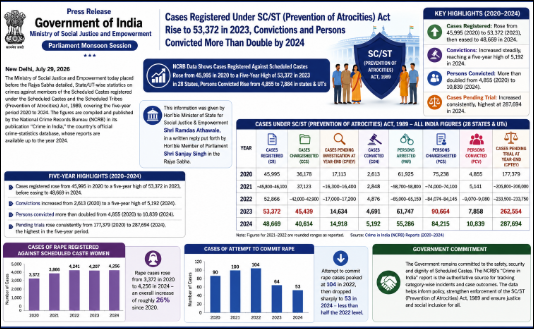
In 2022, SC/ST Act case registrations increased dramatically to 52,866 cases, with roughly 42,000 to 42,900 chargesheeted and about 17,000 to 17,200 cases pending investigation. The convictions doubled from the previous year to 4,876. The arrests numbered around 65,000 to 65,150, persons chargesheeted numbered between 84,074 and 84,145, and persons convicted rose sharply to roughly 9,070 to 9,080. The cases pending trial rose to between 233,500 and 233,750.
The year 2023 witnessed a five-year high with registration of 53,372 SC/ST Act cases, of which 45,439 were chargesheeted, 14,634 were pending investigation, and convictions stood at 4,691. Total arrests stood at 61,747. In 2024, cases came down to 48, 669, though convictions rose to 5,192.
Between 2018 and 2022, conviction and charge-sheeting rates have remained low despite a rise in case numbers, with conviction rates falling from 39-40% in 2020 to 32-33% in 2022. In addition, 60% of cases registered under the SC/ST Act ended in acquittal or discharge.
Between the years 2019 and 2023, while total reported atrocities against Scheduled Castes surged to a five-year peak of 53,372 cases in 2023, around 14% to 15% of all disposed cases annually were essentially concluded without reaching trial under these final closure report grounds.
In 2020, the Rajasthan Police declared that more than 40% of cases filed under the SC/ST Act were fake.
The majority-acquittal outcome across the board indicates that a significant share of cases registered under the SC/ST Act were never caste-based atrocities to begin with.
While in some cases it may be true that there was a shoddy investigation or perhaps a cover-up to save the perpetrators, or witnesses turn hostile after out-of-court ‘settlement’, the consistently low conviction rates and high final report closures indicate a systemic misuse and weaponisation of a law meant for protection from caste-based atrocities, for caste-based vengeance and financial gains.
Major cases wherein the court found blatant misuse of the SC/ST Act provisions
In the wake of the rampant weaponisation of the SC/ST Act, people belonging to the general and the OBC category have begun fearing any legitimate public criticism of topics ‘sensitive’ to the SC or ST community, be it caste-based reservations, reforms in reservations, Dr BR Ambedkar or the blatant Hinduphobia displayed by a section of ‘Ambedkarites’.
There have also been incidents wherein individuals were threatened with fake SC/ST Act cases out of sheer hatred for the general category individuals, for coercing others into favourable land dispute settlements or for compensation.
In 2020, people in a village in the Firozabad district in Uttar Pradesh fled the village due to fake cases registered against them under the SC/ST Act. Reports said that residents of Gothua village had sold their homes and moved to other places due to harassment from fake cases. Villagers have written on the outside walls and doors of their houses that they will be sold.
BJP leader who was killed over a petty dispute was falsely implicated under the SC/ST Act
In March 2021, Dhirendra Bahadur Singh, a 52-year-old booth president of the Bharatiya Janata Party, was found brutally killed in Pithapur Malak village in the Pratapgarh district in Uttar Pradesh. It was alleged that the murder was a fallout of a dispute between two parties over sugarcane. Singh had intervened in the dispute between two people over cutting sugarcane from a field without permission.
While the issue seemed to have been resolved, Dhirendra was later beaten to death by two brothers, Ranjeet and Vipin Saroj, of the nearby Hatsara Mangapur village after he tried to intervene in their fight. Dhirendra Singh’s killers have previously tried to implicate Singh in a false SC/ST case. It was reported that locals alleged that the accused often misused the Act to threaten the people of the village.
Woman abused and molested, threatened with fake case under the Act when she resisted
In late March 2021, Narendra Kumar Nirmal, a teacher belonging to the SC/ST community, was accused of threatening a woman with a fake case under the Act if she resisted molestation. The incident happened in Samaspur Salwara village, falling under the Manikpur police station area of Pratapgarh, Uttar Pradesh.
Maratha girl falsely booked under the SC/ST Act for opposing the vandalism of a Hindu temple
In March 2021, it was reported from Maharashtra that a young Maratha girl was molested, brutally beaten up and booked under the SC/ST Act for opposing the vandalism of a Hindu temple. A mob of 15-20 people had reportedly attacked her genitals and other sensitive body parts with stones.
The victim’s family had alleged that some Dalit locals in the village tried to demolish their Hindu temple, in a bid to build an Ambedkarite temple. The victim had resisted these attempts. The Maratha girl was beaten, flogged, her genitals were mutilated, and she was also booked under the SC/ST Act.
Brahmin man Vishnu Tiwari wrongfully imprisoned for 20 years on false charges of rape and SC/ST Act
In February 2021, a Brahmin man named Vishnu Tiwari was set free by the Allahabad High Court after he spent 20 years in jail on false charges of rape and the SC/ST Act.
Tiwari, a resident of Lalitpur village, was booked on charges of rape, sexual exploitation, and criminal intimidation under the Indian Penal Code (IPC) and other sections of the SC/ST (Prevention of Atrocities) Act, when a woman from Silawan village, which is 30 km away from his place, accused him of raping her. He was held guilty by a trial court and sentenced to life imprisonment at the age of 23 in the year 2000. In the 20 years he spent in jail, Tiwari lost all his family members.
The Court’s acquittal was based on the medical examination report, which said that no sperm or injuries were found on the prosecutrix, who was five months pregnant at the time. Her testimony also indicated that she was not a ‘stellar witness’.
Professional disagreement, workplace grievances can’t be automatically charged under SC ST Act, unless specific casteist abuse in public: Calcutta HC
In February 2026, the Calcutta High Court stated in an order that all kinds of professional disagreements, administrative disputes or instances of facing workplace humiliation cannot automatically attract offences under the SC ST (Prevention of Atrocities) Act, unless there is clear caste-based insult or abuse in public view.
The HC quashed proceedings against a Sanskrit professor under the SC ST Act, saying that though the complainant belongs to the SC community, the incident of altercation and insult cannot be called a caste-based atrocity and does not come under Section 3 (1)(r) of the Act.
The professor has a PhD in Sanskrit and had served as Head of the Department of Sanskrit at Sanskrit College & University. She was accused by an assistant professor of the same university, who belongs to the SC community, of professional jealousy and harassment.
The complainant had alleged that the accused had excluded him from departmental decisions, stopped his classes, obstructed him from performing his departmental duties and insulted him during an online meeting using objectionable language. He had alleged that the HOD’s behaviour was motivated by his caste identity. The court, however, found no substance in this claim, and thus set aside the charges under SC -ST Act.
A woman filed three SC/ST cases for vengeance against Mumbai professor for questioning reservation eligibility
In March 2026, the Bombay High Court quashed a 16-year-old case against advocate and law professor Virendranath B. Tiwari, who was booked under the provisions of the SC/ST Act. The complainant named Chitra Shalunkhe had three cases against Tiwari.
In all three cases, the complainant invoked provisions of the SC/ST Act, each stemming from broadly similar allegations. In the earlier two instances, Tiwari had already been acquitted or discharged. Yet, an FIR was registered once again, this time over a 2007 incident where Shalunkhe alleged that Tiwari questioned her academic qualifications and credentials for a reserved post and assaulted her.
The court, however, found no caste-based offence, and Justice Bhobe noted that initiating proceedings “for the third time” on similar grounds appeared to be “an act of vengeance aimed at causing harassment and humiliation” to the accused, a 74-year-old senior citizen.
Woman misused SC/ST Act and filed fake rape case against ex-boyfriend
In November 2025, an SC/ST Special Court sentenced a woman named Rinki to three and a half years of imprisonment, along with a fine of Rs 30,000. The court mandated that any assistance she obtained from the state government must be returned. This came after the convict lodged a false rape and SC/ST case against her former boyfriend as an act of revenge. Special Judge Vivekananda Sharan Tripathi pronounced the verdict.
A family in Aligarh extorted Rs 46 lakhs by misusing the SC-ST Act and had filed 15 fake cases in 10 years for compensation
In a classic case of how the SC/ST Act is misused, a woman named Chandrawati Devi, a resident of Hastpur village, and her allegedly misused government schemes meant for Scheduled Castes (SC) and fraudulently pocketed around ₹46 lakh.
It was reported that in the last 10 years, 15 different cases have been registered against Chandrawati Devi and her family. Many of these cases were filed under the SC/ST (Prevention of Atrocities) Act, 1989.
Under this law, victims are provided financial assistance and legal protection. The allegation is that Chandrawati and her family repeatedly filed false cases to avail the benefits of these schemes and have so far received nearly ₹46 lakh.
Allahabad University assistant professor lodged fake SC/ST Act cases against three senior colleagues
In February 2024, the Allahabad High Court quashed a 2016 FIR registered on the complaint of an Allahabad University assistant professor, and imposed a fine of ₹15 lakh on her.
The complainant was found to have falsely accused her colleagues of various offences, including voyeurism and criminal intimidation. She had also made allegations of offences under the Scheduled Castes and Scheduled Tribes (Prevention of Atrocities) Act.
While quashing the FIR, Justice Prashant Kumar said, “This is a case where a Professor had to pay a very heavy price for asking an Assistant Professor to take classes and teach properly. He was made an accused in a frivolous and malicious criminal case and had to face trial for last eight years, and further had to face humiliation, stigma, for no fault of his own, and on the other hand, the complainant, by misusing the provisions of Scheduled Castes and the Scheduled Tribes (Prevention of Atrocities) Act, 1989 (hereinafter referred as ‘the S.C./S.T. Act’), had been using as a weapon and threatened the other seniors from taking any action against her.”
Dalit woman falsely implicated general category lover in SC/ST Act case
In June 2025, a 22-year-old Dalit woman named Rinki filed a complaint at Mohanlalganj in Uttar Pradesh, alleging that a man named Deepak, from the general category, raped her on the pretext of marriage. Deepak, who was in a relationship with the complainant for five years, was then booked under the provisions of the SC/ST Act along with rape charges. Rinki filed a fake rape and caste atrocity case against Deepak after the latter married someone else.
Karnataka HC quashed it after it turned out that the SC/ST Act was weaponised in an employment dispute
In February 2026, the Karnataka High Court quashed a 2025 FIR involving individuals from the Bengaluru North University, over apparent procedural lapses and the absence of a prima facie atrocity. The court held that an employment dispute cannot be simply turned into a caste-atrocity case merely because the respondent belonged to a non-SC/ST category.
Even noted public figures do not shy away from threatening SC/ST Act cases against people not acting as per their whims
Not only common people, but even many public figures have no qualms about boasting that they would misuse the SC/ST Act if something does not happen as per their whims. In January this year, Vanchit Bahujan Aghadi (VBA) president and grandson of Dr B.R. Ambedkar, Prakash Ambedkar, threatened to pursue legal action against Maharashtra’s Water Resources Minister and BJP leader Girish Mahajan for mere failure to mention Dr B.R. Ambedkar during his Republic Day address.
He alleged that not mentioning the name amounts to an atrocity crime under the Scheduled Castes and Scheduled Tribes (Prevention of Atrocities) Act, and therefore, a case should be registered under the draconian law.
Political encouragement for weaponising the SC/ST Act
In April this year, Kerala Congress leader CP Mathew publicly urged women leaders of his party to file complaints to make cases stronger when confronting political opponents. He also mentioned that women could tear their own clothes and then go to the police, adding that this would help build stronger cases against rivals. Mathew also encouraged women from the SC and ST communities to invoke the SC/ST Act, saying that it would make the cases more serious from a legal point of view.
"ഒരു രാഷ്ട്രീയ സംഘർഷത്തിന് സാധ്യതയുണ്ടായാൽ വനിത പ്രവർത്തകർ സ്വയം ബ്ളൗസ് വലിച്ച് കീറണം" എന്നൊക്കെ പറയുന്നത് പബ്ലിക്കായി പ്രസംഗിക്കാൻ മാത്രം വല്യ ക്രെഡിറ്റ് ഉള്ള കാര്യമാണ് എന്നാണ് ഇടുക്കി ജില്ലാ കോൺഗ്രസ് കമ്മിറ്റി പ്രസിഡന്റ് സി പി മാത്യു ധരിച്ച് വെച്ചിരിക്കുന്നത്…. 🤷🏽♂️
— RINCE KURIAN (@rinse_kurian) April 5, 2026
സ്വന്തം… pic.twitter.com/VijqFEePY6
The game of compensation: what the law says and how compensation is the fundamental reason why fake SC/ST cases are filed
Beyond vengeance, there is a lesser-talked-about reason for the significant surge in filing of fake SC/ST Act cases: compensation. Under the SC/ST (Prevention of Atrocities) Rules, 1995, as amended in 2016, complainants are entitled to monetary relief at multiple stages. This monetary relief is disbursed immediately on FIR registration, as interim relief during trial, and as final compensation on conviction.
Roughly, 25% to 50% of the amount is released by the District Collector within seven days of the FIR’s filing, another 25% after the chargesheet is filed, and the balance on conviction, drawn from a schedule that ranges between ₹1 lakh for offences like caste slurs up to ₹8.25 lakh for murder or gang rape.
It is crucial to note that this financial relief is linked to registration and charge-sheeting; these stages occur well before any court has even tested the allegation, and not conviction alone.
Since a substantial portion of the compensation is required to be disbursed upon the registration of an FIR, this framework ends up incentivising the filing of frivolous SC/ST Act cases for compensation money. While recovery of the amount after a case turns out to be false or ends in acquittal, it is not automatic and is, in most cases, incomplete.
What is even more alarming is that there are well-oiled broker networks actively involved in the systematic filing of cases under the SC/ST Act by falsely implicating upper-caste individuals to obtain compensation.
In August 2025, a Special SC/ST Court in Lucknow sentenced a lawyer to life imprisonment after he was convicted of filing false rape cases under the Scheduled Castes and Scheduled Tribes (Prevention of Atrocities) Act, 1989. The advocate, named Parmanand Gupta, used a Dalit woman working under his wife to file a large number of fake rape cases against various men. The scam was exposed after the Dalit woman revealed everything after becoming an approver in a case.
Pooja Rawat had filed 12 such cases through advocate Parmanand Gupta, in which she levelled serious allegations, including rape, against the accused persons, and invoked the SC/ST Act. During the trial of one of the cases, it was revealed that she was not even present at the alleged crime scene and had never even met the accused persons. Apart from this, Parmanand Gupta himself filed around 18 cases against various persons.
Courts raise alarm over misuse of SC/ST Act for compensation
Recently, the Allahabad High Court bench of Justice Santosh Rai directed the Uttar Pradesh Government to initiate an inquiry into the process through which benefits under the SC/ST Act and the Rules framed thereunder are claimed and disbursed. The court directed particular scrutiny into the cases involving repeated claims by the same complainants or family members.
The direction was issued to the UP government when the court heard the case of one Santosh Kumar Dohrey, an advocate by profession, and his family members received roughly ₹23,36,250 in financial relief or compensation across various criminal cases under the 1995 Rules.
The court also noted that around 10 to 12 further cases involving claims for relief by the same advocate and his family were currently pending before the concerned District Level Committee. The court stressed that the SC/ST Act relief scheme’s integrity must be “zealously safeguarded”.
In November 2024, the Allahabad High Court had raised concerns over the misuse of the SC/ST Act and relief scheme to obtain compensation for a caste atrocity that was never committed.
The court stressed the need for a thorough verification before registering the FIR under the SC/ST Act to assess the credibility of the allegations and protect people from being falsely implicated under the stringent law.
The court said this after a complainant admitted before the court that he had filed a false FIR under the pressure of the villagers. The complainant had received over ₹75,000 from the state as compensation. The court directed that the amount be given to the accused.
Madhya Pradesh High Court judge raises concern over misuse of SC/ST Act, says brokers get involved in such cases for compensation
In January 2025, Madhya Pradesh High Court judge Vivek Agarwal raised alarms over the rampant misuse of the SC/ST Act. He also expressed concern over the misuse of laws related to crimes against women.
Addressing a division-bench workshop, Justice Agarwal said, “If we have the right, we also have the duty to ensure that an innocent person is not wrongfully punished. It is imperative to filter out inconsistencies and bring out the truth.”
The High Court judge also warned the public prosecution and police administration about the provision of compensation in the SC/ST Act. He said that as soon as such cases come to light, many middlemen also become active and trap innocent people in the name of getting compensation for the complainant. The judge also highlighted how middlemen or brokers exploit the legal system by filing bogus cases under the SC/ST Act to procure compensation for the victims and then claim a share in the payout.
“Many times people are falsely implicated in SC/ST cases. Investigating officers should take care that in such cases innocent people are not implicated and the guilty should not escape. In this case, the administration, police and judiciary are lacking somewhere. Therefore, during the investigation, we should keep in mind that our credibility is not being damaged because of the middlemen. If we have the right, we also have the duty to ensure that an innocent person is not wrongfully punished. It is imperative to filter out inconsistencies and bring out the truth,” Justice Agarwal said.
Centre proposes 40% compensation hike even as cases of SC/ST Act misuse increase
While alarms have been raised about the growing alleged misuse of the SC/ST Act for compensation, the Modi Government proposed a 40% increase in compensation for SC/ST victims of atrocities, based on the rise in the Consumer Price Index (CPI).
The minimum compensation is expected to rise to ₹1 lakh and the maximum to about ₹12 lakh, according to those privy to the development. The proposal has been sent to the Expenditure Finance Committee for approval.
While those who file false cases obtain their vengeance or financial compensation, those falsely implicated in SC/ST Act cases lose their reputation, their precious years of life, their dignity, and they and their family suffer due to a lifelong stigma of imprisonment, making it impossible for them to start afresh with the same confidence, respect and dignity they had before such cases. This blatant abuse of the system for money must not be allowed to persist and thrive. This fake caste atrocity-based extortion and fraud must be stopped.