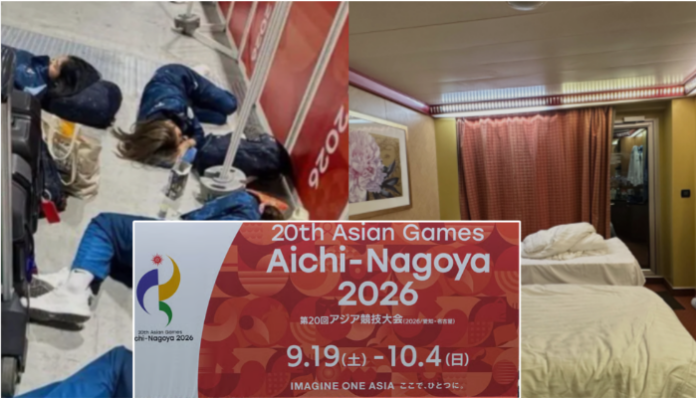
Japan is hosting the 20th edition of the Asian Games. It is officially known as the “Aichi-Nagoya 2026 Asian Games.” The official opening ceremony is scheduled to take place on 19th September (Saturday). However, the international event has already been marred by massive controversies and severe backlash. The criticism has escalated to the point of calling it “the worst in history.”
Nagoya, designated as the venue for thousands of athletes and officials attending the distinguished competition, has faced substantial issues with lodging and transportation. South Korea, the reigning Asian Games men’s football champions, were late for a training session because the team’s scheduled bus did not show up at their hotel. As a result, they arrived at their recovery session with a 20-minute delay after officials hastily arranged a substitute bus for them.
This incident happened after another similar mishap, as the bus transporting the team to their opening match proceeded to a baseball facility rather than the Mizuho Rugby Stadium. They were at the correct location 30 minutes beyond the planned time of arrival.
“Minor issues regarding vehicle scheduling and operations have been continuously arising during every training session and official event throughout the tournament. This is a situation that all teams currently participating in the tournament are facing, not just us,” stated a Korea Football Association official, reported Reuters.
These occurrences have only contributed to a series of grievances that have been persistently raised amid the ongoing Asian Games. Furthermore, some events, including football, have taken place ahead of the formal inauguration of the pivotal multi-sport contest.
The customary flag-hoisting ceremony also underwent a postponement, then an interruption due to undisclosed operational difficulties on Friday, while numerous nations, including India, sought transparent communication from the event administrators.
VIDEO | Nagoya, Japan: The traditional flag hoisting ceremony at the Asian Games was first delayed and then disrupted for unspecified "trouble" on Friday as multiple countries, including India, waited for clarity from the organisers, who are facing criticism for the logistical… pic.twitter.com/nytB9IdJHX
— Press Trust of India (@PTI_News) September 18, 2026
Cramped rooms, water leaks and more: Budget cuts and poor planning behind the growing complaints
The Olympic committee for South Korea reported that there was “a serious shortage of accommodation” at the tournament, while Philippine authorities resorted to Airbnb. The problem persisted, and even the Japan team had to consider other arrangements because male and female athletes were assigned shared rooms.
“Tall players over 2 meters tall cannot even stretch their legs on the beds. This is beyond common sense,” expressed Jung Jae-yong, vice president of the Korean Basketball Association, who referred to the tournment as “the worst ever.” Moreover, the space was not only argued to be small, but even the management of the facility had been equally poor.
A member of the Korean men’s national basketball team wrote, “Please help me,” with a picture of water seeping from pipes in his room, turning the floor into a sea of water. Those allotted container dormitories had to be evacuated immediately during Nagoya City’s record-breaking heavy showers last week as multiple places experienced leaks.
According to Japanese reports, the extreme budget cuts by organisers and inadequate planning are the root of this situation. Instead of setting up apartment-style athlete villages, the organising committee built wooden container dorms designed to be used as emergency evacuation shelters.
On the other hand, they only anticipated 15,000 athletes and officials, but the number of participants greatly surpassed the original projection and touched 17,000, which is higher than at the Olympics, triggering the current limitations.
Afterwards, the organisers asserted to have “neither the manpower nor the budget” to handle the increased figure. “The budget is only for 15,000 people. It’s impossible to cover costs for excess participants, and there are no physical dormitories available. If they still come, they must solve it themselves,” Aichi Governor Omura Hideaki declared last month.
Hence, the teams are forced to stay in temporary wooden container-style dorms that house thousands of people. This has led to a wave of complaints from national delegations. The competitors also travel great distances for everyday training in the absence of a proper Athletes Village.
An Italian cruise ship with a capacity of 4,000–5,000 passengers that was docked at Nagoya Port to provide a memorable experience likewise turned into a source of embarrassment due to ridiculous hotel assignments, which unfolded in the presence of the Japanese delegation. Some competitors had to wait for hours there. Heavy rains also stopped many athletes from boarding the vessel.
The Japanese team also met with inconvenience after male and female athletes were paired together and coaches and athletes were given the same room. The matter was resolved after intervention, but some sports organisations had to book private hotels outside the cruise ship due to this episode. Meanwhile, athletes from the Thailand team slept on the floor in the cruise ship’s welcome area before they were able to check in.
The magnitude of the problem can be assessed through the feedback of the athletes who have grown weary of the recurring difficulties and are no longer able to tolerate the situation.
Transportation issues, food shortage, congested spaces greet Team India
The Indian squad landed in Japan in preparation for the games, where a distressing ordeal awaited them. They were stranded for 14 hours after entering Nagoya, akin to athletes from Vietnam, China, South Korea and Thailand who were also hit by the same problem.
The on-site system struggled to locate information for many athletes, preventing them from boarding the scheduled shuttle buses, which prompted long delays for teams from multiple countries and areas. Many delegations had to wait hours to reach their official accommodations. However, there was no formal explanation provided for the problem.
🚨 INDIAN ATHLETES LEFT STRANDED IN NAGOYA DURING ASIAN GAMES! 🇮🇳🇯🇵
— The Khel India (@TheKhelIndia) September 17, 2026
Indian athletes reportedly waited for more than 14 hours for accommodation after arriving in Nagoya for the Asian Games.
Athletes from Vietnam, China, South Korea and Thailand were also reportedly a
Credits -…
The Indian team also found that the three hotels that house the men and women, as well as the coaches, are situated more than four kilometres from the Tsukuba training centre. The following day, hotel personnel informed the men’s team that breakfast had not been set up for them. The athletes encountered another challenge that evening when the assigned bus did not transport them to the training session.
According to sources, the Indian team had to travel four kilometres for dinner and lunch as the Japanese hotel served soybeans and rice for breakfast. “There is no special diet, no fruit. At the Indian restaurant, they were served rice, roti and chicken,” the insiders unveiled to The Times of India.
The predicament aboard the Costa Serena ship also affected the Indian team, as rooms meant for individuals had to be occupied by three. A member of the contingent conveyed, “In some rooms which are meant for only two athletes, three players are staying. The rooms are already small, and one additional athlete makes it even more inconvenient. The athletes want to give their best in such a mega event, but they are facing this.”
Additionally, many Indian officials have been urged to manage things on their own. Two members of the rowing team support staff have to stay outside because the cruise ship is unable to accommodate them, while certain athletes were asked to wait for more than 12 hours before they were eventually handed over their accommodations on the ship.
Indian contingent’s Chef de Mission Sahdev Yadav mentioned, “There has been a bit of mismanagement from them (organisers), but we are sorting out the issue. We are working on that.”
Over 17,000 athletes and officials, including Olympic and world champions, will attend the 20th Asian Games. The competition will continue till 4th October and will mostly be held in the port city of Nagoya and in the larger Aichi prefecture.
How loudly would cries of racism have echoed across the media and online discourse if this preventable disaster had unfolded in India
Protests are being expressed over the preventable conditions unfolding in Japan at this critical time, when the focus should only be on the prominent competition, especially for the athletes. Years of training, sacrifice and preparation can come down to a few crucial days, and inadequate arrangements, poor meals, lack of transportation and similar lapses can easily affect their physical and mental state. This also has consequences for countries with limited resources that make significant efforts to invest in their teams for the global stage.
Yet, the outrage is nowhere close to the fury that would have been visible if the same complaints were reported in India, when even a relatively minor issue is often magnified into a sweeping narrative of incompetence and the country’s supposed inability to host global events.
The label of a “third-world” nation would have been readily invoked as the global Islamist-leftist ecosystem would seize the opportunity to target India. The racists would also have a field day pushing their propaganda through misleading and fabricated videos.
However, the reflexive outburst appears to be absent when the shortcomings transpired from Japan, a highly developed country with substantial resources and infrastructure and a very small population, in stark contrast to India. The East Asian country neither shoulders the responsibility of maintaining the world’s largest population nor experiences the same degree of resource constraints.
Thus, the question is not whether organisational failures should be criticised or not, but why are standards of accountability and the language used to describe such episodes so varied depending on where they occur?
Interestingly, Indians are equally intrigued by this pronounced discrepancy in reaction. “Had this happened in India, 100% this would be a bigger deal. The media would be running wild with it, and India as a country wouldn’t hear the end of it,” stated Mixed Martial Arts (MMA) fighter Varun Sanyal, who is also in Japan, while highlighting the array of distressing conditions encountered by athletes.
Indian social media was also flooded with posts calling out the glaring double standards. A user posted an image showing athletes sleeping on the floor, underscoring that India would have been subjected to severe hatred if the incident had surfaced in the country. He added, “The reason India gets so much bad PR is because Indian opposition trolls team up with anti-India content creators abroad just out of hatred and jealousy against Prime Minister Narendra Modi.”
Total chaos at Asian Games in Japan
— Abhishek (@AbhishBanerj) September 17, 2026
Athletes from various countries sleeping on the floor … no vehicles, nothing.
Imagine the gaali-galauj if this was India
The reason India gets so much bad PR is because Indian opposition trolls team up with anti-India content creators… pic.twitter.com/Oxds00DSpo
An individual listed the hardships endured by the athlete, emphasising the same argument regarding how India would have been subjected to perpetual attacks had such scenes taken place in the country.
🚨 Asian Games | Nagoya, Japan 🇯🇵
— Arun Pudur (@arunpudur) September 17, 2026
• Athletes stranded at the airport for 12 hours
• No food, water or toilets
• Athletes sleeping on floors
• Very small meal portions
• Some athletes reportedly housed in remote villages
Imagine the headlines if this happened in India. 🇮🇳😂 pic.twitter.com/TW8TaxQGg7
Another shared a similar sentiment, noting how the arrangements have been characterised as “worst ever” and “worse than military quarters.” The person further stated, “I wonder what would have happened if anything even remotely close was true for an event hosted in India,” pointing out, “Even outrage is hierarchical.”
Housing of Athletes for the Asian Games in Japan is being described as "worst there ever has been" and "worse than military quarters".
— Harrapa Civillisation Times (@harrapasabhyata) September 16, 2026
I wonder what would have happened if anything even remotely close was true for a event hosted in India.
Even Outrage is hierarchical! pic.twitter.com/X9TwzutxE9
“Imagine the global outrage if India faced issues on this scale at a major international sporting event,” a netizen commented, while drawing attention to the grave shortcomings documented at the Asian Games in Japan.
2026 Japan Asian Games:
— Lala (@LalaXd) September 17, 2026
• Athletes & officials stranded at Aichi Sky Expo due to shuttle service failures
• Widespread transport delays and wrong shuttle-bus routes
• Complaints over cruise ship and container housing
• Poor access to competition venues
Imagine the global… pic.twitter.com/Vle88COeox
India repeatedly put in the dock regardless of the truth behind the allegations
While the condemnation directed at Japan is not even a fraction of what India receives over groundless allegations, another aspect of the contrast warrants consideration: how the global cabal has actively tried to defame India and repeatedly tried to discredit its achievements.
The Western media recently used poverty porn to reinforce a particular perception of India during the G20 Summit in New Delhi, where its focus was not on the scale and success of the event, but on images carefully framed to underline poverty and deprivation. People cycling, sleeping on benches or riding mopeds past G20 posters were turned into featured images, in hopes of creating a visual contrast between the two realities to undermine India’s stature.
The media narrative was only one part of the story. An online campaign was pushed alleging that several leaders who attended the summit had fallen sick, which became another vehicle for racism and anti-India propaganda. The misinformation was serious enough for the Ministry of External Affairs to step in and publicly debunk the claims.
This is also reminiscent of when The New York Times mocked India’s historic Mangalyaan mission through a deeply offensive cartoon, and it issued an apology after being called out for its racist antics.
The fundamental point is that two global events, despite differing in nature and scale, occurred in two distinct regions of the world. In one case, unverified claims were orchestrated and amplified to target a country, while in the other, a genuine situation has attracted muted attention because the objective is really not to scrutinise failures but to simply portray India in a negative light, even when it has to be manufactured.
What makes this more concerning is the role of the entire ecosystem of India’s opposition, which has completely blurred the line between political antagonism towards the Bharatiya Janata Party (BJP) and PM Modi and hostility towards the country itself. They seem to have joined the global anti-India network and lend their support to propaganda against their own country and people, which they otherwise claim to serve.
Of course, any critique levelled at Japan in relation to the Asian Games should be limited to the organisational shortcomings and not racism or advancing any agenda, but one cannot overlook the hypocrisy and dual standards applied to India.