

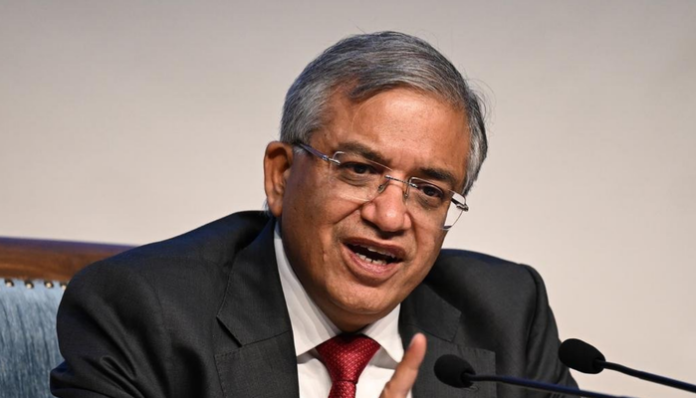
On Sunday, 4th October, the Congress government in Keralam has ordered a fresh Vigilance and Anti-Corruption Bureau (VACB) probe into a 2006 case linked to Chief Election Commissioner Gyanesh Kumar, who was serving as the state’s Public Works Department (PWD) secretary at the time. Keralam Home Minister Ramesh Chennithala directed Vigilance Director Manoj Abraham to conduct a detailed inquiry into allegations of irregularities and possible external influence in the earlier investigation. The move comes amid a wider political controversy surrounding Kumar and after a complaint by Congress leader Malayinkeezhu Venugopal.
Keralam Home Minister Chennithala orders Vigilance probe against Gyanesh Kumar over 2006 case https://t.co/SQMfqaUVcw
— The Tribune (@thetribunechd) October 4, 2026
Congress government revives 2006 case against Gyanesh Kumar
The Congress-led UDF government’s decision comes after senior CPI(M) leader and former Kerala Finance Minister T M Thomas Isaac revived unfounded allegations surrounding Kumar’s tenure as PWD secretary nearly two decades ago. Isaac recently recalled the controversy in a social media post, bringing back into focus the alleged suicide of Malaysian civil engineer Lee See Been, who was associated with the PATI-BEL consortium working on a major road project in Kerala.
The case is connected to the Kerala State Transport Project (KSTP), under which PATI-BEL was involved in upgrading the MC Road between Angamaly and Thiruvananthapuram. Lee, who was the chief project manager associated with the consortium, died by suicide in Malaysia in 2006 after returning from Kerala. Reports from the time suggest that his suicide notes referred to difficulties involving government officials, corruption allegations and delays in payments. Kumar, who was then the PWD secretary, was among the officials whose names were reportedly mentioned.
The Kerala Home Department has now sought the files related to the preliminary Vigilance inquiry conducted in 2006. The fresh investigation will examine not only the original allegations but also claims that the earlier inquiry was derailed or discontinued because of external pressure. Chennithala said the allegation of outside influence was serious enough to require a detailed examination.
“I am convinced that a detailed Vigilance inquiry is essential,” Chennithala said after examining Venugopal’s complaint. He added that he had discussed the matter with Chief Minister V D Satheesan before directing the Vigilance Director to take lawful action.
The Home Department has already called for all files concerning the original 2006 VACB preliminary inquiry, with the minister stressing that allegations of external influence back then are serious and require deep scrutiny.
CPI (M) Thomas Isaac revives decades-old allegations
This fresh probe started after CPI(M) leader and former Kerala Finance Minister T.M. Thomas Isaac revived long-standing allegations of corruption and controversy surrounding Gyanesh Kumar’s stint as the PWD secretary. Taking to social media, Isaac shared a Facebook post claiming that Kumar’s name had allegedly appeared in the suicide note of a Malaysian company official connected to a major road construction contract in Kerala.
This renewed push by the opposition leader directly triggered the media reports and subsequent action by the ruling Congress government in Kerala. The Home Department noted that the fresh probe was specifically initiated following claims that the preliminary investigation conducted way back in 2006 was derailed or suppressed due to external pressure and political interference.
The hypocrisy of a long-silent opposition
What makes this sudden revival fascinating is the glaring political convenience behind it. The CPI(M) leader who is now aggressively pushing this two-decade-old case, T.M. Thomas Isaac, was himself serving as the Finance Minister of Kerala when the incident originally took place in 2006. Back then, his own party was ruling the state, and Isaac held immense power and authority to order a thorough probe into the matter.
Yet, during his tenure in power, he did nothing and completely ignored the issue. He chose to stay silent while his party was at the helm, and only now, nearly twenty years later, has he recalled the case for political benefits. The ruling Congress party in Kerala jumped into action and announced the probe following an Indian Express report that put CEC Gyanesh Kumar right at the centre of the controversy, creating a charged environment where old controversies are being weaponised.
Inside the 2006 KSTP case: Financial squeeze and tragic suicide
The 2006 KSTP suicide case was largely the result of administrative failures and financial withholding by the government of the day. The case stems from the tragic suicide of Lee See Been, the former Chief Project Manager of PATI-BEL, an Indo-Malaysian joint venture tasked with executing the Kerala State Transport Project (KSTP) for reconstructing the Main Central (MC) Road. The consortium held a contract worth ₹215 crore to upgrade a 127-kilometre stretch. While work was supposed to finish by December 2005, delays pushed the deadline to May 2006. When the project remained incomplete, the then ruling LDF government withheld bills totalling ₹17 crore, leaving the contractors unable to clear dues worth ₹12.5 crore to various agencies.
Lee fell into deep depression after the government withheld funds and the company refused to pay compensation for the administration’s failure to acquire and hand over land on time. Distressed, Lee returned to his hometown of Kuala Lumpur, where he was tragically found hanging beneath an iron bridge near a lake at Subang Ria Park. Reports indicated his suicide note mentioned rampant corruption and high-ranking officials demanding bribes. Lee had previously told colleagues about pressure from top bureaucrats.
Thomas Isaac’s own legal troubles in the Masala Bond case
While Dr T.M. Thomas Isaac tries to point fingers at past officials, he is currently battling serious legal and financial allegations of his own. The Enforcement Directorate (ED) has heavily implicated him in the infamous KIIFB Masala Bond case. In a show-cause notice issued under the Foreign Exchange Management Act (FEMA), the ED accused top Kerala figures, including Chief Minister Pinarayi Vijayan and former Finance Minister Thomas Isaac, of forex violations amounting to a staggering ₹466 crore.
The federal agency noted that Vijayan chaired meetings that approved purchasing land from foreign-borrowed funds against RBI rules, while Isaac was directly involved in executive committee meetings that diverted bond proceeds for land acquisition.
Despite the gravity of these charges, Isaac has dismissed the federal action completely. Defending himself, Thomas Isaac remarked, “This is nonsense. We never used the fund for purchasing land. Land acquisition for KIIFB projects was conducted strictly in accordance with norms. The ED notice is part of an election stunt.” Nevertheless, his attempts to dodge accountability, including skipping multiple ED summons and approaching the Kerala High Court, highlight the deep irony of him raising questions about past administrative integrity.
So-called political rivals join hands to revive an old controversy involving Gyanesh Kumar
Ultimately, the sudden resurrection of this decades-old case reveals a classic tale of political posturing and convenience. So-called political rivals are ganging up and bringing up an incident from twenty years ago involving CEC Gyanesh Kumar purely for short-term political benefits. When Thomas Isaac actually held supreme financial power in the state during his party’s tenure, he completely ignored the case and chose not to open any investigation, recognising that it pointed toward systemic failures and major corruption happening right under his government’s watch.
The fact that the issue involved multiple officials of that era, not just Gyanesh Kumar, was conveniently swept under the rug when the CPI(M) was in power. Now, with political alignments shifting and CEC Gyanesh Kumar already at the centre of controversy, both parties, despite claiming to be political rivals, have joined hands to bring the matter back into focus. Leaders from both sides are using the historical controversy as a convenient tool to settle scores, while disregarding their own past inaction and legal controversies.


