

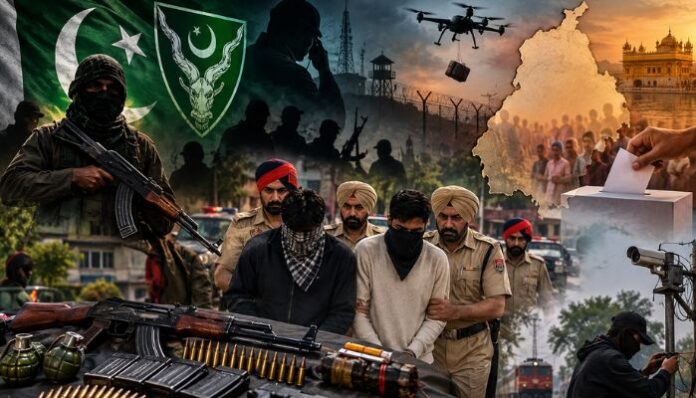
Ahead of the 2027 assembly election in Punjab, homegrown terrorists and sleeper cells in the state, with the help of Pakistan-sponsored criminals and terror networks, are trying to create fear and unrest.
A series of police operations in 2026 has highlighted how foreign-based handlers are using local operatives to move weapons, explosives and other material into Punjab. Investigations have also pointed to the use of social media for contacting recruits, spreading anti-India and anti-police messages and giving instructions.
The latest case has once again brought the focus on Pakistan-linked terror networks operating in Punjab.
Pakistan-linked terror module busted in Amritsar
Amritsar Rural Police have busted a Pakistan-linked terror module and arrested a 28-year-old man, recovering a large quantity of weapons and ammunition from him. The accused has been identified as Navjot Singh, alias Cheema, a resident of Sarai Manthan Khan.
Police recovered an AK-47 rifle, two hand grenades, nine live cartridges, a magazine, a mobile phone and a motorcycle from his possession. Navjot works as a truck driver and had earlier been involved in drug-related activities, according to the police.
The investigation has found links to a Pakistan-based handler connected with the Inter-Services Intelligence (ISI) and another handler based in the Middle East. Inspector General of Police (Border Range) Gurpreet Singh Bhullar said the weapons and explosives were brought into Indian territory through drones.
Police said Navjot had been instructed to take the weapons to a location in a neighbouring district. He was then supposed to meet another person through a cut-out arrangement. Further instructions, including the exact delivery point, were to be given to him later.
For carrying out the task, Navjot had been promised up to Rs 50,000. However, police said he had not received any payment before his arrest.
The police have not disclosed the intended target or the exact place where the weapons were to be delivered. Officials said the investigation is continuing and more people linked to the network are being traced.
The operation was carried out by the Amritsar Rural Police team under the Punjab government’s zero-tolerance policy towards terrorism, organised crime and gang-related activities. The operation was led by Amritsar Rural SSP Kanwalpreet Singh Chahal and his team.
Bhullar said the recovery was an important preventive action as the weapons could have been used to carry out a serious crime.
A pattern of Pakistan terror-linked cases in Punjab in 2026
The Amritsar case is not an isolated incident. Several similar cases have been reported in Punjab during the year 2026 alone, with police repeatedly finding links to Pakistan, ISI handlers and foreign-based operatives.
In these cases, investigators have recovered assault rifles, foreign-made pistols, hand grenades, explosives and petrol bombs. Some modules were also found using social media to communicate with handlers, recruit people and plan attacks.
ISI-linked arms smuggling and radicalisation module
In another major operation, Amritsar Rural Police busted an ISI-sponsored terror and cross-border arms smuggling module and arrested two people. The operation led to the recovery of an AK-47 rifle, two magazines and 36 live cartridges. Three sophisticated Glock 9mm pistols were also seized.
Punjab DGP Gaurav Yadav described the action as an important step in the fight against terror networks and cross-border arms smuggling.
The initial investigation found that the accused were in contact with foreign-based handlers through social media. Police said these handlers were operating from across the border and had links with Pakistan’s intelligence agency, the Inter-Services Intelligence or ISI.
The police also said the network was involved in radicalisation activities. The accused were using online platforms to spread anti-India and anti-police messages and influence vulnerable people.
An FIR was registered at Gharinda police station in Amritsar Rural. Investigators are examining the digital devices and social media accounts of the accused to identify their contacts and find other members of the network.
Grenades with Pakistan markings and plans to target police
In another case, the Counter Intelligence Wing of Punjab Police busted an ISI-backed terror module being run by Pakistan Intelligence Operatives, or PIOs.
Three people, Sarabjit Singh of Tarn Taran, Bikramjit Singh of Amritsar and Amandeep Singh of Amritsar were arrested. Police recovered two Argus hand grenades and a foreign-made Glock pistol.
A key detail in the case was that the recovered grenades carried markings of the Pakistan Ordnance Factory, or POF, pointing to their cross-border connection.
According to DGP Gaurav Yadav, the group was involved in plans to target police establishments in several states. The accused were in contact with Pakistan Intelligence Operatives through social media.
During the investigation, police found that Bikramjit Singh was the main operative and primary contact of the foreign handlers. He was working from the DSA of Gujarat. The information was shared with the Gujarat Anti-Terrorism Squad, which helped in his arrest.
Police said the group was planning grenade attacks on police establishments in Punjab and other states on the instructions of ISI handlers.
A case was registered at the State Special Operations Cell police station in Amritsar under the Explosive Substances (Amendment) Act, Arms Act and the IPC.
Four hand grenades recovered in ISI-backed module
On April 16, Punjab Police busted another terror module linked to Pakistan’s ISI and arrested one person.
The operation was jointly carried out by the State Special Operations Cells of Amritsar and Mohali along with the Counter Intelligence Wing. Four hand grenades, two foreign-made pistols and ammunition were recovered.
DGP Gaurav Yadav said the accused was working on the instructions of foreign-based handlers. Police also found links between the accused and a terror module connected with a recent grenade attack in Chandigarh.
An FIR was registered at the State Special Operation Cell police station in Amritsar. The investigation was launched to trace other members of the network and establish their links with foreign handlers.
BKI module busted in Jalandhar, IED recovered
Counter Intelligence Jalandhar, working with Jalandhar Rural Police, also busted a Pakistan-sponsored Babbar Khalsa International (BKI) terror module.
The operation led to the arrest of Satbir Singh, a resident of Padiana village in Adampur, Jalandhar. Police recovered an improvised explosive device, or IED, containing 1.3 kilograms of high explosives, shrapnel and ball bearings. His black Platina motorcycle was also seized.
Police said Satbir had collected the explosive consignment on the instructions of foreign-based handlers. Acting on information, Counter Intelligence teams set up a checkpoint at Dhandaur village and stopped his motorcycle. The IED was found inside a bag during the search.
The recovery raised concerns because the explosive device contained material that could cause serious damage and disrupt public peace.
The investigation is now focused on identifying the foreign handlers and local support network connected to the BKI module.
An FIR was registered at Patara police station in Jalandhar Rural under the Bharatiya Nyaya Sanhita, Explosives Substances Act and Arms Act.
Two Pakistan-backed modules linked to surveillance and petrol bombs
Punjab Police also claimed to have busted two Pakistan-backed, ISI-linked terror modules and arrested nine suspects, including four juveniles.
According to police, one of the groups was involved in surveillance. Its members were installing cameras near railway tracks and sending live footage across the border.
The second group was preparing petrol bomb attacks. Police recovered four petrol bombs and three pistols during the investigation.
Officials said Pakistan-based handlers were providing support, training and material to the members for attacks targeting security personnel and establishments. Investigators also found links between some suspects and people who had visited the Jantar Mantar protest site in Delhi.
Police said the suspects were arrested during an intelligence-based operation before they could carry out their plans.
Authorities also pointed to the use of petrol bombs as a new method being adopted by terror networks because they can be prepared using materials that are easily available.
Shahzad Bhatti terror network: Punjab and beyond
In recent months, the police and security agencies have arrested numerous individuals allegedly working for the terror network of ISI proxy and gangster Shahzad Bhatti.
The ISI-backed Shahzad Bhatti Network is actively involved in recruitment, online radicalisation, reconnaissance, logistics, espionage, illegal procurement of arms, establishment of sleeper cells and facilitation of terrorist activities across different parts of India.
Intelligence inputs indicate that the anti-India terror network operates via Pakistan-based handlers using encrypted communication channels and maintains association with several front organisations involving Khalistani separatists, including the Khalistan Armed Force, Punjab Sovereignty Alliance, Khalistan Liberation Army, Sher-e-Punjab Brigade, United Sikh Brotherhood, Sikh Tigers of Khalistan and Tehrik-e-Taliban Hindustan.
The newly created TTH had claimed responsibility for two targeted killings of Punjab Police personnel in February and May this year. One of the early tasks assigned by TTH to an Indian operative named Sohail was painting “TTH” graffiti across Delhi and Faridabad. Sohail was later arrested by the Delhi Police Special Cell.
The ISI proxy has weaponised social media to recruit ‘operatives’ in India. The Pakistani handlers allegedly scan social media profiles to identify unemployed or vulnerable youth, lure them with money, and begin with small assignments. Gradually, the handlers assign violent tasks to the operatives, including firing at clubs, throwing grenades, targeting police personnel, and filming terror acts.
An alarming aspect of Bhatti’s network is that he is not recruiting only Muslims but also Sikhs, and even Hindus, through the ISI-style brainwashing and other tactics.
In July, the Bikaner Police arrested a man named Anil Kumar over allegations of him providing Indian SIM cards to Pakistani gangster Shahzad Bhatti’s gang members. The action comes after the investigating agency came to know that a WhatsApp account had been operating in Pakistan using an Indian mobile phone number belonging to the 18-year-old arrestee.
On 17th July, Anil Kumar, a resident of Godu village in the Bajju Police Station area, shared the one-time password (OTP) required to activate the SIM card with Shahzad Bhatti’s associates. Initially, the Rajasthan ATS detained Kumar and interrogated him. Thereafter, the ATS handed him over to the police, who arrested him on 19th July.
In a 2024-25 case in the Mahajan Field Firing Range espionage case (2024–25), a canteen operator, an e-Mitra operator, and a railway employee were arrested for leaking information related to Army activities and maintaining contact with Pakistani female operatives.
In November 2025, a grenade attack took place on the Sirsa Women Police Station in Haryana. The National Investigation Agency linked the incident to the Bhatti gang.
In April 2026, Delhi Police Special Cell uncovered a plot involving shootings, grenade attacks and planned murders in Delhi NCR. The police arrested two men working at the behest of Bhatti, Rajveer and Vivek Banjara from Madhya Pradesh. The duo had procured weapons and cartridges on the instructions of Shahzad Bhatti.
The name of the Shahzad Bhatti Network also emerged in the arrest of a man named Vikrant Kashyap from the Jhajhra area in Uttarakhand. Kashyap was reported to have been in contact with Bhatti and his associates through Instagram and WhatsApp.
In February 2026, Chinese-made pistols and ammunition were allegedly dropped by a drone near the Khajuwala border. The probe into the case uncovered an active cross-border smuggling network.
In late July 2026, the Assam Police Special Task Force (STF) arrested three suspected members of the Shahzad Bhatti Network. The arrested suspects were identified as Akramul Islam, aged 26, a resident of Beparipara in Dhubri district; Aminur Rahman, aged 22, of Dhupiri in Panbari, Chirang district; and Abdul Hussain, aged 54, of Dabandia in Kalgachia, Barpeta district.


