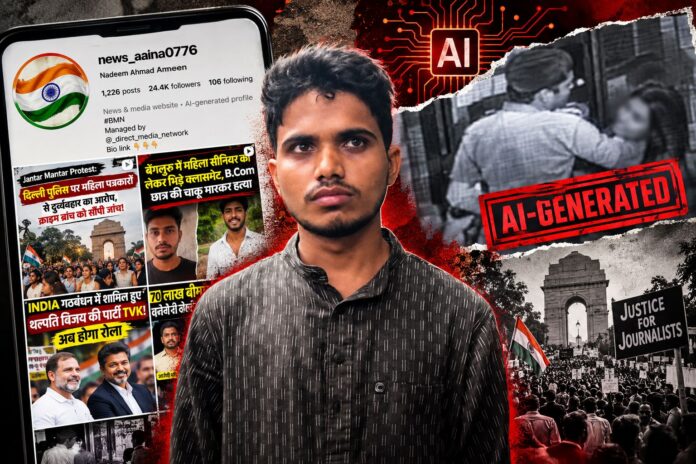
The Delhi Police have arrested 24-year-old Nadeem Ahmad, who used artificial intelligence tools to create and circulate a fabricated video portraying a Delhi Police officer sexually assaulting a woman during the protests at Jantar Mantar. The video was presented as CCTV footage from the protest site and circulated on social media, where it was used to amplify allegations against the police.
According to Delhi Police, the video was not genuine CCTV footage but an AI-generated fabrication. Investigators traced its circulation to an Instagram channel operated by Nadeem, who claimed during interrogation that he was an independent journalist.
Team of Cyber Police station, @DCPNewDelhi arrested one self claimed independent journalist for circulating a fabricated video falsely portraying Sh. Vivek Bhagat, ACP, Delhi Police in bad light. The accused person circulated the incriminating video reel through one Instagram account as authentic. The mobile phone used for its circulation was also recovered. @LtGovDelhi #DPUpdates #HelloDelhiPolice
— Delhi Police (@DelhiPolice) October 6, 2026
Police have now seized his phone and are examining his digital activities, funding sources and possible associates to determine whether the episode was an isolated act or part of a larger conspiracy.
Who is Nadeem Ahmad Ameen?
Nadeem Ahmad, identified by police as the son of Farukh Ahmad and a resident of Palwal, Haryana, appears to have built an online identity around the social-media page ‘news_aaina’.
His Instagram account, @news_aaina0776, had more than 24,000 followers and 1,226 posts at the time of his arrest. The account describes itself as a “News & media website” and explicitly labels itself an “AI-generated profile”, while also stating that it is managed by @_direct_media_network.

A cursory look at the account shows that AI-generated visuals formed a significant part of its content strategy. The page frequently used stylised AI imagery and videos to present or comment on political and current-affairs developments. A substantial portion of the content appears sympathetic towards the Congress, the CJP and other opposition parties, while several posts are sharply critical of the government and law-enforcement agencies.
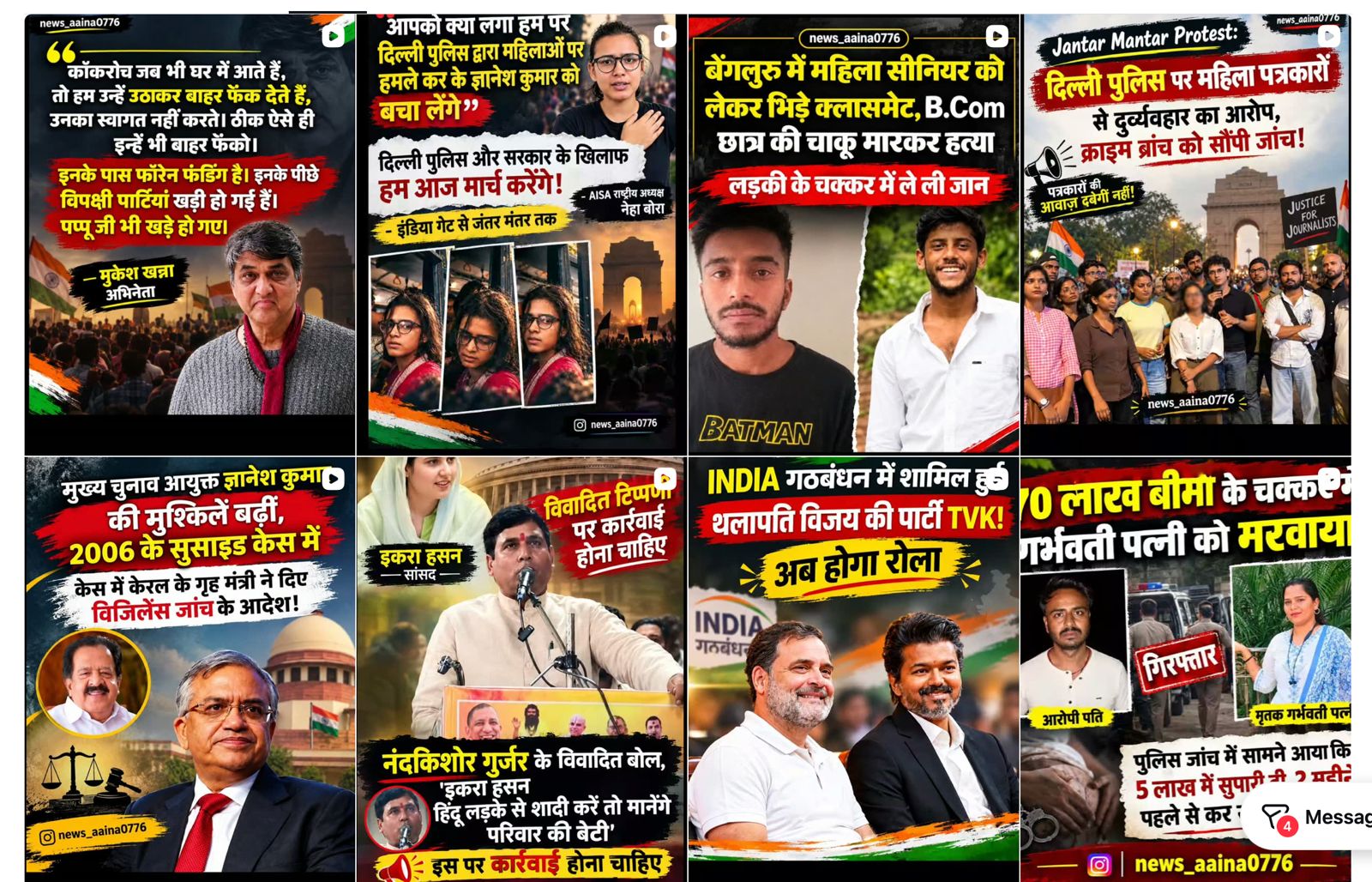
His Facebook profile provides another glimpse into his online persona. The profile identifies him as being from and living in Hathin and lists him as a digital creator, with over four thousand followers. His Facebook activity also includes AI-generated visuals dealing with political and social issues, often accompanied by highly charged messaging and provocative commentary against the government.

Some of the posts visible on his Facebook and Instagram pages employ provocative imagery and language portraying the government and its institutions as oppressive, while others use AI-generated scenarios to comment on ongoing political controversies. The nature and extent of this content are now relevant to the Delhi Police investigation, particularly given the allegation that AI tools were deliberately used to manufacture material capable of inflaming tensions.
From social-media creator to accused in fabricated CCTV case
The Delhi Police said the controversy began when reels started circulating on Instagram and Facebook claiming to show CCTV footage from the CJP protest at Jantar Mantar.
The footage purportedly showed a man in police uniform misbehaving with women. It was further claimed that the man was a senior Delhi Police officer. The footage was accompanied by the identification of the alleged officer, potentially exposing him to public anger and retaliation.
The Cyber Police Station of New Delhi district registered an FIR after taking cognisance of the videos.
Technical analysis eventually led investigators to the Instagram channel news_aaina, following which police identified its alleged handler as Nadeem Ahmad, a resident of Palwal.
Police arrested him on October 5.
According to Additional Deputy Commissioner of Police (New Delhi) Manjeet, Nadeem admitted during questioning that he possessed several AI tools and had used them to fabricate the purported CCTV footage.
The sequence established by investigators is that the video was created on October 3 and began circulating on October 4, coinciding with protests at Jantar Mantar.
What did Nadeem tell police?
Police said Nadeem described himself as an independent journalist when questioned.
During interrogation, he said that he had studied up to Class 10 at a madrasa in Saket, Delhi, but had failed his Class 10 examination.
More significantly, police said he admitted creating the fabricated video using AI tools.
According to the police account, Nadeem said the purpose was to tarnish the image of the Delhi Police, turn protesters against the force, create unrest and potentially provoke violence. Police are now investigating his alleged sources of funding and identifying people who may have assisted him.
The authorities are also examining whether his activities during the CJP protest were part of a broader, pre-planned effort to inflame the situation and trigger riots.
His mobile phone has been seized for forensic examination.
The controversy involving ACP Vivek Bhagat
The AI-generated video emerged against the backdrop of a controversy that began on October 3, when Rosy, a worker associated with the CJP who had presented herself as an independent journalist, accused Delhi Police ACP Vivek Bhagat of sexually harassing her while she was covering the detention of a protester.
The allegations quickly spread across social media, accompanied by purported photographs and CCTV visuals allegedly showing Bhagat molesting her.
Delhi Police subsequently fact-checked one of the key visuals and said that the purported CCTV image was AI-generated/manipulated and fake.
“FACT CHECK: The post contains AI-generated/manipulated visuals. The CCTV footage image is fake,” Delhi Police said in a post on X, warning users against circulating the material and cautioning that legal action could follow against those responsible for spreading it.
The official Delhi Police X account also rejected social-media claims that female protesters had been subjected to physical assault.
“These allegations are baseless and misleading. Female protesters are handled by female staff and are treated with dignity and due regard,” the police said.
The police’s fact-check subsequently became central to the investigation into the origin and circulation of the fabricated footage.
ACP Bhagat gets Additional DCP charge
Amid the controversy, Delhi Police ACP Vivek Bhagat has been assigned the current duty charge of Additional Deputy Commissioner of Police.
Bhagat is among 12 DANIPS officers included in the Delhi Government’s Home Department administrative order. He was previously serving as SDPO, Connaught Place, in New Delhi district.
The timing of the development is notable as it comes a day after Delhi Police debunked the viral visual that had been used to portray Bhagat as a perpetrator of molestation.
However, the administrative order does not constitute a finding on the allegations against Bhagat. The current duty charge is an interim administrative arrangement and does not by itself confer the regular seniority, pay or other benefits attached to the Additional DCP post.
Why the case is significant
The case comes amid an already charged controversy surrounding allegations of harassment of women journalists during protests against Chief Election Commissioner Gyanesh Kumar.
An assistant commissioner of police, Vivek Bhagat, had faced allegations concerning the treatment of a woman journalist during the protests. The controversy subsequently intensified, with complaints by women journalists and demands for action against police personnel.
Against this backdrop, the circulation of purported CCTV footage showing a police officer sexually assaulting a woman had the potential to dramatically escalate public anger.
The Delhi Police now assert that the footage was deliberately fabricated using AI and circulated as genuine evidence.
That makes the Nadeem case significant beyond the individual allegations against him. It highlights how generative AI can be used to manufacture apparently credible “evidence” during an already volatile political confrontation, and how such fabricated material can potentially influence public opinion before its authenticity is established.
Nadeem has been produced before a court and remanded to police custody for further investigation. The allegations against him remain subject to the outcome of the investigation and judicial proceedings.