

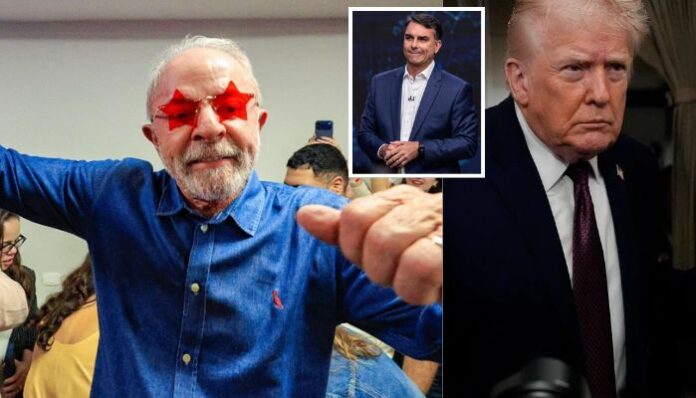
Luiz Inácio Lula da Silva, the President of Brazil, defeated his right-wing rival Flávio Bolsonaro in the presidential election on Sunday, 25th October, securing another term in office despite pressure from US President Donald Trump. According to official figures released by Brazil‘s Superior Electoral Court (TSE), Lula secured 51.79% of the valid votes against Flávio Bolsonaro’s 48.21%, a decisive difference of over 4 million votes.
BREAKING: Brazil’s election authority declares Lula the winner of the Brazilian presidential election. He has 51.76% with 99.8% of the votes counted. The Bolsonaro team is likely to challenge the result in court after the Supreme Court Justice Zanin extended voting nationwide by 2 hours on Lula’s request
— Visegrád 24 (@visegrad24) October 26, 2026
The victory marks a historic milestone in Brazilian political history. For the first time since the nation’s return to democracy in 1988, a candidate who lost the initial round of voting managed to stage a total comeback and win the presidency in the runoff. In the first round earlier in the month, Flávio Bolsonaro had taken the lead, leaving Lula trailing. However, Lula mobilised millions of voters to flip the tide.
Celebrating his victory alongside First Lady Rosângela da Silva and political allies in a video released by his campaign, Lula thanked supporters who stood up for the country’s democratic values. Delivering a clear statement on international affairs, Lula declared that the result proved Brazil “will not accept being anyone’s backyard”.
Lula’s victory is significant beyond Brazil’s domestic politics. The country is Latin America’s largest economy, with an annual GDP of around $2.6 trillion, and Lula has repeatedly opposed Trump’s efforts to expand Washington’s influence over the region. His return to office means Brazil will continue to be led by a president who has challenged the US administration on trade, sovereignty and its treatment of Latin American countries.
The victory comes at a time when several Latin American countries have elected right-wing leaders, many of whom share political positions with Trump. Lula’s win, therefore, represents a setback for those who hoped to bring Brazil under a government more closely aligned with Washington. Together with Mexico, Brazil will continue to have a left-of-centre government at the head of one of the region’s two most populous nations.
Flávio Bolsonaro refuses to accept defeat, demands annulment of election results
Despite the electoral court confirming Lula’s victory, Flávio Bolsonaro refused to concede defeat on Sunday night, 25th October. He questioned the decision to extend voting hours and demanded that the election results be annulled, arguing that the circumstances surrounding the vote made the outcome impossible to accept.
JUST IN: 🇧🇷 Flávio Bolsonaro officially rejects results of presidential election against Lula da Silva. "It is impossible to recognize the election results… we will use our legal team, we will request the annulment of these elections." https://t.co/auRRgmI2ul
— BRICS News (@BRICSinfo) October 26, 2026
Bolsonaro challenged Supreme Federal Court Justice Cristiano Zanin’s decision to extend voting by two hours. He claimed that the measure had not been applied equally and had undermined the principle of equal voting conditions. “It is impossible to recognise the election results given the circumstances in which these events unfolded,” Bolsonaro said while announcing his intention to challenge the result through the courts.
BREAKING: Flávio Bolsonaro: It is impossible to recognize the election results in the context of how these things happened. We are going to use our legal team, we are going to request the annulment of these elections. https://t.co/PVtKvb9b3M
— Clash Report (@clashreport) October 26, 2026
The dispute follows the political path taken by his father, former Brazilian President Jair Bolsonaro, who also refused to accept his defeat to Lula in the 2022 presidential election. Jair Bolsonaro was subsequently convicted of plotting a coup to remain in power and sentenced to 27 years in prison in September 2025. The younger Bolsonaro’s refusal to concede could prolong the political confrontation even after the electoral court’s confirmation of the results.
However, a demand for annulment does not itself invalidate an election, and any legal challenge would have to be decided through Brazil’s judicial system.
Overcoming a foreign Regime-change strategy
Lula’s electoral triumph represents a major resistance against external political interference. Over the past year and a half, the United States executed what amounted to a concerted regime-change strategy aimed at ousting Lula and replacing him with a pro-Washington leadership. The objective of this intervention was straightforward: to remove an independent, anti-Trump voice leading South America’s largest economy and install a subservient, pro-US right-wing government under Bolsonaro.
By pushing through punitive economic sanctions, threatening aggressive tariffs, and manipulating diplomatic channels, foreign actors attempted to destabilise Lula’s administration and force a political shift in Brasilia.
Yet, by securing a mandate directly from the Brazilian electorate, Lula successfully weathered this regime-change push. His survival at the ballot box highlights a firm rejection of outside interference and re-establishes Brazil’s determination to chart an independent foreign policy course.
The US campaign to restore Bolsonaro
The attempts to influence Brazil’s political trajectory were orchestrated by key political appointees within the US State Department. A Reuters investigative report revealed that two senior officials, Darren Beattie, Senior Advisor for Western Hemisphere Affairs, and Ricardo Pita, Deputy Assistant Secretary for North America, led a covert campaign designed to tilt the electoral playing field in favour of the Bolsonaro clan.
Operating with broad authority over Washington’s Latin America policy, Beattie and Pita explicitly instructed US diplomats in Brazil that restoring former President Jair Bolsonaro to power was an official US priority, even though the elder Bolsonaro had been legally barred from holding office due to his involvement in the 2022 coup attempt.
When Jair Bolsonaro was sentenced to 27 years in prison in September 2025, the officials pivoted immediately to his son, Senator Flávio Bolsonaro. US embassy staff were ordered to avoid engaging with any rival conservative contenders who might split the right-wing vote against Flávio.
To systematically weaken Lula’s standing ahead of the 2026 election, these officials advocated for punitive US measures against Brazil. These actions included designating prominent Brazilian criminal groups as foreign terrorist organisations and pushing for US sanctions against the Brazilian Supreme Court Justice spearheading the judicial investigations into Jair Bolsonaro.
While former State Department officials condemned these efforts as crossing the line from standard diplomacy into blatant political intervention, the campaign reflected a calculated attempt to use state power to engineer an election outcome.
Washington’s strategic ambitions in South America
The aggressive backing of Flávio Bolsonaro was tied directly to Washington’s wider geopolitical ambitions across Latin America. Over the preceding 18 months, right-wing or far-right candidates had won presidential contests in seven Latin American nations, many enjoying explicit support from Donald Trump.
Winning Brazil, the continent’s economic powerhouse with a $2.6 trillion GDP, represented the ultimate prize to cement ideological control over the entire Western Hemisphere.
To pressure the Brazilian state, the US administration repeatedly deployed economic leverage. When Brazilian courts moved to prosecute Jair Bolsonaro for his role in the 2022 plot to overturn election results, a conspiracy that involved draft decrees, military backing, and assassination plots against Lula and top judges. Washington threatened a massive 50% tariff on Brazilian goods, labelling the trial a “witch hunt.”
Trump is threatening a 50% tariff on Brazilian goods, citing treatment of its former President Jair Bolsonaro https://t.co/XYMc5q6EYr
— The Wall Street Journal (@WSJ) July 9, 2025
Later, as the 2026 campaign intensified, a 25% tariff was imposed on select exports, and US State Department officials tried to enter Brazil under the guise of inspecting “electoral integrity,” only to be denied visas by Brazilian authorities for attempting to meddle in domestic affairs.
Instead of weakening Lula, these aggressive tactics backfired. Lula leaned into the confrontation during his campaign, portraying Flávio Bolsonaro as “Trump’s candidate” who would compromise national sovereignty and leave Brazil vulnerable to exploitation. By standing firm against economic threats, Lula turned the foreign intervention into a rallying cry for national pride.
A historic comeback in the fourth term
Lula’s re-election secures an unprecedented fourth non-consecutive term as president, capping one of the most remarkable political journeys in modern history. After three unsuccessful presidential bids, he won his first term in 2002 and was re-elected in 2006. Though his early political legacy was later shadowed by corruption scandals and imprisonment, his convictions were eventually annulled, clearing the way for his political comeback in 2022 when he narrowly defeated Jair Bolsonaro.
During his third term, Lula focused on rebuilding key social safety nets, significantly slowing deforestation in the Amazon, and repairing democratic institutions after years of political volatility. His 2026 victory solidifies his legacy as a central figure in Latin American politics who successfully resisted foreign pressure and preserved domestic governance.


