

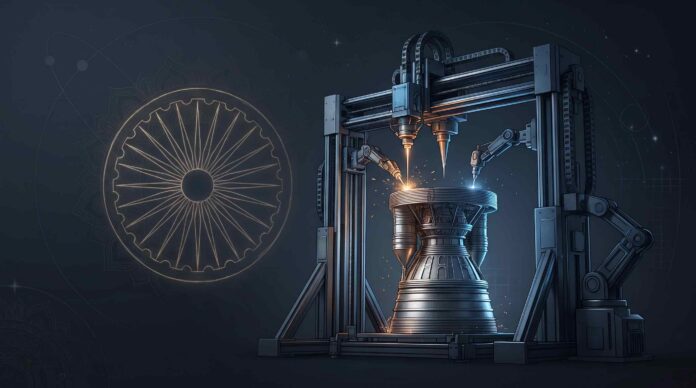
For decades, the Indian industrial apparatus functioned primarily as a secondary consumer of imported technology, remaining heavily reliant on vulnerable foreign supply chains. However, the Ministry of Electronics and Information Technology is systematically dismantling this historical dependency through the National Strategy for Additive Manufacturing. The ministry announced phase 2.0 of the strategy this month, aiming to position advanced three-dimensional printing as a foundational building block for Atmanirbhar Bharat.
Consequently, the government is planning for an explicitly larger market capture, targeting an aspirational USD 5 billion domestic ecosystem by 2030. Additive manufacturing represents a profound architectural shift in modern industrial engineering. Instead of traditional subtractive processes that waste massive blocks of raw material, this digital technology deposits advanced materials layer by layer to construct precise physical components.
The production workflow begins entirely within the digital domain using computer-aided design software. The physical printing hardware reads these precise digital instructions to execute the build, relying entirely on algorithmic precision to prevent structural failure. This digital forge is rapidly replacing legacy industry across India’s most critical strategic sectors.
The domestic aerospace industry provides the most prominent evidence of this technological shift. Private space enterprises have successfully fabricated single-piece, semi-cryogenic rocket engines entirely through additive metal processes. This achievement demonstrates how digital manufacturing can completely circumvent complex assembly bottlenecks.
Similarly, the Indian Army is resolving severe logistical challenges by deploying precast, 3D-printed defensive structures and tactical bunkers across high-altitude operational sectors in Ladakh. Furthermore, the domestic healthcare ecosystem is systematically reducing its reliance on expensive imported medical technology. Private enterprises and state initiatives are now localising the production of patient-specific bioceramic bone grafts and experimental tissue scaffolds.
In the civil infrastructure domain, automated construction printers are demonstrating significant environmental viability. Advanced on-site printers can now build 2,500 square foot residential units within 30 days. These pilot projects utilise low-carbon geopolymer materials, projecting a staggering 90 percent drop in carbon emissions compared to conventional cement casting techniques.
To consolidate these diverse technological gains, the government relies on seven specialised Development and Deployment Centres established across the country. Furthermore, the state mandate has already facilitated the specialised training of over 1.54 lakh technical workers, exceeding initial baseline targets. The upcoming Emerging Science, Technology and Innovation Conclave in New Delhi will further catalyse strategic institutional collaborations.
Ultimately, mastering additive manufacturing is no longer an optional industrial upgrade. While global powers aggressively reshore their manufacturing capabilities, India is moving rapidly to secure its own digital sovereignty. Therefore, the successful execution of NSAM 2.0 will fundamentally determine whether India secures its position as a dominant digital manufacturing hub.
Read the full article on Chapter 1 Magazine.


