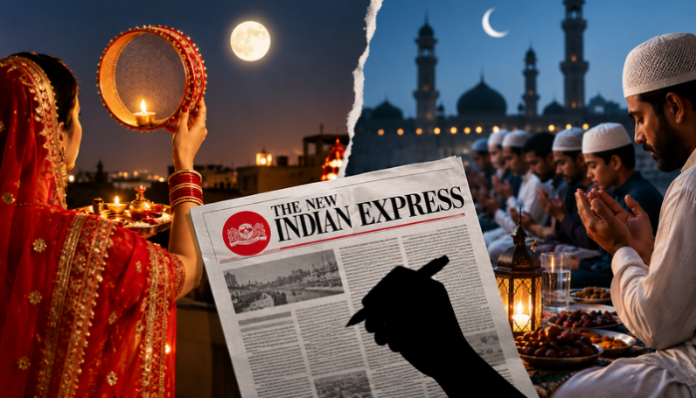
The New Indian Express has achieved a kind of editorial schizophrenia that would be laughable if it were not so insidious. Let’s compare their two articles side by side on Karwa Chauth and Ramzan. These articles are a pure example of pseudo-journalism in which you have to appease Muslim culture and festivals while dehumanising Hindu ones.
The New Indian Express shows its editorial hypocrisy by applying a hermeneutic of suspicion to Karwa Chauth, stripping it of spiritual meaning, and reducing it to a tale of entitled women, while a Ramzan observance is wrapped in a hermeneutic of charity and presented as sacred, communal, and a festival of harmony.
Vilification of Karwa Chauth by anecdote
The very title, “The Hunger Games of Karwa Chauth,” trivialises the festival by evoking a dystopian survival contest. The article opens by centring on the physical hunger of mehndi artists, quoting one saying, “Bhook lagi hai humein, khaana nahi khaya hai” (“We are hungry. We haven’t eaten”). From this single anecdote, a verdict has been delivered before any evidence is heard. The piece then centres on a dispute between mehndi artists and their customers in a Delhi market. From this single incident, it extrapolates a sweeping indictment of millions of Hindu women. It declares, “This is a festival built around hunger,” reducing a day of spiritual discipline to a biological inconvenience.

The article does not interview a single woman about why she observes Karwa Chauth. It does not explore the theology, the familial bonds, the history or the emotional texture of the ritual. It seizes on a marketplace conflict and uses it to portray Hindu women as hypocritical and hollow. “Humility rarely travels beyond the fast itself,” the writer sneers, before accusing the same women of demanding “that others serve their ritual on their terms, with little regard for people who do not share their social background and whose hunger counts for less.”
The practitioner is not a devotee but a caricature: a woman performing sacrifice while secretly being cruel. The closing lines are a masterclass in condescension: “Going hungry for a day is the easy part… The harder fast is the one in which you hold back your impatience, your entitlement.” The ritual is thus stripped of any spiritual meaning and recast as a performance of hollow sacrifice, with the practitioner framed as entitled and unfeeling.

This framing dehumanises the festival. It does not explore the devotion, the familial bonds, or the cultural significance of Karwa Chauth. Instead, it seizes on a minor conflict in a marketplace to indict the entire tradition, portraying Hindu women as hypocritical and their fast as an exercise in vanity.
Legitimising Ramzan: The “Feasts of Faith” framing
Now turn to “Feasts of Faith.” The contrast is grotesque. The Ramzan article opens with reverence: “As the month of Ramzan unfolds, it brings with it not only a period of fasting and spiritual reflection but also a deep cultural significance.”
It describes the month as “a month-long celebration of faith, perseverance, and the profound connection between food and communal identity.” It quotes Rumi and glamorises the fake and nonsensical communal beauty of iftar in Old Delhi. It lingers lovingly on the “rich aromas of kebabs, freshly baked breads, qormas, and phirni” and the “undeniable sense of anticipation as people from all walks of life come together to share in this sacred moment.”
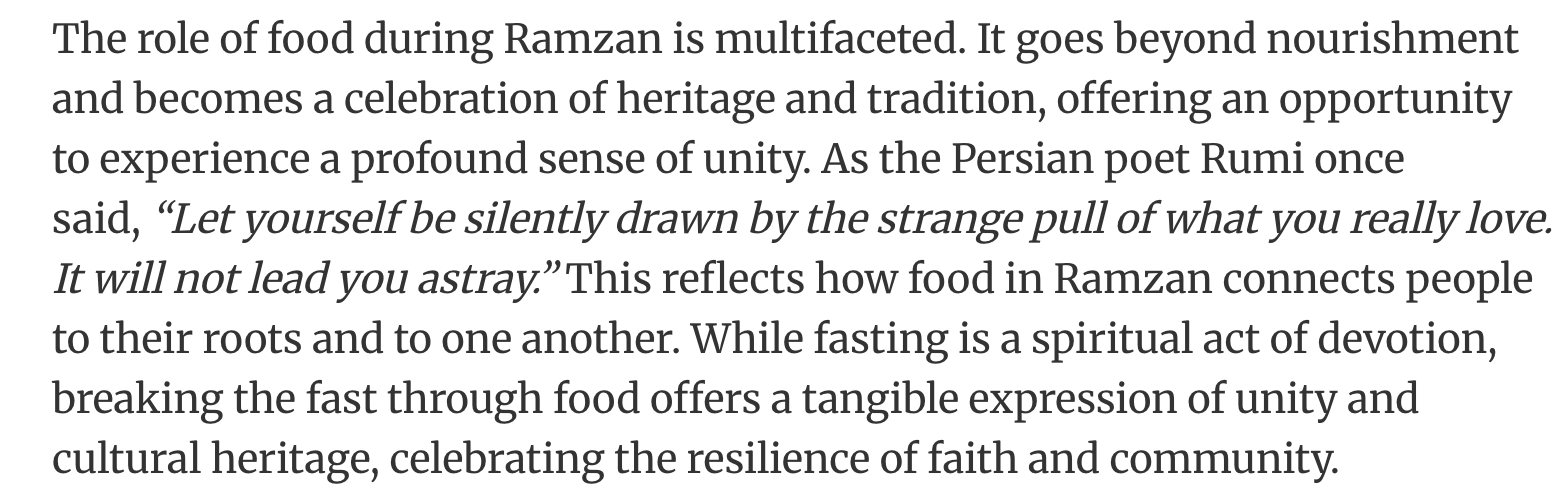
There is no critical scrutiny here. No mention of any unpleasantness at an iftar stall. No suggestion that any Muslim diner might ever be impatient, or entitled, or unkind to a server.
The article acknowledges that “the experience of iftar in Old Delhi can be overwhelming due to the sheer volume of people,” but this is immediately recuperated as a positive: “Yet, this bustle adds to the sense of communal belonging.” Every potential friction is smoothed over; every human failing is airbrushed out.
The Muslim festival is presented as a seamless fusion of spirituality, heritage, and community, a “celebration of spirituality and an enduring expression of cultural heritage.”
This is not reporting. It is public relations. The article functions to legitimise Ramzan as a sacred and socially valuable institution, shielding it from the kind of sceptical, hostile gaze that the newspaper applies so readily to Hindu festivals.
The hypocrisy: A double standard in editorial judgment
The hypocrisy is structural, not incidental. The Karwa Chauth article uses one isolated incident to condemn an entire tradition. The Ramzan article ignores any incident that might complicate its beatific portrait.
The Hindu festival is framed through hunger and hypocrisy; the Muslim festival through faith and feast. The Hindu woman is a hypocrite; the Muslim community is a beacon of unity. If The New Indian Express were interested in genuine social critique, it might have asked whether the commercialisation of Ramzan food stalls obscures the month’s ascetic ideals, or whether any iftar gathering displays the same class tensions it was so eager to criticise at a Karwa Chauth market. It did not. The scrutiny runs in only one direction.
This is not neutral journalism. It is a form of cultural denigration dressed as progressive commentary. The New Indian Express has every right to criticise ritual hypocrisy, but it has no right to do so selectively, using the Hindu community’s festival as a punching bag while treating another’s with kid gloves.
The paper’s editorial board should be ashamed. It has abandoned the pretence of fairness and revealed itself as an institution that believes Hindu traditions are fair game for mockery, while minority faiths must be handled with reverence. That is not journalism. It is bigotry with a byline.
The double standard is not confined to Karwa Chauth
Karwa Chauth is hardly the only Hindu festival that finds itself under the microscope of self-appointed social reformers.
Holi is regularly discussed through the language of pollution, water wastage, harassment and environmental damage.
Diwali is subjected to endless arguments about pollution, consumerism and the supposedly excessive nature of Hindu celebrations. Again, environmental concerns are real and deserve serious attention. But the existence of a problem associated with a festival does not mean its entire cultural and religious significance should be reduced to that problem.
Hindu weddings, temple rituals, fasting traditions and even the celebration of religious symbols are frequently examined through a narrow set of assumptions about caste, gender and superstition.
Some criticism is justified. Religious traditions are not immune from scrutiny, and no community should be exempt from discussions about social reform. But the same scrutiny is not extended to
But criticism becomes intellectually dishonest when it is selective, when it presumes that Hindu practices must first justify their existence before they can be understood, or when the same questions are not asked of comparable practices elsewhere.
A festival can have commercial excesses and still possess religious meaning. A tradition can have patriarchal historical elements and still be experienced by contemporary women as an expression of devotion. A religious observance can be open to reform without being treated as an embarrassment that its adherents must apologise for.
These possibilities are not mutually exclusive. It is the refusal to acknowledge them that makes so much commentary on Hindu customs feel less like analysis and more like a predetermined verdict.
The test of secularism is consistency
Let us be clear about what this argument is not.
It is not a demand that journalists praise every Hindu custom. It is not an argument that Ramzan should be discussed negatively because Karwa Chauth has been criticised. It is not a claim that Muslim religious traditions must be stripped of their cultural significance to achieve some artificial balance.
Muslims have every right to celebrate Ramzan as a sacred month of fasting, prayer, charity and fellowship. A journalist who explains its cultural richness performs a useful service to readers Who want to know about Ramzan and the supposed benefits of fasting throughout the day?.
But the same courtesy should extend to Hindus.
If fasting is worthy of being discussed as an act of spiritual discipline during Ramzan, Hindu fasting traditions deserve the same basic willingness to understand the beliefs that animate them. If food and feasting can express community during iftar, the ritual meals and family gatherings associated with Hindu festivals deserve to be understood beyond their commercial packaging. If religious identity is a legitimate source of belonging for one community, it cannot automatically become a sign of backwardness when expressed by another.
Secularism does not require journalists to pretend that traditions belonging to the minority faith are more important and culturally enriching than those belonging to the majority. It requires them to apply comparable standards of inquiry, empathy and criticism.
And consistency means more than occasionally publishing a positive story about a Hindu festival. It means approaching each community without assuming that one requires cultural sensitivity while another requires ideological correction.
The incident involving the mehndi artists deserved attention. The customers’ alleged behaviour, if accurately reported, deserved criticism. The article’s closing argument about exercising patience and empathy towards workers is sound advice.
But none of that requires turning the religious fast into the principal instrument of moral judgment. The same message about entitlement could have been conveyed without making the reader’s assessment of Hindu women’s devotion the final test.
A journalist can criticise a person’s conduct without making the person’s religious tradition bear the weight of that criticism. And a publication can celebrate the cultural richness of one community without treating the traditions of another as a convenient stage for social commentary.
Hindu festivals are not public property for ideological sermons
There is a growing impatience among Hindus with a familiar pattern: their traditions are welcomed as colourful spectacles for tourism, food writing and cultural photography, but become fair game for condescending lectures when their religious meaning enters the conversation.
The problem is not criticism itself. Hindu civilisation has a long history of internal debate, philosophical disagreement and social reform. Its traditions have never been beyond discussion.
The problem is the presumption that the Hindu believer must always be placed in the dock, explaining why a ritual matters, defending why it survives and proving that it does not violate the sensibilities of an external observer.
A Hindu woman should not have to demonstrate that Karwa Chauth makes her sufficiently progressive before her religious choice is respected. Nor should a Hindu family have to defend the cultural value of Holi or Diwali every time a discussion about misconduct or environmental costs arises.
The same standards of evidence and scrutiny should apply to every religious tradition. Where a practice causes harm, discuss the harm. Where a person behaves badly, criticise the person. Where a custom raises questions about gender or social pressure, examine those questions honestly. But do not use an isolated incident as an excuse to reduce an entire tradition to its least flattering interpretation.
The contrast between Awal’s two articles is not, by itself, proof of an anti-Hindu agenda. It is, however, proof of something far more insidious: hypocrisy. It reveals the double standards of how the language of faith, community and cultural heritage appears so prominently in one account, while the other leans on a moral critique of the women observing a Hindu fast.
That is the question The New Indian Express and its readers should be willing to confront.
If the objective is genuine cultural understanding, it cannot operate on a hierarchy in which some religious practices are presumed meaningful until proven otherwise, while others are presumed regressive until they pass an ideological test.
The standard cannot be cultural empathy for Ramzan and cultural condescension for Karwa Chauth.
If a fast is an expression of devotion for one community, the starting point for understanding another community’s fast should be the same respect for the believer’s agency. Criticism can follow where it is warranted, but it must follow evidence and consistent principles, not a predetermined hierarchy of which faith deserves sympathy and which deserves a sermon.
Hindus do not need journalists to endorse every custom they practise. They deserve something far less demanding: to have their faith understood without being patronised, their traditions examined without being caricatured, and their festivals treated with the same intellectual fairness extended to everyone else.
That should not be a controversial demand in a country that prides itself on pluralism.
It should be the bare minimum of good journalism.