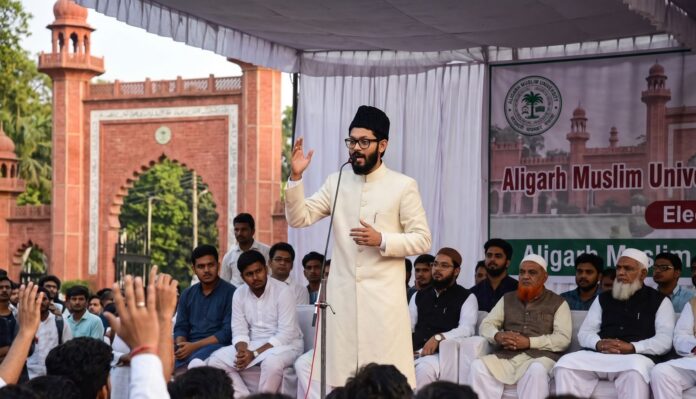
After an eight-year hiatus, the Aligarh Muslim University (AMU) finally conducted its Students’ Union (AMUSU) elections for the 2026–27 academic session. While the return of student democracy at a central university funded heavily by the Indian taxpayer would ordinarily be expected to revolve around academic infrastructure, hostel accommodations, placement cells, and administrative accountability, the campaign at AMU took a markedly different trajectory.
With the election of Noman Ashraf as the President of the AMU Students’ Union, the election has underscored how transnational pan-Islamic causes, opposition to state law enforcement, and solidarity with individuals accused under the Unlawful Activities (Prevention) Act (UAPA) continue to dominate the political imagination of student leadership on the AMU campus.
Throughout the election campaign, campus-specific student welfare issues took a backseat as presidential contenders competed to project themselves as the fiercest defenders of global Muslim causes and domestic political figures facing serious legal charges. Noman Ashraf’s victory comes on the heels of a series of fiery campaign speeches that sparked widespread debate and outrage across the country, raising critical questions about the ideological direction of student politics at one of India’s most prominent central universities.
AMU student union election results are out, and Noman Ashraf is elected president. His heart beats for Gaza, Palestine, and the Ummah, while his speeches obsess over Islamic history. Know all about Noman, a staunch backer of Sharjeel Imam and Umar Khalid, with @Keshavmalan93 https://t.co/I5DXXoralL
— OpIndia.com (@OpIndia_com) November 6, 2026
The ideological pitch: Invoking the ‘Ummah’ and ‘Mazi’ over campus governance
A close examination of Noman Ashraf’s campaign rhetoric reveals a calculated strategy to appeal to religious identity and pan-Islamic solidarity rather than mundane student grievances. In his addresses to the student body during the run-up to the polls, Ashraf explicitly relegated everyday issues to the background to focus on broader political and religious narratives.
In one of his widely circulated campaign speeches at the university, Ashraf declared:
“Qaum aur Millat ki baat toh hoti rahegi, lekin mulk ke siyasi haalaat tashweesh-naak hain. Musalmano ka haal bad-se-badtareen hai. Ek particular identity ki wajah se mazaaron ko mismaar kiya ja raha hai, masjido ko shaheed kiya ja raha hai, aur uske baad gharon ko bulldozer se dhaya ja raha hai.” (Talks of the community and nation will keep happening, but the political situation of the country is alarming. The condition of Muslims is going from bad to worse. Because of a particular identity, shrines are being demolished, mosques are being martyred, and homes are being razed with bulldozers.)
Student politics at AMU descends into calls for Islamic Ummah. Campaigners invoke Islamic history and frame routine law enforcement as targeted persecution. Presidential candidate Noman Ashraf play the victim card. @Keshavmalan93 and @RitikaChandola https://t.co/uNReSddNTd
— OpIndia.com (@OpIndia_com) November 4, 2026
By framing legal and municipal actions against illegal encroachments and criminal elements across India as a targeted assault on a “particular identity,” Ashraf sought to cultivate a deep sense of siege among the student electorate. Rather than urging students to look toward modern academic excellence, scientific temperament, or constitutional remedies, his prescription was a return to religious orthodoxy and historical revivalism.
Addressing the students as the “ghayyur talaba saathiyon” (proud/zealous student companions) of Aligarh, Ashraf diagnosed the contemporary challenges facing the community as a “decline of the Ummah” (Ummat ka zawaal) and a “lack of leadership” (leadership ka fuqdan) resulting from Muslims forgetting their past (apni maazi ko bhool chuke hain). He issued a passionate call to the students:
“Apne maazi ki taraf laut kar aao, Rasool-e-Paak ki taraf laut kar aao, Sahaba-e-Kiram ki taraf laut kar aao… Sir Syed ki taraf laut kar aao, Shibli aur Hali ki taraf laut kar aao, Aligarh Movement ke alambardaron ki taraf laut kar aao.”
The seamless blending of religious figures with the pioneers of the Aligarh Movement, a movement historically rooted in separatist identity politics before 1947, demonstrated how deeply religious revivalism remains embedded in the electoral calculus of AMU’s student union.
Gaza, Palestine, and the ‘Army of Ababeels’: Transnational Islamism in a university election
Perhaps the most striking aspect of Noman Ashraf’s campaign was his heavy reliance on international geopolitical conflicts in the Middle East and Africa, issues that have zero bearing on the administration or academic functioning of a university in Uttar Pradesh. While canvassing for votes, Ashraf devoted significant portions of his speeches to Palestine, Gaza, Iran, and Sudan, positioning the AMU student body as an extension of the global Ummah-e-Muslima (the global Islamic community).
With theatrical flair, placing his hand over his heart before a cheering crowd of students, Ashraf proclaimed:
“Aye Falasteen ke logon, aye Iran, Sudan ke logon, tumhare liye mera dil dhadakta hai, tumhare liye mera dil tadapta hai. Ghabrane ki zaroorat nahi hai, Ummat-e-Muslima tumhare saath khadi hai.” (O people of Palestine, O people of Iran and Sudan, my heart beats for you, my heart yearns for you. There is no need to fear; the Muslim Ummah stands with you.)
The heart of an AMU presidential candidate bleeds for Gaza, Palestine, Iran, and Sudan. Are Palestinians flying in to cast votes in the AMU student union election? Listen to the speech by Noman Ashraf and see what his key issues are. https://t.co/NSV7a2qZBR
— OpIndia.com (@OpIndia_com) November 4, 2026
Going further, Ashraf invoked explicit religious war imagery from Islamic tradition, referencing the Ababeel, the mythical flocks of birds described in the Quran (Surah Al-Fil) that dropped stones of baked clay to destroy the army of Abraha marching on Mecca.
“Har tareeki ke baad, andhere ke baad subah honi hai. Ababeelon ka lashkar aayega, tumhari fatah hogi, Allah tumhe bachayega. Inshallah tabarak wa ta’ala, tum surkhuru hoge, tum kaamyab hoge.” (After every darkness, morning is bound to come. An army of Ababeels will arrive, victory will be yours, Allah will protect you. God willing, you will be victorious and successful.)
The invoking of the “Lashkar of Ababeels” and rallying students around Iran, Sudan, and Gaza during a university union election serves no practical purpose for the students of Aligarh. Instead, such rhetoric functions as a potent ideological dog-whistle designed to polarise the electorate along transnational religious lines, prioritising global Islamist solidarity over local civic and academic responsibilities.
Whitewashing UAPA accused: The defence of Sharjeel Imam and Umar Khalid.
If the invocation of foreign conflicts highlighted an obsession with pan-Islamism, Ashraf’s vocal defence of Sharjeel Imam and Umar Khalid brought his campaign directly into conflict with concerns over national security and India’s territorial integrity. Both Imam and Khalid are currently facing grave legal proceedings under the stringent Unlawful Activities (Prevention) Act (UAPA) for their alleged roles in the larger conspiracy behind the February 2020 anti-Hindu riots in Delhi, which left over 50 people dead and hundreds injured.
Sharjeel Imam, in particular, has a direct and notorious connection to the AMU campus. During the height of the anti-CAA agitation in early 2020, it was on the very grounds of Aligarh Muslim University that Imam delivered his infamous speech calling upon Muslims to mobilise in large numbers to permanently “cut off” Assam and the entire Northeast from the rest of India by blocking the strategic Siliguri Corridor, commonly known as the “Chicken’s Neck.”
Imam had explicitly urged the disruption of military and supply lines to the Northeast to force the Indian state to bow to their demands. Similarly, Umar Khalid, who first rose to national infamy during the 2016 JNU sedition row where anti-India slogans were raised, stands accused by Delhi Police investigators of being one of the principal conspirators who engineered the communal violence in the national capital during a high-profile state visit by the US President in February 2020.
Despite the severity of the charges and the documented video evidence of Imam’s secessionist rhetoric at AMU itself, Noman Ashraf chose to champion both individuals as “political prisoners” during his presidential campaign. Facing criticism for bringing up their names, Ashraf doubled down in a subsequent speech to loud applause from his supporters:
“Baat karte ho ki maine political prisoners ki baat kar di, maine Sharjeel Imam ki baat kar di, maine Umar Khalid ki baat kar di… Sharjeel Imam ya Umar Khalid koi bhi ho, maine apni taqreer mein kaha tha ki kanoon ko haath mein lene ki ijazat kisi ko nahi hai. Adalat ka faisla abhi nahi aaya hai, trial shuru nahi hue hain, tum kaise kisi ko aatankwadi, terrorist, aur is tarah ka tamgha de sakte ho?” (You question why I spoke about political prisoners, why I mentioned Sharjeel Imam, why I mentioned Umar Khalid… Whether it is Sharjeel Imam or Umar Khalid, I said in my speech that no one is allowed to take the law into their own hands. The court’s verdict has not come yet, and trials have not begun; how can you label someone a terrorist and attach such a stigma to them?)
While Ashraf cloaked his defence in the technicality of “due process” and pending trials, the roaring reception from the crowd at the mere mention of Sharjeel Imam and Umar Khalid exposed the underlying sentiment. By elevating individuals accused of plotting communal riots and advocating the severing of Indian territory as persecuted heroes, Ashraf’s campaign effectively mainstreamed sympathy for radical elements who have shown open contempt for Indian sovereignty and communal harmony.
Notably, Ashraf made no mention of the role of defence counsels in delaying the framing of charges and trial proceedings in the Delhi riots case, nor did he express any sympathy for the victims of the 2020 violence, such as Intelligence Bureau officer Ankit Sharma or head constable Ratan Lal.
Resenting the rule of law: ‘Police used to tremble before entering AMU’
Beyond national and international politics, Ashraf’s campaign speeches also betrayed a deep-seated hostility toward state law enforcement and university disciplinary mechanisms. In a video from his November 3 campaign rally, Ashraf lamented that after 2020, when law enforcement cracked down on violent anti-CAA protests on campus, the university had supposedly undergone “saffronization” (bhagwakaran) because police were now able to enter the campus and register FIRs against errant students.
In a startling admission of how the university campus was previously treated as an extra-judicial zone above the law of the land, Ashraf stated:
“Aakhir campus ke andar police ka involvement badha. 2020 ke baad is campus ke andar saffronization aur bhagwakaran bhi hua hai, isko bhi jaanna padega. Woh police jinki kabhi roohें kaampti thi campus ke andar entry karne se, woh Aligarh mein ghus kar talaba biradri par FIR karti hai, suspension deti hai.” (After all, police involvement inside the campus increased. After 2020, saffronization has also happened inside this campus; we must recognise this. That police whose very souls used to tremble at the thought of entering the campus, now enter Aligarh and file FIRs against the student fraternity and hand out suspensions.)
“Police used to tremble at the thought of entering AMU.” Noman Arshad, a presidential candidate at Aligarh Muslim University, made this provocative statement. https://t.co/RtIbesWRcd
— OpIndia.com (@OpIndia_com) November 4, 2026
He went on to issue an open warning to the administration against detaining or suspending students, promising that under his leadership, every single student who had been suspended or detained for indiscipline or unlawful activities would be reinstated (“Ek-ek bachche jinko suspend kiya gaya hai, detain kiya gaya hai, Inshallah sabki bahali hogi”).
Expecting state police to “tremble” before entering a public university campus and equating the enforcement of law and order with “saffronization” highlights a mindset that views AMU not as an educational institution governed by Indian law, but as an autonomous fiefdom where students should enjoy impunity from legal consequences.
A broader pattern: Azam Khan and Jauhar University
It is also worth noting that Noman Ashraf was not an outlier in this election cycle; rather, his rhetoric reflected the broader ecosystem of the 2026 AMUSU polls. His rival presidential candidate, Mohd Inthikhab, similarly bypassed campus issues to champion Samajwadi Party leader Azam Khan, who has been convicted and jailed in multiple cases ranging from land grabbing and theft to forgery.
Addressing the electorate, Inthikhab referred to Azam Khan as an “Old Boy” (alumnus) of AMU and claimed he was imprisoned solely because he established Mohammad Ali Jauhar University in Rampur, conveniently ignoring the numerous judicial findings regarding how state power was abused to acquire land from poor farmers and Dalits for the private institution. Inthikhab went so far as to issue a veiled threat to the state administration:
“Hamare Old Boy Azam Khan ko sirf isliye jail mein rakha hai kyunki unhone Hindustan ke logon ke liye ek bada idara qaayam kiya… Dubara agar Jauhar University ki taraf kisi ne aankh utha kar dekha, toh yeh Aligarh ke bahadur sipahi aapke saamne chattaan ki maanind khade honge, aur yeh saabit karenge ki woh idara hamara hai, usko hum chalayenge.” (Our Old Boy Azam Khan has been kept in jail only because he established a major institution for the people of India… If anyone dares to raise an eye toward Jauhar University again, these brave soldiers of Aligarh will stand before you like a rock, and prove that the institution belongs to us and we will run it.)
What Noman Ashraf’s victory signifies
The election of Noman Ashraf as the President of the AMU Students’ Union after an eight-year gap is a sobering reminder that the ideological currents within the university remain largely unchanged. When a candidate can secure the highest student office at a central university by lamenting that the police no longer fear entering the campus, by pledging allegiance to foreign conflicts in Gaza, Iran, and Sudan, and by whitewashing individuals accused of plotting communal riots and threatening India’s territorial integrity, it raises serious concerns about the environment being fostered on campus.
Central universities are meant to be crucibles of learning, research, and nation-building. However, the 2026–27 AMUSU election campaign and Noman Ashraf’s subsequent victory demonstrate that for a significant section of the student leadership at Aligarh, campus politics remains a vehicle for radical identity politics, religious polarisation, and defiance of the Indian constitutional and legal framework.