

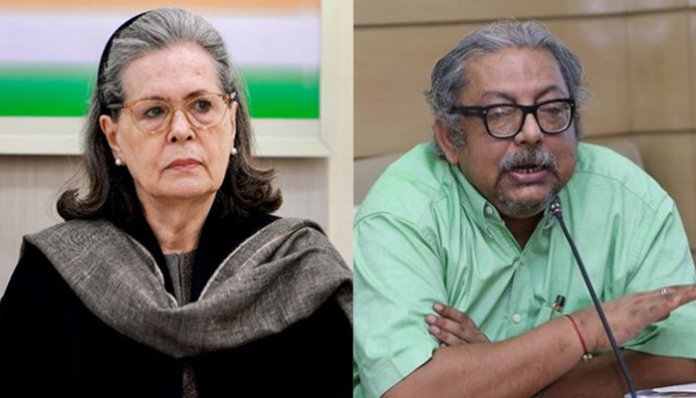
‘Belonging: A Journey of Love’, the memoir of veteran Congress leader Sonia Gandhi published on 10th November 2026, has stirred a fresh debate that goes beyond political revelations. The book has triggered some uncomfortable questions for Gandhi and her party, particularly in light of several lies, distortions, and factual inaccuracies. Now senior journalist Kanchan Gupta has recalled how Sonia Gandhi got him sacked from the position of Associate Editor at The Pioneer over an article criticising her.
Despite containing several distortions relating to political and historical events, the book continues to be available for people to read.
This has led many to question whether such freedom of expression would have been allowed without consequence had Sonia Gandhi and her party been in power.
A real account relating to senior journalist Kanchan Gupta provides an answer to the question.
As the debate around freedom of expression gained traction in the context of Gandhi’s memoir, Kanchan Gupta recalled his sacking from the position of Associate Editor at The Pioneer at Sonia Gandhi’s behest.
In an X post published on 14th November, Kanchan Gupta narrated how he was suddenly fired from his job after attracting the wrath of Sonia Gandhi by merely writing a piece that she did not like.
Gupta wrote that he was not only rendered jobless for simply doing his job, but he and his family were also left without a roof over their heads as the house they lived in belonged to his employers.
“It was an extremely distressing experience to get sacked in 1995 from The Pioneer, where I was Associate Editor because the then Editor (economist Ashok Mitra famously described him as a ‘handout Editor’) needed to suck up to Sonia Gandhi,” Gupta wrote.
“No less distressing was the reality of being left without a roof and phone (rented/owned by The Pioneer’s then owners, the Thapars) with a family in tow — we were literally out in the streets with nowhere to go,” he added, recalling the tough period.
Kanchan Gupta was sacked because he wrote an article titled “Ram Rajya vs Rome Rajya” before the 1996 Lok Sabha elections. After the article was published in The Pioneer, Sonia Gandhi’s then PA, Vincent George, called the Executive Editor at the time and conveyed Gandhi’s displeasure at the article. This led to Gupta losing his job overnight.
I must thank @ARanganathan72 for flagging my sacking at the behest of a Lutyens clerk merely because I was not deferential to his boss. So this is how this and other near-sackings happened in my otherwise vanilla life. It was an extremely distressing experience to get sacked in 1995 from The Pioneer where I was Associate Editor because the then Editor (economist Ashok Mitra famously described him as a ‘handout Editor’) needed to suck up to Sonia Gandhi. No less distressing was the reality of being left without a roof and phone (rented / owned by The Pioneer’s then owners, the Thapars) with a family in tow — we were literally out in streets with nowhere to go. All this happened after Vinod Mehta resigned in protest against pressure from Thapar House to be ‘nice’ to Sharad Pawar to whom the ‘Bombay Club’ was beholden. That was not my first or last experience of running into trouble with Sonia Gandhi and her factotums. I had published a photograph of Rajiv and Sonia in The Statesman’s popular weekend section (The Saturday Statesman) which I edited, shot during their visit to Mizoram in 1986. Sonia was in a Lacoste tee and the couple looked remarkably striking. Those were still Camelot days of Prince Charming. It was a measure of the then Government’s illicit and undeclared reach that they had access to The Saturday Statesman, which was printed in Kolkata and shipped to Delhi on Thursday-Friday, before its distribution on Saturday. HY Sharada Prasad, Press Advisor to Rajiv Gandhi, called CR Irani, MD of The Statesman, and rained fire and brimstone on him for daring to publish a ‘private photo of Madam.’ Sharada Prasad demanded that The Saturday Statesman with the Rajiv-Sonia photo should not be distributed and all copies must be destroyed. Irani, who was then struggling to get the rebuilding plans for The Statesman’s Delhi office at CP approved, worked out a deal that there would be an ‘apology’ in the main paper and The Saturday Statesman would be distributed. Irani asked me to draft the apology and run it in Saturday morning’s paper. On that occasion Swapan, also at The Statesman, stood like a rock by me — I remain grateful to him. He also drafted the ‘apology’ for me — Swapan’s nib-breaking, tongue-twisting, brain-wracking English impressed Sharada Prasad but little did he realise it was actually a non-apology. The story of my encounters with the Nehru Dynasty is one of several episodes. In 2012 the Sonia Gandhi-led UPA regime invoked the draconian anti-Freedom of Expression, anti-liberty, anti-Constitution Section 66A (drafted and implemented by Kapil Sibal with great fervour to prevent, prosecute and punish any criticism of Sonia Gandhi and silence all critical Speech in India) against me, instructing ISPs to block my Twitter handle. The handles of several other journalists and regime critics were also blocked. The sinister charges against me, never registered formally but only informally conveyed, made me feel like Trotsky in Stalin’s court. Better counsel by way of domestic and global criticism of this attempt to choke voices prevailed and the block order was quietly buried after a hearing in a dark room with a single electric bulb hanging from the ceiling, very reminiscent of the interrogation chambers of Mussolini’s secret police OVRA. I was later told the Gestapo-style hearing was the brainchild of then Home Secretary RK Singh whose fetid imagination had also birthed the hideous nomenclature ‘Saffron Terror’. He who later floated into NDA and has now floated out again. @kushanmitra
— Kanchan Gupta 🇮🇳 (@KanchanGupta) November 14, 2026
When Sonia Gandhi censored a newspaper
Gupta further writes that this was not the only time that the Congress government suppressed the freedom of expression.
He recalls how on another occasion the Congress government tried to prevent the publication of a photograph of Rajiv Gandhi and Sonia Gandhi.
He writes that, while editing The Saturday Statesman, the weekend edition of The Statesman, he had published a photograph of Rajiv Gandhi and Sonia Gandhi taken during their visit to Mizoram in 1986.
“I had published a photograph of Rajiv and Sonia in The Statesman’s popular weekend section (The Saturday Statesman), which I edited, shot during their visit to Mizoram in 1986,” Gupta said.
But before the newspaper’s weekend edition could be published, the newspaper’s Managing Director, CR Irani, received a phone call from Rajiv Gandhi’s Press Advisor, H.Y. Sharada Prasad, expressing anger over the photo, which he described as a “private photo of Madam”. Gupta said that Prasad demanded that the photo not be distributed, all its copies be destroyed, and an apology be published in the main paper.
“Sharada Prasad demanded that The Saturday Statesman with the Rajiv-Sonia photo should not be distributed and all copies must be destroyed. Irani, who was then struggling to get the rebuilding plans for The Statesman’s Delhi office at CP approved, worked out a deal that there would be an ‘apology’ in the main paper and The Saturday Statesman would be distributed. Irani asked me to draft the apology and run it in Saturday morning’s paper,” Gupta wrote.
The senior journalist pointed out the influence and the control the Congress government exercised over the press at the time.
He said that during the UPA government, the Prime Minister’s Office had access to newspaper copies even before their scheduled circulation.
According to Gupta, The Saturday Statesman containing the photo was printed in Kolkata, and its copies were dispatched to Delhi on Thursday and Friday to be distributed on Saturday. But the government got access to the newspaper before it was publicly distributed and censored it.
When the UPA government got journalists blocked on social media
Gupta describes another instance from 2012 when the Congress government muzzled freedom of expression. He said that in 2012, the UPA government tried to silence him by invoking Section 66A of the Information Technology Act, 2000, which was later struck down by the Supreme Court as unconstitutional.
Gupta said that the government got the Twitter handles of several journalists, including his, blocked.
“In 2012, the Sonia Gandhi-led UPA regime invoked the draconian anti-Freedom of Expression, anti-liberty, anti-Constitution Section 66A (drafted and implemented by Kapil Sibal with great fervour to prevent, prosecute and punish any criticism of Sonia Gandhi and silence all critical Speech in India) against me, instructing ISPs to block my Twitter handle,” Gupta wrote, adding that the charges against him were never formally registered.
Kanchan Gupta is one among many whose freedom of expression was unscrupulously crushed by the same Congress party that now accuses the Modi government of curtailing the fundamental right.
The account underlines the hypocrisy of the Congress Party and its duplicity with respect to freedom of expression. Congress’s track record shows how the party upholds the fundamental right only when it serves its agenda and brutally suppresses it when it does not.
It is evident from the fact that it was the Congress-led government that introduced Section 66A to the IT Act and used it to target people who were critical of the government or the Gandhis.
The provision was declared unconstitutional and struck down by the Supreme Court in 2015 in Shreya Singhal v. Union of India.


