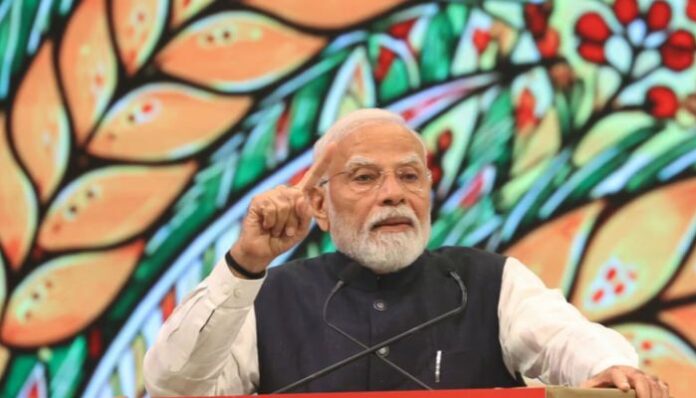
On 12th November 2026, Prime Minister Narendra Modi spoke about emerging mobile/sensor-based soil testing technology at the Kisan Tak Bharat Agriculture Conference organised by India Today Group at Bharat Mandapam in New Delhi. However, PM Modi’s detractors could help themselves with their knack for nitpicking to attack him, and framed his remarks about how mobile phones are playing a significant role in soil testing as the PM saying, ‘smear soil on a mobile screen and it will give a report’.
In this vein, the Cockroach Janta Party (CJP) posted on X, ” What’s next? Get your MRI report by posting a selfie?”
What’s next? Get your MRI report by posting a selfie? https://t.co/qQrki8EuCk
— Cockroach Janta Party – CJP (@Cockroachisback) November 14, 2026
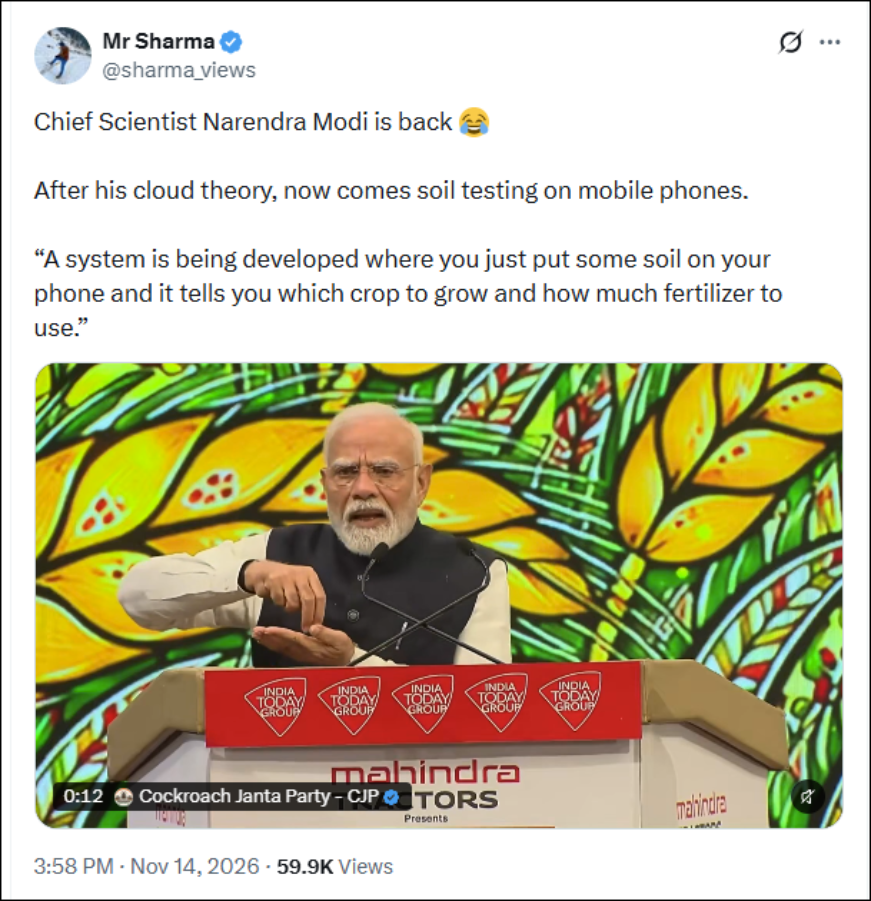
One pro-Congress troll wrote, “Chief Scientist Narendra Modi is back After his cloud theory, now comes soil testing on mobile phones. “A system is being developed where you just put some soil on your phone and it tells you which crop to grow and how much fertilizer to use.”
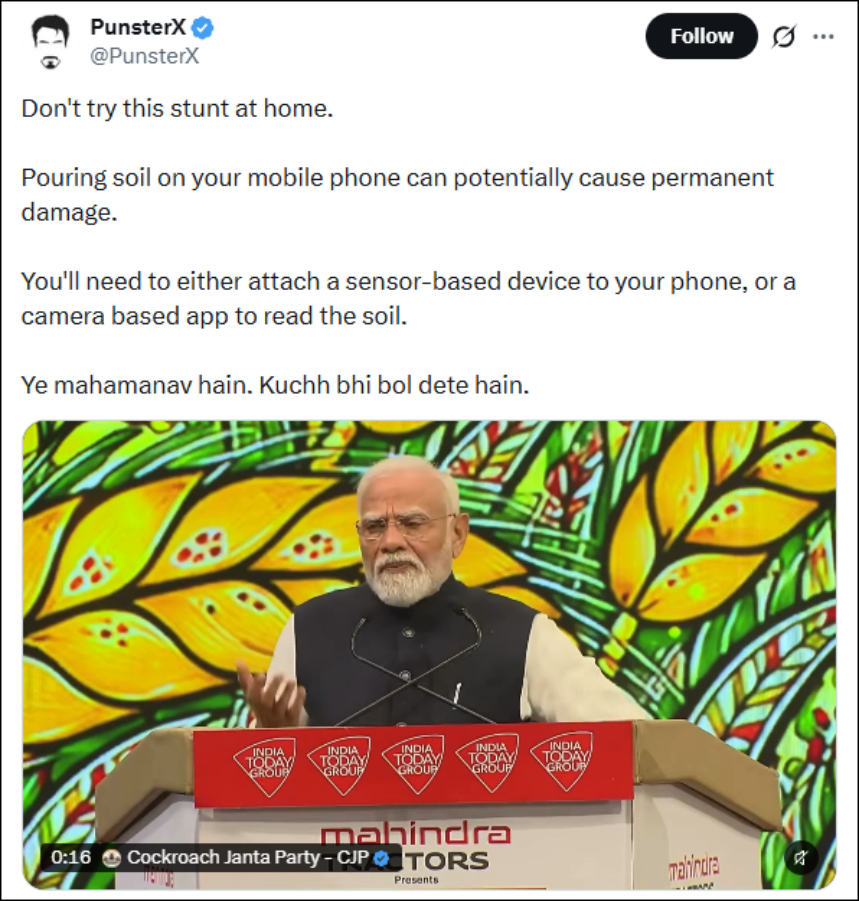
Another one wrote, “Don’t try this stunt at home. Pouring soil on your mobile phone can potentially cause permanent damage. You’ll need to either attach a sensor-based device to your phone, or a camera based app to read the soil. Ye mahamanav hain. Kuchh bhi bol dete hain.”
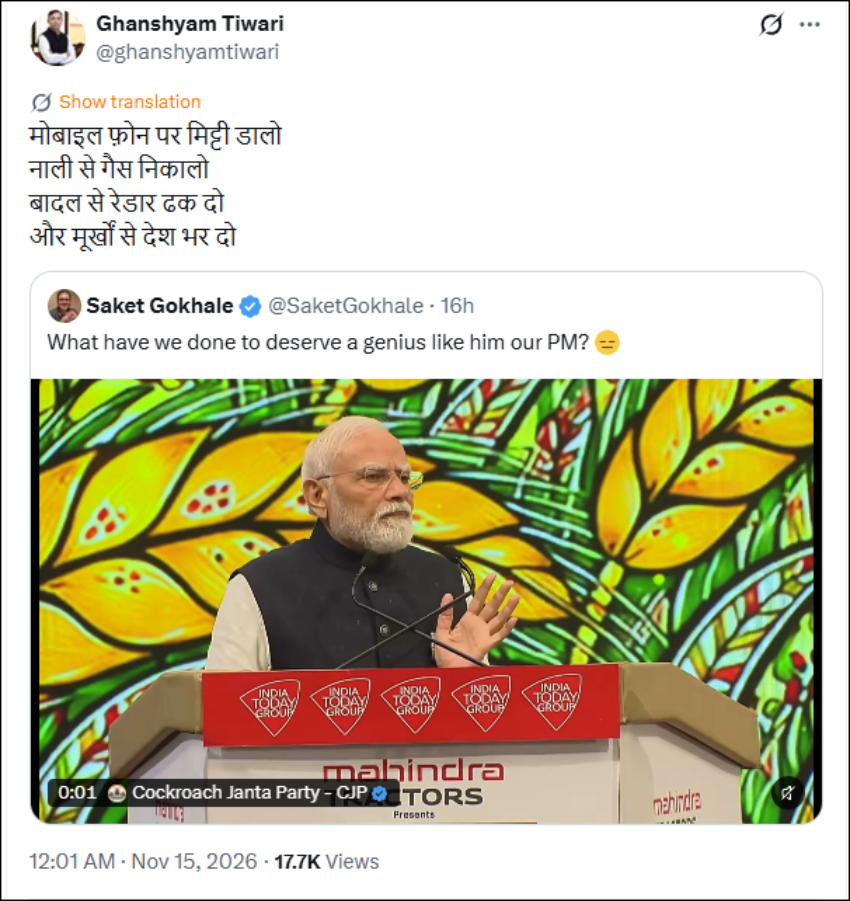
Meanwhile, Samajwadi Party spokesperson Ghanshyam Tiwari wrote, ” Pour dirt on a mobile phone Let gas escape from a drain Cover a radar with a cloud and fill the country with fools.”
Did PM Modi really say that farmers have to just pour dirt on a mobile phone screen to obtain a soil test report?
During his address at the Kisan Tak Bharat Agriculture Conference, Prime Minister Narendra Modi spoke at length about the role of engineering in agriculture, which is expanding rapidly. He said that agricultural scientists, engineers, and youth are together developing such tools and machines that are reducing the cost of farming.
PM Modi urged those engaged in manufacturing machines and equipment for farmers to pivot toward solar energy.
“Our agricultural scientists, engineers, and youth are together developing such tools and machines that are reducing the cost of farming. In some places, machines are being developed that are making sowing and harvesting easier. And I would especially like to urge the people from industry present here, those engaged in manufacturing equipment for farmers, as well as our startup founders, that whatever equipment you build from now on should be powered by solar energy, because we are taking solar power to every farm. Just as the whole world has now rushed towards electric vehicles, I am in favour of making every type of agricultural tool solar-powered,” he said.
Speaking at the Bharat Agriculture Conference. @IndiaToday @aajtak https://t.co/zSM5kaRsvi
— Narendra Modi (@narendramodi) November 12, 2026
It was after this that Prime Minister Modi spoke about soil testing with the use of mobile phones.
Contrary to the claims being made by the anti-Modi cabal online, PM Modi did not essentially say that farmers can conduct soil test by simply dropping or smearing dirt on the screen of their mobile phone.
PM Modi explicitly spoke about how sensor-based equipment powered by Artificial Intelligence (AI) technology is now being developed that can provide precise information to farmers and can be affordable even for the smallest farmers.
PM Modi said that technology is under development to facilitate soil testing through mobile phones. He said that farmers have to just place a little soil on the mobile-based device, and their phone will immediately provide a report identifying the soil quality, the type and quantity of fertiliser required, etc.
“Not only that, sensor-based equipment equipped with AI technology is now being developed that can provide precise information to farmers and can be affordable even for the smallest farmers. Arrangements are now being developed for soil testing through mobile phones. You simply place a little soil on the mobile-based device, and your phone immediately provides a report identifying which crop your soil is suitable for, how much fertiliser is required, and what type of fertiliser is needed. In other words, just see how rapidly change is taking place,” PM Modi said.
PM Modi’s wording was somewhat colloquial, and his hand gesture simply emphasised how easy the process of soil testing becomes with the advent of technology, allowing soil testing through mobile-based devices. The trolling and the mockery would have made sense had PM Modi not mentioned the sensor-based devices equipped with AI tech and their integration with mobile phones to make soil testing easy, time-saving, and affordable. However, the Prime Minister did replicate Rahul Gandhi’s “aaloo se sona” moment.
The mockery, thus, does not make sense beyond political jibes since PM Modi never claimed that mobile phones themselves chemically analyse soil through their screens or cameras encountering soil smeared over them.
What PM Modi pointed to is real and advancing soil-testing technology linked to smartphones.
IIT Kanpur has developed Bhu-Parikshak, a portable, wireless handheld cylindrical device which uses near-infrared (NIR) spectroscopy.
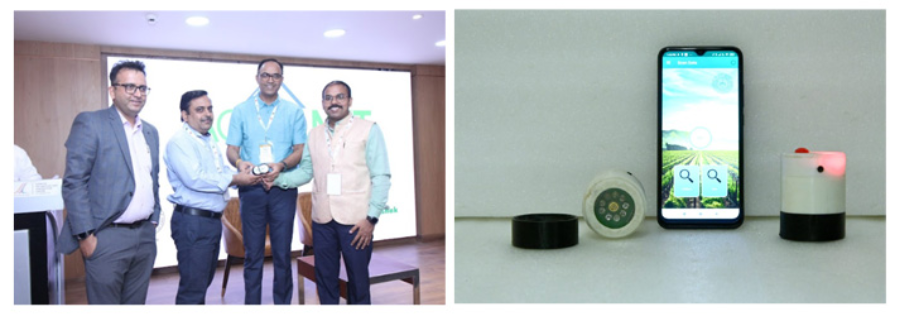
A dry soil sample, about 5 grams, is placed into the device. The device connects to a smartphone via Bluetooth and analyses key parameters, including Macronutrients like Nitrogen, Phosphorus, and potassium; in addition, Organic Carbon, Clay content, Cation Exchange Capacity, etc., within 90 seconds.
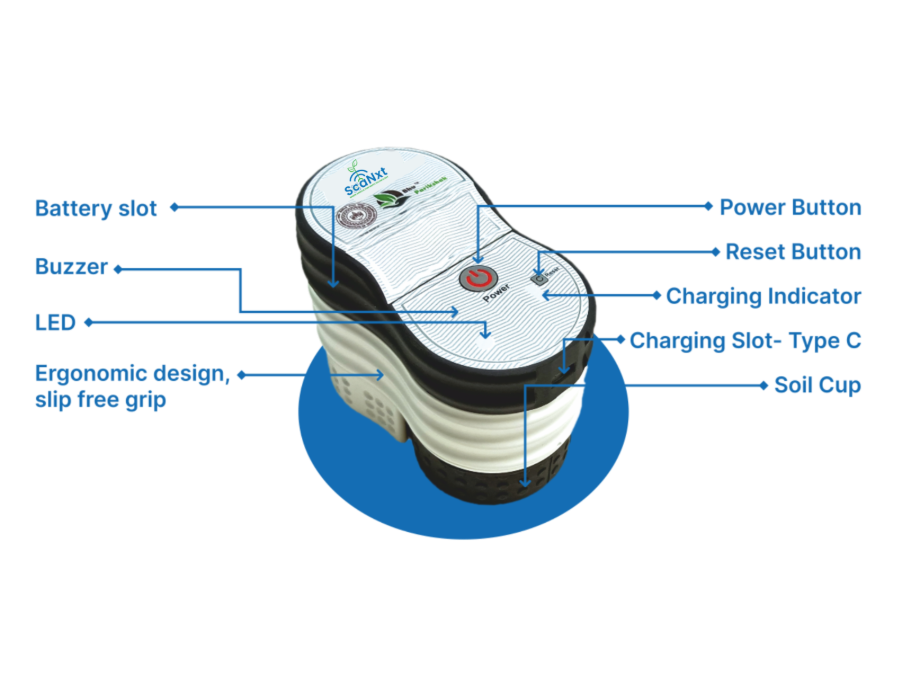
The device delivers a soil-health report and fertiliser recommendations through a mobile application with local-language support. Bhu-Parikshak can handle large numbers of tests.
The technology was developed at IIT Kanpur, then transferred to aggrotech firm AgroNxt for commercialisation.
There are various soil-health apps and portals, handheld devices with satellite AI elements and private tools delivering fast recommendations in local languages.
These efforts cut reliance on distant labs, support precision nutrient management, reduce excess fertiliser costs, and enhance soil health over time.
Wish you guys had gone to school, studied, and learned basic Google search to know the reality. The other day the Prime Minister mentioned at the Kisan Tak event that new systems let farmers put a little soil into a phone-connected device and get an instant report on nutrients and fertiliser needs. Opposition parties mocked it as absurd. The technology already exists. IIT Kanpur’s Bhu Parikshak does exactly this: add a small soil sample, connect via Bluetooth to the app, and get results on N, P, K and other parameters in about 90 seconds. App: https://t.co/GwdL1lr4s3 NITI Aayog has highlighted similar pocket-sized devices: https://t.co/NWrD2tlmMC Mocking is easy. The tech is real.
— Sandiip Gandotra (@sandiipgandotra) November 15, 2026
Expansion of soil testing laboratories and development of mobile-based technology is significant; in 2014, there were only a few hundred soil-testing laboratories in the country. Now the number of soil-testing labs has increased to over 8,400, and there are more than 750 Krishi Vigyan Kendras nationwide.
India’s soil-testing infrastructure, as highlighted by PM Modi, is expanding significantly, with rapid, affordable tools addressing real problems of delayed lab results, overuse of fertilisers and dwindling soil health.
It was while highlighting the “Lab to Land” approach that PM Modi spoke about how emerging or available sensor/device plus mobile app systems for near-instant, on-field soil insights are and carry the potential of transforming farming in India. PM Modi did not claim that a mobile phone can magically test dirt poured on its glass/screen and provide a soil-testing report.
PM Modi’s 2019 radar remark, the hue and cry and its factual accuracy
Akin to the ‘soil on mobile’ mockery, back in 2019, the anti-BJP and extended lefti-liberal cabal had trolled PM Modi for his remarks about clouds affecting the efficiency of radars.
In an interview in May 2019, PM Modi said that on the day the Indian Air Force conducted the air strike on terror camps in Balakot, Pakistan, it was rainy weather. While deliberating on whether to go ahead with the strike in such weather, Modi had said the weather may be beneficial for Indian Air Force jets, as the clouds may disrupt Pakistan’s radar.
While the anti-Modi coterie mocked the Prime Minister, several people with knowledge about the field had clarified that Modi was absolutely right, and radar signals are in fact disrupted by clouds.
Later, then Air Marshal Raghunath Nambiar, the Commanding-in-Chief of the Western Air Command, also said that it is true that strong clouds can prevent radar from detecting aircraft accurately. He said, “That is true up to some effect that very strong clouds and very strong convective conditions in clouds prevent the radar from detecting very accurately.”
PM Modi’s remarks about biogas transportation using tyre tubes, and the uninformed mockery
Back in 2018, during his speech at an event on World Biofuel Day, PM Modi spoke about the concept of creating biofuel from sewage gas. His remarks invited immediate mockery and trolling from the anti-Modi cabal.
They suggested that the Prime Minister was making unscientific claims, even though storing and transporting biogas in tyre tubes is not a new concept. It has been tested, researched and proven a successful concept not only in India but in other countries as well.
Bottom line: PM Modi often uses colloquial terms to articulate otherwise technical and complex subjects during his public speeches and interviews. However, instead of indulging in constructive and issue-based criticism, PM Modi’s detractors resort to mockery, only to end up revealing their own disconnect from reality.