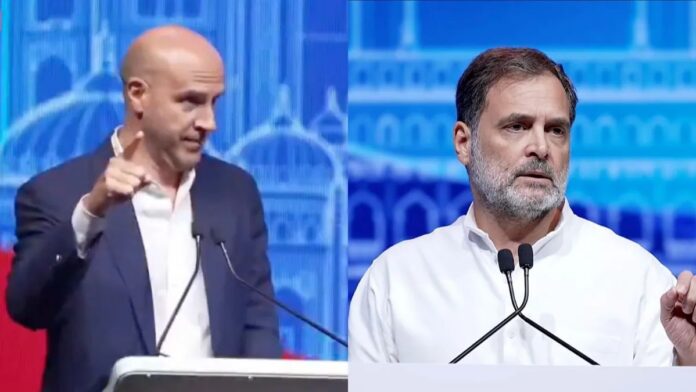
On Saturday in Hyderabad, the Leader of the Opposition in the Lok Sabha told a room of invited foreigners that the country which still lets him hold that office is “actually no longer a democracy.” Then he laughed, as an Italian socialist translated a Congress slogan into English and told India’s elected government to get off its seat.
If this is what a dead democracy looks like, it has a well-attended valedictory session.
He said it was “proven”. It was only repeated.
Rahul Gandhi’s line was not careless. It was the thesis. “It is important for the democratic movement on the planet that India remains a democracy,” he told the Bharat Summit’s valedictory session on 14 November, hosted by the Congress-led Telangana government. “What we have found and proven is that India is actually no longer a democracy.”
“Proven” is a heavy word. It demands proof. What followed was the same allegation, packaged for an international hall. He said the Opposition had been “in shock, not for a year, not for two years, but for an entire decade.” He then turned to Maharashtra, alleged that the Opposition had secured almost the same number of votes in the Lok Sabha and Assembly elections but got sharply different results, and claimed that around seven million new voters added to the rolls in the three months before the Assembly election had “all” voted for the BJP. He also asked, “How can the election be legitimate if the Election Commission declares 140 million voters to be illegal?” He did not explain that figure, or show how every newly added elector had voted for the Bharatiya Janata Party.
Those are allegations. They remain allegations.
The Maharashtra comparison does not survive the vote share. The Maha Vikas Aghadi won 30 of the state’s 48 Lok Sabha seats in 2024, and only 49 of 288 Assembly seats a few months later. Stare only at seats, and the swing looks mysterious. Count the votes, and it does not. Hindustan Times found the two alliances nearly tied in the Lok Sabha, 43.9 per cent to 43.5 per cent. In the Assembly election, the Mahayuti’s vote share rose to 51.3 per cent, and the MVA’s fell to 35.4 per cent, not the same votes, a different result, but a documented shift in who the electorate chose.
A year earlier, the Election Commission had already answered the slogan he was now exporting. On 17 August 2025, Chief Election Commissioner Gyanesh Kumar called the use of words like “vote chori” an “insult to the Constitution.” He said the Commission could not act on such serious charges without an oath, that no proof had been forthcoming, and issued a blunt choice: “Give an oath, or apologise to the nation. There is no third option. If we don’t get an affidavit within seven days, this would mean that all these allegations are baseless.” It was later reported that the deadline ended with no affidavit, and an official was quoted as saying the claims stood “invalidated.”
The slogan did not retire. It travelled to Hyderabad, and acquired an Italian translation.
The Italian was not a wayward guest. He was the message
Giacomo Filibeck, secretary-general of the Party of European Socialists, did not stumble into a Congress talking point. He recited it. After praising Gandhi’s campaign for “one person, one vote,” he delivered the line the hall had been waiting for: “Vote Chor Gaddi Chhod.” He translated it himself: “Vote thief, leave your seat.”
He went further. “Democracy is under attack in India, and we need to defend it. And the best way to defend it is to stand by Rahul Gandhi and the Indian Congress Party.”
That is not a footnote on electoral rolls. It is a European party official, on Indian soil, telling Indians that the defence of their democracy runs through one party and one family heir. Gandhi was seen laughing and applauding.
Union Parliamentary Affairs Minister Kiren Rijiju asked the only question that mattered: “Have you ever seen anyone laughing when India is insulted by a foreigner? I’m not asking about which Indian goes abroad to insult India.” Home Minister Amit Shah said the Congress had “invited propagators of leftist ideology from across the country and abroad,” and that Gandhi had “worked to defame India across the entire world by expressing anti-India views at an international conference.”
This was not Filibeck’s first turn as a foreign plus-one to someone else’s opposition. In April 2018, the Philippines denied him entry at Mactan-Cebu airport and deported him the same day. He had arrived at the invitation of the opposition party Akbayan.
Congress MP Pramod Tiwari’s defence was that “if a foreigner comes and says this, there is a need for introspection.” That is not introspection. It is outsourcing an argument the party could not win at the ballot box.
A cancelled visa is not a collapsed republic.
The other exhibit in Gandhi’s indictment was an apology. “I would like to apologise to the many delegates and leaders who were scheduled to attend but were not allowed to come by the Government of India,” he said. “It is not our fault, but it gives you a sense of what we are dealing with in our country.”
Congress MP Shashi Tharoor alleged that 115 of the 315 speakers “cleared” by the Ministry of External Affairs were refused entry or had their visas cancelled, “apparently on the instructions of the Union Ministry of Home Affairs.” He called it a shame that “a proud democracy has become so insecure that it must stifle any voices it fears will be critical.”
That 115 figure is Tharoor’s allegation. The government has not confirmed it. Asked about the row at the MEA’s briefing on 13 November, spokesperson Randhir Jaiswal said only this: “Visa matters are sovereign functions of any country or any government.”
He was right. Every serious country decides who enters. A cancelled visa is not proof that “India is actually no longer a democracy.”
Even Italy has now told its socialist to sit down.
The most useful rebuttal came from Filibeck’s own country.
On 16 November, Deborah Bergamini, a Forza Italia leader and a coalition ally of Italian Prime Minister Giorgia Meloni, answered him. “I believe that, in a democracy, everyone is free to put forward whatever arguments or accusations they choose, provided, of course, that they can substantiate them.”
It was, she said, “inappropriate to intervene in the domestic political debates of a major friendly nation.” And then the line that should have been obvious to anyone who has watched an Indian election: “Moreover, as Europeans, we find it inappropriate to lecture on democracy a nation that enables 970 million citizens to cast their votes. India possesses its own political institutions and judiciary; any disputes or grievances should be addressed in accordance with, and with respect for, the established rules of democracy.”
That is the grown-up position. If there is a dispute about electoral rolls, take it to the Election Commission and the courts. Do not import a European socialist to chant “leave your seat” in Hyderabad and call the chant a finding.
The Opposition’s whataboutism was thinner still. Congress spokesperson Girija Shetkar asked whether “Abki baar Trump sarkar,” from Prime Minister Narendra Modi’s 2019 Howdy Modi event in Houston, was not a comment on another country’s internal affairs. Shiv Sena (UBT) leader Sanjay Raut offered a chocolate: “If Modi can offer Melody chocolates to the Italian Prime Minister, then an Italian politician can come here and speak about this country.” These are not analogies. Appearing with a US president at a diaspora rally is not the same as inviting a foreign party official to demand that India’s elected government resign. A box of toffees is not a doctrine of foreign supervision.
The script is old. Only the accent is new.
None of this began in Hyderabad. In February 2023, at Cambridge University, Gandhi told students that “Indian democracy is under pressure and under attack.” He also offered the preface he would repeat in 2026: that preserving Indian democracy was “more than just about India,” because it was “about the democratic structure and democratic system on the planet.”
The Hyderabad sentence was the same sermon with the volume raised. In Cambridge, democracy was “under attack.” In Hyderabad, India was “actually no longer a democracy,” and an Italian official was on hand to agree. The Congress has not spent three years assembling a case under oath. It has spent three years searching for rooms, preferably foreign-filled, in which the accusation sounds larger than the evidence.
Amit Shah’s political point was crude and difficult to dodge. The Congress, he said, was “venting the frustration” of losing three consecutive Lok Sabha elections. He told Gandhi that if he wanted power, he should “stop your foreign trips and start visiting the villages of India.” The BJP-led alliance won in 2014, 2019 and 2024. Gandhi is Leader of the Opposition because those elections happened, and because the system he pronounces dead still reserves him a seat from which to say so.
The test is simple: swear to it, or stop selling it abroad.
A democracy is not disproved by an Opposition defeat, a cancelled visa, or a European socialist booked to say the losing side’s slogan in a second language. It is tested by whether charges of theft are taken to the institutions built to hear them, under oath, with evidence, in time.
Gandhi chose a different test. He told a foreign audience that the finding had already been “proven,” treated a visa decision as a character certificate for the republic, and laughed when Filibeck told the government of India to vacate its chair. The moral test does not require a summit. If the Leader of the Opposition has proof that India is “actually no longer a democracy,” he should put it on affidavit, as the Election Commission asked him to do in August 2025. If he has proof that seven million new Maharashtra voters all voted for the BJP, he should show it, booth by booth, in the forums the law already provides. If he cannot, he should stop asking the world to take a slogan for a verdict.
The alternative on display in Hyderabad is uglier. It is to tell 970 million voters that their franchise is a fraud, import a foreign party official to chant for the government to resign, and call the applause a defence of democracy. That is not courage. It is a campaign that has run out of Indian rooms in which the claim can still be made without being asked for proof.