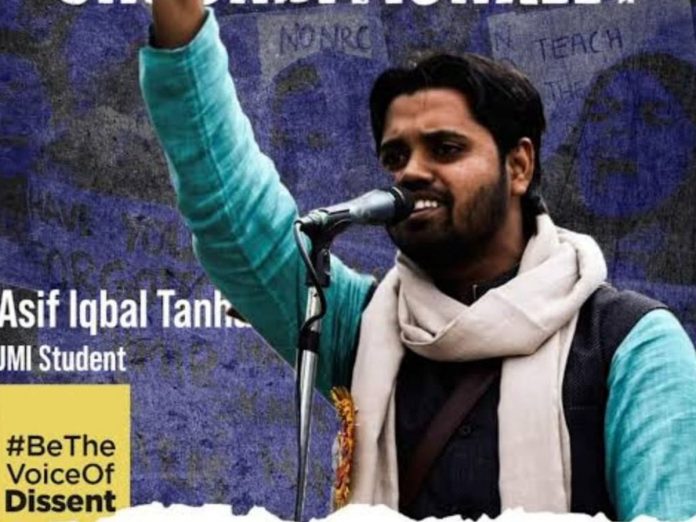
On Monday, a Delhi court dismissed the bail plea of Asif Iqbal Tanha in connection with the Anti-Hindu Delhi riots, which took place in February this year. Asif, a Jamia Millia Islamia student and member of the Student Islamist Organization (SIO) since 2014, was arrested under the Unlawful Activities (Prevention) Act in May for purportedly being a part of a larger conspiracy behind the February riots in northeast Delhi.
During the hearing, Asif’s lawyer Siddharth Aggarwal told the Court that his client had not committed any offence, which was punishable under the UAPA, and sought bail for the accused. He further alleged that the testimonies of three witnesses were false. While dismissing the bail petition, Additional District and Sessions Judge Amitabh Rawat ruled on Monday that there existed ‘reasonable grounds’, based on prima-facie evidence, that the charges against him are true. The Court emphasised that the statements have to been taken at face value until proven in the trial.
Delhi Court earlier rejected the bail plea of Asif Iqbal Tanha in September
Earlier on September 3, the riot-accused Asif Iqbal Tanha was denied bail by the same Delhi court. While hearing Asif’s case, Additional Sessions Judge Amitabh Rawat noted that the witness testimonies reflected his role in engineering the conspiracy and orchestrating a ‘chakka-jam’ that culminated into the riots. As per reports, protected witnesses have stated that Asif was one of the primary coordinators of the conspiracy. Judge Amitabh Rawat stated that while freedom of speech and expression is guaranteed under the Indian Constitution, it is subjected to ‘reasonable restrictions.’
The Conspirator behind Jamia riots
As per the report, Asif Iqbal admitted to orchestrating riots and a march of 2500-3000 people from the Gate no.7 of Jamia Millia Islamia on December 12. He revealed that Sharjeel Imam gave a provocative speech to encourage ‘protestors’ to execute a ‘chakka jam’ on December 13.
Asif confessed to organising a ‘Gandhi peace march’ on December 15 from the Jamia metro station to the Parliament via Zakir Nagar and Batla House. He stated that the purpose of naming it after Mahatma Gandhi was to lure more people into joining the march. Reportedly, the Delhi police had set up barricades near the Surya Hotel to prevent the ‘protestors’ from surging forward. Asif Iqbal confessed to provoking people to break through the police barricades under the impression that the cops lacked the ‘guts’ to stop them.