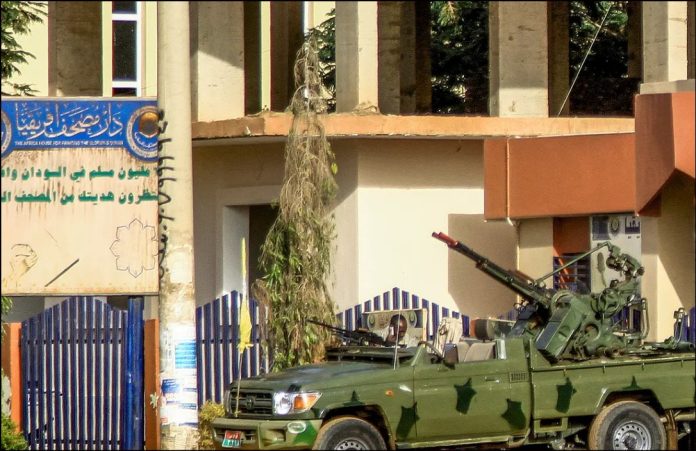
Amid mounting fears that the ongoing power struggle between the country’s army and its primary paramilitary organisation will devolve into a devastating civil war, the World Health Organisation said Tuesday that fighters have taken a national public laboratory in the capital city of Khartoum in Sudan storing samples of various pathogen such as polio and measles.
#BREAKING 'Huge biological risk' after Sudan fighters occupy lab: WHO pic.twitter.com/BGPnhlyWK8
— AFP News Agency (@AFP) April 25, 2023
Calling it an “extremely, extremely dangerous” situation, Nima Saeed Abid, the WHO’s representative in Sudan warned there is a “huge biological risk associated with the occupation.”
“There is a huge biological risk associated with the occupation of the central public health lab… by one of the fighting parties,” Nima Saeed Abid, told reporters in Geneva.
Without taking names, Abid said that fighters “kicked out all the technicians from the lab… which is completely under the control of one of the fighting parties as a military base.” It is unclear if the occupying fighters belong to the Sudanese armed forces or the rival Rapid Support Force (RSF) paramilitary group.
Abid claimed he received a call from the head of Sudan’s national laboratory in Khartoum on Monday, a day before a 72-hour truce arranged by the US between Sudan’s warring generals went into effect after 10 days of urban battle.
The UN health agency also documented 14 strikes on healthcare facilities throughout the war, killing eight people and wounding two.
It also cautioned that “depleting stocks of blood bags risk spoiling due to a lack of power.”
“In addition to chemical hazards, bio-risk hazards are also very high due to the lack of functioning generators,” stated Nima Abid.
Sudan crisis
More than 400 people have died in clashes between Sudan’s military and its main paramilitary force and control of Khartoum’s presidential palace and airport is now questionable following disputed claims from both sides. The fighting poses a threat to the stability of Sudan and the wider region.
An apparent power struggle between the two main factions of Sudan’s military dictatorship led to the outbreak of violence.
The WHO retweeted a post from Sudan’s Health Ministry on Sunday saying at least 420 people had been killed and 3,700 injured in the fighting so far.
As war rages intensified in Sudan, countries scrambled to evacuate their diplomats and citizens from the Sudanese capital on Saturday and Sunday. France on Monday evacuated 388 people from 28 countries, including Indian nationals.