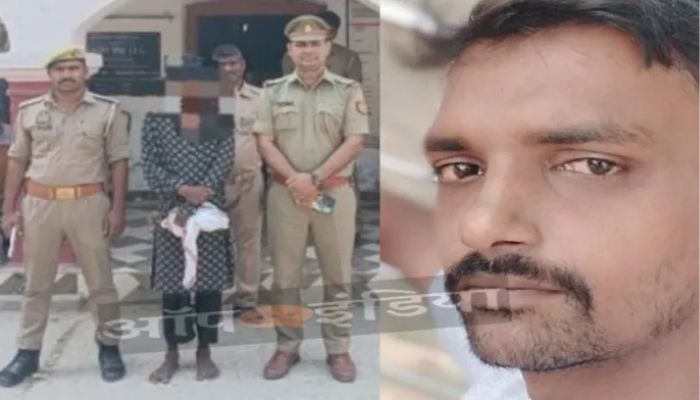
In the Ghazipur district of Uttar Pradesh, Mukhtar Sulemani stabbed a person named Vishal Gupta in the neck while attempting to behead him on the 14th of May. Vishal’s hand was severed while he attempted to defend himself against the second attack. Accused Sulemani was miffed over the victim asking him to work properly. The accused has been arrested after the victim lodged a complaint.
This incident transpired in the Dildarnagar police station area of Ghazipur. On the 17th of May, victim Vishal Gupta filed a complaint with the police, stating that he works at Pradhan Dhaba in Hussainabad, Ghazipur. The Dhaba’s owner is named Taufiq. When Vishal needed an assistant, he hired Ghazipur resident Mukhtar Suleimani.
उक्त प्रकरण के सम्बन्ध में अभियोग पंजीकृत कर अग्रिम विधिक कार्यवाही की जा रही है ।
On the 14th of May Vishal rebuked Sulemani for not doing his job correctly and being negligent at work. He advised Sulemani that if he is unable to do his job well, he should return home. Sulemani held a resentment against this. Vishal went to sleep after having dinner at around 11:40 pm that night and soon after, Mukhtar Sulemani arrived with a knife.
Sulemani attacked Vishal’s neck when he was sleeping causing the victim to wake up in panic after being injured by the first strike. As the accused was about to strike again, the victim grabbed his knife. During the snatching, Vishal’s hand was slashed with a knife. By then, the people staying nearby had arrived.
According to Vishal, Mukhtar Sulemani fled when he noticed people approaching. Vishal was immediately sent to the local hospital, however, given Vishal’s critical condition, doctors referred him to the district hospital. Vishal’s condition had deteriorated significantly due to severe bleeding and he underwent treatment at the trauma centre.
Notably, Subaiv Khan and Raja, among others, worked at this dhaba and assisted Vishal in taking him to the hospital, but no one informed the police. Vishal filed a police complaint on the 17th of May after his health began to recuperate. The victim has sought strict action against Sulemani. The police have filed a FIR against the accused under Section 307 of the IPC.
Meanwhile, Avinash Choubey, a Ghazipur Bajrang Dal official, demanded that the police take stern action against Sulemani. Police nabbed the accused on Sunday. OpIndia has obtained a copy of the FIR. OpIndia spoke with the victim who told us that he would not work at Taufiq’s dhaba now.
Vishal and Mukhtar Sulemani live in the same area and since the two have known each other for a long time, Vishal let Sulemani work with him. Taufiq, the dhaba owner, initially paid for some of Vishal’s medical expenses and later the entire cost was incurred by the victim’s family.
The hit-and-run case in Pune has exposed some startling facts that have caused people to pause and reflect on several issues, chief among them the functioning of our legal system and how the wealthy escape punishment for heinous crimes. After being asked to write an essay on accidents as ‘punishment’, the juvenile had been granted bail on the assurance of his grandfather, the grandfather who himself has underworld connections.
Later on Wednesday (22nd May), the Juvenile Justice Board, however, cancelled the bail granted to the teenage driver and sent him to the Children Observation Centre. As per the order, the teen has been sent to remand home for 15 days, that is, till 5th June.
Now, a report by India Today has quoted CBI sources as saying that Surendra Kumar Agarwal, the grandfather of the accused who started the family’s construction business, is facing trial for contracting the gangster Chhota Rajan’s shooter in 2009 to kill Shiv Sena’s Ajay Bhosale.
Surendra Kumar Agarwal had ironically, stood surety for the bail of his accused grandson. He also assured the Juvenile Justice Board (JJB) that the minor would mend his ways. This means that it was on his assurance that the court granted bail to the 17-year-old.
Notably, the teenager, who allegedly crashed his Porsche into a motorbike killing two software engineers at Kalyani Nagar in Maharashtra’s Pune on Sunday, is the son of now-arrested real estate developer Vishal Agarwal.
The juvenile justice board gave the boy, who was intoxicated at the time of the accident, bail in exchange for a Rs 7,500 surety and his grandfather’s promise to keep him away from bad company.
However, reports have now emerged that the grandfather, on whose assurance the court granted bail to the teen, was himself booked by Pune police for hiring a mercenary from Chhota Rajan’s gang to kill a Shiv Sena corporator, Ajay Bhosale.
According to Hindustan Times, the accused’s grandfather had in 2009, first given the contract to the gangster to mediate with his brother with whom he was having a dispute over the division of multiple properties, the CBI said.
Chhota Rajan, in turn, got in touch with Bhosale, who was close to the brother, in an attempt to get him to help his client win the dispute. Bhosale refrained from interfering as he was in the midst of contesting the 2009 assembly elections from Wadgaon-Sheri on a Shiv Sena ticket. According to the CBI, Rajan’s client instructed the gangster to kill Bhosale because he thought the latter was biased towards his brother. As Bhosale’s car went through Koregaon Park, a hitman opened fire, but the bullet missed its target and wounded his driver. Bhosale got away unharmed.
Speaking to Hindustan Times on Wednesday (May 22), Bhosale said, “Sometime in 2009, I was contacted by Chhota Rajan to intervene in the property disputes between two brothers (the teen’s grandfather and his sibling). Since I refused, the builder gave a contract to Rajan and accordingly the attack on me was orchestrated on October 11, 2009.”
Interestingly, the builder’s name was left out from the FIR that was filed with the Bund Garden police station. The CBI then took over the case, unravelling the plot to assassinate Bhosale and leading them to the builder, who is well-known in Pune for his high-end residential developments in the eastern regions of the city.
Pune Hit-and-run case
Early on Sunday morning (19th May), an overspeeding Porsche, reportedly driven by a drunk teenager crashed into vehicles and killed two persons in East Avenue, Kalyani Nagar, Pune. A man and a woman named Anis Awadhia and Ashwini Costa were killed in the incident.
The drunk teenager’s speeding luxury car reportedly crashed into multiple vehicles before hitting a pavement. Locals rushed to the spot and assisted the injured persons. The teenager was also caught and thrashed by locals, allegedly for trying to flee the scene. Though the teenager, the son of a builder, was arrested, he was granted bail in just 15 hours with certain conditions which created a furor on social media. He was granted bail under the condition that he would work with the Yerwada traffic police for 15 days and write a 300-word essay on road accidents. Now, the Juvenile Justice Board has cancelled the bail and sent him to remand house till 5th June.
On Wednesday (22nd May), the Juvenile Justice Board cancelled the bail granted to the teenage driver who is accused of crashing his speeding Porsche, in an inebriated state, into a motorbike killing two people on the spot in Pune. The board said that the minor, who is 17 years and eight months old, would have to be sent to the Children Observation Centre. As per the order, the teen has been sent to remand home for 15 days, that is, till 5th June.
In its plea, the Pune police have demanded that the minor accused should be treated as an adult during prosecution based on the crime. Arguing for his remand before the Juvenile Justice Board, Police said, “He is not safe outside as people will possibly attack him and people are safe if he is inside”.
However, the defence counsel argued that the teen suffered from depression that’s why he got into the habit of drinking. Before the board, the accused said that he wanted to stay with his mother and would feel safe at home adding that he could further slip into depression if he is kept inside the remand home.
Meanwhile, Pune Police Commissioner, Amitesh Kumar said, “We had filed a review application before the Juvenile Justice Board to allow the juvenile to be tried as an adult and also to send him in the remand home.”
He added, “The operative order was communicated to us by the Juvenile Justice Board and the said juvenile accused has been sent to the remand home for 15 days, till June 5. The order of him being tried as an adult is awaited at the moment.”
It is pertinent to note that, before the hearing began in the Juvenile Justice Board (JJB), Pune police added some more sections against the teenage accused who is 17 years 8 months of age. In addition to section 185 of the Motor Vehicle Act (driving by a drunken person), sections 184 (action against those who violate traffic rules through rash or dangerous driving), 119 (age limit in connection with the driving of motor vehicles), and 177 (general provision for punishment of offences) have been added in the FIR.
In another development in the case, Sessions court on Wednesday sent the father of the teenage accused, Vishal Agarwal, a real estate developer, to two days of police custody. According to the remand copy, Vishal Agarwal was not cooperating with police in the investigation therefore, Pune police sought his custody for further questioning.
Earlier in the day, Maharashtra Transport Commissioner Vivek Bhimanwar said that the accused teen will be barred from getting a driving license till he turns 25 years of age.
Pune Hit-and-run case
Early on Sunday morning (19th May), an overspeeding Porsche, reportedly driven by a drunk teenager crashed into vehicles and killed two persons in East Avenue, Kalyani Nagar, Pune. A man and a woman named Anis Awadhia and Ashwini Costa were killed in the incident.
The drunk teenager’s speeding luxury car reportedly crashed into multiple vehicles before hitting a pavement. Locals rushed to the spot and assisted the injured persons. The teenager was also caught and thrashed by locals, allegedly for trying to flee the scene. Though the teenager, the son of a builder, was arrested, he was granted bail in just 15 hours with certain conditions which created a furor on social media. He was granted bail under the condition that he would work with the Yerwada traffic police for 15 days and write a 300-word essay on road accidents. Now, the Juvenile Justice Board has cancelled the bail and sent him to remand house till 5th June.
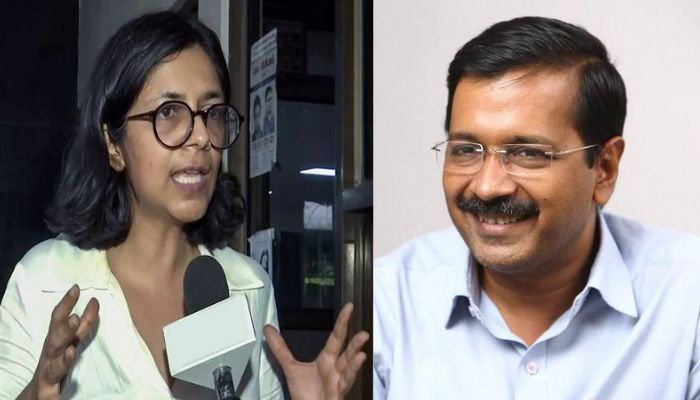
AAP Rajya Sabha MP Swati Maliwal, in a first, hit back at Delhi Chief Minister and AAP Supremo Arvind Kejriwal, nine days after she accused his close aide, Bibhav Kumar of assaulting her at the Chief Minister’s residence on 13th May. Taking to X, she dismissed Kejriwal’s fair probe demand in her case stating that she doesn’t buy it “one bit”.
Notably, on Wednesday (22nd May), Kejriwal gave his first response on the Maliwal assault case after he faced massive criticism for maintaining silence and deflecting media queries over the 13th May incident for eight straight days. It is pertinent to note that while he didn’t speak about the particular incident until Wednesday, he had extended his support to the assault accused, Bibhav Kumar. Kumar accompanied him on a visit to Lucknow and the CM also held a protest against his arrest in this case and stormed BJP’s headquarters in the national capital.
In an interview with the news agency PTI, Kejriwal on Wednesday said that there are two versions of the incident (in the Maliwal assault case) and Police should probe both versions fairly. He, however, added that he expects a fair investigation into the matter and that justice should be served.
Kejriwal claimed that since the matter is “sub-judice,” his comment might affect the ongoing proceedings. He added, “But I expect there will be a fair investigation. Justice should be served. There are two versions of the event. Police should investigate both versions fairly and justice should be done.”
Responding to Kejriwal’s response, Maliwal, for the first time took a direct hit at Kejriwal. Rubbishing his “fair probe” demand, she retorted saying, “Irony died a thousand deaths. I don’t buy this one bit.”
Slamming the AAP Chief, she wrote, “After unleashing the entire army of leaders and volunteers at me, calling me a BJP agent, assassinating my character, leaking edited videos, victim shaming me, roaming around with the accused, letting him re-enter the crime scene and tamper evidence and protesting in favour of the accused, the Chief Minister, in whose drawing-room I was beaten up, has finally said that he wants free and fair investigation in the matter.”
After unleashing the entire army of leaders and volunteers at me, calling me a BJP agent, assassinating my character, leaking edited videos, victim shaming me, roaming around with the accused, letting him re enter the crime scene and tamper evidences and protesting in favour of… https://t.co/ybNwRqGq1K
Additionally, earlier in the day, Maliwal said that there is “a lot of pressure” within the party to tarnish her reputation.
कल पार्टी के एक बड़े नेता का फोन आया। उसने बताया कैसे सब पर बहुत ज़्यादा दबाव है, स्वाति के ख़िलाफ़ गंदी बातें बोलनी हैं, उसकी पर्सनल फ़ोटोज़ लीक करके उसे तोड़ना है। ये बोला जा रहा है कि जो उसको सपोर्ट करेगा उसको पार्टी से निकाल देंगे। किसी को PC करने की और किसी को ट्वीट्स करने…
Taking to X, she said, “Yesterday, I got a call from a senior leader of the party. He told me how there is a lot of pressure on everyone, they have to speak dirty things against Swati, and they have to break her by leaking her photos. It is being said that whoever supports her will be expelled from the party. Someone has been given the duty of doing PC and someone else has been given the duty of tweeting.”
Development in the case
On 13th May, the Delhi Commission for Women (DCW) chief Swati Maliwal accused the Personal secretary of Arvind Kejriwal of assaulting her. In her complaint, Maliwal has alleged that Kejriwal’s personal Secretary Bibhav Kumar “slapped” her “at least seven to eight times” while she “continued screaming” and “brutally dragged” her while “kicking” her in her “chest, stomach, and pelvis area.” According to the Delhi Police FIR, Maliwal described the events of May 13 when she had gone to the Civil Lines residence of Chief Minister Kejriwal. The Delhi Police have arrested Kumar in this case.
In Kumar’s remand application, Delhi Police submitted in the remand application that the attack on the AAP MP could have been fatal. Delhi Police mentioned this in its application submitted to the court seeking a seven-day police remand of the accused Bibhav Kumar.
The Police also mentioned in their remand request that Bibhav Kumar admitted to formatting his Apple iPhone 15, and the phone needs to be taken to Mumbai to recover the data, for which his police remand was needed. Notably, as per the Police, CCTV footage from Delhi Chief Minister Arvind Kejriwal’s official residence during the period of assault on May 13 has turned out to be blank. It was also reported earlier that Delhi Police may add a destruction of evidence charge against Bibhav Kumar for deleting CCTV footage and formatting the phone.
Meanwhile, as the entire Aam Aadmi Party, except DCW member Vandana Singh, has started a campaign against Maliwal calling her allegations “false” and labelling her a “traitor and a BJP agent”, she recently warned her party against using such tags for her stating that she will take Kejriwal and company to court for every lie spread against her.
A Hindu young man named Vicky Hawale was brutally attacked by Muslim youths in the Partur area of Jalna district in Maharashtra, Sudarshan News reported. He was having a meal at a hotel with his younger brother when he received a call and the “Jai Shree Ram” ringtone was heard on his mobile phone, which angered two Muslim males sitting at a nearby table and they assaulted him, the report said.
He suffered grave injuries and was admitted to a hospital where he has been undergoing treatment for four consecutive days. A complaint was filed with the police but no action has been taken against the accused till now.
The brothers were sitting in their cabin when the two Muslims barged inside and viciously thrashed the victim. One of the perpetrators is reportedly named Sameer. The entire incident was recorded on the CCTV camera. The offenders are involved in many illegal activities and the authorities are not taking any measures against them even after a First Information Report has been launched because they share their illicit proceeds with the latter and carry out their unlawful activities even in small villages with complete impunity. The cops are also trying to weaken the case in an attempt to save the culprits. The instance has angered the Hindu community and Hindu organisations who are demanding strict charges against the pair.
Hindu shop owner in Bengaluru assaulted for playing Hanuman Chalisa
Notably, a Hindu shop owner named Mukesh was targeted by Islamists for playing Hanuman Chalisa and other Hindu devotional songs in his shop, which is located near a mosque in Bengaluru in March of this year. The occurrence came to light when the video of the incident went viral on social media in which a group of miscreants were seen assaulting a shopowner in Siddannagalli. He launched a complaint at the Halasuru Gate police station but the authorities were reluctant. A large group of local traders then gathered outside the police station and pressured the cops to act. Suleiman, Shahnawaz and Rohit were booked as the main accused.
Leaders of the Bharatiya Janata Party also organised a large-scale protest after the episode, calling for stern punishment in the case. Mukesh disclosed that when the assailants claimed that it was time for Azaan he tried to convince them that there was still time for it, but they refused to listen to him and grabbed him by the neck. According to him, they began beating him up and threatening to stab him with a knife when he came out of his shop to confront them. However, the police insisted that there was no communal angle and later the Halasuru Gate police station submitted a case against him on the counter-complaint of Mah Jabeen who was the mother of Suleiman.
On Tuesday (21st May 2024), the Madhubani district court in Bihar sentenced four individuals to life imprisonment for gang-raping a minor Hindu girl. The four convicts include Mohammad Zafar Ansari, Mohammad Jibril, Mohammad Ahmed, and Akhtar Ansari. The court also imposed a fine of Rs 25,000 on each of the convicts.
According to reports, the crime took place in the Harlakhi police station area of Madhubani. On 5th September 2022, the 16-year-old victim went with her brother to visit a fair in Kasera village. After some time, the victim went to a school near the fair venue for defecation. During this time, Mohammad Zafar Ansari, Mohammad Jibril, Mohammad Ahmed, and Akhtar Ansari also arrived there.
They caught hold of the victim and forcibly took her to the roof of the school building where they took turns to gang-rape her. Hearing the victim’s loud cries for help, people began gathering nearby. Fearing that they would be caught, all the culprits fled from the crime scene. However, passersby chased them, caught hold of Zafar Ansari, and handed him over to the Police.
During interrogation, he told Police that Mohammad Jibril, Mohammad Ahmed, and Akhtar Ansari were also involved in the crime. The police then raided and arrested the remaining three culprits. The next day, on 6th September 2022, the victim’s mother filed a complaint in the police station. Based on her complaint, the Police registered an FIR under Section 376 (D) of the IPC and POCSO Act and started an investigation.
The case was heard in the court of Devesh Kumar, the Additional District and Sessions Judge No. 7 (ADJ 7) of Madhubani. During the case proceedings, the defence and the prosecution submitted their arguments.
Following the completion of arguments by both sides, the court considered the evidence presented by the prosecution sufficient and sentenced Mohammad Zafar Ansari, Mohammad Jibril, Mohammad Ahmed, and Akhtar Ansari to life imprisonment.
The victim’s elder sister was also gang-raped: Victim’s Lawyer
Speaking with OpIndia, the victim’s lawyer said that the court, in its remarks, ordered that all the convicts be kept in jail until their last breath. He mentioned that during the trial, which lasted for one and a half years, the culprits changed lawyers multiple times; however, it proved to be of no benefit to them.
The court has asked the Bihar government to pay a compensation of Rs 5 lakh in this case. Advocate Ajay Jha Yash further stated that the victim’s elder sister was also gang-raped. The trial of that case is also going on in the court of ADJ 7. The sentencing in that case will be debated on 1st June 2024.
The Enforcement Directorate (ED) filed a plea challenging the transfer of the Bhushan Steel money laundering case from a judge who stated, “ED matters main kaun si bail hoti hai (Where is the question of bail in ED matters),” reported Bar and Bench. The Delhi High Court reserved its decision on 22nd May. Judge Swarana Kanta Sharma observed that judges lack public relations (PR) representatives to speak up for them and refute the lies about them.
“I want someone to talk about the rights of the judges also. This is a new issue. Judges don’t have PR offices that someone will speak for them about whatever nonsense is spoken about them,” she charged after considering the facts of the case as well as the ED’s assertions that these instructions would discourage judges who hear the agency’s matters.
According to the court, a judge is impacted when a case is transferred from them and could leave the district judiciary demoralised. “Being a judge for 32 years, people have been saying so many things against me after I passed orders in the last few weeks. Sab kuch bola bhi to nahi saktey hain na (We cannot say everything here). These orders (of transfer) get published everywhere. What effect does it have on the judge,” the court pointed out. Justice Sharma declared that she would be issuing a comprehensive order but she had not made up her decision as of yet.
Background of the matter
Special Judge (Prevention of Corruption Act) Jagdish Kumar who was hearing the case was replaced by Special Judge (Prevention of Corruption Act) Mukesh Kumar. The accused Ajay S. Mittal entered a plea, and on 1st May 1, the District & Sessions Judge at Rouse Avenue Court authorized the transfer. The hearing for Mittal’s bail request was scheduled for 10th April before Judge Jagdish Kumar. The matter was postponed until 25th April after the attorney requested more time to prepare for the arguments on the set date.
As the counsel left the courtroom, Mittal’s wife who is also a defendant in the case, overheard the judge addressing the court employees, “Lene do date, ED matters main kaun si bail hoti hai (let them keep taking dates, where is the question of bail in ED cases).” The District Judge accepted the motion and maintained that it was not feasible to establish that Mittal was incorrect or misguided in believing that the judge was biased in favour of the ED. The High Court was moved by the agency following the judge’s transfer.
When Special Counsel Zoheb Hossain represented the ED, he contended that the case was transferred based only on an affidavit that the accused’s wife had filed. He pointed out, “Ek zara bhi proof nahi diya hai unhone (They have not given even a speck of proof).” The agency mentioned that the claims could not be regarded as gospel truth and that none of the lawyers representing any side had heard the judge’s statement.
He highlighted, “We were there. The counsel for the other side was also there. No one has supported the allegations. Only on the word of the lady, the matter get transferred. This will have a deleterious effect. Any person who does not want their matter heard by a particular judge will make bald, substantiated allegations and get his matter transferred. It amounts to forum shopping. This is a classic case of forum shopping. They took repeated adjournments before the previous judge.”
He observed that the judge from whom the case was transferred is a Special Judge who oversees Central Bureau Of Investigation (CBI) and ED cases and is based at Rouse Avenue Court. He added, “Such a transfer will raise questions about his competence to handle any ED case.” Senior Attorney Sandeep Sethi, who was representing Mittal at the time, alleged that the transfer order was an administrative one. Mittal’s wife heard the comment, per him, and she swore an affidavit to that effect.
He claimed, “She did not make any allegation earlier. We are not choosing any court. We are not saying please transfer this case to a particular judge.” The senior advocate submitted that there is no alternative means of confirming the validity of the judge’s statement. “This is a very serious issue for us. We have all heard the phrase, justice should not only be done but it should appear to have been done.” The intricate problems of case administration, judicial integrity and the effects of administrative transfers within the judiciary will all be covered in Justice Sharma’s reserved decision.
Justice Sharma faces online trolling
Justice Swarana Kanta Sharma faced a lot of criticism, especially from the Aam Aadmi Party and its ecosystem for her ruling against the party’s national convenor and Delhi Chief Minister Arvind Kejriwal who claimed her to be biased and pro-Bharatiya Janata Party while creating false equivalences. A person charged, “How high court judge Swarna Kanta Sharma is giving discriminatory judgements. The case of Dilip Ray whose sentence was stayed because he had to contest elections on behalf of the BJP is a living example of it,” with a video of Delhi Minister Saurabh Bharadwaj.
Must Watch & Share
High Court की जज Swarna Kanta Sharma किस तरह से भेदभाव वाले जजमेंट दे रही है
इसका जीता जागता उदाहरण है दिलीप रे का मामला जिसकी सजा पर इसलिए रोक लगा दी गई क्योंकी इन्हें बीजेपी की तरफ़ से चुनाव लड़ना है
Another AAP supporter slammed her for allegedly “delaying the proceeding” over a “procedural point raised by BJP (ED),” implying that both the justice and the agency are working at the behest of the saffron party.
On just a 'procedural point' raised by BJP (ED), Delhi High Court Judge Swarna Kanta Sharma has allowed BJP (ED) to DELAY the proceeding.
Roshan Rai, an avid I.N.D.I. Alliance supporters referred to the judge as someone installed by the BJP and alleged, “Read the judgement by Swarna Kanta Sharma while dismissing Arvind Kejriwal’s plea against his arrest. You won’t be able to figure out if it is a BJP spokesperson speaking or a Judge of the Delhi High Court.”
Read the judgement by Swarna Kanta Sharma while dismissing Arvind Kejriwal's plea against his arrest.
You wont be able to figure out if it is a BJP spokesperson speaking or a Judge of the Delhi high court.
Similar remarks were made by a user, who characterized her as being partial toward the BJP while comparing the bail petition of Dilip Ray and Sanjay Singh. “Delhi HC Judge Swarna Kanta Sharma granted Dilip Ray instant relief, staying his conviction. Ray, a BJP candidate, is now allowed to contest. The same judge whose bail denial for Sanjay Singh was overturned by SC. Also handled Kejriwal’s arrest challenge, stopping short of conviction.”
Delhi HC Judge Swarna Kanta Sharma granted Dilip Ray instant relief, staying his conviction. Ray, a BJP candidate, is now allowed to contest.
The same judge whose bail denial for Sanjay Singh was overturned by SC.
One AAP supporter even called her a stain on the legal system and claimed, “Swarana Kanta Sharma is a blot on the judiciary. She does not understand the pain of jail and giving dates like SBI (State Bank of India).”
Swarna kanta sharma is blot on judiciary she does not understand the pain of jail and giving dates like SBI https://t.co/k25bUH2qtx
— AAP Sunil Jodhpur INDIA (@AAPsunil4490) May 10, 2024
The analogous sentiment could be seen in other comments shared by AAP supporters, who blamed the judge for being prejudiced against the party while benefiting the BJP.
The urban landscape of Mumbai is a canvas of paradoxes. Every day, the whims of elites clash with the needs of the common man. While the elites enjoy “swift” rides across smooth roads, the not-so-rich spend hours struggling to reach their destinations on local trains. Often termed the “Mumbai spirit”, videos of commuters getting crushed in a sea of “Mumbaikars” surface on social media. Amidst all this, the hope and desire to get a better way to commute, Mumbai Metro, is yet to bring relief to the common man on a burning Wednesday. On the other hand, “elite” Lutyens Journalists like Rajdeep Sardesai and other celebrities indulge in flip-flops over whom to support, development or made-up environmental causes.
On 22nd May 2024, Sardesai posted on X (formerly Twitter) about his swift journey from Worli to Nariman Point on Mumbai’s coastal road. He hailed it as a “game changer for Mumbai car traffic”. He is not wrong. The road is smooth like butter. The ease with which he travelled from one point to another on the coastal road is in stark contrast with the struggles millions face daily on Mumbai’s overcrowded local trains.
Wow! Just did Worli to Nariman Point in eight minutes on the coastal road. Can’t complain! Game changer for Mumbai car traffic! (Now to ensure that lakhs of commuters who have travelled in crowded suburban trains for years also have metro service fully up and running soon)? pic.twitter.com/wDY7QEbICm
— Rajdeep Sardesai (@sardesairajdeep) May 22, 2024
On the same day, Rajdeep Sardesai made another post painting a vivid picture of the common commuters cramped in buses and walking miles in the summer heat for a glimpse of political leaders. The picture painted by him was expected as the Lok Sabha Elections 2024 are ongoing. He emphasises the dire state of education and health services available for rural India. He urged for a “Viksit Bharat” that is dependent on services rather than catchy slogans. He made a call for better infrastructure for the common man as well.
As I travel across the country, the ordinariness of people’s lives stands out in contrast to the lifestyle of most leaders. The leaders in their huge SUV convoys, palatial bungalows and unlimited spending capacity while the average citizen is cramped in overcrowded buses or…
— Rajdeep Sardesai (@sardesairajdeep) May 22, 2024
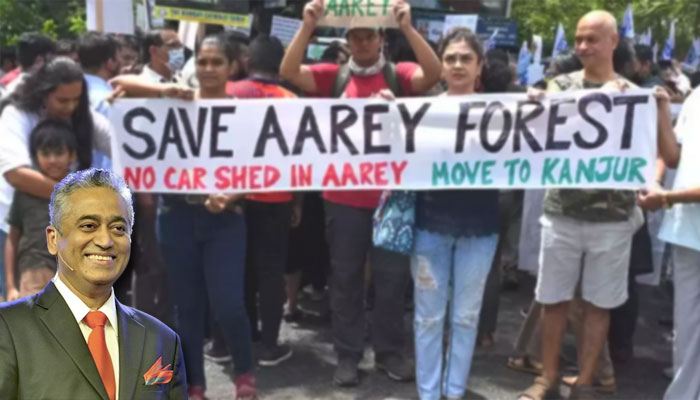
While Sardesai’s post on X might have made him look like a caring man who thinks about the common, poor, marginalised and needy people of India, in reality, he is among those journalists, activists and celebrities who supported the Aarey Forest protests that stalled a crucial metro project in Mumbai.
In October 2020, Rajdeep Sardesai lauded then-state minister Aaditya Thackeray for “saving” the Aarey Forest. The step taken by the then-Maharatra government led by the Maha Vikas Agaadi (MVA) alliance was celebrated by environmentalists and elite Mumbaikars. For those who are unfamiliar with the controversy, the Aarey Metro project was intended to create a metro car shed as part of the Mumbai Metro project. It would have improved the public transportation system in the city.
This is good news @AUThackeray . For many Mumbaikars of my age, Aarey’s forested area holds many wonderful memories. Not easy but let’s try and preserve at least some of us the city’s green lungs.. need to do more!?? https://t.co/zoCIAw7FlI
However, it met environmental protests led by the well-off residents of the city and the project was halted. They argued that Aarey was the “green lungs” of the city. The decision taken by the then-government to find another place for the metro shed deprived millions of Mumbaikars of a more efficient and less congested commuting option.
If we look at the reports from that time, it is clear that the Aarey protests were no less than a vendetta against the Metro project as it would have resulted in falling off very few trees. Comparing it to the film city present in the same forest area, the damaging effect of the latter is much more on the environment. However, the protesters created an atmosphere against the Aarey Metro Shed Project.
The hypocrisy of Rajdeep Sardesai is glaring. While he and his elite peers have the liberty to enjoy luxurious car rides on newly built buttery roads, the average Mumbaikar continues to become the victim of the mythic “spirit of Mumbai”.
It raises a critical question. Whose interests are being served by halting such projects. The elites often participate in protests to preserve their egos and nostalgic memories. They do not care about the immediate and practical needs of the working population of the cities. The metro project is not just about cutting travel time. It is about providing a better, more efficient and dignified way to commute. However, Mumbaikars often have limited choices. The overcrowded city, burdened local train system and unimaginable traffic across the city, do not make life easier.
It would not be wrong to say that the “spirit of Mumbai” is a curse rather than a boon. While Sardesai’s latest posts on social media highlight the newfound sympathy he has for the common commuters, they also bring forward the persistent urban hypocrisy. The elites can influence city planning in their favour. The common man cannot wake up and fix things on a ‘Wednesday’… It is high time that urban development in Mumbai prioritises the needs of the broader populace over the nostalgic and sometimes myopic views of the privileged residents.
One can only hope just like supporting the protests against Aarey Metro Car Shed, Sardesai would not come in support of the protests that are scheduled to be launched to save the “Slum of Dharavi” in the coming months. One can only hope that the elites of Mumbai do not promote the disgusting “slum tourism” of Dharavi as a focal point of the city and let the largest slum vanish from the face of the earth forever.
In a recent televised interview, Prime Minister Narendra Modi asserted that the decline in the population of the ‘all-inclusive’ Hindu civilization should be a matter of concern for the world. Notably, in an interview with Republic TV, PM Modi made these remarks in the context of a recent study conducted by the Economic Advisory Council to the PM regarding global demographic shifts. The comprehensive report pointed out that while the population of Hindus in India shrunk by 7.8%, the population of minorities, excluding Jains and Parsis, grew between 1950 and 2015.
Speaking with Republic TV’s Editor-in-Chief Arnab Goswami, PM Modi emphasised that the report has exposed the “false narratives” that “minorities are under threat in India’.
The Prime Minister said, “Between 1950 and 2015, the share of Hindus dipped by 7.82%, while that of Muslims increased by 43%. Hindu civilisation is all accommodating, there is no point spreading false narratives anymore. Those creating narratives of minorities under threat must look into the report and come out of their false perception.”
PM Modi added, “A great culture which is all-inclusive, which can somehow keep the world in balance in the future, which is no one’s enemy, will not be able to influence if its share declines. Today the world should be concerned about how the Hindu population will increase.”
India’s TFR drops below 2.1 (replacement rate) for the first time, eyeing challenges currently staring at countries like Japan and South Korea
Notably, before the study by the EAC-PM, the international medical journal, Lancet highlighted concerns for India, noting that the nation is facing looming demographic challenges similar to what South Korea, Japan, China, and other countries are experiencing globally – population collapse or depopulation in the coming decades. In March this year, the Lancet released a comprehensive report regarding fertility rates across the globe.
The study pointed out that in recent years, India’s TFR (Total Fertility Rate) has fallen below the coveted replacement level of fertility – 2.1 – for the first time. The Total Fertility Rate is the average number of children born to women during their reproductive years. It differs from birth rates – defined as the number of live births per 1,000 women in the total population.
A country’s TFR below the replacement level of 2.1 generally means that the country’s population will decline in the coming years, while a TFR above 2.1 indicates that its population will stay steady or might increase. Nations strive to maintain their TFR around 2.1, which takes into account the need to replace the population compensating for mortality and other factors.
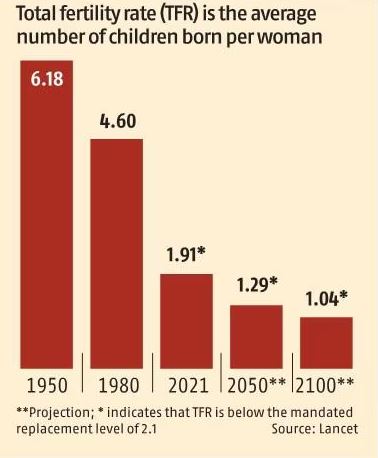
According to the Lancet study, India’s TFR has registered a sharp decline over the last century, from 6.18 in 1950 to 1.91 in 2021. It is further projected to decline, reaching 1.29 by 2050 and 1.04 by 2100. It is pertinent to note that India’s TFR decline is in line with alarming global trends. In addition to Lancet, several other global observers, including OECD data (which recorded India’s TFR as 2.03 in 2021) and World Bank data (reporting India’s TFR as 2 in 2021), have also indicated that India’s TFR is below the replacement level.
(Image Source – Business Standard)
By 2100, 97% of nations will have TFR below 2.1, says Lancet: Concerns of ‘Baby Boom’ and ‘Baby Bust’, challenges for ‘depopulated’ nations
The Lancet study projects that 155 out of 204 countries and territories worldwide, amounting to around 76% of nations, will have fertility rates below population replacement levels by 2050. It further estimates that by 2100, 198 countries, or 97% of nations, will have TFRs below 2.1. The forecasts are based on surveys, censuses, and other sources of data collected from 1950 through 2021 as part of the Global Burden of Diseases, Injuries, and Risk Factors Study.
Elon Musk and Population Collapse
Many people around the world mistakenly believe that there are too many people on Earth. However, in reality, the planet has the capacity to sustain a much higher population than its current level.
The global Total Fertility Rate (TFR) has fallen from around 5 in 1950 to 2.2 in 2021. As of 2021, 110 countries and territories (54%) had rates below the population replacement level of 2.1 children per woman.
According to the study, fertility rates in nearly all countries will be below replacement level by the end of this century. By then, the majority of the world’s live births will be taking place in low-income countries (LIC) which are prone to economic and political instability. The study indicates that the trend will lead to a divide between “baby boom” (in LIC) and “baby bust” (across the globe). With boom indicating population surge and bust indicating population decline.
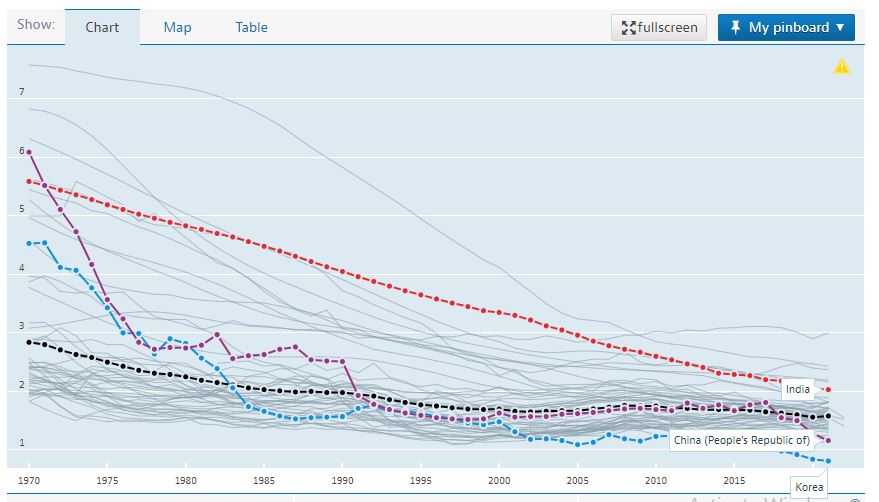
(OECD data – Chart of all countries’ TFR with highlighted ones of India, OECD average, Korea and China, Source – OECD)
By 2100, it is projected that more than 75% of live births will take place in low- and lower-middle-income countries, and more than half will occur in sub-Saharan Africa.
South Korea, a country with the world’s lowest TFR, scripts new records every year; a lesson for India
While the decline in Total Fertility Rate (TFR) has become a pervasive global issue, the challenges are particularly pronounced for South Korea, which has the world’s lowest TFR. Since 2018, South Korea has been the only member of the Organisation for Economic Co-Operation and Development (OECD) with a TFR below 1. According to reports, its population in 2023 declined for the fourth straight year.
(Video Courtesy – France24)
According to preliminary data from Statistics Korea, a government-affiliated body, the average number of children a South Korean woman has during her lifetime (TFR) in 2023 registered an alarming drp. It fell from 0.78 in 2022 to 0.72 in 2023. It has earlier projected that its fertility rate will likely fall further to 0.68 in 2024.
(Couples in South Korea are getting increasingly hesitant to start family and have babies for economic and other concerns, Image Source – BBC)
According to the Institute for Health Metrics and Evaluation at the University of Washington in Seattle, if the low fertility rate persists, the population of Asia’s fifth-biggest economy is projected to almost halve to 26.8 million by 2100.
Additionally, South Korean women give birth for the first time at an average age of 33.6 which is the highest among OECD members.
It is alarming that the country’s fertility rate continues to shrink and script record low every year despite comprehensive measures undertaken by the government and spending billions to increase its population. The country is facing what is being described as a threat of “national extinction”.
South Korea has spent over $270 billion on programs to encourage people to have more children, with no success
Since 2006, the Korean government has invested more than 360 trillion won ($270bn) in programs to urge Korean couples to have more children. For this, they have given a slew of incentives including cash subsidies, babysitting services, and support for infertility treatment. Conservative President Yoon Suk Yeol’s administration has made reversing the falling birthrate a “national priority”. In December, his government promised to come up with “extraordinary measures” to tackle the situation.
However, financial and other allurements have failed to convince Korean couples to have babies or bigger families.
Since 2006, South Korea's government has spent $270bn, or just over 1% of GDP a year, on babymaking incentives. Here's the dismal result: pic.twitter.com/w9qIbubGA6
— James Pethokoukis ⏩️⤴️ (@JimPethokoukis) May 22, 2024
It’s important to note that sustained low fertility rates often indicate a rapidly aging population, leading to economic challenges. With fewer people of working age, boosting the economy becomes difficult, and a significant portion of the budget is redirected towards increasing healthcare and social security costs for the elderly.
However, South Korea is not alone in the region which is struggling with a rapidly aging population and population decline as the trends persist in Japan and China despite incentives.
In 2023, China’s population fell for the second consecutive year, experiencing a record-low birth rate. According to the National Bureau of Statistics, China’s population dropped by 2.08 million (0.15%) to 1.409 billion in 2023. This decline was higher than the previous year’s decrease of 850,000 in 2022. It marked the first time since 1961, during the Great Famine of the Mao Zedong era, that China’s population had experienced an annual decline.
According to Reuters, in March this year, several hospitals in China stopped offering newborn delivery services due to declining demand.
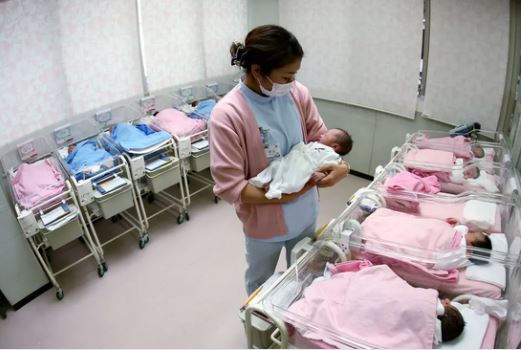
Similarly, Japan registered a significant drop in its population last year. This was accompanied by a record decrease in the number of births and the lowest number of marriages since the end of the Second World War. According to government data, the number of babies born in Japan in 2023 fell for an eighth straight year to a historic low. The health and welfare ministry reported that only 758,631 babies were born in Japan last year, marking a 5.1% decline from the previous year and the lowest number of births recorded since statistics were first compiled in 1899.
(Baby ward in Japan, Image Source – The New York Times)
The development came a year after Prime Minister Fumio Kishida warned that the stubbornly low birthrate would soon threaten the country’s ability “to continue to function as a society”. He added, “The problem cannot wait and cannot be postponed”.
Elon Musk: "The birth rate on Earth is so low that we're facing civilizational collapse unless the birth rate returns to a sustainable level…Population collapse is one of the biggest threats to the future of human civilization, and that is what is going on right now. Take… pic.twitter.com/LtK9O6wYSm
Additionally, the number of marriages, in Japan, decreased by 5.9% to 489,281 couples, dropping below half a million for the first time in 90 years—a significant factor contributing to the declining birthrate.
Japan’s population, currently over 125 million, is projected to decline by approximately 30% to 87 million by 2070, with four out of every 10 individuals aged 65 or older.
Expressing concerns and stressing the need to “act now”, the chief cabinet secretary, Yoshimasa Hayashi, said the declining birthrate had reached a “critical state”. Speaking with reporters, he said, “The period over the next six years or so until the 2030s, when the younger population will start declining rapidly, will be the last chance we have to try to reverse the trend. There is no time to waste.”
Governments around the globe announcing various incentives to encourage couples to have babies, but nothing seems to be working
According to the BBC, Korean couples with children receive free taxi services, and married couples are exempt from hospital bills and IVF treatment costs. With South Korea’s fertility rates plummeting, the city of Seongnam, the fourth-largest in the country, has resorted to organizing ‘mass blind dates’ in hopes of reversing the declining birth rates. Prospective parents are being enticed with various incentives, including cash rewards and housing subsidies.
As reported by Business Insider, the Hangzhou government in China is offering new parents $2,800 for their third child, while Wenzhou city in southeast China is providing $416.70 in subsidies per child. Chinese cities have also introduced up to 30 days of paid marriage leave for couples.
Concerns of young couples and initiatives undertaken by various governments to arrest the population decline; a ‘gloomy’ crystal ball for India
Despite government incentives, the birth rates are falling drastically. Young couples around the globe, particularly in South Korea and Japan have been reluctant to have babies and express hesitancy towards marriage and starting families. However, the same trend is growing in India as well. They cite reasons such as skyrocketing property prices, a lack of well-paid jobs, prioritization of work over daycare for children, increasing living expenses outpacing salary growth, and a costly education system. They believe that raising children and providing decent living amenities are becoming increasingly expensive.
Additionally, experts believe that the country’s social structure also influences fertility rates. They state that cultural factors, including the challenges working mothers face in balancing their jobs with household chores and childcare, play a significant role.
Unlike Western nations, being married is considered a prerequisite to having children in these nations. However, marriages are also declining as couples cite the soaring cost of living as one of the main reasons for delaying or avoiding marriage.
Lessons that India can draw from depopulating countries
As highlighted above, there is a growing trend in India where the average age at which individuals are getting married and having their first child is increasing. Couples are increasingly hesitant about marriage and are prioritizing work and career over starting a family. This trend mirrors global patterns seen in countries like South Korea, Japan, and even some parts of China, where economic pressures, career ambitions, and the high cost of living are leading many young people to delay or forgo traditional family structures.
If this persistent trend is not addressed in a timely manner, it will become nearly impossible to avoid the trajectory experienced by South Korea and Japan. This could lead to an acute crisis characterized by a sluggish economy, a lack of working-age population, a crumbling family structure, apathy towards raising families, an aging population, and a host of other insurmountable challenges.
Elon Musk in 2023:
"Population collapse is a major risk to the future of civilization. No new humans means no humanity." pic.twitter.com/vtK6KY9d1w
As Elon Musk and several demographers have noted, “Population collapse is potentially the greatest risk to the future of civilization”. In India, the most populated nation in the world, it is hard to fathom a nation without people, but that reality may not actually be that far away. The demographic challenge and social faultlines in India may also mean that the rapid decline of the population of certain communities, in contrast to a rapid rise in the population of specific other communities, leads to major socio-economic and political challenges, eventually affecting the very fabric of the Indic civilization.
On the 20th of May, voting for Bihar’s Madhubani Lok Sabha seat took place. Four persons were found casting bogus votes on Jaale and taken into police custody. That same night, a mob of approximately 140 people attacked the police station and released all four. The police have constituted a Special Investigation Team to investigate the matter.
Jaale is located in Bihar’s Darbhanga district, however, it falls within the Madhubani Lok Sabha constituency. Four persons were found voting fraudulently at Haqqania Madrasa Deora Bandhauli, a polling booth in the Jale police station area. These four people were being held at the Jale police station when, in the evening, a mob of 130-140 people attacked the station and freed the arrested individuals.
Shocking ??
Darbhanga, Bihar ?
Mohammed Sanaullah & 3 Muslim women were arrested from Hakkania Madrasa polling station.
Why: Because they falsely voted while wearing Burqa.
— Shashank Shekhar Jha (@shashank_ssj) May 22, 2024
As per the FIR copy obtained by OpIndia, Sector Officer Nirbhay Kumar caught four people on 20 May, while patrolling during the voting process. Following this, the Jaale police station filed case number 103/24. In this case, one Sanaullah, Sadia Sheikh, Saleha Fatima, and Zeenat Parveen, all of whom reside in Deora Bandhauli, Police Station Jaale, District Darbhanga, were all found voting fraudulently. Sector Officer Nirbhay Kumar turned over all four to the police.
Reports say that a mob comprising around 130-140 people attacked the police station to free the four arrested persons and misbehaved with police officials. After this, the mob released the four from police custody. The police have now registered FIR against 24 named people and over a hundred unnamed people. The video relating to this case has gone viral on social media, with claims that the same crowd attacked the police station.
जाले थाना अंर्तगत घटित घटना का अधतन विवरण:- #Biharpolice#HainTaiyaarHum#Bihar pic.twitter.com/EOUCY6y7Bc
— Darbhanga Police (@DarbhangaPolice) May 21, 2024
Meanwhile, Darbhanga Police confirmed the attack on the police station. Darbhanga Police said in a statement that an FIR has been filed against 130-140 people based on the Jale Police Station in-charge’s complaint. Darbhanga police have filed a complaint under Sections 147/148/149/323/324/225/353/354 (B)/504 IPC. To investigate this matter, a Special Investigation Team has been formed under the command of Darbhanga SP. The Darbhanga SP-led SIT is conducting raids to nab the accused persons.