Home Blog Page 1302

NIA arrests PFI terrorist Mohammad Ghaus Niazi, accused of killing RSS leader Rudresh, from South Africa

Mohammad Ghaus Niazi, a terrorist of the banned Islamic organization Popular Front of India (PFI), has been arrested in South Africa. The National Investigation Agency (NIA) has extradited him to India. Niazi is accused of killing a Rashtriya Swayamsevak Sangh (RSS) leader in Bengaluru, the capital of Karnataka. The NIA has also declared a reward of five lakh rupees on him.

Mohammad Ghaus Niazi was a big face of PFI. He was allegedly involved in the murder of 35-year-old RSS leader Rudresh in Bengaluru in 2016. In this case, the investigating agencies have booked him as an accused. After committing the murder, he escaped and left India to form his base in different countries. The case is being probed by the NIA.

The Anti-Terrorist Squad (ATS) of Gujarat Police first tracked Mohammad Ghaus Niazi in South Africa. After this, they gave this information to the central agency NIA. The NIA then contacted South Africa. The South African agency apprehended Mohammad Ghaus Niazi. He has now been extradited to India and is currently taken to Mumbai.

In 2016, Rashtriya Swayamsevak Sangh leader Rudresh was murdered in the Shivaji Nagar area of Bengaluru. Rudresh was returning after attending an RSS function in Bengaluru when he was killed. During that time, the terrorists already sitting in an ambush attacked him. He was killed in this attack.

Volunteers took to the streets after the RSS leader was hacked to death with a sharp weapon. After the incident, the then Karnataka BJP president BS Yeddyurappa met Rudresh’s family. He had assured that the matter would be investigated till the end. After 6 years of this murder, the NIA has succeeded in bringing terrorist Mohammad Ghaus Niazi to India.

In 2019, the NIA said that Asim Sharif, another accused in Rudresh’s murder, had conspired to kill Rudresh to prevent people from joining the Hindu organisation. He had planned to kill two more RSS workers. Apart from Asim Sharif, four other PFI leaders including Mohammad Ghaus Niazi were also involved in this murder.

Asim Sharif was the Bengaluru president of the Popular Front of India. Asim Sharif has already been charged for involvement in the murder in this case. Sharif challenged the NIA’s action in the Supreme Court on 2nd January 2018. However, the court had rejected his plea. This paved the way for prosecution on him.

In 2020, Samiuddin was detained by the Bengaluru Police in connection with the violence in a part of Bengaluru over an alleged comment made on a controversial Facebook post. The police official had then said that during the investigation, Samiuddin was found to be in touch with an accused in the RSS worker Rudresh murder case. Samiuddin has also been in touch with members of the Al-Hind terrorist group for the past few years.
TMC used women as “vote bank”, then looked elsewhere when women sought justice in Sandeshkhali: PM Modi

0

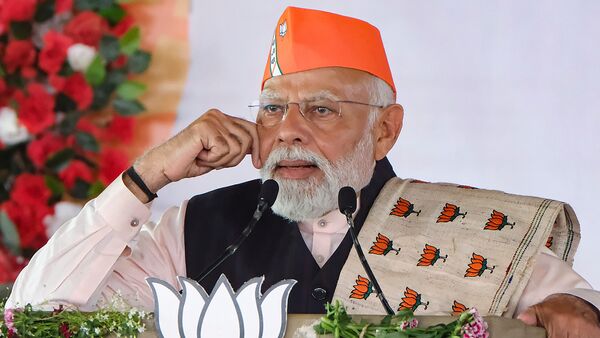
Tearing into Trinamool Congress government in West Bengal over allegations of “sexual abuse” and “land grab” in the Sandeskhali area of North 24 Parganas district, Prime Minister Narendra Modi on Saturday alleged that the ruling party “did not want the accused to get arrested.”

PM Modi further alleged that the ruling party used the womeloon of Bengal as a “vote bank”.

In his public address at Krishnanagar, PM Modi said that while the women of Sandeshkahli “cried out for justice,” the ruling party in the State “looked elsewhere.”

PM Modi said, “Using the slogan of ‘Maa, Maati, Manush’, the TMC government used the women of Bengal as a vote-bank. Today, Maa, Maati and Maanush are all in the TMC mode of governance. Women of Sandeshkhali kept asking for justice, yet the government did not hear them.”

PM Modi alleged that the TMC had no “intention” to get the prime accused arrested in the Sandeshkhali incident. “But the nari shakti of Bengal stood like a Durga (goddess Durga).

“In Bengal, the police do not decide when a criminal must be arrested; it’s the criminal who decides everything for himself. The state government did not want the accused in the Sandeshkhali incident to be arrested…,” the Prime Minister said.

He said every worker of the BJP stood with the women of Sandeskahli in their struggle for justice. “Then the state government relented,” referring to the arrest of Shahjahan Sheikh.

Sanndeskhlai has been on a boil and witnessed violent protests in recent days over the allegations of “sexual abuse” against Shahjahan Sheikh, who was arrested earlier this week after remaining elusive for over a month.

The BJP state leadership also felicitated Prime Minister Narendra Modi during a program in Krishnanagar.

PM Modi’s visit assumes significance ahead of the Lok Sabha elections expected to be held in April-May. 

(This news report is published from a syndicated feed. Except for the headline, the content has not been written or edited by OpIndia staff)

Lashkar-e-Taiba (LeT) terrorist and 26/11 Mumbai terror attack’s key conspirator Azam Cheema dies in Pakistan

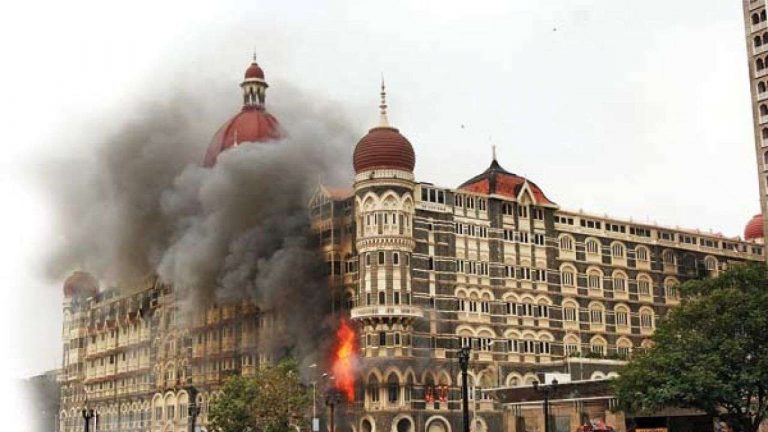
Azam Cheema, a senior commander of the Pakistan-based terrorist organisation Lashkar-e-Taiba (LeT) and a key conspirator in the 2008 26/11 Mumbai terror attacks, has died in Pakistan’s Faisalabad city from a heart attack. His funeral was reportedly arranged in Malkhanwala.

Azam Cheema joined the LeT in 2008 as an operation adviser, and later took on the role of commander. Afterwards, the United States Department of Treasury’s Office of Foreign Assets Control designated him as a Specially Designated Global Terrorist under the Specially Designated Nationals and Blocked Persons List.

According to the authorities, the 70-year-old was also the mastermind of the 2006 Mumbai train bombings that left 188 people dead with more than 800 injured. The government was on the lookout for him because he provided training to the terrorists who carried out the 26/11 terror attacks that resulted in 166 fatalities, including 18 security personnel, and wounded over 300 individuals.

The United States Treasury Department started action against Azam Cheema and targeted LeT’s financial networks in 2010. The department released a statement asserting that he had participated in the terror group’s training programs, especially bomb-making and skills required to infiltrate India.

Azam Cheema was a “key commander” in LeT’s operations and had connections to Osama bin Laden’s Al-Qaeda network.

According to intelligence sources, he lived with his wife and two children in Bahawalpur, during the early 2000s. A source stated, “He was often spotted moving around in a Land Cruiser with six bodyguards. It was Cheema who had once brought former ISI chief general Hamid Gul, Brigadier Riyaz and Colonel Rafiq to brainwash jehadis undergoing arms training in the Bahawalpur camp. He would occasionally visit Karachi and Lahore training camps as well.”

He was an Afghan war veteran who was well-versed in reading maps, particularly those pertaining to India. “He taught the jihadis to spot vital installations of India on the map. He would also instruct LeT terrorists across India via satellite phone in the mid-2000s,” revealed another source.

When Azam Cheema was selected as an operations adviser to LeT’s top functionary Zaki-Ur-Rehman Lakhvi in 2008, he was serving as the LeT commander for Bahawalpur in Pakistan. In addition to training recruits, Cheema was involved in the planning and execution of the 26/11 Mumbai attacks.

Notably, multiple terrorists have died in Pakistan in the past few months. On the intervening night of 2nd and 3rd December, Lashkar-e-Taiba terrorist Hanzla Adnan was shot by unknown gunmen near his residence in Karachi. He was then secretly taken to a hospital there by the Pakistani Army where he succumbed to his injuries and died on 5th December.

Lashkar-e-Taiba terrorist and recruiter Habibullah was shot dead by unknown gunmen on the evening of 17th December. They reportedly fired at him in Khyber Pakhtunkhwa’s Tank district. He was involved in the Pulwama and Uri terror attacks.

Pakistan-based Jaish-e-Mohammed (JeM) terrorist Shahid Latif was killed by unidentified gunmen on 11th October in Sialkot, Pakistan. He was a JeM handler and the mastermind of the 2016 terrorist assault in Pathankot. Shahid Latif was among the most wanted terrorists in India and was sought in a Unlawful Activities (Prevention) Act (UAPA) case by the National Investigation Agency (NIA).

On 8th September, some anonymous assailants opened fire inside the Al-Qudus mosque in Rawalkot, Pakistan-occupied Kashmir and murdered a top terrorist leader of the Lashkar-e-Taiba (LeT). He was identified as Riyaz Ahmad alias Abu Qasim.

Bengaluru: Blast suspect caught on CCTV footage, had ordered Rawa Idli before leaving a bag at Rameshwaram Cafe

A bomb blast took place at Rameshwaram Cafe in Bengaluru on Friday(1st March). The accused had kept a bag full of explosives in the cafe. At least 10 people were reportedly injured in the blast. Now, the day after the blast, a photograph of the suspect has surfaced. CCTV footage released by the police shows a man wearing a cap and mask coming to the café with a bag purportedly filled with IED explosives in his hand. He then ordered Rawa Idli at the café and left the bag there while leaving the cafe.

Newly surfaced CCTV footage from Saturday depicts the individual suspected of involvement in the Rameshwaran Cafe blast in Bengaluru, seen approaching the restaurant with a bag believed to contain an Intensive Explosive Device (IED). Following the explosion on Friday, which injured 10 individuals, the perpetrator is reported to be evading authorities. In response, police have established multiple teams to track down the suspect. According to police sources, the blast at the popular cafe in Bengaluru was executed through a low-intensity IED triggered by a timer.

This suspect is around 30 years old. He came to the cafe with a bag at around 11:30 a.m. He ordered Rawa Idli at around 11:38 a.m. He was captured on a CCTV camera placed above a counter in the cafe. Nevertheless, he did not eat the food and was seen near the wash basin area around 11:44 a.m. Approximately a minute later, he exited the cafe. The explosion occurred at approximately 12:56 p.m. Another CCTV footage revealed the individual approaching the restaurant while carrying a bag. Police speculate that a makeshift improvised explosive device (IED) containing a timer, concealed within the bag, triggered the low-intensity blast.

A case regarding the explosion incident has been filed under the rigorous Unlawful Activities (Prevention) Act and Explosives Substances Act. On Saturday, personnel from the National Investigation Agency (NIA) and National Security Guard (NSG) arrived at the scene to assist local law enforcement in their inquiry. Divya Raghavendra Rao – the co-founder and managing director of Rameshwaram Cafe – affirmed cooperation with the authorities and officials conducting the investigation. Meanwhile, Karnataka Chief Minister Siddaramaiah has called a meeting of senior police officers on Saturday afternoon in connection with the blast.

Rahul Gandhi returns to India from ‘paid event’ in UK, Congress supporters hail him as ‘Visiting Professor’ of Cambridge University

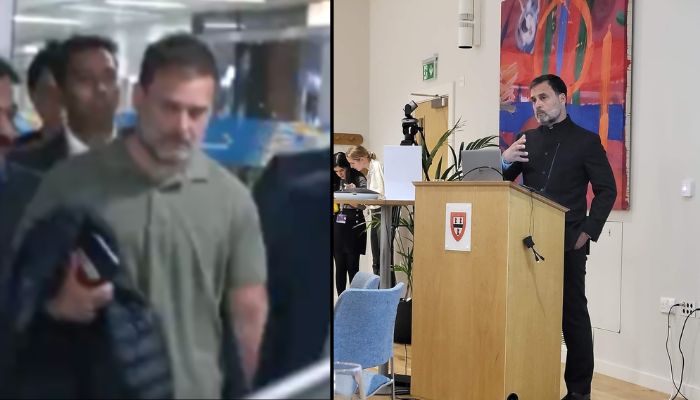
On Saturday (2nd March), Rahul Gandhi returned to India from the United Kingdom after speaking at a paid, private event at the Jesus College of the University of Cambridge.

Contrary to the claims by the Congress party that he was ‘invited’ by the prestigious institution, OpIndia found no evidence that could remotely suggest the existence of any such invitation by the University of Cambridge.

After shamelessly passing off old images of Rahul Gandhi as recent pictures from his ‘address’ at Cambridge, his supporters are now hailing Rahul Gahul as the ‘Visiting Professor’ of the renowned varsity.

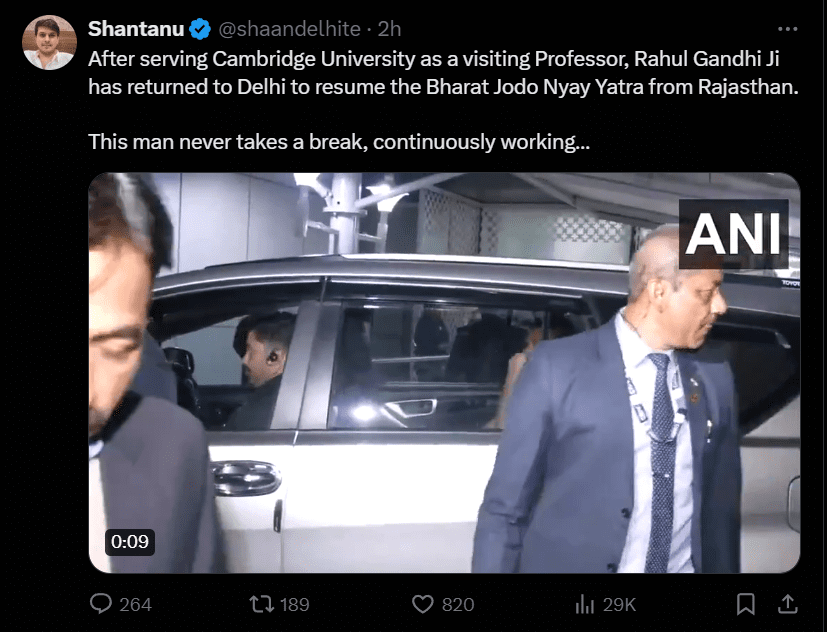
Following the return of Rahul Gandhi to India, Congress loyalist Shantanu tweeted, “After serving Cambridge University as a Visiting Professor, Rahul Gandhi ji has returned to Delhi to resume the Bharat Jodo Nyay yatra from Rajasthan.”

He further claimed, “This man never takes a break, continuously working.”

Screengrab of the tweet by Shantanu

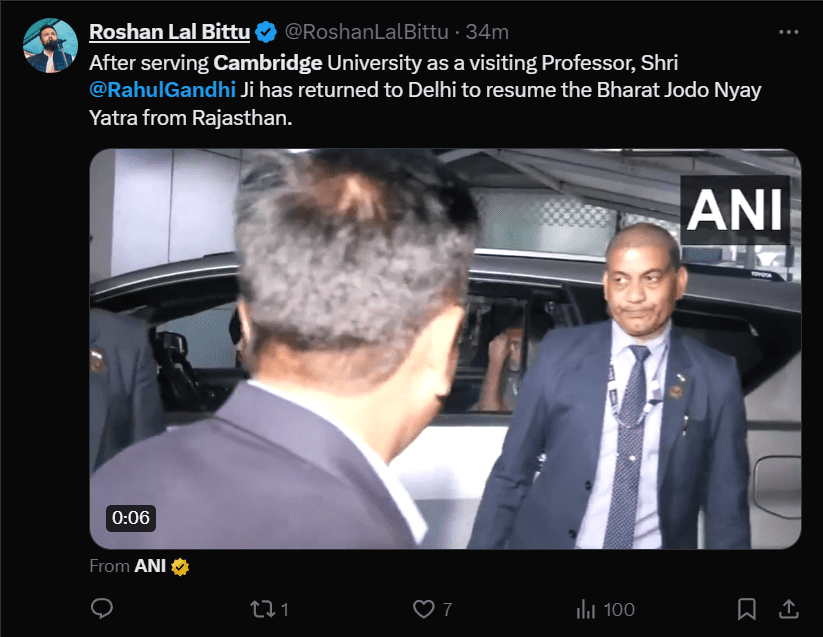
A similar tweet was posted by Congress member Roshan Lal Bittu. Interestingly, Rahul Gandhi is far from being the ‘Visiting Professor’ of the University of Cambridge.

In fact, the Congress scion is not even a ‘visiting Fellow’. An investigation led by The New Indian in March 2023 revealed that Rahul Gandhi is not a ‘Visiting fellow’ but an ‘Honorary non-visiting Fellow.’

But this did not stop the supporters of the grand-old-party from hailing the Congress leader as a ‘Visiting Professor’ of the University of Cambridge.

Screengrab of the tweet by Roshan Lal Bittu

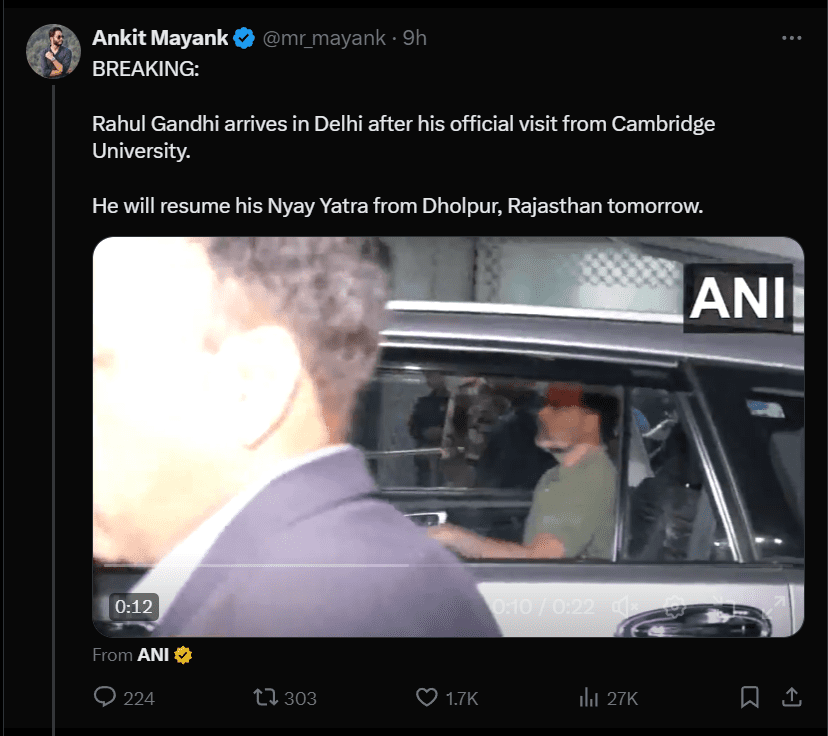
Another Congress supporter named Amit Mayank reiterated the same lies about Rahul Gandhi being invited by the University of Cambridge.

He tweeted, “Breaking: Rahul Gandhi arrives in Delhi after his official visit from Cambridge University. He will resume his Nyay yatra from Dhoplpur, Rajasthan tomorrow.”

Screengrab of the tweet by Ankit Mayank

Opindia investigation into Rahul Gandhi’s Cambridge ‘lecture’

Having found the glaring inconsistencies in the claims made by Congress about Rahul Gandhi delivering ‘special lectures’ at the University of Cambridge, OpIndia wrote to the administration of Jesus College and asked the following questions:

  1. When was the conference room booked and for how long?
  2. Who were the organisers of the event?
  3. Did the college administration invite Rahul Gandhi to speak at the event?
  4. How many attendees were present at the event?
  5. How much was paid by the organisers to book the Elena Hall?

On Friday (1st March) evening, OpIndia received a response from a spokesperson of Jesus College of the University of Cambridge.

Screengrab of the email received from Jesus College

The official confirmed that the event organised at Elena Hall for Rahul Gandhi was a paid event and not organised by the college administration of the varsity.

“The event was an external, commercial booking. The College had no involvement in the organisation or financing of the event,” the spokesperson emphasised.

As such, it becomes crystal clear that Rahul Gandhi was not invited by the University of Cambridge for any ‘special lecture.’ The Congress scion halted his ‘Bharat Jodo Nyay Yatra’ for a paid event, conducted at a conference hall of a constituent college of the esteemed university.

I was asked to sleep with a producer at the age of 19: Actress Ankita Lokhande reveals shocking casting couch experience

Actor Ankita Lokhande rose to fame owing to the popularity of her TV series Pavitra Rishta and gained further recognition after she entered Bigg Boss 17 with her husband Vicky Jain. However, if she hadn’t experienced a casting couch early in her career, she might have begun her career as a film actress. She opened up about her unpleasant experience with a film producer who offered to cast her in a South Indian film only if she agreed to “sleep with him.”

Ankita Lokhande told Hauterrfly that she met a filmmaker at a Mumbai hotel after receiving a call informing her that she had been selected for a role. Replying to a question on whether she faced any casting couch incident, she recounted, “I had given an audition and I got a call saying, ‘You have been selected.’ I was supposed to go to sign and I told them, ‘Yes, I will come to the hotel.’ I even told my mother excitedly that I am going and I will get the signing amount.” 

She said that was apprehensive about the pleasant development and added, “When I went to the hotel, they called me in and asked my coordinator to stand outside. They said, ‘You have to compromise.’ I was just 19 then. At that time, it was like ‘I want to be a heroine and that phase was on.’ I played smart because I did not want to hear that I had to sleep with someone. So I asked them, ‘What kind of a compromise? Do you want me to go to a party with your producers, finances?’ I played it very smart so that I don’t get to hear what they were supposed to say.”

She further shared that they told her, “You have to sleep with the producer.” When Ankita Lokhande heard their words, she stood up and replied, “I don’t think your producer needs a talent, they need a girl to sleep with and I am not that one,” before leaving. She determined that day that she would only work in the television industry and would not pursue a career in film, despite the fact that she handled the situation quite effectively.

She mentioned, “That day I realised this industry or anywhere, I cannot give anyone the right to any person who can ask me that I have to sleep with them. I felt so low about myself that how could someone say this to me? That day I decided, I was not going to do films. I don’t want to do films. Because I don’t give rights to anyone, it’s dirty and then I decided whatever happens, I am happy with my television industry. After that, I got this opportunity of Pavitra Rishta and I happily did that.”

Ekta Kapoor’s Pavitra Rishta, starring Ankita Lokhande and late Sushant Singh Rajput, is one of the most popular soap operas on Indian Television. It aired on Zee TV from 2009 to 2014. Sushant later became a popular film actor before his mysterious death in 2020.

However, Ankita Lokhande made her Bollywood debut with Kangana Ranaut’s ‘Manikarnika: The Queen of Jhansi’ in 2019 after a successful career on the small screen. She also acted in ‘Baaghi 3’ which was released in 2020 and will soon be seen playing a significant part in Randeep Hooda starrer ‘Swatantra Veer Savarkar.’

Watch the complete interview here:

Gujarat: Muslim boy attacks two farmers over trivial dispute, encroachment by his father bulldozed

A few days ago, a minor Muslim teenager attacked two elderly farmers in Bhachau of Kutch in a trivial dispute matter, in which the farmers suffered serious injuries. A case was registered in the matter but the minor accused was later granted bail. Now the encroachment on government land by his father Haji Traya has been removed by the bulldozer action taken by the local administration and police.

After the incident was reported, Hindu organisations gave memorandums to the local administration demanding the strictest punishment for the accused. Meanwhile, complaints were also lodged against the accused’s father Haji Amad Traya and his brother for allegedly encroaching on government land in the Shikarpur village.

Given these memorandums, the Bhachau Taluka administration took action to remove the encroachment on the government land. The Taluka Development Officer investigated the matter and asked for the site to be vacated, after which the accused vacated the place. Then on Friday (1st March), the top officials of the administration and the officials of the police system reached the spot with a bulldozer and demolished the encroachment.

Tehsildar, Taluka Development Officer, Extension Officer, DySP, SOG officials as well as a large number of police personnel were present at the spot during this bulldozer action. According to reports, the accused had built two encroachments. One of them was razed off. The other one is under litigation and there is a stay order by the court in this regard. That second structure is not razed off by the bulldozer.

The encroachments were made by Haji Traya. There are multiple offences already registered in the past against him. The list includes offences like murder, assault, death threats and arms-related offences. Recently fifteen days ago his minor son had also beaten up two elderly farmers over a trivial matter.

On 15th February 2024, 55-year-old Bhavanbhai Patel, a resident of the Shikarpur village in Bhachau, was working in the field when the accused minor approached him and threatened to kill him by beating him with a stick, saying, ‘Why do you keep a watch when we graze goats’. The old man suffered serious injuries in his hands and legs due to the attack and was admitted to the hospital, where fractures were detected in both his hands and one leg.

On the same day, this minor boy also attacked a 65-year-old man in Naransari village near Shikarpur. The accused had entered the old man’s field to graze goats. The farmer refused to allow him to graze the goats fearing damage to the crop. The minor teenager got angry over this and tried to hit the farmer in the head. The farmer received an injury in his hand as he resisted the attack. Another case was then registered against this minor.

The accused was arrested after two offences were registered but was later granted bail. Now action has been taken against the encroachment on the government land by his father.

Extreme Poverty is now officially eliminated in India, says think tank report, praises initiatives of Modi govt

India has now officially eliminated ‘extreme poverty’, which can be seen through the sharp decline in headcount poverty ratio and stark increase in household consumption, American think tank Brookings said in a report.

The report, authored by Surjit Bhalla and Karan Bhasin, states that this has been a result of the government’s strong policy thrust on redistribution, which has led to strong inclusive growth in India over the last decade.

India has just released its official consumption expenditure data for 2022-23, providing the first official survey-based poverty estimates for India in over ten years.

According to the data, real per capita consumption growth has been recorded at 2.9 per cent per year since 2011-12. Under this, rural growth at 3.1 per cent was significantly higher than urban growth of 2.6 per cent

The data also presented an unprecedented decline in both urban and rural inequality.

The urban Gini (x100) (index to measure inequality) declined from 36.7 to 31.9; the rural Gini declined from 28.7 to 27.0.

In the annals of inequality analysis, this decline is unheard of, and especially in the context of high per capita growth.

According to Brookings, high growth and large decline in inequality have combined to eliminate poverty in India for the Purchasing Power Parity USD 1.9 poverty line.

The Headcount Poverty Ratio (HCR) for the 2011 PPP USD 1.9 poverty line has declined from 12.2 per cent in 2011-12 to 2 per cent in 2022-23, equivalent to 0.93 percentage points (ppt) per year. Rural poverty stood at 2.5 per cent while urban poverty was down to 1 per cent.

For the PPP USD 3.2 line, HCR declined from 53.6 per cent to 20.8 per cent.

Notably, these estimates do not take into account the free food (wheat and rice) supplied by the government to approximately two-thirds of the population, nor utilization of public health and education, the think tank stated.

The data show a strikingly lower number of poor people in India, at both thresholds, than those estimated by the World Bank.

The Brookings report presented a chart showing India’s Headcount Poverty Ratio for both the 1.9 USD PPP and the 3.2 USD PPP from 1977-78. It stated that the change in slope of the HCR for the higher 3.2 USD poverty line “reveals the extent of inclusive growth experienced in India over the last decade.”

The decline in HCR at the higher poverty line is remarkable given that in the past it took 30 years for India to witness a similar decline in poverty levels as now witnessed over 11 years, it added.

The authors are of the opinion that the relatively higher consumption growth in rural areas should not come as a surprise given the “strong policy thrust on redistribution through a wide variety of publicly funded programmes.”

Brookings lauded the national mission for the construction of toilets and attempts to ensure universal access to electricity, modern cooking fuel, and, more recently, piped water, among the policies that thrived consumption.

The rural access to piped water in India as of August 15, 2019 was 16.8 per cent and at present it is 74.7 per cent, the report cited. The reduced sickness from accessing safe water may have helped families earn more income.

Similarly, under the Aspirational District Programme, 112 districts in the country were identified as having the lowest development indicators. These districts were targeted by government policies with an explicit focus on improving their performance in development.

“Official data now confirms that India has eliminated extreme poverty, as commonly defined in international comparisons. This is an encouraging development with positive implications for global poverty headcount rates,” the Brookings report stated.

“This also means that time has come for India to graduate to a higher poverty line much like other countries. The transition to a higher poverty line provides an opportunity to redefine existing social protection programs particularly with the objective of better identification of intended beneficiaries and providing greater support to the genuine poor,” Bhalla and Bhasin added in the report.


(This news report is published from a syndicated feed. Except for the headline, the content has not been written or edited by OpIndia staff)

Himachal Congress chief Pratibha Singh lauds BJP, admits that Congress is no competition for the saffron party

On one hand, the Gandhi scion, Rahul Gandhi is wandering from state to state leading his Bharat Jodo Nyay Yatra to consolidate people’s mandate in a last-ditch attempt to revive his party’s fortune before the upcoming Lok Sabha elections, and on the other, the party has been struggling with an array of obstacles in various states. In Himachal Pradesh, for example, the party is in deep trouble.

Day after party observers declared that they have mediated a truce between rival factions, state party president Pratibha Singh struck a divisive note on Friday, March 1, complimenting the BJP and drawing attention to flaws in her party-led state administration.

The internal feud in Himachal Congress was in the open after six rebel Congress MLAs cross-voted during the Rajya Sabha elections that were held on February 27, resulting in the loss of the Congress party candidate Abhishek Manu Singhvi and the win of BJP’s Harsh Mahajan. As a result, on February 29 Himachal Pradesh Assembly speaker Kuldeep Singh Pathania disqualified these six rebel Congress MLAs. The six leaders cease to be members of the Himachal Pradesh Assembly with immediate effect.

Further complicating matters for the Congress government in Himachal Pradesh, Vikramaditya Singh, a state minister and the son of the former Chief Minister Virbhadra Singh and the current State Party President Pratibha Singh stepped down from his position on February 28.

Soon after, the Congress high command ordered DK Shivakumar to fly to Himachal urgently to manage the crisis. However, only a day after Karnataka Deputy Chief Minister and Congress observer for Himachal Pradesh, DK Shivakumar, declared that Himachal Pradesh’s political crisis was over, state Congress chief Pratibha Singh declared how her party might not stand a chance to even come close to BJP in the upcoming Lok Sabha polls.

Congress is on a weak footing: Congress Himachal chief Pratibha Singh bats for BJP in the upcoming Lok Sabha polls

On Friday, March 1, hours after her son Vikramaditya Singh met with the rebel MLAs who voted against the Congress in the Rajya Sabha elections, Pratibha Singh told ANI, “A lot of things remain to be done in Congress…It is true that BJP’s work is better than ours”. Further, claiming the BJP “will do a lot of things” as per the directions of Prime Minister Narendra Modi, she said the Congress is on a weak footing.

“From day 1, I had been telling the CM that we would be able to face the upcoming elections only if he strengthens the organisation. This is a very tough situation for us. We can see a lot of difficulties on the ground. As per the directions of PM Modi, BJP is going to do a lot of things…We are on weak footing there. I urged him again and again that we need to strengthen and the party needs to be organised…I can say that it is a difficult time. Still, we have to contest elections and win,” she added.

Pratibha Singh further went on to demonstrate the disconnect between the party’s observers and the state unit when she questioned DK Shivakumar’s assessment of Chief Minister Sukhvinder Singh Sukhu. Shivkumar had shown confidence that his-led Himachal Pradesh state government would stay and that all the MLAs wanted the Congress government for five years. However, Pratibha Singh was quoted by ANI as saying, “Observer ke bolne se kya hota hai’, it is the people who will decide what will happen in the future.” 

Earlier, the State Congress chief defended the six dissident MLAs, stating that their only demands were to be heard and opposed their disqualification.

Notably, the Congress had 40 MLAs while the BJP has 25 in the 68-member state assembly. The remaining three seats are held by independents. Now, with the disqualification of the six Congress rebel MLAs, the strength of the House has reduced from 68 to 62. The halfway mark is now 32. The Congress now has 34 MLAs and the BJP has a total of 28 MLAs, including independents. The fortunes of the grand old party in the hill state now rely on its capability to keep the rest of its party MLAs together.

Kerala treasury facing crunch of funds, salaries of government employees delayed

The Kerala state government finds itself grappling with a funds crunch, leading to a delay in the disbursement of salaries for its employees. Initially slated for payment on the first of the month, the salaries are now expected to be credited on 4th March.

The delay in salary distribution can be traced back to the inability to access funds from the Employees Treasury Savings Bank (ETSB) account via traditional banking channels due to the absence of online transaction provisions. This predicament has affected approximately 97,000 employees who were anticipating their payments on schedule.

The current financial strain has resulted in the freezing of the Employees Treasury Savings Bank (ETSB) account, necessitating urgent action to replenish the treasury. Public sector organizations are being called upon to redirect reserves and dividends into the state coffers to mitigate the crisis.

Amidst the mounting frustration among government employees, protests have escalated, with the Secretariat Action Council laying blame on the government’s mismanagement for the delay. Plans for a protest demonstration are in motion, reflecting the growing discontent within the workforce.

While the Treasury Department and the Finance Department have remained tight-lipped, citing technical issues, there are murmurs of dissatisfaction within the affected employee base. Despite the salaries being reflected in their ETSB accounts, access to funds remains elusive, raising suspicions about the government’s transparency in handling the situation.

Some critics have voiced concerns over the government’s motives, alleging a deliberate attempt to mask the severity of the financial crisis by creating the illusion of salary disbursement. Among those affected are employees from critical departments such as Home, Revenue, Treasury, GST, and Secretariat, further exacerbating the impact of the delay.

As the situation unfolds, it underscores the pressing need for transparent financial management and accountability within the Kerala state government, especially concerning the welfare of its employees.