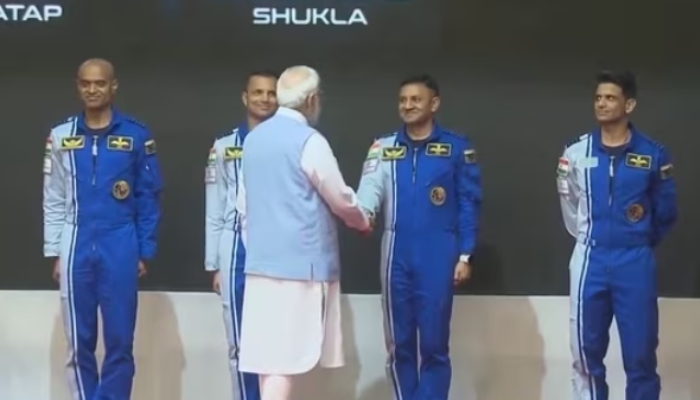
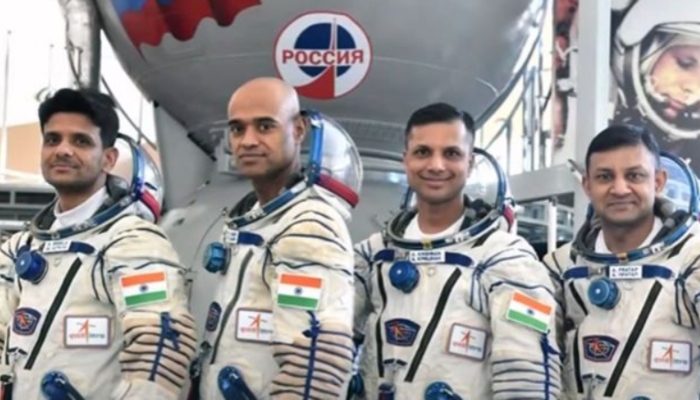
Prime Minister Narendra Modi, during his Kerala visit on 27th February, visited the Vikram Sarabhai Space Centre (VSSC) in Thiruvananthapuram and reviewed the progress of ‘Gaganyaan’, India’s human spaceflight mission. During the event, the PM bestowed astronaut wings to the astronaut designates and congratulated them for the project.
The Prime Minister, meanwhile, also inaugurated three important space infrastructure projects worth about Rs 1,800 crore. The three space infra projects include ‘The PSLV integration facility’ at Satish Dhawan Space Centre, Sriharikota, ‘A semi-cryogenics integrated engine and stage test facility’ at the ISRO propulsion complex in Mahendragiri, and ‘A trisonic wind tunnel’ at VSSC.
#WATCH | Prime Minister Narendra Modi reviews the progress of the Gaganyaan Mission and bestows astronaut wings to the astronaut designates.
The Gaganyaan Mission is India's first human space flight program for which extensive preparations are underway at various ISRO centres. pic.twitter.com/KQiodF3Jqy
The four prospective astronauts selected, all either wing commanders or group captains for the Gaganyaan mission are Shubanshu Shukla, Prashanth Balakrishnan Nair, Angad Prathap, and Ajit Krishnan. These astronauts were bestowed astronaut wings by PM Modi.
The four astronauts have been training at the space agency’s astronaut training center in Bengaluru. The astronauts were selected from the IAF’s Institute of Aerospace Medicine.
“I am happy that today I got the opportunity to meet these astronauts and present them in front of the country. I want to congratulate them on behalf of the entire country…You are the pride of today’s India,” PM Modi said during his address.
He added, “India’s success in the space sector is sowing the seeds of scientific temperament in the country’s young generation.”
The American space agency NASA will also prepare one Indian astronaut for a journey to the International Space Station by the end of 2024, according to the agency’s administrator Bill Nelson, who visited Delhi in 2023.
Gaganyaan mission
The Gaganyaan Mission is India’s current project to send a 3-day manned mission to 400 km Low Earth Orbit (LEO) with a four-person crew and safely return them to Earth. As part of this program, the Indian government has approved two unmanned missions and one human mission.
The Gaganyaan Mission is an ambitious and well-coordinated attempt by ISRO in partnership with other organisations, including numerous research labs, Indian academia, and enterprises, intending to conduct human space flights and space exploration.
The Gaganyaan project’s success is likely to inspire other inexpensive human spaceflight programs to explore the solar system and beyond, as well as sample return missions and other scientific investigations. Gaganyaan’s expected accomplishments will also inspire students to pursue careers in science and technology, particularly in the realm of space science, where they will be challenged to innovate and create.
It will facilitate diplomatic contacts with other spacefaring countries, providing the road for joint missions, knowledge sharing, and international cooperation in space exploration, consequently boosting international relationships.
The Gaganyaan mission holds the potential to drive economic growth by developing space-related companies, technology spin-offs, and job creation, all of which will benefit India as a whole.
The first manned spaceflight is planned to occur in 2025. The Gaganyaan Mission’s accomplishment will place India among the select group of nations capable of human space flight (the United States, Russia, and China).
PM Modi will embark on a two-day trip to Kerala, Tamil Nadu, and Maharashtra beginning on 27th February to launch and lay the groundwork for a plethora of development projects totaling more than Rs 24,000 crore across the three states.
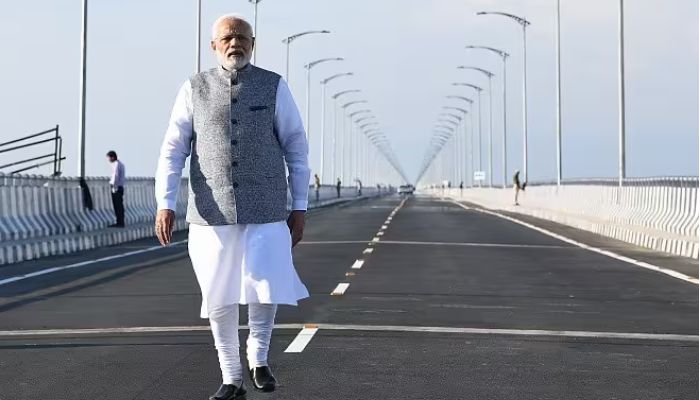
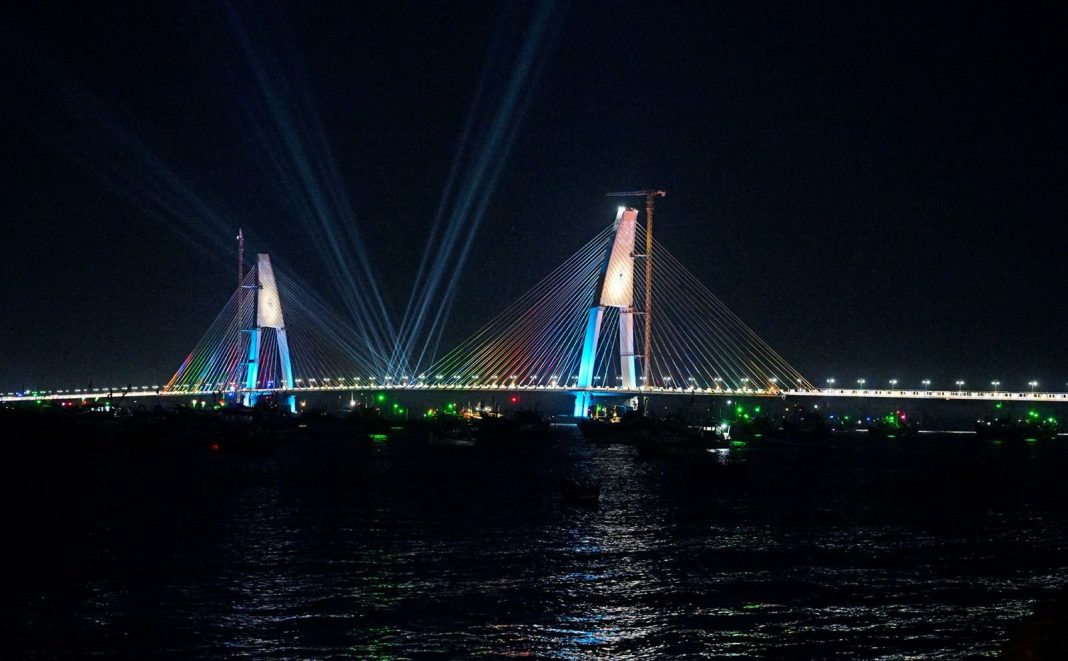
On Monday (26th February), Prime Minister Narendra Modi dedicated railway infrastructure projects worth over Rs. 41,000 crores to the nation. This includes the face-lift of 553 stations that would be redeveloped under the Amrit Bharat Station Scheme. As part of it, scores of over-bridges and underpasses across India will also be inaugurated. A day earlier, PM Modi inaugurated Sudarshan Setu, the longest cable-stayed bridge in India, an “Infrastructural marvel”.
An infrastructural marvel in Gujarat…here is why the Sudarshan Setu is exceptional! pic.twitter.com/aiRPKJx0ri
As a continuum, the last decade under the Modi government has seen an Infrastructure boom in roads, Railways, waterways, Airports, multi-modal logistical parks, and freight corridors among others. However, the Modi government has been focusing on ‘Sabka Vikas’ taking development to every corner of India.
Canvassing from the mighty Himalayas to the treacherous waters of Brahmaputra or from the ‘line of sight’ of the adversary on LAC, to the re-invigoration of old edifices to face-lift them as tourist hotspots, the Modi government has been literally and figuratively bridging North-South, East-West and the forgotten treasure chest, the North-East. Highlighting the same becomes important at a time when the opposition is adamant about widening the fault lines based on caste, religion, or region.
Here are examples of ten stellar bridges built under the Modi government that have been bridging geographical and societal divides in addition to bringing prosperity and enabling ease of connectivity for Indians.
Sudarshan Setu
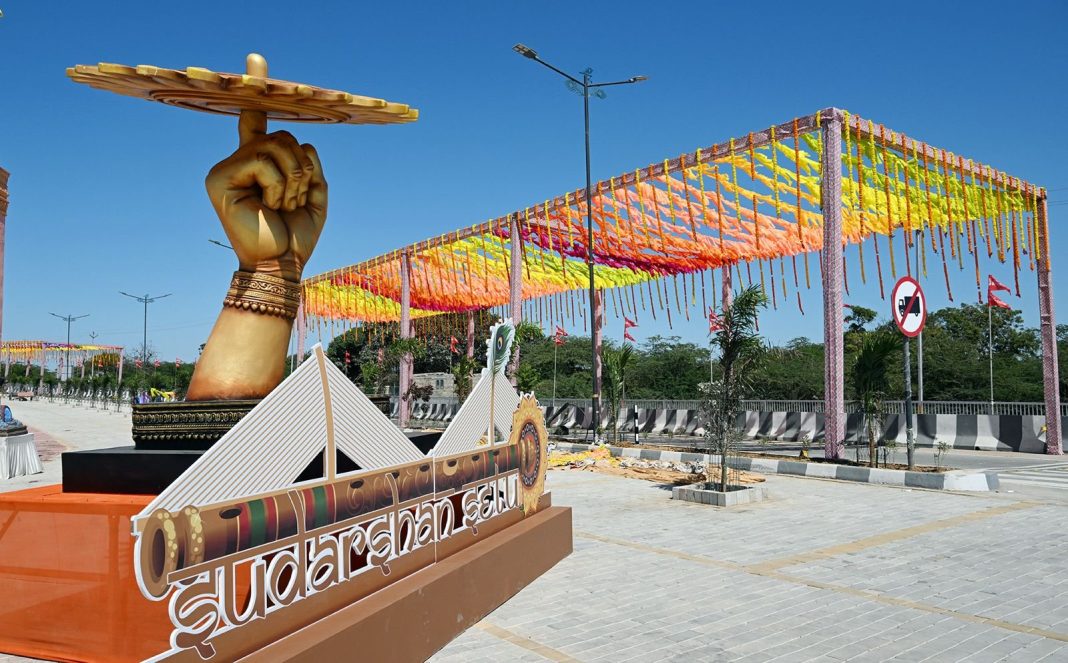
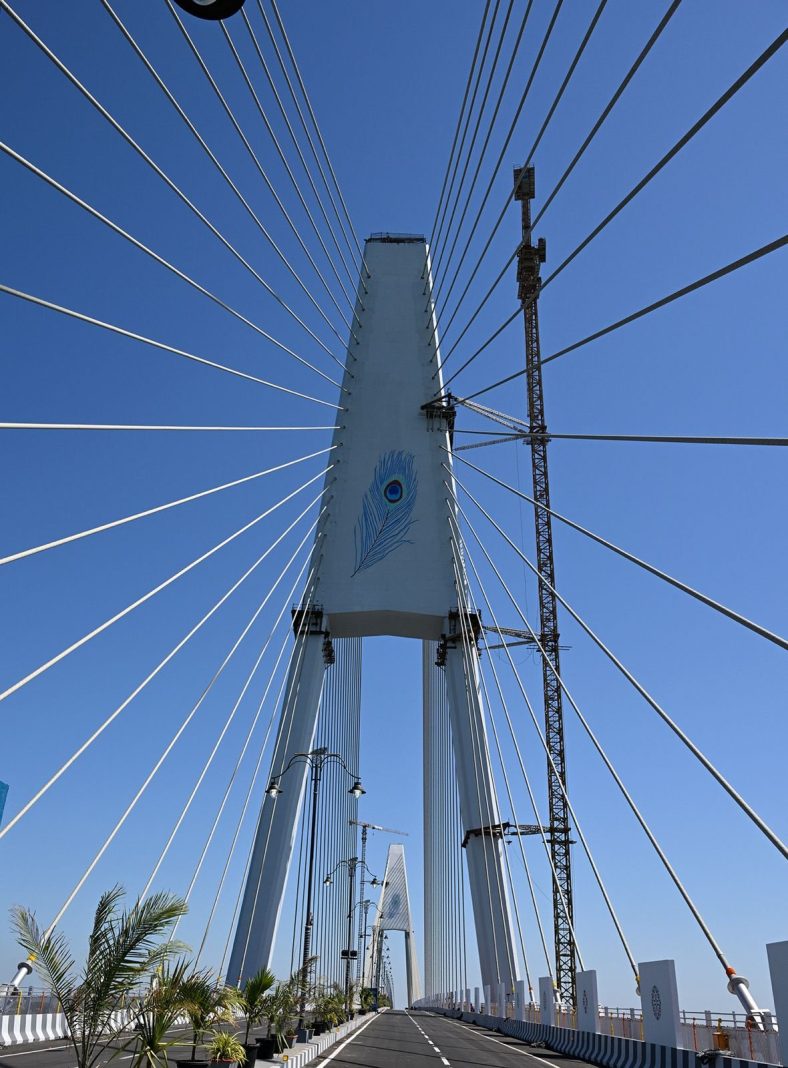
The Modi government on 25th February inaugurated the longest cable-stayed bridge in India and changed its name from ‘Signature bridge’ to ‘Sudarshan Setu’. Notably, Sudarshan Chakra is the main weapon of Bhagwan Shri Krishna.
The bridge connects Okha mainland and Beyt Dwarka island. It has a length of 2.32 KM and has been built at a cost of around Rs 980 crores. It has a unique design that features a footpath adorned with verses of the Shrimad Bhagavad Gita and images of Bhagwan Krishna on both sides. Before the bridge, the devotees faced hardships in reaching Beyt Dwarka and only relied on boat transport which comes with its own restrictions.
(Images Source – X_NarendraModi)
Atal Setu
Not long ago, the state of Maharashtra had witnessed the stalling of critical infrastructure development projects like the Metro Car shed project in the name of the politically stirred ‘Save Aarey forest’ protest under the Mahavikas Aghadi (MVA) government.
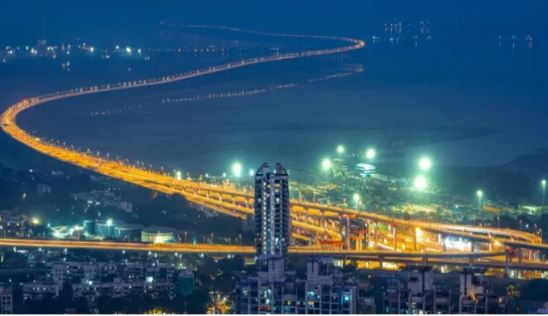
However, post-MVA, the BJP-led NDA government revived the earlier projects giving a renewed impetus to the Infrastructure development in the state. The Mumbai Trans Harbour Link (MTHL) or Atal Setu, inaugurated by PM Modi on 12th January could be an apt mascot of prosperity and infrastructure for a nation that is poised to become a developed economy in the foreseeable future.
The Atal Setu is the longest sea bridge in India and ranks 12th longest globally. It has been named after former prime minister and BJP veteran Atal Bihari Vajpayee. This six-lane bridge is 21.8 km in length and has been constructed at the cost of Rs 18000 crore. It reduces the travel time between Mumbai and Pune Expressway.
The stark contrast in the pace of infrastructure development between the Modi-led BJP government and Congress-led governments could be gauged from the fact that the Atal Setu project had been in the works since the 1990s, and multiple attempts had been made to develop it. Prime Minister Narendra Modi laid the project’s foundation stone in December 2016, then construction began in April 2018 on three civil packages.
Chenab Rail Arch Bridge
The reformed landscape in the terrorism-hit valleys of Jammu and Kashmir could stand out as one of the biggest transformative stories of peace and prosperity in modern India’s history. Once hailed as a ‘heaven on earth’, the wounds of the residents in the region were left to fester and a sense of alienation and separatism had taken actionable measures – including ‘seceding’ mentally to neighbouring Islamic nations and picking arms.
With the inauguration of several strategically important bridges and tunnels, the residents have been achieving all-weather connectivity, a surge in tourism, and a reduction in expenses due to shortened trips. For security forces, the bridges have ensured the protection of the supply lines.
Prime Minister Narendra Modi on 20th February inaugurated multiple projects in Jammu and Kashmir, including the Chenab Bridge. The Chenab Bridge is the world’s highest single-arch railway bridge. It is a majestic example of an engineering marvel showcasing the infrastructure prowess of new India, and a bold statement of the country’s ambitions.
The bridge is taller than the Eiffel Tower in Paris and this project is considered the biggest civil-engineering challenge by any railway project in India’s recent history. It stands at the height of 1,178 feet above the riverbed, that is, it is 35 metres taller than Paris’ tourist icon, the Eiffel Tower. It is built over River Chenab in J&K with a cost of around Rs 14,000 crore. It connects Bakkal and Kauri in the Reasi district of Jammu and Kashmir and forms a crucial link from Katra to Banihal.
It was approved in 2003 and contracted in 2008. The Railways carried out tests for high-velocity winds, extreme temperatures, earthquake resilience, and the impact of rising water levels on hydrology to ensure the stability and safety of the world’s highest bridge.
Bridge near Galwan in the face of belligerent China to safeguard troop movement
Apart from aesthetic and civilian ease, the Modi government has also laid special emphasis on ensuring the safety of the troop movement and securing their supply line.
In June 2020, the engineers of the Indian Army completed the construction of a 60-metre bridge over the Galwan River in eastern Ladakh. It would strengthen India’s control of the region by enabling the Indian troops to move across the river and provide a shield to the 255 KM strategic road from Darbuk to Daulat Beg Oldie, the final post south of the Karakoram Pass. The four-span bridge is situated three kilometres east of the Shyok river-Galwan confluence. The flashpoint-PP14 where violent clashes erupted between Indian and Chinese soldiers, is located further 2 km east of the Bailey bridge.
The construction of the bridge was completed in the wake of belligerence displayed by the People’s Liberation Army (PLA) in a bid to discourage the Indian Army from completing the project.
Under-construction 6-lane extra-dosed cable-stayed bridge on Ganga River in Bihar
In December 2023, the Modi government approved the construction of a 4.56 km long, 6-lane bridge on the Ganga River. It will be built with the approximate project cost of Rs 3,064.45 crore and connect two Districts namely Patna at Digha on the south side and Saran on the north side across River Ganga, Bihar. The work is expected to be completed in 42 months from the appointed date.
Abridging ‘dil ki duri’ with the Northeast
After coming to power, PM Modi changed the dynamics of how the Centre framed its policy and made it a more people-centric and decentralised governance style where the Northeast took center stage. This includes changing the policy paradigm from ‘Look East’ and ‘Act East’ to ‘Act Fast and First for Northeast’, and PM Modi directing Union Ministers to station for days on a frequent basis in North Eastern states. PM Modi is reducing the geographical as well as sentimental (Dil ki duri) distances that cropped up after years of neglect by the Congress-ruled states and partly because of difficult terrain.
Under the Modi government, the North East has seen a major facelift in connectivity with the Central part of India. For this, an ‘expanding number’ of new airports, railway routes, and alternate waterways are coming up for the Northeastern states.
Here are the major projects abridging Northeastern states to the rest of India:
Dhola-Sadiya Bridge
The Dhola-Sadiya Bridge in Assam is the longest bridge in India. It is named after Bhupen Hazarika and was inaugurated by Prime Minister Modi on 26 May 2017. It connects the villages of Dhola and Sadiya in Tinsukia district in Assam. It is also the first permanent road connecting north Assam and east Arunachal Pradesh.
The feasibility study for the project was first conducted under the Atal Bihari Vajpayee government in 2003. The project was then approved in 2009, 6 years after the feasibility study was started, and construction finally began in 2011. However, due to delays, the project which was set to be completed by 2015 was delayed to 2017.
Bhupen Hazarika Setu ~ An engineering marvel, which has brought Arunachal and Assam closer!
A testimony to Hon PM Shri @narendramodi Ji's commitment to develop Northeast.
— Pema Khandu པདྨ་མཁའ་འགྲོ་། (@PemaKhanduBJP) March 30, 2023
Bogibeel Bridge
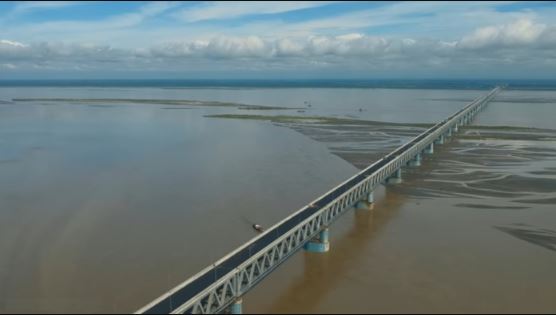
On 25th December 2018, PM Modi inaugurated the Bogibeel Bridge over the Brahmaputra River in Assam. With a length of around 4.94 kilometers, it is India’s longest Rail cum Road bridge. The bridge has a three-lane road on the top deck, while the deck below carries two broad gauge railway tracks. This is around 100 km away from India’s longest bridge, the 9.76 km long Dhola-Sadiya bridge over the Lohit River, one of the three rivers that form the Brahmaputra River.
Just like in Jammu and Kashmir, in North East, several Infrastructure projects are built keeping in mind the strategic requirements of the Indian armed forces, especially after the misadventures of our Northern neighbour China.
For military assistance, in January 2023, Defence Minister Rajnath Singh inaugurated the strategically important Siyom bridge in Arunachal Pradesh. It is a 100-metre steel arch bridge on the Along-Yingkiong Road and a resolute symbol of Infrastructure development coming up across the northeast, particularly Arunachal Pradesh.
@BROindia is proud to present it's 28 infrastructure projects that have been completed at a cost of Rs 724.3 Cr. This will make it to 103 infrastructure projects completed by @BROindia in year 2023 at a cost of Rs 2897 Cr. These 28 projects will be dedicated to the Nation by(1/2) pic.twitter.com/PnKXvrTDhL
It was constructed by the Border Roads Organisation (BRO) under the project Brahmank. Notably, the BRO has four projects in Arunachal Pradesh – Arunank, Vartak, Brahmank, and Udayak. Through these four projects, the BRO maintains and develops infrastructure in the difficult geographical terrain and strategically important areas of this state.
The bridge was dedicated to the nation after the Chinese were handed a humiliation and their adventurism in the Tawang sector was thwarted, a month earlier.
Building bridges over the treacherous waters of Brahmaputra
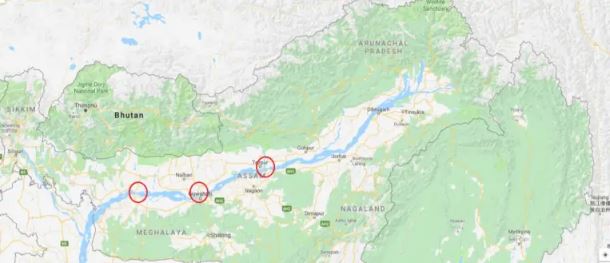
The 2.9 km long Bridge built over the Lohit River was opened in January 2017. This was the new Sariaghat Bridge or the second Sariaghat Bridge. The old Saraighat bridge was started by Britishers in 1910 and opened in 1962. It is parallel to the rail cum road Saraighat Bridge and was built to ease the traffic congestion in the area. This bridge over the Brahmaputra River lies in the Kamrup district of Assam and connects the capital city of Guwahati.
(Three bridges marked with red circles over the Brahmaputra till 2014, Image Source – OpIndia Archive)
Fig: Three bridges over the Brahmaputra till 2014. Old Saraighat (started in 1910), New Saraighat (2017); Tezpur (1987, the peak of Assam Accord), Golaghat (opened by Shri AB Vajpayee in 1998)
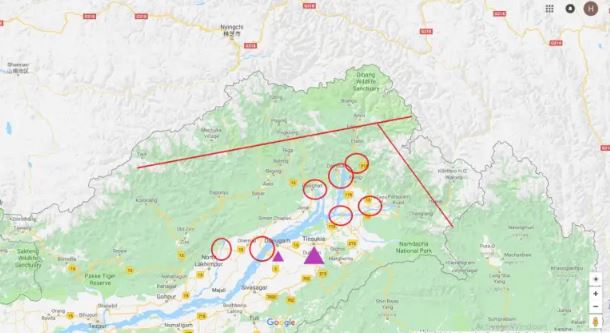
(Now the same area is facilitated with 7 more bridges making citizens’ life much easier and convenient)
Fig: Accessibility to border areas of eastern Arunachal due to newly constructed bridges since 2015
In November 2021, Assam CM Himanta Biswa Sarma announced that three more bridges would be coming up on Bhramaputra in the next five years. The upcoming three bridges include bridges connecting Narengi-Kuruwa, the under-construction Guwahati- North Guwahati bridge, and the Palashbari-Sualkuchi bridge.
Glass skywalk on Sikkim’s Singshore Suspension Bridge
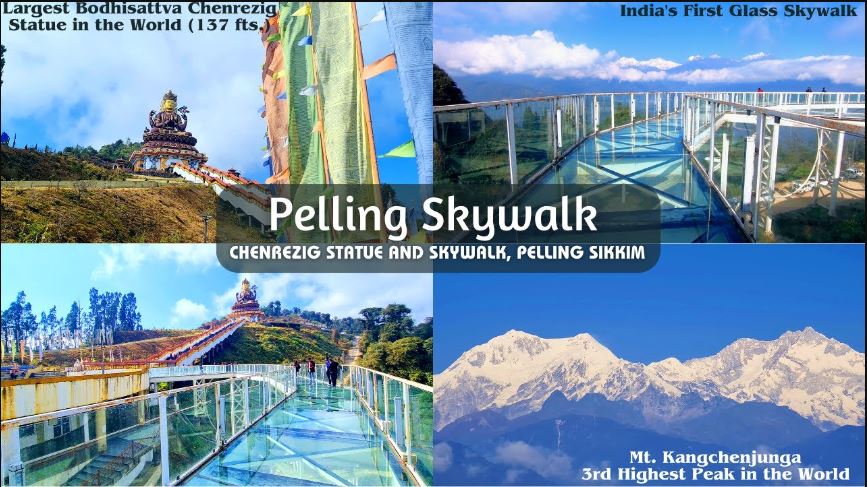
India’s first glass skywalk was inaugurated in 2018. It is built in Sikkim’s Pelling and situated right opposite the 137-foot statue of Chenrezig. It is located at 7,200 ft above sea level. After receiving confirmation from the Prime Minister’s Development Initiative for North East Region (PM Jiwain), the old bridge was slated to undergo remodeling and reconstruction to become a glass skywalk. The old Singshore Bridge was originally constructed in 1993 and it holds a significant place on the tourism map of West Sikkim.
Nonetheless, these are ten picks from scores of bridges that have been built across the country or are under construction. Undoubtedly, they are works of brilliance like the Signature Bridge in Delhi but the aforementioned have been included to buttress ‘Sabka Vikas’ bridging the gap in India’s infrastructure and connectivity, and bringing people together.
It is pertinent to note that Infrastructure development is not just about building roads, bridges, and superstructures, it’s also about building opportunity and hope, empowering communities that had been left behind, and supporting them to reach their full potential. Through a visible transformative change in the Infrastructure, the Modi government has been harnessing the dormant power of a sleeping giant and moving towards the goal of tapping the full potential of development in the country.
From the times of romanticisation and exaggeration of stories of hardships like Grannies crossing mountains and tidal waves to reach far-off schools or earn a livelihood, India has leapfrogged and arrived at a stage where it is sharing tales of Infrastructure prowess and not just reaching the last man left out in the queue in remote, unmotorable routes. It is excelling in the art, building first and best among the line, thinking big, and setting examples for its billion-strong population.
Asserting a significant change from times of hardships and a palpable, metastasising sense of alienation, the Modi government is bridging the hearts and minds of every community left behind. The above bridges are the pillars of ‘Sabka Vikas’, extending arms of brotherhood and prosperity.
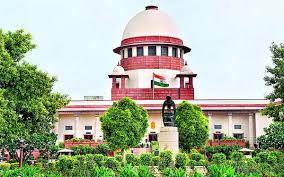
The Supreme Court on Tuesday, 27th February, upheld the demolition of a Chennai mosque illegally constructed on public land.
A bench of Justices Surya Kant and KV Vishwanathan ruled that such unauthorised religious structures can never be a venue for preaching religion.
The SC dismissed an appeal filed by Hydha Muslim Welfare Masjid-E-Hidaya and Madrasa against the Madras High Court order from 22nd November 2023 for the removal of the mosque.
The SC bench reminded the authorities of the previous SC orders asking the states and HCs to ensure that no unauthorised constructions are allowed in the name of temple, church, mosque or gurudwara on public streets or public places.
Appearing for the appellant, senior advocate S Nagamuthu stated that the trust had bought the land and the mosque wasn’t causing hindrance to the public. He further claimed that the land was vacant for a long time.
However, the court noted that the Chennai Metropolitan Development Authority had acquired the land and the construction was raised without any permission.
“The land belonged to the government. You did not have any right to it,” the bench reportedly said.
The court further noted, “The petitioner is admittedly not the owner of the subject property, which vests in Chennai Metropolitan Development Authority, free from all encumbrances; the petitioner is an unauthorized occupant; the petitioner never applied to sanction building plans; the construction was raised in a totally illegal manner; the illegal construction, remained unabated despite notices being served by the CMDA Authorities on December 9, 2020.”
Upholding the Madras HC order, the apex court said the case warrants no interference by this court. The SC granted the petitioner time till 31st May 2024 to remove the mosque.
Notably, on 31st January 2018, the Supreme Court in a case ‘Union of India Vs State of Gujarat’ (2006)’ had directed all the high courts to ensure the implementation of its previous orders on the removal of all illegal religious structures on public places.
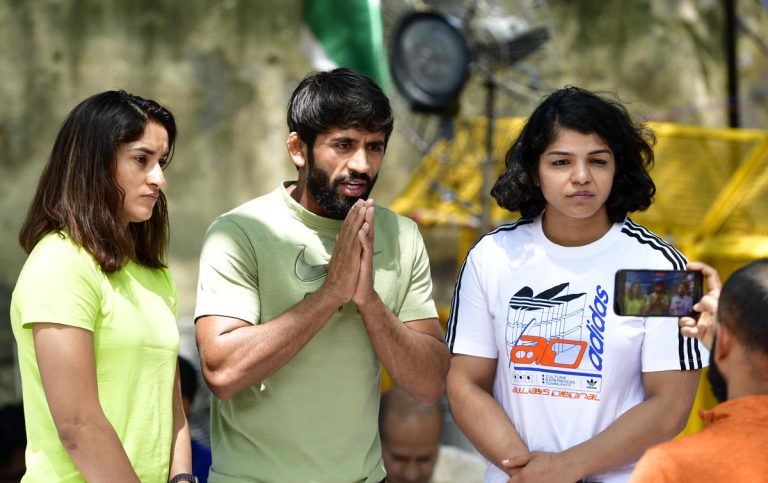
Suspended Wrestling Federation of India (WFI) president Sanjay Singh invited Olympic medalist Bajrang Punia, World Championship medalist Vinesh Phogat and retired wrestler Sakshi Malik to compete in national trials in March to decide the team for Asian competitions, including the 2024 Paris Games Qualifiers in Kyrgyzstan.
WFI also announced the dates to hold selection trials for an Olympic qualifying event for Paris 2024, as well as the senior Asian championships – both scheduled to take place in April in Kyrgyzstan.
The Wrestling Federation of India announced the trials on March 10-11, including the names of star grapplers Bajrang (65kg freestyle), Vinesh (55kg), and Sakshi (62kg), who declared her retirement from the sport on the day Sanjay Singh was elected president.
“I would like to inform all affiliated units of the Wrestling Federation of India (WFI) that the selection trials to select the teams for participation in the following events are being conducted on 10th and 11th March 2024 at K.D. Jadhav Wrestling Indoor Stadium, IGI Sports Complex, New Delhi,” said Sanjay Singh in a statement.
According to the announcement, the trials are being held to determine teams for the Senior Asian Wrestling Championship in Bishkek (Kyrgyzstan) from April 11 to April 16, as well as the Asian Olympic Games Qualifier Tournament at the same location from April 19 to April 21.
“All state units are requested to intimate the wrestlers as per the list attached to participate in the said trials,” added the statement. Earlier this month, United World Wrestling (UWW) lifted the suspension on the Wrestling Federation of India (WFI) with immediate effect.
The three wrestlers have been seeking Brij Bhushan Sharan Singh’s arrest for alleged sexual harassment of female wrestlers. In response to the severe charges, the sports ministry suspended the WFI last year and established an ad hoc council to oversee the sport’s operations.
The ministry also ordered new elections, which were held in December of last year, but the newly elected body, led by Sanjay Singh, was suspended three days later.
Antim Panghal, who is the only Indian to qualify for the 2024 Paris Olympics so far, will appear for trials in the 54kg category.
(This news report is published from a syndicated feed. Except for the headline, the content has not been written or edited by OpIndia staff)
Bengaluru is experiencing a severe water shortage this year, months before peak summer, causing many residents of “India’s Silicon Valley” to ration their water consumption and pay nearly double the regular price to satisfy their daily water demands.
Notably, people in Bengaluru have begun to experience a 24-hour water supply disruption beginning at 6 am on 27th February. According to the reports, the shortage will last until 6 am on 28th February. This is as the Bangalore Water Supply and Sewerage Board (BWSSB) has announced a shutdown to perform vital maintenance and install Unaccounted For Water (UFW) bulk flow meters.
The water shortage is expected to affect several areas in South Bengaluru including BHEL Layout, Nandini Layout, Srinivasa Nagar, Jaimaruthi Nagar, Badavane, Sakamma Layout, Narasimha Swamy Layout, Muneshwara Nagar, Jnana Jyothi Nagar, Jnanaganganagar, Mallathahalli, NGEF Layout and also East and North Bengaluru.
Weak southwest monsoon rains have impacted groundwater levels and reduced water levels in the Cauvery River basin reservoirs that supply the southern Indian city, which is home to over 14 million people and thousands of IT enterprises and start-ups, according to a report.
This is causing city residents to pay rising water tanker costs even before the peak summer season begins. Water tanker merchants also in some sections of Bengaluru are now asking up to 2,000 rupees ($24.11) for a 12,000-litre tanker, up from 1,200 rupees ($14.47) a month ago.
“We now need to book water tankers two days in advance, my plants are dying and I’m taking alternate-day showers,” said Santhosh C.A., a resident of Horamavu, in north Bengaluru, as quoted by Reuters. “The worry now is that despite paying, the tanker vendors won’t show up due to scarcity of groundwater,” added another Bengaluru resident.
The Bangalore Water Supply and Sewerage Board (BWSSB), the city’s water supply agency, gets the majority of its water from the Cauvery River, which originates at Talakaveri in Karnataka and flows through neighboring Tamil Nadu before draining into the Bay of Bengal.
In order to shore up its supply in the coming months, the BWSSB has asked authorities for more water from the Cauvery basin.
Explaining the water shortage crisis in Bengaluru a little deeper, one of the Twitter users named Raj Bhagat said that the city of Bengaluru depends on the Cauvery River for water due to its height. “Bengaluru is unofficially a hill station which is located nearly a kilometre above sea level. Being at the top of a ridge line, the city is partly within the Kaveri watershed and partly in Ponnaiyar (Dakshina Pinakini watershed). Being on top, water from elsewhere doesn’t flow through Bengaluru but flows outward from the city. Bengaluru right now depends on the Kaveri River for water supply. Because of its height, Water is pumped for a height of 1000 feet from the river 100km away from the city,” he wrote posting maps in a series of posts on X.
Bengaluru right now depends on Kaveri river for water supply. Because of its height, Water is pumped for a height of 1000 feet from the river 100km away from the city pic.twitter.com/aQf0ApgvgM
As per Bhagat’s study, Kaveri is overexploited and must be conserved in all sectors (mainly agriculture) in both Karnataka and Tamil Nadu. Any year with normal or below-average rainfall will result in a drought or water crisis, not just in Bengaluru.
Bengaluru is overcrowded given its topography, and growth across the country and within the state must be spread to next-tier cities, which would necessitate expenditures in the same direction.
Probable solutions suggested by BJP MP to the ongoing water problem in the city
Notably, the National President of BJP Yuva Morcha, Tejasvi Surya who is also the MP for Bengaluru South Lok Sabha Constituency commented on the issue and urged the citizens to come together to solve this growing problem of water shortage. “Water shortage in Bengaluru is a result of multiple factors,” he said adding that around 40% of the borewells in the city had dried.
“Bengaluru has 11,000 borewells under the control of BWSSB & a whopping 4.5 lakh private borewells. Of these, close to 40% have either dried up or have precariously low levels of water. Mindless white topping of roads is further reducing the groundwater level in the areas. Unbridled construction, unprecedented migration, deterioration of the lake ecosystem & mindless white topping and concretization of the city preventing adequate recharge, have all contributed to the current water crisis,” he added.
Many areas of Bengaluru are suffering from severe water shortage. The Government & citizens should come together to address the issue.
Water shortage in Bengaluru is a result of multiple factors. The city requires upwards of 2050 million liters per day (MLD). Out of which, 1450… pic.twitter.com/JOD94g8HOh
Surya further suggested that the city cannot completely depend upon the Cauvery water and has to make efforts to focus on increasing groundwater levels and sustaining the lake ecosystem. He said that digging borewells and operationalizing the Cauvery Phase 5 project would help the city cope with the problem of water shortage.
He further highlighted the grave discrepancy between the demand and supply which has caused the surge in the water crisis in India’s tech capital.
“In the period between 2017 & 2024, while the supply of Cauvery has remained at 1450 MLD, the demand has drastically increased at unprecedented levels. More than 1.5 lakh new water connections, including to large apartments, have come up within this period itself,” the BJP MP pointed out.
“To add to the current crisis, water tankers which were earlier available for Rs 700- Rs 800 per tanker, are now being sold at Rs 2000- Rs 3000 per tanker. Government must provide water to low-income areas for free and cap the prices of tankers for other areas,” the BJP leader added.
“Bengaluru’s population was slated to touch 1.5 crore by 2030 to BWSSB estimates. However, we have breached this mark in 2024 itself. Therefore, our efforts to safeguard the city’s water requirements must be extremely aggressive with practical targets. What was once the city of 1000 lakes, parks, and rivers like Vrishabhavati and Arkavathi, now stares at a bleak future. This is the time to wake up, avoid petty political tussles, and address this issue in unison on a war footing,” he said in a post on X on 26th February.
Cauvery water dispute
It is important to note that the states of Karnataka and Tamil Nadu have been fighting for a long time over the supply of Cauvery water. This long-running issue, known as the Cauvery water dispute, has its roots in past agreements and competing water-related demands.
On 16th February 2018, the Supreme Court issued a unanimous decision that reduced Karnataka’s yearly water releases from 192 TMC (Thousand Million Cubic Feet) to 177.25 TMC. This decision also resulted in a decrease in Tamil Nadu’s allocation of water.
Following the court’s directions, the Indian government established the Cauvery Water Management Authority on 1st June 2018, to oversee the implementation of the Supreme Court’s decision.
Recently on 14th August 2023, the Tamil Nadu government petitioned the Supreme Court for its involvement in forcing Karnataka to immediately release 24,000 cubic feet per second (cusecs) of water from its reservoirs. Tamil Nadu petitioned the Court to direct Karnataka to deliver 36.76 TMC of water by September 2023, as mandated by the Cauvery Water Disputes Tribunal’s (CWDT) final verdict in 2007.
Karnataka claimed that a drop in rainfall in the Cauvery catchment area, which includes parts of Kerala, caused insufficient inflow into its reservoirs. The state CM then emphasized that historically, whenever there was excess water in the reservoirs, Karnataka freely donated it to Tamil Nadu. However, this year’s poor weather has prevented Karnataka from fulfilling its goal.
On 18th September, the Cauvery Water Management Authority reaffirmed the requirement for Karnataka to continue releasing 5,000 cusecs (cubic feet per second) of water to Tamil Nadu for 15 days, following an earlier order given by the Cauvery Water Regulation Committee on 12th September.
Several protests were reportedly carried out by various organizations in Karnataka and Tamil Nadu. The detailed reports of the same can be read here.
Bengaluru to implement new property tax system from April 1
Earlier, it was reported how the Bruhat Bengaluru Mahanagara Palike’s guideline value-based property tax, which is set to take effect on the 1st of April, would impose an additional cost on landlords who have rented out their houses for residential and commercial purposes in the city of Bengaluru.
This significant increase in property tax values is anticipated to raise rents for tenants who are already paying higher prices for renting. The new tax system requires rented-out properties to pay twice the property tax as property occupied by owners themselves. Additionally, tariffs have been increased 3-5 times for different commercial structures.
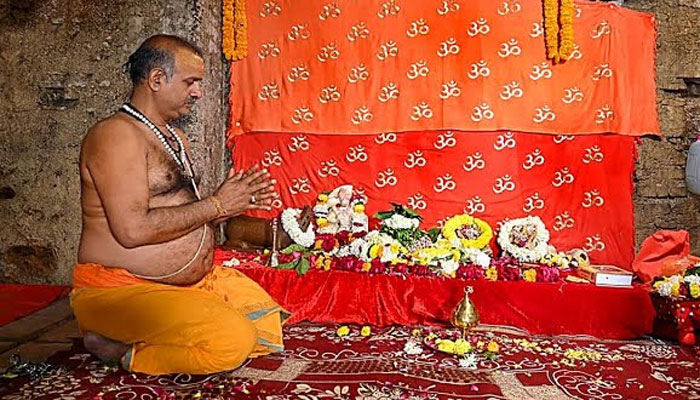
On Monday, 26th February, the Allahabad High Court stated that the order passed by Mulayam Singh Yadav-led Uttar Pradesh government to stop Hindu worship rituals in Vyas Ka Tehkhana in 1993 was illegal. The court dismissed the plea of Anjuman Intezamia Masjid Committee challenging the Varanasi District Court’s 31st January order allowing regular Puja at the Vyas Ka Tehkhana in the disputed structure of Gyanvapi.
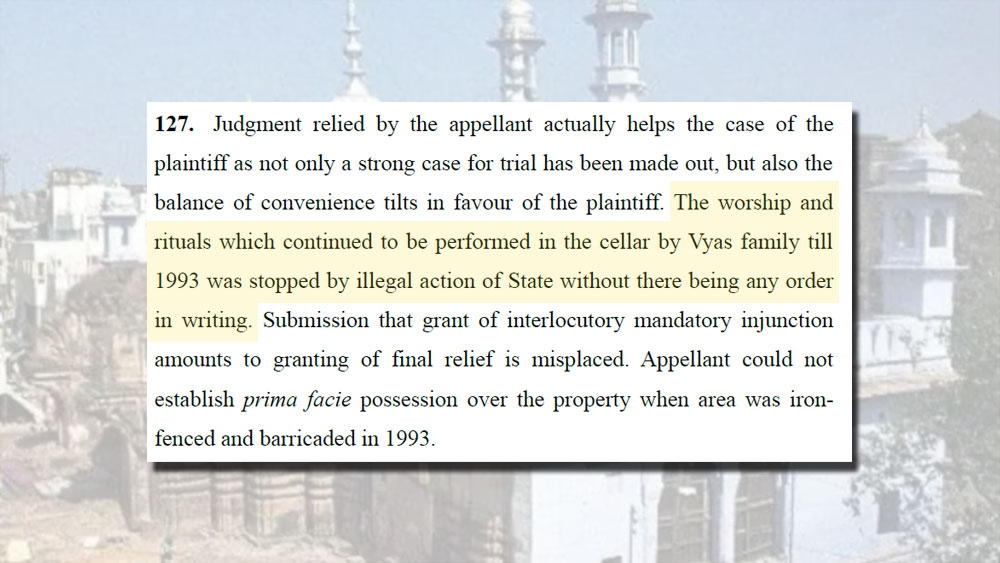
In its observation, the court stated that the state [under Mulayam Yadav] stopped the worship rituals without an order in writing, thus it is illegal.
Excerpt from Allahabad High Court judgment
In 1993, Assembly Elections took place in UP after Kalyan Singh government was dismissed following the demolition of illegal Babri structure, and Mulayam Singh Yadav of the Samajwadi Party became the Chief Minister of Uttar Pradesh. Soon after assuming the office, Yadav sealed the cellar, citing law and order concerns. The court said, “The act of the State Government since 1993, restraining the Vyas family from performing religious worship and rituals and also by the devotees, was a continuous wrong being perpetuated.”
The court further stated in its observation that stopping worship and performing rituals by the devotees “would be against their interest”. Furthermore, citing Article 25 of the Constitution of India, the court said that the citizen’s rights protected under the constitution cannot be “arbitrarily revoked” by the state. The court noted that Vyas’s family has the religious freedom to conduct worship and rituals in their cellar, and it cannot be stopped based on the government’s oral orders.
Notably, on 1st February, the Anjuman Intezamia Masjid Committee moved to the Supreme Court with their plea against the Varanasi District Court’s order. However, the Supreme Court refused to entertain their plea and asked them to approach the Allahabad High Court. Reportedly, hours after the Varanasi court delivered the verdict allowing the worship of Hindu deities in the Vyas Ji Ka Tehkhana (the basement cellar of the Vyas family), the Committee of Management, Anjuman Intezamia Masajid, Varanasi filed an urgent application on 31st January seeking status quo at the disputed site. However, the Supreme Court rejected this plea and refused to accept the petition, asking the Masjid Committee to approach the High Court instead.
In the Rudrapur district in Uttarakhand, Mohammad Shafi and Khatoon Jahan strangulated and killed their 17-year-old daughter over a love affair. The parents tried to pass off the murder as suicide and also tried to bury the body to cover up their crime. However, when they were preparing to send the body to Rampur in Uttar Pradesh for burying, police reached the house and took custody of the body. Later, it was sent for post-mortem and as per the autopsy report, the girl was strangulated to death.
The incident happened on Friday, February 23 but the Uttarakhand police got the information on Saturday, February 24, after which they launched an investigation and arrested the two accused.
Uttarakhand police found signs of assault on the minor’s body
A report by the Times of India quoted ASP Neeharika Tomar as saying, “An informant approached us on Saturday and informed the officers that Shabana had been in a relationship with a married man for three years and she was allegedly strangled to death by her parents Mohammad Shafi (50) and Khatoon Jahan (45) on Friday night.”
The ASP added that the family tried to bury her body in UP’s Rampur district to cover up the crime. “Police intercepted them and found signs of assault on the body, particularly around the mouth and neck. An autopsy confirmed that she was strangled to death.”
The police arrested the accused from the Pahargang Mohalla and recovered the murder weapon. The duo confessed to the crime during interrogation. They said that they were against the relationship which is why they killed their daughter.
Honour killing in Pakistan
Last year, an incident of honour killing was reported from Pakistan where an 18-year-old girl fell victim to the abhorrent practice in Kolai-Palas district of Khyber Pakhtunkhwa’s (KP) Kohistan on 26 November. The horrific act was performed by the victim’s family members following the directives from a local jirga (council of elders) in the Barsharyal village, 150 kilometres northwest of Mansehra.
The instance took place after a video that showed her and another girl dancing with some boys gained traction on social media.
A shocking case of rape of a minor girl has come to the fore from Vadhwan in Gujarat’s Surendranagar district. In the incident, an orphan girl from a Muslim family was brutally raped by her uncle and other acquaintances. The girl has allegedly been raped for several months. The girl became pregnant as a result of continued sexual exploitation.
The rape of the minor girl in Vadhwan has caused a stir in the area. The accused in the case has been identified as the victim’s uncle (the husband of her father’s sister/fufa) Rehman (name changed).
According to the reports, a girl from a Muslim family in Vadhawan, Surendranagar, stayed at her aunt’s house after her parents passed away. The 16-year-old orphan girl was raped by her own uncle Rehman.
Following this, Salman, Amir, Abdul, and Mohammad (all names changed to protect the minor victim’s identity) also sexually assaulted the minor. Salman and Amir are also accused of frequently taking the girl on a bike to various locations and raping her. The horrific crimes of the accused persons came to light after the girl was found six months pregnant.
Minor girl found pregnant after prolonged sexual exploitation, more names expected to emerge in the investigation
Notably, the girl has been a victim of rape for the past 8 months. The incident came to light when the victim was found 6 months pregnant. When it turned out that the girl was pregnant, the Surendranagar police filed a complaint against the accused under various provisions, including intimidation, POCSO, and rape, and launched an investigation into the case.
According to preliminary investigations, the girl was raped by five persons, including her uncle (fufa). However, according to a report by Sandesh, the names of several more people are likely to come out after a further investigation into the incident.
Meanwhile, OpIndia contacted the Surendranagar District Police to fetch more details. Our team was then informed that the accused had not yet been arrested and that necessary action had been initiated. We will update this report as soon as we receive additional information regarding the case.
Reports quoting government sources have said that the anti-India British academician Nitasha Kaul was deported upon arrival at Bengaluru airport based on a preventive lookout circular issued against her.
The circular was issued after Indian agencies flagged her “pro-separatist” comments and statements and “anti-India” line stand on Kashmir taken on various public forums.
Intelligence agencies have reported that Pakistan's ISI has been amplifying her statements and articles as part of its "anti-India propaganda" on Kashmir issue, writes TOI's Bharti Jain.https://t.co/qVPI3nOteV
Moreover, it has reportedly come to light that Kaul’s statements on Kashmir have been amplified by Pakistan’s ISI as part of its anti-India propaganda.
“Preventive LOC is issued on request of a law enforcement agency, based on assessment and analysis of background of a subject particularly any history of statements or publicly-stated views challenging sovereigny, unity or integrity of India, and possibility of the person taking a similar line when in India,” an officer reportedly said.
On Monday, 26th February, Kaul took to X claiming that she was denied entry into India on the orders of the Central Government. Her post was followed by a long thread wherein she likened her work to defending democracy while berating words like “Hindutva” and “saffron”.
Kaul was invited by the Congress-led Karnataka government for the two-day event ‘Constitution and National Unity Convention-2024’ on 24 and 25 February in Bengaluru. She was denied entry and put on the next flight back to UK.
Nitasha Kaul is an ‘Overseas Citizen of India’ (OCI) cardholder and is eligible for lifelong visa-free travel to India.
Reports quoting sources stated that the lookout circular against Kaul was meant to prevent her from repeating her anti-India views on Indian soil. There is also a possibility that she may be blacklisted on the same grounds.
Kaul has also justified terrorism in Kashmir terming it an “armed struggle for freedom” and denying the genocide of Kashmiri Pandits.
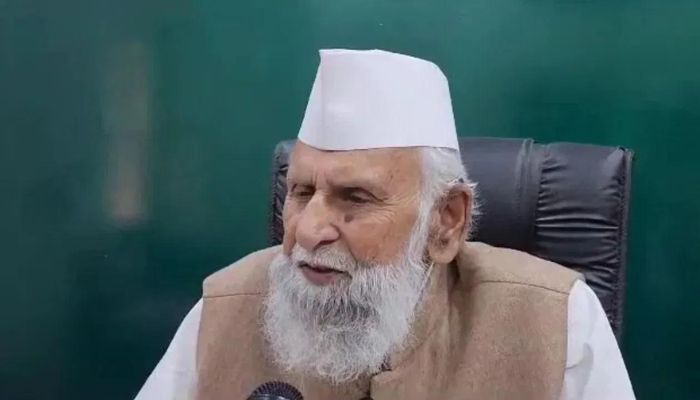
Controversial Samajwadi party leader, Shafiqur Rehman Barq, passed away on Tuesday (27th February). He was 93 years old at the time of his death.
As per reports, Shafiqur Rehman Barq was admitted to the Intensive Care Unit (ICU) of a private hospital in Moradabad due to health-related ailments. He passed away during the treatment.
It must be mentioned that the Samajwadi party leader was elected from the Sambhal constituency in Uttar Pradesh and was the oldest Parliamentarian at the time of death.
UP : जिला संभल से सपा सांसद शफीकुर्रहमान वर्क का 93 साल की उम्र में इंतकाल हुआ। वे संसद में सबसे अधिक उम्र के सांसद थे। सपा ने इस बार उन्हें फिर से लोकसभा प्रत्याशी बनाया था। pic.twitter.com/WMxeQqESgY
During his lifetime, Barq had expressed open support for terror outfits and attempts to Islamise the country. In November last year, he called for the inclusion of the Quran in the NCERT syllabus and hailed it as the ‘greatest book.’
A month earlier, he claimed that Hamas is not a terror organisation. In February 2023, he asserted that India has never been and would never be a ‘Hindu Rashtra’ and claimed that Islam is the only true religion.
In October 2022, Shafiqur Rahman Barq went on a misgynistic rant and claimed that allowed women to walk without a burqa in public would only enhance wildness and promiscuity in men. He had also asserted that chanting Vande Mataram was against the tenets of Islam.
The Samajwadi party leader was earlier booked for hailing Taliban and comparing the radical Islamist outfit to Indian freedom fighters. He was also booked in conenction to violent protests against the Citizenship Amendment Act (CAA) in Sambhal district of Uttar Pradesh.