Home Blog Page 1398

Land-for-job scam: CBI to file a supplementary charge sheet by February end in scam involving Lalu Yadav and his family

0

The Central Bureau of Investigation (CBI) on Tuesday informed the Rouse Avenue Court that it will file a supplementary charge sheet by the end of February 2024.

The agency informed the court of Special CBI judge Vishal Gogne while giving a reply on an application moved by RJD leader Ahmed Ashfaq Karim for releasing an amount of cash worth Rs 13 lakh seized during the investigation.

Meanwhile, the court has kept the application pending until the filing of the supplementary charge sheet. The matter was listed for February 27.

This case is at the stage of scrutiny of documents filed along with a charge sheet against Lalu Prasad Yadav, his family members, and other accused.

The counsel for Karim submitted that the applicant is not an accused in this case and the cash in question is not evidence, so it may be released immediately.

The CBI’s special public prosecutor (SPP), D. P Singh filed a reply and submitted that the agency will file a supplementary charge sheet by the end of February next month.

He also submitted that the cash amount is unaccounted for. The investigation is at an advanced stage. The nature of the case amount may become more crystallised after filing the supplementary charge sheet.

The application may be taken up after the filing of the supplementary chargesheet, the SPP submitted.

On the last hearing on January 6, 2024, the Central Bureau of Investigation (CBI) sought time to file a reply on the applications of Lalu Prasad Yadav and others seeking supply of documents.

On December 20, 2023, the Rouse Avenue court sought a reply from the CBI on an application moved by accused persons, including Lalu Prasad Yadav, Rabri Devi, and Tejaswi Yadav, seeking the supply of documents filed along with the charge sheet.

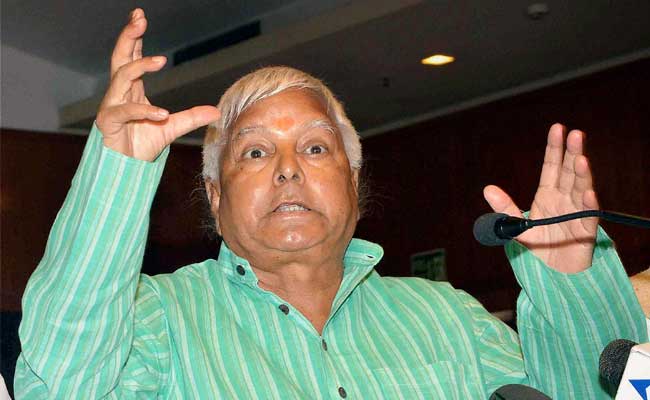
Lalu Prasad Yadav, Rabri Devi, and Tejaswi Yadav are arrayed as accused in Land for Job Scam.

On October 4, the court granted bail to former Railway Minister Lalu Prasad Yadav, Bihar’s Deputy Chief Minister Tejashwi Yadav, Rabri Devi, and others in relation to a fresh charge sheet in the alleged Land for Job Scam case.

According to the CBI, this is the second chargesheet in the designated court against 17 accused, including then Union Minister of Railways Lalu Prasad Yadav, his wife Rabri Devi, son, then GM of West Central Railways (WCR), then two CPOs of WCR, private persons, private companies, etc. in a case related to Land for Job Scam

The CBI filed a charge sheet in the land for jobs alleged scam case against former Union Railway Minister Lalu Prasad Yadav, including Bihar’s Deputy Chief Minister Tejashwi Yadav and others.

CBI had registered a case on May 18, 2022, against the then Union Minister of Railways and others, including his wife, two daughters, and unknown public servants and private persons.

It is alleged that the Union Minister of Railways during the period 2004-2009 obtained pecuniary advantages in the form of the transfer of landed property in the name of his family members, etc., in lieu of the appointment of substitutes in Group “D” Post in different zones of railways.

It was further alleged that in lieu thereof, the substitutes, who were residents of Patna themselves or through their family members, sold and gifted their land situated at Patna in favour of the family members of said Minister and a private company controlled by his family members, which was also involved in the transfer of such immovable properties in the name of said family members.

It was also alleged that no advertisement or any public notice was issued for such appointments of substitutes in Zonal Railways, yet the appointees who were residents of Patna were appointed as substitutes in different Zonal Railways located in Mumbai, Jabalpur, Kolkata, Jaipur, and Hazipur.

Searches were earlier conducted at multiple places, including Delhi, Bihar, etc., said the CBI.

During the investigation, it was found that the then Union Minister of Railways, with the intent to acquire the land parcels situated at the places where his family was already owning land parcels or the places that were already connected to him, entered into a conspiracy with associates and family members and allegedly derived a design to grab the land of various land owners by offering / providing group D employment in railways, the CBI said.

The accused had allegedly collected applications and documents of such candidates through associates and then sent those to West Central Railway for processing and providing jobs in railways, and the general managers of West Central Railways, under the influence and control of the accused, accorded approval for the engagement of candidates.

For providing jobs in railways, they allegedly devised an indirect way wherein the candidates were engaged firstly as substitutes and subsequently, were regularised. A hard disc containing lists of candidates who were engaged was also recovered during searches. It was further alleged that a land parcel was purchased in the name of a private company at Rs. 10.83 lakh during 2007, and subsequently, the said land, along with some other land parcels purchased by the said company, were brought into the ownership / control of his wife and son, the then Union Minister of Railways, by way of a transfer of shares at Rs. 1 lakh only.

At the time of transfer, the company was allegedly owning land parcels purchased at a total cost of Rs 1.77 crore (approximately), and they were transferred for a mere Rs 1 lakh (approximately); however, the market value of the lands was much higher.

Earlier, a chargesheet was filed on July 7, 2022, against 16 accused. “Investigation is continuing,” the CBI informed the Court.

Madhya Pradesh: Daughter files false rape case against father, man acquitted after spending 12 years in prison

On 24th January, Madhya Pradesh High Court acquitted a man accused of raping his own daughter. As per the judgment, the daughter filed a fake rape case against her father under the influence of her then-boyfriend in 2012. In February 2013, the man was sentenced to life imprisonment and fined Rs 10,000. He had filed an appeal against the decision in the High Court in the same year. After 12 years of waiting, he was finally acquitted by the court.

A two-judge bench comprising Justice Sujoy Paul and Justice Vivek Jain said in the judgment that the daughter herself admitted to submitting a false rape case after her father caught her with her boyfriend and scolded her. Later, under the influence of her boyfriend, the girl approached her grandfather and later filed a false rape case against her father. Her boyfriend lured her into filing a case claiming that it would stop her father from interfering in their lives.

Background of the case

OpIndia accessed a copy of the judgment in the matter. The complainant, who was a minor at the time of the incident, lived in a slum area. A complaint was filed on 21st March 2012 at Chola Mandir Police Station. As per her complaint, on the night of 18th March 2012, her father sexually assaulted her after dinner. Her mother was not at home that night. She claimed that her father threatened to kill her if she narrated the incident to anyone including her mother. On 20th March, he again attempted to assault her as per the complaint but she fled and approached her grandfather.

She narrated the incident to her grandfather who took her to the police station and filed a complaint. The man was booked under Sections 376 and 506 of the Indian Penal Code (IPC). Following investigation, the man was arrested and on 15th February 2013, he was sentenced to life imprisonment after trial. A fine of Rs 10,000 was also imposed.

Following the conviction at the Sessions Court, the father filed an appeal at the Madhya Pradesh High Court in 2013. During the hearing, advocate Vivek Agarwal, appearing for the father, pointed out that MLC dated 21st March 2012 did not mention any sexual assault. Furthermore, a doctor appearing as a witness also stated there was no sign of sexual assault. Interestingly, second doctor appearing in the matter pointed out that when she asked the girl to remove clothes for a checkup, she fled away and reached the police station.

During a question in the court, the girl candidly admitted to having a romantic relationship with one boy and having physical relations with him. She further admitted that her father scolded her several times over the relationship. The judgment read, “Heavy reliance is placed on para-5 of the cross-examination wherein she admitted that when father scolded her, she, along with the said boy, lodged a report in the police station. She candidly admitted that her father/appellant has not developed any physical relationship with her. She clarified that her physical relations were only with the said boy.”

Furthermore, her grandfather turned hostile during the hearing and did not support the story told by the girl. Another witness, her younger sister, also turned hostile. Advocate Agrawal pointed out that the family lived in a single-room house and it was improbable for the father to sexually assault the girl in the room where her four younger siblings lived.

Interestingly, the forensic report suggested there was sperm found on the girl’s underwear but a DNA test was not conducted. Advocate Agrawal pointed that ” not conducting the DNA test, the adverse inference should be drawn against the prosecution.”

The court, after careful consideration, acquitted the appellant. The court highlighted that the prosecution failed to establish the foundational facts necessary for the conviction. The court noted, “Given the foregoing analysis, the appellant deserves to be acquitted. Unfortunately and sadly appellant remained in custody from 21/03/2012. The prosecution has miserably failed to establish its case on merits.”

Setting aside the Session Court’s judgment, the court added, “If the presence of the appellant in the custody is not required for any other case, he be released forthwith.”

BBC’s misleading reportage about Haji Malang Dargah row copied by Pakistani media to cast aspersions on Ram Mandir

The BBC and Pakistani media have carefully dug up a nearly month-old story, just a week after the Ram Mandir Pran Pratishtha, to weave their basic favourite narrative that “Muslims are living in fear and danger in Hindutva India”.

On 3rd January, Maharashtra Chief Minister and Shiv Sena Chief Eknath Shinde while addressing an event in Thane reiterated the party’s commitment to liberate Malanggad, popularly known as the Haji Malang Dargah.

The BBC reported Shinde’s statement on 29th January, which, interestingly, was surprisngly 6 days after the Pran Pratishtha but exactly 25 days after the issue first came to light.

Speaking about Shinde’s statement in Thane earlier this month, the report read, “His claim comes at a time when some prominent mosques and Muslim-made monuments in India are mired in disputes over claims that they were constructed by demolishing Hindu temples centuries ago.”

This was a passing remark at Ayodhya Ram Mandir and the Gyanvapi dispute. The report talks about the Malanggad dargah and portrays it as a symbol of religious unity and coexistence. And then it goes on to malign Hindus, who perform pooja at the shrine, by calling them “Hindu hardliners”.

The sinister report attempts to paint a picture as if to influence the electoral landscape by making insinuations including that the Malanggad hill area is deprived of amenities because it is a Muslim area.

On one hand, the BBC report states that “Hindu hardliners have continued the practice of performing pooja at the shrine on full Moon days, occasionally leading to clashes with Muslim devotees and locals.”

On the other hand, it quotes the Muslim management of the dargah and Muslim locals to say that “Hindus and Muslims have co-existed in harmony”. It does so by shooting the gun off the politicians’ shoulders.

Notably, the dargah is maintained by a three-member trust which reportedly includes a Hindu Brahmin family. The BBC has not bothered to speak to the Hindu Brahmin family, the Ketkars, managing the dargah, for their report.

Interestingly, the BBC report got picked up in no time by the Pakistani media and the facts as we know them ceased to exist.

A report shared by the Pakistani channel Geo TV’s digital website was titled, “Haji Malang Dargah ‘on radar of Hindutva extremists’ after Ram Mandir’s opening”.

The headline suggests that the dargah issue has been raked up recently by Hindus after Ram Mandir was opened, as if all Muslim structures are under threat because of Ram Mandir.

This misleading rhetoric does not mention that the issue about the Haji Malang Dargah is an old one and did not result after the opening of Ram Mandir. The dargah controversy and Ram Mandir have absolutely no links whatsoever. Morever, the statement made by Shinde was weeks before the Ram Mandir opened and not “after”.

Additionally, the issue of the dargah has been raised by the Shiv Sena multiple times in the past.

Suffice to say that the GEO TV report has copied fake and misleading news proudly from the BBC report. They too, like BBC, have demonised Hindu hardliners for being responsible for the altercations with Muslim worshippers because the former perform poojas there on full moon days.

What is the controversy over the Haji Malang Dargah?

The Haji Malang Dargah or Malanggad is situated 3000 feet above sea level to the south of Kalyan in the Matheran hill ranges.

On 20th February, devotees will mark the death anniversary of Haji Abd-ul-Rahman, a so-called Sufi saint of the 12th century.

In 1980s, prominent Shiv Sena leader Anand Dighe – who was Eknath Shinde’s political mentor – led the first agitation claiming that the structure was the location of an old Hindu shrine belonging to the Nath Panth.

Dighe began an agitation claiming that the shrine belonged to Hindus and that it was a site of a 700-year-old Machindranath temple. In 1996, he insisted on leading 20,000 Shiv Sainiks to the shrine to perform pooja.

It is since then that the structure has been called Shri Malanggad.

The Gazetteers of Bombay Presidency published in 1882 states that the shrine was built in honour of an Arab missionary, Haji Abd-ul-Rahman.

He reportedly arrived with a bunch of followers from Yemen and settled on the lower plateau of the hill.

In February 2023, Maharashtra CM Eknath Shinde performed aarti at the site and offered a saffron covering inside the dargah.

Latur: Altaf Qureshi booked under sections of the SC/ST and POCSO Act for sexually assaulting a 6-year-old girl; a manhunt launched to capture him

0

In a horrific case reported from Deoni district of Maharashtra’s Latur district, a 6-year-old minor girl has been brutally assaulted by an individual identified as Altaf Mehboob Qureshi. As per the complaint copy obtained by OpIndia, the accused sexually assaulted the minor for 4 continuous days and also threatened her to keep her mouth shut.

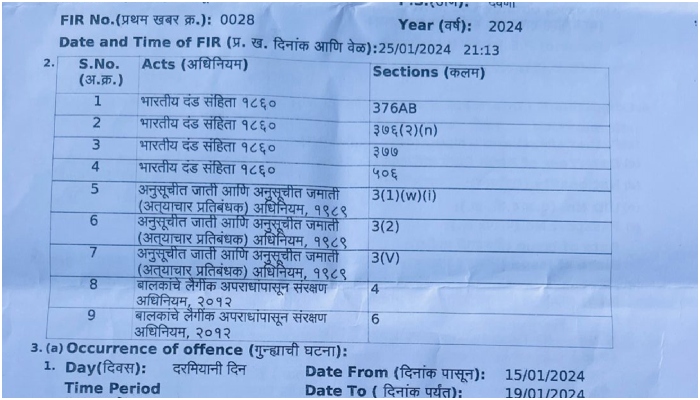
Altaf has been booked by the state police under sections 376AB, 376(2)n, 377, 506 of the Indian Penal Code, 1860, sections 3(1)(w)(i), 3(2), 3(v) of the SC-ST Act, and sections 4 and 6 of Protection of Children from Sexual Offences Act. The incident is said to have happened in the Walandi village of Latur district.

FIR copy obtained by OpIndia

As per the FIR copy, the accused stayed in the victim’s neighbourhood. The mother of the victim works as a labourer in the nearby village. In the absence of her, the accused is said to have taken the victim to his house and abused her sexually. He also threatened the girl to death and asked her to keep her mouth shut.

The mother of the victim mentioned in the complaint that the accused sexually abused the girl from 15th January to 19th January. However, the incident came to the fore on 20th January after the girl arrived home from her school.

“She returned home that day at around 3 pm. After some time, Altaf who stays in the neighbourhood came to call her to accompany him to a local store. I allowed. However, the girl started crying aloud and refused to go with Altaf. Initially, I didn’t understand anything. Later, I took my daughter into confidence and asked her the reason. Then she revealed to me what Altaf did to her,” the mother said.

Enraged by the incident, locals have demanded strict action against the accused. The accused is believed to have absconded since the incident and the police are looking into the case. Further investigations into the case are underway.

Tamil Nadu police say state govt not anti-Hindu, but court docs reveal how only 4 out of 288 permissions were given for 22nd Jan events before courts got involved

On the 29th of January 2023, the Tamil Nadu Director General of Police filed a counter affidavit in the Supreme Court, responding to a petition which claimed that the Chief Minister of Tamil Nadu had issued an oral order against granting permission to events surrounding Ram Lalla Pran Pratishtha. The Police DGP said that there had been a deliberate attempt to defame the Chief Minister and portray the government as ‘anti-Hindu’, which was patently false.

Interestingly, it is evident from the counter-affidavit filed by the Tamil Nadu police itself that before a court order passed by the Madras High Court in a separate petition, the Tamil Nadu administration had granted permission to only 4 of the 288 permissions applications they received.

In the short hearing on the 19th, the bench headed by Justice Sanjiv Khanna granted an additional 15 days for the state of Tamil Nadu to file a separate counter affidavit, apart from the one filed by Tamil Nadu police. However, it disallowed the petitioner to file a rejoinder to the counter-affidavit filed by the Tamil Nadu police. Justice Sanjiv Khanna reportedly said that the event (Pran Pratishtha) was already over so the petitioner should not “push it further”. The court, in this case, effectively denied the opportunity to the petitioner to present their side of the argument and point towards the duplicitous stand that is clearly being taken by the Tamil Nadu police.

The Tamil Nadu police in its counter affidavit said, “The Petitioner in this writ petition has narrated the facts of the case in about 12 paragraphs, of which he has utilised 9 paragraphs to defame the Hon’ble Chief Minister of Tamil Nadu and to criticise the actions of the Government. The contents in paragraphs number 1 to 8 are totally unwarranted and are derogatory against the Hon’ble Chief Minister of Tamil Nadu. The petitioner has portrayed the Tamil Nadu Government as an Anti-Hindu Government which is totally false and condemnable”. With the police displaying substantial bombast, one would imagine that the petition was wildly false and that the administration did indeed grant permission to events surrounding Ram Lalla Pran Pratishtha to all the Hindus. However, is that true?

To truly understand the politics that was played by the Tamil Nadu administration, it becomes imperative to break down the information provided by the Tamil Nadu police itself in its counter-affidavit to the court.

What the petition by Vinoj P Selvam said

The petition by Vinoj P Selvam said to be a BJP functionary from the state, had said that the Tamil Nadu government had taken a decision to disallow events surrounding the Ram Lalla Pran Pratishtha on the 22nd of January 2023. The petition claimed that Chief Minister M K Stalin had “orally instructed not to allow any ceremony or function” on January 22 — to celebrate the consecration of the Ram temple in Ayodhya.

Interestingly, as per a news report published by Tamil daily Dinamalar on 21st January, the DMK-led-Tamil Nadu government had given ‘unofficial verbal directive’ to temples against conducting special prayers and offering Annadanam (free food) on the occasion of Ram Mandir Pran Prathistha.

The report pointed out that the government has verbally warned temple administrators against organising special programmes on behalf of the devotees.

“No special puja, offering of Annadanam and any related programs should be held in Tamil Nadu temples on the occasion of the opening ceremony of Ayodhya Ram temple. No program should be held on behalf of the temple administration or in the name of devotees or in the name of organizations or parties. It should not be advertised. Action will be taken against the concerned temple executive if any activities including Annadanam are done in violation,“ the report emphasised.

The report further added that the Tamil Nadu police are actively working to prevent the live telecast of the Ram Mandir Pran Prathistha on big screens in public places in the State.

What the Tamil Nadu Police DGP claimed in his counter-affidavit

Since the Tamil Nadu police have claimed that the petitions against the state are baseless and that the permissions for events surrounding Pran Pratishtha were not denied, it becomes important to delve into the explanation provided by the police to substantiate their stand.

Apart from saying that the petition was meant to defame the Chief Minister and that the government of Tamil Nadu is not anti-Hindu, the police DGP said, “It is further submitted that the petitioner has approached this Hon’ble Court under an illusion and on false interpretation of reality. He has come with imaginary claims and has challenged a non-existent order. This Writ Petition has to be dismissed in limine because it is politically motivated and filed without any legal grounds”.

The DGP’s affidavit asserts there was no oral order by the Chief Minister to deny permission for Pran Pratishtha events, but the data provided by him leaves much to be desired as permissions for even indoor live streaming were denied before intervention by courts.

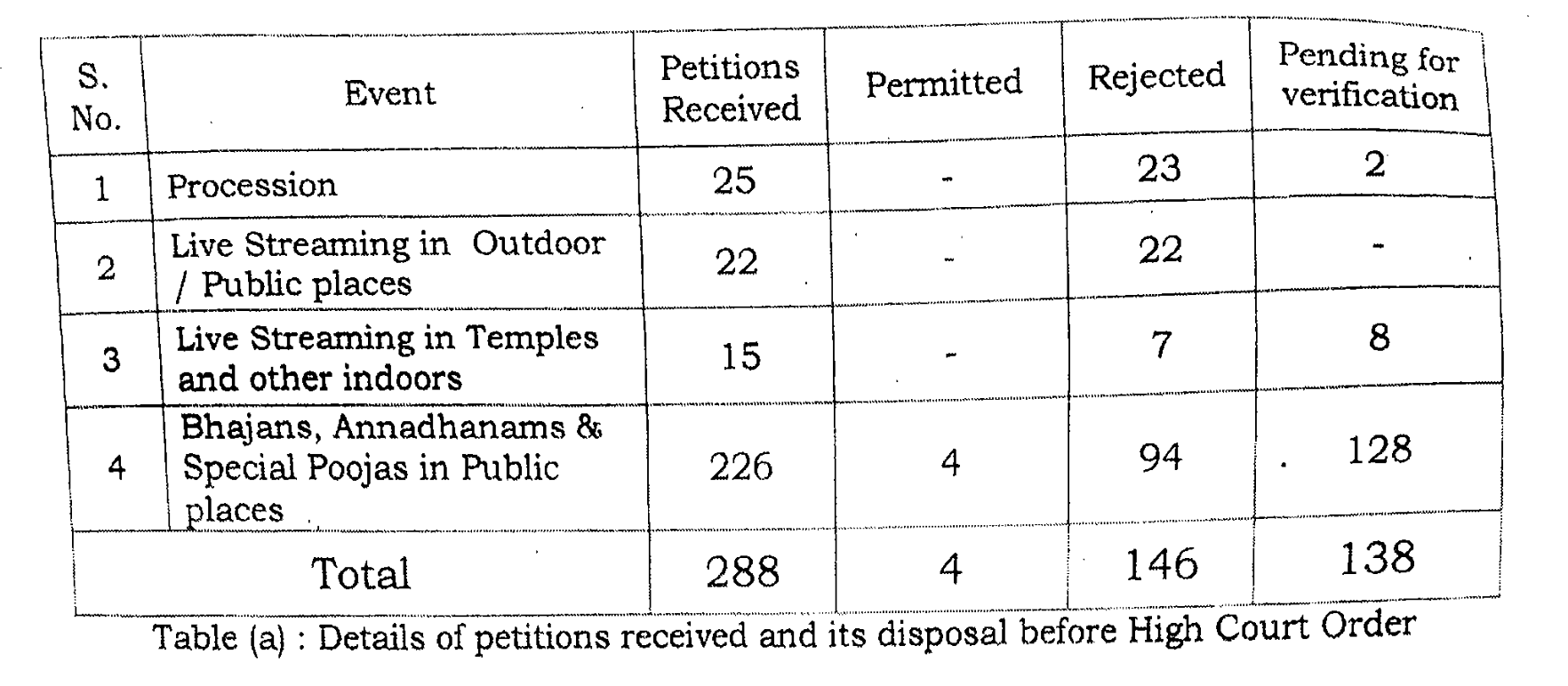
The police informed that they received 288 applications seeking permission for events on the date of the Ram temple Pran Pratishtha at Ayodhya. These applications pertained to requests for processions, bhajans, annadhanams, live streaming through LED screens in public places, and live streaming in and around private temples and temples under the HR &CE department.

The police goes on to admit that before the intervention of the court, the state of Tamil Nadu had only approved 4 of the 288 requests they had received.

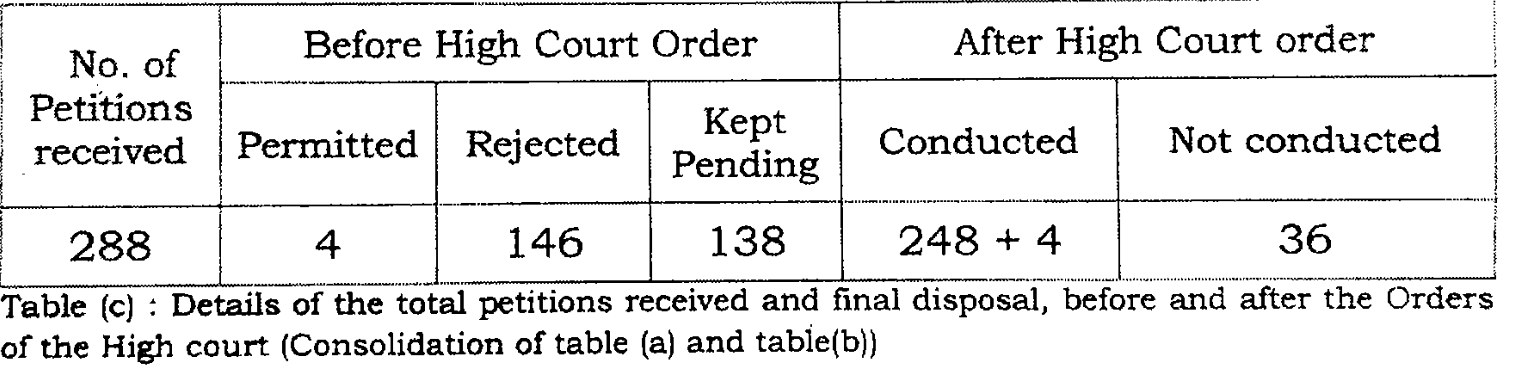
Out of the 288 requests they received, the police themselves informed the court that they had granted permission for only 4, rejected 146 and kept 138 requests pending for verification.

Further, the police submits that it is only after the order of the Madras High Court and its Madurai Bench that they granted permission for the events.

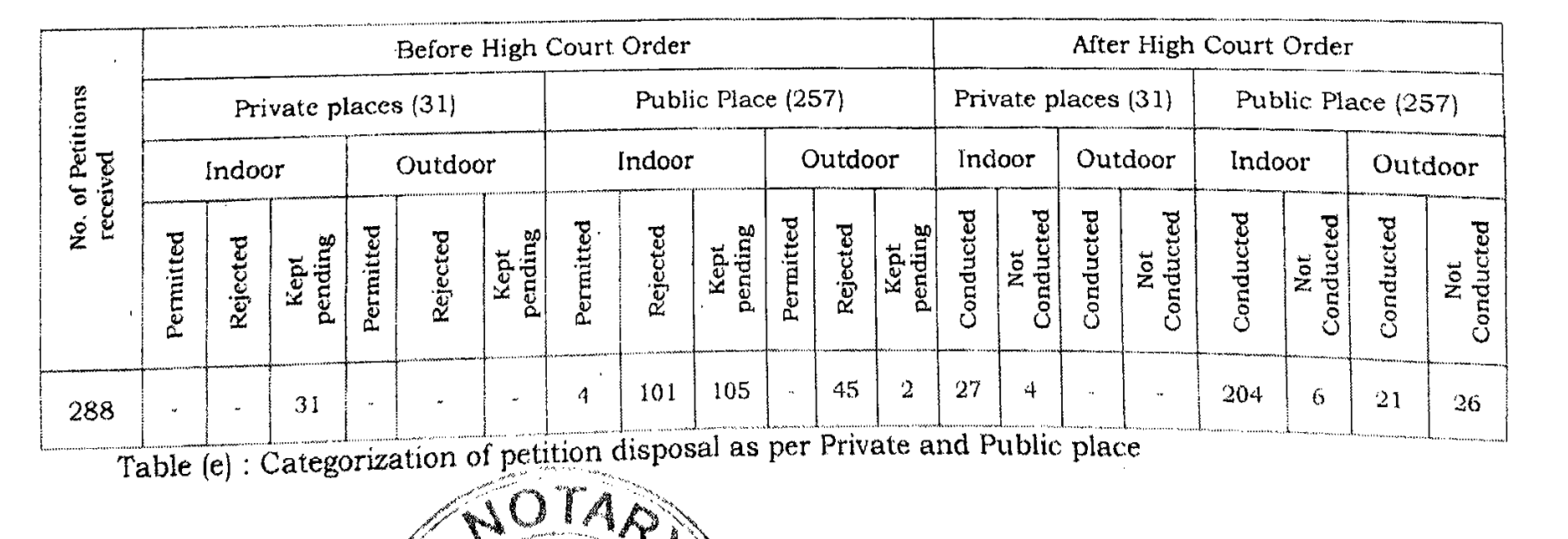
Here is a table that the police affixed in their counter affidavit:

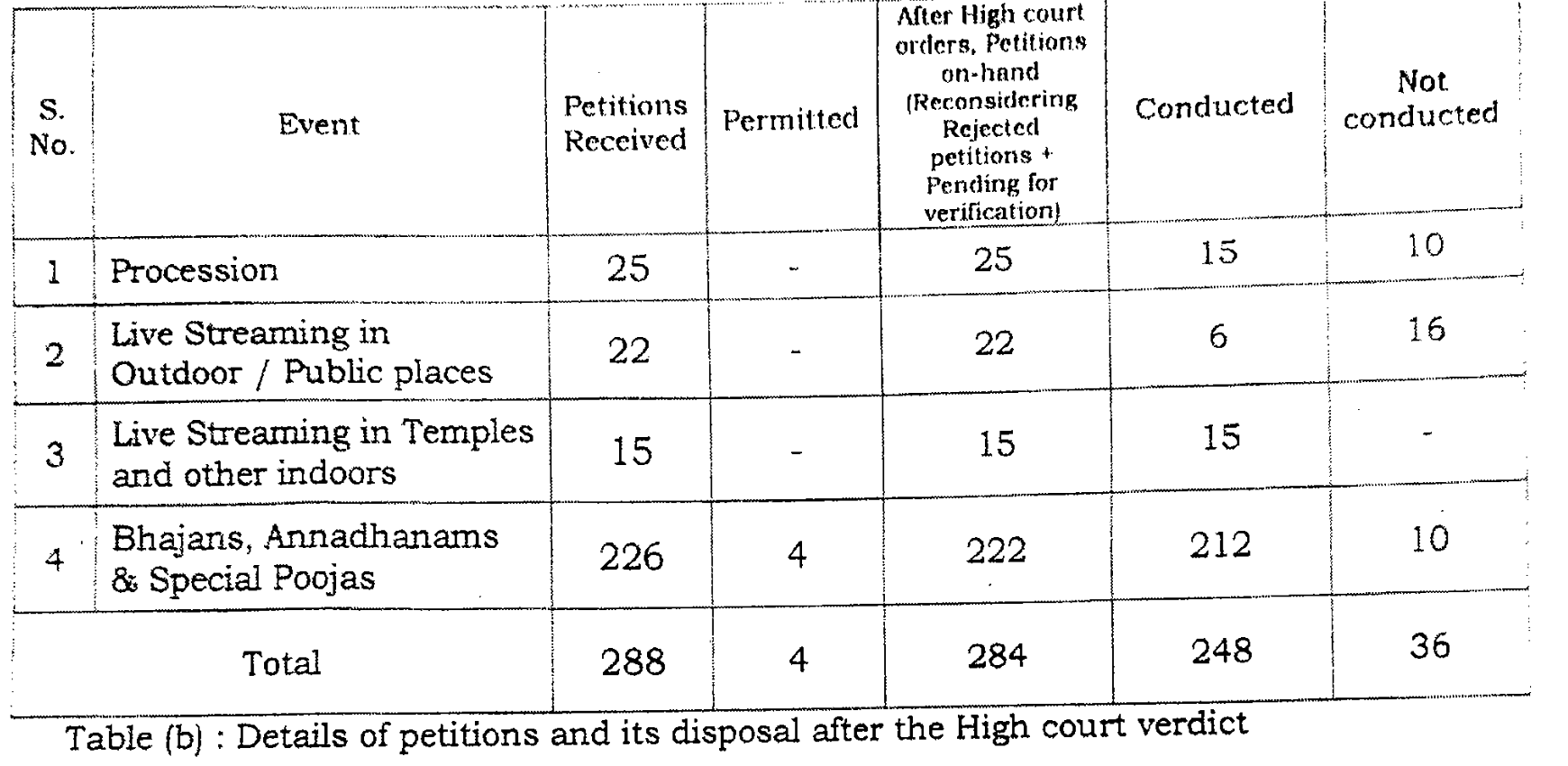
According to the Tamil Nadu Police’s affidavit, before the order by the Madras HC and the Madurai Bench, they had granted permission to only 4 requests. After the order by the court, granted permission to 248 requests (252 including the previous 4 granted).

The police petition says, “After the orders of the Hon’ble High Court of Madras and its Bench at Madurai, petitions those were rejected and kept pending for verification were reconsidered and petitioners were allowed to conduct the events”.

The Tamil Nadu Police elaborates that before the order of the High Court, they had granted 4 permissions. After the HC order, they ended up granting 248 additional permissions.

The police further says that out of the 288 permission requests received till the 20th of January, the local units rejected 146 events based on “the prevailing local issues and the proceedings were served accordingly quoting the same”.

It is, therefore, pertinent to ask what circumstances changed in 2 days that the police believed that these “prevailing local issues” were no longer a consideration and that permissions could be granted – this is a point we will analyse later in this report.

In fact, the petition of the police itself exposes how even permissions for events at private places were skirted by the police and cleared only after the High Court order.

Before the High Court order, the Tamil Nadu police granted permission to only 4 indoor events in public places. All requests for events at private places, indoors and outdoors, were either rejected or kept on hold. Right after the HC order, the Tamil Nadu police granted permission to most.

The police said that they got “requests for 31 events at private places and 257 events at public places. Out of which 138 petitions were at the verification stage due to late submission of the petition by the organisers. However, after the Hon’ble High Court verdict, all the proposals were reconsidered and regulated by the local police in a tie-up with the organisers and concerned departments. Finally, out of 31 private place events, 27 were allowed and out of 257 public place events, 225 were conducted”.

At this point, a pertinent question to be asked would be that while the Tamil Nadu police had kept various permissions on hold either because of late submission or the verification process, how did the backlog get magically cleared once the High Court order was passed and if they could indeed simply grant permission, why did they not do it before the High Court judgement itself? And since they did not, and it took an HC order to get them to let Hindus hold events on 22nd January, does it not bolster doubts cast by the petitioners that there may have been a deliberate plan to allow such events only sparingly in the state run by DMK, leaders of which wanted to eradicate Sanatan Dharma? It’s for the TN government to clarify.

What the High Court and Supreme Court had said, slamming the Tamil Nadu government

The Supreme Court had come down heavily on the police for their absurd arguments denying permission for Pran Pratishtha events. The Supreme Court had heard another petition on the same day as the Madras High Court.

The Supreme Court, while hearing the case, had directed the Tamil Nadu police and govt to act according to the law and stop arbitrarily refusing permissions.

Terming the reasons provided by the Tamil Nadu police “atrocious” for denying permission to a local temple to hold an event on the 22nd of January, the Supreme Court slammed the Tamil Nadu police.

Tamil Nadu had in its response essentially said that since Hindus are a minority in the Dindigul District, the temple could not be granted permission. The Supreme Court said that if this argument was to be accepted, then wherever Muslims are a minority, they would be able to hold prayer meetings or religious events. The reason given by the state was reportedly, “Here the Hindus are in the minority if they are permitted to hold this prior meeting, that will cause problems in the society”. The judge read this reason out and asked Tamil Nadu counsel, “is this a reason?”.

The Judge then told the state to regulate the events since they have the power, but providing this reason for denial of permission was “atrocious”.

The Supreme Court asked the Tamil Nadu government, who had denied that there was any oral order, to record the reasons for denial of any permission sought for processions, puja etc on the 22nd of January.

What had angered the Supreme Court in this case were statements of the DSP to an application by the administrators of the Sri Bhagavatiyamman Temple, seeking permission to hold Annadaman on the occasion of Ram Lalla Pran Pratishtha in Ayodhya. The DSP had denied the request saying, “The area of A Vellodu village, where you have requested permission to conduct the event, is predominantly inhabited by Christians. Additionally, there are areas with Christian temples. Due to the lower number of Hindu residents in this village, there is a possibility of encountering cultural sensitivities or legal complications related to public peace and morality when organizing events that are perceived as deviating from the prevailing religious practices”. It was further said, “Also, public peace is likely to be affected by the programme proposed to be conducted and law and order problems are likely to arise. Religious problems also are likely to arise public property is likely to be damaged, and the public is likely to be put to discomfort. Therefore, due to the above reasons, permission is denied for the program you want to conduct”.

The Supreme Court categorically said that if such reasons are given by the state to deny permission, “they will be in trouble”.

The Madras High Court on the other hand had to come down on the Tamil Nadu government as well.

In the response by the Tamil Nadu DGP, he refers to Writ Petition No. 1430 of 2024 and the order passed by the Madras HC, according to which, the Tamil Nadu administration had granted permissions.

OpIndia pulled out the order passed by the Madras HC in this case, which was in response to a petition by L Ganapathy. The petition was against the rejection of permission for Rama Nama Bhajan and Annadhanam on 22nd January at KKR Kalyana Mandapam, Pattabiram. The petition had also called to refrain officials from interfering in the rituals.

The public prosecutor claimed that the permission had already been granted and placed a copy of the proceedings of January 21 before it. The government then said that 1) There is no permission required for events in private enclosures like mandapams, private temples and any other private place, 2) If there is the possibility of spillover to public places, the organisers need to inform the police and seek permission 3) If such functions are planned to be conducted within temples, which are within the control of the HR & CE Department, the concerned official belonging to the Department must be informed about the same beforehand, and the permission will be granted subject to reasonable conditions imposed by the Department, and 4) Wherever considering the local situation, the police thinks that the area is sensitive, it will be left open to the police to impose such restrictions and to ensure that the function does not lead to any unnecessary law and order problem.

The Madras High Court accepted these submissions by the Government and disposed of the petition.

Another order cited by the police in their counter-affidavit was WP(MD) No.1383 of 2024. In this case, which came up in front of the Madurai Bench of the Madras HC, the petitioner was one V Subbiraj. The petition was against the denial of permission to “live Telecast, Broadcast or Recording of the Establishment and consecration of Lord Ramllalla Pran-Pratishtha Ceremony at Shri Ram Janmabhoomi Temple at Ayodhya through the medium of Television, to hold the flex boards, to use mike sets with permitted decibels to worship the God to be held on 22.01.2024 from 08.00 am., to 10.00 pm., at the place of the Desabandhu Ground, Virudhunagar”. This permission was denied on the 20th of January 2024 and the order in this case was passed on the 22nd of January 2024.

In this case, the single Judge bench cited the government’s submissions which were accepted by the court in the petition filed by L Ganapathy and directed the police to give adequate police protection for the Live Telecast of the event at the place of the Desapandhu Ground, Virudhunagar and allow the event to take place. It also said that if any untoward incident happened, the organisers would be held responsible.

The Temples under control of HR&CE and how the Tamil Nadu government tried to control events in those Temples

While the Tamil Nadu government and police want the courts and the people at large to believe that they are not anti-Hindu, their stand on events pertaining to Pran Pratishtha being held at Temples, especially the ones controlled by HR&CE raises several questions.

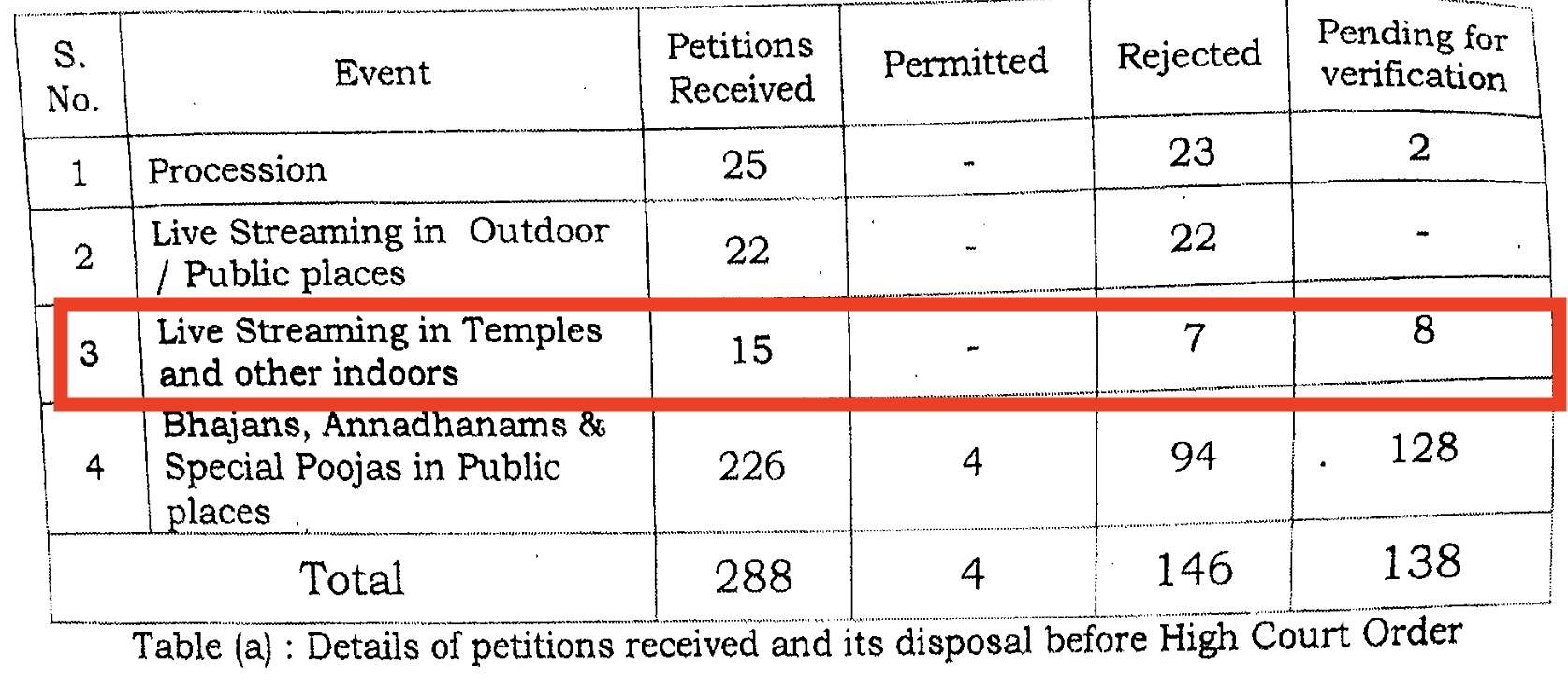
This is the table submitted by the Tamil Nadu police DGP in his counter affidavit.

Point Number 3 is of particular concern. The police say that before the High Court order, they had received 15 petitions for permissions for “live streaming in Temples and other indoors”. 7 of these were rejected and 8 were kept pending – this would mean that NONE of the permissions sought were granted by the administration. Given that in the High Court, the government admitted that for events at HR&CE-controlled temples, they were within their right to grant permission only within “reasonable restrictions”, one has to wonder how many of these permissions originally rejected by the TN administration were those temples which were under the control off HR&CE Department (state control).

If the administration actively rejected applications by those temples that were state-controlled before the High Court order, can it be said that the state was not trying to stop religious events on the day of the Pran Pratishtha of Ram Lalla in Ayodhya?

It was only after the High Court order that the Tamil Nadu administration promptly granted permission to all 15 applications. If the intention was not to stop the celebration of Ram Lalla Pran Pratishtha, why were these 15 permissions not granted before the Court was approached? The answer to this question has not been clear from any of the responses by the government or the police.

The attempt to eyewash by the Tamil Nadu government and administration

The counter-affidavit by the Tamil Nadu police DGP is rather revealing in itself. It claims that the Tamil Nadu government is not anti-Hindu because the administration granted permission to events on 22nd January AFTER the order by the High Court and the slap on the wrist they got from the Supreme Court, however, there is very little to explain why only 4 permissions were granted out of 288 before the courts got involved.

There is also very little to explain why they would stop permission for events that were to be held inside the Temple premises. Further, it is evident that several of the permissions were denied earlier simply because they did not want to offend other religious communities, thereby, stifling the religious rights of the Hindus in the process.

With such facts that have been revealed mostly by the Police itself and the orders by the Supreme Court, and High Courts, one has to wonder on what basis is one supposed to conclude that there was no active attempt by the government to ensure that the piety of the Hindus were denied an outlet.

The media on its part has, as usual, failed to highlight the duplicitous stand that the Tamil Nadu government and the administration have taken with respect to the Pran Pratishtha events and the manner in which they had denied permissions before the Courts got involved.

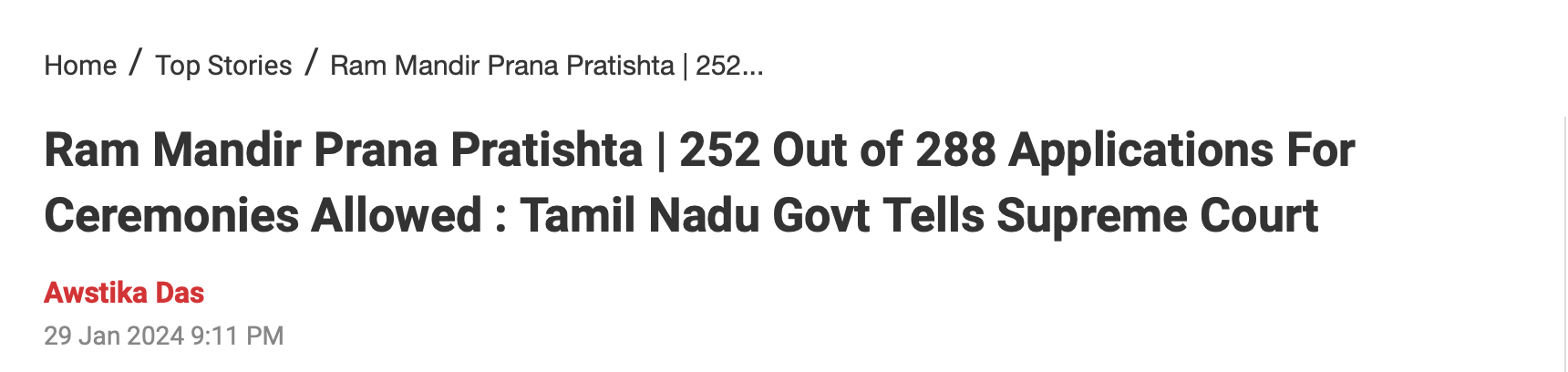
The headline by a supposed legal reporting platform gives the impression that the Tamil Nadu govt willingly granted permission to 252 out of 288 applications and therefore, all allegations thereof were unsubstantiated. This is clearly not the truth.

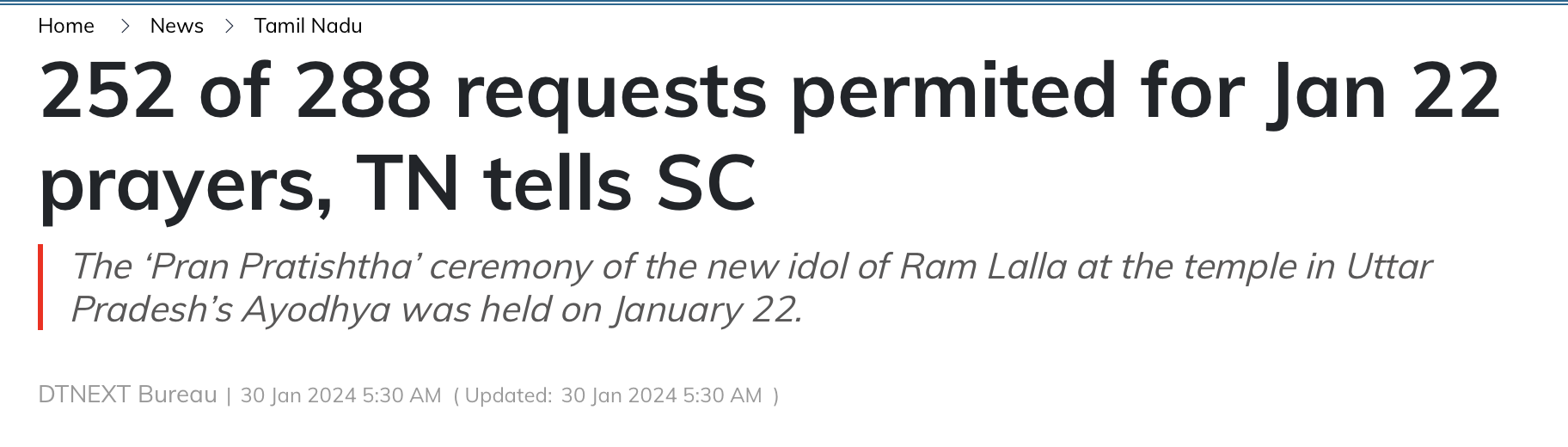
DT Next had a similar headline.

One cannot really be surprised by the chicanery of the Tamil Nadu administration, which has leaders who want to eradicate Sanatan Dharma and the complicity that the media has displayed in this case.

On 22nd January, Prime Minister Narendra Modi conducted the Pran Pratishtha of Shri Ram Lalla and inaugurated the Ram Mandir in a grand ceremony which saw about 7,000 guests attending and Deepavali-like celebrations across the country and the world over.

Exactly 18.75 lakh pilgrims have visited ever since. As per reports, daily visits have averaged over 2 lakh. It has been estimated that the holy city will see an annual footfall of about 5 crore pilgrims.


‘Apologise to PM Modi, and the people of India’: Maldives Opposition leader tells President Muizzu

0

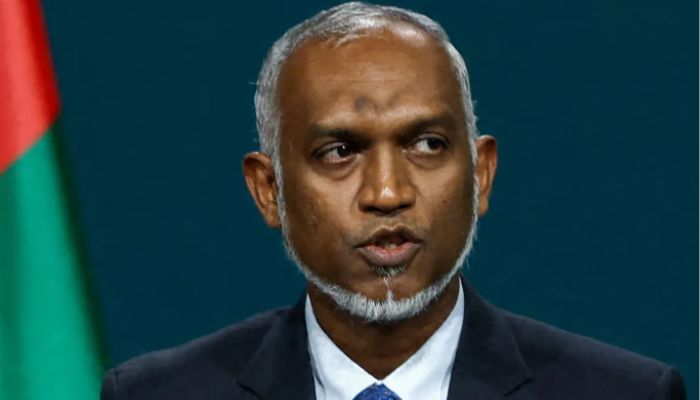
The Maldives Jumhooree Party (JP) leader Qasim Ibrahim called on Maldivian President Mohammed Muizzu to formally apologize to Prime Minister Narendra Modi and the people of India, Voice of Maldives, a Maldivian digital news outlet, reported.

“Regarding any country, especially a neighbouring one, we shouldn’t speak in a way that affects the relationship. We have an obligation to our state that must be considered. President Solih did consider this obligation and issued a Presidential Decree banning the “India Out” campaign. Now, Yameen is questioning why Muizzu, who participated with him in the India Out Campaign, has not nullified the Presidential Decree,” he said.

He added, “The Decree should not be nullified, as it would only result in a loss to the nation. That cannot be done. I would tell Muizzu that it shouldn’t be done. Also, I call on President Muizzu to formally apologize to the Indian government and Prime Minister Modi regarding his remarks after the China trip.”

Earlier last year, then Maldives President Ibrahim Solih signed a decree stating that the opposition’s ‘India Out’ campaign is a “threat to national security”. This allows security agencies to take down campaign banners and provides constitutional cover to take action against opposition parties.

The opposition, led by former president Abdulla Yameen of the Progressive Party of Maldives (PPM) was spearheading an ‘India Out’ campaign for over the last year propagating the unproven claim that Indian military officers stationed in the Indian Ocean island nation are a violation of Maldives’ sovereignty. 

The campaign’s implicit target was then Maldivian President Solih and the Maldivian Democratic Party, both perceived as close to India.

Notably, Solih was one of the prominent Maldives leader to condemn the derogatory remarks made by some junior ministers which led to a diplomatic standoff between the two nations.India and the Maldives on January 14 “agreed to fast-track the withdrawal of Indian military personnel” from the island nation, according to the Maldives’ Ministry of Foreign Affairs.

The removal of Indian troops in the Maldives was the main campaign plank of Muizzu’s party during the presidential elections. Currently, there are around 70 Indian troops, along with Dornier 228 maritime patrol aircraft and two HAL Dhruv helicopters, stationed On the second day of assuming office, Muizzu officially requested the Indian government to withdraw its military personnel from the Maldives.

Apart from the call for the withdrawal of Indian military personnel, a massive row erupted after a Maldivian deputy minister, along with other cabinet members and government officials, made disparaging and unsavoury references to Primer Minister Narendra Modi’s recent Lakshadweep visit and call to development the Indian archipelago as a global retreat for beach tourism.

The Maldives government, however, distanced itself from the remarks.

(This news report is published from a syndicated feed. Except for the headline, the content has not been written or edited by OpIndia staff)

Hindus move Supreme Court seeking ASI survey of Shivling in wuzukhana of disputed Gyanvapi masjid complex

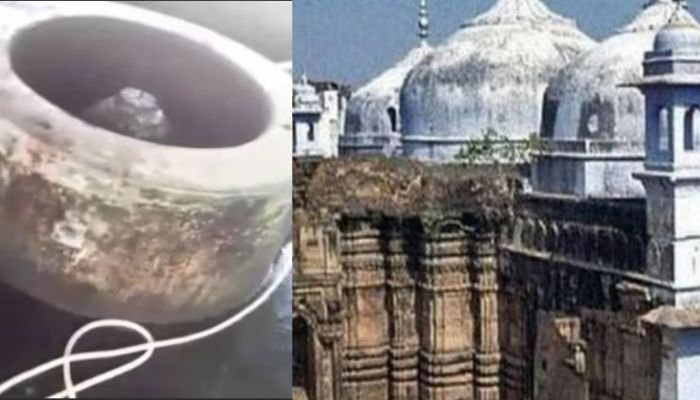
Days after the Archaeological Survey of India (ASI) report on Gyanvapi Masjid was public, the Hindu side has filed an application before the Supreme Court seeking direction to the government agency to conduct survey of the Shivling found in the wuzukhana of the disputed site.

“Direct the Director General of Archaeological Survey of India to make necessary investigation/survey of Shivlingam for determining the nature of Shivlingam and associated features without causing any damage to the Shivlingam situated within the sealed area in terms of the impugned order dated 12.05.2023 passed by the Hon’ble High Court after removing the artificial/ modern walls/floors surrounding the Shivlingam and also to undertake survey of the entire sealed area by excavation and using other scientific methods and submit report within the time provided by the Hon’ble Court…” the application read.

The Hindu side highlighted that the Shivling in the wuzukhana is surrounded by artificial walls and has no religious significance for the Muslims. They argued that the new construction of walls was deliberately done to hide original features (Peeth, Pithika) of the Shivling.

“It is submitted that the survey of the entire premises has been conducted except the sealed area by ASI and now it is necessary that the sealed area be also surveyed by ASI, otherwise, the very purpose of survey would be frustrated as there will be no report of ASI regarding the area under seal”, the application added.

Islamists, left-liberals continued to call ‘Shivling’ as fountain in wuzukhana

Soon after the discovery of a Shivling inside a wuzukhana of the disputed structure of Gyanvapi Masjid in May 2022, left-liberals and Islamists expectedly suffered a prolonged meltdown on social media. Some deliberately called it a ‘fountain’ while others compared Shivling to everyday objects.

They made casual ‘Hinduphobic’ remarks and mocked Hindu deities in an attempt to discredit the discovery of the Shivling inside the disputed structure of Gyanvapi masjid in Varanasi.

The usual suspects, who have a notorious past of chiding Hindus for being unapologetic and proud of culture and heritage, took to Twitter to mock Hindus for celebrating the presence of Shivling inside the disputed structure.

Denial of ASI report

On 25th January, the report by the Archaeological Survey of India (ASI) report on the Gyanvapi Masjid was made public. It revealed the existence of a large Hindu temple structure underneath the disputed structure.

As expected, Muslim peitioners refused to believe the report and vowed to challenge it before the higher Judiciary. SM Yasin, Joint Secretary of Anjuman Intezamia Masjid Committee (AIMC) remarked, “It is our first and foremost responsibility to keep the mosque safe… ASI has given the report as per its reputation. This is a report and not a decision.”

He claimed, “The Gyanvapi mosque was built 600 years ago by a zamindar (landlord) of Jaunpur. It was renovated by Mughal emperor Akbar during his rule. Then the expansion and renovation of the Gyanvapi mosque was done by Mughal emperor Aurangzeb. Muslims have been offering namaz for about 600 years ago…and will continue to do so in future too.”

Jharkhand CM Hemant Soren ‘appears’ in Ranchi residence after 30 hours, holds meeting with party MLAs amid ED summons

Days after Enforcement Directorate (ED) officers failed to find Jharkhand Chief Minister Hemant Soren at his Delhi residence, he was seen walking out of his Ranchi residence on Tuesday (30th January).

Soren, who left Ranchi for Delhi on 27th January, reportedly traveled by road to see his father Shibu Soren in the state capital. The ED officials had gone to Soren’s residence in Delhi, the Jharkhand Bhavan, and a few other sites to question him, but he was not located.

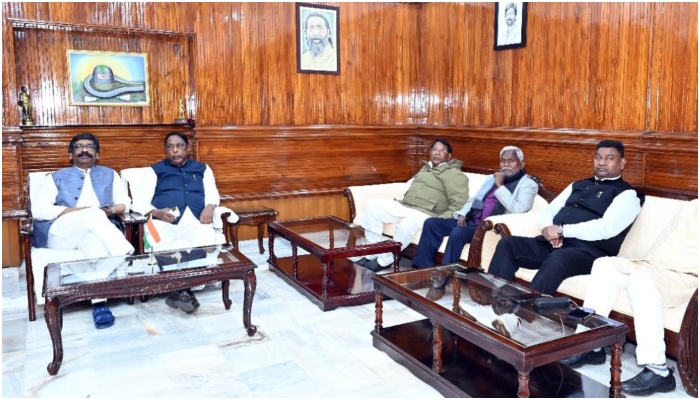
He is currently chairing a meeting of ruling alliance MLAs at the CM House to examine the current political scenario in the state. According to the reports, Soren arrived at his official apartment past midnight. In images and videos published by the CMO on X, a significant number of MLAs and ministers were seen greeting Soren before the meeting began.

The Chief Minister’s wife, Kalpana Soren, was also present at the meeting. All legislators from the Jharkhand Mukti Morcha-led ruling alliance in Jharkhand were instructed not to leave the state capital and to join the conference.

The conference was called to address current political strategies, as well as the Enforcement Directorate’s proposal to question the Chief Minister on 31st January. Meanwhile, Governor CP Radhakrishnan has called the State DGP to discuss the state’s situation with regard to law and order.

Babulal Marandi, the State BJP leader and Leader of Opposition in the Assembly, stated that “as there has been no trace of the Chief Minister for the last two days, it will become a constitutional crisis in the State.” BJP MP Nishikant Dubey had stated that the JMM is planning to appoint Soren’s wife Kalpana as the next CM in case he gets arrested.

He had notified the ED that officials could question him on 31st January at his home.

In an email to the federal government on 29th January, Soren claimed that the issuance of summons to him was “wholly vexatious and in the colorable exercise of powers given by the statute”. “Preserve video recording of seven-hour questioning [of January 20] to make available to the Court of Law,” Soren added, agreeing to record his statement at his apartment at 1 p.m. on 31st January.

Soren filed his statement with the ED after ignoring eight summonses from the agency. The ED had previously summoned Soren on August 14, 24, September 9, 23, October 4, December 12, 29, and January 13, all of which he skipped.

The case concerns the suspected trade of tribal territory using forged documents between 2020 and 2022.

Lalu Prasad Yadav appears before ED: How the fodder scam convict’s dark past has been forgotten to hail him as a politician with ‘unyielding integrity”

0

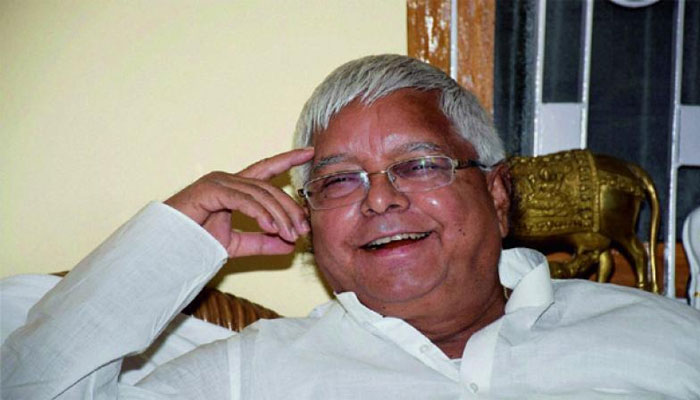
On 29th January, Rashtriya Janata Dal (RJD) chief Lalu Prasad Yadav was summoned by the Enforcement Directorate in the “Land for Job” scam. Social media was flooded with posts in support of Yadav, who has become their favourite as he opposes the Narendra Modi-led government at the centre.

In recent times, it has become a trend of selective amnesia among certain sections of the public as they relentlessly support Lalu Prasad Yadav even though he is a convict in a fodder scam. It seems as if Yadav’s “charismatic political persona” has clouded the judgment of the left-liberals, anti-Modi activists and a special section of journalists. They not only overlook the gravity of the charges Yadav faced but also ignore the legal pronouncements that followed.

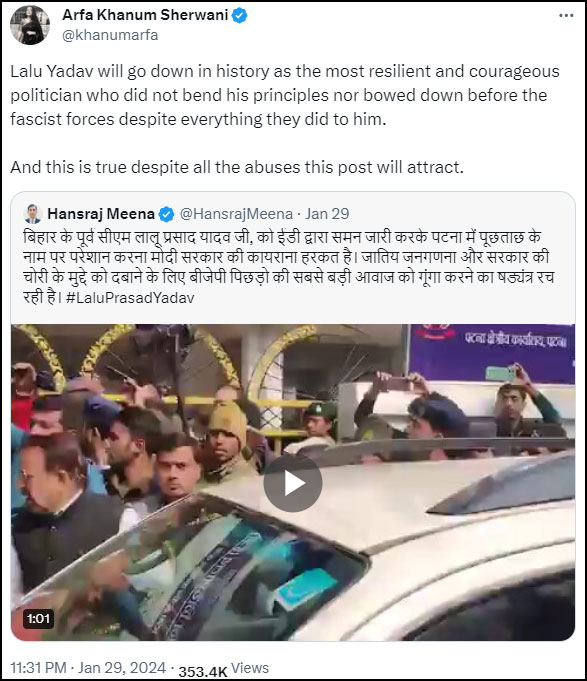
Dubious journalist of The Wire, Arfa Khanum Sherwani, called Lalu Prasad Yadav resilient and courageous. She said, “Lalu Yadav will go down in history as the most resilient and courageous politician who did not bend his principles nor bowed down before the fascist forces despite everything they did to him. And this is true despite all the abuses this post will attract.” Notably, this is not the first time she came in support of Yadav. In January 2021, she called for his release from prison. According to Arfa, the accused in the terror and communal riots were sitting in the Parliament, however, ‘Dalit-OBC’ messiah Lalu Yadav was still languishing in jail. “How is this justice? Where is this justice?” asked Arfa Khanum Sherwani, who herself has a history of peddling false propaganda on social media platforms.

Source: X

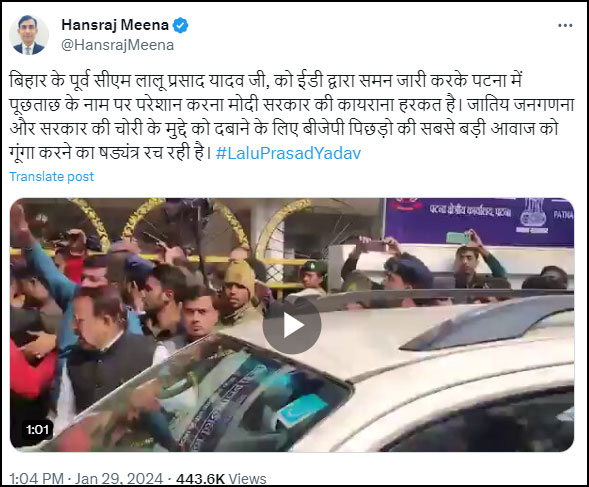
In the recent matter, Arfa was quoting the founder of Tribal Army Hansraj Meena who wrote, “It is a cowardly act of the Modi government to harass former Bihar CM Lalu Prasad Yadav ji by issuing summons to him in the name of interrogation in Patna by ED. To suppress the issue of caste census and government theft, BJP is conspiring to mute the biggest voice of the backward classes,” in a post in Hindi.

Source: X

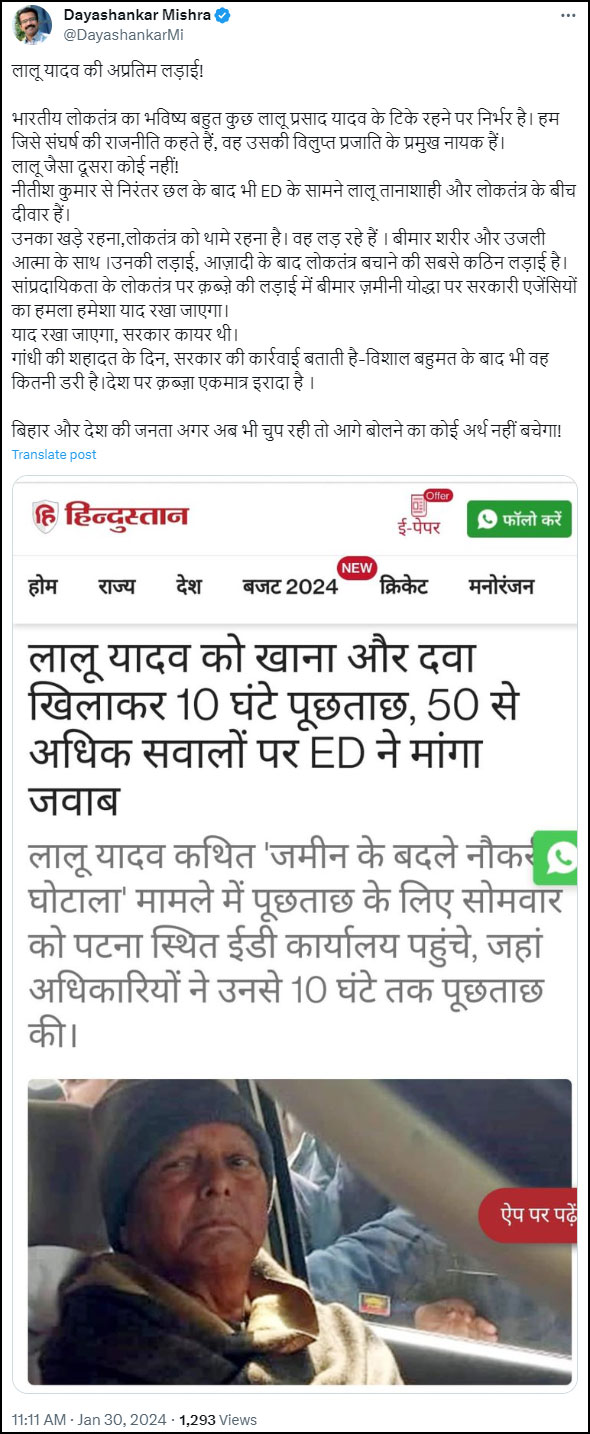
Dayashankar Mishra, who wrote a book on Rahul Gandhi, said, “Lalu Yadav’s unparalleled struggle! The future of Indian democracy relies heavily on the existence of Lalu Prasad Yadav. In what we call the politics of struggle, he is the prominent leader of his endangered species. There is no one like Lalu! Even after constant manoeuvring by Nitish Kumar, Lalu stands tall against the tyranny and walls between dictatorship and democracy before the Enforcement Directorate.”

“His standing is essential for preserving democracy. He is fighting, with a frail body and a bright spirit. His battle, after independence, is the toughest to save democracy. In the fight against the capture of democratic institutions by communal forces, the attack on the ailing ground warrior by government agencies will always be remembered. It will be remembered that the government was cowardly,” he further added.

“On the day of Gandhi’s martyrdom, the government’s actions reveal its fear, even after a massive majority. The sole intent is to establish control over the nation. If the people of Bihar and the country remain silent even now, speaking later will be meaningless!” Mishra concluded in a post on X.

Source: X

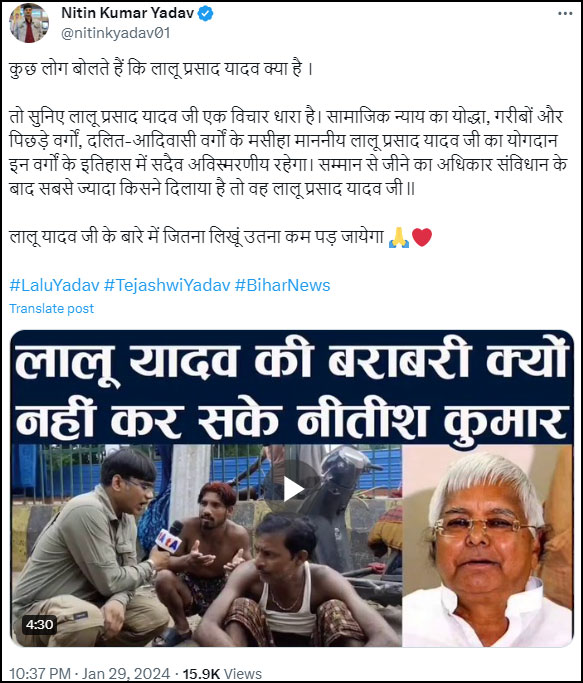
Editor of Public Station Nitin Kumar Yadav wrote, “Lalu Prasad Yadav is a visionary. Revered as a warrior for social justice, and the saviour of the poor, downtrodden, Dalits, and Adivasis, the honourable Lalu Prasad Yadav’s contribution to the history of these groups will always be unforgettable. If anyone has secured the right to live with dignity the most after the Constitution, it is Lalu Prasad Yadav,” in a post on X in Hindi.

Source: X

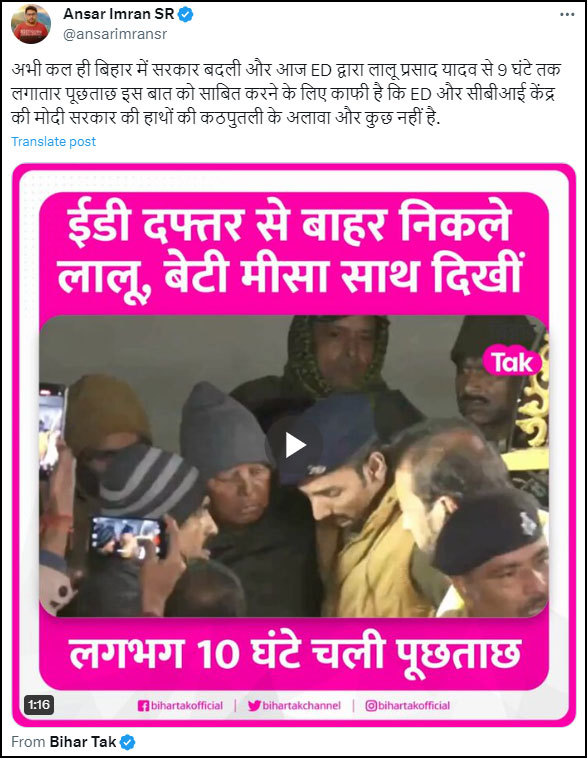
Another dubious journalist Ansar Imran SR called central agencies like CBI and ED “puppets of Central Government” just because ED questions Yadav.

Source: X

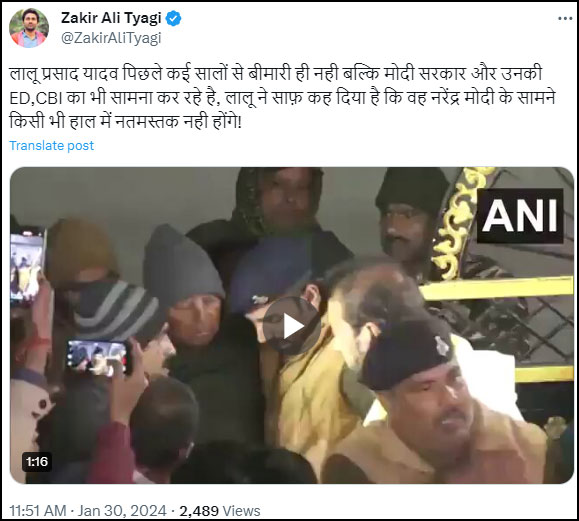
‘Journalist’ Zakir Ali Tyagi claimed Lalu would not bow down before PM Modi.

Source: X

These posts on social media are just the tip of the iceberg. While these people flaunt their amnesia, it is essential to revisit the observations of the court while convicting Yadav in the fodder scam. The court found Yadav guilty of embezzling public money meant for cattle fodder. His actions undermined the trust citizens placed in the elected representatives. Notably, the judgment highlighted the need for accountability in public life and sent a strong message against corruption that spanned across Bihar during Yadav’s regime.

It was found that excessive withdrawals had been the trend for several years. For example, between the years 1993-96, Rs. 10.5 crores were approved by the government to purchase 5,664 pigs, 40,500 hens, 1,577 goats and 995 sheep. However, the State Department of Animal Husbandry withdrew a whopping Rs 255.33 crore. After factoring in over-expenses, according to the Auditor General’s report, the total fraudulent withdrawals stood at Rs. 409.62 crores.

The Auditor General’s comments while preparing the report on financial irregularities drew the imagery which became synonyms for the fodder scam. He commented, “cattle were transported on scooters, police vans, oil tankers and autos.”

The respective scam covered districts of present-day Jharkhand namely, Ranchi, Chaibasa, Dumka, Gumla and Jamshedpur along with Banka in Bihar. The scale of the fodder scam was estimated at Rs 950 crore (in rough value through dollar conversion, it would be over 2,300 crore today).

Despite the clear verdict, these individuals who support him turn a blind eye to the fact just because they do not like the sitting Prime Minister and the ruling party. The tendency to selectively ignore the legal proceedings and evidence in favour of personal biases also raises serious questions on the integrity of these individuals, especially when they are part of public life being journalists and social activists.

Interestingly, the fodder scam was not the only black spot in Yadav’s and his family’s political career. Between 2004-09, Lalu Prasad served as the Minister of Railways and ordered a fresh probe into the Sabarmati Express fire at Godhra in Gujarat, the incident in which 59 people were killed on February 27, 2002, by Islamists. Lalu argued that as per the forensics report “no inflammable material was thrown in the compartment of the Sabarmati Express from outside. The only damage done to the coach was by stone-throwing”.

Furthermore, over 10,000 traders and businessmen fled from the state during that decade under the Yadav family’s rule due to fear of life or extortion. More about his political career and controversies can be seen here.

Those who choose to champion politicians like Lalu Prasad Yadav despite being convicted in scams must critically assess their stance. Supporting such leaders sends a detrimental message to the public. It undermines the fabric of the democratic principles and erodes public trust on critical institutions such as the judiciary. It is high time people start to position their stand with the truth instead of allowing their political considerations and pathological hatred of a man skew their sense of morality.

I.N.D.I. Alliance’s first election lost: BJP’s Manoj Sonkar defeats AAP-Congress candidate to become Chandigarh mayor

On 30th January, Bharatiya Janata Party (BJP)’s Manoj Sonkar became Mayor of Chandigarh after defeating Congress-AAP candidate Kuldeep Tita. He secured 16 out of 35 votes while Tita secured only 12. Eight votes were declared invalid.

Following the results, protests broke out against presiding authority Anil Masih. Marshals were called into the house to control the situation. BJP’s Rajinder Kumar was elected as Deputy Mayor. The voting took place at the Municipal Corporation Building in Chandigarh.

This was the first time the opposition’s I.N.D.I. Alliance members fought any election against the BJP. Also, it is the first time AAP and Congress allied to defeat BJP in any election. It is unclear how deep the impact would be on the alliance. Notably, AAP has already announced it will fight Lok Sabha elections alone in Punjab which was a major jolt for the I.N.D.I. Alliance for the general elections.

The polling process took place in the presence of Chandigarh Municipal Corporation Deputy Commissioner Vinay Pratap Singh. The voting was scheduled for 10 AM. However, it began almost an hour later as the deputy commissioner and BJP councillors were late. Ex-officio member of the house and BJP MP Kirron Kher was also present in the house. She was the first to cast a vote in the election.

It took an hour to complete the voting process. Though the AAP-Congress alliance had 20 votes and the BJP had 15 votes excluding one from the ex-officio member Kher, the alliance failed as eight votes were declared invalid.

This was the first time reporters were not allowed in the press gallery to cover the elections. They watch the process on a screen installed in the conference room.

Initially, the elections were supposed to take place on 18th January. However, they were postponed to 6th February after Masih got sick. However, the opposition councillors of AAP and Congress approached Punjab and Haryana High Court over the new date. The court directed that the elections be held on 30th January.