Home Blog Page 2418

NDPP-BJP alliance returns to power with a bigger majority in Nagaland: Here is how development and peace were main planks in the state

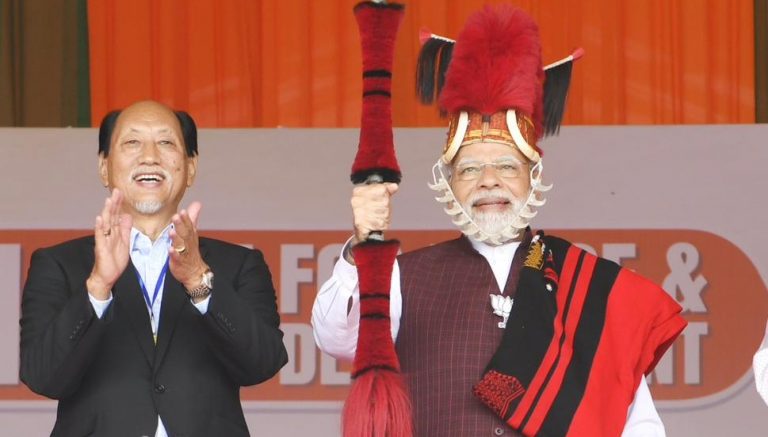
Neiphiu Rio is set to become the Chief Minister of Nagaland for the fifth time, as the NDA alliance is heading for a spectacular victory. Rio-led Nationalist Democratic Progressive Party (NDPP) is winning 25 seats, while BJP has won 12 seats as per the latest results. Therefore, the ruling alliance is returning to power with a comfortable majority in the 60-member house.

Among the three north-eastern states that went to assembly polls, Nagaland, Meghalaya and Tripura, the result of Nagaland is the least surprising, as it was widely expected that NDA led by Rio will return to power. The results are largely in line with predictions made in exit polls and opinion polls.

Polls in Tripura and Meghalaya were close. The Congress-left alliance and emergence of Tipra Motha had become a major threat to the BJP in government in Tripura, while the presence of too many parties in Meghalaya had made things complicated in that state. But NDA alliances are winning these two states too. All three states have 60 members in their assemblies.

In Nagaland, Naga Peoples Front, a major party in the state which ruled the state for several terms, has fared badly, leading in just 2 seats. It is notable that Neiphiu Rio was earlier in NPF, and became CM from the party in 2003, 2008 and 2013. In 2018, he formed the NDPP after splitting the NPF, taking away a large number of leaders and supporters from his former party.

Ahead of the 2018 assembly elections, BJP dumped NPF and formed an alliance with NDPP realising that most popular leaders from the regional party had moved to the new party, including Rio. While NPF had emerged as the largest party in 2018, it could not cross the halfway mark, and the BJP-NDPP managed to form the government with the support of two other MLAs.

Compared to the tight victory in 2018, this time the BJP-NDPP alliance has secured a comfortable majority, underlying a pro-incumbency verdict.

While the Congress party remains missing from Nagaland politics, Nationalist Congress Party has performed surprisingly well, winning 7 seats. National People’s Party, led by Meghalaya CM Conrad Sangma, has won 5 assembly seats in Nagaland. While NPP currently has an alliance with BJP for the current government in Meghalaya, both parties contested the polls separately.

As it is highly likely that NPP and BJP will come together along with UDP to form the next government in Meghalaya, NPP may join the government in Nagaland also, which will increase the numbers for the ruling alliance.

Apart from that, JD(U) has won 1, Lok Janshakti Party (Ram Vilas) has won 2, and the Republican Party of India (Athawale) has won 2 seats in Nagaland. There are four independent MLAs in the new Nagaland assembly. In the last outgoing assembly, there was one JD(U) MLA and he had supported the NDA government, and later the party unit in the state merged with NDPP. Given the past trend in the region, it is very much possible for other parties to join the NDA in the state.

While the Congress party had ruled the state for several terms in the past, it has become history in Nagaland. Just like the last elections, Congress didn’t win a single seat this time also.

The victory of NDA in Naganld underlines the massive improvements that have taken in the state in terms of infrastructure development and peace. While the state was synonymous with insurgent activities for a long time, the Modi govt has been able to control the situation. Naga peace talks are progressing well, and it is expected to bring lasting peace to the state. The Armed Forces Special Powers Act has been withdrawn from several districts in the state, signifying a decrease in insurgent activities.

Like the rest of the country, Nagaland also has seen a massive improvement in infrastructure. The state is now connected with modern wide highways, while railway lines are being laid up to Kohima, giving a massive boost to connectivity. Similarly, there are new job opportunities due to new industries that are being set up in the state.
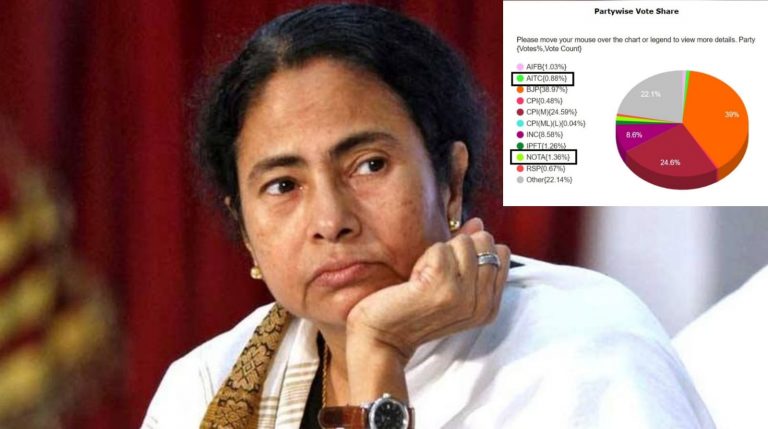
NOTA gets more votes than TMC in Tripura despite Mamata Banerjee’s campaign in the state

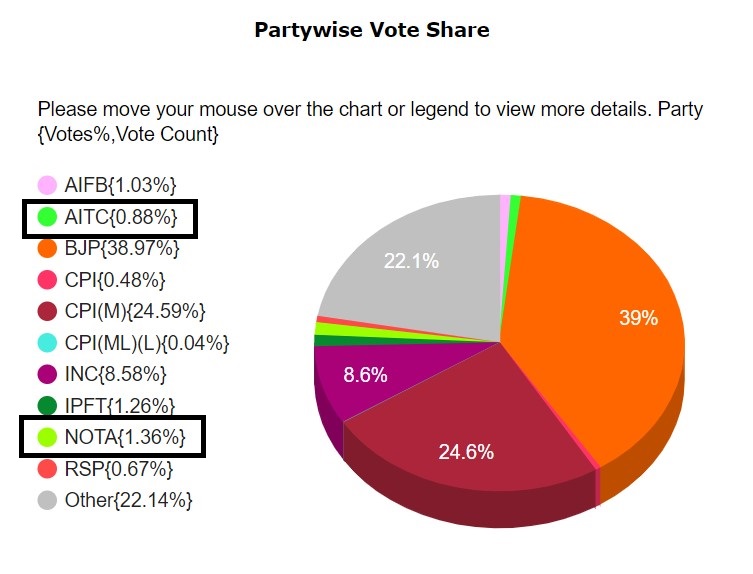
The counting of votes for the 60 assembly seats in Tripura began at 8 am today (March 2, Thursday), the voting for which took place on February 16. In a major embarrassment for Mamata Banerjee, her Trinamool Congress party received 0.88 percent of the votes in this election. Interestingly, the Tripura voters preferred NOTA (None Of The Above) over Mamata Banerjee’s TMC.

As per the data available on the Election Commission website, a significantly higher number of voters preferred NOTA over Mamata Banerjee’s Trinamool Congress Party in the Tripura polls. While Mamata-led TMC has bagged 0.88 percent of the vote share, NOTA outperformed them by securing 1.36 percent of the total vote share.

The vote share of TMC (Election Commission)

Notably, despite Mamata Banerjee’s attempts at wooing voters ahead of the polls, her party failed to outperform NOTA votes in Tripura. In February, ahead of the polls, Mamata Banerjee campaigned for two consecutive days in Tripura with her nephew and TMC national general secretary Abhishek Banerjee. She even held a nearly 5-kilometer-long padayatra in Agartala.

Speaking at a rally following the padayatra, the TMC chief highlighted the Trinamool Congress model of ‘development’ in Bengal in an attempt to impress voters in Tripura, claiming that her party was the only alternative if the people of the northeastern state wanted jobs, development, and peace.

Mamata repeatedly stated that Tripura was her second home, remembering her substantial work on the ground there during her long tenure with Congress Party and she pleaded with the people of the Bengali-dominated state to give her a chance.

Mamata Banerjee’s appeal clearly did not work with the voters of Tripura as the total vote percentage of TMC in the state was 0.88%.

Source: Election Commission website

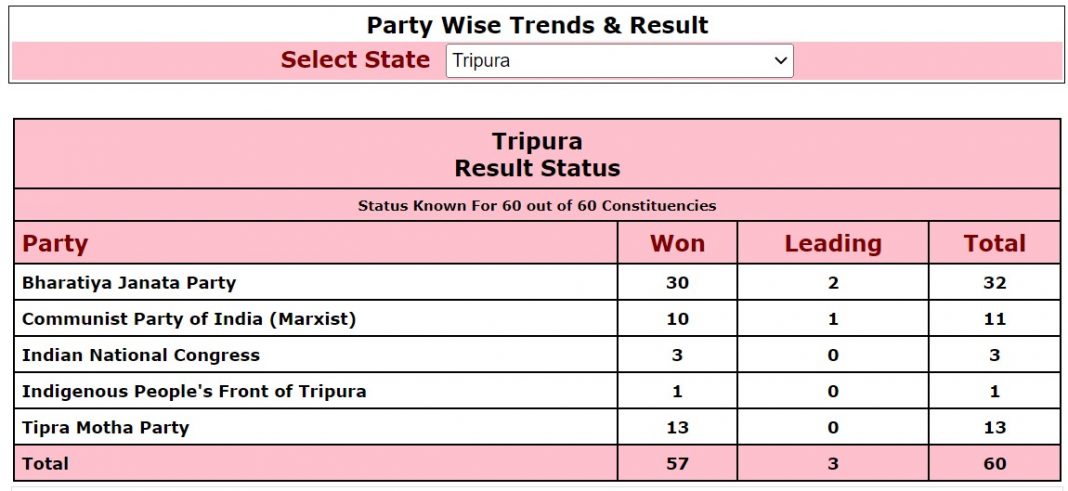
Meanwhile, according to the Election Commission data available at the time of publishing this report, the ruling BJP was inching towards victory as it crossed the halfway mark in the 60-member Assembly, winning over 30 seats, and leading in 2 others. While the CPI(M) registered a victory in 10 seats, the Congress is ahead in 3 seats. Royal scion Pradyot Kishore’s TIPRA Motha party is winning 13 seats.

Christian missionaries in Delhi book fair provide anti-Hindu material, Bible for free, persuade Hindus to convert religion, United Hindu Front protests

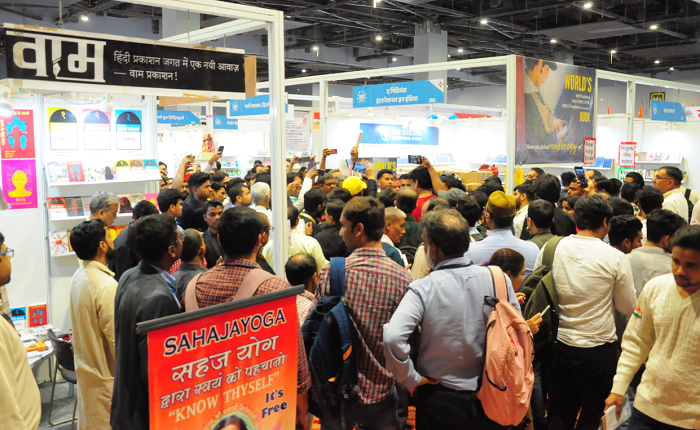
On Wednesday, the United Hindu Front launched a protest at a book fair in Delhi’s Pragati Maidan after several Christian missionaries attempted to distribute objectionable content against Hindus. The missionaries also distributed free Bible and indicated the non-Christian attendees to accept Christianity as their new religion.

The event was posted by the United Hindu Front on Twitter which said, “The United Hindu Front demands strict action against Christian missionaries spreading propaganda against Hinduism and distributing objectionable material and protested.”

According to the reports, the Christian missionaries were distributing objectionable content against Hindus and Bible for free even to small children. They were trying to prepare Hindus for conversion, it said.

The protest at the book fair erupted after Dharmendra Bedi, the national vice president of the United Hindu Front, arrived at the event together with Rahul Manchanda, the organization’s leader in Delhi, and other UHF employees. 

Jai Bhagwan Goyal, the national president of the Rashtrawadi Shiv Sena and the international executive president of the Front, said that individuals working for Christian missionaries were disparaging Hindus and persuading them to convert to Christianity.

In the meanwhile, Goyal has requested that the book stalls installed by the Christian missionaries be taken down immediately.

He further stated that the Kejriwal administration has encouraged open conversions in the nation’s capital. Goyal also requested that individuals engaged in conversion operations face harsh punishment from the police and the administration.

NIA attaches property of Al-Umar Mujahideen chief Mushtaq Ahmad Zargar, released in Kandahar plane hijacking

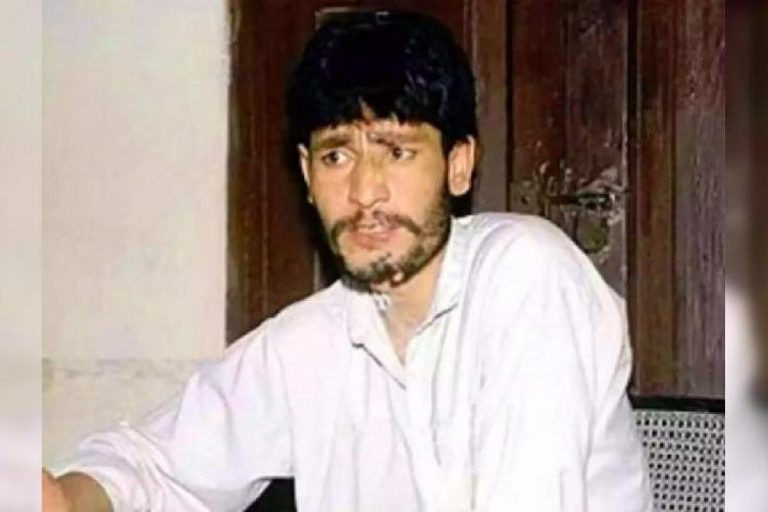
NIA has attached the house of fugitive terrorist Mushtaq Ahmad Zargar, chief of Al-Umar Mujahideen, in Srinagar’s downtown area as part of the ongoing crackdown against the militants. The property is located at Gani Mohalla, Nowhatta in Srinagar.

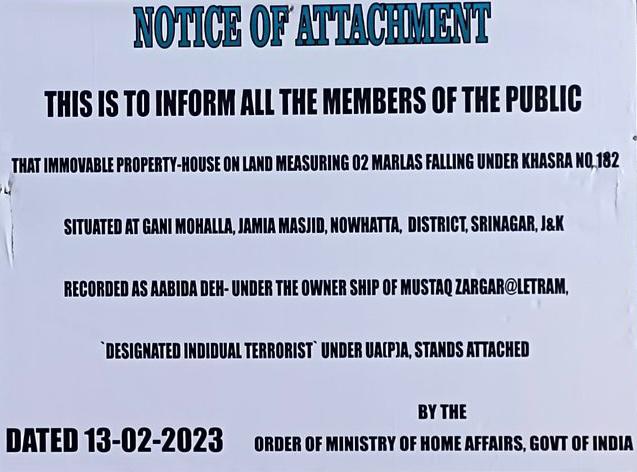
Mushtaq Ahmad Zargar was one of the terrorists to be released after the IC-814 hijack case and now lives and operates from Pakistan. Earlier Mushtaq was listed as a terrorist in the first schedule of UAPA by the union home ministry. An NIA team with the assistance of local police and CRPF attached the 540 sq feet house on Thursday morning. NIA informed that the house at Ganai Mohalla, Jamia Masjid, Nowhatta, Srinagar, has been attached under the relevant provisions of UAPA.

This is part of NIA’s plan to weaken the terror activities in Jammu and Kashmir, as weakening the terrorists financially will break the back of terrorism. In the last several months, authorities have seized a large number of residential and commercial properties owned by terrorists and terror groups. While most of these terror networks have now moved their setup to Pakistan and operate from there, they are earning income from these properties.

Notice outside Mushtaq Zargar’s house

The family of Mushtaq has protested against the attachment order and said that Muhtaq has nothing to do with the property.

Security agencies have identified hundreds of such properties worth crores belonging to terrorists and terror groups, and are in the process of attaching them. In December last year, 20 properties of Jamaat-e-Islami worth ₹123 crore, including a house in Srinagar owned by Syed Ali Shah Geelani, were seized by the State Investigation Agency (SIA) of the Jammu and Kashmir Police.

Mushtaq was involved in the kidnapping of Rubiya Sayeed, the daughter of the then Home Minister Mufti Mohammad Sayeed in 1989. At that time, he was a member of the Jammu Kashmir Liberation Front. He left the group in 1991 and formed his own organisation, Al-Umar Mujahideen. Mushtaq was arrested in 1992, but was released in 1999, along with Jaish chief Masood Azhar and Ahmed Omar Saeed Sheikh, in exchange for the release of the hijacked Indian Airlines flight IC-814.

Mushtaq has been living and operating from Pakistan after he was released, and he revived his Al-Umar Mujahideen in Muzaffarbad. He has been the chief recruiter of Lashkar and JeM and has ties with Al Qaeda as well.

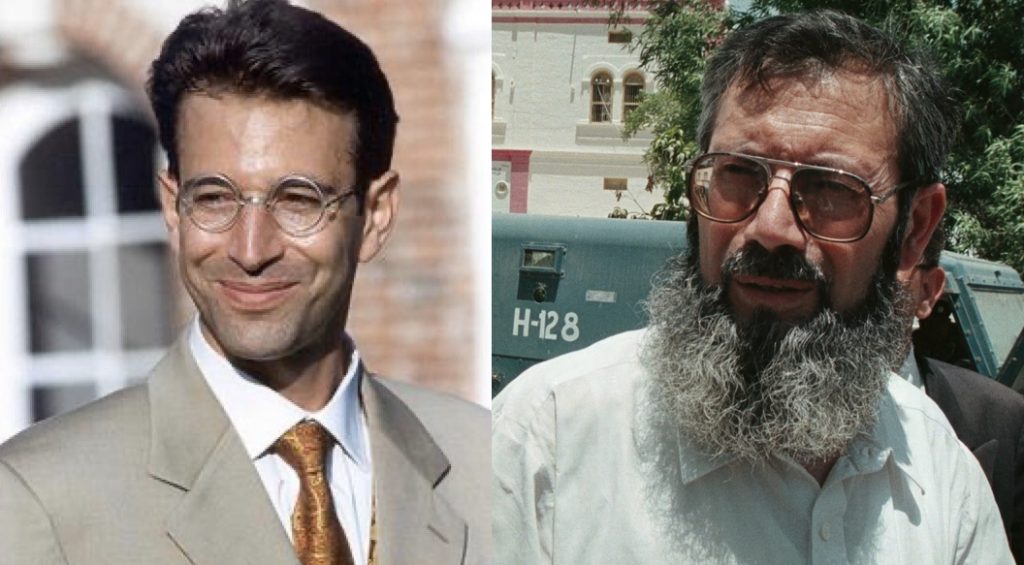
Daniel Pearl, Ahmed Omar Saeed Sheikh

All three terrorists released after the hijacking have emerged as major terrorist leaders. Masood Azhar was the mastermind in the 2001 terrorist attack on the Parliament of India and Omar Saeed was involved in the gruesome killing of The Wall Street Journal reporter Daniel Pearl. Daniel Pearl murderer Omar Sheikh operated the terror organisation called Harkat-Ul Ansar.

From Infosys leader to Oxfam director: who are the members of the committee set up by SC to review regulatory mechanism in Adani Hindenburg case

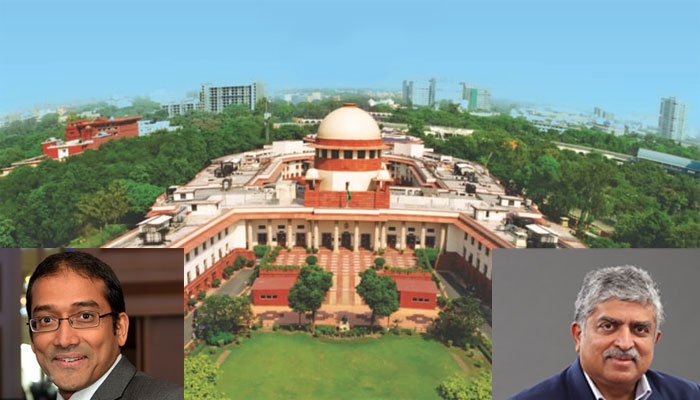
On March 2, Supreme Court constituted a six-member committee in the Adani-Hinderburg case. Supreme Court judge Abhay Manohar Sapre will head the committee. The other five members appointed by the apex court are Om Prakash Bhatt, Justice JP Devadhar, KV Kamath, Nandan Nilekani, and Somasekhar Sundaresan. The committee has been asked to submit a report in two months.

Justice Abhay Manohar Sapre has an experience 20 years of practising civil, constitutional and labour law at the Madhya Pradesh High Court. Earlier, he also served as Chief Justice of the Guwahati High Court and as the first Chief Justice of the Manipur High Court.

Om Prakash Bhatt is the former chairman of the States Bank of India. He serves as an independent director on the boards of multiple MNCs, including Tata Steel Limited, Hindustan Unilever Limited, and Tata Motors and serves as a non-executive chairman in multiple companies. He is also the chairman of the Indian Banks’ Association.

Justice JP Devadhar was chairperson of the Securities Appellate Tribunal (SAT) for five years from July 2013. He practised law at the Bombay High Court in 1977.

KV Kamath is an Indian Banker who has worked with ICIC Bank. He has been in various positions, including chief of the New Development Bank of BRICS countries and chairman of Infosys. Kamath’s name was involved in the high-profile ICICI Bank fraud case by CBI and ED, as per the Pgurus report.

Nandan Nilekani is the Co-Founder and Chairman of Infosys Technologies Limited. He was also the founding chairman of UIDAI in the rank of Cabinet Minister. In January this year, he was appointed as co-chair of the G20 Task Force on Digital Public Infrastructure for Economic Transformation, Financial Inclusion and Development”. Nilekani contested Lok Sabha elections from Bangalore South constituency in 2014 and lost to BJP’s Ananth Kumar by over 2,00,000 votes.

Somasekhar Sundaresan worked as a journalist in his initial years. He has served as a committee member set up by the central government, SEBI and Ministry of Corporate Affairs. Somasekhar is also a board member of Oxfam India. Notably, Oxfam India has a tendency to work against the central government. On the international platform, Oxfam International is one of the front runners that have worked against the Adani Group in countries like Australia, where the company is investing in coal mines.

Sundaresan’s name was proposed to be elevated by the Supreme Court as High Court Judge. However, the central government objected to it because of his highly biased opinions on social media. Later, the SC reiterated his name in January this year. In January this year, Oxfam India published a dubious report on how taxpayers are divided among income sections. OpIndia’s report on it can be read here.

2020 Hathras case: UP court acquits three accused and holds one guilty under section 304, rape charges dropped

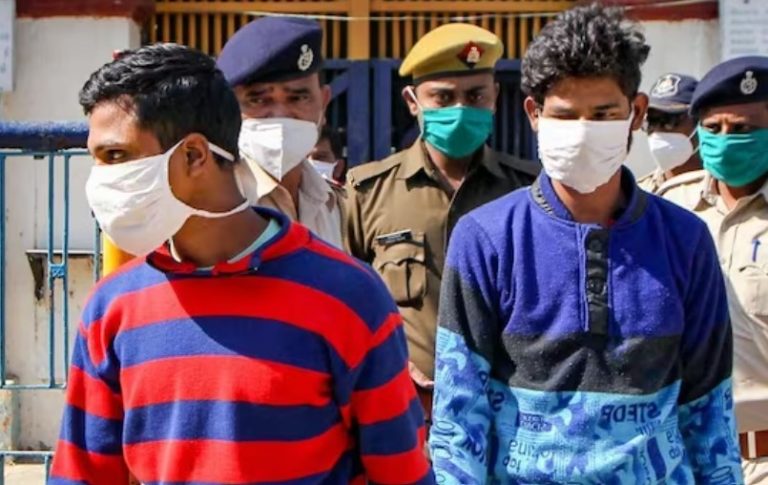
On Thursday, March 2, an SC-ST court in Uttar Pradesh acquitted three people accused in the Hathras case and held only one guilty. Out of the four accused, namely, Sandeep (20), Ravi (35), Luv Kush (23), and Ramu (26), the court held that Sandeep was guilty of the crime.

The quantum of punishment for Sandeep would be decided by the court post-lunch today. Sandeep was held guilty under IPC section 304 (punishment for culpable homicide not amounting to murder) and sections of the SC/ST act.

Significantly, in the Hathras case, where it was initially alleged that the girl was gang raped and then murdered, none of the four accused has been found guilty of the offence of rape by the Special Court. In fact, the court has reportedly invoked only IPC section 304 (punishment for culpable homicide but not murder) and the SC/ST Act against Sandeep, who has been held guilty by the court, while acquitting the other three.

Soon after the court announced the verdict, the victim’s family, through their lawyer, expressed their disappointment with the court’s decision and said they intend to appeal to the Allahabad High Court.

Meanwhile, the Hathras District Court will hear arguments against the sentence later today.

Hathras case

On September 14, 2020, the victim had gone to the field to collect fodder when she was attacked. The teenager was dragged by a dupatta around her neck, which probably caused the spinal injuries, to a field where she was allegedly raped.

The accused, who was nabbed, had tried to strangulate her to death as she resisted them, as per the victim’s family’s complaints. Though the claims of rape and brutality were included in the complaint, the forensic report stated that to signs of sexual assault were found on the victim’s body. Initial media reports and even the initial police complaint by the victim family have no mention of rape, gang rape or and caste atrocity angle.

The victim later succumbed to her injuries on September 29, 2020, at Safdurjung hospital in Delhi. The Hathras case was hyped by the opposition to stir up caste violence in the state. However, eventually, the politicisation fell apart. A detailed timeline of the media and political narratives around the case can be read here.

Children under attack from stray dogs: Telangana, Uttar Pradesh, and Rajasthan, stray dogs mauling kids to death across India

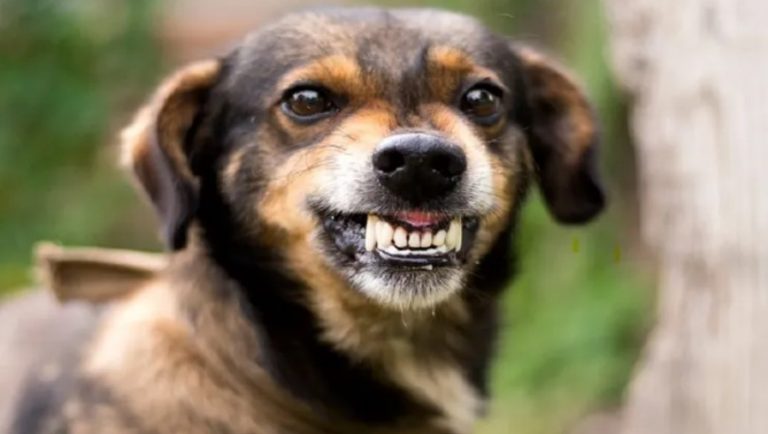
Recently, three separate incidents of children being attacked by stray dogs have come to light. The first was reported from Warangal town in Telangana, the second from Bareilly in Uttar Pradesh, and the third from the Sirohi district of Rajasthan.

On Wednesday, March 1, stray dogs attacked a seven-year-old boy playing outside his house near Pochamma Gudi in the Kashibugga area of Warangal town in Telangana.

When the boy, identified as Rohith, began screaming, villagers came to his aid and drove away the four dogs that had attacked him. The child had bite marks on his head and hands by then.

Rohith’s parents rushed him to the Mahatma Gandhi Memorial (MGM) Hospital, where he is currently recovering.

Stray dogs mauling a toddler to death in Bareilly, UP

In Bareilly, Uttar Pradesh, a pack of 15 to 20 stray dogs mauled a 3-year-old girl to death. The incident reportedly happened late on Tuesday (February 28) evening in the Bandia village where the victim resided. “The dogs dragged the toddler for around 100 meters and mauled her badly,” the police said.

The family members of the victim rushed her to hospitals where doctors declared her dead. According to the doctors, the victim, identified as Pari, daughter of Avdesh Gangwar, a labourer, had 200 bite marks on her body.

According to locals, on Tuesday evening, Pari went towards a field to play when around seven-eight stray dogs pounced on her. A youth heard her cry for help and rushed to rescue her. He too was bitten by the dogs when he rescued Pari from the dogs. Pari was rushed to the hospital, where doctors declared her dead.

Pari’s uncle Jitendra Kumar said, “She walked far from the house and no one in the family could hear her screams for help. The dogs even dragged her and bit her all over the body, causing deep injuries, especially on the neck.”

Stray dogs enter the hospital, kill infant sleeping next to mother in Rajasthan

In a similar incident reported on Tuesday, February 28, a month-old baby boy was mauled to death by stray dogs in a district hospital in the Sirohi district of Rajasthan, while she was reportedly sleeping next to his mother. The body was found outside the hospital ward.

Rajasthan Police said the CCTV footage showed that two dogs went inside the TB ward of the hospital on Monday night and one of them returned with the infant.

SHO Kotwali, Sitaram sad Mahendra Meena, the child’s father, was brought to the hospital for silicosis treatment. He claimed that the child’s mother, Rekha, who was caring for the patient alongside her three children, fell asleep when the incident happened. He also claimed that no hospital staff was present at the time of the incident.

“Post-mortem has been conducted by a medical board. A case will be registered in the matter after further investigation,” the SHO said.

Meanwhile, the child’s father accused hospital and police officials of forcing his wife to sign blank papers and perform his child’s final rites without informing him.

“I was admitted to the hospital on Monday. Dogs were coming inside the ward and I chased them away. My wife woke up at 2 am and found the dogs mauling our child. Today, the hospital authorities and police took the signature of my wife on blank papers and got the last rites of my son done without informing me. I could not even see my son’s face,” Meena said.

The hospital administration has also initiated a probe into the matter.

Similar incident of dog attack happened in Hyderabad

On February 19, Sunday, stray street dogs killed a 4-year-old boy in a housing society in Hyderabad, Telangana. As per reports, the boy was rushed to the hospital, where he was declared brought dead. CCTV footage of the incident had then gone viral on social media.

Street dog menace

This is not the first time stray dogs have killed or attacked a child. There have been several such reports where a pack of dogs attacks children, women, elders, and vulnerable members across the country. Not only street dogs but incidents of pets attacking without provocation have also come to the fore many times.

As SC orders new system to appoint election commissioners, know about Navin Chawla, indicted in Shah Commission report, whom Sonia Gandhi had appointed as EC

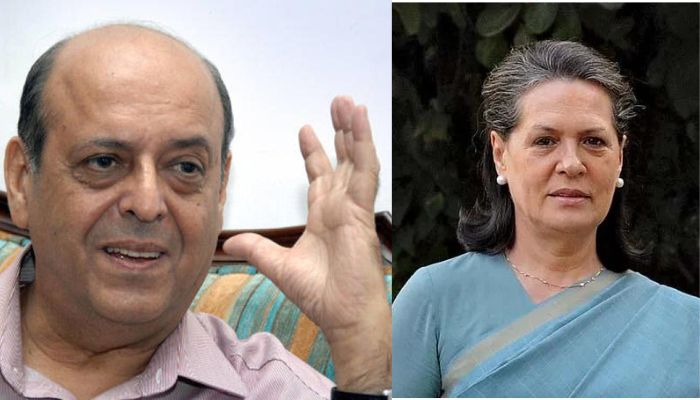
On March 2, the Supreme Court of India ordered a new format for appointing Chief Election Commissioners and Election Commissioners. As per the SC orders, the appointment will be made by a committee comprising the PM, the opposition leader, and the Chief Justice of India. This brings to memory the case of Navin Chawla who was appointed as an election commissioner in 2005 by then Congress president Sonia Gandhi.

Who is Navin Chawla?

Navin Chawla was working as a secretary in the information and broadcasting department before his appointment as an election commissioner. Navin Chawla was considered to be a bureaucrat close to the Gandhi family. Sonia Gandhi’s influence played a major role in getting him appointed as the election commissioner. He further went on to be the chief election commissioner during the 2009 Lok Sabha elections.

He was about to retire from his regular duties in 2005. According to a report by India Today, he was seen as the next home secretary of Sonia Gandhi’s choice, but he was appointed as the election commissioner instead. In general, an EC appointment is the greatest post-retirement opportunity for IAS officers. It permits people to work for up to six years or until they reach the age of 65, whichever comes first. Navin Chawla completed 65 years of age on 30th July 2009. It is clear that Sonia Gandhi wanted him to head the election commission during the 2009 Lok Sabha election.

Shah Commission’s remarks about Navin Chawla

Navin Chawla was not only closely associated with Sonia Gandhi but, in the past, he had been a trusted officer of Indira Gandhi, during the emergency. In 1977, the government of India appointed a commission headed by the former chief justice of India JC Shah to inquire about all the excesses committed during the emergency period. There were serious remarks against Navin Chawla in the report submitted by the Shah Commission.

During the 1975-77 Emergency, Navin Chawla worked as a private secretary to Kishan Chand, then lieutenant governor of Delhi. It is notable that Kishan Chand later committed suicide because he could not tolerate the so-called humiliation after the Shah Commission’s negative findings about him.

Shah Commission’s report observed about Navin Chawla and his cohorts that they “exercised enormous powers during the emergency because they had easy access to the then prime minister’s house. Their approach to the problems of the period relating to the citizens was authoritarian and callous. They grossly misused their position and abused their powers in cynical disregard of the welfare of the citizens, and in the process rendered themselves unfit to hold any public office which demands an attitude of fair play and consideration for others. In their relish for power, they completely subverted the normal channels of command and administrative procedures.”

Chawla was also found to have used ‘extra-statutory authority in jail issues,’ including the treatment of detainees. He didn’t just tell his master who was going to be arrested; he also instructed him how they were going to be treated in jail. For example, he advocated for the construction of specific cells with asbestos roofs to ‘bake’ some inmates. Kishan Chand miserably revealed before Judge Shah that he was not a free agent and that Chawla used to receive instructions straight from Sanjay Gandhi and that he (Kishan Chand) was simply in the picture to complete certain procedural requirements.

According to an article by BS Raghavan, LP Singh – a member of the commission headed by JC Shah – had said that the report by the Shah Commission “indeed made Chawla unfit to hold any public office and that he deserved to be summarily dismissed from service without any further inquiry or proceedings, invoking the special powers under provisos (b) and (c) of Article 311 of the Constitution.”

This is exactly what Chawla would have faced if the Janata Party administration had not fallen and Indira Gandhi had not returned to power, culminating in the restoration to coveted positions with a vengeance of all those accused by Justice Shah. Besides these remarks, the bureaucrat also has a book based on the life of Mother Teresa to his credit. When Sonia Gandhi became a power centre as the chief of the national advisory council and ran the Manmohan Singh government, in that period of the UPA regime, she appointed this Navin Chawla as the election commissioner who went on to head the panel during the 2009 Lok Sabha elections.

Twitter user followed by Prakash Raj calls for the beheading of Brahmin women and children in the name of ‘Dalit empowerment’

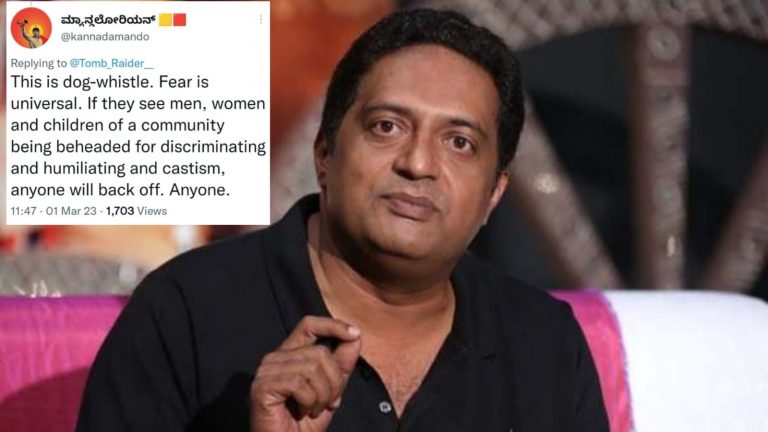
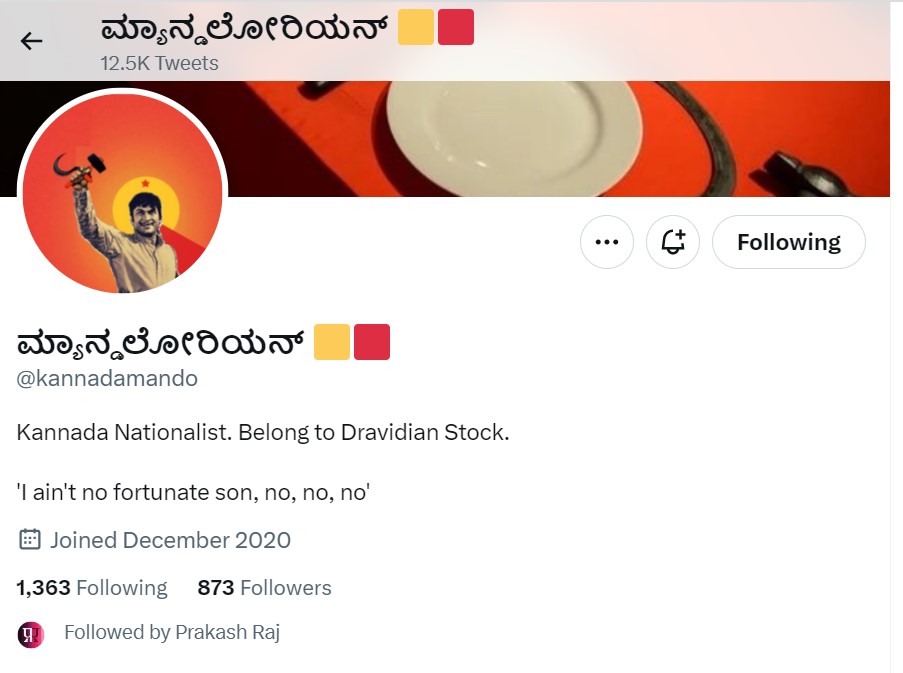
On March 1, Tuesday, a Twitter user with the handle @kannadamando, identifying himself as belonging to the ‘Dravidian stock’ called for a genocide of Brahmins in India. The controversial Twitter account is followed by Kannada actor Prakash Raj, a left-wing ideologue. @kannadamando called for the beheading of Brahmin women and children by Dalits so that the Davidian-Marxist idea of social justice is achieved.

Dravidian ideology is an ideology propagated by British-era Tamil politician Erode Venkatappa Ramasamy, called ‘Periyar’ by his followers. Periyar had called the independence of India a ‘black day’ because his dream of a separate nation of Dravidians was not realized on 15th August 1947.

The self-identified Dravidian account @@kannadamando made this call for the mass killing of Brahmin women and children while ‘discussing’ the condition of Dalits in the Indian society with another Twitter user that identified itself as an ‘Ambedkarite’ i.e. following ideals of BR Ambedkar. The Ambedkarite didn’t seem to agree with the solution of mass killings of Brahmin women and children, but he/she agreed that Dalits needed to do more. Both of them however agreed on the need to eradicate Hinduism.

The call for the mass murder of Brahmin women and children was made on 1st March (Monday) by the Twitter user @kannadamando. It should be noted that the call for violence against Brahmins is a recurring theme among followers of Periyar. The said user has Marxist themes in his Twitter display picture and cover image and was not suspended for any violation of Twitter rules at the time of publishing of this report.

While the real identity of the Twitter user with genocidal tendencies is not known, the Twitter account is followed by Kannada actor Prakash Raj, who recently made light of the genocide of Kashmiri Hindus by terming ‘The Kashmir Files’ movie as ‘nonsense’.

SS of the Twitter user’s profile

Many Twitter users took offense to the open calls of violence against Brahmins. Condemning the Twitter user for his open display of hatred towards the Brahmin community while masking it under the ‘Dalit empowerment’ rhetoric, @agenetics1 called for police action against him.

The controversial Twitter account with wet dreams of a Brahmin genocide is still active and at the time this report was published, Twitter had not taken any action against these conspiracies of a genocide of Brahmins

The Caravan steals artwork of Netherlands based artist in latest issue attacking Dr Jaishankar

Far left propaganda magazine The Caravan is accused of stealing artwork of a Netherlands based artist in its latest issue attacking External Affairs Minister Dr S Jaishankar.

The Caravan accused of plagiarism

The Netherlands based artist, ‘Ghostly_t’, on its Instagram profile has shared that far left propaganda The Caravan stole their artwork for the cover. “Give credit, don’t steal artists works”, they added in the message. In subsequent story, the artist shared original artwork that appeared on the cover image of The Caravan.

Dr Jaishankar has come under fire by the leftist cabal after he criticised American billionaire George Soros for trying to interfere in India’s internal affairs right before 2024 general elections in what appears like meddling in electoral politics in India. In its March 2023 edition, The Caravan had attacked Dr Jaishankar and written a cover story on him being Modi government’s ‘Hindu nationalist foreign policy’ as if it were a bad thing.

By the time of this report, The Caravan has not yet reacted to allegations.

Update: After OpIndia article was published, The Caravan has acknowledged stealing someone else’s artwork without credit. In a series of tweets, The Caravan claimed that a freelance visual artist named Samyak Prajapati was hired for the cover image of the edition and claimed they had no knowledge of some other artist’s artwork being used by Samyak Prajapati who was hired by them.

Caravan claimed that they have added credit to original artist Tijana in their cover image.