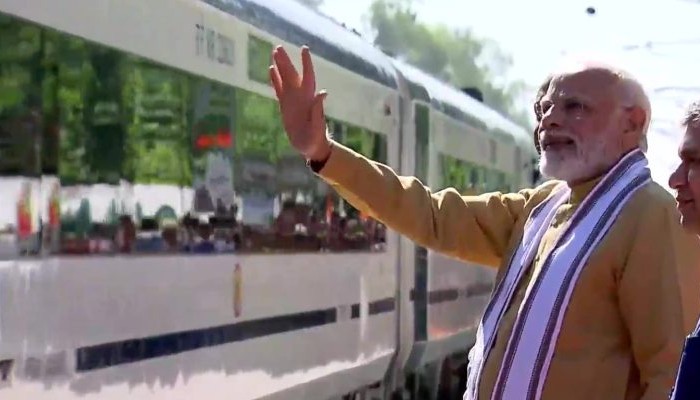
During his visit to Himachal Pradesh today (October 13), Prime Minister Narendra Modi flagged off the fourth Vande Bharat Express train from Una. The train will run between Una and Delhi. The train will specifically run between Delhi and the Amb Andaura Railway Station in Una. Prior to this, PM Modi inaugurated the third Vande Bharat train on the Mumbai-Gandhinagar route on September 30. The launch of trains on the new route bolsters the ‘Make in India’ campaign. Moreover, it contributes to the Prime Minister’s ambition of operating 75 Vande Bharat trains across multiple railway sections.
The fourth Vande Bharat Express is an advanced version of the earlier ones and is much lighter and faster, according to the Prime Minister’s Office (PMO).
According to the Ministry of Railways, the new Vande Bharat has advanced features including reclining seats, automatic fire sensors, CCTV cameras, and an on-demand Wifi facility, every coach has 32 screens to offer information and infotainment (the previous Vande Bharat trains had 24 screens), three hours of battery backup, a GPS system and many other features in order to make the travel experience safer and comfortable.
The Vande Bharat Express 2.0 offers an aircraft-like travel experience. It is outfitted with cutting-edge safety features, including an indigenously developed Train Collision Avoidance System (KAVACH).
Notably, the Vande Bharat Express accelerates to 100 kilometres per hour in just 52 seconds with a maximum speed of 180 kilometres per hour. Vande Bharat Express apart from providing a faster and more convenient mode of travel will also boost tourism in the state.
PM Modi was welcomed by the people of Una who raised ‘Modi-Modi, Sher Aaya’ slogans with PM Modi greeting the crowd as seen in the video tweeted by ANI.
#WATCH | People raise ‘Modi-Modi, Sher Aaya” slogans as they welcomed PM Modi in Himachal Pradesh’s Una.
Today in Una, PM Modi flagged off the Vande Bharat Express train, dedicated IIIT Una to the nation and laid the foundation stone of Bulk Drug Park. pic.twitter.com/9R8u0wAOEg
After flagging off the Vande Bharat Express in Una, PM Modi said that the BJP government both in the state and at the centre is accomplishing the needs of the people of the state which the previous governments at the centre and state did not care to understand and fulfil.
Himachal Pradesh Chief Minister Jairam Thakur and Railways Minister Ashwini Vaishnaw and Hamirpur MP and union minister Anurag Thakur were also present at the event.
PM Modi laid the foundation stone of Bulk Drug Park in Una
PM also laid the foundation stone of a Bulk drug Park in Una with an aim to boost the pharmaceutical sector. The Drug Park will be built at a cost of about Rs 1,900 crore. The Drug Park will also play a significant role in curbing dependence on active pharmaceutical ingredient (API) imports.
It is likely to attract investment of around Rs 10,000 crores and provide employment to more than 20,000 people. It will also fillip to economic activities in the region, as ANI quoted PMO statement in its report.
Along with this PM Modi inaugurated the Indian Institute of Information Technology (IIIT) Una, the foundation stone of which was laid by PM Modi in 2017.
Notably, PM Modi had on October 5, inaugurated the All India Institute of Medical Sciences (AIIMS) in Himachal Pradesh’s Bilaspur. The foundation for the AIIMS was laid in 2017 under the Pradhan Mantri Swashthya Suraksha Yojana.
The farmers of New Zealand are furious as Prime Minister Jacinda Ardern has proposed to impose a tax on the cows and sheep of the country in an attempt to cut methane emissions. The proposal has attracted a sharp reaction from the farmers in the country.
If the proposal passes, New Zealand will become the first country in the world to have a tax system to charge farmers based on the level of emissions from their herds. As per reports, the payable amount will depend on the number of animals, the size of the farm, the type of fertiliser used, and any methods used that can mitigate methane production.
Cattle and sheep outnumber the New Zealand population
If we compare the number of cattle, sheep, and people in New Zealand, the country has five times as many sheep and almost twice as many cattle in the country than people. The dairy and meat industries in the country depend on these two animals. However, it is notable that they are also responsible for half of the country’s methane emissions.
There are around 6.3 million dairy cattle heads in the country. The number has increased by 82% in the last 20 years. There are around 3.8 million beef cattle, 800,000 deer, and 26.8 million heads of sheep in the country. The current population of New Zealand is approx 5.1 million.
As per 2019 stats, 50% of the country’s greenhouse gas emissions come from methane and nitrous oxide. Out of this 50% of emissions, just under 90% comes from livestock. The methane these animals generate is produced due to the ruminants’ digestion and use of synthetic nitrogen fertilisers.
The proposal’s consultation launched on October 12
On October 12, a consultation was launched in the country’s parliament to discuss the proposal. It will conclude in November. The proposal suggests a levy tax not only on the methane burped or farted by the livestock but also on the nitrous oxide found in their urine. The tax may get implemented in some form by 2025.
In July this year, when the proposal first came to light, it was said that by 2025, all farms in the country would be required to track and manage their greenhouse gas emissions. They will have to pay a tax according to how much the livestock at a particular farm pumps out. To earn credits against the emissions, the farmers can plant crops to reduce carbon emissions, including trees.
As per PM Ardern, the money collected by introducing the tax in 2025 will be used for research and incentives for the farmers who are ‘struggling to reduce the methane contribution by their herds’. Furthermore, the PM argued that the tax would put the country on the best possible footing to attain carbon-neutral meat and dairy products.
Notably, PM Ardern has pledged to reduce methane emissions by 10% by 2030 and make New Zealand a carbon-neutral country by 2050.
The agriculture community objected to the proposal
PM’s proposal did not please the agriculture community. The tax was first announced in July this year, and since then, protests have been taking place opposing the proposal. Agriculture is one of the largest industries in the country and contributes to 5% of the economy. Both dairy and meat are among the country’s largest exports.
President of the Federated Farmers of New Zealand, Andrew Hoggard told Financial Times that the move by the government would affect small-town New Zealand as the farmers will be forced to sell their land to forestry companies. He said, “We didn’t sign up for this. Our plan was to keep farmers farming. Now they’ll be selling up so fast you won’t even hear the dogs barking on the back of the ute [pick-up truck] as they drive off.”
The 2003 ‘fart tax’
Notably, the first such tax was introduced in 2003, around 20 years ago, when the Helen Clark-led government approved a similar scheme. At that time, it was dubbed a ‘fart tax’ by the opponents. The approval was withdrawn after a tractor protest comprising 400 farmers with 20 tractors outside New Zealand Parliament.
Then President of Federal Farmers Tom Lambie had said, “New Zealand farmers are completely unsubsidised, completely unprotected in a hugely distorted global market. The imposition of this unnecessary levy is just another cost we shouldn’t have to bear.”
At that time, every farmer would have ended up paying NZ$300 per year as the ‘fart tax’. In opposition, a petition gathered over 64,000 signatures, which was over half of the New Zealand farmers.
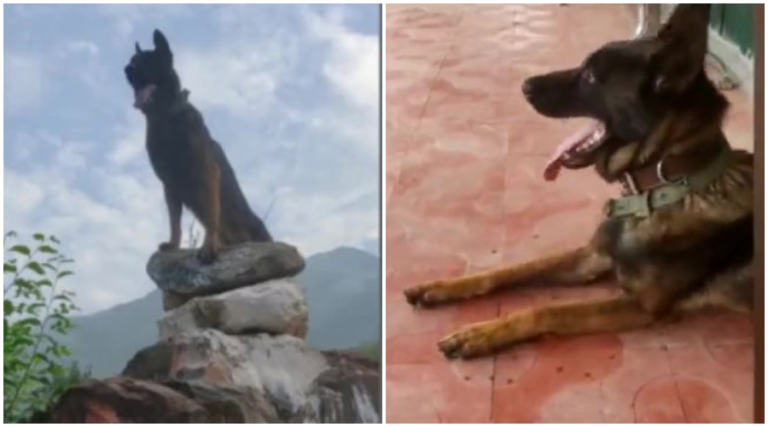
Army dog Zoom, who was being treated in Srinagar after suffering gunshot wounds while fighting terrorists in Anantnag, Jammu and Kashmir, has passed away today. Zoom had got surgery on October 12 and was in stable condition. However, his condition suddenly deteriorated today.
#UPDATE | Army dog Zoom, under treatment at 54 AFVH (Advance Field Veterinary Hospital ), passed away around 12 noon today. He was responding well till around 11:45 am when he suddenly started gasping & collapsed: Army officials
Army officials have stated that Zoom was under treatment at 54 Advance Field Veterinary Hospital in Srinagar. He was responding well after surgery but at around 11.45 am he suddenly started gasping for breath and collapsed.
The canine suffered injuries during an anti-terror operation in Kokernag, Anantnag when Zoom attacked terrorists and received two bullet injuries. However, despite injuries, Zoom continued with his task, resulting in the neutralisation of two terrorists by Army officials.
#WATCH | In an operation in Kokernag, Anantnag, Army's dog 'Zoom' attacked terrorists & received 2 gunshot injuries. In spite of that, he continued his task which resulted in neutralisation of 2 terrorists. The canine is under treatment in Srinagar, J&K.
Chinar Corps released a video to celebrate the bravery and unparalleled courage displayed by the dog in identifying and neutralising the terrorists. The security forces launched a cordon and search operation in the Tangpawa area of south Kashmir late on Sunday after receiving specific input about the presence of terrorists in the region.
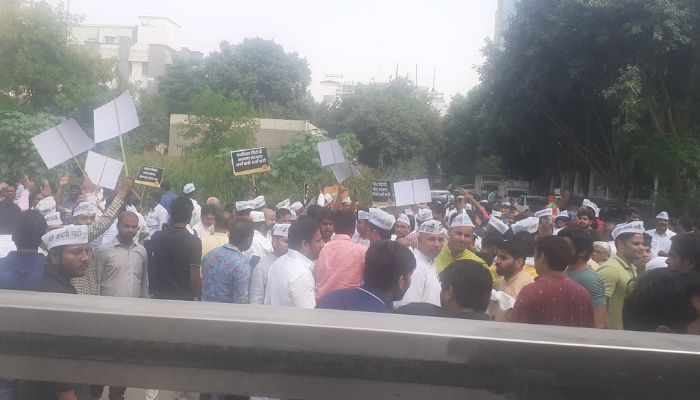
A crowd of Aam Aadmi Party workers created a ruckus outside the National Commission for Women (NCW) office in Delhi on 13th October 2022. The party workers gathered outside the NCW office after the NCW served notice to Gujarat AAP chief Gopal Italia for his indecent words against PM Modi and women.
Earlier, Gopal Italia’s videos from 2018 and 2019 went viral in which the state president of AAP’s Gujarat unit could be heard making offensive remarks.
Gopal Italia was pulled up for his comments against PM Narendra Modi in which he called the Prime Minister a ‘neech’ person. Now, his other video has gone viral in which he called the temples and Dharmic gatherings of Hindus like Kathas, the centers of exploitation of women. AAP workers have decided to back the abusive leader even after the NCW called these comments misogynistic and sexist in nature and summoned him to give a clarification on the same.
Gopal Italia, the leader of the Aam Aadmi Party (AAP) in Gujarat, has received a summons from the National Commission for Women for using a derogatory term for the Prime Minister as well that is equally offensive to women. The NCW has claimed in its notice that Italia’s offensive language is sexist, discriminatory against women, and abhorrent.
Women Commission must take action against the sexism & misogyny displayed by this AAP man Gopal Italia, relegating women to mere objects, and denigrating women in modern India even as they contribute to the cause of the nation.
Italia has been asked by NCW to personally appear before the Commission on October 13 at 12:30 p.m. If he fails to do so, the Commission may continue to take any measures it considers appropriate. Barnali Shome, Under Secretary of NCW, has issued the notice. It is notable that Italia insulted Prime Minister Modi in his video by using “Chu” repeatedly for the PM.
@NCWIndia has taken cognizance of the matter.The abusive & indecent language used by Sh. Gopal Italia is gender biased, misogynist & condemnable. The Commission has scheduled a hearing in the matter wherein he is required to appear in-person on 13.10.2022 at 12:30PM. @sharmarekhahttps://t.co/FlbPuul8Kepic.twitter.com/ExdXEbhUwo
As Gopal Italia was supposed to be present before the commission on 13th October at 12:30 pm, AAP workers gathered outside the NCW office and created a ruckus ahead of his hearing.
On Wednesday, October 12, the Enforcement Directorate filed a prosecution complaint against alleged journalist Rana Ayyub in a money laundering case. The complaint was filed under Section 8 of the Prevention of Money Laundering Act, 2002 in a special court in Ghaziabad, in relation to the three fundraising campaigns that Ayyub ran on Ketto but didn’t utilise most of the collected money for stated purposes.
The agency took to its official Twitter handle on Thursday, October 13 to inform the same.
“ED has filed Prosecution complaint against Rana Ayyub under PMLA, 2002 in Hon’ble Special Court, Ghaziabad on 12.10.2022.”
In the prosecution complaint, the ED stated that it had initiated a money laundering investigation on the basis of an FIR registered on 07.09.2021 by the Indirapuram Police Station, Ghaziabad, U.P, under various sections of IPC 1860, Information Technology Amendment Act 2008 and Black Money Act against Rana Ayyub alleging that she illegally acquired funds from the general public in the name of charity by launching fund-raiser campaigns on the online crowdfunding platform ‘Ketto’.
ED filed Prosecution complaint against Rana Ayyub under PMLA in Spl Court, Ghaziabad on Oct 12
Case registered against her alleging she illegally acquired funds from general public in name of charity by launching fund-raiser campaigns on an online crowd funding platform-‘Ketto’
ED also stated that Rana Ayyub is a journalist by profession and received foreign contributions without registration under FCRA. According the statement issued by ED, the investigation revealed that Rana Ayyub launched 3 fundraiser campaigns on ‘Ketto platform’ starting from April 2020, and collected funds totaling to Rs. 2,69,44,680/-, namely:
Help in raising funds for slum dwellers & farmers
Relief work for Assam, Bihar and Maharashtra
Help Rana Ayyub & her team to help those impacted by Covid19 in India.
The ED probe has found that all the money transferred to her personal bank accounts, Rana Ayyub used only around 10.8% of the fund she collected for relief work, and the bulk of the money was kept in bank accounts. The statement said, “Investigation by ED revealed that the funds raised on the online platforms were received in the accounts of her father and sister and subsequently transferred to her personal accounts. Ms. Rana Ayyub utilized these funds to create fixed deposits of Rs. 50 lakhs for herself and also transferred Rs. 50 Lakhs in a new bank account. ED investigation revealed that only approx. Rs. 29 lakhs was used for relief work.”
#ED has filed Prosecution complaint against #RanaAyyub under #PMLA, in Special Court, #Ghaziabad on oct 12. ED investigation revealed that Rana Ayyub launched 3 fundraiser campaigns on ‘Ketto platform’ starting from April 2020 and collected funds Rs. 2,69,44,680/-
Notably, in July this year, the Delhi High Court had barred the Enforcement Directorate (ED) from taking further steps under Section 8 of the Prevention of Money Laundering Act, 2002 against alleged journalist Rana Ayub in a money laundering case. Justice Yashwant Varma issued the notice after Ayyub filed a petition against her assets being attached.
ED further states in order to claim more expenses towards relief work, fake bills were submitted by Ms Rana Ayyub. Subsequently, bank balances in the accounts of Ms. Rana Ayyub amounting to Rs.1,77,27,704/- (including FD of Rs. 50 Lakh) were attached u/ s 5(1) of PMLA vide a Provisional Attachment Order dated 04.02.2022.
Alleging Rana Ayyub of illegally raising funds from the public for herself, the EDS said, “Investigation by ED further revealed that Ms. Rana Ayyub illegally raised Rs. 2.69 Crore by launching three online campaigns in the name of charity by cheating the general public donors. These funds were not used for the intended purpose, instead used for creation of assets for herself. Ms Rana Ayyub has tried to project these funds as untainted and thus has laundered the funds received from general public.”
ED also said that Ayyub violated laws by receiving funds from foreign countries without any approval or registration from the government which is required under Foreign Contribution Regulation Act, 2010.
“ED Investigation has established that Ms. Rana Ayyub had launched the aforesaid campaigns with the sole intention to cheat the general public and acquired Proceeds of Crime in form of FD and balances in bank accounts projecting them as untainted”, the central agency concluded in the complaint.
On Ayyub’s petition, the court served notice to the investigating agency and requested a response within six weeks.
The court, additionally, also restrained Ayyub from disposing of or creating any third-party rights over the attached funds in certain bank accounts.
Allegations of fund embezzlement against Rana Ayyub
It may be recalled that on February 10, OpIndia had reported that ED seized Rs 1.77 crore in Ayyub’s and her family’s accounts under the Prevention of Money Laundering Act. A few days after the expose, Ayyub alleged in a statement that she was being framed for her “journalism” and that she did not misuse the money.
However, all her claims were debunked by a Twitter user Hawk Eye who was the first to share details of alleged charity fraud last year. The ED has, in its attachment order, said, “Rana Ayyub has cheated the general Public Donors in a pre-planned manner and with the intention to cheat the general public donors.”
The order emphasised that the ‘scam’ started from the time she received the funds, which she did not use for Covid-19 relief work. She instead made a fixed deposit of ₹50 lakhs and transferred the amount to the savings account of her father, and sister through net banking. You can read the details about the allegations of misuse of Covid-19 funds by clicking on the link here.
On March 29, Rana Ayyub was stopped by Indian Immigration officials from boarding a flight to London due to the pending money laundering case against her. On April 4, she was granted permission to travel abroad by the Delhi High Court with the pre-requirement that she divulges details of her travel, contacts and her place of stay.
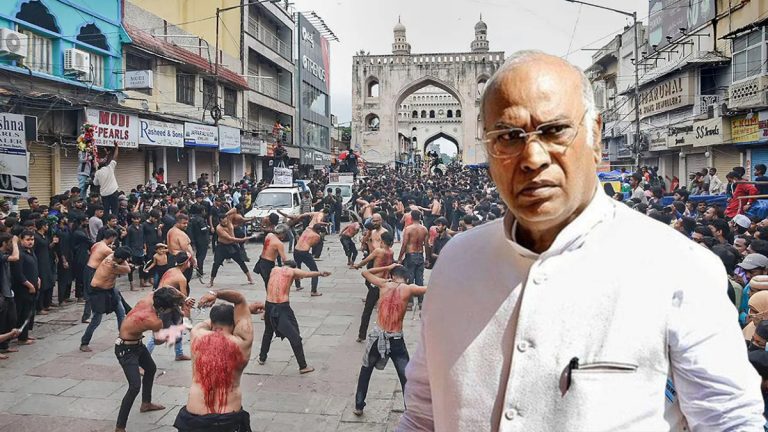
On Wednesday, All India Congress Committee Presidential candidate Mallikarjun Kharge seemed mock the Islamist occasion of Muharram while in Bhopal, Madhya Pradesh. Kharge was in the city to appeal to the Congress leaders to vote in his favour in the upcoming party presidential elections. Kharge made the Muharram reference when the media asked him whether the grand old party would field him or Rahul Gandhi as its prime ministerial face in 2024.
To this, Kharge said, “There is a saying “Bakrid mein bachenge to Muharram mein nachenge”. First, let these elections get over and let me become president, and then we’ll see. The remarks were strongly condemned by the BJP who said that the veteran leader had insulted the Muslims by mocking the Islamist occasion of Muharram.
#WATCH| Bhopal, MP | There is a saying “Bakrid mein bachenge toh Muharram mein nachenge”. First, let these elections get over and let me become president, then we’ll see: Congress presidential candidate Mallikarjun Kharge when asked who would be the PM’s face, Rahul Gandhi or he. pic.twitter.com/wvtCPqDlIH
BJP spokesperson Shehzad Poonawalla shared Kharge’s video and said, “Firstly, Muharram is not a celebration but a mourning! This is highly insulting to Muslims. The statement made by Kharge is highly objectionable”. He further stated that Muslims across the globe never celebrate Muharram. “It is not a month of celebrations. It is a month of sorrow and a month of mahtaam (mourning). Therefore, to say that there will be naach-ganaa in Muharram is extremely objectionable”, he added.
Congress’ first family chosen proxy president nominee was asked who will be the PM candidate of Congress in 2024
His reply, “बकरी ईद मे बचेंगे तो मोहर्रम मे नाचेंगे ।”
Firstly Muharram is not a celebration but a mourning! This is highly insulting to Muslims
“But more importantly is the importance of this politically loaded statement for Rahul Gandhi and the truth that Mr Kharge himself has disclosed about the position of the Congress party which is getting extinct state after state”, he was quoted.
Kharge meanwhile on October 12 also said that the biggest challenge before the nation was that the BJP government was trying to damage the Constitution. “Autonomous bodies are being weakened and misused. I am contesting these polls to protect the Constitution and our democracy. To fight BJP from the streets to the Parliament”, he said.
Before that, the veteran leader had also rubbed off the rumors that the Gandhi family was extending support to him in the ongoing party’s presidential election. “Someone has spread this rumor to defame the Congress party, Sonia Gandhi, and me. She has clearly stated that she will not participate in the party elections nor will she come in support of any candidate”, he noted.
The All India Congress Committee will elect its President on October 17. Shashi Tharoor, a Lok Sabha MP, and Mallikarjun Kharge, a Rajya Sabha MP, are both competing for the top post. Both leaders are presently touring the states, pleading to Congress leaders to vote in their favor to ensure their success.
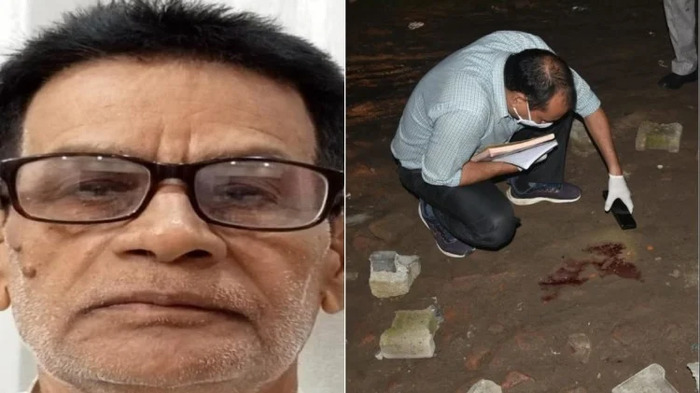
On Wednesday, a 70-year-old man was beaten to death by a group of people while trying to intervene in a drunken brawl outside his house in the Jaiprakash Nagar locality, Varanasi.
A Satish Ganesh, the Varanasi Police Commissioner informed that the incident took place on Wednesday night at around 11:30 PM. The victim who has been identified as Pashupati Nath Singh, and his son Rajendra Singh stepped out of their house to intervene in a drunken brawl between two groups.
The group of miscreants attacked Rajendra with sticks and rods for intervening uninvited. One of the attackers hit Pashupati on the head with a stick when he came to rescue his son. Pashupati died on spot, following this all the miscreants fled leaving Rajendra severely injured.
Bhaskar journalist Sachin Gupta has informed that 9 policemen have been suspended over the incident.
UP के वाराणसी में कल रात BJP कार्यकर्ता पशुपति नाथ सिंह की पीट–पीटकर हत्या कर दी गई। उनके घर में बराबर में वाइन शॉप है। कुछ लड़के सेल्समैन को पीट रहे थे। शोर सुनकर पशुपति नाथ वहां आ गए और भीड़ का शिकार हो गए। 9 पुलिसकर्मी सस्पेंड हुए। #Varanasi
Both the victims were rushed to the BHU trauma centre where Pashupati Singh was pronounced dead by the doctors while Rajendra’s condition remains critical. According to a TOI report, CP Varanasi has said that they do not have any information about the connection of the dead victim with the BJP yet.
Reportedly, the victim had earlier complained to the Cantt MLA Saurabh Srivastava about the nuisance caused by several gangs outside the liquor shop. Three of the miscreants who attacked the victim are history sheeters as per media reports.
The police have informed that one of the attackers has been arrested and the search is on to nab others.
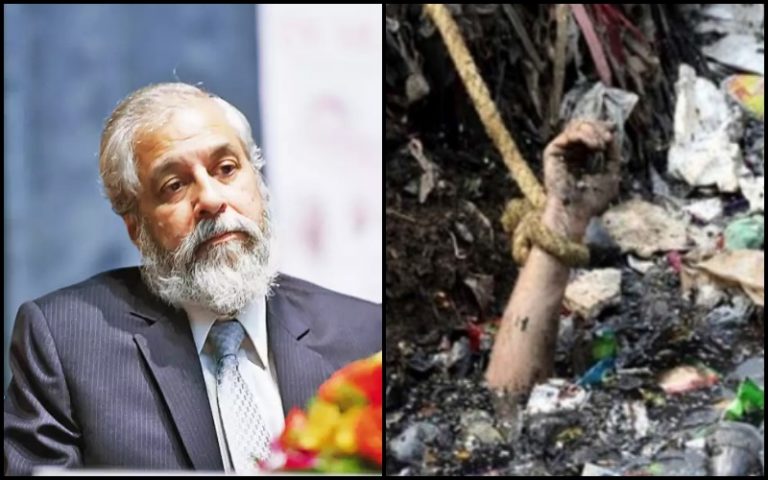
The Delhi Riots that saw Delhi burn in 2020 has become the battleground of narratives, where truth is the ultimate casualty. From the time the violence erupted to today, two years on, the Left-Islamist nexus has been trying its best to skew facts in favour of the aggressors and claim that it was pre-meditated violence by the Hindu community against the Muslim community. The facts, however, are far from it. Recently, a “Citizen’s report” released by a committee headed by retired Justice Madan B Lokur, analysing the Delhi anti-Hindu riots, furthered the same narrative by cherry-picking facts and distorting the truth.
In addition to Justice Lokur, the ‘committee’ which released the report titled “Uncertain Justice: A Citizen’s Committee Report on the North East Delhi Violence 2020”, comprised former Chief Justice of the Madras and Delhi High Courts A P Shah; former judge of the Delhi High Court R S Sodhi; former judge of the Patna High Court Anjana Prakash; and former Home Secretary G K Pillai.
If one reads the coverage in the corporate media, one is pressed to find any criticism of the report, even a cursory one. There seems to have been no reading of the report itself to figure out if the report is authentic. The media essentially bases their reporting on the “appeal to authority” argument fallacy, where they assume that since former Supreme Court judges released this report, it must be authentic. There has been no perusal of facts and misinformation due to omission or commission that are included in the 171-page report.
When one starts reading through the report, it executive summary of the report itself has several fallacies. The first paragraph of the executive summary itself says, “Polarisation between communities, particularly anti-Muslim hate, was deliberately fuelled in the months preceding the violence”. The report in this para says that the Muslim community was grappling with fears of losing their citizenship due to the compounding effect of CAA and nationwide NRC. In the entire report, the Justices refuse to mention who was fuelling the misinformation regarding CAA and NRC that fuelled that supposed fear of the Muslim community.
The Delhi Riots chargesheet number 59, which spans over 17,000 pages, tracks in excruciating detail the conspiracy to foment riots and unrest that started shaping on the 5th of December itself. 5th was the day after the Citizenship Amendment Bill was tabled in parliament. In short, on the 5th of December, Sharjeel Imam made WhatsApp groups of Muslim students and on the 6th of December, he started distributing pamphlets in mosques. Pamphlets which were written by Sharjeel Imam himself were distributed in the Jama Masjid area by the MSJ group. This fact was revealed by the chats recovered between Sharjeel Imam and Arshad Warsi. The pamphlets were communal in nature and essentially aimed to incite hate in the Muslim community by invoking the Supreme Court decision in the Ram Janmabhoomi case. Some of the pamphlets read “Law of Allah above all else” and “The command of Allah is above every law”. The pamphlets had misinformation about CAB and also, spoke about the destruction of the illegal structure previously on Ram Janmabhoomi, called Babri.
In the subsequent days, there was misinformation spread about CAB, protest marches held by United Against Hate and Sharjeel Imam categorically talking about “doing something big” next week. It is pertinent to note that violence had broken out on the 15th of December as well.
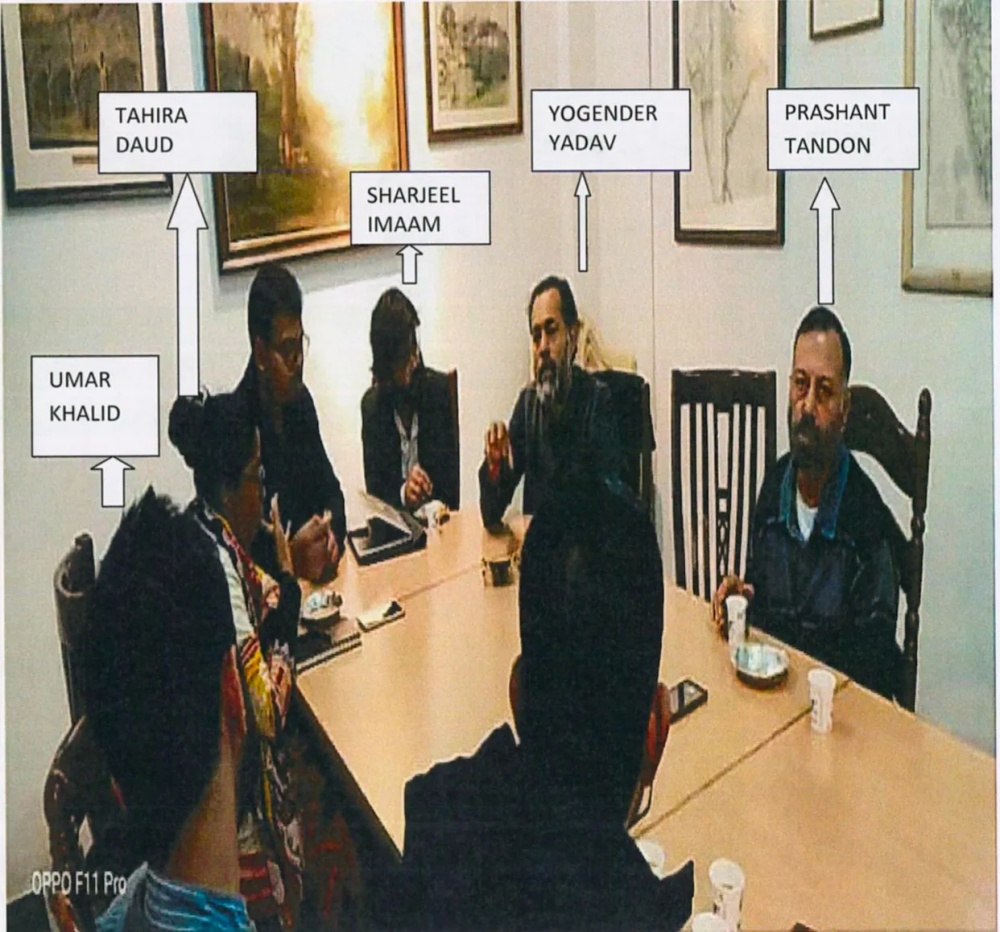
There were several meetings that were held between these “intellectuals” who were spreading fake news against CAB. On the 8th of December, this meeting was held, a picture of which is added to the chargesheet.
The picture of the 8th December meeting
On the same day, a WhatsApp group was formed called the ‘CAB TEAM’. The core members of the team were following:
Yogendra Yadav
Umar Khalid
Sharjeel Imam
Nadeem Khan
Parvej Alam etc.
Thereafter, “minutes of the meeting” of this core CAB team was shared in WhatsApp groups made by Sharjeel Imam (who was present at these meetings).
There were a few extremely points that must be highlighted. These were:
Avoid over-secularisation of this movement. They asserted that since the CAA is supposedly against Muslims, the nature and character of this movement should also have a ‘Muslim characteristic’.
Contact AMU and Jamia. It is pertinent to note that here is where the violence was triggered in December.
Contact international media like BBC, TRT and Al Jazeera.
Make contact with local mosques through 2-3 leaders.
United Against Hate called for a protest on the 19th of December, which was to be strengthened.
Interestingly, all these points had larger implications during not only the December violence but also the February riots. The fact that mosques were being mobilised and also international media which had sympathies with Islamists were getting involved were also factors that played a major role in perpetuating a false narrative after the February riots and also, helped in the coordination and execution of the riots.
While the 17,000-page chargesheet has several other details, these are sufficient to point towards the hollowness of the report by Justice Lokur and other retired Judges, given that there is no consideration in the report of any of these facts. In fact, when it is backed by evidence that the misinformation regarding CAA and NRC (mythical one, since there is no national draft for NRC yet) was spread by the anti-CAA protestors, predominantly Leftists and Islamists, one has to wonder how the report can lay the blame of the riots on “Anti-Muslim hate” and exonerate the Muslim community by claiming that they were scared of the implications of the laws. The report further lays the blame for the riots on the media (select media, of course) that supposedly “framed the anti-CAA protest as a Hindu vs Muslim narrative”. With slogans like “Hinduon ki kabar khudegi” and other details like how Tahir Hussain wanted to teach “Kafirs a lesson”, one has to wonder if it was the media responsible for framing the issue such or the anti-CAA protestors who were seeing the issue as a “us vs them” issue, and the media simply covered it, albeit, with several details conveniently left out.
The report also alludes to the speeches by Anurag Thakur and Kapil Mishra to say that it was their inflammatory speeches that led to the violence. Fact remains that Anurag Thakur’s speech took place only in January and the report holds it responsible for the violence. However, it leaves out several other inflammatory speeches by other politicians that took place in December itself – for example – it makes no mention of the speech by Sonia Gandhi where she asked people to take to the streets on the 14th of December, a day after which violence had erupted. Further, it fails to mention other Muslim-centric speeches and posts that contributed to the violence immensely.
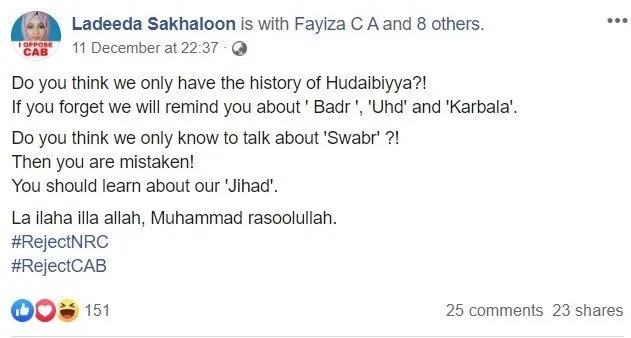
Here is a post from the 11th of December of a “Shero” who was hailed as a brave Muslim protestor against CAA.
Post by Ladeeda Sakhaloon
In fact, while talking about Chargesheet 59, which is a 17,000-word chargesheet, the report by Justice Lokur and others only focuses on how UAPA should not be applicable to the speeches made by Sharjeel Imam, Umar Khalid and others in an attempt to dilute their offences. Tahir Hussain, who is one of the main conspirators of the Delhi violence, is mentioned 7 times in the 171-page report. 4 times to cherry-pick facts to trash the investigation of the Delhi police and 3 times to tangentially say the application of UAPA is not valid. None of his crimes and his confessions is added to the report because they clearly inconvenience the conclusion that the report wishes to reach. This is evidenced by the fact that in the entire section that actually attempts to detail the violence in Feb 2020, Tahir Hussain’s name is not mentioned even once.
Implicating Kapil Mishra in the riots, the report by Justice Lokur and others says:
“In response to a call for a nationwide protest, anti-CAA women protesters in the Seelampur-Jaffrabad area of North East Delhi blocked the road outside the Jaffrabad Metro Station on the night of February 22, 2020. From the morning of February 23, BJP leaders, prominently Kapil Mishra, as well as Hindu nationalist figures such as Ragini Tiwari, gave calls for mobilization and direct action against this group. At about 4 p.m. that day, Kapil Mishra delivered a speech at Maujpur Chowk close to the new anti-CAA protest site. He gave an ultimatum to the Delhi Police to “clear the roads in Jaffrabad and Chand Bagh” within 3 days, or he and his supporters would do so themselves. He was referring to the anti-CAA protests taking place in these localities. Shortly after his speech, stone pelting broke out between pro-CAA and anti-CAA groups in Maujpur and Jaffrabad. It becomes clear that the hateful content purveyed on 22-23 February was designed to incite, exhort and provoke actions of violence and these calls, thereby, appear to have acted as an immediate trigger to the break-out. The stone pelting across the Maujpur-Jaffrabad faultline spiralled into mass violence by the morning of 24 February. Stone pelting, arson, and gun violence by mobs on both sides spread through neighbourhoods across North East Delhi in the next few days. There were attacks on journalists reporting on the violence. Alleged police complicity adds another important layer to the nature of violence”.
In this craftily worded paragraph, the report fails to mention who started the violence and more importantly, the violence that preceded the Delhi anti-Hindu Riots. OpIndia had documented how Hindus had come under attack consistently since December 2019 almost on a regular and daily basis in the run-up to the Feb violence. The report can be accessed here on Kindle.
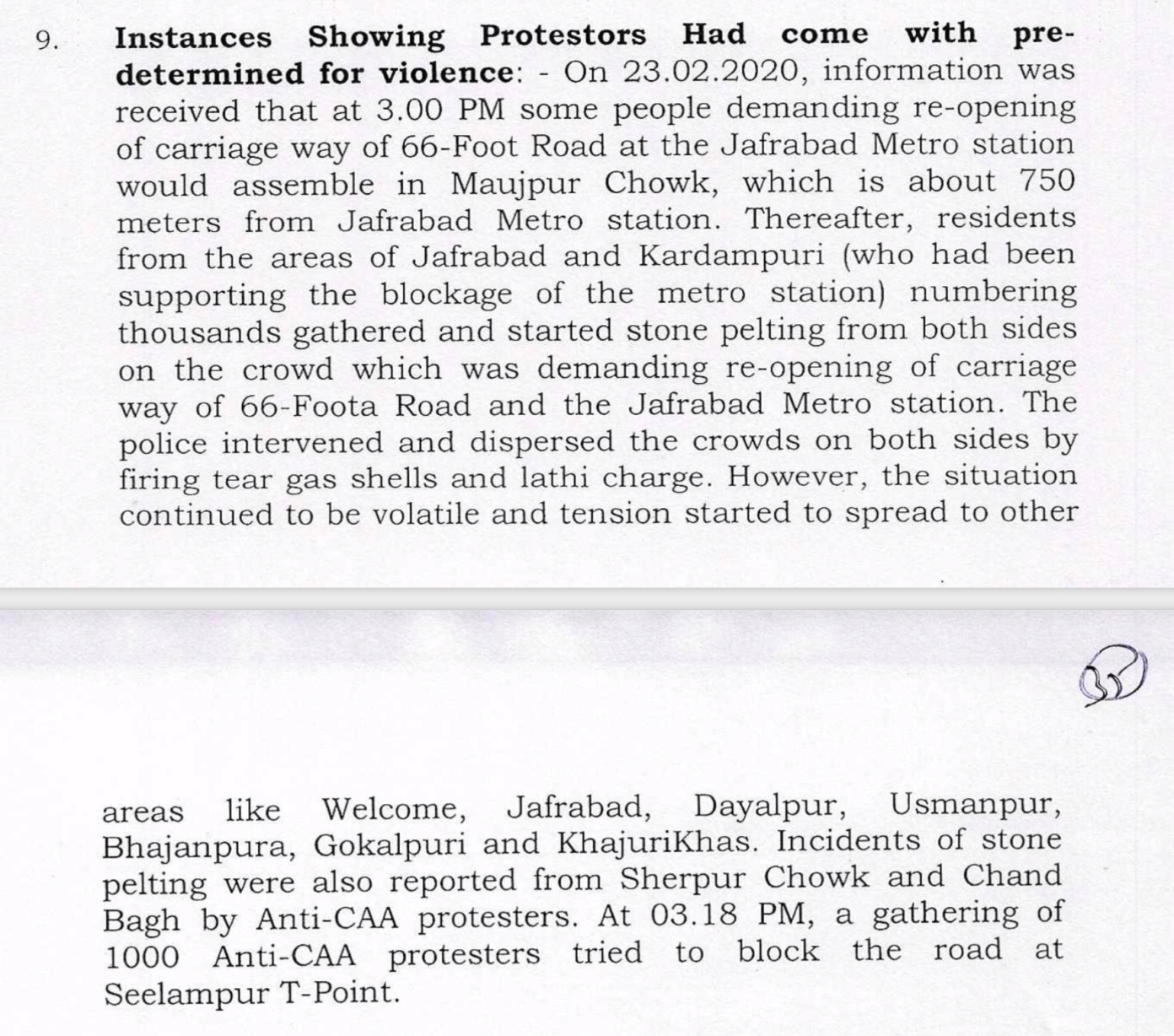
Moreover, the chargesheet categorically talks about which side started the violence on the 23rd of February. In the chargesheet, it categorically mentioned that it was the anti-CAA Muslims who had started pelting stones and indulging in violence at those who were demanding the re-opening of the roads blocked by the anti-CAA protestors.
Chargesheet excerpt
A group of individuals who were demanding the opening of the 66-Foot road near Jafrabad had assembled at Maujpur Chowk around 3:00 PM on 23rd February. The Maujpur Chowk where they had assembled was about 750 M away from the Jafrabad Metro Station.
The charge sheet then reveals that the residents of Jafrabad and Kardampuri who were supporting the blockage of the Jafrabad metro station congregated in the thousands and started pelting stones from all quarters at the group that was demanding the re-opening of the roads.
While the police fired tear-gas shells etc to disperse the crowd, the situation remained tense.
However, this portion of the charge sheet proves that the incidents of violence were indeed started by the anti-CAA protestors and were not a ‘clash’ per se between the two groups as earlier reported.
It was on the 24th of February that a clash between two groups in Maujpur has been recorded in the charge sheet. However, on the 23rd, it is evident that it was the anti-CAA group that was attacking the group which wanted the re-opening of roads.
While the report tries to paint the Muslim community as blanket victims and leaves out material evidence that goes against their narrative, the report also craftily tries to downplay the brutal murders of Hindus.
In a section about Ankit Sharma, here is what the report says:
Excerpt from the Lokur report
In this section, the report by Justice Lokur and others pulls a slide of hand while saying that “the circumstances of Ankit Sharma’s death remain uncertain”. Firstly, it was not a “death” but a brutal murder where he received multiple stab wounds from Islamists. His postmortem report has details about the brutal torture that was inflicted upon the IB staffer by the goons of Tahir Hussain, who was an AAP leader and was subsequently suspended after the carnage. The chargesheet filed categorically says that Ankit Sharma was murdered by a mob led by Tahir Hussain.
The charge sheet said that Ankit Sharma was murdered outside the residence of Tahir Hussain in the Khajuri Khas area on February 25. After stabbing him multiple times, the mob threw his body into the nearby drain. A witness standing at a distance on a terrace captured the video on his mobile in which a mob is seen dumping the deceased body into the drain. The dead body was recovered from the drain the next morning.
The post-mortem report claimed that there were 51 sharp and blunt injuries found on Ankit Sharma’s body. Ten people including ex-AAP councillor Tahir Hussain have been arrested in this case. Further investigation has revealed that there is a deep-rooted conspiracy behind the riot and the murder of IB Official Ankit Sharma who was a very familiar face in the area. The charge sheet says that he was specifically targeted by the mob led by Tahir Hussain who was then a politician of the Aam Aadmi Party and a sitting councillor in East Delhi Municipal Corporation, Delhi.
The investigation has revealed that Tahir Hussain is the main person who had been instigating the mob both on the 24 and 25 of February in the Chand Bagh area. Another charge sheet against him has been filed for orchestrating riots on 24 February.
With these horrific details out in the public domain and mentioned in the chargesheet, the report on the Delhi violence states that the circumstances surrounding the death of Ankit Sharma are unclear and further, refuses to add the details of the role of Tahir Hussain and his mob.
The veracity and authenticity of the report is evident from the glaring omissions in the facts of the case, done deliberately to create a specific narrative.
The report also goes on to specifically indict the Ministry of Home Affairs with no evidence whatsoever. The report talks about how there was hardly any police deployment during the initial phase of the Delhi Riots. The report essentially tries to indicate that the Ministry of Home Affairs was somehow deliberately letting the fire burn during Delhi Riots. It is a fact that nearly 7,000 central paramilitary forces were deployed in the area from February 24th onwards. It is also a reported fact that three special commissioners, six joint commissioners, an additional commissioner, 22 DCPs, 20 ACPs, 60 inspectors, 1,200 male and 200 women personnel and 60 companies of outside forces were stationed at crucial locations. Union home minister Amit Shah reviewed the situation every two hours. However, none of these numbers is made available to the public in the report – they merely say that the inadequacy of deployment is evidenced by “official numbers”.
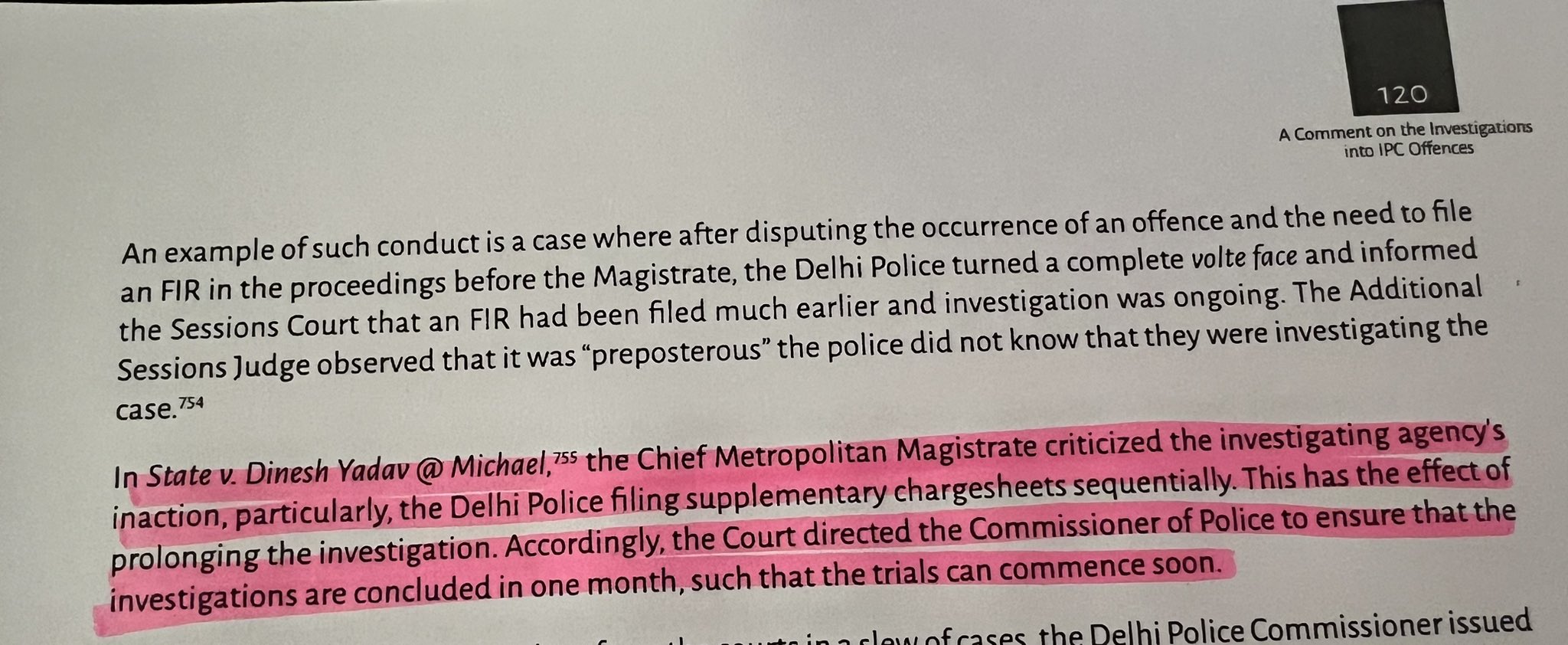
Beyond all of this, one would imagine that a bunch of former Supreme Court judges would be able to talk about the judicial nuances better than anyone else. In one section of the report, they talk about the case of one Dinesh Yadav – the first person to be convicted and sent to 5 years in jail in the case of Delhi anti-Hindu riots. The Justices allude to this case simply to mention one small portion of the case to trash the investigation by the police. However, they leave out criticising the massive loophole in his conviction itself.
Excerpt from the Lokur report
The Justices dishonestly gloss over the fact that the Dinesh Yadav’s conviction was a judicially unviable judgement for several reasons.
The two reports that detail how the judgement was legally untenable have been detailed here and here.
In all, the report by Justice Lokur and the others have certain specific aims and facts have been tortured to fit that specific narrative:
The aim is to prove that Hindus were responsible for the riots (that were actually anti-Hindu in nature).
That nationalist media and Hindu nationalists fired the violence and spread anti-Muslim hate for months preceding the violence.
Dilution of UAPA – this is evidenced by the fact that they mostly focus only on chargesheet 59 (that too selectively) and have dedicated an entire section to talk about how UAPA should not be applicable to the cases of Tahir Hussain, Sharjeel Imam, Umar Khalid and the others.
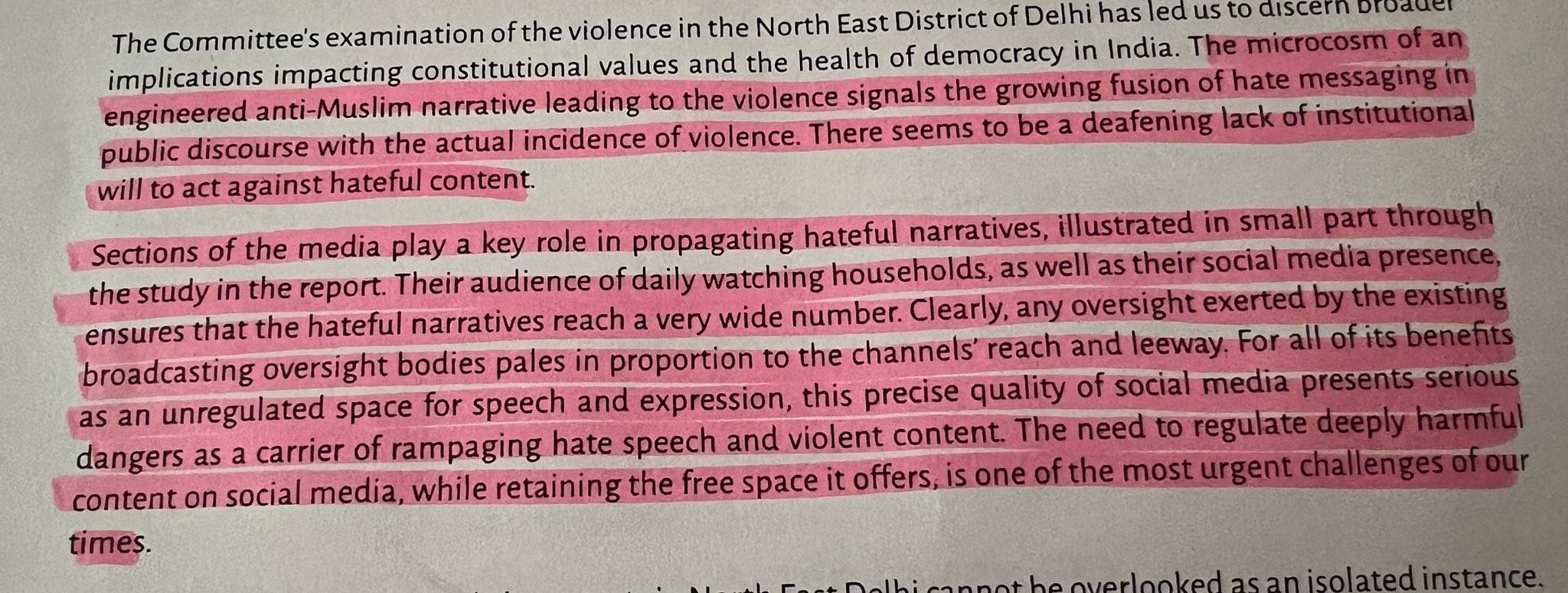
Call for a clamp down on social media and media at large for “hate speech”. This, of course, is being done with the specific aim of shutting down dialogue on social media, which essentially dampens their larger agenda, as it did during the Delhi Riots, to implicate Hindus and ensure that their narrative runs large.
Here is a portion that calls for clampdown on social media.
Excerpt from the Lokur report
The report titled “Uncertain Justice: A Citizen’s Committee Report on the North East Delhi Violence 2020” by Justice Lokur and others is an essential practice in furthering a skewed narrative on the Delhi violence, essentially blaming the victims – the Hindus – and using the dead bodies to fulfil their agenda of censorship and exoneration of anti-National elements like Sharjeel Imam, Umar Khalid and others, while calling also for the dilution of UAPA to give such elements a free run, and implicating the government with no evidence whatsoever.
While there are thousands of facts omitted and loopholes in this report, that can only be called pathetic, to put it kindly, these select facts are sufficient to prove that the rightful place of this report, which aims to be taken seriously simply because it has been endorsed by former SC judges, is in the trashcan.
In Bareilly, Uttar Pradesh, a case of Muslim residents of the area halting the construction of a Hindu temple and threatening a Hindu economic boycott has come to light. Muslims in Bairamnagar village forcibly stopped the construction of a Hindu temple. They also allegedly publicly threatened to shut down Hindu businesses.
Notably, Bairamnagar is a Muslim-majority area. The incident was brought to notice after a villager shared a video on social media of Muslims threatening Hindus. The village pradhan allegedly issued the boycott call against Hindus.
According to the report in Dainik Jagran, Hindus built a well in the village. Near the well, a small Shivling was placed. When some children placed bricks there, Muslims began to protest, stating that they will not allow the construction of a Hindu temple there. Following this, Bairamnagar Hindus met with SSP Akhilesh Chaurasiya and requested police intervention in the matter, and submitted a written appeal. The written appeal was submitted by Ugrasen, Ved Prakash, Virendra Singh, and several other Hindu villagers.
Informing about the action taken in this matter, Bareilly police tweeted, “A video of some people making anti-social statements is going viral on social media. Following an investigation into the above viral video, a case has been registered at the police station in Shergarh, Bareilly under the relevant sections.”
सोशल मीडिया पर एक वीडियो वायरल हो रहा है जिसमें कुछ व्यक्तियों द्वारा समाज-विरोधी वक्तव्य दिये गए हैं। उक्त वायरल वीडियो की जाँचोपरान्त थाना शेरगढ़, बरेली पर सुसंगत धाराओं में अभियोग पंजीकृत किया गया है। #UPPolicepic.twitter.com/sIO93qqD2Y
Speaking about the dispute, Rajkumar Agarwal, SP Bareilly (rural) said, “The dispute was settled through talks between both sides.” The Hindu side stated in their appeal that the temple was built in accordance with the rules after obtaining the necessary permission. There is no conflict between the two sides in the village now. Some people are attempting to cause unnecessary tension in the village. Strict action will be taken against such people.”
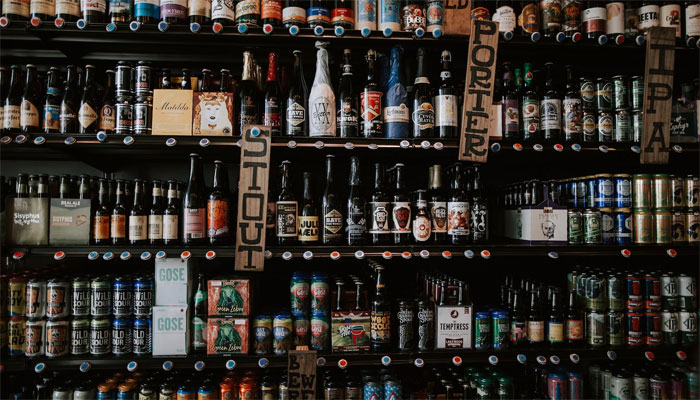
On October 11, Muttahida Majlis-e-Ulema (MMU), a group of various social, educational and religious organisations in the Kashmir valley, condemned the decision of the Jammu & Kashmir administration’s decision to allow the sale of beer and other ready-to-drink (RTD) beverages in the departmental stores. As per the reports, the Islamic body has said in a statement that the decision deeply hurts the sentiments of the Muslim community.
They further added that Kashmir is a Muslim-majority place and such decisions show ‘utter disregard for the tenants of Islam’. The statement read, “Open sale of alcohol in departmental stores will further promote addiction which is a major issue in Kashmir, especially among our youth, something that the authorities also claim to be concerned about. It will also encourage immoral behaviour.”
The body further questioned why the sale of alcohol was being encouraged in J&K while it was banned in some states. They urged the administration to withdraw the decision immediately.
Congress opposed the decision to allow the sale of beer
Apart from the Islamic body, the Jammu and Kashmir Congress also condemned the decision on October 11. The party called it an anti-youth move. They said that ‘after downgrading J&K’s statehood, the proxy BJP administration is pushing the youth in the UT towards alcohol addiction.’
Raman Bhalla, JKPCC working president, said, “The people of Jammu gave 25 MLAs to BJP, and it returned the favour with the worst gift possible”. He added that the decision would tarnish the image of Jammu, the holiest city of temples, that houses Mata Vaishno Devi Shrine.
Bhalla claimed that such a decision would encourage the consumption of alcohol that would affect the youth. He said, “When BJP was in the opposition, it used to blame the Kashmir-based governments for pushing Jammu youths into addiction. Now, the party has resorted to the wholesale opening of liquor shops in J&K.”
Mehbooba Mufti condemns the decision
In a statement, Mehbooba Mufti also condemned the decision. She said, “They (LG’s administration) issued an order yesterday allowing the sale of liquor in departmental stores. In their ‘model’ state of Gujarat as well as Bihar, the sale of liquor is banned. But here, they have brought a separate law to hurt the sentiments of Muslims.”
She added, “Religious scholars are being put behind bars, and others outside are being maligned. The government policies have failed, and if they keep pursuing wrong policies and continue with atrocities on the people, the results will be negative.”
Sale of beer allowed by J&K administration
On October 10, The Jammu and Kashmir administrative council, under the chairmanship of Lieutenant Governor Manoj Sinha, approved the incorporation of liberal provisions in Jammu and Kashmir Liquor Licence and Sale Rules, 1984, and Excise Policy, 2023-24 for the grant of licence JKEL-2A. With the decision, the departmental stores in the urban areas will be allowed to sell beer and Ready to drink beverages in the UT.