Home Blog Page 2993

‘Aurangzeb – Whitewashing Tyrant, Distorting Narrative’: New book debunks distortions around the Mughal tyrant Aurangzeb

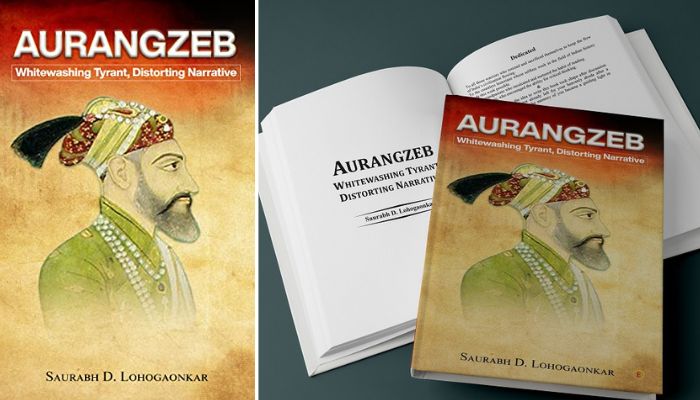
As I was turning the pages of the book, the news of ‘Aurangabad’ – a city in Maharashtra getting its new identity as ‘Sambhajinagar’ came to the fore. This shift in the Overton window, that a modern-day Indian city should not glorify the 17th-century genocidal tyrant was a long game in narrative, eventually carved out by electoral politics. Debutant author Saurabh Lohogaonkar’s book ‘Aurangzeb: Whitewashing Tyrant, Distorting Narrative’ thus could not have come with better timing.

The book occupies an unusual space in the coterie of historical non-fiction, a genre that is ruling bestseller charts in the larger Indian literary circuits. This had a lot to do with India’s renewed sense of history, identity and assertive politics of the day. Underlined with identity politics and Muslim appeasement, the ‘secular’ class of Indian politicians continues to gloss over the tyrannies carried out by Islamic rulers like Aurangzeb whenever a debate over history is contested.

This has prompted a class of historians in turn to justify the barbarism of Islamic imperialism in India through academia – with authors like Audrey Truschke writing problematic turn-around biographies of Aurangzeb. A narrative was created that the Mughal Emperor was not as cruel as the ‘Hindu Right’ paints him, and was a mere ‘product of his times’.

While books whitewashing Aurangzeb, the tyrant, including those authored by Truschke met divisive criticism, Saurabh Lohogaonkar thought to himself that the answer to a book is another book in itself. His latest book is neither a linear biography of Aurangzeb, as he claims nor is it a rebuttal directed against any specific hagiography of the Mughal emperor.

Interestingly, Lohogaonkar calls his work a ‘fact-finding’ exercise. He picks up contested issues in the historiography of the central character including his succession war with his brother Dara Shikoh, claims around the sound representation of Hindus in his administration to absurdist assertions like ‘Aurangzeb building Hindu Temples himself’ and assesses them through diligent investigation of available sources.
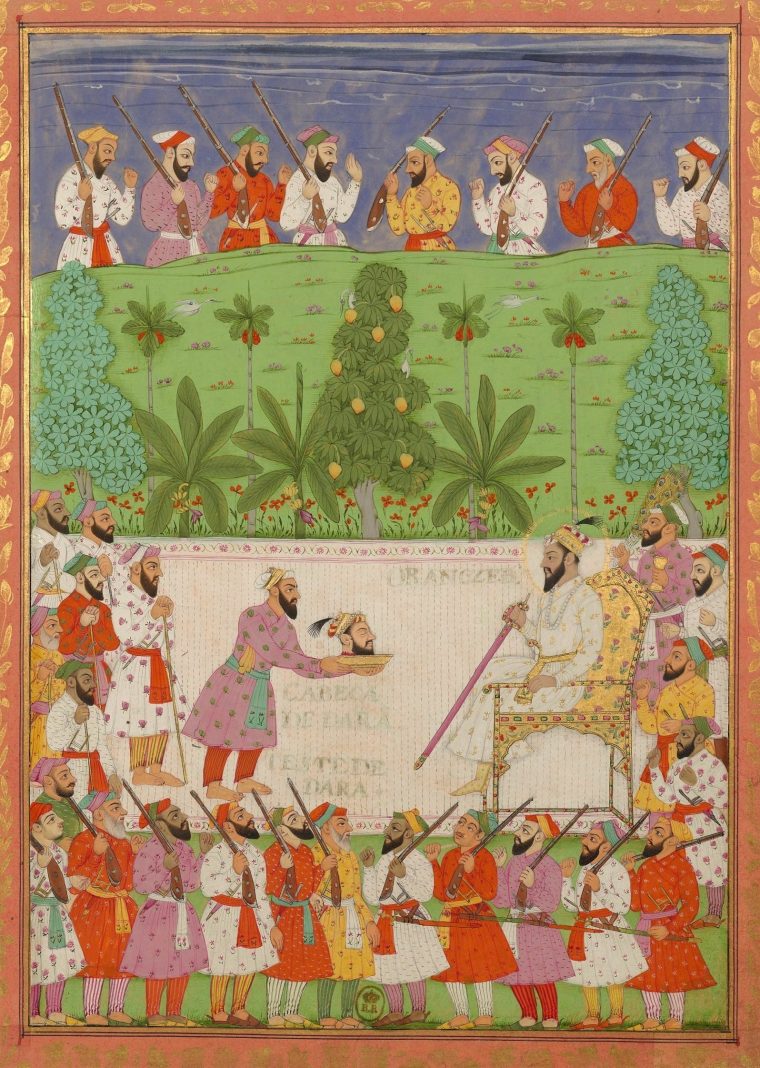
Dara Shikoh’s head being presented to Aurangazeb upon his order was realised in 1659. Source: Wikimedia Commons

The author elucidates in detail why any primary source has to be dealt with seriously inside the frame of context as opposed to the consideration of the text as a definitive understanding of the times. For example, notings of Hindu chroniclers in the Mughal Court like ‘Futuhat-i-Alamgiri’ and ‘Tarikh-i-Dilkusha’ which glorify Aurangzeb’s rule are often positioned as a mark of his collaborative style of rule by his modern-day sympathizers.

While an argument in the case is made that even the Hindus in Alamgir’s administration have lauded him as a ruler of Hindustan, the author asks us to take the court propaganda with a pinch of salt. “The employment and well-being – of Hindus commissioned to write history in the Mughal Durbar, “was directly dependent on how (they) wrote about Aurangzeb and (his) Empire in general. The narratives of Hindus employed in the Mughal Administration must be taken into consideration with due diligence, as they are neither independent and a certifying authority of ‘Secularism’ and ‘Tolerance’ dispensed by Mughal Kings nor were they speaking on behalf of all Hindus of the era as we are made to believe,” notes Lohogaonkar.

The author classifies the carefully stitched myth about Aurangzeb as a ‘Protector of Temples’ as opposed to his known opposition to idolatry and the destruction of Hindu temples in three ‘phases’. From 1669-1673, the temples present in the land directly administered by the Mughals were demolished. In the second phase of Temple destruction during Aurangzeb’s reign, from 1679 to 1681, the temples present in the Hindu kingdoms which were under Mughal supremacy were demolished whereas, in the third phase, the destruction of temples by Mughal forces during Aurangzeb’s stay in Deccan is categorized. While the ‘Aurangzeb Defender Lobby (ADL)’ – as the author calls it, went ahead to suggest that the Mughal Emperor did not destroy any temples during his tenure in Deccan, the rhetoric doesn’t hold much ground. As Aurangzeb marched ahead to conquer newer territories South of the Narmada, he gave a general order to loot, ransack and demolish many Hindu temples in Maharashtra including the famous Mahalaxmi Mandir in Kolhapur and the temple of Lord Vitthal in Pandharpur.

The author’s mastery over sources, powered with data is not only reflected through his arguments but also in the detailed bibliography in the end. The book has been written with academic spirit but with simple poise, which makes it an easy read. It is a gift for amateur historians, who are fed up with everyday narratives glorifying Aurangzeb, to assess the history dispassionately. And for those, who will stop not with their whitewashing exercise, more such books, expectedly by new authors like Lohogaonkar are yet to come.

The book can be purchased from amazon.in from here.
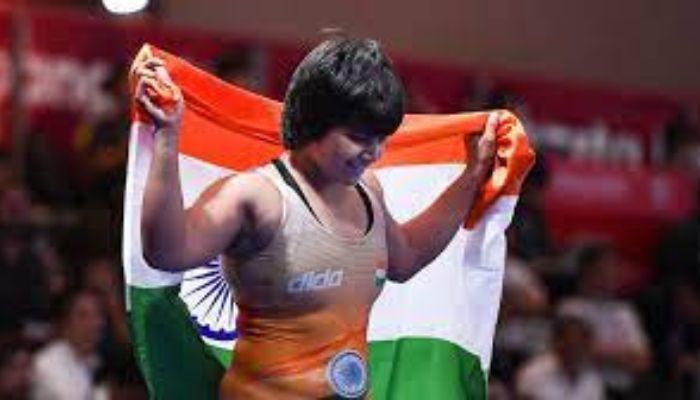
Commonwealth Games medalist Divya Kakran once again highlights the lack of support for athletes from Arvind Kejriwal-led AAP government

On 7th August 2022, Divya Kakran, the wrestler who won a bronze medal in the ongoing Commonwealth Games 2022, has shared on Twitter how she hasn’t been given any prize money to date by the Delhi government. She shared this in response to the congratulatory tweet from Delhi chief minister Arvind Kejriwal.

Divya Kakran tweeted, “Heartfelt thanks to Hon’ble Chief Minister of Delhi for congratulating me on the medal. I have a request to you that I have been living in Delhi for the last 20 years and have been practicing my sports wrestling, but so far I have not been given any kind of reward money from the state government nor any help has been given to me.”

She wrote in the next tweet, “My only request to you is that I should be honored in the same way as other players, who despite being from Delhi play from other states, are honored.”

Divya Kakran comes from a humble background. Her mother used to sew ‘Langots’ and her father used to sell those to earn a livelihood. Rising from such difficult situations, the 23-year-old wrestler won a bronze medal in the Commonwealth Games 2018 and a gold medal in the Asian Games 2018 making India proud.

Earlier, on 6th August 2022, Delhi chief minister Arvind Kejriwal congratulated the Commonwealth Games medalist wrestlers of India in his tweet in which he said, “Bravo wrestlers. Our wrestlers have made a mark in the Commonwealth Games. In wrestling, India got a total of 6 medals in a single day, out of which 3 are gold. Many congratulations to Sakshi Malik and Deepak Punia for their gold and Divya Kakran and Mohit Grewal for bronze medals.”

Delhi government’s history of poor support to the athletes

This is not the first time that Divya has criticized the Delhi government’s negligent approach toward sportspersons. Even after winning in Asian games in 2018, she had complained about the Delhi government’s lack of support for sportspersons.

In a meeting after winning the gold medal at the Asian Games 2018, and a bronze medal in the CWG 2018, she was seen lambasting Arvind Kejriwal. She said at that time, “Didn’t we have any ‘jugaad’? And I have brought a bronze medal for the country at the age of 19 in these Commonwealth Championship matches and in the Commonwealth Games 2018 too. I have won 12 gold medals for Delhi at senior-level championships. When I won a gold medal in the Asian Games, at that time also, nothing was done for me. It is very difficult to reach where I am starting from where I come from.”

Speaking at a felicitation ceremony for the athletes, Kakran said, “It is okay that you are doing something today but please think about those players who come from a poor economic background. Today you have brought all of us together in this program and you are congratulating us. But when we need somebody’s help the most, at that time nobody comes to help us. Because I have reached here today, you are doing this. I would say that you don’t do this much for us after achievement. But help us when we need it the most. If we get help and support in those hours, we will perform even better. Had we received any support, I would have brought a gold medal for the country for sure.”

Expressing her gratitude for her coach, Kakran said, “Our coach has done so much for us. I am a very lucky girl. He left his job and ensured that I stand on the mat to wrestle. I could not afford to have a healthy diet. My coach ensured that I get good quality dry fruits. But all this was working well till he was with us. Now, things have changed. I brought a medal from the Commonwealth Games and so you invited me here and said that you will now help us. I asked you for the help we needed at the time of the Asian Games. You told us that kindly write to us about the same. I gave everything in writing. But what happened after that? Nobody received my call.”

Underlining the commitment of the athletes, she said, “Sir, we are poor, but you can’t imagine the fire within us. What more can I say? I reached here today and suddenly everyone is supporting me. But when we needed this support the most, nobody did. There are many more players like me. Please think of them. I reached here because the Gods supported me, the coach blessed me and the parents supported me.”

Comparing the sports culture of Delhi with that of Haryana, she said, “Remember that Delhi has got a very less number of medals. Go and see how many medals are there with Haryana because they got the state support. A budget of Rs 3 crore is a huge amount, Sir. Delhi has sanctioned Rs 1 crore after this win. Earlier we had Rs 20 lakhs. Look at our hard work and hardships. Nothing happens in those 20 lakhs. In Haryana, no one tells the athletes that we don’t have milk and we don’t have ghee. Even we do have milk and ghee here in Delhi and we are also equally inspired. But we lack state support. So please think and act in a way so that next time Delhi bags the maximum number of medals in the Asian Games and all of them are gold medals.”

Divya Kakran won the Bharat Kesari title in 2018. It is notable that she had secured a spot in the finals of this tournament by defeating legendary wrestler Geeta Phogat.

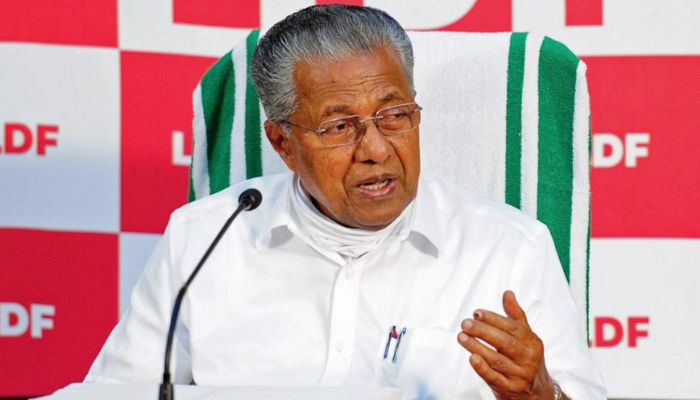
Infighting breaks out between the CPI and CPIM in Kerala over projecting Pinarayi Vijayan above the party

On Saturday (August 6), the Communist Party of India (CPI) lambasted its ally Communist Party of India Marxist (CPIM) for projecting the government headed by Kerala Chief Minister Pinarayi Vijayan as ‘one-man show.’

As per a report in Onmanorama, the CPI presented a political report during a recent conference held in the Pathanamthitta district of Kerala. It slammed its Communist counterpart for presenting the Left Democratic Front (LDF) Government as that of Pinarayi Vijayan’s government.

“The CPIM is deliberately trying to brand the government as Pinarayi’s government. The CPIM always refers to the Left government as the Pinarayi government. A trend that has never before been seen in the tenure of an LDF government needs to be corrected,” it emphasised.

The Communist Party of India has expressed its displeasure over the contractual appointments in the State as well as the policy of the CPIM on the issue of cooperative banks. It has also pointed out how CPIM has denied it of its due share.

“The government had to suffer the backlash over the impertinence shown in implementing the (SilverLine railway) project. Like the Sabarimala issue, this was also rendered complicated. The project should have been implemented only by convincing the public but instead, it was handled in a manner that incited public anger, ” CPI added.

The Communist party also accused its ally of bypassing employment norms and exhibiting a hostile attitude towards its student body, All India Student’s Federation (AISF). CPI alleged that it had accounted for the actions of CPIM.

The party also criticised the Kerala CM for his intolerance toward black flags. “The black flag is the mode of protest used by everyone. The intolerance for black shown by the Chief Minister, who has led numerous agitations, is not in the democratic spirit,” CPI said.

It must be mentioned that the CPI and the CPIM officially split in 1964 over the former’s support for China and the latter’s support for the USSR. CPIM was quick to replace the original Communist party in Kerala, Tripura and West Bengal.

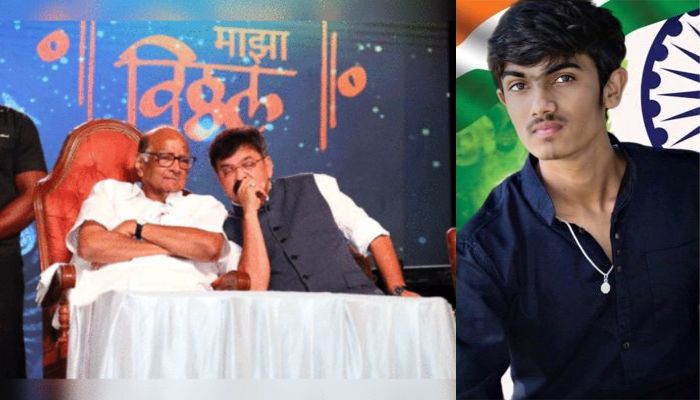
Maharashtra: Nikhil Bhamre who was arrested for a tweet against Sharad Pawar joins Twitter with a new handle, thanks BJP and RSS for support

Nikhil Bhamre of Dindori in the Nashik district of Maharashtra who was arrested for a tweet allegedly against Sharad Pawar joined Twitter with a new handle. Nikhil Bhamre thanked the Maharashtra state unit of Bharatiya Janata Party, Rashtriya Swayamsevak Sangh, Devendra Fadnavis, and legal experts including Advocate Prakash Gade for supporting him in his difficult times.

This Twitter account of Nikhil Bhamre is created in August 2022. Advocate Prakash Gade, a member of the BJP, was one of the lawyers who supported Nikhil Bhamre. He has followed this account on Twitter and retweeted Nikhil Bhamre’s new thread of tweets.

In his tweet, Nikhil Bhamre said, “I am Nikhil Shamrao Bhamre, I am back. To thank them, who stood firmly behind me in difficult times. Honorable Devendra Fadnavis Ji, Thank you very much. I will always be indebted to you for your help. I have come back to thank everyone who directly and indirectly helped me and my family through difficult times. They make me feel stronger today than ever before.”

Nikhil Bhamre further said, “Due to studies and exams, I could not meet, talk or express anyone for the last one month. But after a long time, I have come back to express myself. Nidhi Kamdar, Sister, you were taking time out of your busy time to get an update on what happened, and what was going on at every hearing of my case and were constantly giving the necessary tips on how to move forward. I am very grateful to you for that.” Nidhi Kamdar is an officer on special duty working with Devendra Fadnavis.

Thanking Advocate Prakash Gade Nikhil Bhamre said, “Prakash Gade Dada, you stood by me and helped me like an angel. You not only gave me a lot of courage and patience during those difficult times, but you also took care of my safety. Jiten Gajaria and Pratik Karpe, you had taken utmost care that I would not have any problem in the various hearings in the court. I am also very grateful to you for that.”

Nikhil Bhamre also thanked Pradeep Bachchhav who is the Dharma Awareness Program Head of the RSS in the western Maharashtra region. Naming him, Nikhil Bhamre said, “I am forever indebted to you for your mental and emotional support.” He further wrote in his tweet, “The sister ties the rakhi and the brother protects her. But Trupti Garg is the elder sister who stood up to protect this younger brother. My heartfelt thanks to her.”

Besides, he named all other members of the legal team that fought for him in multiple cases heard at various courts in Maharashtra. He also thanked RSS, Bharatiya Janata Yuva Morcha, and his friends and followers. Before concluding the threat with ‘Jai Shri Ram’, he also said in his tweet that he will come back to share more things.

Why Nikhil Bhamre was arrested?

The 21-year-old pharmacy student shared a post on Twitter on 11th May 2022. In his tweet, Nikhil Bhamre wrote, “It is time to create a Nathuram Godse of Baramati for a ‘Gandhi’ of Baramati. Uncle, do apologize.” It is notable that Baramati in the Pune district of Maharashtra is the hometown of Sharad Pawar. The tweet by Nikhil Bhamre was probably responding to a recent incident in which Sharad Pawar quoted poetry by Marathi poet Jawahar Rathod to make derogatory remarks against Hindu deities.

He was arrested for allegedly defaming Sharad Pawar when his social media post did not mention Sharad Pawar by name. Minister in the Maha Vikas Aghadi government and Nationalist Congress Party leader Jitendra Awhad had asked police to take action against Nikhil Bhamre. Jitendra Awhad tagged in his tweet the official Twitter handles of the Mumbai police, the commissioner of the Mumbai police, Maharashtra’s director general of police, Pune city police, and Thane city police.

Multiple FIRs were lodged against him at various places in the state after Jitendra Awhad incited his party workers to do so. He was arrested from his rented accommodation in Nashik. He is from Dindori and belongs to a farmer’s family and was living in Nashik to pursue his studies. Similarly, Marathi actress Ketaki Chitale was also arrested by the police in May 2022 for an allegedly insulting post against Sharad Pawar. Ketaki Chitale was also lodged in jail for more than a month before she was granted bail by the court.

No money left to feed lions: Pakistan decides to sell the animals to save space and money

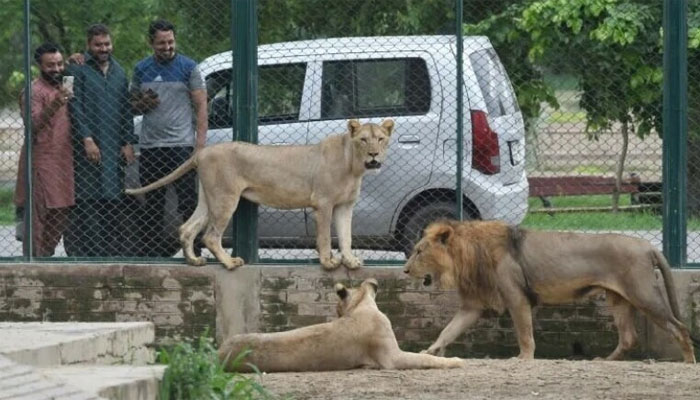
The high inflation rate and poor economic condition of Pakistan are not only affecting its people but the animals as well. As per reports, the Lahore Zoo has decided to auction its big cats, including lions and tigers, to private entities. The zoo authorities have stated it would save space and money.

At present, there are 29 lions in Lahore Zoo, and they are between the ages of 2 to 5 years. According to Deputy Director of Lahore Zoo Tanveer Ahmed Janjua, 12 of the big cats will be auctioned on August 11. He further added there are six cheetahs and two leopards in the zoo apart from lions.

The animal activists in Pakistan are against the auction. They have suggested either shifting the lions to other zoos or giving contraceptives to female lions. Activist Uzma Khan said, “Once such an auction takes place from the zoo, it will become a business that will adversely affect the conservation of wildlife.”

The minimum bid for the lion has been set at $700 by the officials. However, they expect to earn around 20 lakh Pakistani Rupees per lion. The auction will be open to everyone. Interestingly, there have been reports that goats in India have fetched more prices than the minimum bid price Lahore Zoo officials have set for the lions.

Notably, Chief Veterinary Officer Mohammad Rizwan Khan of Lahore Zoo said in a statement that the authorities attempted to sell the lions last year as well, but the process could not be completed due to the lack of necessary papers.

Pakistan is taking drastic steps to reduce expenses and increase income but in vein. Recently, the Minister of Planning and Development, Ahsan Iqbal, requested the people of Pakistan to drink less tea as it would help in reducing pressure on the foreign reserves of the country. Pakistan is the largest importer of tea. In 2020, it imported tea worth $646 million and exported tea only worth $15.2 million. The majority of its tea comes from Kenya.

Bihar: One Mohammad Jibril Alam beheads his wife and 3-year-old daughter, keeps wife’s head near her parent’s house

On Friday 5th August 2022, one Mohammad Jibril Alam, a resident of Pokhariya Tola village in Ramnagar Mahesh panchayat under Srinagar police station in Madhepura district of Bihar, beheaded his 30-year-old wife Murshida Khatoon and 3-year-old daughter Jia Parveen using a sharp-edged weapon.

The accused Mohammad Jibril Alam, after beheading his wife, placed her head near her parent’s house in the Godhaila village of Bharrahi police station area with a note that read “Here you take this and keep your beloved daughter with you”. The accused left his wife and daughter’s bodies and daughter’s severed head in his house. He placed the severed head of his wife on a culvert 200 meters away from her parent’s house and ran away with his son and another daughter.

According to a report by the Times of India, Mohammad Jibril Alam also shot a video after committing the killings and shared it on some WhatsApp groups. As the police came to know about this incident, they rushed to the spot and took the mortal remains of the deceased Murshida Khatoon and Jia Parveen for postmortem.

Enraged members of Murshida Khatoon’s parent’s family blocked National Highway 107 for many hours at the Chandni Chowk in the Godhaila village. They demanded the immediate arrest of the accused killer. After the senior police officers assured strict action against the accused, the blockade was lifted.

Superintendent of Police, Madhepura, Rajesh Kumar said, “The dead bodies of mother and daughter have been recovered. Raids are being conducted in search of the accused. Meanwhile, both the bodies have been sent to Sadar Hospital for post-mortem.”

According to a report by ETV Bharat, the police sources have said that Mohammad Jibril Alam committed this crime because he suspected that his wife was involved in an illicit relationship. A letter stained with blood was found on the spot.

The police sources have also claimed that Mohammad Jibril Alam was thrashed by his in-laws some days ago and he had threatened at that time of killing his wife and surrender to the police. The police have arrested the mother and stepbrother of the killer. Further investigation is going on in this case.

Filmmaker Kamal Chandra announces movie ‘Hum Do Hamare Baarah’, Islamists cry foul on social media

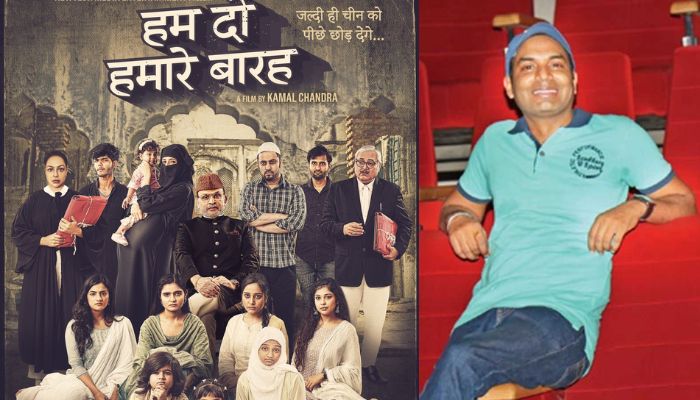
On Friday (August 5), filmmaker Kamal Chandra announced his upcoming film ‘Hum Do Hamare Baarah’ on the contentious issue of population explosion within the Muslim community.

The social drama movie features National Award winner Annu Kapoor in the lead role. Besides Kapoor, Manoj Joshi and Ashwini Kalsekar will also be seen in prominent role in the film.

In a tweet on Friday, film trade analyst Komal Nahta said, “First look poster of upcoming socially relevant film ‘HumDoHamareBaarah’. The film touches upon the hot topic of population explosion in India.”

“Producers: Ravi Gupta, Birendra Bhagat & Sanjay Nagpal. Director: Kamal Chandra. It stars Annu Kapoor, Ashwini Kalsekar & Manoj Joshi,” he further informed. The movie’s first poster shows Annu Kapoor as the head of a Muslim family of 11 children, while his pregnant wife stands alongside him.

The movie title, ‘Hum do Hamare Baarah (We two and our 12 children)’ is also accompanied by the tagline ‘Jaldi Hi Cheen Ko Picche Chhod Denge (We will soon leave China behind).’ Soon after the poster’s release, ‘journalist’ Rana Ayyub led the pack of Islamists in denouncing the socially relevant movies as ‘Islamophobic.’

She tweeted, “How does the censor board allow a film like this that depicts Muslims as the reason for population explosion and extends the relentless attack on the community. The brazen hate and Islamophobia when they use the image of a Muslim family and call it ‘Hum do Hamare Baarah’.”

“This Sanghi promoted, Bigoted film that depicts Muslims as the reason for population explosion and extends the relentless attack on the community. The brazen hate and Islamophobia when they use the image of a Muslim family and call it ‘Hum do Hamare Baarah’,” wrote another Islamist.

One Talha Hussain wrote, “And yet the Hindi film Industry also has some bastards who produce films like hum do hamare baarah.”

The date of release of the film ‘Hum do hamare Baarah’ has not yet been announced. However, it is likely to stir even more controversy once it hits the theatres.

Varun Gandhi apes the IQ of his cousin Rahul, gets confused between ‘loan waiver’ and ‘loan writeoff’, Kejriwal follows suit

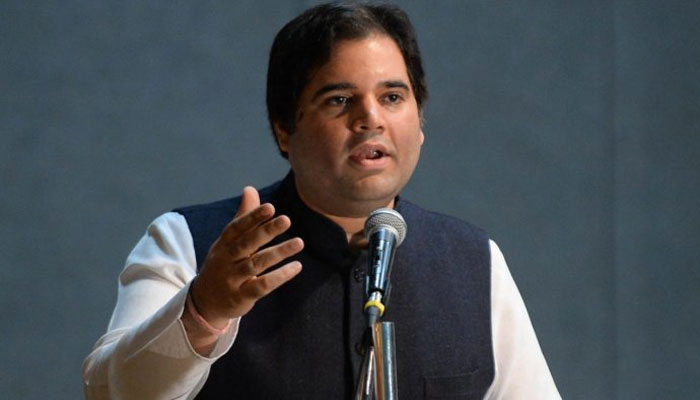
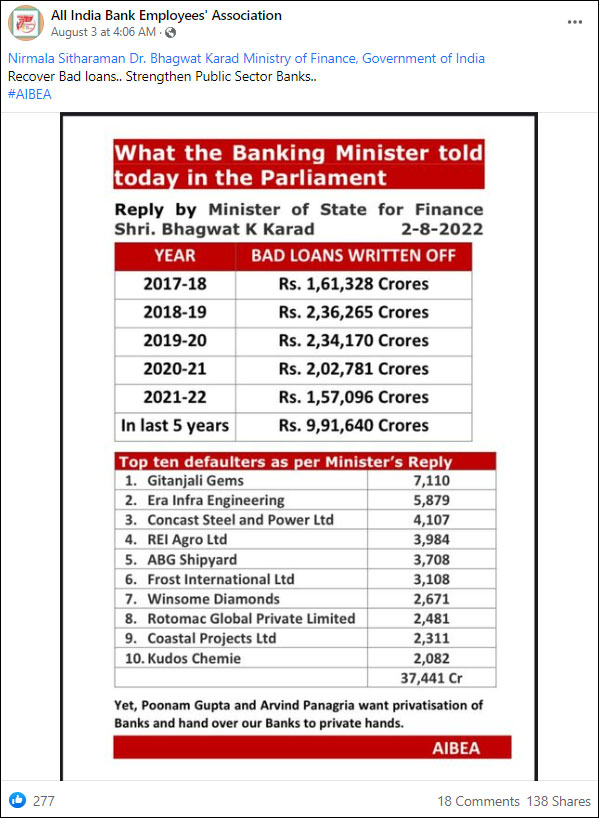
On August 6, BJP MP from Pilibhit Varun Gandhi, in a tweet, targeted the central government over ‘written-off loans’ in the past five years and confused it with ‘loan waiver’. Varun Gandhi shared an infographic made by the All India Bank Employees Association (AIBEA) based on the reply given by Minister of State for Finance Bhagwat K Karad on August 2 in Rajya Sabha.

In his tweet, Gandhi wrote, “The House which aspires to get a ‘thank you’ for giving 5 kg ration to the poor. The same House says that in 5 years, the loan of corrupt ‘money animals’ up to 10 lakh crore has been waived. Mehul Choksi and Rishi Aggarwal’s names are on top among those who take ‘Free Ki Rewari’. Who has the first right on the government treasury?”

Varun Gandhi seems to be walking in his cousin Rahul Gandhi’s footsteps and mistaken loan write off with loan waiver.

Difference between written-off and waived-off

From time to time, the leaders of the opposition have used the term written-off in a completely misleading manner. They depict as if the banks have forgotten about the loans when they write them off. In reality, a bad loan is written-off to remove them from the balance sheet. It is a regular process that banks follow as per the RBI guidelines.

A balance sheet should reflect the real position of assets and liabilities. Hence Banks have to write off loans given to borrowers, which are “assets” to the banks, which have now shown signs of weakness. If they don’t write off loans, it is like claiming to hold a high quality asset, when actually the quality has deteriorated. Will you trust an entity that doesn’t give the true picture of its assets?

Secondly, if a loan is not written-off and is continued as a healthy asset (when it actually is an Non Performing Asset), then banks can continue to book interest income on the loan, on accrual basis of accounting. This has two impacts: First, the bank is artificially increasing its income by booking interest on accrual basis, income which it may or may not receive (since the loan is actually an NPA). Second, the bank has to pay tax on such interest income. Both are undesirable. A write off prevents banks from doing this, since once a loan is “written-off”, income booking on the same is based on actual receipt of income, and not based on accrual. Banks do not stop earning interest on such loans, but now they can recognize it as income only when they receive it.

Hence write-offs are a purely technical, accounting entry. Loans, which may not be repaid by the borrower in normal course of business are written off. Even when these loans are written off, various recovery procedures like recovery suits filed before the DRT/ Court. and action initiated under SARFAESI Act continue. Now, the bank takes control of the assets secured against such loans and sells them off to recover the loans.

When loans are ‘waived’, however, the money lent is gone forever.

Rahul Gandhi and his complicated relationship with loans

There have been countless occasions when the Congress leader has intentionally or unintentionally got confused between loan waiver and loan write-off. For example, in December 2020, he put out misleading information on the alleged ‘waiving-off’ loans of industrialists by the Modi government. He came up with some magical numbers of Rs 2,37,206 crore, claiming that the Modi government forgave some industrialists by ‘waiving off’ their loans. According to Rahul Gandhi, the huge amount, which according to him was ‘waive-off’ by the government, could have been provided for 11 crore families in the difficult time of COVID, each with Rs 20,000.

Gandhi was not the only one who rode on the “confused” wagon. Chief Minister of Delhi Arvind Kejriwal, who continues to stay irked by Prime Minister Modi’s ‘free ki revdi’ statement, also targeted the government with a similar tweet. Kejriwal wrote, “Providing free education to the children of the country and arranging free treatment for every Indian is patriotism, virtue, religion, nation building. It is treason against Maa Bharti to give free revri on own friends.”

Kejriwal had posted a photograph of a newspaper clipping that talked about the statement given by MoS Karad in Rajya Sabha. Interestingly, Kejriwal is an IIT graduate and former Income Tax official and one would expect that of all people he would know difference between loan waiver and loan writeoff. Except, he is also a politician now and hence facts don’t seem to matter.

AIBEA’s incomplete data analysis

AIBEA is an organisation comprising of bank employees, and one may expect a better understanding of the data. It is also expected from a union like AIBEA to put out complete facts and not just incomplete information that could result in misleading the general public. On August 3, they published the said infographics on its social media accounts and urged the government to recover bad loans.

Source: Facebook

There was no mention if any of the amounts were recovered by the banks and which banks had written-off the loans as per the information provided by MoS Karad. The incomplete information gave a chance to the leaders like Varun Gandhi, and similar incomplete information by media houses let the likes of Kejriwal mislead the public.

MoS Karad explained loans written off and recoveries done by banks

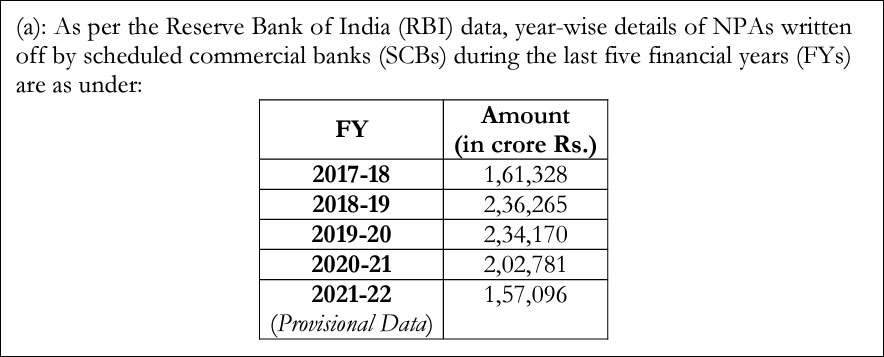
MoS Karad was replying to Congress MP Mallikarjun Kharge, who had sought information on bad loans written off by commercial banks and public sector banks in the last five years, loan defaulters, and recoveries made by commercial and public sector banks. In his written reply, MoS Karad informed the house that in the past five financial years, commercial banks have written off bad loans worth Rs 9,91,640 crores.

Written-off amounts in last five financial years. Source: Rajya Sabha

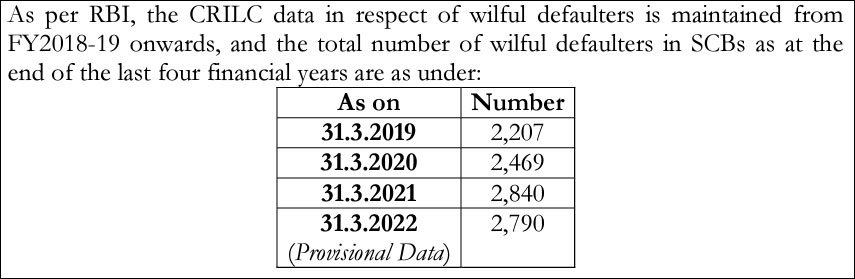
He further added that as per data provided by the Central Repository of Information on Large Credits (CRILC) database of the Reserve Bank of India, there were 2,207 willful defaulters in 2019 having aggregate credit exposure of Rs 5 crore and above. In 2020, the number went up to 2,469, followed by 2,840 willful defaulters in 2021 and 2,790 in 2022.

Willful defaulters in last four financial years. Source: Rajya Sabha

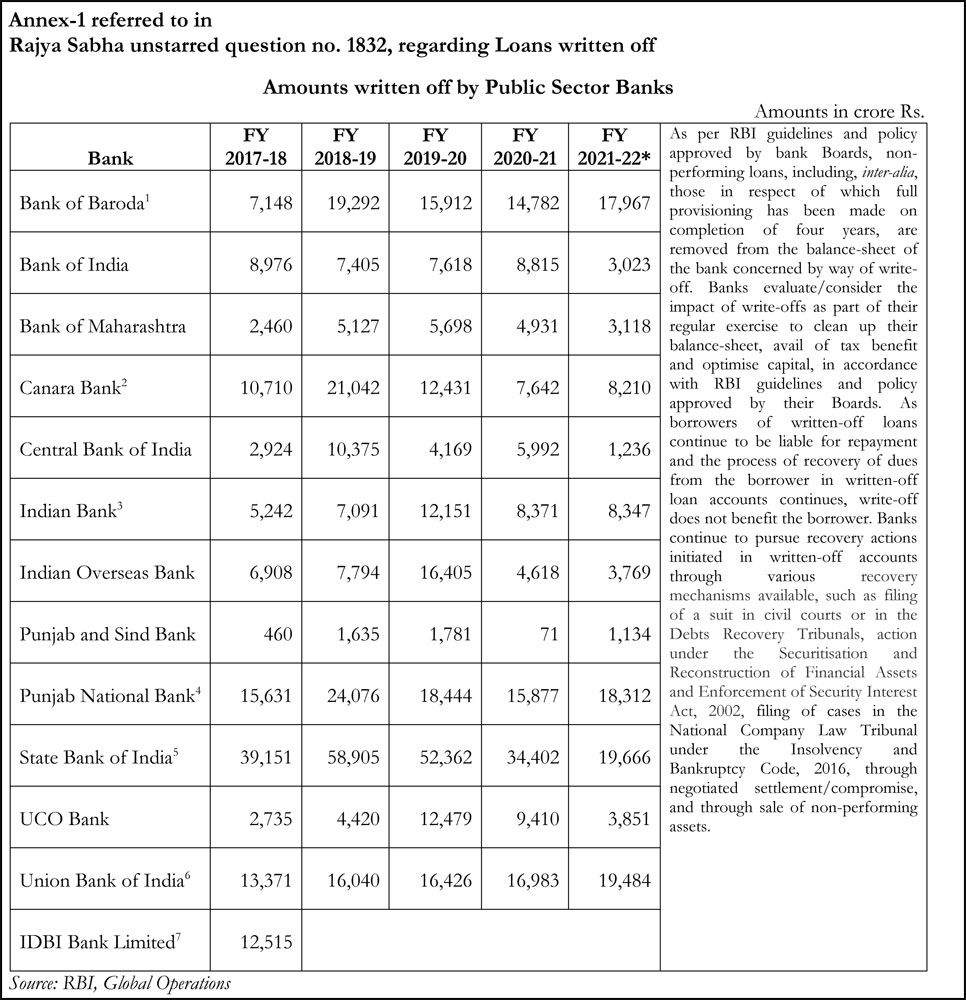
As per the data, the State Bank of India has written off Rs 2,04,486 crores in five years. Similarly, Union Bank of India has written off 1,42,339 crores, Punjab National Bank has written off 92,340 crores, Bank of Baroda has written off 75,701 crores, and Canara Bank has written off 60,035 crores. Other banks listed by MoS included Bank of India, Central Bank of India, Indian Bank, Indian Overseas Bank and more.

Written-off loan amounts year-wise by Public sector Banks. Source: Rajya Sabha

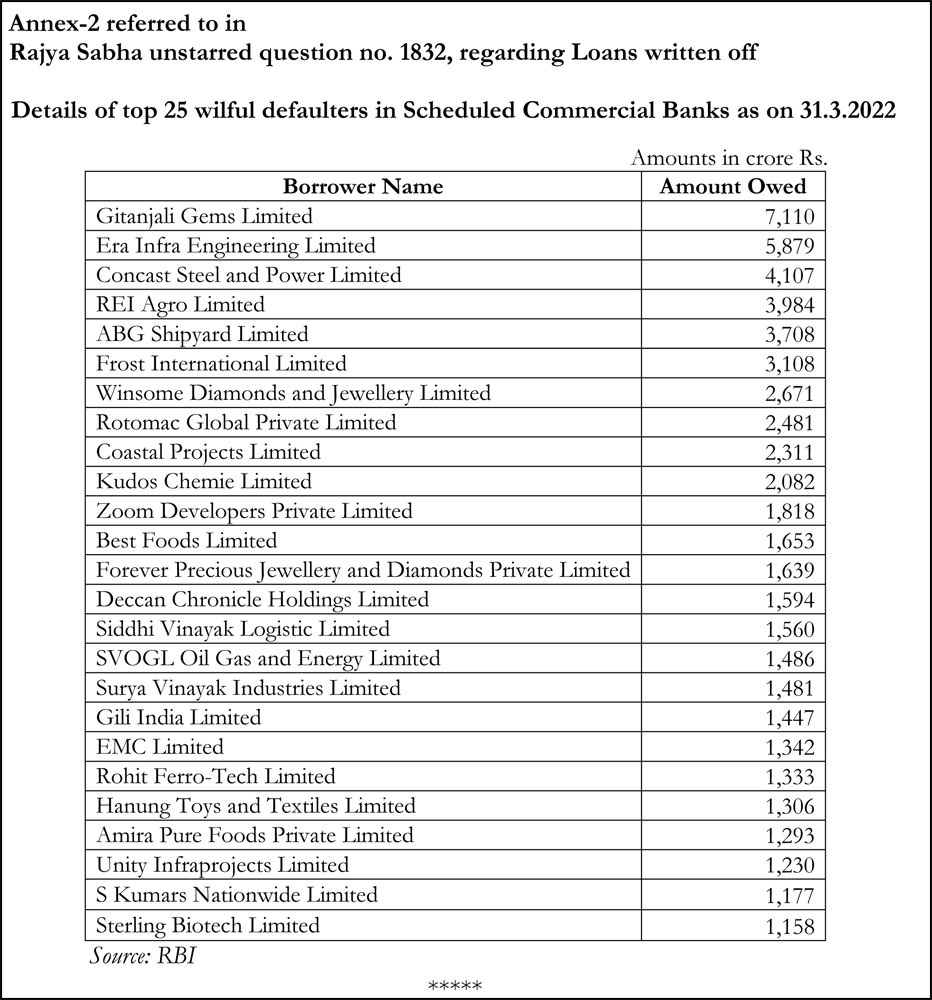
Top defaulters included Gitanjali Gems Limited, which has Rs 7,110 crores of bad loans, Era Infra Engineering Limited has Rs 5,879 crores of bad loans, Concast Steel and Power Limited owned Rs 4,107 crores of bad loans, REI Agro Limited had Rs 3,984 crores of bad loans and ABG Shipyard Limited had Rs 3,708 of bad loans among many others.

Top 25 willful defaulters. Source: Rajya Sabha

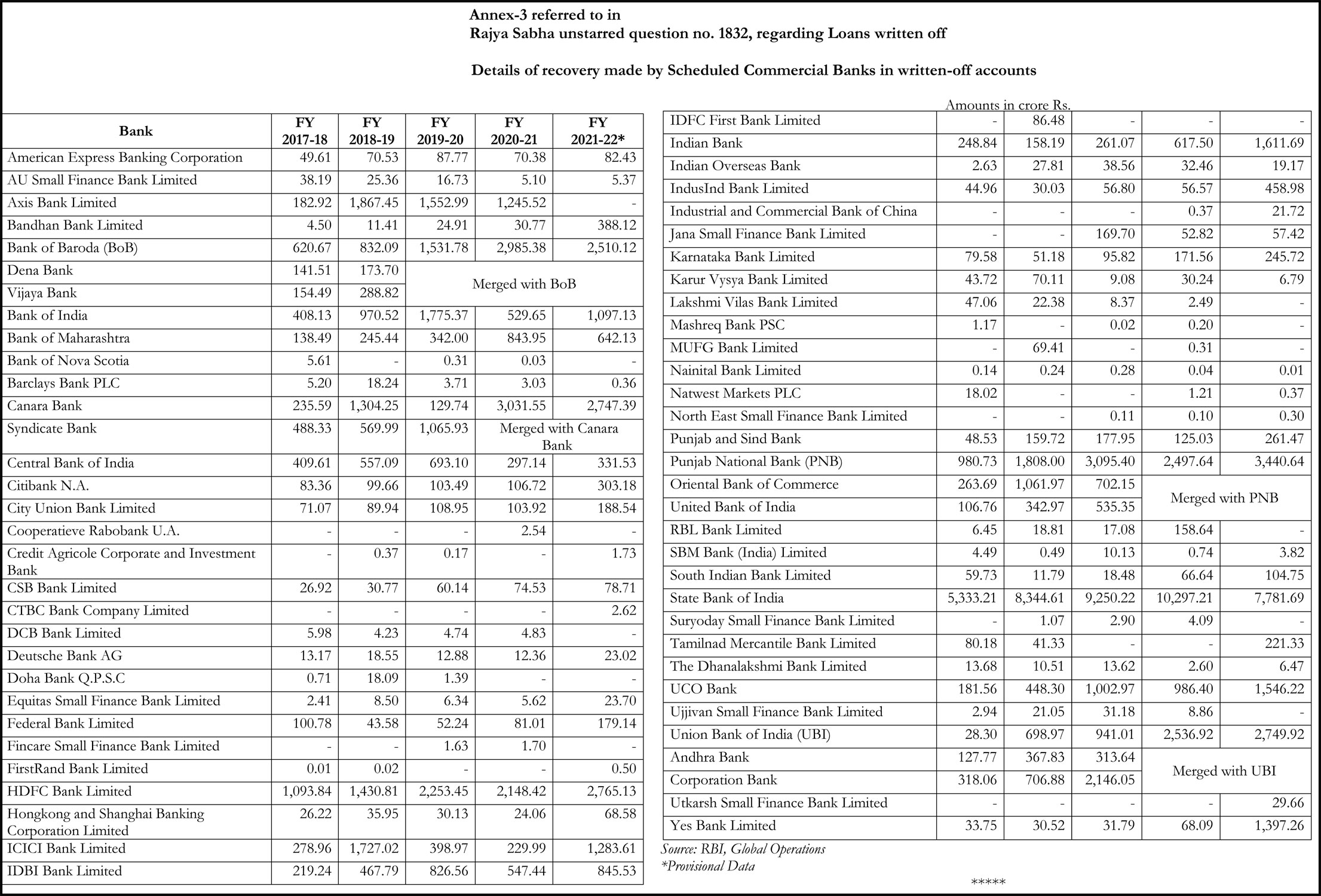
Coming to the recovery part that Varun Gandhi, Kejriwal and many media houses miss, MoS Karad mentioned that SBI had recovered Rs 41,006.94 crores of bad loans that were waived off during that period, and the process of recovering the remaining bad loans is in the process by the bank. Similarly, Union Bank of India recovered Rs 6,955.12 crores, Punjab National bank recovered 11,821.37 crores, Bank of Baroda recovered Rs 9,540.04 crores, and Canara Bank recovered Rs 7,348.52 crores. The government of India is using all possible means to recover the bad loans, and the results are visible in the stats. In recent years, the recovery process and paced up, and year-wise, recovery has increased for almost all commercial banks.

Bank-wide recoveries in last five financial years. Source: Rajya Sabha

Not to forget, it was reported in February 2022 that Rs 18,000 crores were recovered from three defaulters including Vijay Mallya, Nirav Modi and Mehul Choksi.

Amusingly, the infographic Varun Gandhi shared talked about how banks should not be privatised and thought this loan writeoff data was a clinching evidence that banks in India should not be privatised. However, he seems to have missed the part where the banks that had actually loaned the money written off were all public sector banks. If at all, it actually makes a case for privatisation of banks. But why let facts get in the way of narrative building.

‘Darlings’ on Netflix: Alia Bhatt and Shefali Shah make a ‘killer’ duo, far from endorsing, it shows domestic violence in all its stark reality

Let me be honest, Bollywood has set the bar so low that a moderately good movie is a rare exception. Issues like rape, stalking, harassment and abuse have been normalised, even romanticised on the big screen in a way that is cringe-worthy for any sane individual. Alia Bhatt’s recent release ‘Darings’, however, is something different.

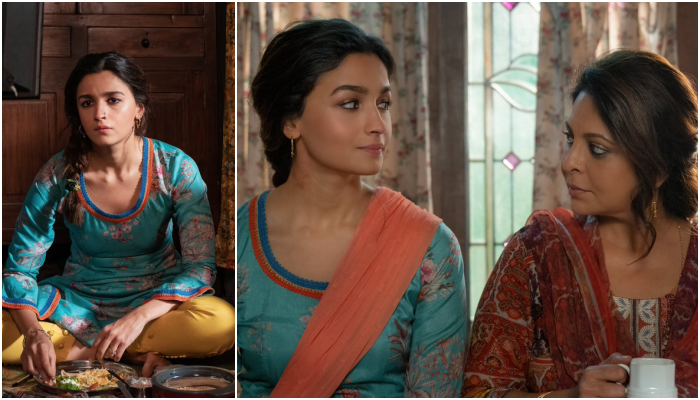
Shefali Shah is a phenomenal actress and it is an established fact. Shefali Shah delivering a stellar performance is the norm. What comes across as surprising in Darlings is Alia Bhatt’s on-screen presence and acting skills ‘owning’ the movie. Alia has been one of the very rare good actors from her generation of entitled products of nepotism and she has indeed proven her mettle with performances in Highway, Raazi and Udta Punjab. In Darlings, she has just taken it to the next level, a stellar job throughout.

This review contains spoilers.

‘Darlings’ looks at domestic abuse the way Bollywood has not, so far. In usual productions from the Indian entertainment industry, we either get sick romanticisation or unrealistic ideals. We either get movies that depict harassment, rape, stalking and abuse as “things the hero does to win the heroine’s love”, or we get ideal ‘Adarsh Naaris’ where the protagonist is the permanently wronged, innocent, pure as morning dew, perfect, ‘no-fault in her’ unreal image that further twist the already warped social ideas about the issues.

Alia’s character of Badrunnisa Sheikh in Darlings is not like that. Badrunnisa is a good girl, yes, but Badrunnissa has her own vices. Badrunnisa sometimes cooks carelessly, Badrunnisa uses her female charms on vendors to buy things for cheap, Badrunnissa is silly, selfish, melodramatic and sometimes argues with her husband when he is already tired from work. Badrunnissa is what normal people are. She has her own flaws and ‘Darlings’ does not cover them up to prove its point. The movie does not preach unrealistic ideals.

Badrunnisa’s husband Hamza Sheikh is the regular boyfriend who slowly turns abusive in the course of the marriage. He is not the ‘evil personified’ bad man of regular Bollywood flicks who have evil music accompanying every scene, and who looks and smiles menacingly at their prey. Hamza suffers from his own issues, a bad boss that humiliates him, financial woes, alcohol addiction and in his own flawed, feeble way, does make some efforts to be nice to his wife. However, as abusive husbands often do, he fails at it miserably.

How domestic abuse is normalised by society in general

Netflix’s ‘Darlings’ does not preach. It does not guilt-trip and shame people for doing what they do. Badrunnisa’s neighbours, her local shopkeepers, her friends, and even her mom Shamshunnisa (Shefali Shah) all know that she gets beaten by her husband on a regular basis. They feel bad about it. Her mother suffers knowing that her only child is being beaten mercilessly by the man she loves, she does try to persuade her to leave him, but like abuse victims usually do, Badrunnissa keeps believing that one day, Hamza will change. Shamshu, like a regular Indian mother, despite her outrage, allows her only child to go back to her household and keep making efforts to ‘change’ her husband.

Badrunnisa’s friend, who runs a beauty salon downstairs, hears every single slap, every single kick, yet she keeps going about her business. She helps Badru buy ‘sexy’ outfits when she decides getting pregnant may help change Hamza. She eventually starts asking her customers to ignore the sound of cries and blows from upstairs because she knows it is Badru who has got to decide how much is too much.

Badru gives herself false hope, even if her loved ones try to help, she loves Hamza so much, and loves her silly ideals of love and marriage so much that she keeps believing him after repeated, almost regular abuse. She allows herself to believe Hamza’s false promises, despite knowing better. The denial, the rage, the vulnerability, the acceptance and the final snapping of her sanity are well performed by Alia. Amidst the chaos, dark humour and noise, the mother-daughter duo of Badru and Shamshu deal with their own demons in their own way.

The scene where a broken Badru is about to jump off a hospital window after learning about her miscarriage, and suddenly asks herself, “Why me? It is his fault, he needs to pay”, without uttering a single word, is a few minutes of acting that should set Alia as one of the best among present generation actors. That scene is powerful.

The mental breakdown, the revenge drama, and the ‘unhinged’ behaviour that Badru displays is the dark spiral that follows next. The second half of the movie is a bit weaker than the first, but Alia and Shefali do manage to keep it afloat with their performances.

‘Darlings does its jobs wells’.

Ashok Gehlot blames imaginary ‘hanging law’ for increase in incidents of murder of rape victims, except, he is wrong

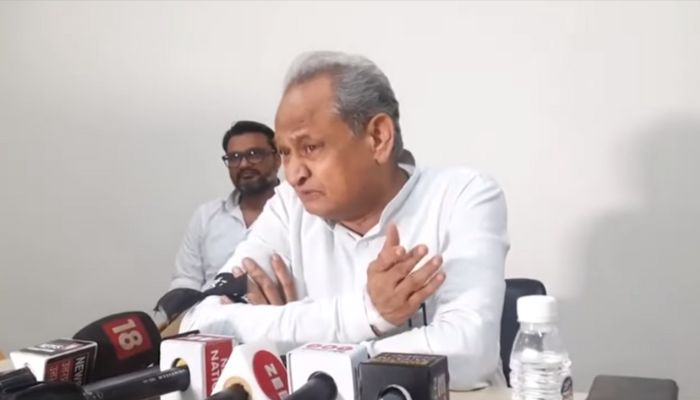
On Friday (August 5), Rajasthan Chief Minister Ashok Gehlot courted controversy after he blamed the Centre for increased murders following rapes in the country. He made the contentious remarks during a press conference.

The Congress leader claimed that the Union government had passed a law, making it mandatory to award death penalty to all rape convicts after the Nirbhaya case.

At about 4 minutes 36 seconds into his press conference, Gehlot alleged, “The situation is extremely grim in the country. Children are being raped! And the situation has worsened after law was made to award capital punishment to all rape convicts, following the Nirbhaya case.”

“After such a law was made, the killings of rape victims have increased. When the perpetrators see that the government is against them, they not only rape the victims but also kill them,” he claimed.

“I am seeing this trend across the country. This is a state of crisis for a democracy like India. I have never encountered such a situation before,” the Rajasthan Chief Minister concluded.

The truth behind the claims made by Ashok Gehlot

To begin with, there is no law that makes death penalty mandatory for all convicts of rape. Following the Kathua and Unnao rape case, the Modi government passed the Criminal Law (Amendment) Act of 2018 [pdf].

The Centre had then amended the Indian Penal Code of 1860 and Prevention of Child Sexual Offences Act of 2012 to introduce harsher punishments for the rape convicts. One of the major highlights of the legislation was the increase of minimum punishment for rape from 7 years to 10 years.

The law was made even stricter for the rape and gang rape of minor children. For instance, the punishment for rape of a girl below the age of 16 years is punishable by a minimum sentence of 20 years or life sentence.

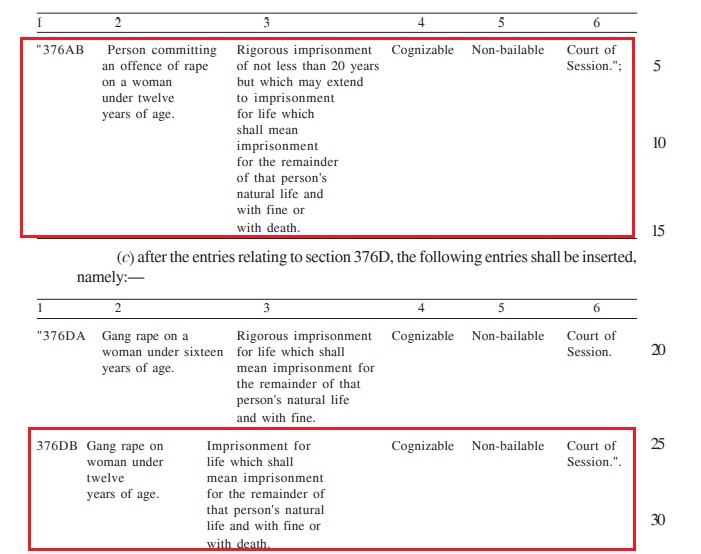
Screengrab of the Criminal Law (Amendment) Act of 2018

The biggest amendment was perhaps in relation to the rape and gang rape of children below the age of 12 years. For the first time, a provision to award death penalty to the rapist was introduced in the IPC Section 376 (punishment for rape). A new section ‘376AB’ was incorporated into the existing law. It states –

Whoever, commits rape on a woman under twelve years of age shall be punished with rigorous imprisonment for a term which shall not be less than twenty years but which may extend to imprisonment for life, which shall mean imprisonment for the remainder of that person’s natural life, and with fine or with death.

Another section of 376DB was inserted to account for gang rape of victim below the age of 12 years. It states –

Where a woman under twelve years of age is raped by one or more persons constituting a group or acting in furtherance of a common intention, each of those persons shall be deemed to have committed the offence of rape and shall be punished with imprisonment for life,which shall mean imprisonment for the remainder of that person’s natural life, and with fine, or with death.

Apart from introducing the provision of the death penalty for the rape of minors under the age of 12 years, another provision in rape law has been for awarding the death penalty, which is for repeat offenders. Section 376E of the IPC says if someone who was convicted of rape commits another rape, that convict can be given capital punishment.

Indian Penal Code section 376E says, “Whoever has been previously convicted of an offence punishable under section 376 or section 376A or section 376AB or section 376D or section 376DA or section 376DB and is subsequently convicted of an offence punishable under any of the said sections shall be punished with imprisonment for life which shall mean imprisonment for the remainder of that person’s natural life, or with death.”

Although the provision for capital punishment has been introduced for a certain cohort (victim age <12 years or repeat offenders) of rape victims, it does not automatically imply that the convict will be awarded the death penalty. The discretion ultimately lies with the Judiciary to decide the quantum of punishment on case-by-case basis.

Moreover, the death penalty is not even a provision in the law for rape cases, where the maximum punishments are jail of 10 years, 20 years and life imprisonment. Therefore, courts can’t award the death penalty if the age of the victim is above 12 years or if it is the first conviction of the accused in a rape case.

The Indian courts abide by the doctrine of rarest of rare case to award capital punishment to a convict. While some convicts were awarded the death sentences depending on the severity of case, all of those are generally rape and murder cases. And even in those cases, many convicts are pardoned and their death sentence is then converted to life imprisonment. In the 21st century, it has been used twice in India – one in the Hetal Parekh case and another in Nirbhaya case, both of which were rape and murder cases.

Thus, the Rajasthan Chief Minister is wrong in claiming that the Union government has made death penalty mandatory for all and that it is to somehow blame for the alleged rise in the killing of rape victims by the perpetrators.