Home Blog Page 3295

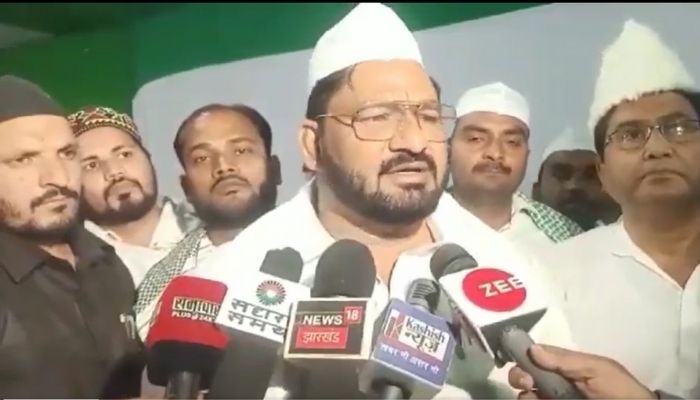
Jharkhand: Minister Hafizul Hassan says if 30% of minorities are disturbed, the 70% majority will have to suffer too

Jharkhand Minister Hafizul Hassan caught a controversy on Thursday 28th April 2022 by issuing veiled communal threats through his remarks over minority and majority. He warned the government for what he called ‘messing with the minority’ and said that if the 30% population is disturbed, it is the remaining 70% that will suffer more.

The Jharkhand Mukti Morcha leader and the minister of youth and sports affairs Hafizul Hassan said, “Whatever the Central government is doing against us will cause them equal damage. If we make up 30% of the population, you are 70%. If you shut down our businesses and homes, you too have 70% to lose.”

Bharatiya Janata Party’s Jharkhand state unit president Deepak Kumar tweeted, “This is the real face of the Hemant Soren government. If the chief minister is courageous enough, he should ask the minister to resign.”

Hafizul Hassan is an MLA from Madhupur which falls under the Godda constituency of Lok Sabha. BJP leader Nishikant Dubey is an elected MP from this constituency. He tweeted, “Mr Chief Minister, your Minister Hafizul Ji has openly threatened the Hindus. Have you given a supari to the Minister? Your agenda of conversion and inciting religious sentiments is before the public. Hafiz Ji is an MLA from my Lok Sabha, and he will lose his deposits in the next election.”

Hafizul Hassan also has a controversial background. In 2014, he was booked under Sections 409, 420, 120B, and 177 of the IPC for criminal breach of trust with respect to properties. In December 2021, when the union cabinet approved the raising of the minimum marriageable age of girls from 18 to 21, Hafizul Hassan had opposed this decision and had said, “Looking at the growth of girls nowadays, it should be reduced to 16, if not, then it should remain at 18.”

He also heads the minorities welfare ministry of the Jharkhand state government. Hafizul Hassan was also seen mourning the death of the former Prime Minister Dr Manmohan Singh even when he was alive and was just diagnosed with dengue.

Ex CEO of Twitter, after whose exit stocks of Twitter had jumped, now targets the new owner Elon Musk over Vijaya Gadde

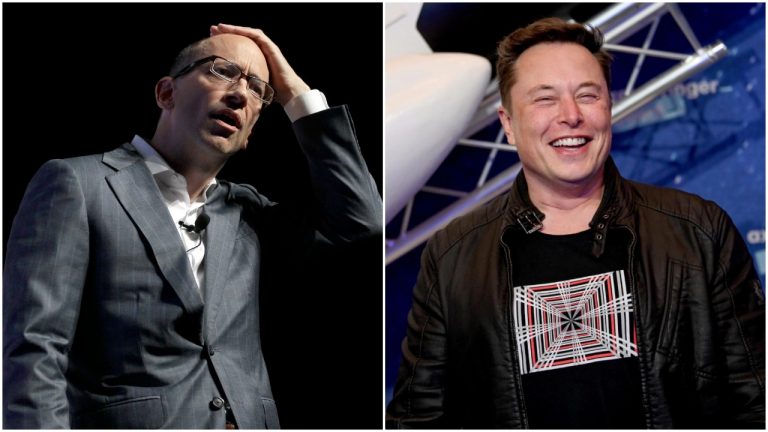
Former Twitter CEO Dick Costolo targeted the microblogging site’s latest owner Elon Musk over his tweet exposing the left-wing bias of Twitter’s head of legal, policy and trust, Vijaya Gadde.

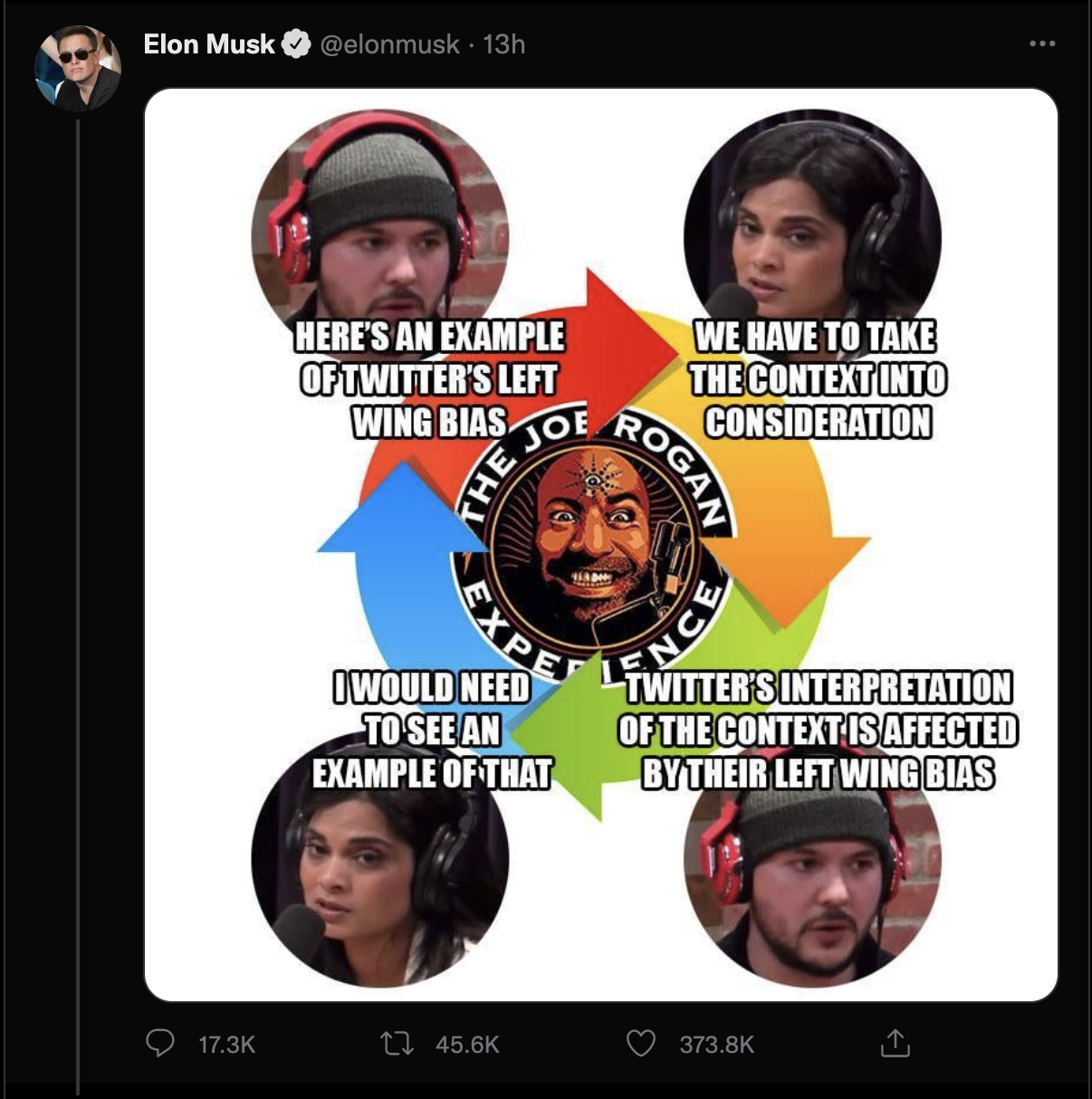
On Wednesday, Twitter owner Elon Musk had put an infographic highlighting the left-wing bias of the Twitter platform and its policy head Vijaya Gadde. In his tweet, Musk had shared a meme of Vijaya Gadde’s interview with American podcaster Joe Rogan and Tim Pool, where she was confronted about Twitter’s left-wing bias and arbitrary action against right-wing and conservative accounts.

The Tesla CEO tweeted the image to imply that the corporation has a “left-wing bias”, prompted by Gadde.

This particular tweet had come after Elon Musk had slammed Twitter’s top lawyer Vijaya Gadde over the ‘incredibly inappropriate’ censorship of Hunter Biden’s laptop story. Musk was replying to a post where a report by Politico was shared claiming Gadde had cried during a virtual meeting with the policy and legal teams that she oversees.

Vijaya Gadde is the chief legal officer and general counsel of Twitter. She had reportedly played a vital role in terminating ex-President Donald Trump’s account on Twitter.

Elon Musk criticised the decision the company made in 2020 to block a New York Post story about Hunter Biden to add that suspending the Twitter account of a major news organisation for publishing a truthful story was obviously incredibly inappropriate.

In response, Dick Costolo, the former CEO of Twitter from 2010 to 2015, replied to Musk, “What’s going on? You’re making an executive at the company you just bought the target of harassment and threats.”

It is important to note that during Dick Costolo’s tenure as CEO of Twitter, the micro-blogging site had faced one of the most challenging times. The platform had lost to other competitors in market share during Costolo’s leadership and was also accused of promoting left-wing bias. His tenure is often said to be the most controversial phase of Twitter, such that the stock price went up on reports that he was on his way out. Ironically, Costolo is now preaching and attacking Musk over his tweets.

Musk was also quick to hit back. “What are you talking about?” he retorted, adding, “I’m just saying Twitter needs to be politically neutral.”

“For Twitter to deserve public trust, it must be politically neutral, which effectively means upsetting the far right and the far left equally,” Musk tweeted.

Recently, Twitter accepted Elon Musk‘s offer to buy Twitter for $54.20 per share in cash. Since the announcement, the Leftists across the world have been showing signs of severe meltdown as they believe Musk’s thinking over “free speech” does not match with theirs.

Uttar Pradesh: Eight members of two Muslim families revert to Hinduism

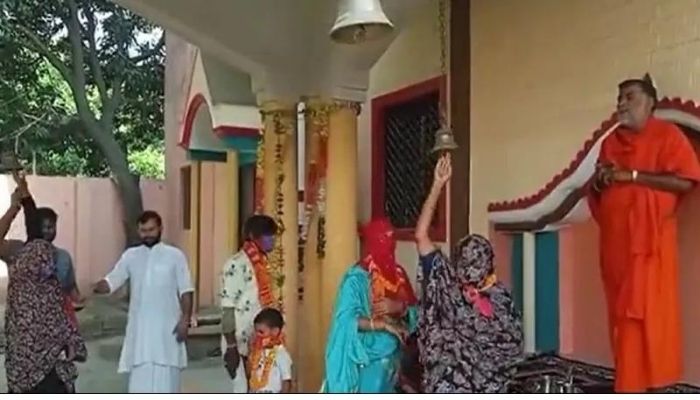
Eight members of two Muslim families reverted to Hinduism in Muzaffarnagar district of Uttar Pradesh on Tuesday, April 26, 2022. Mahant Swami Yashveer Maharaj and Swami Mrigendra Maharaj of Swami Yashveer Ashram Parishad at Bagra brought them back to Hinduism fold after performing the havan and puja rituals. All of them became Hindu amidst the chants of holy mantras by doing Achamana of the holy Gangajal.

After embracing the Sanatan faith, these people also got new names. Accordingly, Shahista is now Radha, Rashida has become Geeta, Harun got a new name Arun, and Barkha is now Varsha. Similarly, Akbar is now Krish, Ikra became Sheetal, Ehsan got the name Sachin, and Gullu will now be known as Hritik.

Swami Yashveer Maharaj said that after learning about the Hindus who had converted under greed or pressure, he decided to get such people back into their original faith. To date, he has brought hundreds of such people back into the Sanatan dharma. About the two families who recently returned to Hinduism, he said, “These are the people whose parents or the generation before them converted to Islam for some reason. The two families who have been repatriated are originally from the Meerut district.”

He further said, “After independence, from 1947 till the BJP government came to power in the country, all the governments have done the work of promoting conversion in a very vicious manner. The clerics often visit the houses of poor Hindus and ask them to convert to Islam by luring them in all kinds of ways. When poor Hindus don’t agree to convert, they are also threatened.”

The Hindu saint added, “In Uttar Pradesh, Hindus were persecuted in the earlier governments. They were converted to Islam. But the things have changed in the Yogi government. Now those who have left their religion are returning home. The pride of the people is awakened.”

Punjab: Guru ki Sarai allegedly converted to mosque by intimidating a Sikh family in Patiala, situation tense as Hindu organisations protest

0

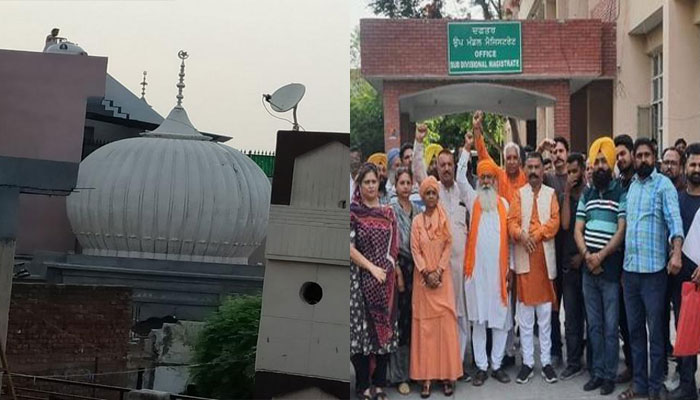
A controversy erupted in Rajpur in Patiala district of Punjab, after allegations that Guru Ki Sarai was converted into a mosque. Hindu organizations have alleged that the building was taken over by intimidating a Sikh family and later converted into a mosque. On the other hand, the Muslim community has claimed that the mosque has been located at the place for over 75 years, and only renovation work has been done.

According to a News Nation report, the Hindu community claimed that a Sikh family had lived at that place since before the partition. The family took care of the Guru Ki Sarai. Later, the family was intimidated by the members of the Muslim community, and they acquired the place. After some time, a mosque was built at that place.

The place had Sikh symbols that were replaced by Islamic symbols. The dispute reached a court in 2017, where the Muslim community failed to prove that the building belonged to them. The building was ordered to be handed over to the Sikhs. Hindu organizations claimed that Namaz is being offered in Guru Ki Sarai.

The disputed building is located in the Gujranwala locality of Patiala. Vishwa Hindu Parishad claimed that the Muslim community did not take permission before converting the disputed property into a mosque. The local residents of the locality and people from the Sikh community are supporting VHP. They are demanding action against those who converted the building into a mosque.

The Muslim community is headed by Attar Hussain, President of Gujranwala Masjid. In a statement, he said, “We had submitted documents to SDM in this regard. There was a mosque already situated at this place. After the partition, many people who lived here migrated to Pakistan. However, some Muslims stayed to save the mosque as part of its heritage. Now we have renovated the mosque.”

Sub-Divisional Magistrate (SDM) Rajpura Sanjeev Kumar said in a statement that he has scrutinized the documents of both sides and heard their claims as well. They have been called to submit their statements with documents on May 9, after which he would take the decision over the matter.

Twitter user fakes ‘car for dowry for sister’s wedding’ story over ‘delayed delivery’

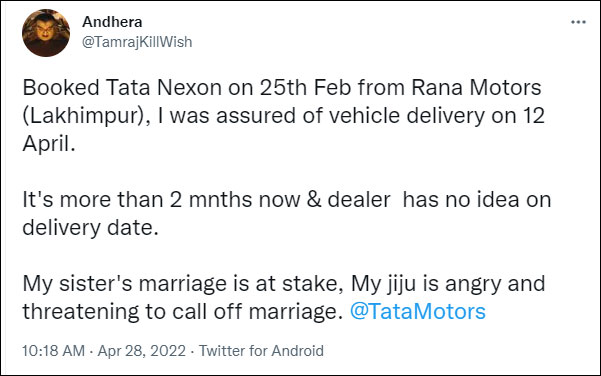
On April 28, a Twitter user with the user ID TamrajKillWish expressed his anger over the non-delivery of a Tata Nexon car by Rana Motors of Lakhimpur, Uttar Pradesh. The Twitter user mentioned that he had booked the car on February 25, and he was promised it would be delivered on April 12. However, the car was not yet delivered, and it was causing trouble.

Source: Twitter

Interestingly, he mentioned that the car was mentioned to be given to his would-be brother-in-law at the wedding, allegedly as a dowry. The brother-in-law, according to the Twitter user, was angry as the car was yet to be delivered, and he had threatened to call off the wedding. Notably, Tata Nexon costs anywhere between Rs 7 lakh to Rs 13.5 lakh depending on the model of the car.

Tata Motors, from its official Twitter ID, replied to the Twitter user and said, “Hi, we never want our customers to have such an experience with us. Please share your contact details via DM so that our team can connect with you to assist further.”

The Tweet has attracted severe criticism as the netizens assumed the car was meant for dowry as the brother-in-law has been threatening to call off the wedding. Twitter user D Sharma said, “Please deliver the dowry ASAP. Also, give three years extra warranty so that sister lives for three years more & doesn’t get burnt before that.”

On the other hand, Twitter User Shivaay urged the company not to deliver the car and said, “Don’t deliver this car now. It’s a dowry and which is a crime. Save the girl if without this car marriage gets cancelled, you will be saving a girl’s life from suffering.”

Another Twitter user Msmhater said, “The bigger worry should be your prospective brother-in-law. If the marriage with your sister is predicated on getting a car… Tomorrow he will extort you all for a luxurious flat in some posh colony. Get rid of him first… Car will be delivered sooner or later.”

Twitter user The Bull Rider suggested him to change his brother-in-law and said, “You should find a new jiju & new car dealer for you immediately!”

The Twitter user has been dodging the questions related to a possible case of dowry. OpIndia tried to contact the Twitter user but could not connect.

We could not get confirmation or comment from the Twitter user.

We also contacted Rana Motors in Lakhimpur, and the person who picked up the call was unaware about the booking for the car and said he would try to provide information later.

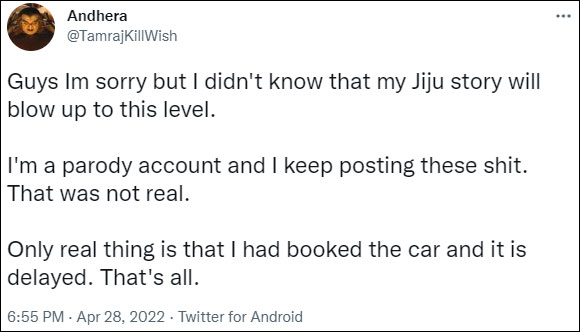
However, after the article was published, the Twitter user retracted his ‘dowry’ allegations and claimed that he is a parody account and that he had made up the dowry story. However, he claimed, he had booked the car and delivery of the same was delayed.

Twitter user’s tweet

At 7 PM, the Twitter user claimed that he did not know his ‘Jiju’ story will blow up to this level and that he keeps posting such tweets. He claimed that the incident of dowry he had originally claimed was not real. He added that he did, however, book the car and delivery of the same is delayed.

Speaking to OpIndia, Harjeet Rana, owner of Rana Motors, said that he got information from web about his store being dragged in a controversy on social media. However, the customer had not contacted him for the alleged delayed delivery, he said. “There is a waiting period of six months for the car mentioned in the tweet. We do not promise anyone delivery before the waiting period. However, the bookings that we got in January have already been delivered,” he said.

Note: The story and headline have been updated after the Twitter user admitted he made up story of dowry for his sister over alleged delayed car delivery.

Prashant Kishor’s refusal to join Congress is of relief to Ashok Gehlot, loss for Sachin Pilot: Here is how

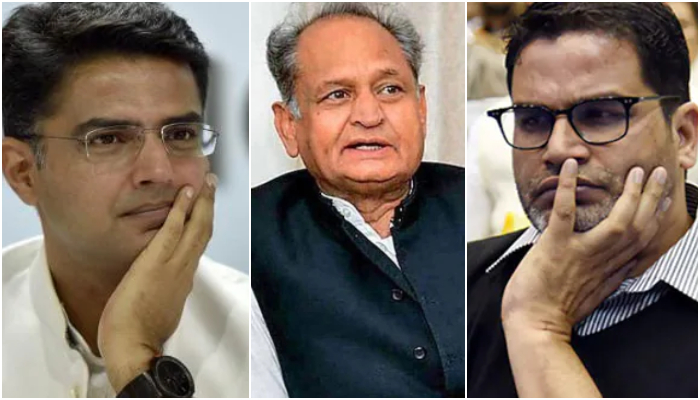
The decision of celebrity poll strategist Prashant Kishor to stay away from the Indian National Congress has done anything but comforted the Rajasthan CM and senior Congress leader Ashok Gehlot. Amid the strong political buzz that Congress’ Sachin Pilot might take over the reigns of Rajasthan ahead of the elections next year, CM Ashok Gehlot this week refuted the claims and said that the citizens should not believe in the ‘rumours’.

This is days after Congress leader Sachin Pilot met Sonia Gandhi in Delhi and discussed his future role in the state. According to the reports, he talked about how the party needed to break the trend and return to power in the state of Rajasthan. “Certain steps need to be taken to further strengthen the party,” he had stated on April 21.

Gehlot on April 23 then had mentioned that he had given his permanent resignation to Sonia Gandhi on the day he had become the Chief Minister of Rajasthan. He said that Gandhi would decide whether to keep him or remove him from the position and that when that happens, people won’t even get a hint. He said that the speculations of Pilot taking over the control of Rajasthan were just ‘rumors’.

Reports mention that the Pilot camp in the state of Rajasthan is struggling more since poll strategist Prashant Kishor has refused to join the Congress party. Kishor had suggested the Congress party focus upon and give chance to young leaders of the party. Kishor’s entry into Congress would have helped Sachin Pilot to create a big political change in the state.

Kishor’s expectations from the Congress party were simple. He wanted to handle the entire process of communication and messaging, he wanted the party to lead alliance talks with regional parties and wanted the party to focus on the Lok Sabha election 2024. However, the two failed to crack the deal because of the absence of strong leadership and a weak, uncharged local Congress cadre. The Congress wanted Kishor to focus on the state assembly elections scheduled this year and the next year.

The deal also is said to have failed as Congress wanted Kishor and not his company, the Indian Political Action Committee (IPAC). IPAC to date has helped many political parties including Janata Dal (United) in Bihar, Trinamool Congress in Bengal, Aam Aadmi Party in Delhi, and the Bharatiya Janata Party to win the elections.

Meanwhile, Gehlot’s relief over Kishor’s refusal to join Congress was also highlighted by state technical education minister Subhash Garg who tweeted that ‘the party needs a Chanakya, not any trader or service provider. Only leadership and workers can make an outfit strong”. Garg has been closely associated with Gehlot for past many years.

However, Sachin Pilot’s camp in the state of Rajasthan has stated that Pilot will not stop fighting, he will not give up his political space for any ‘lollipop’. “Pilot’s political space is Rajasthan and he knows that leaders who give up their roots don’t retain political importance”, the report quoted. The next Rajasthan legislative assembly election is scheduled to be held in or before December 2023 to elect all 200 members of the State’s Legislative Assembly.

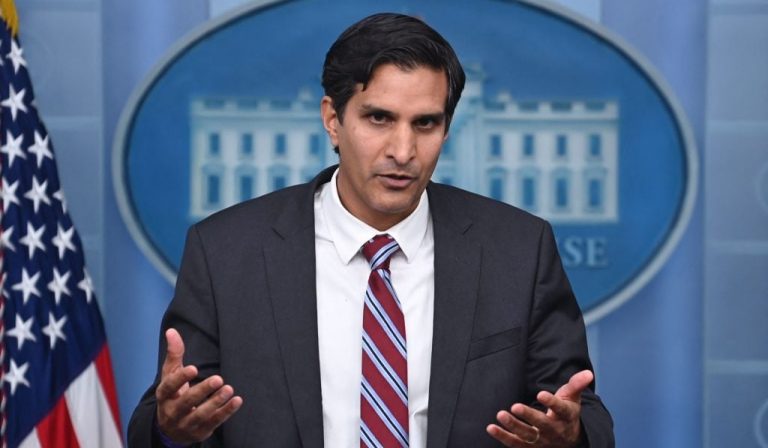
Joe Biden’s Russia sanctions coordinator Daleep Singh takes ‘leave of absence’, had threatened India over Russian oil imports

On Thursday, Deputy National Security Adviser for International Economics of the Biden administration, Daleep Singh, decided to take a ‘leave of absence’ from May first week citing personal reasons. Singh is a senior official of the Biden administration and serves as the chief architect of US sanctions on Russia amid the Russia-Ukraine war.

According to the reports, the absence of Daleep Singh might create problems for the United States which had relied upon the global sanctions to punish Russia for its invasion of Ukraine. However, the dates of Singh’s ‘leave of absence’ to resolve family issues are not yet clear.

Singh has been one of the chief architects behind economic sanctions imposed by the Biden Administration on Russia. He identified that the Russian economy was dependent on Western technologies such as microchips and software and that Russian banks were dependent on overseas capital. He helped to coordinate sanctions on Russia’s central bank, as the US, EU, UK, and Canada prohibited its banks from doing business with the Russian central bank.

It is important to note that Singh had earlier threatened India for purchasing oil from Russia and setting up an alternate payment mechanism to circumvent the US sanctions. Aiming to coerce India into submitting to the Western diktat, he had said that the country doesn’t want to see a rapid acceleration in India’s imports from Russia of energy and other commodities prohibited by global sanctions regimes.

“I come here in a spirit of friendship to explain the mechanisms of our sanctions, the importance of joining us, to express a shared resolve, and to advance shared interests. And yes, there are consequences to countries that actively attempt to circumvent or backfill the sanctions,” he had remarked.

He had also claimed that Russia would not come to India’s rescue if China was to continue its misadventure along the Line of Actual Control (LAC). “Russia is going to be the junior partner in this relationship with China. And the more leverage that China gains over Russia, the less favorable that is for India, I don’t think anyone would believe that if China once again breached the Line of Actual Control, Russia will come running to India’s defense,” he had said.

Hitting back strong at Singh, External Affairs Minister S Jaishankar then had said that the largest buyers of Russian oil and gas were from Europe and that it was natural for the countries to look for good deals, especially at the time when global markets were volatile.

The Biden-led government has imposed various sanctions on Russia. The recent sanctions imposed by the US consist of economic measures to ban new investment in Russia, severe sanctions on two Russian financial institutions – Alfa-Bank and Sberbank, sanctions on critical major state-owned enterprises, and sanctions on Russian government officials and their family members, including President Putin’s adult children and relatives of Foreign Minister Sergei Lavrov.

The country has also banned the import of some Russian fuels and goods and funneled cash and arms to Ukraine to buy its defense. Reports mention that the White House is considering replacing Singh temporarily with Mike Pyle who serves as chief economic adviser to Vice President Kamala Harris.

Centre makes FCRA clearance mandatory for educational institutes to collaborate with China’s Confucius centres after control changes hand: Details

The centre has notified that the educational institutes that intend to collaborate with China’s Confucius centres will need to have prior Foreign Contribution (Regulation) Act clearances and the approval of the foreign ministry.

According to the reports, the Centre’s decision came after the control of Confucius centres shifted from the Chinese government to a non-profit institution.

In 2020, the Ministry of Education had called for a review of all collaborations between Confucius centres and Indian institutes after the standoff along the Line of Actual Control. Following that, in early April this year, the Ministry of Education had sent another confidential circular saying that the control and operation of CIs have changed from the erstwhile Hanban, a public institution affiliated with the Chinese Ministry of Education, to a ‘non-profit trust’, the Centre for Language Education and Cooperation.

In another letter, the All India Council for Technical Education and the University Grants Commission have asked institutes that any collaboration with any NGO/foundation needed FCRA clearances.

“Hence all universities/institutions having collaboration with Confucius institutes / Hanban / CLEC or planning to collaborate to set up Confucius institutes or any other joint venture in any other name will be required to seek prior clearance under FCRA,” the communication sent by AICTE and UGC reads.

As per the latest order, Confucius centres are regarded as foreign cultural centres and will also require the approval of the foreign ministry for the setting up of new centres and the continuation or renewal of existing ones. All higher education institutes were asked to take necessary clearances.

It is important to note that the Confucius Institutes (CIs) have come under scrutiny for allegedly infiltrating several institutions to further Chinese propaganda. There are allegations of spying against people associated with Confucius Institutes.

Several CIs have been shut down in the US and Europe over such concerns. Last year, the US-based Tufts University in the United States decided to shut down the contentious Confucius Institute from its campus.

In September last year, the State Department had written to the governing boards of US universities cautioning them about the threats posed by the Chinese Communist Party. US State Secretary Mike Pompeo had said that he was hopeful that dozens of Chinese-government funded Confucius Institute cultural centres on US campuses would be shut down by year-end. The institutes are accused of working to recruit “spies and collaborators”.

The Confucius Institutes now exist in 29 British universities and 150 schools. While they claim to promote Chinese culture and language, the Mail reported that they curb free speech and peddle CCP propaganda. The Confucius International Education Group bought the Riddlesworth Hall Preparatory School, a school where Princess Diana studied, in 2015.

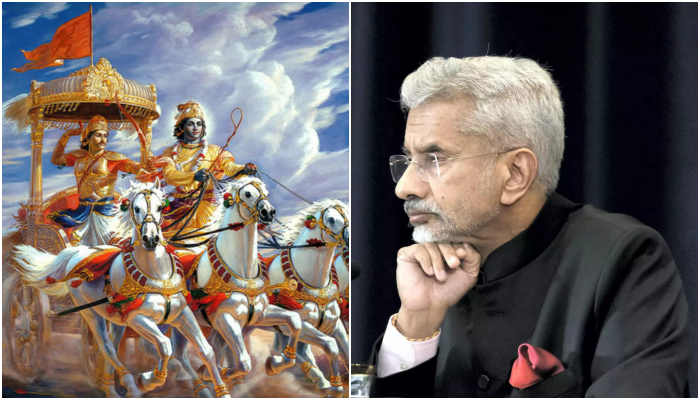
‘To understand Indian thought process, it is necessary to study the Mahabharata’: Dr Jaishankar explains ‘the India way’ through the greatest story ever told

India’s External Affairs Minister Dr S Jaishankar has been ruling the headlines since the day he took charge. A reinvigorated foreign policy with visible confidence that was glimpsed under Sushma Swaraj has now evolved into an assertive, assured and powerful projection of a rising India. If one follows the statements and responses of Dr Jaishankar on a world stage, the stark transformation from the apologetic, unsure India in the past years to a powerful nation aware of its strength is quite visible.

In his book ‘The India Way’, Dr Jaishanakr gives us an idea of how he sees India’s role in a changing world and how he wants the world to see India.

There is a chapter named ‘Krishna’s Choice: The Strategic Culture of a Rising Power’ where Dr Jaishankar explains why, for India to understand its strategies and goals, and for the world to understand India, it is necessary to study the Mahabharata, ‘the greatest story ever told’. The chapter starts with a quote by Goethe: “A nation that doesn’t honour its past has no future’.

Throughout the book, Dr Jaishankar has made one thing very clear. That is, a multipolar world is already here. This is something many Western powers seem reluctant to admit, at least in their statements and expectations from the rest of the world. In Dr Jaishankar’s view, the Indian thought process, choices and dilemmas in a multipolar world are a reflection, and in so many ways modern-day projections of the scenarios narrated in the powerful epic, The Mahabharata.

If there are today hurdles to understanding India’s viewpoint, much of that arises from an ignorance of its thought process. That is hardly surprising when much of the West was historically so dismissive of our society. It is revealing that the standard American introduction to Indian strategic thought does not even refer to the Mahabharata, though that epic so deeply influences the average Indian mind.

Dr Jaishankar in “The India Way’

Dr Jaishankar writes further that, just as it is impossible to comment on Western strategic tradition while ignoring Homer’s Iliad, or Machiavelli’s The Prince, or to try to understand China while disregarding their equivalent, Three Kingdoms, one cannot understand India without studying the Mahabharata.

He asserts that many of the challenges that India and even the world currently face have their analogy in ‘the greatest story ever told’.

धर्मे च अर्थे च कामे च मोक्षे च भरतर्षभ: |
यदिहास्ति तदन्यत्र। यन्नेहास्ति न तत् क्वचित्॥

The shloka in the great epic depicts its scale and scope quite effectively. It means, that whatever of Dharma, Artha, Kama and Moksha exist in this world, exist in this text (Mahabharata), and what is not in the epic, is not found elsewhere either.

Dr Jaishanakar explains that the India of Mahabharata was also multipolar, its leading powers balancing each other. When the fierce rivalry between two balancing poles could not be contained, other powers had to eventually take sides. The costs and benefits were constantly weighed then and weighed now too by relevant parties. The choices made by the powers define the current geopolitics.

Arjuna’s dilemma: The need to implement policies Vs the fear of consequences

Dr Jaishankar explains that Arjuna’s behaviour as a warrior is often displayed by state players in international relations and major policy decisions. There often arises situations where the reluctance to take decisive actions comes not from the lack of capabilities, but, like Arjuna, the fear of the consequences. Just as Arjuna could not choose his relatives, India did not choose its neighbours. We have to face the realities of our position and decide our path.

The expression of a ‘soft state’ describes a nation’s inability or unwillingness to do what is necessary, the EAM writes. India’s predicament has often been the same as Arjuna’s, especially in the fight against terrorism. We are often constrained by our lack of imagination and fear of risks, he writes. India’s response to terrorism has started to change, but like Arjuna, we will have to emerge as a righteous warrior who is willing to take risks, and face the consequences.

Asserting national interests and securing strategic goals is the dharma of a nation, as it was of an individual warrior in mahabharata. India needs to summon the willpower to address concerns that are upon us, rather than rationalize inaction by highlighting its costs.

Dr Jaishankar in “The India Way’

Blunt force is for imminent dangers and serial offenders

While asserting the need to be a righteous warrior who descends on the field ready to face the consequences and collateral damages that may be the cost of a conflict, Dr Jaishankar also highlights the necessity of displaying responsibility. ‘Power, as it grows, must be debated, projected and applied judiciously”, he writes in his book. Most of the military conflicts India faced had been defensive wars where justification was self-evident. But as the equations in the neighbourhood grow complex, India also needs strategic patience for the ‘modern-day Shishupalas’. Casual application of forces always leads to damage and blunt force, like the Sudarshan Chakra, should be reserved for serial offenders and imminent dangers. ‘Most strategists fight the last war, not the first’, the EAM explains through Krishna’s patience and long rope given to Shishupala. He also highlights strategic thought and application of wise choices, with Arjuna choosing Krishna’s guidance rather than his Narayani Sena. The choice had surprised Duryodhana, but Arjuna was aware of Krishna’s ‘game-changing potential’.

Asserting the need for making wise choices, the EAM writes that in a changing world, understanding the game-changing potential of capabilities that are over and above the established spheres of power, like artificial intelligence, robotics, data analytics and sensing, advanced surveillance etc are the need of the hour. Learning the importance of cards at hand, and playing them well, is the key in a new world, he explains. Duryodhana lost in that key aspect because he was oblivious to the significance of Sri Krishna, he just believed that the Narayani Sena will help him win.

Navigating the line between adherence to rules and occasional deviation

Dr Jaishankar notes the multiple instances in the Mahabharata of violations of the code of conduct, and how they were played in the long run. As the stakes mounted in the great war, rules and codes of conduct were laid aside. Duryodhana was killed with a blow that was literally ‘below the belt’. Bheeshma was brought down using a woman, Karna was killed when he was trying to make his chariot move, unarmed and unprepared. The worst of all was the killing of Abhimanyu.

However, rules, when adhered to and respected, prove to be very valuable in international relations, because, serial violators are given little credit when they comply while a responsible power, if it becomes an occasional disrupter, can always justify a deviation. “Powerful nations are understandably reluctant to put their options and interests at the judgement of others”, he asserts.

This is something Dr Jaishankar stated in a different way on Wednesday, 27 April while speaking at the Raisina Dialogue. “It is better to engage with the world on the basis of who we are rather than try to please the world as a pale imitation of who they are. The idea that others define us and we need approval, is an era that we need to put behind us.”

In the book, he underscores that the strength of an unorthodox player is to make an accurate judgement about the likely responses of the more orthodox and ruled-bound ones. In the modern world, open societies, the rule-based players often have to face less scrupulous competitors. “Fighting the uneven fight is their Karma”, and the most extreme situation in this context arises when rule-based players face state-sponsored terrorism, he says.

India’s response to terrorism: Handling an enemy that is suicidal

Dr Jaishankar cites two examples from the Mahabharata, to explain how suicidal small powers behave. King Susarma of the Trigarta kingdom was once humiliated by Arjuna. The Trigarta warriors made the single instance of humiliation their driving force, so much so that, they focused all their energy on exacting revenge, even at the cost of self-annihilation. Constantly pouring fire into the Kuru-Pandava rivalry, they had tried to flush the hiding Pandavas out from the Virata kingdom during their exile. In the war, they challenged Arjuna to a fight to the death. Though Arjuna did triumph in that battle, it came at a great cost. Arjuna’s absence from the battlefield eventually led to the death of Abhimanyu.

Similarly, Sindhu king Jayadratha’s vow to avenge his humiliation also proved to be very dear to the Pandavas. Dr Jaishankar says that though such unifocal competitors are rare, they need special attention. Because this is what Pakistan is for us, an enemy that has gone to extreme levels to hurt India, even if its own system is corroded by the very forces it nurtures. India cannot replicate Arjuna, but India does need strategic clarity while dealing with Pakistan because ignoring the visceral feelings of an adversary that is willing to self-annihilate proves very expensive.

The problem does not have a one-fix solution. But one of the solutions is to ensure that there is no longer guarantees of protection for terrorists. Naive notions that India’s engagement itself is a solution have to be put away, Dr Jaishankar asserts. India has to make terrorism very costly to sustain. Pakistan can only be treated as a normal neighbour when it starts behaving like one, Dr Jaishankar minces no words in making this clear.

Regime change and leveraging the external environment to own benefit: Two sides of the same coin

Dr Jaishankar discusses that regime change has long been in practice, since the time states existed. In Mahabharata, Krishna’s decision to eliminate Jarasandha not just served to put down an immediate challenge, it also removed a potential major obstacle from Yudhisthira’s path to becoming the emperor. Krishna, the leader of the Yadavas, also settled an old score. However, the killing of Jarasandha was also immediately necessary, because he was holding 98 princes captive and was going to sacrifice them once the number reached 100.

This regime-change operation also was an example of a group of less powerful nations combining their power against the dominant opponent, what we call in modern terms a ‘South-South cooperation, he explains. In killing Jarasandha, a national goal was obtained in the name of global good. Regime change carries a negative connotation mostly because the USA’s botched up attempts in Iraq, Libya and elsewhere, but if it must be done, it is best achieved by an ethical explanation that has credibility.

The other side of the same coin is leveraging an external environment, Dr Jaishankar explains. Though the Pandavas were outnumbered and outmatched by the Kauravas in military terms in the 7:11 ratio, they never hesitated from taking help. They invoked the very Gods to obtain potent weapons and rallied support from unorthodox allies.

Those who advocate strengthening comprehensive national power are certainly in the right, but that is the obvious answer. What should not be neglected is the skill to tap into the influence and power of others.

Dr Jaishankar in “The India Way’

Shaping the narrative, gaining the upper side through public opinion

Dr Jaishankar explains that in the Mahabharata, though the Pandavas were the victims through much of their lives, their ability to play victim was no less. Shaping, and controlling the narrative was something where they consistently scored high above their Kaurava cousins, through acts of valour and nobility. Their days of growing up in the forest, the murder attempt at the house of lac, the unfair partitioning of the Hastinapur kingdom and the subsequent ability to execute a start-up kingdom in Indraprastha, all of it gave the upper hand in public opinion. Eventually, the tragic and abominable treatment of Draupadi was sued as casus belli that was never allowed to dampen. In Jaishankar’s words, the final proposal of a reasonable settlement with just five villages was the ultimate masterstroke, significantly shifting the opinion in their favour just on the eve of war.

He explains that there is a broad correlation between occupying the high moral ground and shaping the narrative. During the cold war, one side put their argument for democracy, personal freedom and a market economy, while the other side stressed on social justice and the common good. As China rose globally, it has tried to amplify its message of prosperity and peaceful character. The West in general and the EU in particular, has reinvented itself by championing global issues. As India rises, it will also have to take a call on its own narrative, and decide what message it wants to give to the world.

“A society that would soon be the most populous and prominent in its economic size cannot be without its message”, Dr Jaishanakr asserts. In the past, there was comfort in group mentality and non-involvement. As India rises in a rapidly changing world, we won’t have that comfort for long.

Conclusion

Dr Jaishanakr writes that in Mahabharata, the subtext that runs is the balance between powers. in modern-day contexts, the intuitive feel for creating and maintaining such balances has been diminished in our country. In going forward, as we enhance our capacities, the confidence level will have to be improved too. Realising that national interests will have operational costs, and making those difficult choices is the responsibility of leadership. Like the Pandavas, born to different mothers and equipped with unique skillsets, diversity and the successful integration of those diversities are our strengths. Blessed with both social pluralism and extreme individualism, India has to grapple with set habits, administrative reforms and break silos to bring about effective implementation of policies, he adds.

Dr Jaishankar writes that the determining factor in the Mahabharata was Sri Krishna. Like Sri Krishna, to become the master of the game, one needs to see the big picture, fashion a strategy accordingly and come up with tactical solutions to achieve goals. “As Indians prepare for greater contributions, they must rely on their own traditions to equip them in facing a tumultuous world. That is certainly possible in an India that is now more Bharat. As we make our choices in a world of all against all, it is time to come up with our own answers”, he concludes.

Dr Jaishankar’s book ‘The India Way: Strategies for an uncertain world’ is available both in print and e-book format here.


Centre cancels FCRA licenses of four NGOs for diverting funds and not complying with rules

0

The Central Government has cancelled the Foreign Contribution Regulation Act (FCRA) licenses of several more NGOs, including Human Rights Initiative (CHRI), Apne Aap Women Worldwide India (AAWWI), Heavenly Grace Ministries and the Peoples Organisation For Empowerment Of Tribals (POET). The government has stated that these NGOs violated the provisions of the Act.

A ministry official was quoted by the Indian Express saying that the license of CHRI has been cancelled after completing the investigation. It was already under suspension for one year. The official said, “It has now been cancelled as the investigation has been completed, and the ministry is of the opinion that given the violations, the NGO cannot be allowed to continue to receive foreign funding.”

Last year Ministry of Home Affairs (MHA) suspended CHRI’s license for 180 days, citing an alleged violation of FCRA laws. In the order, the Ministry stated CHRI failed to provide information about opening a bank account in February 2016. The NGO was also accused of violating other regulations under FCRA, 2010. The order read, “Further, one utilization account through which the association has been utilizing foreign contribution has not been intimated in ARs (annual reports) for FY 2016-17 and 2017-18.”

CHRI failed to provide information about projects for which it had received foreign funding in the annual report. It also refunded some foreign contributions to the donor in 2013-14 and 2014-15 but did not mention it in the reports, which was in violation of the FCRA regulations.

After the suspension of the license, CHRI approached Delhi High Court. The NGO said in its plea that the suspension would threaten its existence and cause harm to its reputation. It added the suspension would stop it from utilizing funds for planned activities and paying salaries to the employees. The NGO claimed to have provided information on funds and bank details for FY 2018-19 to the government. However, the High Court did not provide any relief to the NGO.

Along with CHRI, the FCRA licence of Apne Aap Women Worldwide (AAWW) was also cancelled by Union Home Ministry. The organisation failed to file annual financial returns mandated under the Foreign Contribution Regulation Act 2010.

Odisha based NGOs, Heavenly Grace Ministries, and the Peoples Organisation For Empowerment Of Tribals (POET) also got their licenses revoked over violations of the FCRA Act. Their license was suspended for 180 days last year. A govt official has said that the these two NGOs failed the basic criteria needed to regularise their FCRA licences. “Based on the evidence received against both the NGOs, the MHA had suspended their registration in August last year, and finally cancelled their licence after a proper investigation,” the official said.

Heavenly Grace Ministries is a Christian evangelical organisation, while POET is involved in the welfare works of tribals in some districts in Odisha.

In the last several years, thousands of NGOs have lost their FCRA licence for failing to comply with the rules. In the last 5 years, from 2017 to 2021, licences of around 1900 NGOs or associations registered under ‘social’ category have been cancelled by the union government for violation of FCRA rules. On January 1 this year, licences of over 6000 NGOs were expired as they had failed to apply for renewal.