Home Blog Page 3479

Cities in Canada may impose curfew amid ‘Freedom Convoy’ protests: Indian High Commission in Ottawa issues advisory

0

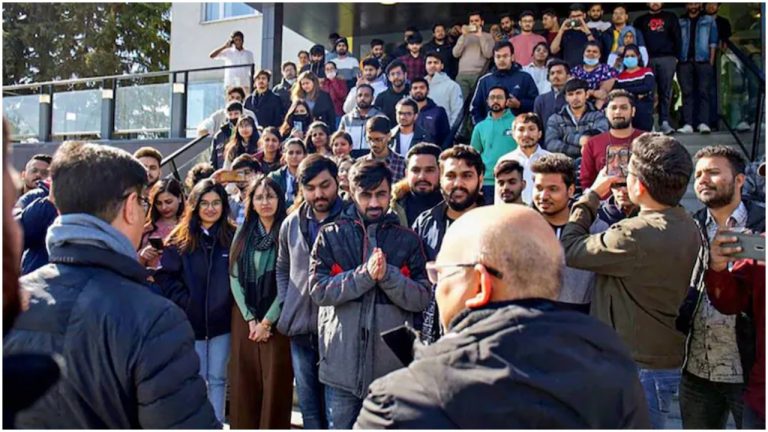
On Tuesday, the Indian High Commission in Ottawa issued an advisory for the Indian citizens in Canada and for those Indians planning to visit Canada to avoid areas where protests are taking place, such as downtown Ottawa. The cities in Canada including Ottawa, Toronto and others are witnessing truckers protests who have organized large gatherings and blocked roads.

In an appeal, the High Commission said that the blockade has severely disrupted the public services and has caused heavy traffic jams, a shortage of essential items. “Owing to the prevailing situation, a state of emergency has been declared for the city of Ottawa. The impact on traffic and services is likely to continue”, the official statement read.

The High Commission stated that the local authorities in major cities of Canada are planning to impose curfews amid the protests. It asked the Indian citizens to remain alert and follow the instructions by local authorities.

The High Commission has also set up a special emergency helpline viz (+1) 6137443751 to provide assistance and guidance to Indian citizens in distress. “The Indian citizens are advised to monitor local media for the evolving situation”, the advisory read.

Truckers in Canada have been protesting against the COVID-19 measures. They are opposing the vaccine mandates imposed by the Trudeau government. On February 8, the Mayor of Ottawa declared a state of emergency over the ‘Freedom Convoy’ protests in Ottawa.

Also, Canadian Prime Minister Justin Trudeau claimed that protesters cannot stall the economy under the garb of democratic rights. “Canadians have the right to protest, to disagree with their government, and to make their voices heard. We’ll always protect that right. But let’s be clear: They don’t have the right to blockade our economy, or our democracy, or our fellow citizens’ daily lives. It has to stop”, he tweeted.

However, Trudeau has vowed that the Canadian government will do everything necessary to bring the situation under control.

How Nehru and Congress had betrayed Goa: Declined to send armed forces, denied support to liberation efforts

When Prime Minister Narendra Modi was extending his motion of thanks for the President’s speech in Rajya Sabha on Tuesday, he touched upon the often neglected episode of Liberation of Goa from the Portuguese in 1961. While addressing the chair on the occasion of completion of sixty years of Goan Independence and its accession to India, PM Modi made glaring remarks on why the then PM Nehru hesitated to use armed forces for helping the revolutionaries in Goa with their struggle.

Speaking about the armed revolutionary struggle which finally led to the liberation of Goa in 1961, Modi minced no words while criticising the Congress for its derailed decision-making capabilities which resulted in huge losses of a large number of Goan civilians who wanted to accede to India. He said, “This year as we celebrate sixty years of Independent Goa, I want to say, had Sardar Patel been allowed to frame a policy for Goa like Hyderabad or Junagarh, Goa would not have to wait after fifteen years of the Indian independence to liberate itself.”

PM Modi quoted from Nehru’s speech, highlighting how he had alienated his own countrymen and had tried to shame the Satyagrahis struggling for the liberation of Goa.

Further quoting the media reports of the time, he said that then PM Nehru was worried more about his personal image in the world and hence didn’t use force to liberate Goa from Portuguese colonial rule. He said, “Even when bullet shots were fired at Satyagrahis in Goa when Indian people were being fired at for fighting for India, Prime Minister Nehru had the audacity to not send the army for Goa.” According to Modi, Nehru had declined to help even the peaceful protestors for which freedom fighters in Goa had faced the colonial brunt for an additional fifteen years.

While quoting Nehru from his 1955 speech from Red Fort, PM Modi said, “There should be no fear that we will do a military operation in Goa. There is no force in and around Goa. The people think by disrupting the situation, they can convince us to send our forces there, but we won’t budge,” Insinuating the Satyagrahis who were joining the struggle in Goa from all corners of the country, are lawless elements who are disrupting the peace. Perplexed at the language used against his own countrymen, PM Modi asserted that the people of Goa would never forget what Nehru and Congress did to them.

Nehru’s lethargy in taking action for Goa

There are many speculations as to why Goa had to wait for so long to get itself liberated from the colonial rule of Portuguese alongside Dadra and Nagar Haveli and French rule in Pondicherry. What remains a fact is Nehru’s reluctance to use armed forces in operations against the foreign rulers. Initially, Nehru was in favour of using diplomatic channels to further the cause, in order to keep his identity as a ‘peace-loving’ global leader. When the diplomatic battle of gaining support from allies continued to fail, Nehru’s close aide VK Krishna Menon, the defence minister finally decided to send the army to Goa on December 11, 1961.

The Indian Government’s sudden decision to employ force owed to Menon’s election candidature against JB Kriplani in the 1962 Lok Sabha elections from North Bombay. The annexation Goa worked in favour of Menon while he won the elections defeating Kriplani. But it was Menon and not Nehru who sent the armies to help the revolutionaries of Goa.

Even while assessing Nehru’s efforts objectively, one would conclude that his over-dependence on diplomacy and perpetual seeking of validation from international platforms did not work in his favour ever. On February 27, 1950, when the Nehru Government asked the Portuguese to open negotiations about the future of Portuguese colonies in India, Portugal asserted that its territory on the Indian subcontinent was not a colony but part of metropolitan Portugal and hence its transfer was ‘non-negotiable’. The Portuguese claimed that India had no rights to this territory because the Republic of India did not exist at the time when Goa came under Portuguese rule.

A newspaper clipping reporting about the timid approach of the Indian Government to solve the Goan problem.

The Portuguese had captured Goa in the Adil Shahi period and continued to rule the territories of Goa, South Konkan and Daman and Diu for around 450 years, even after the British left the Indian Subcontinent. While PM Narendra Modi in his address opined about the role Sardar Patel could have played had he been given the responsibility of Goa, it is time to explore what role he had played before his death in 1950. Rajmohan Gandhi, the grandson of MK Gandhi has described in his book ‘Patel: A life’ a meeting that took place between top leaders concerning Goa’s situation in 1950. With tightly closed eyes, Patel was hearing all the points which were being made. He rose up to interject suddenly and said, “Want to enter Goa, it’s a matter of mere two hours”. However, Nehru was to decline this proposition and Patel did not interject thence.

Besides not letting the army perform its task to liberate fellow Indians from foreign rule, Nehru had also opposed other revolutionaries from India who wanted to join the struggle at Goa. A newspaper clipping from the late 1960s has reported the All India Congress Committee approving a resolution to call back Satyagrahis (peaceful protestors) to Indian soil. It read, “any entry into Goan soil by Indian Nationals will be inappropriate and even individual Satyagrahas should be avoided”. This was happening when the Goan inquisition was again showing its colours while political prisoners were being beaten up in jails.

Shefali Vaidya, author and researcher on the Goan inquisition, whose father was a revolutionary in the struggle for the liberation of Goa has recounted how Azad Gomantak Dal members were prevented from getting arms and ammunition from India and the Indian Government eventually rendered them helpless.

While going by the diplomatic means to secure the interests of Goa did make sense at a certain time, the call given by Nehru to snub Indian revolutionaries to weaken them does not add up to the puzzle. The Indian Air Force bombed Dabolim airport on December 18 and on the next day the Indian army entered Goa from the south. Facing no resistance whatsoever, by the next evening Goa had been liberated after 5,000 Portuguese armies had surrendered. Even after the episode unfolded, the diplomatic exercises did not bear fruits as many countries in Europe, America, France, China and Great Britain targeted India in the United Nations to stop the Indian army’s operations in Goa.

Nehru and the Congress collectively failed the nation and the people of Goa, resulting in its delayed accession and had actively worked against Indians who were struggling to liberate a chunk of India that was still under foreign rule long after 1947.

Hyderabad: 101 goats sacrificed for AIMIM chief Owaisi’s long life

0

On February 6, a businessman in Hyderabad sacrificed 101 goats at Bagh-e-Jahanara to pray for the long life of All India Majlis-e-Ittehadul Muslimeen’s chief Asaduddin Owaisi. Owaisi was present at the event. This came days after the car Owaisi was riding in was shot at by two men.

The alleged attack on Owaisi

On February 3, Owaisi was travelling to Delhi from Meerut after attending a political event. He was allegedly fired upon near Chhajarsi toll plaza. He escaped without any injuries. Since the attack, his supporters have been praying for his safety and long life.

Reports suggest that two people identified as Sachin Pandit and Shubham were arrested by Hapur police in the case. A 9mm pistol was recovered from Sachin. After the incident, Union Home Ministry approved Z-security for Owaisi, which the AIMIM leader rejected while speaking in Lok Sabha.

Prashant Kumar, ADG (Law and Order), informed that an illegal 9 mm pistol, which was used in the crime, was recovered. Five teams were formed to probe the case. Two accused were nabbed by the cops. Superintendent of Police (Hapur), Deepak Bhuker, stated that the assailants attacked Asaduddin Owaisi because they were offended by his “anti-Hindu” statements.

Owaisi refused to accept security by central govt.

While addressing Rajya Sabha over the matter, Home Minister Amit Shah informed the house, “Two unidentified people had fired on the carcade. He came out safe, but there were three bullet marks on the lower portion of his vehicle. The incident was witnessed by three witnesses. An FIR has been registered.”

HM Shah added Owaisi’s event in Hapur districted was not pre-planned and local authorities were not informed about his visit. He said, “Taking quick action, two accused were arrested, two unauthorised pistols and an Alto car were recovered from them. The forensic team is doing a minute investigation of the car and the incident site, evidence being collected,”

He further told the house that the government would reassess the security threat to the Lok Sabha MP Owaisi. He also pointed out Owaisi had refused to accept security provided by the Central government. He urged Owaisi to accept the security and said, “Home Ministry took a report from State Govt immediately. On the basis of earlier inputs from central security agencies, the Centre had ordered to provide him security. But due to his unwillingness to avail security, Delhi and Telangana Police’s efforts to provide him security didn’t succeed.”

While addressing a rally in Chhaprauli, district Bhagpat, on February 5, Owaisi compared himself with MK Gandhi and said, “Those who attacked me are the ones who killed Gandhi.”

Uttar Pradesh Assembly elections

Assembly elections in Uttar Pradesh will be held in seven phases starting from February 7. The last phase will be held on March 7. The results will be announced on March 10. AIMIM is contesting UP Assembly elections for the first time.

CFI and Jamaat-e-Islami Hind counselling us in the row, we started wearing Hijab only in December, said Burqa clad women

The role of the Campus Front of India(CFI), the notorious student wing of the radical Islamist outfit Popular Front of India, in instigating the Muslim students to create the hijab controversy in Udupi, Karnataka, has come to light.

According to a January 19, 2022 report by The News Minute, the Muslim students who are protesting against uniform regulations in the state were in contact with radical Islamist outfit CFI. The students admitted that they began wearing the hijab in college only in December 2021, realising that there was no particular rule banning the hijab in the college rulebook. 

“Initially, when we joined the college, we thought that our parents had signed a form which had barred the hijab, but though there is a form, there was no mention of the hijab in it. So, our parents met the college authorities thrice and requested them. But there was no response, so we decided to wear the hijab in school. This was in December (2021),” one of the students reportedly said to TNM.

According to the reports, the Women’s Government Pre-University College in Udupi, the epicentre of the burqa protests, has become a hub for PFI to carry out its communal political events, especially over the last year. It is being said that a few Muslim students of the college had participated in a protest organised by ABVP in October 2021.

Apparently, an image of the same had gotten viral on social media angering PFI. Later, suspiciously, another photograph began doing rounds on social media, stating, “These students had participated in a protest without knowing that it is a protest by the ABVP. After Campus Front of India leaders counselled them today, they joined the Campus Front of India of their own volition.” 

The Hijab-clad Muslim students also admitted that the Campus Front of India members are counselling them on the ongoing controversy. Reportedly, the students who had joined the protests in the October 2021 incident are among the ones who are protesting against the uniform rules and insist that they would be wearing hijab in the classroom.

“We approached the CFI (over the hijab issue) after talks between parents, and the college authorities did not lead anywhere,” admitted one student in the TNM report.

Not just PFI, Jamaat-e-Islami Hind, another radical Islamist outfit accused of receiving funds from abroad to promote Islam in the country, has been playing an influential role in the ongoing controversy. Both Campus Front of India (CFI) and Students Islamic Organisation (SIO), the student wing of Jamaat-e-Islami, had even approached the authorities on December 30 asking that the Muslim girls will be allowed to wear Hijab. 

Jamaat-e-Islami receiving funds from Saudi Arabia to promote Islamic dress code

In the light of the ongoing controversy, it is pertinent to note that a Kerala-based journalist had made a sensational disclosure in July last year regarding how radical Islamic organisations such as Popular Front of India and Jamaat-e-Islami are receiving funds to promote Islamism in India. In a Clubhouse discussion, Kerala-based journalist MP Basheer had revealed details pertaining to the international funding to advance radical Islam in the country.

In his disclosure, Basheer had said that T Arif Ali, secretary-general of the radical Islamic organisation Jamaat-e-Islami Hind, had accessed a letter written by Jamaat-e-Islami requesting the King Abdul Aziz University in Saudi Arabia to increase the financial grant to the radical Islamic organisation so that they could create awareness and promote Islamic dress code in Kerala and India.

Further, Basheer had revealed that Jamaat-e-Islami had started a project in India to promote the Islamic dress code for women and had access to funds from King Abdul Aziz University, an Islamic university in Jeddah, Saudi Arabia. He also said that many top Muslim journalists in the country were employed to assist them in this nefarious design, which King Abdul Aziz University allegedly paid.

The letter which Basheer mentioned in his Clubhouse discussion was a letter written by Jamaat-e-Islami seeking more grants for implementing this Islamisation project, which according to the journalist, has been continuing for the last three decades. The outfit was banned on February 28, 2019, by the Government of India following the terror attack in Pulwama as it was suspected of funding the terror organisation Hizbul Mujahideen.

Ironically, the Karnataka unit of the radical Islamist outfit Jamaat-e-Islami Hind, which is fighting for the rights of Muslim women to wear Hijab, had taken strong objection to the central government’s directive to perform “Surya Namaskar” on Republic Day and had asked Muslim students and parents to refrain from participating in the event as it is against Islam.

Hijab controversy turns violent, Muslims caught pelting stones at Hindu students

The uniform regulations in educational institutions have now taken a dangerous turn in Karnataka after a few Muslim students refused to follow the guidelines and insisted that they would be wearing Hijab inside educational institutions. In response, Hindu students also started wearing the Saffron shawls prompting the authorities to ban both outfits.

The issue started when some Muslim girls alleged that they were not allowed to wear hijab to the school. However, it is being alleged that the Muslim girls were demanding to be allowed to wear hijab inside the classrooms, violating the existing rules.

However, the Muslim students have brazened it out to protest against the authorities outside, risking the future of several other students studying in the school. On Tuesday, the burqa row took an ugly turn after stone-pelting and violence were reported from various parts of the state.

Yashpal Suvarna, the Vice President of the College Development Committee, said that even though 150 Muslim students are studying in the college, none of them has made this demand. According to him, eight girls, allegedly belonging to CFI, wanted to create a controversy.

Meanwhile, Karnataka’s Primary & Secondary Education Minister BC Nagesh also said that they suspect that the Social Democratic Party of India (SDPI), the political arm of the PFI, is instigating the Muslim students in the ongoing Hijab controversy.

According to the videos that have gone viral on social media platforms, stone-pelting was reported in Shivamogga, Bagalkot, Udupi, and other parts of Karnataka. In one video, it was seen that a Muslim mob was allegedly throwing stones at the protesting Hindu students, leaving many injured.

In another incident, the Muslim mob allegedly tried to threaten Hindu students who were going to college with saffron shawls. The situation was brought under control after the police intervened.

A similar situation was reported from the surrounding areas of the Bapujinagar Government Pre-University College in Shivamogga. According to reports, police have resorted to lathi-charge as pro-Hijab groups pelted stones at private buses near the Junior college. 

Anticipating more violence in the state, Karnataka Chief Minister Basavaraj Bommai ordered the closure of all high schools and colleges in the state for the next three days.

‘Yogi govt stopped hooliganism, we have received all govt benefits without any discrimination: Ground report from Muslim-dominated Deoband seat

Deoband, one of the five constituencies in the Saharanpur district of North Uttar Pradesh, is a Muslim dominated constituency. The Darul Uloom, prolific for its fatwas, has great influence in this area. Maa Balasundari temple is located in this area. Arjun, the third among Pandavas had meditated here during the Agyatvaas. Shri Krishna Gaushala, which has ‘Devvrind’ inscribed on its entrance, is also located here in Deoband.

The demand to change Deoband’s name to Devvrind is a long-standing one. According to Vijaypal, who has been observing the work of this cowshed since 1990, there are currently 324 cows here. Before 2017, he claims, the police used to come here with a huge number of bovines that were rescued from cow smugglers. In recent years, cattle smuggling has been reduced to a great extent, he says.

Deoband is also notorious for cow slaughter. Despite the Yogi government’s efforts to tighten its grip on the perpetrators, illegal cow slaughtering still continues to some extent.

Saharanpur SSP Akash Tomar told OpIndia: “I have been in this district for more than 3 months. Since then, action has been taken against 57 cow slaughterers under the Gangster Act. Property of cow smugglers worth more than 1 crore has been attached. Many cases have been registered against these people. Cow slaughter is being prosecuted vigorously. It’s also worth noting that the Shri Krishna Gaushala cart visits Deoband neighbourhoods every day to collect roti, but we couldn’t discover a single Muslim name among the Gaushala’s contributors.”

Silence of Muslims on Ram Mandir

Deoband has been beset by a number of issues, including unlawful cow slaughter and smuggling. Another issue that has prevailed in the area is intolerance and prejudice against Hindus. Earlier in the day, it was reported how Ahsan Rao, a youth from Deoband, Uttar Pradesh was abused and called ‘su*r’, dog, h**ami ka bacha and more. He was threatened with questions like ‘what will happen to you when Bhaiya comes, and Yogi will go to the Math’?” The reason behind the continuous abuse is that he raised slogans of ‘Jai Shri Ram’ and ‘Bharat Mata Ki Jai’ during a rally in Saharanpur in December 2021.

Even during election season, the Muslims of Deoband refrain from speaking out on these matters. When OpIndia spoke to Sufiyan Qureshi, who otherwise reads ballads in the admiration for BJP, regarding Ram Mandir, he refused to comment. However, Sufiyan Qureshi told OpIndia that “73% of the voters here are Muslims. Many Muslim households I know had houses built by the BJP. According to what I’ve heard, there are 900 dwellings erected here by the BJP of which 650 are that of Muslims. People whose homes were built by the BJP or Modi ji now openly declare that they will vote for the person who built their home,” confirmed Qureshi.

BJP Vs BSP

The BJP has re-nominated Brijesh Singh Rawat as their candidate from the Deoband constituency. There was conjecture in the media before the announcement of the polls that Chief Minister Yogi Adityanath would run for one of the seats, which included Deoband. However, the party ultimately put its trust in Rawat who had in 2017 also won this seat by defeating Majid Ali from the Bahujan Samaj Party with a margin of 29400 votes.

The SP has fielded Kartikeya Rana, the son of former minister Rajendra Singh Rana, from this constituency in the hopes of securing the Muslim votes and splitting Hindu support. However, it is being believed that BJP and BSP are the main contenders for the Deoband seat.

It’s worth mentioning that Deoband is the only seat in western Uttar Pradesh where a BSP candidate is running in the main election.

Umar Madani has been nominated by Owaisi’s party, AIMIM. He is a member of the Madani family, which is quite influential in the region. Nonetheless, he is just perceived as a vote cutter.

Mohammad Anwar, who is an engineer by profession, told OpIndia, “Madani ji’s family is respected for religious reasons. They have no political influence. Maulana Madani’s statement has come that you should support such a party that maintains peace and brotherhood in the country. The one who has done such work so far, has given the slogan of Sabka Saath Sabka Vikas, is the Bharatiya Janata Party. People here are getting benefit from this.”

‘Hooliganism will return if Akhilesh Yadav comes back to power’

However, the challenge for the BJP in Deoband is not entirely one-sided. Many of the people who threatened to visit Ahsan Rao after March 10 dwell on the same streets of Deoband.

Speaking to OpIndia, Ahsan said, “After the video of raising slogans went viral, I started receiving calls including from Pakistan, Dubai and Qatar. They told me to become Wasim Rizvi or apologize. What should I apologize for?”

“In my village, some people started protesting against me. Now I got security, but as soon as I leave the house, people start shouting, ‘this is the same pig, dog and bastard who raised the slogans of Jai Shri Ram’.” When asked who these people were, Ahsan said, “They are people from our society. Wherever I go, they abuse me. Everyone is waiting for Bhaiya (Akhilesh Yadav) to come back in power. If the government changes, they will take revenge. They are also trying to mislead my father, family members, relatives and everyone associated with me. Is it wrong to praise the country where I live?”

There is a segment of Muslims that praises the development work done in the Yogi government. However, there is also a certain section that is hoping for a change in government. To understand this better, let us consider the words of a police officer stationed in Deoband, who spoke to OpIndia on conditions of anonymity: “They want to wear topis, ride their bikes around freely, and cause a ruckus on the streets and the police should not intervene. When Akhilesh Yadav was in power, such things were quite common. When Yogi came in power all this had stopped. Now they want Akhilesh to return and bring back the hooliganism that was common during his era.”

‘Women are safe under Yogi regime unlike when SP was at the helm in UP’

Explaining the plight of women during the Samajwadi Party regime, Roshan Ara, who identifies herself as a social worker, told OpIndia: These rioters did not target solely Hindus. “There was a lot of crime during the previous regime, due to which women especially are extremely wary of Akhilesh Yadav and his party. Under the Yogi government, women in the state are secured and feel safe. Now, women can travel wherever they want without feeling threatened,” Roshan Ara added.

“Previously, when women walked on the streets they were hounded and harassed by the Samajwadi Party goons. But not anymore. Right now, the police administration is in place. There is no danger at all. Police have stopped taking bribes and have become more duty-bound than before”, added Ara.

“Previously, gangsters used to harass girls while strolling down the street,” Sufian Qureshi also said, adding that girls were previously not allowed to attend school. People were petrified to be out in the open. People used to be robbed here in the past, but not right now.

“Law and order is the most important factor”, opined Mohammad Haroon Ansari, while batting for the return of Yogi Adityanath as UP’s next CM.

‘Vandalism and street hooliganism were common under Akhilesh rule, now it has stopped’

Mohammad Anwar, while comparing the Akhilesh Yadav regime to the current Yogi Government asked, where is the crime now? He added that at present there is zero-tolerance for crime, but things were different prior to 2017. “Before 2017, areas like Muzaffarnagar, Deoband, Saharanpur, Kairana, Shamli, and Gangoh were hotbeds of criminal activities. However, there has been calm in Uttar Pradesh since Yogi ji’s government assumed power”.

Anwar added: “There are educational institutions in Deoband, which prior to 2017, use to shut before 5 pm as the girl students studying there felt unsafe. The girls coming out of these institutions were teased and harassed so much that most parents barred their girls from attending classes. This compelled the institutions to reduce their operational hours. Things have, however, changed now after Yogi has taken up the reins of Uttar Pradesh. These same institutions now operate peacefully till 10 pm.

The most pressing issue for Murtaza Qureshi is also law and order reforms. “This is the nicest part about BJP,” he said. Previously, we would witness gangs of boys fighting excessively, some riding their bikes doing stunts on roads, vandalism and hooliganism were common. It is no longer the case now. Law and order situation has improved a lot.”

‘Muslims have backed the BJP and will continue to do so’

“So, what will be the final result of Deoband? The results of the polls would indicate whose party is winning,” Sufyan Qureshi told OpIndia, adding that the BJP’s work here has been speaking for it. Those who call the BJP an anti-Muslim party should ask why the BJP is building houses for Muslims. Why did the BJP then grant Muslims the Ayushman card? Why, then, is the BJP canvassing Muslim households for votes?”

Speaking to OpIndia one Mohammad Anwar said: “The government has provided the benefits of the schemes here without any discrimination. People have no animosity towards the BJP as a result of this. Despite the fact that the area is predominantly Muslim, a BJP MLA was elected here in the past. This indicates that Muslims have backed the BJP and will continue to do so”.

“We have not been discriminated against under this regime,” added Murtaza Qureshi, backing the Yogi regime in Uttar Pradesh. “The benefits of all the schemes have been given to us as well. Whenever we’ve asked for any help from the MLA, it has been provided to us. Sabka Saath Sabka Vikas. We are voting for Brijesh ji,” asserted Qureshi.

This year, the Deoband Assembly constituency is scheduled to go to the polls on February 14, 2022, and the counting of votes will be held on March 10.

Kerala: MediaOne channel goes off air, high court upholds Centre’s decision to revoke licence, had backed Islamist outfit Jamaat-e-Islami

The Kerala high court has upheld the Centre’s ban on Malayalam news channel MediaOne on Tuesday, dismissing petitions filed by the channel against the government order. The ministry of information and broadcasting (I&B) had shut down the channel on Monday due to security concerns after the regional television channel was found to be supporting the radical Islamist organisation Jamaat-e-Islami. The injunction was sent to MediaOne’s parent corporation, Madhyamam Broadcasting Limited, a group owned by the radical Islamist organisation Jamaat-e-Islami.

The Kerala High Court, while dismissing the writ petition challenging the Ministry of Information and Broadcasting’s ruling, made it clear that natural justice principles and court intervention in circumstances of national security have a very limited role. The court further said that from the evidence produced before it, the adverse inputs given by the intelligence agencies were of serious nature.

Passing the orders Justice AN Nagaresh said he has gone through the files. “I find that the ministry has called for reports from various intelligence agencies. Based on those inputs, it was found that security clearance should not be renewed. There are inputs that justify the decision. Therefore, I am dismissing the petition,” said the judge.

Following the single-judge decision, the channel authorities requested two days to submit a review petition with the Division bench, which they were denied.

“I cannot extend it even for an hour,” the Court said, dismissing the petitioner’s request to put the judgement in abeyance for two days.

The TV channel, on the other hand, has decided to pursue the appeal. It has been contended that MHA clearance was only required at the time for fresh permission/license and not at the time of renewal.

Countering the assertion made by MediaOne, the court ruled: “Broadcasting in India is considered an integral part of the freedom of speech and expression. Uplinking and downlinking of channels in India are governed by the policy guidelines of the Information and Broadcasting ministry. It is clear from the policy guidelines that at the time of considering the renewal of application of the existing holder’s certain terms and conditions are applicable. In the case of renewal applications for downlinking also, security clearance is mandatory. The contention of the petitioners that security clearance is a one-time affair cannot be accepted.”

The Central Government on Wednesday, February 2 had informed the Kerala High Court that its decision to revoke the licence of the Malayalam news channel MediaOne was based on credible national security concerns flagged by the Ministry of Home Affairs (MHA). 

Earlier On January 31, after the channel MediaOne went off the air, the Kerala High Court had deferred the Central Government’s order for two days until the hearing. This morning, however, it dismissed the channel’s arguments.

From Quranic verses to pigs: Here are the arguments made in Karnataka High Court in the burqa row

The Karnataka High Court today began hearing in Resham Farooq’s plea seeking relief from the Government PU college’s claimed refusal of admission to eight female students for wearing the hijab. The petitioner is represented by senior Advocate Devdatt Kamat. Advocate General of the State Prabhuling K Navadgi appeared from the side of the State.

The case was heard before Justice Krishna S Dixit’s bench. Before the hearing began, he emphasized that the court will follow the constitution, which he said is superior to the Bhagavad Gita.

The advocate general began by emphasizing that the state had not intervened in the situation and that the college’s development committee was allowed to make its own decisions. Adv. Kamat protested, claiming that there was a recent government directive on the subject.

Only the petitioner’s side made the submission today. According to Adv. Kamat, wearing a hijab is a fundamental Islamic practice mandated by the Quran. Kamat then proceeded to read a few verses from the Quran. Meanwhile, the court asked for a genuine and reliable copy of the Quran to be made accessible to the court.

Furthermore, Kamat asserted that wearing a hijab is a basic right guaranteed by the constitution and that the state has no authority to determine vital religious practices. He also cited several judgments to support the idea that religious behaviour cannot be assessed on secular ideas outside of religious authority.

“It is not correct for a woman after she starts menstruating to show her hands and face to strangers” Kamat quoted referring to Hadith mentioned in a Kerala HC judgment.

Since Kamat stressed a lot about laws from Kerala, the court pointed out this obsession. After which he went on to state that Hijab cannot be banned stating public order. “If it is a public order issue, how is it that when Muslim women wear #hijab outside, it is not a public order issue and it becomes a public order issue when they enter college? When they go to market, not issue but in college, there is a public order issue!” said Adv. Kamat to which the court responded by saying “Is there a uniform test for public order? That if it is not public order issue outside, it cannot be a public order issue inside.”

“If I carry a baby of a swine and go to Connaught Place, nobody will create an issue except saying this man has gone crazy. But if I go like that to a mosque or a temple or a church, it might create an issue.” the court added.

Kamat submitted that the girls wearing Hijab made to sit in separate classes is a kind of “religious apartheid.” This got a strict objection from the AG that such assertions can instigate sentiments and the case should be kept away from making it a religious one.

Following some more arguments, the case proceeded to end for the day. In the last, the AG requested injunctions in order to maintain law-and-order in the state.

The court was adjourned with an interim order requesting students and the public to maintain peace and tranquillity. The hearing will commence again tomorrow at 02:30 PM.

Pro-AAP blog refers to Hindu students chanting Jai Shri Ram slogans in Karnataka College as ‘terrorists’

The hijab controversy in Karnataka has triggered controversy across the country. Muslim students in Karnataka have been demanding to be allowed to wear burqa inside colleges while colleges say that the burqas or hijabs are not part of uniform and hence should not be allowed. Amid all this, a video went viral today where a burqa clad person was seen being heckled by some men as that person tried to enter the college. Responding, she yelled ‘Allahu Akbar’ to the people who were chanting Jai Shri Ram.

In this, pro-AAP blog Janta Ka Reporter referred to the students protesting against the burqa and chanting Jai Shri Ram as ‘terrorists’.

A Twitter user named INFERNO (@TheAngryLord) pointed this out via a tweet stating “Hi @ianuragthakur, how can we tolerate such media outlets calling ppl chanting ‘Jai Shree Ram’ as terr0rists? This piece of crap is owned by @RifatJawaid”

Here is a screenshot of the article as it was published for the first time.

Screenshot of Janta Ka Reporter website

You can view the archived article here.

However, soon after this thing gained attention, the portal changed the headline of the article from the previous one and made it “Hindu students.”

Janta Ka Reporter article now

The current version of the article is the edited one.

There has been a concentrated effort to defame Jai Shri Ram chant and many a times Islamists have referred to it as a ‘war cry’ of ‘Hindutva terrorists’. Many a times many Islamists have also claimed that they were ‘beaten up’ by ‘Hindu mobs’ and ‘forced to chant Jai Shri Ram’. However, many of these incidents have turned out of be false. Here is a list of 20 such incidents in a short span of time where Islamists and ‘liberals’ tried to defame Jai Shri Ram chant.

Pro-AAP blog Janta Ka Reporter’s Editor is Rifat Jawaid and website has been accused of using soft porn to drive traffic.

Meet Advocate Devadatt Kamat who cited Islamic scriptures to defend Hijab in schools and colleges

On Tuesday (February 8), the Karnataka High Court began hearing four petitions filed in connection to the ongoing Hijab row at a pre-University College (PUC) in Udupi. The controversy began on January 1 this year when 6 female Muslim students tried to enter their classes with a Hijab but were denied permission by the school principal.

As per reports, senior advocate Devadatt Kamat appeared on behalf of the Muslim petitioners and argued in favour of wearing hijab in schools. He claimed that the headscarf is an integral part of the Islamic dress code. Kamat also quoted authentic Hadiths while reiterating his claims.

“Wearing of hijab is protected by the right to expression under Article 19(1)(a) and can be restricted only on grounds under Article 19(6),” he further argued.

The senior advocate claimed that wearing hijab fell under the right to privacy as recognised under Article 21 of the Indian Constitution. Kamat said that recent order by the Karnataka government, regarding dress codes at schools, is outside the scope of Karnataka Education Rules and that the State has no jurisdiction to issue the same.

Kamat and his association with the Congress party

It must be mentioned that Devadatt Kamat was appointed as the Chairman of the legal coordination committee of the Congress party in the run-up to the Uttar Pradesh elections. The committee was formed to coordinate with the Election Commission of India (ECI) in light of the Assembly elections. His appointment was made by the Central Committee of the Congress.

Kamat is a native of Karwar, which is located in the Uttar Kannada district of Karnataka. He was earlier appointed as the Additional Advocate General to the Government of Karnataka during the Congress-JDS reign in the State. In 2019, he was elevated to the status of ‘senior advocate’ in the Supreme Court of India.

Investigative journalist Vijay Patel pointed out that Devdatt Kamat had fought several cases on the behest of the Congress party and its allies. Kamat was the advocate for the Mumbai police in the fake TRP scam case against Republic TV and its Editor-in-Chief Arnab Goswami.

Kamat was also part of the legal team for the Maha Vikas Aghadi government after Shiv Sena ditched its ally BJP to side with the Congress and the Nationalist Congress Party (NCP). Vijay Patel also pointed out that the Supreme Court advocate represented the Mumbai police in the media trial in Sushant Singh Rajput Case. In visuals shared by the investigative journalist, Kamat was seen handing out masks, oximeters during the second wave of Covid-19 along with other Congress workers

Advocate Devadatt Kamat also peddled fake news

Following the footsteps of Congress scion Rahul Gandhi, Devadatt Kamat had also peddled fake news on social media. Recently, he dubbed a video of a family banter between an uncle-nephew duo as ‘Hindutva hegemony on the streets’.

He tweeted,” Classic case of Hindutva hegemony on the streets. These kinds of political bullies should be shamed and exposed.” Kamat was responding to a video posted by Tehseen Poonawalla, wherein he alleged that a BJP councillor from Govind Nagar(Kanpur) had threatened a senior citizen who favours voting against the saffron party.

In the video shared by Arvind, BJP councillor Raghavendra Mishra could be seen accosting and asking the senior citizen to support the BJP. The old man, on the other hand, who appeared to be against the BJP, fiercely stood his ground, asking Mishra as to why he should support the saffron party. Later, it was revealed that it was friendly banter between the two and the senior citizen is Mishra’s uncle.

“The video that had gone viral was an internal matter of our family. I am related to his(Raghavendra Mishra) father. We may be supporters of different parties but we share an affectionate bond with each other. The video of fighting between us was all in fun. He was trying to persuade me to support BJP and I was countering him why should I support the saffron party,” Mishra’s uncle said.

Despite this, Devadatt Kamat did not correct his tweet or issue a clarification to let the fake narrative of ‘Hindutva hegemony’ go unabated.

The Karnataka Burqa row is not about education, it’s Islamism stamping its foot and liberals dutifully massaging it

0

The Karnataka burqa row took an unprecedented turn on Tuesday, February 8, after chief minister Bommai announced the closure of all schools and colleges in the state for the next 3 days, a move that underscores the gravity of the raging controversy that first erupted last month when burqa-clad female students of a Udupi college were denied entry into classes because they were not complying with the college’s uniform dress code.

Before long, the controversy spread to other educational institutes across the state, where Muslim students were engaged in a standoff with college authorities for not allowing them to attend classes in burqas. As Muslim students demanded they be allowed to attend schools and colleges wearing burqas, Hindu students organised a protest against burqas in educational institutes. Scores of Hindu students from colleges across Karnataka wore saffron shawls and scarves in opposition to burqas.

A petition was also filed in Karnataka High Court arguing that Muslim girls wearing Hijab/Burqa should be permitted to attend classes. The petition was filed by a Muslim student, asking the High Court for a direction to allow wearing a hijab in college, stating that it is her “Fundamental Right” granted under Article 14 and 25 of the Indian Constitution and “integral practise of Islam”.

On Tuesday, the Karnataka High Court heard the matter and advised students to maintain peace & tranquillity so that people are not inconvenienced. Justice Dixit said that the court has full faith in the wisdom and virtue of the public at large and it hopes that the same would be practised. The hearing will continue on Wednesday.

Karnataka burqa row: A controversy that is emblematic of growing Islamism

Nevertheless, the Burqa row has snowballed into a major controversy, largely due to the perennial efforts of the left-liberal intelligentsia to create a fear psychosis in the minds of Muslims, painting a dystopian picture about the current state of affairs and painting the centre as working against the Muslims. Instead of holding recalcitrant Muslim girls who are bent on visiting colleges and schools in burqas, in violation of established rules and regulations, the liberals have blamed college authorities and administration for the current imbroglio, alleging that Muslim girls being denied entry to institutions is a part of a sinister plan of the government to target Muslims.

For years now, being denied entry into educational institutes because of the inappropriate uniform was never a controversy. Instead, schools, colleges, and universities were encouraged to have uniforms so that the importance of discipline is inculcated among the students. Similarly, for years now, Muslim girls did not insist on wearing burqas to their schools and colleges, keeping their religious assertiveness strictly confined to their homes and treating educational institutes as nothing more than centres of learning.

However, that behaviour has changed dramatically of late, as Muslim girls showed eager alacrity to wear their religion on their sleeves, even if that violates the pre-established rules of uniform dress code formulated by educational institutes. This change could be said to have been triggered by the growing awareness among Hindus, who have come to realise that secularism is a one-way street, where the burden of securing the pluralistic ethos of the country rests solely on the burden of the majority community while others are not constrained by any such moral obligation.

Liberals and Islamists make common cause amidst growing awareness among Hindus

As Hindu consciousness has grown, sections of radical Muslims have sought to counter it by doubling down on their exclusivist identity politics than taking efforts to transform secularism into a mutual affair or a two-way street. Rather than adopting contemporary and modern practices, such Muslims have leaned on medieval era customs, including the insistence of wearing burqas for women. Consequently, this radicalism has seeped into younger minds, with minor and teenage Muslim girls considering it their religious duty to wear burqas in public.

Although radicalism among Muslims was growing apace, the first signs of it were visible during the first tenure of the Modi government, when Islamists and left-liberals joined forces to counter the increasing assertiveness of Hindus. Controversies like the beef ban were deliberately stoked where a section of vocal Muslims virtually insisted that they won’t stop eating one dish just to respect Hindus. They demanded the right to kill and eat an animal that millions of Hindus consider holy and sacred.

Liberals, however, played along even then, concealing Islamists’ disdain for Hindu sentiments by using specious reasoning to justify their demands. They cited individual rights and food choice to justify the validity of the demands made by Islamists while it was clear that Muslim parties were not furthering their arguments based on vaulted liberal principles but because they wanted to stamp their identity.

Several other controversies during the first tenure of the Modi government proved that Islamists were bent on asserting their religious identity rather than upholding the principles of secularism and syncretism. The controversies surrounding the chanting of Vande Mataram slogans, Bharat Mata Ki Jai, standing up for the national anthem in theatres,, cattle smuggling—and many other issues illustrated that Muslim parties were driven by their uncompromising and fundamentalist stand that was rooted in strict and puritanical interpretation of Islam. Even then, liberals extended unwavering support to them, citing freedom of expression, liberty as enshrined in the Constitution.

But in the second tenure of the Modi government, India saw this Islamist supremacist identity politics exerting itself violently and in the streets. Be it the riots that swept the country over the Citizenship Amendment Act or the row over offering namaz in public space, or even the ‘sar tan se juda’ rallies carried out by Islamists, and recently, the raging burqa controversy—all these incidents are motivated by the desire to follow a pure version of Islam and exert their Islamic culture on the beliefs of the ‘Kafir Land’, a term Islamists use to refer to Hindu-majority India.

Though there is no liberalism exhibited by the Muslim groups who have taken to the streets, creating ruckus and indulging in violence, liberals have still fallen over themselves to defend their actions, referring to obscure liberal principles to make a case for the Islamists.

However, Islamists don’t really need liberals to defend them. They have already captured ‘intellectual’ space too, with people like Sharjeel Imam, Sharjeel Usmani and others writing articles about absolving Jinnah, downplaying the menace of radicalism among Muslims, branding every attempt to expose the murderous ideology harboured by Islamists as “Islamophobic”, and supporting every Islamist demand by citing the Constitution of India.

How liberals who champ at the bit of defending Islamists are failing liberalism

Furthermore, Islamists have also demonstrated that they can survive, perhaps even thrive, without the help of their ideological brethren from the left intelligentsia. This is why Islamists do not flinch from targeting liberals who do not toe their line. For example, actor Naseeruddin Shah was cancelled by Islamists for criticising them for expressing glee over the Taliban takeover of Afghanistan. Shah, who is usually a favourite of Indian Islamists was described as ‘not Muslim enough’ for asking Muslims to introspect whether they want a “reformed, modern Islam” or the “barbaric values” of past centuries.

Just like Naseeruddin Shah, Swara Bhaskar, one of the luminaries of the left-liberal intelligentsia in India was also cancelled because she was seen following the Hindu rituals of Grih Pravesh. Following rituals and customs of other religions is strictly prohibited under Islam and Islamists felt no compunction in attacking one of their most staunch supporters when she was found indulging in a practice that was inherently Hindu.

Making common cause with Islamists is akin to going on a wild goose chase, a foolish pursuit of something unattainable, especially when those being defended care little about the efforts put in by their ideological supporters, and waste no time in attacking those very supporters who oppose them or indulge in activities that run counter to their supremacist beliefs. Yet, the liberals continue to be drawn towards Islamists, showing little respect for their ideals and principles and their own self-esteem.

These incidents nonetheless prove that liberals are failing liberalism yet again, perhaps one billionth time. One of the most famous failures of liberals was the Shah Bano case, in which the Supreme Court delivered a judgement favouring the maintenance given to an aggrieved divorced Muslim woman, but the Rajiv Gandhi government at the Centre caved in to the demands of the Islamists and passed a law that diluted the top court’s judgment and restricted the right of Muslim divorcees to alimony from their former husbands for only 90 days after the divorce.

Karnataka hijab row is not about education but about opposition to exclusivist identity politics practiced by Islamists

The Karnataka burqa row is yet another example of how not only liberals but even the judiciary is failing liberalism. During the hearing on the petition filed in the hijab controversy, Congress leader Devadatt Kamat, who appeared in court in support of hijab, argued that not covering the head is considered as “haram” as per the Islamic Sharia.

The incidents of the last few months indicate that, unfortunately, India is on a collision course as Islamists have decided to stamp their authority without fear, liberals have decided to be their toilet cleaners, while Hindus too have decided that they are not going to take this attempt of subjugating them lying down, and fight fiercely to oppose this exclusivist identity politics. Thus, the Karnataka burqa row has nothing to do with education as being bandied about, rather it is Islamism stamping its identity and liberals dutifully massaging it, while Hindus buckle down to preserve the secular fabric of India and its pluralistic ethos.