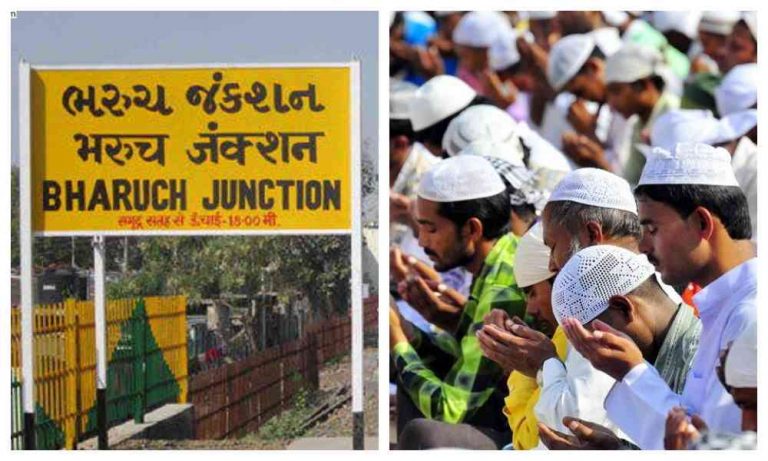
A local court in Bharuch, on Monday, rejected bail application of the three accused in the Bharuch mass religious conversion case. Three of the accused, Ibrahim Puna Patel alias Jitubhai Punabhai Vasava, Aiyub Barkat Patel alias Ramanbhai Barkatbhai Vasava and Yusuf Jivan Patel alias Mahendrabhai Jivan Patel, had moved court and applied for bail after a charge sheet was filed in the case.
The accused’s lawyer, while arguing that the sections of SC/ST Atrocities Act levelled against the accused were not applicable against them since the accused and the complainant, both belong to the Scheduled Tribe. Advocate Vora had claimed that since the accused had professed Islam faith, since they belonged to Scheduled Tribe before conversion to another faith, their status of being Scheduled Tribe is not diluted. Hence, the SC/ST Atrocities Act does not apply to them.
Public Prosecutor P B Pandey, however, argued that the FIR registered in the case is an example of communal discord which has been propagated by applicants with an ulterior motive of creating tension amongst the two sects of society. He also said that filing of charge sheet is no new ground for applying again for the bail.
Bharuch mass conversion case
OpIndia had reported that in November 2021 an FIR was registered against Fefdawala Haji Abdullah, Salahuddin Sheikh and others on complaint of one Pravin Vasava of Kankariya village in Amod Taluka of Bharuch district in Gujarat where allegations of religious conversion of people from Vasava community (Scheduled Tribe) to Islam was carried out by luring them with financial gains like job, house, prospective bride for marriage. The FIR stated how the funds from foreign countries were routed to India for helping with the activities of said religious conversion.
The tentacles of the racket were also linked to the Uttar Pradesh mass religious conversion racket that was busted in June-July 2021 where along with Umar Gautam, Salahuddin Sheikh was also one of the main accused. It was alleged that through Sheikh’s NGO AFMI, funds were routed by Fefdawala and others and the same were used for anti-social activities. In December, 2021, the Home Ministry cancelled the FCRA registration of the NGO. Sheikh is currently in Uttar Pradesh Police’s custody while Fefdawala is absconding.
On 15th November 2021, a case was registered at Amod Police Station Part A under Gujarat Freedom of Religion Act under section 4, 5, 4-G along with Indian Penal Code section 120 (B), 153 (B) (C), 506(2), 153A (1), 295 (K), 466, 467, 468, 471, Atrocities Act section 3 (2) (5-a), 3 (2)(5) and Information Technology Act, 2000 section 84-C against nine accused. The nine accused were: Shabbir Bakerywala (Amod), Samaj Bakerywala (Amod), Abdul Aziz Patel (Kankaria, Amod), Yusuf Patel (Kankaria, Amod), Ayub Barkat Patel (Kankaria, Amod), Hasan Tisli (Achhod, Amod), Fefdawala Haji Abdullah (Nabipur, currently, London, UK), Ismail Achhodwala alias Delawala (maulvi) (Achhod, Amod) and Ibrahim Patel (Kankaria, Amod).
In the Karnataka High Court, a churn is taking place as to whether wearing the Hijab can be held as an ‘essential religious practice’ of the Islamic faith. Arguments from both sides have cited different sources and interpretations of the Quran. Senior Advocate Devdatt Kamat who was appearing on behalf of the petitioners has quoted The Holy Quran’s translation as available on the website Quran.com.
On February 22, Advocate General Prabhuling Navadgi argued that the interpretation cited by the petitioners was from a website which is created by a few volunteers and is not the authorised version of it. The court has taken the reference of previous cases including the Shah Bano case, Ismail Faruqui case (which dealt with the acquisition of Babri structure) and others to verify as to which interpretation of the Quran has been authorised by Indian Judicial courts in earlier cases.
SA Devadatt Kamat’s arguments
On the first day of hearing of the case February 08, Senior Advocate Devdatt Kamat appeared before the court while referring to the Kerala High Court judgement on the allowance of Hijabs in schools. Quoting from paragraph 13 of the judgement, “Kamat read, “Religious practice cannot be tested on the secular thoughts or any other consideration outside the religious authority,” Arguing over what constitutes an essential practice, he said that it should be determined on religious beliefs alone and not based on secular notions. Kamat then referred to the verses from the Quran which talk about wearing a veil as described by the interpretation given on the website Quran.com.
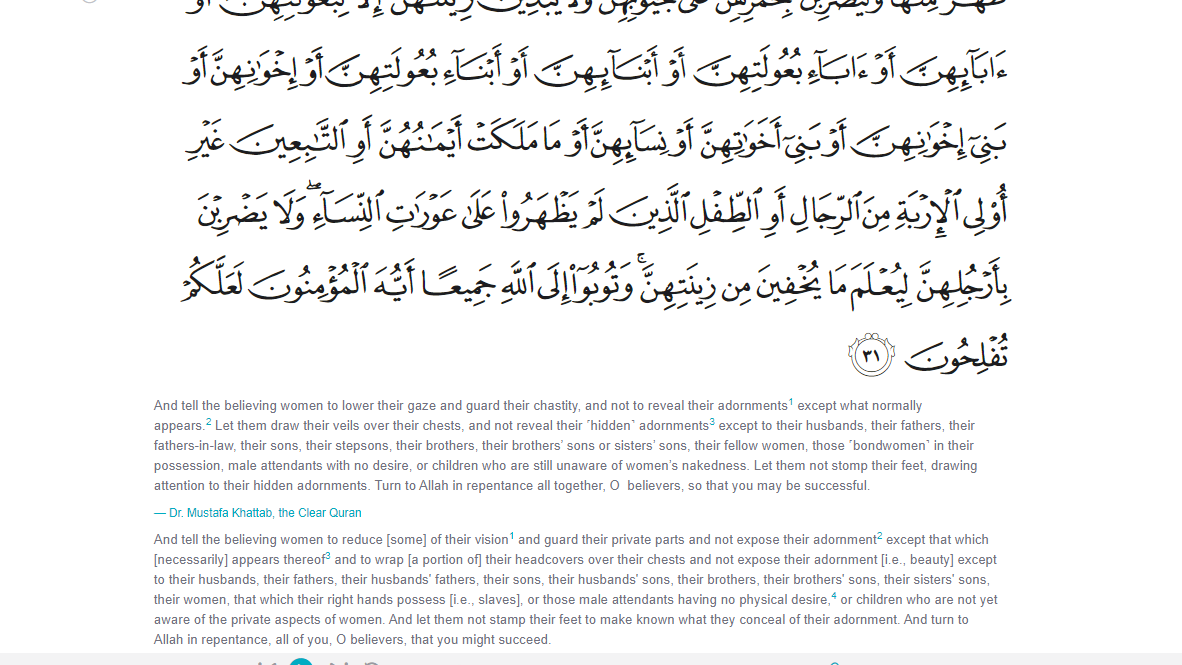
In Surah 24 verse 31, it has been mentioned that women should be let to draw their veils over their chests, and not reveal their ‘hidden adornments’ to ‘guard their chastity.’
Screengrab of Quran.com citing verse 24.31
An interpretation of the verse by Dr Mustafa Khatab says, “And tell the believing women to lower their gaze and guard their chastity, and not to reveal their adornments except what normally appears. Let them draw their veils over their chests, and not reveal their ˹hidden˺ adornments except to their husbands, their fathers, their fathers-in-law, their sons, their stepsons, their brothers, their brothers’ sons or sisters’ sons, their fellow women, those ˹bondwomen˺ in their possession, male attendants with no desire, or children who are still unaware of women’s nakedness. Let them not stomp their feet, drawing attention to their hidden adornments. Turn to Allah in repentance all together, O believers, so that you may be successful.”
Kamat refers to Verse 24.31 of Holy Quran. The prescription of head scarf he is specifically prescribed in Holy Quran, he says.#karnatakahijab#KarnatakaHighCourt
The second verse quoted by Kamat (Surah 24, verse 33) talks about not forcing one’s ‘slave-girls’ into prostitution. In case they are forced into the same for achieving short-term gains of this world, Allah will be merciful to them – the verse says. Kamat put before the court the above two verses saying that they talk of Hijab and that it is wearing the same is demanded in the Quran. Kamat repeated his stance on February 10, by quoting verse 24.31 calling the prescription of a headscarf is ‘specifically prescribed’ in the Holy Quran.
AG Prabhuling Navadgi’s submission challenging the Plea
On the eighth day of the Karnataka Hijab case hearing, Advocate General Navadgi continued his submission arguing wearing hijab does not constitute to be an essential religious practice as shown by the petitioners – especially by SA Kamat. The basis of the AG’s arguments as presented today was to establish whether citations in the Quran count as essential practices and whether their interpretations are mandated or are ‘prescriptions’. He referred to the Mohd Hanif Qureshi case that considered the issue of whether cattle slaughter restrictions interfered with religious practice.
AG : I read this judgment (Qureshi) to show that it has said reading of Quran has shown that sacrifice of cow on that day is not obligatory. The very fact of an option seems to run counter to an obligatory duty.#HijabBan#KarnatakaHighCourt
Concluding that there exists no direct evidence as to prove that sacrifice of a cow as ‘obligatory’, he connected the dots of the case to the Hijab row. “What is optional is not compulsory; What is not compulsory is not obligatory; What is not obligatory is not essential,” he added. He then stated that there is a dichotomy in the petitioner’s argument to wear the Hijab as a free expression guaranteed by article 19(a) while also quoting article 25 which allows citizens to practice compulsory (Fundamental) religious practices. According to him, Article 19 (a) deals with freedom of ‘choice’ whereas Article 25 deals with the right to practice ‘Compulsion’.
AG: Art 25 has an element of compulsion as far as dress is concerned. The consequences of a declaration of a court in ERP is that every member of the community is bound to abide. #HijabBan#KarnatakaHighCourt
In such a case, it is evident according to the petitioner’s own argument that there seems to be confusion on whether wearing hijab is a choice or a compulsion. Furthermore, AG Navadgi pointed out that the source mentioned by the petitioner Advocate Kamat was an interpretation by the website Quran.com which is created by a few volunteers and is not authorised.
AG : Petitioners have referred to https://t.co/QFtOh2okR6. It is a website created by few volunteers and it is not authorised. But transaltion is more or less the same in respect of these verses with which we are concerned
He then referred to Sura 24, verse 31 which was put before by Kamat earlier before the Court. AG Navadgi repeated it saying, “Say to the believing women that they should lower their gaze and guard their modesty, that they should draw their veils over their bosoms..and not display their beauty except to their husbands, their fathers…” Referring to the verse, Chief Justice Krishna Dixit pointed out at ‘hijab’ is not as such directly mentioned. AG repeated that he wanted to point out the same.
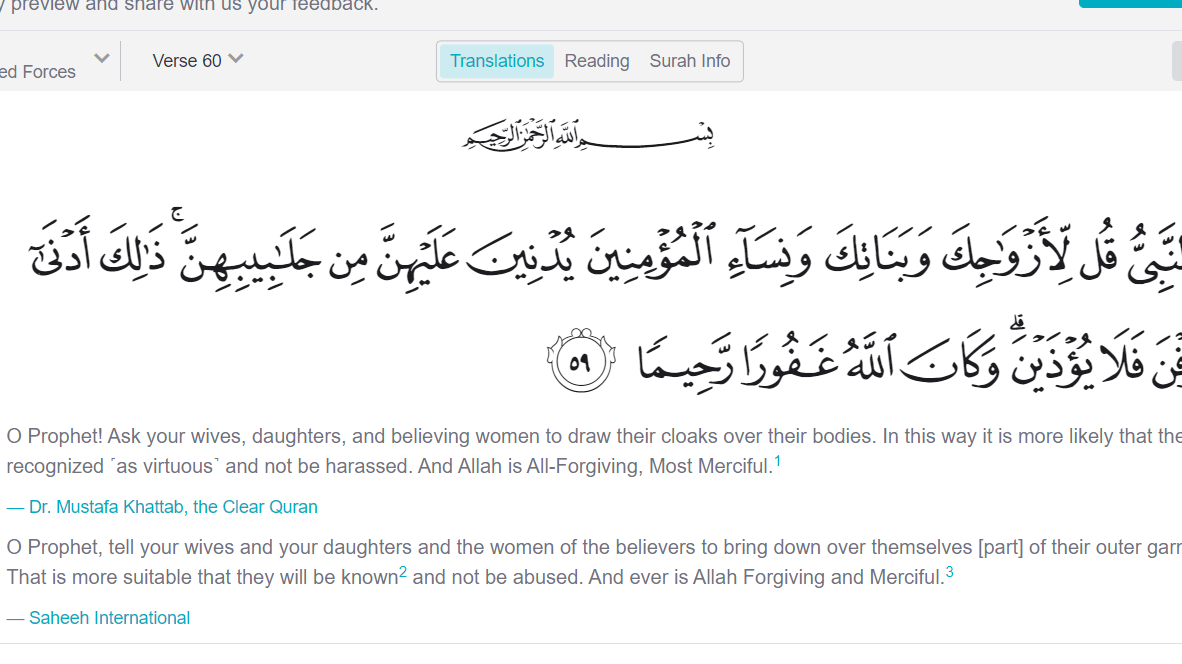
AG Prabhuling Navadgi then quoted another verse (33.59) which deals with women wearing veils from the holy Quran.
Screengrab of Quran.com citing verse 33.59
According to the website Quran.com, it read, “O Prophet, tell your wives and your daughters and the women of the believers to bring down over themselves [part] of their outer garments. That is more suitable that they will be known and not be abused. And ever is Allah Forgiving and Merciful. It is evident that the Hadith in the Quran is asking women to cover their bodies while the CJ was quick to point out that it only talks about a dress which is a long gown and not a headdress.
AG now refers to Sura 33, Verse 59
Chief Justice : It talks about a dress which is a long gown. Not headdress
AG: They have relied upon. This is an area I would be more circumspect in making submission. Because it is very Holy.#HijabBan#KarnatakaHighCourt
The Advocate General has argued before the court that the source on which the petitioners have relied also does not mention hijab. He further added that if all submissions by the petitioners calling hijab an essential religious practice are concerned, a judicial declaration based on a religious sanction is being sought. “(Here) The element of choice goes away. A woman concerned becomes obligated by religious sanction to wear that particular dress,” he added.
CJ : You want to say suppose the court hold that wearing of hijab is essential religious practice, the women who do not wear will be lowering their dignity?
While concluding his observations, AG Navadgi said, “For a large number of petitioners who represent women organisations, I am making a statement, dignity of the women must be kept in mind.”The Karnataka High Court intends to close the hearing by the end of this week. For wearing of hijab to whether to be termed as an essential religious practice, both sides of the spectrum argued in the court in length.
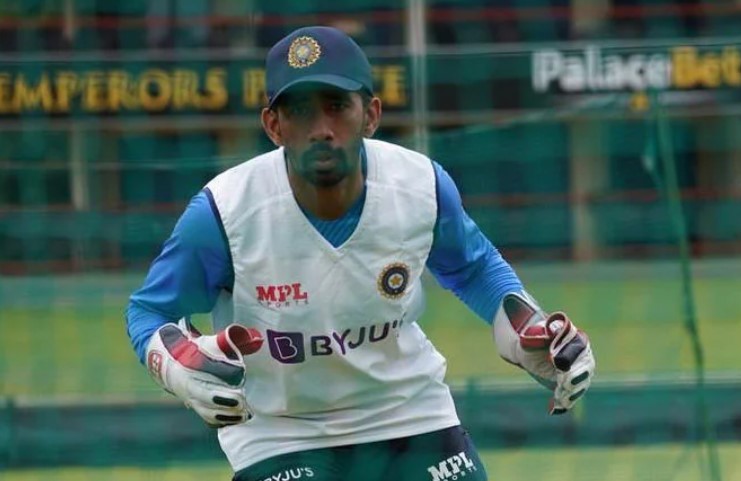
Indian cricketer Wriddhiman Saha said on Tuesday, February 22 that he would not disclose the name of the journalist who allegedly forced him for an interview and then used disdainful language to deride him for not responding.
In a series of Tweets, the cricketer said that he would keep the name of the journalist to himself on grounds of “humanity looking at his/her family”. He, however, warned that if he faces a similar situation in the future he would not “hold back”.
I was hurt and offended. I thought not to tolerate such kind of behaviour and didn’t want anyone to go through these kind of bullying. I decided I will go out and expose the chat in public eye, but not his/her name, wrote Saha.
“My nature isnt such that I will harm anyone to the extent of ending someone’s career. So on grounds of humanity looking at his/her family, I am not exposing the name for the time being. But if any such repetition happens, I will not hold back,” further Tweeted Shah.
2/3- My nature isnt such that I will harm anyone to the extent of ending someone’s career. So on grounds of humanity looking at his/her family, I am not exposing the name for the time being. But if any such repetition happens, I will not hold back.
In his last Tweet, he thanked “each and everyone who has shown support and extended their willingness to help”.
Notably, in an interview with The Indian Express, the cricketer had echoed a similar opinion saying that he will not reveal the identity of the journalist who threatened him even if the BCCI asks him.
“I haven’t received any communication from the BCCI yet. If they ask me to reveal the name (of the journalist), I would tell them it was never my intention to harm somebody’s career, to pull a person down. That’s why I didn’t reveal the name in my tweet. That’s not the teaching of my parents. The main purpose of my tweet was to expose the fact that there’s someone in the media who does such things, disrespecting a player’s wish,” Saha was quoted as saying by The Indian Express.
Wriddhiman Shah’s decision to not expose the name of the journalist who had sent him a threatening message came after cricketers like Pragyan Ojha and Harbhajan Singh and former stars like Virender Sehwag had urged Saha to name the journalist in question.
Please name him wriddhi! I promise you as a representative of players, I will make sure our cricket community boycotts this so called journalist!! https://t.co/XmorYAyGvW
Notably, ever since Shah put out a Tweet exposing how a “Respected” journalist had threatened him, several members of the Indian cricket fraternity have come out in support of the cricketer. Ravi Shastri, the former India team head coach, in fact, urged BCCI president Sourav Ganguly “to dive in”.
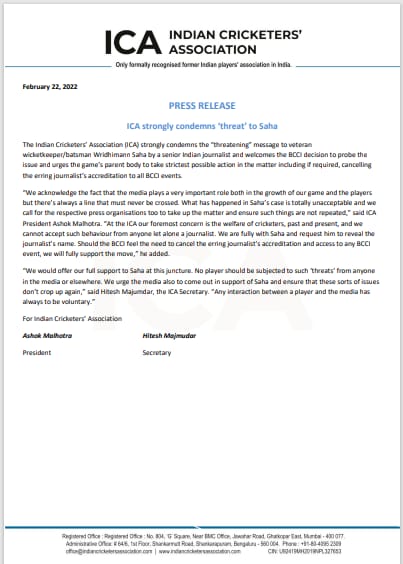
The Indian Cricketers Association earlier in the day condemned the threatening message sent to Saha.
The BCCI on Monday said it will probe the matter.
Wriddhiman Saha shares chat with journalist forcing him for an interview
On Saturday, Indian cricketer Wriddhiman Saha took to Twitter to share a screenshot of disturbing messages sent to him by a journalist forcing him for an interview and then using disdainful language to deride him for not responding.
After all of my contributions to Indian cricket..this is what I face from a so called “Respected” journalist! This is where the journalism has gone. pic.twitter.com/woVyq1sOZX
“After all of my contributions to Indian cricket..this is what I face from a so called “Respected” journalist! This is where the journalism has gone,” Saha wrote in his tweet as he shared the screenshot.
This revelation from Saha came after the Indian selection committee headed by Chetan Sharma announced the India team for the T20I and Test series against Sri Lanka, leaving out Wriddhiman Saha from the squad.
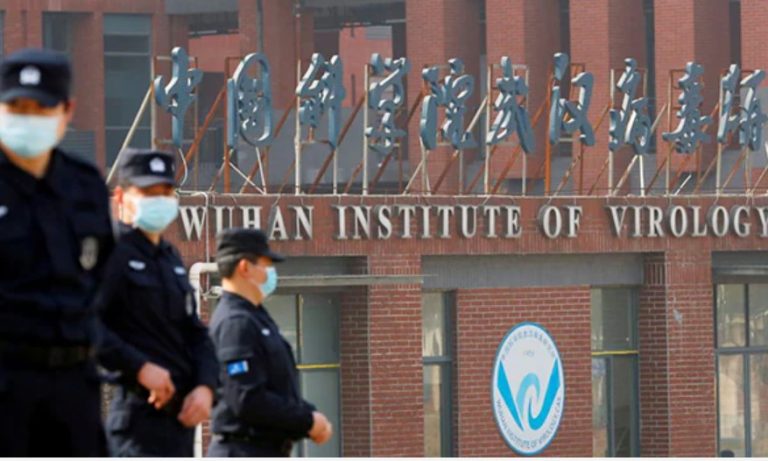
According to a report published in Providence Magazine, Chinese President Xi Jinping’s deployment of an army officer to assume charge of Wuhan lab, proving that the govt of China was never upfront about the virus’s origins and that it was all a ruse to create misleading narratives.
It may be recalled that last year in February, Chinese military scientist and a high-level officer in the People’s Liberation Army, Major General Chen Wei was reportedly selected to take over a secretive virus laboratory in Wuhan, raising conspiracy rumours that the Covid-19 crisis could be linked to the army. Reports had then suggested that Chen Wei was flown into Wuhan by the CCP government before taking over as director of the Wuhan Institute of Virology.
Meanwhile, the report by Providence further stated how the Chinese govt tried to keep COVID origin investigations at bay by deliberating its propaganda media to create an elaborate online disinformation campaign centred on an internet persona claiming to be a Swiss biologist to mislead the public about the origins of the coronavirus pandemic.
Notably, Dr Wilson Edwards, a self-described Swiss virologist, had alleged on Facebook that the US was exerting undue political pressure on the WHO to blame China for the coronavirus. However, Edwards was not a real person, as the Swiss embassy in Beijing stated in August 2021.
The report spoke about another incident, wherein a Chinese journalist was put in jail for documenting the Wuhan lockdown. On December 30, 2020, OpIndia had reported how Chinese citizen journalist Zhang Zhan, who was detained by the Chinese government in May this year for reporting on the Wuhan virus, was sentenced to four years imprisonment on December 28. 37-year old Zhan was accused of “picking quarrels and provoking trouble”, a charge that is very commonly invoked against critics and activists in China.
Further, in its effort to scuttle the probe into the origin of coronavirus, China attempted to provoke a trade war with Australia after Canberra demanded an independent probe into the origins of COVID.
Around February 2020, when the pandemic expanded from Wuhan to the rest of the world, the CCP put a gag order on any publications about COVID-19’s origin.
On December 24, 2020, OpIndia reported that Chinese ophthalmologist Li Wenliang had tried to warn his friends and associates about a strange SARS-like virus affecting the people of Wuhan. He used the ubiquitous Chinese social media app WeChat to express his concerns with his friends. However, the Chinese Communist Party, with its tools of surveillance detected the messages and chastised the Doctor for spreading “rumours”. It swiftly moved to remove any references made to coronavirus on the app.
As early as January 1, China censored keywords related to coronavirus and criticism of Chinese Premier Xi Jinping. The report probing the censorship in China also found that as the outbreak swelled, WeChat, owned by Chinese firm Tencent, blocked more words to block Chinese people from knowing facts about the raging COVID-19 pandemic.
In fact, the authoritarian control over the information regulation is so sweeping in China that barely days after thousands were reported to have contracted the coronavirus, China censored all inconvenient information related to the disease and its adverse fallout within the country. It stopped reporting the number of coronavirus cases altogether.
However, reports from some journalists and activists revealed that the number of coronavirus cases in China was significantly larger than what the CCP was claiming. But, CCP not only threatened and intimidated the whistle-blowers, but it also pulled down all the reports that challenged CCP’s utopian view of the COVID-19 outbreak.
Lab leaks do occur, and they are common enough that the government discloses them. Taiwan officially verified a SARS-COV-2 lab leak in December 2021. However, in early 2020, a lab infection occurred in China, but the CCP never formally disclosed the incident, raising the question of whether the lab leak was an accident. The leak hypothesis has also been labelled a “conspiracy” by Western virologists and media.
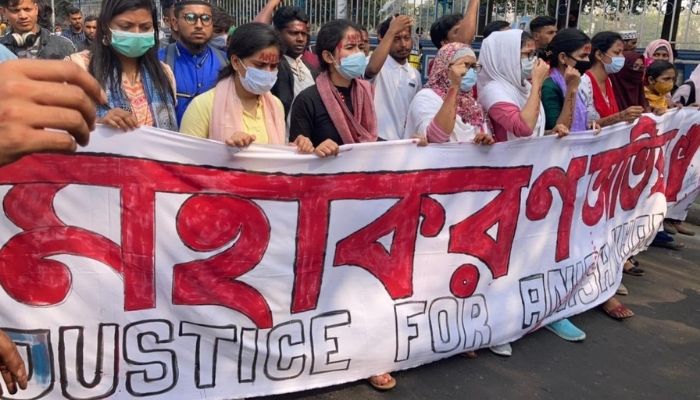
On Tuesday (February 22), the West Bengal police carried out a lathi charge against members of left-wing student organisations after they took a protest rally in Kolkata against the alleged murder of ‘student leader’ Anish Khan. The deceased was a member of the Islamist outfit ‘Indian Secular Front (ISF)’ and had protested against Mamata Banerjee’s government for 130 days.
As per reports, a protest march was conducted by students of the Aliah University in Kolkata. During the demonstration, they formed a human chain at Park Circus 7-point crossing and then started moving in the direction of the former State Secretariat, Writers Buildings.
They later changed course and started marching on College street. The Kolkata police had set up barricades to prevent the students from moving forward. When the protestors tried to break through barricades, the police resorted to lathicharge to pacify the situation. Cops also detained a few people, who took part in the protests.
In a tweet, the left-wing All India Students Association (AISA) wrote, “Condemn the brutal lathicharge by WB Police on protestors of Mahakaran Abhiyan against the murder of Aliah University student #AnishKhan! Many students, including AISA activists Sayantan and Arpan, arrested! Release all protestors immediately! Shame on Mamata’s WB Police!”
Condemn the brutal lathicharge by WB Police on protestors of Mahakaran Abhiyan against the murder of Aliah University student #AnishKhan!
Many students, including AISA activists Sayantan and Arpan, arrested!
The State unit of AISA claimed that over 100s of students were arrested by the West Bengal police on the behest of the Trinamool Congress government.
Shame on TMC Government’s police for brutally assaulting activists participating in the rally organised by Aliah University students demanding justice for Anish Khan !
Hundreds of students have been arrested ! We demand immediate and unconditional release of all students! pic.twitter.com/UwlCm2jTKT
At Jadavpur University, a scuffle broke out between students of left-wing organisations and TMC supporters. “Tension at Jadavpur University as Left students protesting against Anish Khan death case accuse TMC supporters of beating them up. Rubbishing the allegation, TMC leader says JU students were giving provocative slogans but they are exercising restraint,” informed journalist Soumyajit Majumder.
Tension at Jadavpur University as Left students protesting against Anish Khan death case accuse TMC supporters of beating them up. Rubbishing the allegation, TMC leader says JU students were giving provocative slogans but they are exercising restraint.
Earlier, protests were also carried out by Islamist outfit, Student Islamic Organisation (SIO) of India. They demanded a probe in the involvement of police in the alleged murder of Anish Khan.
According to the family of the deceased student leader, Khan was allegedly killed on the night of February 18, 2022, by 4 uniformed police officers and civic volunteers. He was allegedly pushed off the 3rd floor of his own house in Amta in the Howrah district of West Bengal. He was a vocal critic of the Mamata Banerjee government.
“It was around 12:30 am that four persons came to our house and identified themselves as policemen from the Amta police station. One of them stood with me on the ground floor. He was carrying a firearm. The other three took my son upstairs. Moments later, I heard a huge thud and found that my son was lying in a pool of blood. As I raised the alarm, all the four persons fled,” said Salem Khan, Anish Khan’s father.
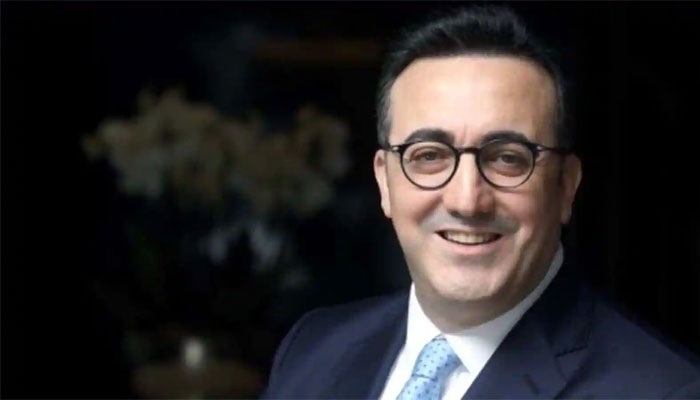
The Ministry of Home Affairs will carry out a thorough background check of Ilker Ayci, the newly appointed Chief Executive Officer of Air India. Soon after the announcement of his appointment as the head of Tata’s recently acquired Air India, allegations of his connections to the terrorist organization Al-Qaeda had emerged.
News agency PTI quoted people familiar with the development, saying such background checks are common for foreign nationals in case they get appointed to the key positions in any Indian company. Notably, the process of the security clearance of Ayci will begin only after MHA receives any communication from any one of the Civil Aviation Ministry, the Tata Group of the nodal ministry. Sources suggested MHA might take support from external intelligence agency RAW for background checks on Ayci.
Ayci’s connection to Turkey and Al-Qaeda
Twitter user BhikhuMhatre wrote a detailed thread on why the investigation in Ayci is necessary. Though it is a common practice to do background checks of foreign nationals, in the case of Ayci, there are allegations against him that cannot be ignored.
Erdogan is Close Supporter of Pakistan & has often taken stand against Bharat on all global platforms. He has such “Clean” track record wrt Terr0ri$t activities including Terr0r Financing that Turkey under His Presidency is in “Grey List” of FATF with his friend Pakistan.
Ayci has been a close aide of Turkish President Recep Tayyip Erdogan. Notably, the Turkish President is a close supporter of Pakistan and often stands against India on the International platform. Turkey is currently in the Grey List of Financial Action Task Force (FATF), just like Pakistan, over the allegations of terror funding.
Ayci has been connected to Erdogan since 94 when he became Mayor of Istanbul. At that time, Ayci was appointed his advisor. Ayci was later appointed as the chairman of Turkish Airlines and had resigned from the post in January 2022.
Apart from his association with Erdogan, according to a report in Atalayar in 2020, Ayci, who was the former chairman of the Turkish Investment Support and Promotion Agency (ISPAT), had promoted private investments and ventures by Yasin al-Qadi, the former alleged Al-Qaeda financier. As per the report, Ayci had met al-Qadi in Cengiz Aktürk’s personal office. Aktürk was also a suspect and trusted member of al-Qadi.
Al-Qadi, an Egypt-born Saudi national, was singled out by the United States Department of Treasury and the United Nations Al-Qaeda Sanctions Committee for alleged links to financing terrorist groups. Sanctions were applied against him, and his assets were frozen by several investigating agencies. However, his name was later removed from the blacklist after several courts had cleared his name.
Erdogan’s sons, Necmettin Bilal and Al-Qadi, were prime suspects in a corruption investigation in 2013. However, Erdogan allegedly used his powers to prevent the arrest and cover up the crimes.
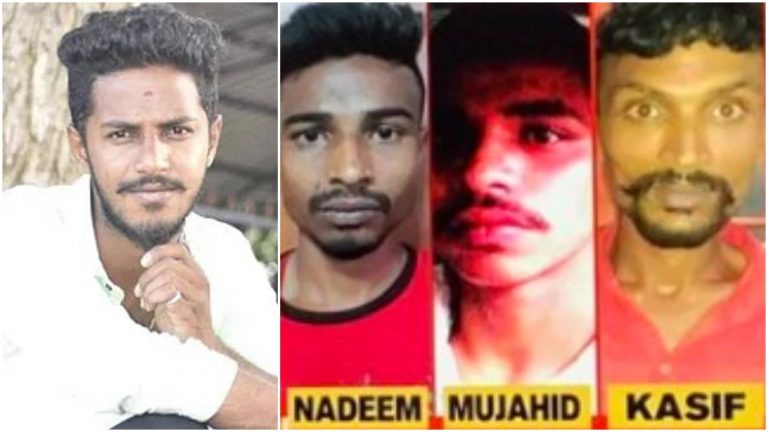
Karnataka police have so far arrested a total of 6 individuals in connection with the murder of Bajrang Dal activist Harsha, Shivamogga SP Laxmi Prasad informed on Tuesday, February 22. According to ANI, the SP added that all 6 arrested accused have criminal records.
The top police official was further quoted as saying that the Karnataka police have also detained 12 others for questioning in the murder case. Each accused will be interrogated separately to know the motive behind the killing of Harsha, further informed SP Laxmi Prasad.
Total 6 arrested, 12 being questioned in connection with Bajrang Dal worker Harsha murder case: SP Laxmi Prasad, Shivamogga, Karnataka pic.twitter.com/hKJkIRlMIc
Media reports suggest that the arrested accused have been identified as Qasif (Kasif), Syed Nadeem, Mujahid, Rihan alias Qasi, Afan and Asif. Accused Qasif allegedly has ten criminal cases registered against him.
— Rajesh Kumar Jha ?? #StaySafe? (@RajeshROfficial) February 22, 2022
The main conspirators Syed Nadeem and Qasif and one other were apprehended from Bengaluru on February 21. The other three have been nabbed Tuesday, February 22.
Addressing a press conference on the murder of the Bajrang Dal activist, SP Laxmi Prasad added that there were few eyewitnesses who testified that Harsha was was chased and killed by the accused who approached him in a car.
Notably, one of the six accused identified as Qasif, who was nabbed on February 21, had also confessed during interrogation that he along with 4 others came in a car and attacked Harsha when he was drinking tea at a canteen on Sunday night. After attacking him with sharp weapons, the accused fled the crime scene.
In view of the tense situation, the district administration has declared a holiday for schools and colleges today as well. Prohibitory orders under section 144 of the CrPC are also in force here.
Harsha was stabbed to death on February 20 night at Bharathi Nagar allegedly by seven people. Harsha was a member of the Hindu organisation, Bajrang Dal, and was seen sporting saffron shawls to demand uniformity in the dress code of schools and colleges. It has come to light that he was issued threats by Islamists in 2015 over alleged ‘blasphemous’ social media posts.
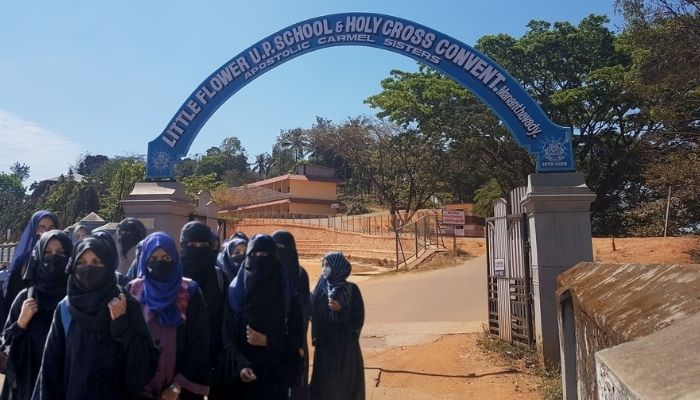
On Monday (February 22), the headmistress of a Christian convent school tendered an apology for barring a female Muslim student from attending classes in her hijab. The incident took place at the Little Flower UP School in Mananthavady in the Wayanad district of Kerala.
It must be mentioned that the headmistress Sr Roshna had earlier reprimanded the Muslim student for superseding the uniform rule. She had asked her parents to take a Transfer Certificate (TC) in case the child wanted to wear religious attire instead of the uniform to school. Following a police complaint by the girl’s parents, coupled with the intimidatory tactics of political groups, the convent school administration succumbed to the demands.
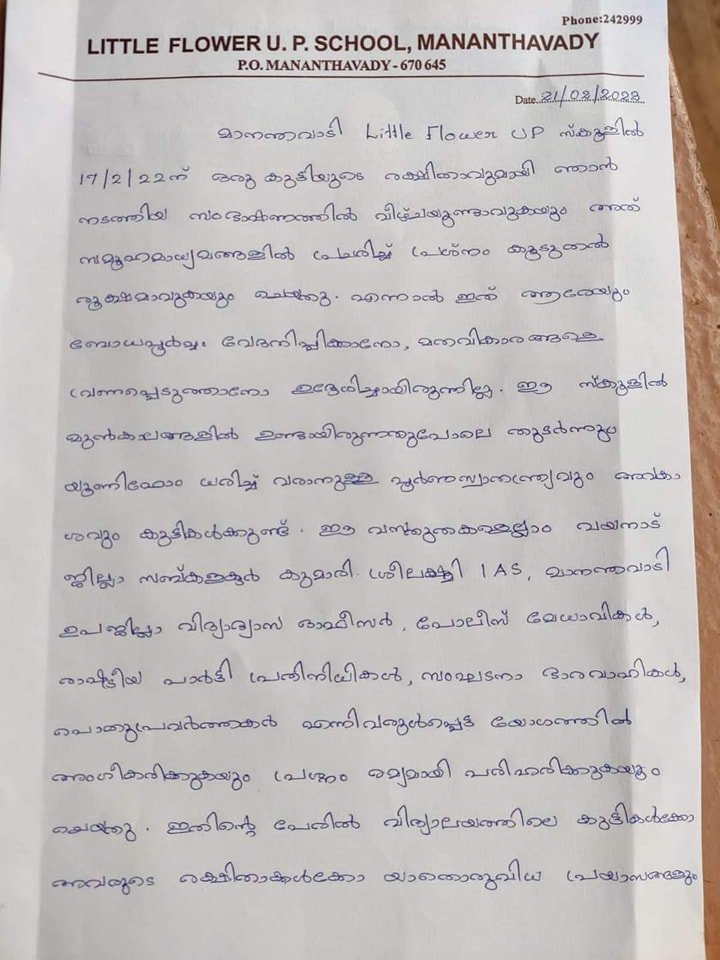
A copy of the apology letter by the school headmistress had gone viral on social media. “On 17/2/22 at the Mananthavadi little flower UP school, my conversation with a child’s guardian had some lapses and it was leaked to the media, thereby worsening the matter. But this was not done with the intention to hurt anyone nor hurt any religious sentiments,” she said.
Screengrab of the apology letter by the headmistress, image via Twitter/@AjmalAramam
Sr. Roshna emphasised that students will have the right and freedom to wear the school uniform like they used to do in the past. She added that the school authorities had no further objection to the wearing of hijab in schools. A meeting was convened by Wayanad Sub-collector R Sreelakshmi regarding the matter and it was attended by political party officials, cops, education department officials and members of student organisations.
As per a report in Janam TV, the headmistress of Little Flower UP School had initially argued that young children should grow up without restrictions, and that none should be allowed to bring their religious affairs to school. She was willing to hand over a TC to parents who prioritised hijab in schools over education and uniformity in the school’s dress code
The Muslim girl, a student of Class V, had earlier complied with the school rules but came to attend classes in hijab and covered hands on February 16, amidst the ongoing controversy in Karnataka. She was denied permission, following which her parents came to the school and argued with Sr. Roshna. They had even lodged an FIR against the school. The demand for religious exemption at the convent school gained momentum after members of the ruling Student Federation of India (SFI), the student wing of the Communist party, took to the streets.
SFl Wayanad District Committee protested demanding apology from the headmistress of Mananthavady Little Flower School for prohibiting headscarf in the school campus.
Upon protest, the school authorities apologized & assured for not repeating their mistake. pic.twitter.com/mbZS7VrIlg
Last month, the Kerala government had made it clear that the Student Police Cadets (SPC) cannot wear hijab, scarf or full sleeves over their uniform. SPC Project is an initiative by the Kerala police in collaboration with the government to make children conscious about laws, discipline and civic sense.
The development came days after an 8th Std student of GHSS Kuttiady named Riza Nahan moved the Kerala High Court, alleging that she wasn’t allowed to take part in the parade for wearing a full sleeve uniform with a hijab. In her petition, she claimed that it was her ‘fundamental right’ to wear hijab and full sleeves. Riza had claimed that she was stopped from participating in the parade due to modifications in her uniform.
Karnataka hijab controversy
Recently, some Muslim students from the PU College in Karnataka filed a petition in the High Court to allow them to attend classes wearing Hijab. They were denied entry into classes because the college management stated that the hijab is not part of the uniform and it cannot be allowed in classes. Since then, the ‘students’ have been protesting while wearing burqas.
The Muslim students had started wearing hijab and burqa to their school, college in defiance of the uniform rules since December 2021 after coming in touch with the Campus Front of India (CFI), the student wing of the Islamist outfit Popular Front of India (PFI) in October 2021. The students had admitted being in consultation with the CFI.
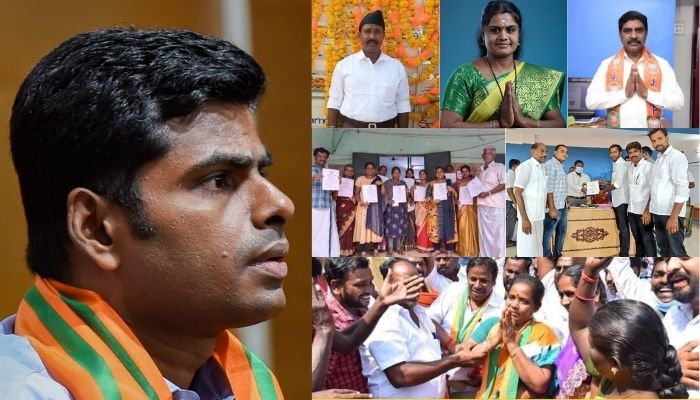
Emerging trends from the ongoing counting of urban local body elections in Tamil Nadu has shown that the Bhartiya Janata Party is paving its way to establishing a stronghold in the state. Today, the counting for the recently conducted elections for Municipal Corporations, Municipalities and Nagar Panchayats is taking place. In a historic win, the saffron party has won a majority of wards in the Kanyakumari district in TN.
The BJP is seen making serious inroads in Tamil Nadu politics by winning many seats in the urban local body elections. In the Municipal Corporation elections, BJP has managed to bag at least six wards in the Nagercoil corporation and a few wards in Bavanisagar and Sathyamangalam MCs as well. Interestingly in Chennai, the party has come second in some wards in Chennai by displacing the assembly ally AIADMK to the third position.
The BJP has bagged the second position by pushing the AIADMK in at least 5 wards in Chennai. In the 174th ward, While DMK candidate Radhika won by a margin of 4960 votes, the BJP stood in second place with 1847 votes while the AIADMK was in third place bagging only 1403 votes. Also in the 54th ward, the BJP while bagging 1142 votes stood second replacing AIADMK while The DMK candidate was leading with 3,570 votes.
However, the DMK is moving towards a landslide victory in the urban local body elections while leading in almost 150 out of 200 wards in Chennai. As of now, the saffron party has bagged 5 seats in Municipal Corporations, 46 in Municipality elections and 188 in town panchayats. The number is said to increase as the counting of seats is still on. Among the significant victories for the BJP was of Puma Jansree who won ward no. 86 in Madurai and Meena Dev who won ward no. 9 of the Nagercoil corporation. BJYM general secretary for Namakkal district has also grabbed a seat in the Tiruchengode Municipality.
In Virudhunagar East, BJP candidate A. Murugantham has won ward no. 26 in Aruppukkottai municipality whereas Jegathampal has won the 13th ward of the Kilambadi municipality in Erode. Meanwhile, the BJP has won 12 out of 15 wards in the Kanyakumari municipality. The party with an increased vote share is also seen giving a tough time to DMK as an opposition party in alliance with the AIADMK in the Tamil Nadu assembly.
On Sunday afternoon, the District General Secretary of Bharatiya Janata Party Yuva Morcha (BJYM), Krishna Yadav, was shot dead in Uttar Pradesh’s Hathras district. The local police immediately reached the spot after getting the information and recovered a pistol from Yadav’s house.
According to the reports, Yadav was shot dead from a very short distance on the first floor of his house. He was covered in bloodstains and was moved to Aligarh for treatment where he breathed his last. Several BJP workers and his friends arrived at the spot.
Vineet Jaiswal, Superintendent of Police, Hathras revealed that Krishna Yadav got shot at his home in the Gausganj Mohalla area of Sikandra Rao assembly constituency. “We received information of a person named Krishna Yadav being shot with a bullet. After reaching the spot, we found bloodstains in his room and recovered a pistol and an empty cartridge. He was later taken to a trauma centre in Aligarh where he was declared dead. We are investigating the case,” he said.
The Police also added in the statement that stains of blood were found on the first floor of Yadav’s residence. The atmosphere in Sikandra Rao constituency has become tense after the death of Krishna Yadav. His sister said to the police that Yadav has been killed and that the incident cannot be a suicide.
Krishna Yadav was a worker of both the BJP Yuva Morcha and the Hindu Yuva Vahini. The Police has initiated the investigation in the case and has affirmed that strict action will be taken against those involved.