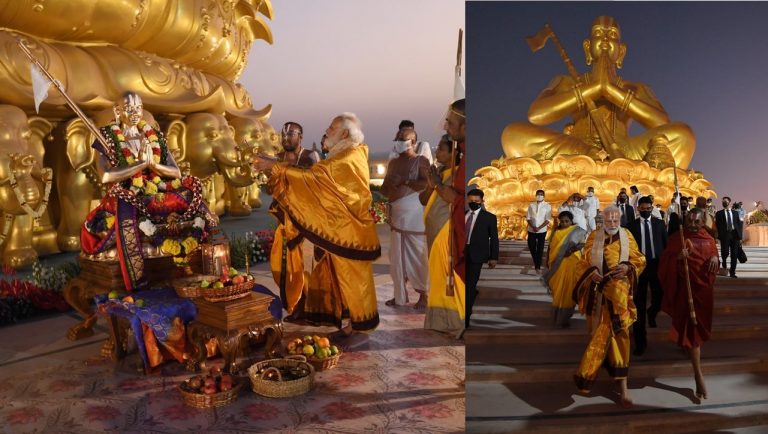
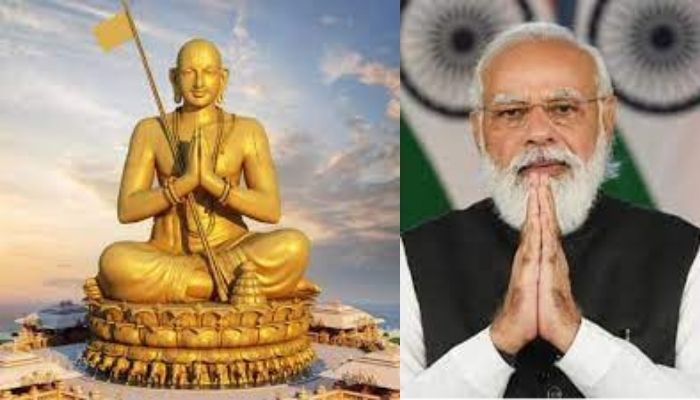
Prime Minister Narendra Modi inaugurated the Statue of Equality today on the occasion of Basant Panchami at Muchintal near Hyderabad in Telangana. In his address after the inauguration, he has asserted that “Progressiveness does not mean detaching from one’s roots. Rather it is necessary that we connect with our real roots and become aware of our real power.”
The 216-feet tall Statue of Equality commemorates the 11th-century Bhakti Saint Sri Ramanujacharya, who promoted the idea of equality in all aspects of living including faith, caste, and creed.
ये जरूरी नहीं है कि सुधार के लिए अपनी जड़ों से दूर जाना पड़े।
बल्कि जरूरी ये है कि हम अपनी असली जड़ो से जुड़ें, अपनी वास्तविक शक्ति से परिचित हों: PM @narendramodi
In his address, the Prime Minister spoke on various aspects of Ramanujacharya’s life and teachings and explained how they hold importance in contemporary times. He said “In today’s world, when it comes to social reforms and progressivism, it is believed that reforms will take place only after detaching from the roots. But, when we see Ramanujacharya ji, we realize that there is no conflict between progressiveness and antiquity.”
आज जब दुनिया में सामाजिक सुधारों की बात होती है, प्रगतिशीलता की बात होती है, तो माना जाता है कि सुधार जड़ों से दूर जाकर होगा।
लेकिन, जब हम रामानुजाचार्य जी को देखते हैं, तो हमें अहसास होता है कि प्रगतिशीलता और प्राचीनता में कोई विरोध नहीं है: PM @narendramodi
He further said “Today Ramanujacharya ji is giving us the message of equality in the form of this magnificent statue of Equality. With this message, today the country is laying the foundation of its new future with the mantra of ‘Sabka Saath, Sabka Vikas, Sabka Vishwas, and Sabka Prayas’.”
आज रामानुजाचार्य जी विशाल मूर्ति Statue of Equality के रूप में हमें समानता का संदेश दे रही है।
इसी संदेश को लेकर आज देश ‘सबका साथ, सबका विकास, सबका विश्वास, और सबका प्रयास’ के मंत्र के साथ अपने नए भविष्य की नींव रख रहा है: PM @narendramodi
Underlining the contribution of Ramanujacharya in unifying the nation through Bhakti Sutra, PM Modi said “Ramanujacharya ji is also a shining inspiration for the unity and integrity of India. He was born in the South, but his influence is on the whole of India from South to North and East to West.”
रामानुजाचार्य जी भारत की एकता और अखंडता की भी एक प्रदीप्त प्रेरणा हैं।
उनका जन्म दक्षिण में हुआ, लेकिन उनका प्रभाव दक्षिण से उत्तर और पूरब से पश्चिम तक पूरे भारत पर है: PM @narendramodi
As the program was organized in Telangana which was formerly a part of the Nizam state before it got attached to independent India on 17th September 1948, PM Modi did not forget to mention Sardar Patel and the Statue of Unity. Mentioning Hyderabad as Bhagyanagar he said, “Who better than the people of Bhagya Nagar knows the importance of Sardar Patel in unifying the nation.”
He further added “Today, on the one hand, Sardar Sahib’s Statue of Unity is repeating the oath of unity in the country, while Ramanujacharya’s Statue of Equality is giving the message of equality. This is the specialty of India as a nation.”
आज देश में एक ओर सरदार साहब की ‘Statue of Unity’ एकता की शपथ दोहरा रही है, तो रामानुजाचार्य जी की ‘Statue of Equality’ समानता का संदेश दे रही है।
यही एक राष्ट्र के रूप में भारत की विशेषता है: PM @narendramodi
Before inaugurating the statue of equality, PM Modi offered Ahuti in the Vishwaksen Yagya. It is notable that Vishwaksen Yagya is a ritual organized for the completion of an undertaken task. PM Modi dedicated this Ahuti to the welfare of the nation and 135 crore Indians.
After the inauguration program, he attended the light and sound show depicting the life and works of Ramanujacharya. Chinna Jeeyar who has conceived the idea of this statue of equality thanked the Prime Minister and urged him to propagate the message of equality given by Ramanujacharya in the world.
After the light and sound show, PM Modi participated in Maha Yagya organized for consecrating Ramanujacharya’s idol in the temple on the upper floor of the temple complex. The treasurer of Ayodhya’s Shri Ram Janma Bhoomi Trust, Shri Govind Dev Giri was also present on this occasion.
A total of 144 Yagya Shala are created to accommodate 1035 Yagya Kunda and 2 lakh kg of pure desi ghee collected from various parts of the nation is used for the auspicious Ahuti. The Maha Yagya has started on 2nd February 2022 and it will conclude on 14th February 2022.
Days after youth Kishan Bharwad was killed by Muslims for blasphemy in Ahmedabad, another incident of violence over alleged blasphemy has been reported from Surat in Gujarat. Reportedly, 2 college boys were beaten by a mob of Muslims, including two of their classmates, for sharing a post on social media. After one of the boys had shared an allegedly blasphemous post on social media, he had received threats from other Muslim students in the same college studying in the same class.
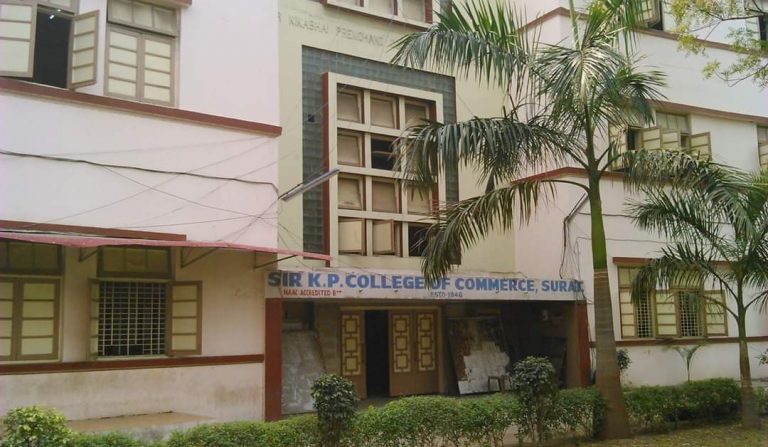
Reportedly, Sunny Pandey, a student of KP Commerce College in Surat, was beaten by some students and their friends after he had posted some ‘offensive’ content on social media. When Sunny’s classmate Himanshu Dubey tried to save him, he was also beaten by the mob. The incident happened at around 11 am on Friday near the KP Commerce College in Umra is Surat.
According to a report by ABP Asmita, Sunny Pandey had received death threats on phone from Muslim students studying in the same college. They had threatened him for sharing social media posts that were allegedly offensive to their religious faith. On 4th February 2022, a mob of eight to ten Muslim attackers surrounded him in front of the college and assaulted him and his classmate Himanshu. After this attack, the boys took refuge in the nearby apartment where they hid. They were saved as the police were present in the vicinity. Later, Sunny registered a complaint with the police against the Muslim students.
Later police arrested two of the accused, who have been identified as Saiyed Sohelali and Rahil Khan. Both are first-year B.Com students of KP Commerce College. The police have charged both the arrested under IPC sections 323 (voluntarily causing hurt), 504 (intentional insult with an intent to provoke breach of the peace), 506(2) (criminal intimidation).
Sunny Pandey said, “He was saying on the phone call that we will enter your house and kill you. He abused me. I said its ok, I accept that you might be hurt and apologize if I am wrong. I cut the phone call. I was not knowing that he will come to the college today to beat me. I came to college today. I attended the lectures. I completed my studies and as soon as I was leaving College, he appeared suddenly from somewhere and started beating me.”
The other victim Himanshu Dubey said, “There were almost ten of them. We know only two of them. Everyone else was brought from outside. The two, whom we know are from the same college and same class as ours. They had beaten us up very badly. They had called almost 8 to 9 people to beat us.”
A Hindu leader Narendra Chaudhari has said, “The boy has posted something on social media. The Muslims did not like it and hence they called him. They threatened the boy on the phone call and abused him too. The boy apologized saying that it is my mistake if you are offended. I will delete the video. And the boy deleted the post. Even after deleting the video, the next day they came and beat them up. Out of the ten people, only two were from the college while others were outsiders. Such violent activities are heating up the public mood in the nation. Even riots may begin in the recent future if this is not stopped here itself. We urge the police and the administration to prevent such incidents. Otherwise, the results of this will be very bad.”
However, police are saying that the assault took place due to personal enmity as the alleged offensive post was already deleted. Additional Commissioner of Police Sharad Singhal said, “The post was already deleted and the issue was settled. The incident has no relevance with any post as it happened due to some personal rivalry.” Similarly, DK Patel, police inspector of Umra said, “The student was attacked due to some personal rivalry between college boys and there is no truth behind the social media post.”
It is notable that after the Kishan Bharwad murder case, a series of such threats and violent incidents over social media posts have been reported in Gujarat. A youth from Anand had recently received similar death threats on a phone call.
The Karnataka Education Department on Saturday took cognisance over the hijab row, asking students to follow the dress code decided by the authorities.
The Department said students studying in the government schools should comply with the dress code requirements mandates by the state government while those in private institutions should follow the uniform dress code as asked of them by the school management.
Colleges that are under the dept of Pre-University, state govt to follow the dress which was decided by the college’s development board (CDC). If there is no such dress code, students can wear the dress which will not affect equality, integrity and law & order: Karnataka Edu Dept
Furthermore, students enrolled in colleges that are under the dept of Pre-University, state govt, are mandated to abide by dress code decided by the college’s development board (CDC). “If there is no such dress code, students can wear the dress which will not affect equality, integrity and law & order,” the Karnataka Education Department said.
Earlier, the Karnataka government invoked 133(2) of the Karnataka Education Act-1983 that states that religious attires are not allowed inside the campus and that a uniform style of clothing is mandatory.
Karnataka hijab row: Institutes deny entry to burqa-clad students
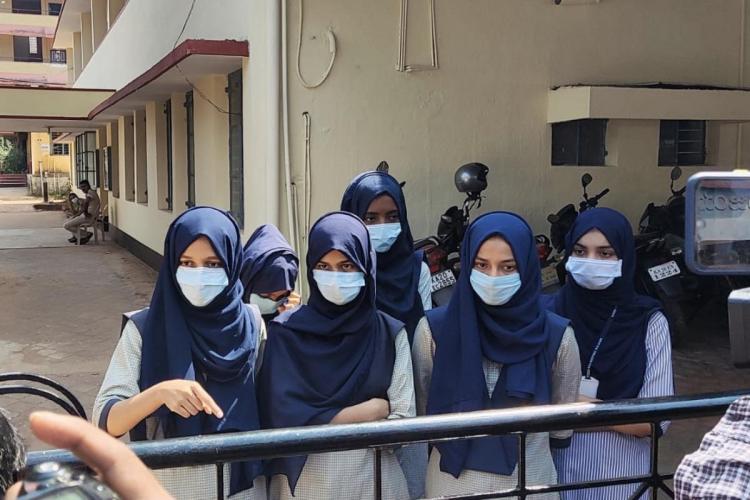
The controversy first erupted in January 2022 after several Muslim students were denied entry to classes in a Udupi college because they were wearing hijab. Social media platforms were rife with videos of college authorities refusing to allow burqa-clad students inside their institutions. The college authorities had then argued that the hijab was not a part of the uniform dress code suggested to the students. Management under the new state guidelines had asked girl students to skip wearing hijab while in college. Eight girl students have constantly refused to follow the guideline as they claimed it prevented them from practising their faith. Subsequently, several other colleges also started denying entry to students who did not conform to their respective dress codes.
Meanwhile, a petition arguing that Muslim women wearing Hijab should be permitted to attend classes was accepted by the Karnataka High Court. The petition was filed by a Muslim student, asking the High Court for a direction to allow wearing a hijab in college, stating that it is her “Fundamental Right” granted under Article 14 and 25 of the Indian Constitution and “integral practise of Islam”.
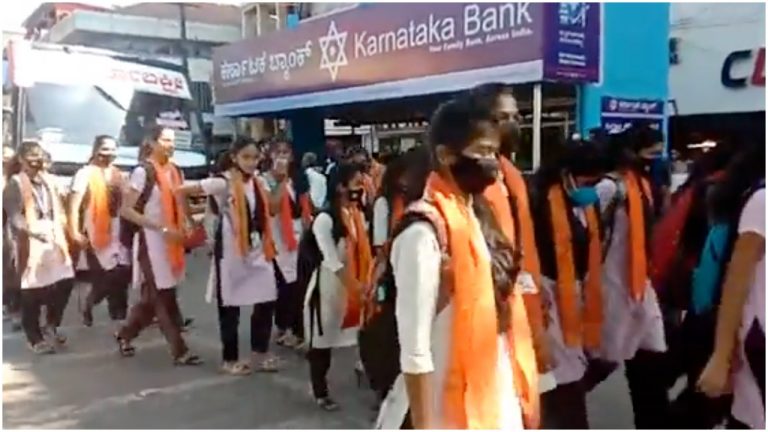
As the hijab row continues to rage on, Hindu students, too, have jumped into the controversy, registering their protests against the Muslims wearing hijab by donning saffron scarves. In a Government Junior College in Kunadapur, around 100 Hindu students came to the college with saffron scarves around their necks to protest against Muslim girls continuing to wear Hijab to the college. On Saturday, in solidarity with their classmates, girl students also hit the streets by wearing saffron shawls to protest against the attempts of Muslim students to vitiate the secular atmosphere in the college by deliberately violating the rules and regulations.
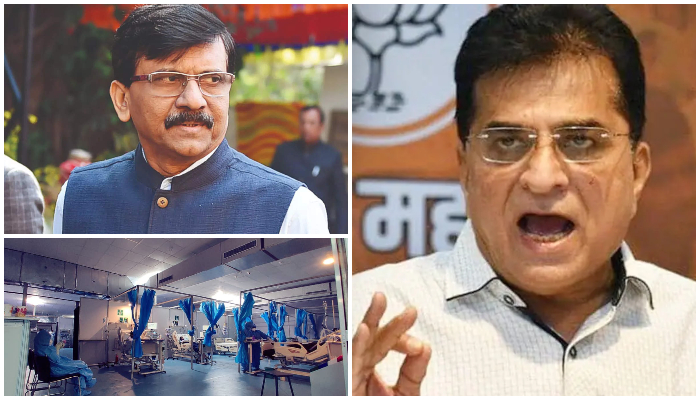
On Saturday, BJP leader Kirit Somaiya was attacked by the goons backed by Shiv Sena in Pune Municipal Corporation. Somaiya was in Pune to lodge an official complaint against Shiv Sena leader Sanjay Raut’s close aide and partner Sujit Patkar in case of Lifeline Hospital Management Services scam worth Rs 100 crores during the COVID19 pandemic. A video of the same has since gone viral.
“I am attacked by Shivsena Gundas inside the premises of Pune Mahapalika”, he tweeted as he said that complaint against Patkar must be registered. The BJP leader stated that Sujit Patkar had obtained the contract of management of Jumbo Covid Center at Shivaji Nagar, Pune on the basis of fraudulent documents. He also said that the Lifeline Hospital Management Services headed by Sujit Patkar did not provide the required facilities to the Centre resulting in massive death of COVID patients.
दुपारी 4 वाजता मी शिवाजी नगर पुणे जंबो कोविड सेंटर घोटाळ्यासाठी संजय राऊत पार्टनर सुजित पाटकर लाइफलाइन हॉस्पिटल मॅनेजमेंट सर्व्हिसेस विरुद्ध शिवाजी नगर पोलिस स्टेशनमध्ये तक्रार करणार
खोटे डॉक्युमेंट्स देवून कॉन्ट्रॅक्ट मिळविला.कोविड रुग्णांचा मृत्यू झाला
This is a day after BJP leader Kirit Somiya released a statement revealing the chaos and corruption in the allotment of COVID centre contracts to entities on paper in Pune and Mumbai. He affirmed that Sujit Patkar’s Lifeline Hospital Management Services was not in existence when it was given the contract by the Municipal Corporation of Greater Mumbai (MCGM).
The Lifeline Hospital Management Services had started providing medical staff and actually running the COVID care centres at Dahisar, NSCI Waroli, Mulund and Racecourse Mahalakshmi one year before the contract was entered into. “MCGM did not receive any document, proper application, experience certificate, nothing but blindly allotted the contract to Lifeline Hospital Management Services”, the statement read.
#SanjayRaut Partner got ₹100 Crore Jumbo COVID Centre Scam.
Sujeet Patkar’s Fraud Paper Company Lifeline Hospital Management Services
Somaiya highlighted Sujit Patkar’s relation and partnership with Shiv Sena leader Sanjay Raut and said that the actual contract between the MCGM and Lifeline Hospital Management Services was never signed. “The company did not have any staff, experience, financial capacity and that resulted in a chaos”, he added.
He also mentioned that the partnership agreement submitted after one year of starting the service to COVID centre in Mumbai and that submitted to Pune Municipal Corporation (PMRDA) was totally different. At Pune’s Jumbo COVID Centre, 3 patients died within the first 7 days due to the casual attitude of the Lifeline Hospital Management Services.
The firm which was never registered under the state Partnership Act was then blacklisted and terminated by PMRDA. According to Somaiya, the four contracts by Mumbai Municipal Corporation were granted to Lifeline Hospital Management Services after Pune’s blacklisting episode.
The matter came to light when ED recently raided Sujit Patkar’s properties in connection with the land scam worth Rs 1034 crores. The document by ED reflected that Patkar had signed the agreement with MCGM one year after actually getting the contract and receiving Rs 32 crores in his account.
Sujit Patkar is also a business associate of the daughters of Shiv Sena leader Sanjay Raut, Purvashi and Vidhita, in their wine company Magpie DFS Pvt. Ltd since the last 16 years. ED suspects that a part of the proceeds from the Rs 1034 crore land scam may have been invested in Magpie DFS.
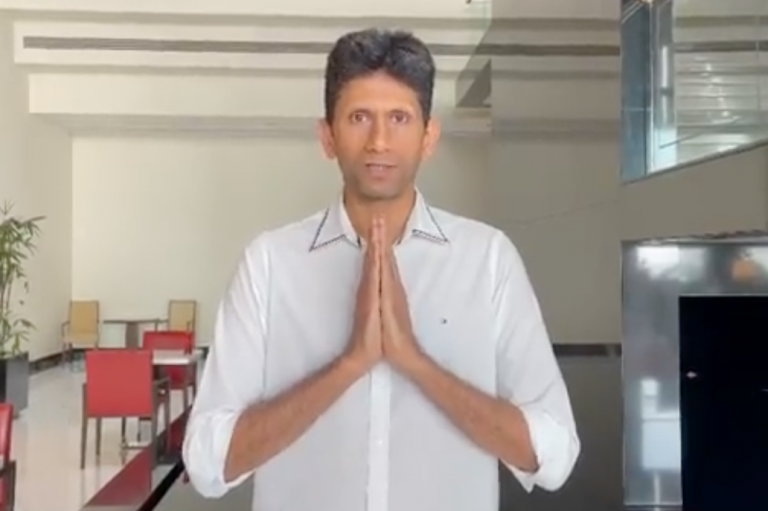
Former cricketer Venkatesh Prasad on Saturday shared a video of himself singing ‘Saraswati Shloka’, a prayer dedicated to Goddess Saraswati, on the occasion of Basant Panchami.
“Sarasvati Namastubhyam Varade Kaama-Ruupinni, Vidya Aarambham Karissyaami Siddhir-Bhavatu Me Sadaa(O Goddess Saraswathi; salutations to you, the giver of boons, the one who fulfils desires. I shall begin my studies. May there always be an accomplishment for me),” Prasad sang followed by wishing his followers a happy Saraswati Puja and Basant Panchami.
‘Saraswati Shloka’ is a Hindu prayer that is recited before the beginning of a class or beginning of one’s studies to seek blessings of Goddess Saraswati in learning all that one resolves to study. It is an address to the Goddess Saraswati, who represents all forms of knowledge, music, art, speech, wisdom, and learning. Knowledge is the most basic pursuit of human life, and a life of learning and study imparts wisdom, discipline among other virtues, and enriches human intellect.
How Venkatesh Prasad unapologetically wears his Hindu roots on his sleeve
It is worth noting that Prasad has been one of the few celebrities who have not shied away from openly expressing their Hindu roots. He joined Twitter on the 8th of April, 2021 and within a matter of a few months, he has posted some interesting content on his Twitter page, affirming his Hindu credentials.
In June 2021, Prasad had shared a video of himself where he was seen singing a few stanzas of ‘Shri Ram Stuti’ written by Goswami Tulsidas in the sixteenth century. He also shared the meaning of the stanzas he sang in the video.
“‘Shri Ram Stuti’ is an aarti, written by Goswami Tulsidas in the sixteenth century. It is a beautiful call to Lord Rama. Tried to share few stanzas with meaning,” Prasad tweeted along with his rendition of the aarti dedicated to Lord Rama.
On International Yoga Day, Venkatesh Prasad demonstrated the Surya Namaskar for his followers, performed in deference to the Sun God. He had also wished people on the occasion of Ganga Dussehra on Sunday as well. Earlier last month, he also sang the Shri Rama Stuti and shared a video of the same on Twitter. He also translated the lyrics for the audience.
Then on the occasion of Mother’s Day, Venkatesh Prasad shared verses from the Skanda Purana to wish people on the day. In another Twitter post, the cricketer also said that Hanuman Chalisa was an important part of his life on Hanuman Janmotsav.
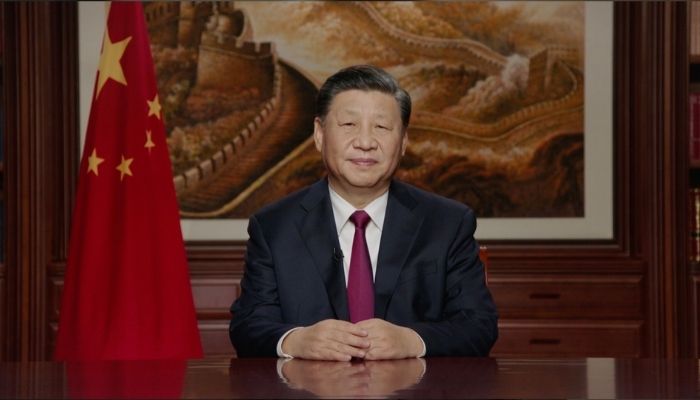
The Chinese Communist Party is infamous for carrying out extensive surveillance on its citizens. China is surging towards becoming the first country in the world to implement a pervasive system of algorithmic and technology-aided supervision to keep a vigil on its entire population. It has now come to light that the country is also spying on citizens in other nations.
In an article in The Spectator, former UK diplomat Charles Patron, who had served 22 years in Communist-ruled China, narrated how he was subjected to surveillance by the Chinese Intelligence machinery. He recounted how an unnamed British Professor at an esteemed UK university set him up to be monitored by the Chinese deep State.
“In 2018, when I was an adviser to the Commons Foreign Affairs Committee, a British professor suggested that my experience in EU/China relations might earn me some good money giving lectures,” he said. Patron informed that the Professor taught at a University, where members of the Chinese Communist Party are trained.
He got in touch with officials at the Shanghai International Studies University, who in turn connected him to their affiliate think tank named Shanghai Institute for European Studies (SIES). Patron stated that the University offered an all-expenses-paid trip to Shanghai.
“Since I was already due to speak in Shenzhen at a conference, we agreed to meet there to talk more about the offer. As the email said, by ‘lucky coincidence’ two of its people were in nearby Guangzhou for business the week after. It was not hard to spot that this was an intelligence approach,” the author wrote in The Spectator.
Screengrab of the article by Charles Patron in The Spectator
Charles Patron recounted how the two ‘CCP officials’ tried to trick him into believing that they are affiliated with the varsity. “Instead of meeting me in my hotel, they directed me to a discreet café. Of the two men, it was the younger, Mr Shen, who did the talking: unusual in a society where seniority matters,” he said.
“Nor was this because of the older’s lack of English. Mr Shen’s own fluency was not fit for purpose, so we switched to Chinese. They then forgot their story about doing business in Guangzhou. It was also clear that as I shifted ground on what I was competent to lecture about, they shifted too, away from their original professed interests,” Patron added.
He informed that the two men handed a printed ‘project proposal’ to him and was quick to turn to the payment section to test his ‘cupidity.’ After parting ways, he shared emails with his Chinese counterparts. They would often inquire about his plans to return to the Communist country under the pretext of one ‘innocuous’ request or the other.
“I let the correspondence lapse. But I am sure that the moment I set foot in China, Mr Shen will appear before me. Except that I won’t be going back…It wasn’t surprising that my intelligence approach was set up by a British academic: our universities are heavily targeted. Yet they seem remarkably relaxed,” he informed.
Charles Patron pointed out that UK universities did not bother to verify the background of their Professors, who often have connections to the Chinese Communist Party. He concluded, “There has, for example, been no debate as to the appropriateness of employing staff who are CCP members. At the very least, party membership should be declared, given that the oath when you join states that ‘I will fight for communism throughout my life’ and ‘be ready at all times to sacrifice my all for the party.”
Almost 100% of China’s public spaces under watch: Reports
Last year, a report published on OneZero stated that China was on the brink of achieving 100% surveillance of its public spaces with the help of the ‘Sharp Eyes’ surveillance program. The program started in 2013 from a backwater region of Pingyi County, where the local government began installing thousands of security cameras across rural and urban areas.
By 2016, a total of 28,500 cameras were installed. Even the smallest of the villages had at least 6 cameras installed, a state media report said. However, an intriguing facet of this unique surveillance program was that it turned neighbours into agents of the Chinese Communist Party, helping them in their snooping activities.
The footage from the CCTV camera was not only monitored by the law enforcement officials and automated facial recognition algorithms but they were also fed to the residents themselves with the help of special TV boxes installed in their homes.
The residents could watch live security footage coming from the CCTV cameras and summon the police in case they found anything suspicious. Two years later, in 2015, the Chinese government announced that it is going to extrapolate the program to the rest of the country.
The program was dubbed as “Xueliang Project”, or Sharp Eyes, in reference to a quote made by former Chinese ruler Mao Zedong who once wrote that “the people have sharp eyes” when looking out for neighbours that do not uphold communist ideals.
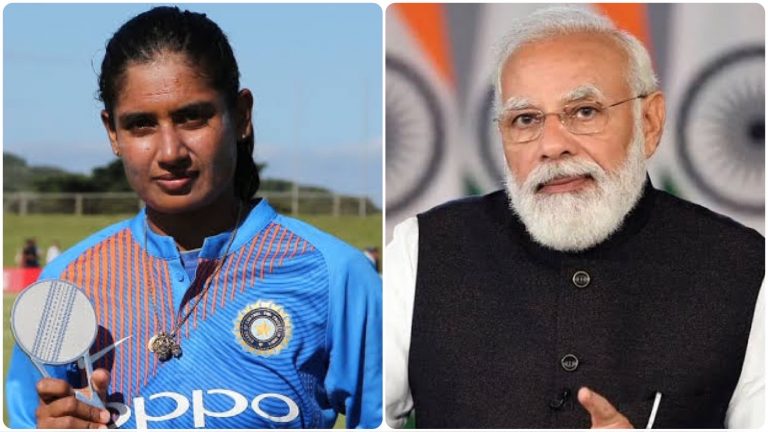
Known for her batting exploits and astute captaincy on the cricket field, Indian woman’s cricket captain Mithali Raj on Saturday sent social media users on Twitter into a tizzy after she responded with Narendra Modi as the one leader she looked up to.
Raj had organised a Question and Answer session on Twitter, asking her followers to ask her any question of their liking. When one of the social media users asked her who is the one leader she looked up to, the prolific cricketer responded with Indian Prime Minister Narendra Modi.
However, this was enough for left-wing supporters to unleash a volley of attack against the cricketer. A bevvy of detractors targeted Raj for expressing her admiration for PM Modi.
Social Media users attack Mithali Raj for holding PM Modi
One of the Twitter users who replied to Raj’s tweets said: “Lost my respect.”
One Twitter user insinuated that cricketers who support PM Modi get paid by Union Home Minister Amit Shah’s son, Jay Shah, who holds an important position in BCCI.
I feel pity for these cricketer, but what options do they have when they get paid by jay shah.
Leftists ‘cancel’ celebrated author Ruskin Bond for praising PM Modi in his new book
‘Cancelling’ famous personalities for their support to PM Modi is a common practice that left-leaning supporters indulge on social media in an attempt to discourage others from expressing their admiration for the Prime Minister.
Earlier in January 2022, Ruskin Bond, the celebrated author, was cancelled by leftists for praising PM Modi in his new book. In his recently released book titled- A Little Book of India: Celebrating 75 Years of Independence, Bond extolled India as an amalgamation of the “physical and spiritual” attributes of India, along with a few words of praise for the leftists’ bête noire- Prime Minister Narendra Modi.
Days after Hindu boys wore saffron shawls in response to the Muslim girl students violating the uniform rules and regulations by wearing hijab, the girl students of the college took to the streets of Kundapur, Udupi by wearing saffron shawls.
The uniform regulations in educational institutions have taken a dangerous turn in Karnataka after a few Muslim students refused to follow the guidelines and insisted that they want to wear hijabs inside educational institutions.
In response, boy students had decided to wear the saffron shawls prompting the authorities to ban both outfits. However, the Muslim students have brazened it out to protest against the authorities outside, risking the future of several other students studying in the school.
On Saturday, in solidarity with their classmates, girl students also hit the streets by wearing saffron shawls to protest against the attempts of Muslim students to vilify the secular atmosphere in the college by deliberately violating the rules and regulations.
Several videos have now gone viral in which girl students adorning saffron shawls took a march to protest against hijabs. In addition, they chanted Jai Shri Ram slogans to show support to their fellow students who were not allowed to enter campus for wearing saffron shawls on Friday.
Hindu girl students today came to college in Kundapura, Karnataka wearing Saffron shawls to show protest against wearing Hijab in schools and colleges pic.twitter.com/NIAV3UFv6R
A Hindu student protesting said that they would also wear Saffron shawls if the authorities allowed Muslim students to wear Islamic attires of hijab or burqa. “There has to be only one rule on the uniform,” said the student.
Not just in Kundapura, Hindu students from various parts of the state have also joined students from coastal Karnataka. Videos have gone viral in which it was seen that many students from across the state are wearing saffron scarves around their necks to protest against Muslim girls continuing to wear Hijab to the college.
In the districts of Belgavi and Hassan, students were seen wearing saffron shawls.
Meanwhile, the Karnataka High Court has agreed to hear a plea arguing that Muslim women wearing Hijab should be permitted to attend classes. A Muslim student has filed a petition in the Karnataka High Court, asking for a direction to allow wearing a hijab in college, stating that it is her “Fundamental Right” granted under Article 14 and 25 of the Indian Constitution and “integral practise of Islam”.
The Karnataka government has stated that religious attires are not allowed inside campus and students will have to obey uniform rules. However, some Muslim students have been protesting outside the gates, demanding the right to wear hijabs. As usual, the so-called ‘secular-liberal’ politicians are supporting the Islamic regressive practice and have been stating that the schools and colleges should relax their rules for Islamic practises.
On 5th February 2022, PM Narendra Modi is inaugurating the Statue of Equality at Muchintal near Hyderabad in Telangana. The 216-feet tall Statue of Equality commemorates the 11th-century Bhakti Saint Sri Ramanujacharya, who promoted the idea of equality in all aspects of living including faith, caste and creed. The Statue is made of ‘panchaloha’, a combination of five metals- gold, silver, copper, brass, and zync, and is among one of the tallest metallic statues in sitting position in the world.
The statue is mounted on a 54-ft high base building named ‘Bhadra Vedi’, which has floors devoted to a Vedic digital library and research centre, ancient Indian texts, a theatre, an educational gallery detailing many works of Sri Ramanujacharya. The statue has been conceptualised by Sri Chinna Jeeyar Swami of Sri Ramanujacharya Ashram.
Sri Ramanujacharya worked tirelessly for the upliftment of people with the spirit of every human being equal regardless of nationality, gender, race, caste or creed. The inauguration of the Statue of Equality is a part of the 12-day Sri Ramanuja Sahasrabdi Samaroham, the ongoing 1000th birth anniversary celebrations of Sri Ramanujacharya. On this occasion, it becomes necessary to remember the saint who transformed the Vaishnav tradition of devotion ten centuries ago.
Ramanujacharya had put a strong foundation of the Bhakti Marga
Ramanujacharya is also known as Bhagvad Ramanuja. He was born in 1017AD in a Tamil Brahmin family in a village Sriperumbudur which is presently in the Tamilnadu state. His mother’s name was Kanthimathi. Keshava was his father. In 120 years of his life, he went on to put the strong foundation of Bhakti Marga, which continued to inspire the devotional movement that spread across the Bharata in centuries to come.
Ramanujacharya is the pioneer of the Vishishtadvaita (qualified monism) doctrine of the Vedanta philosophy. After being initiated by Vidyavrata Sanskara rituals at the age of eight, he joined a local traditional Gurukul to study Vedic scriptures. Ramanujacharya continued his pursuit of knowledge even after his marriage. He moved to Kanchipuram where he studied in the Advaita Vedanta school of thought under the guidance of his master Yadav Prakash.
Ramanujacharya had studied and contributed to Vedanta philosophy
As the name of the school suggests, it was one of the schools following the Advaita philosophy as defined by Adi Shankaracharya. To put it in simpler terms, the basic principle of this Vedanta doctrine is that Brahman (the God or Ishwara) and Atman (oneself, devotee) are one and the same. The physical reality that separates Atman from the notion of this oneness is called ‘Maya’. ‘Maya’ is a Sanskrit word that literally means ‘that which is not.’
Ramanuja frequently had disagreements with his Guru while interpreting Vedic texts especially the Upanishads with this postulate of the Advaita. So he separated from his Guru Yadav Prakash. After this, he continued his journey in the direction of discovering the new meanings of Vedic literature on his own. Departed from his Guru, he started working as a priest in the Varadaraja Perumal Temple of Kanchipuram.
What is Vishishtadvaita as defined by Ramanujacharya?
It was only in the Varadaraja Perumal Temple that Ramanujacharya started teaching that ‘Moksha is not necessarily contemplating the Brahman or getting liberated from the birth-death cycle as understood by many others, but it is an experience of joy that results from devotion, praise, worship, and contemplating the divine perfection.’
Ramanujacharya had put forth that ‘though the God and his devotee have separate existences, the elixir of their cosmic oneness can certainly be experienced and this is a very personal experience for oneself. Therefore, all the differences amongst the humans on the basis of caste or gender should be straightaway discarded and everyone be equally regarded.’ It is this teaching of him due to which his statue being inaugurated by Narendra Modi is named as the statue of equality.
Ramanujacharya was the greatest social reformer of his times
When initiated in the Vaishnava school of thought, Ramanujacharya had received his Deeksha from Kanchipurna Swami, a Shudra disciple of Yamunacharya. Here it is notable that Yamunacharya himself came from a royal family leaving behind his kinglihood and was revered as the one who has given up everything when at the peak of prosperity. Not to forget that all this has happened in Tamilnadu, the home state to Periyar Ramaswami who unfortunately found himself from the other end of the thought process and encouraged and preached caste-based hatred amongst people under the garb of social justice and reforms.
Even while bearing the responsibility as the descendent of his Guru, Ramanujacharya had opened the doors of the Vaishnava doctrine for everyone barring the differences of caste, gender, economic class and social background. Ramanujacharya connected people with a single common thread of Bhakti. This is why attempts were made to kill him.
As mentioned by Vishwanath Mukherji in the thirteenth volume of his series ‘Bharat Ke Mahan Yogi’, Ramanujacharya had taken and completed three vows while being initiated as a Vaishnav devotee. One of them was to bring the ‘Brahmasutra’ scriptures in front of the common masses in a way they would better understand them. This is why he went on to write commentaries on Vedic scriptures.
Ramanujacharya had followed another Saint of his times, Swami Goshthipurna, to receive sacred mantras from him. Ramanujacharya was denied the mantras 18 times as he was always accompanied by at least two of his own disciples. He could receive these mantras only when he met Swami Goshthipurna in solitude and was advised to keep them secret. But as soon as he came out to meet the people, he started chanting those mantras aloud. The reason behind this as told by Ramanujacharya himself was ‘there is no greater salvation than sharing the divine knowing with the ones who are deprived.’
Writings of Ramanujacharya
Through conversations with his disciples, devotees and his colleagues, Ramanujacharya realized that any philosophy cannot be sustained by merely making disciples and preaching to people. For this, it is necessary that the texts of earlier scholars should be rewritten so that the whole philosophy can be accessible to the common masses. To give effect to this idea, Ramanujacharya started writing the commentary of ‘Brahmasutra’. It is known as ‘Sri Bhashya’. Ramanujacharya composed other texts named ‘Vedantadeep’, ‘Vedantasar Sangrah’, ‘Geetabhashya’, ‘Nityaradhana-Vidhi’ and ‘Gadyatraya’. After the writing works of these texts was over, Ramanujacharya left for a tour of Bharat.
Uniting the nation through the Bhakti movement
In his Bharat tour, Ramanujacharya went on to establish Vishnu temples and muths at 108 different places. He had also visited the farthest situated Sharada Peeth of Kashmir for getting references of some scriptures needed for his next writing. Worshipping of Vishnu incarnations Lord Rama and Lord Krishna in north India have a great influence on Ramanujacharya.
During his times, Ramanujacharya had ensured that every single temple and the muth has qualified teachers who teach Vedanta philosophy to everyone who approached with the intent of learning. These schools made sure that the Sanatan (Hindu) faith in the people manifests as a personal bond between the individual and his deity experienced and lived in one’s daily practice rather than becoming a blind cult. Ramanujacharya left the body in 1137 CE only after consecrating his own Prastar Murti (actual live replica) at Sriranganathaswamy temple at Srirangam in Tamilnadu. This life-size murti has been an inspiration for many devotees.
Impact of Ramanujacharya and the Bhakti movement he initiated
The standardization of the rituals in the Bhakti movement has come from the southern part of the nation. Other great philosophers of Bhakti namely Nimbarkacharya, Madhvacharya and Vallabhacharya also hail from the Deccan. They are either contemporary to Ramanujacharya or from the following centuries. Therefore it is well said that भक्ति द्रविडे उपजी, उत्तर लाए रामानन्द, परगट कियो कबीर ने, सात धर्म नौ खंड which means ‘Bhakti first appeared in the southern part of the nation, Ramananda (14th generation of Ramanujacharya’s disciple) expanded it in the north and Kabir revealed the deepest of the secrets of Bhakti to the world.’
From Meerabai and Narsi Mehta in the west to Ramkrishna Paramhans and Chaitanya Mahaprabhu in the east, the effects of the Bhakti movement on the nation have marked their remarkable and longlasting impression. Warkari movement in Maharashtra which is still alive with annual gatherings of more than 25 lakh pilgrims at Pandharpur has drawn almost all its philosophy from Ramanujacharya’s teaching. Bhakti literature by eminent Marathi Saint poets is the similar philosophy of personal bond between the deity and the devotee as told in the regional language of common masses.
In the Islamic invasions that followed, it was this personal bond of individuals with their deity which made it difficult for the religiously motivated invaders to preach to people and inspire them to convert to their faith, because it is always a tough task to convert every individual separately than to bring a whole lot of people into the religion at once. With people of all castes being covered under the umbrella of the profound Bhakti philosophy, conversion became an uphill task for the Islamic invaders. It, therefore, becomes evident that there were fewer willful conversions and more forced conversions as the Islamic rule spread in the medieval centuries.
Statue of Equality
To honour the great philosopher Ramanujacharya, in 2017 – the year of his 1000th birth anniversary, Vaishnava ascetic Chinna Jeeyar came up with the idea of erecting Ramanujacharya’s 216 feet high statue to commemorate his teachings. It is built on an approximately 35-acre site near Hyderabad in Telangana. The statue is surrounded by 108 small temples called Divyadesam. On the walls and pillars of these temples, the life of Ramanujacharya is inscribed.
The complex also includes a library and research centre. On the upper floor, there is a temple in which a 120kg gold idol of Ramanujacharya is established and consecrated for performing daily rituals. The grand 216 feet statue is made of Panchaloha, which is five metallic elements viz. gold, silver, copper, brass and zync. There are 5 lotus petals, 27 Padma Peetham, 36 elephants, and 108 steps have been made to reach the statue. Along with an Omnimax theatre and Vedic school on the premises, this monument becomes a state of the art ancient knowledge centre in the new India. On 5th February 2022, on the occasion of Basant Panchami, Prime Minister Narendra Modi is inaugurating the statue of equality.
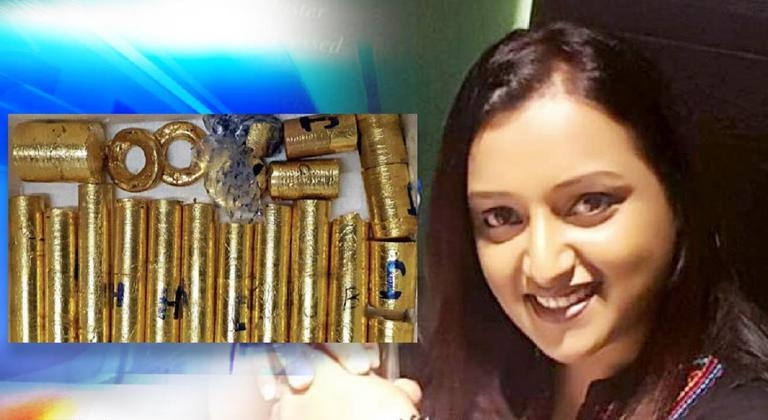
Swapna Suresh, the accused in the Kerala gold smuggling case, lambasted senior bureaucrat M Sivasankar on Friday for making false charges against her. Suresh, who was released on bail a few months ago after being imprisoned for her alleged involvement in the smuggling of gold through the diplomatic route, attacked former Principal Secretary M Sivasankar for stating in his book that she had deceived him.
They did not have a close connection, according to Sivasankar. Swapna, on the other hand, stated that they were close and that after taking voluntary retirement, he wanted to settle down in Dubai. “Sivasankar was a very important part of my life and there was personal intimacy between us. We had a very good wavelength” Swapna said in an interview with Republic Bharat.
#RepublicSuperExclusive | “Sivasankar was a very important part of my life and there was personal intimacy between us. We had a very good wavelength”: Kerala gold smuggling case accused Swapna Suresh to Republic TV
This revelation comes while Sivasankar is releasing his autobiography, ‘Aswathamavu: Verum Oru Aana’ (Ashwathama is just an elephant).
Swapna has also claimed that Sivasankar was aware of what was inside the diplomatic luggage and that everything she did while on the run from police was on Sivasankar’s orders.
Swapna went on to say that Sivasankar was a daily visitor to her home and that they used to travel across states and to Dubai together. She further said that Sivasankar orchestrated the NIA’s involvement in the gold smuggling case in order to keep Swapna quiet.
Swapna stated that she had given other presents to Sivasankar throughout time and that he was exploiting her to clean up his reputation.
The 2020 gold smuggling case
On July 5, 2020, customs officials at the Thiruvananthapuram international airport found gold weighing over 30 kilograms and valued at almost Rs 15 crore. This gold was concealed in diplomatic baggage and sent to the UAE embassy via air freight.
After getting information that the suitcase was part of a smuggling network aiming to misappropriate the name of a diplomat with diplomatic immunity, customs authorities took action.
In this case, Swapna Suresh is the primary defendant. Swapna Suresh, a former employee of the UAE consulate, has been engaged by a private business to work on a project for the Kerala Information Technology Department, which is led by Chief Minister Pinarayi Vijayan. M Sivasankar, the CM’s principal secretary, used to be in charge of this department.