Home Blog Page 3584

Conviction of Dinesh Yadav, bail to Muslims accused in Dilbar Negi murder: Inconsistencies and the miscarriage of justice we need to talk about

The violence that hit the national capital in 2020 was a brutal reminder of India and its tryst with those who wish to annihilate Hindus and balkanise the nation. With the violence, the conspiracy of which started germinating right from the 5th of December 2019, a vicious international campaign was unleashed to paint the violence, initiated by Muslim mobs, as an anti-Muslim pogrom. The fact that the first murder during the violence that erupted on the 23rd of February with Muslim mobs running rampage was that of Ratan Lal and soon after him, Dilbar Negi, a young daily wager, was brutally murdered, was swiftly brushed under the carpet.

With several cases pertaining to the Delhi riots being tried in the court of law, the first judgement has been delivered by the honourable court, in all its wisdom. The first conviction in the case was that of Dinesh Yadav, a young Hindu boy who was seen in the vicinity of a mob vandalising Muslim households on the 25th of February, 2 days after Muslim mobs had unleashed violence against Hindus.

Almost simultaneously, those who were accused of murdering Dilbar Negi were awarded bail. On January 18th, the Delhi High Court granted bail to six persons named Mohd Tahir, Shahrukh, Mohd Faizal, Mohd Shoaib, Rashid and Parvez in the Gokulpuri murder case related to the Delhi Riots of February 2020. The bail was granted by Justice Subramonium Prasad. The six were accused of vandalism and setting Anil Sweet Corner on fire “resulting in the death of 22-year-old Dilbar Negi”.

The conviction of Dinesh Yadav, coupled with the bail granted to the murderers of Dilbar Negi, expectedly, created flutters. While the Muslim organisations and the sympathisers of the rioters were rejoicing the conviction of a Hindu man, those who truly wanted to talk about the truth of the riots rued the inconsistencies in the two judgements passed days apart.

Summary of the basis on which Dinesh Yadav was convicted in the Delhi anti-Hindu riots case

The conviction of Dinesh Yadav hinged on certain fundamental points elucidated in the judgement itself.

  1. Manori, the old woman whose house was vandalised, was not present in the house when the vandalised took place. She said she had left the house at around 4 PM on the 25th and the vandalisation, according to the police personnel (who were also witnesses in the case), began at about 11 PM.
  2. Manori, her family members Ashiq and Asif could not identify any of the rioters, leave alone Dinesh Yadav, since they were not present when the vandalisation took place. In fact, these witnesses were declared hostile by the prosecution where during cross-questioning, they said that they had never told the police that they were in the house when the vandalisation took place. Essentially, it would appear that the police was under the impression that they were present in the house when the vandalisation took place. The family itself had alluded to it several times, even in an Indian Express interview after the verdict was out.
  3. The police personnel, Vipin and Sanoj, named Dinesh because they saw him in the vicinity of the mob. They have admitted that Dinesh was in no way involved in the violence. They said they him with a wooden danda, however, no such danda was recovered from Dinesh. In fact, there was no incriminating material found on his person.
  4. The court in its wisdom said that even though there is no evidence to suggest that Dinesh was involved in the violence, he was a part of the mob and therefore, assumed his intention to further the common goal of the illegal mob – vandalise and commit violence against Muslims.
  5. The court predicated this conclusion on two factors – a) Section 149 applies, which basically says that even if a person is not committing violence but is a part of an illegal assembly creating violence and if he has the intention to further the same illegal goal of the illegal crowd, he should be held liable, b) the mob was Hindu and since he was Hindu too, it can be assumed that he wanted to further the same cause as that of the rest of the mob.
  6. One has to keep in mind that other than this assumption, based on the fact that he is a Hindu, there is no evidence on record to suggest that he was not a bystander and wanted to further the cause of the illegal mob, yet, the court sentenced Dinesh to 5 years in prison.

The full article analysing the Dinesh Yadav judgement and the miscarriage of justice can be read here.

The arguments made in the case of those accused in the Dilbar Negi case

It becomes evident from the analysis of the judgement passed convicting and sentencing Dinesh Yadav that there was a thorough lack of evidence to award a 5-year prison sentence. However, to draw conclusions about how the judgement in the Dinesh Yadav case differs from that of giving bail to the accused in the Dilbar Negi case, and thus how it amounts to a miscarriage of justice, we must now analyse the judgement in the bail case.

The judgement stated:

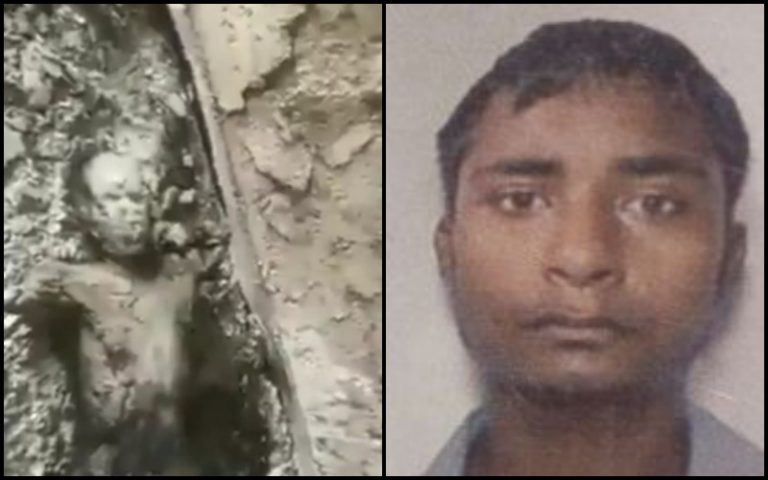
The FIR states that when the Complainant and the Beat Constable reached the said house, they found the door to be broken and the house to be completely burnt. On inspecting the second floor, the Complainant noticed a semi-burnt body lying in the corner. The FIR further states that the deceased seemed to be about 20 years old and that both the arms and legs of the body were chopped off. It is stated that the chopped limbs could not be found and that on inquiry, it was found that the burnt body belonged to a person named Dilbar who was a waiter at the sweet house. The body was then sent to GTB Hospital and then to the GTB Hospital mortuary. The FIR states that it appears that unknown persons belonging to one of the parties opposing and supporting the CAA killed the deceased with a deadly weapon and then set the house ablaze with the intent to destroy the evidence of the crime.

Salman Khurshid, who was representing the accused, said that he was arrested and implicated falsely and that he is a poor boy who works in a repair shop and is the sole breadwinner of the family.

Interestingly, a similar argument that was made in the Dinesh Yadav case was made here by Salman Khurshid. He said that his brother’s shop is in the vicinity where the accused has been working for the past 15 years and therefore he was in the area. It was argued that the Petitioner was only present before Rajdhani Public School to collect certain articles and that he merely closed his shop and returned to his home.

Khurshid submitted that the only evidence against the Petitioner is the CCTV footage, the statement under Section 161 Cr.P.C. of Amit Pal, and the CDR, and these are matters which must go through the rigours of trial. It is pertinent to note here that while CCTV footage did exist in the case of this accused in the Dilbar Negi case, in the Dinesh Yadav case, there was no CCTV footage either. It was only the word of the two policemen who had said they saw Dinesh in the crowd with a lathi, admitting that he was not involved in any violence that had ensued.

Another argument made by Khurshid to ensure bail for the accused was that the body of Dilbar Negi was discovered on the 26th while the FIR was registered only on the 28th. The delay in the filing of the FIR was used to cast aspersion on the role of the accused by the lawyer.

The Public Prosecutor on the other hand had argued that the accused, Md Tahir, had actively participated in the deadly riots on 24.02.2020 wherein the deceased Dilbar Negi was burnt alive. The PP submitted that the Petitioner was identified in the CCTV footage retrieved from Rajdhani Public School where he could be seen instigating others. Pointing at the CCTV footage (CP IP Cam), the learned APP has indicated that the Petitioner has been identified at 3:37:39 PM in a printed white shirt and that the posture of the Petitioner is not that of a curious onlooker. He has submitted that the Petitioner can be seen gesturing and instigating other members of the unlawful assembly.

Interestingly, the public prosecutor in this case also invoked Section 149 saying that in a mob, it is impossible to identify every member of the mob and therefore, any individual who was a part of the mob and identifiable should be held liable for the actions of the mob.

The prosecution also said that on an earlier occasion, Tahir was denied bail by the court on account of the heinousness of the crime. This argument was made by the prosecution after the defence lawyer (Khurshid) had argued that Tahir had been incarcerated for long enough pending trial and therefore should be awarded bail.

Mr. Mahajan has further argued that that Ld. Trial Court vide Order dated 18.08.2020 had also dismissed the Petitioner’s bail application on the ground of the heinousness of the offence. He has, therefore, submitted before this Court that there has been no change of circumstances and that period of incarceration undergone by the accused is not relevant while considering grant of bail. He has submitted that Section 436A of the Code of Criminal Procedure specifically provides for the maximum period for which an accused can be in custody while the trial is underway, and therefore, it should not be a relevant factor for grant of bail. Furthermore, Mr. Mahajan has submitted that the eyewitnesses reside in the same area as the Petitioner and may be susceptible to being influenced or threatened if the Petitioner is enlarged on bail.

What did the court say while granting bail to the accused in the Dilbar Negi murder case

The judgement by the court said that during the course of the investigation, two CCTV footage were discovered by the police. One from the corner wall of the school covering the sweet shop between Rajdhani Public School and Anil Pastry Shop, and another inside Rajdhani School near the main entry gate. The judgement said that though the murder of Dilbar Negi was committed on the 24th of February, the FIR was filed on the 28th of February and that the charge sheet in the case clearly states that the murder was a part of a well-hatched conspiracy.

The judgement states:

The chargesheet additionally states that the CDR of the Petitioner places him at the location of the scene of crime. Further, the statement of Amit Pal under Section 161 Cr.P.C. ascertains that the Petitioner was in front of Rajdhani Public School, raising slogans against Hindus and provoking a crowd of Muslim boys. It states that the Petitioner was involved in pelting stones and setting fire to the shops. A perusal of the video footage shows that the Petitioner was seen on the CCTV camera of CP IP Cam at 03:41:59 PM which shows him before Rajdhani Public School on the day of the incident. It indicates the Petitioner herein calling out to others present in the mob.

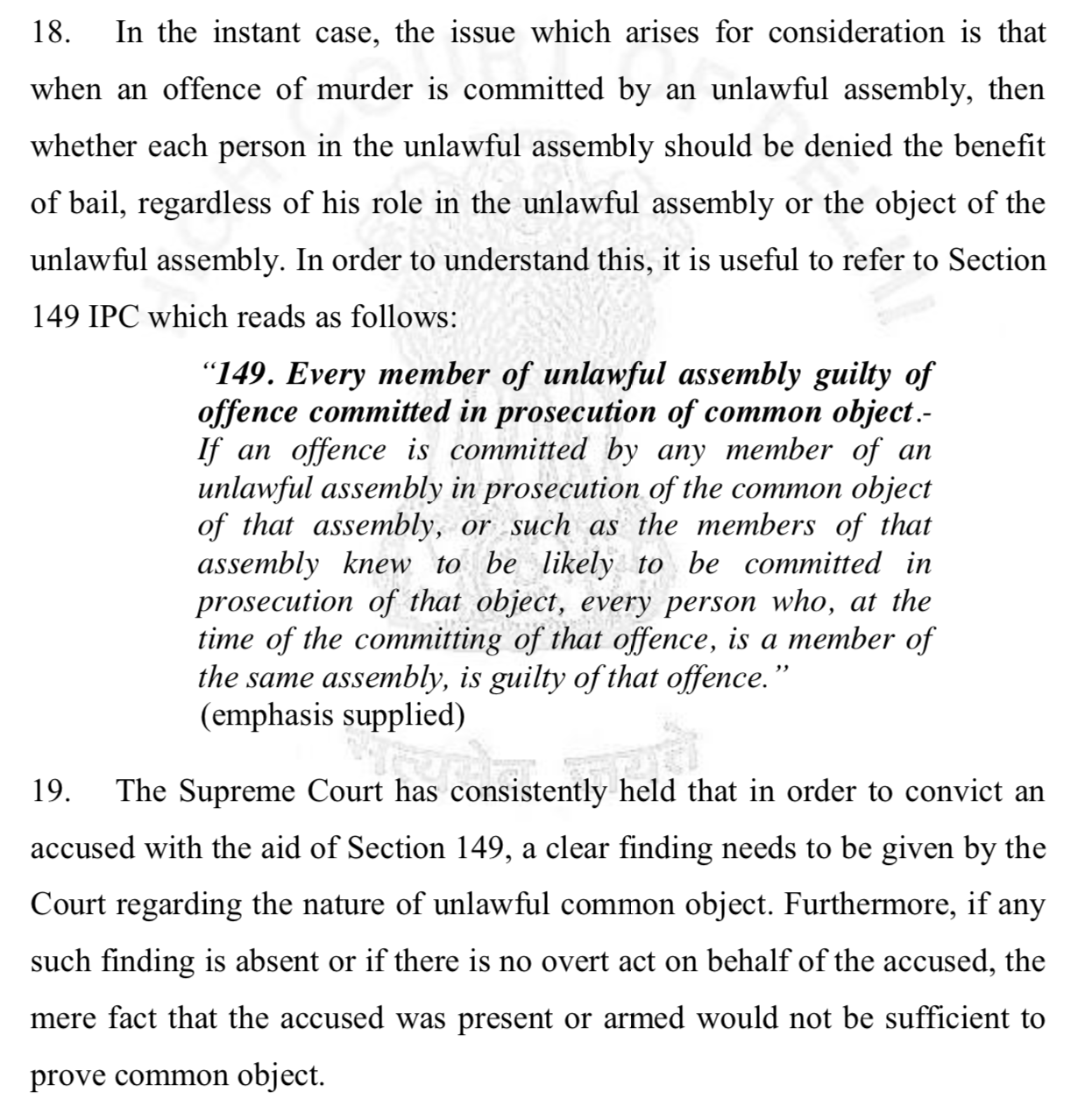
The court, in its wisdom, took exception to Section 149 being applied to every individual who was a part of the illegal assembly.
Judgement giving bail to accused in the Dilbar Negi murder case

This part of the judgement is extremely important and we will analyse how it differs from the one passed in the case of Dinesh Yadav in the next section of the article. The court here observes:

“…clear finding needs to be given by the Court regarding the nature of unlawful common object. Furthermore, if any such finding is absent or if there is no overt act on behalf of the accused, the mere fact that the accused was present or armed would not be sufficient to prove common object”.

The court, therefore, says that just because someone is armed and a part of an illegal crowd, it does not mean that they should be prosecuted for the crime committed by the crowd unless it can be proven that he was a part of the violence.

Citing the case of Sherey and Ors. v. State of U.P., (1991) Supp (2) SCC 437, the court said:

“We feel it highly unsafe to apply Section 149 IPC and make everyone of them constructively liable. But so far as the above nine accused are concerned the prosecution version is consistent namely that they were armed with lethal weapons like swords and axes and attacked the deceased and others. This strong circumstance against them establishes their presence as well as their membership of the unlawful assembly. The learned counsel appearing for the State vehemently contended that the fact that the Muslims as a body came to the scene of occurrence would show that they were members of an unlawful assembly with the common object of committing various offences including that of murder. Therefore all of them should be made constructively liable. But when there is a general allegation against a large number of persons the Court naturally hesitates to convict all of them on such vague evidence. Therefore we have to find some reasonable circumstance which lends assurance…” 

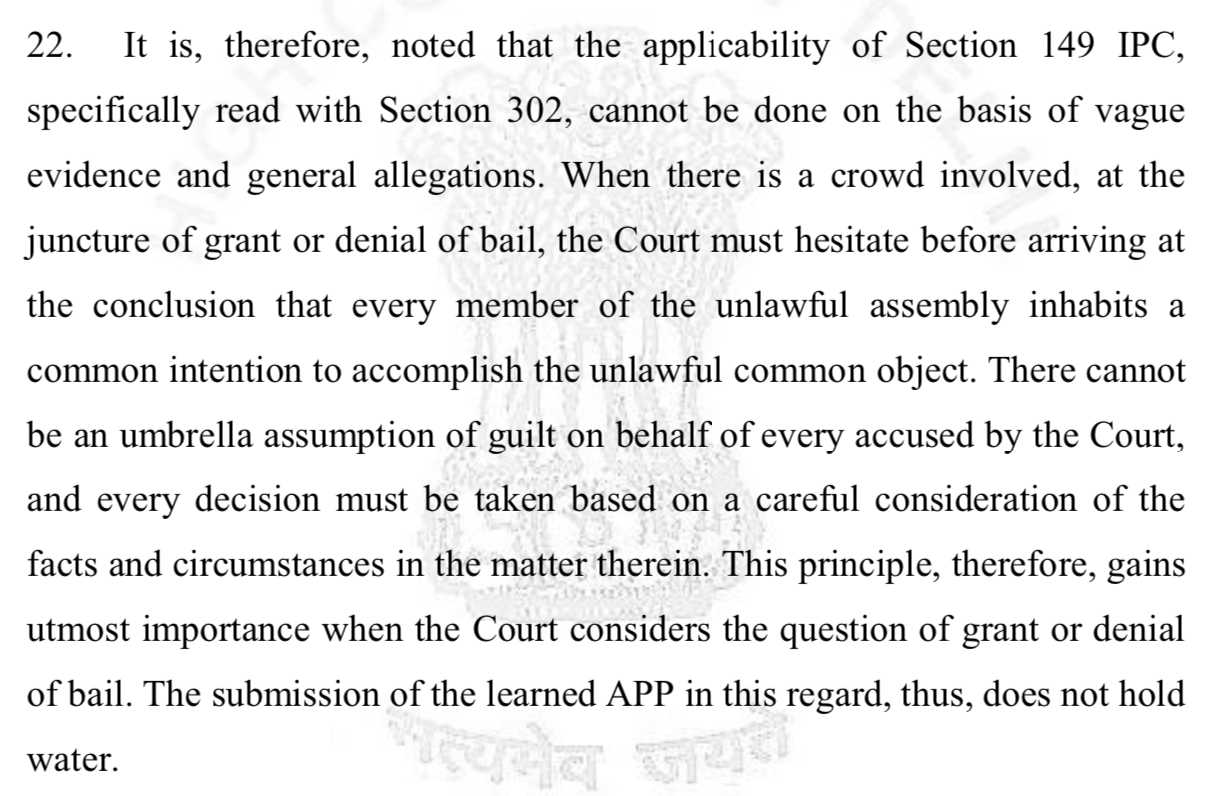
The court further said that Section 149, when read with section 302, cannot be done on the basis of vague evidence and general allegations. 
Judgement giving bail to accused in the Dilbar Negi murder case

On the question of bail, the court observed that the accused had been in jail for 21 months and therefore, the court has to ensure that the personal liberty of individuals is not compromised in the face of excess state power.

The court said:

“…Bail is the rule and jail is the exception, and Courts must exercise their jurisdiction to uphold the tenets of personal liberty, subject to rightful regulation of the same by validly enacted legislation. The Supreme Court has time and again held that Courts need to be alive to both ends of the spectrum, i.e. the duty of the Courts to ensure proper enforcement of criminal law, and the duty of the Courts to ensure that the law does not become a tool for targeted harassment”.

The court, granting bail, based their decision on the following:

  1. Court said that the sole evidence available at this juncture against the Petitioner is his presence in the CCTV footage, the statement of Amit Pal, and the CDR which places the Petitioner at the SOC and this evidence has to be examined during trial.
  2. The court said that the CCTV placed the accused at the spot of the crime at 4 PM, however, the murder happened sometime after 8 PM. Therefore, the evidence is inconclusive at this point and it would be a “bit of a stretch” to say that “the petitioner was present at the SoC when the alleged murder was committed after a gap of almost six hours between the petitioner’s presence at the SoC and the deceased’s alleged time of death”.
  3. The court said that in this case, there were 72 witnesses and therefore, the trial would take long. Since it would, the prolonged incarceration of the accused was not justified.
  4. The court, in its infinite wisdom, also said, “The Petitioner has roots in society, and, therefore, there is no danger of him absconding and fleeing”.
  5. The court makes clear that these observations and only for the purpose of bail and would not be applicable during trial and that the court is not commenting on the merits of the case.

How are the two judgements different? Was conviction of Dinesh Yadav in the Delhi Riots case a miscarriage of justice?

The foundational element in both these cases, the bail order in the Dilbar Negi case and the conviction judgement in the Dinesh Yadav case, was the application of Section 149. This section and its interpretation were used differently in both cases, in one, to convict the Hindu boy Dinesh Yadav in the other, to give bail to the Muslim perpetrators in the Dilbar Negi murder case.

In the case of Dinesh Yadav, where he was convicted, the court said that for Section 149, it does not need to be proved that the individual was a part of the violence at all. The mere fact that Dinesh was allegedly a part of the mob, goes to show that he showed a common goal with the illegal assembly. In fact, the court convicted Dinesh on the basis of this mere assumption. Going further, the court said that because the crowd was Hindu, and Dinesh was Hindu, it is a reasonable assumption that he was a part of the mob sharing their goal to harm Muslims. Keep in mind, that while interpreting Section 149 and throwing Dinesh in jail for 5 years, the court categorically admitted that there was absolutely no evidence to prove that Dinesh was a part of the violence that ensued and led to the house of the Muslim woman being burnt.

In the case where Md Tahir was given bail, the court also interpreted Section 149 but in a manner diametrically opposed to the interpretation used by the court in the Dinesh Yadav case.

In the case of giving bail to the Muslim accused in the Dilbar Negi case, the court said categorically that “…clear finding needs to be given by the Court regarding the nature of an unlawful common object. Furthermore, if any such finding is absent or if there is no overt act on behalf of the accused, the mere fact that the accused was present or armed would not be sufficient to prove common object”.

It went so far as to say that the court has to be circumspect of the personal liberty of individuals and therefore, granting bail is the norm that the court must follow.

As evident, in the two cases, the court interpreted the provision of the law differently using one to convict a Hindu boy and using the other to grant bail to the Muslim accused.

One has to also bear in mind that in the case of the Muslim accused, the court judgement says that there are over 70 witnesses to examine but in the case of Dinesh Yadav, where he was convicted on the basis of a flawed interpretation of the law, there were witnesses who could not identify anyone from the mob because they were not even there when the violence took place and two other police officers, who merely said they identified Dinesh standing around in the crowd and had no evidence that he participated in any violence.

This was not an average situation where any individual who was a part of the mob was there to further the common objective of the illegal assembly. There were widespread riots in the national capital on those fateful days and incidents of violence aplenty. There were several individuals who were bystanders or stuck in the violence-affected areas. Further, there were people also moving around in groups to ensure some sort of safety for themselves. With no proof that Dinesh was a part of the violence, on the say-so of two police officers, with no evidence like weapons recovered or CCTV footage, the court incarcerated him on the basis of the fact that he was a Hindu, standing near a Hindu mob. Whereas, in the case of the Muslim convicts, they have been granted bail on the basis of a completely different interpretation of Section 149.

While it is true that at the stage of the bail hearing, there is a presumption of innocence, the glaring difference in interpretation of Section 149 and the standard of burden of evidence points towards a gross miscarriage of justice as far as Dinesh Yadav is concerned.
Delhi court frames fresh charges of sedition and UAPA against Sharjeel Imam for his inflammatory speeches against CAA

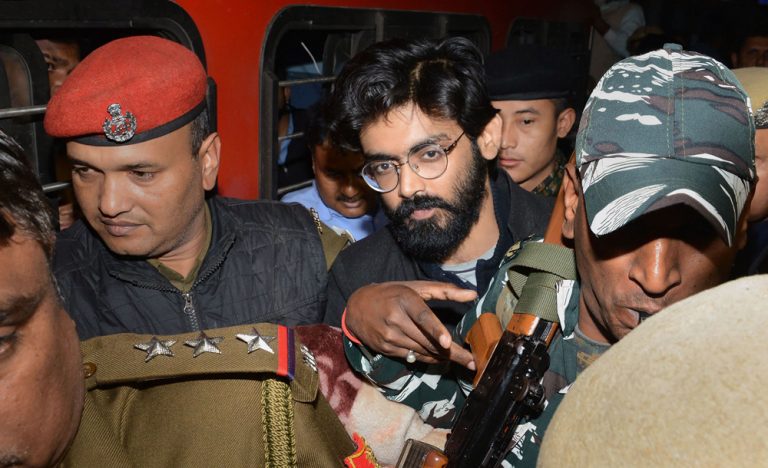
Delhi’s Karkardooma court Monday slapped a fresh sedition charge against Sharjeel Imam over his provocative speeches in Jamia Millia Islamia University and Aligarh Muslim University during anti-CAA protests in Delhi on December 13, 2019, and January 16, 2020, respectively.

Sharjeel Imam was arrested by Delhi Police on 28th January 2020, from Bihar over inflammatory speeches against the Citizenship Amendment Act, advocating for the secession of Assam from the rest of India. Imam, who is currently lodged in Tihar jail, will complete two years in jail this month.

The accusations against Sharjeel Imam were framed under sections 124A (sedition), 153A, 153B, 505 of the IPC, and 13 of the UAPA as per Additional Sessions Judge Amitabh Rawat.

Imam has been charged with sedition, promoting enmity between different groups on grounds of religion, race, place of birth, imputations prejudicial to national integration, and public mischief under the Indian Penal Code, and indulging in unlawful activities under the Unlawful Activities (Prevention) Act.

A detailed copy of the order is expected to be made available later in the day.

The Delhi Police had filed a charge sheet against Sharjeel Imam in the matter, alleging that he offered statements inciting hatred, contempt, and disaffection toward the central government, as well as instigating the people who resulted in the December 2019 riots.

The charge sheet against Imam mentioned: “He is accused of delivering seditious speeches and inciting a particular section of the community to indulge in unlawful activities, detrimental to sovereignty and integrity of the nation.”

“In the garb of protesting against the Citizenship Amendment Act, he exhorted people of a particular community to block the highways leading to the major cities and resort to ‘Chakka Jam’, thereby disrupting normal life,” it read.

Last year, on November 27, Allahabad High Court had granted bail to Sharjeel Imam in the case of provocative speech against the Citizenship Amendment Act (CAA) at Aligarh Muslim University in December 2019.

In October 2021, a Delhi Court had denied bail to Imam in the sedition case. Additional Sessions Judge Anuj Agarwal has opined that Imam’s speech at Jamia on December 13, 2019, was communal and divisive that could affect the peace and harmony in the society.

Who is Sharjeel Imam

Imam was arrested in 2020 from Jehanabad, Bihar. He is a former Jawaharlal Nehru University, Delhi, and one of the key members of the group that organized Shaheen Bagh protests against CAA. Multiple FIRs were filed against Imam for a speech in which he allegedly asked the protestors to cut off Assam from India. FIRs were filed at Police stations in Assam, Arunachal Pradesh and Manipur. He also got bail in the cases filed at Assam and Arunachal Pradesh.

Imam was accused of making provocative speeches outside Jamia Milia Islamia University in December 2019 that led to violence outside the campus. In April 2020, he was charged with sedition by Delhi Police. According to the FIR, his speech promoted enmity between communities that led to the riots at the area where University is located.

Another FIR in the Jamia case was registered against Imam in the Aligarh district. Both FIRs were registered in January 2020 under Sections 124 A (sedition) and 153 A (promoting or attempting to promote disharmony or feelings of enmity on the grounds of religion, race, place of birth, residence, language, caste or community or any other ground whatsoever), 153B (making statements provoking breach of peace) and 505(2) (statements made which are alarming, false intention to create disharmony) of the Indian Penal Code (IPC).

Mumbai: Man rapes woman, wife films the act, tries to blackmail victim, accused Yusuf arrested from Kolkata

0

Mumbai Police has arrested a couple identified as Syed Yusuf Jamal and Naaz Syed from a hotel in the New Market area of ​​Kolkata, West Bengal. Syed Yusuf Jamal has been charged with rape and blackmailing a woman. His wife Naa Syed has been accused of filming the incident and using it to extort money from the victim. With the help of Kolkata Police, Mumbai Police have recovered certain videos from the hotel which the accused reportedly filmed and thereafter used to blackmail the victim. After being produced in the city court, the couple was brought to Mumbai on transit remand.

The incident was brought to light after the victim filed a report with Mumbai’s Nagpara police station. She claimed that Yusuf used to rape her in front of his wife Naaz, who, in turn, recorded the act on video.

In her complaint, the victim alleged that the couple had threatened her that if she complained to the police, they would upload all the videos online. The victim further claimed that both of them blackmailed her and extorted Rs 1.5 crore from her. The complainant alleged that the duo also practised black magic.

According to reports, the victim had met Yusuf at a party in 2015. Following that, the two began to converse with each other over the phone. A few days later, Yusuf called the victim to his house on Dr Babasaheb Ambedkar Road under the Byculla (East) police station area of ​​Mumbai on the pretext of introducing her to his wife.

The accused thereafter spiked the drink he offered to the victim, because of which she fell unconscious. After she regained consciousness, Yusuf and his wife Naaz forced her to watch an obscene video in which Yusuf could be seen raping the victim. They then began blackmailing the victim by threatening to post the explicit content online. Fearing that her films and photos might go viral on social media, the woman began paying money to the accused couple.

Yusuf also used the tapes to coerce her into seeing him, and every time the victim was forced to see him, Yusuf would rape her as his wife recorded the incident on camera.

The woman reportedly remained silent during the coercion, but when the accused attempted to force her minor daughter into doing the same and tried recording her video also, she chose to come out against the duo.

She lodged a police complaint against the accused, following which the couple fled from Mumbai and started living separately in two hotels in Kolkata’s New Market area. When the Mumbai Police got information about this, they arrested them on Saturday (January 22, 2022) evening with the help of the Kolkata Police.

Speaking about the case, a top Kolkata Police officer said: “Mumbai Police wanted our help and we cooperated with them. The couple has been arrested and we have produced them in court, after which they are being taken to Mumbai.”

Delhi police unearths cyber fraud module transferring Cryptocurrency into the wallets linked to Islamic terrorist organization Hamas

A cyber fraud module was unearthed by Delhi police sending crypto funds into the wallets of Al-Qassam Brigades, the armed branch of the terrorist organization Hamas. Intel from a foreign intelligence agency to Indian intelligence identifying crypto wallets operated and managed by the military branch of Hamas prompted Delhi Police to investigate a first-of-its-kind crypto hacking case.

The case was reported in 2019 after a businessman from Paschim Vihar, Delhi, lodged a police complaint after losing access to his wallet. The victim possessed 6.2 Bitcoin, 9.79 Ethereum, and 2.44 Bitcoin cash in his blockchain mobile wallet on his Oppo F17 mobile smartphone, according to the complaint. As per estimates, his money was worth around Rs 30.6 lakh at the time. The current value of the cryptocurrencies stands at Rs 4 Crore.

The investigation was soon assigned to the Special Cell for further technical evaluation. Rakesh Asthana, the commissioner of the Delhi Police, requested that the case be investigated as soon as possible. A special team led by DCP KPS Malhotra was constituted under Special Cell’s Intelligence Fusion and Strategic Ops section to launch a multi-angle inquiry. Malhotra then constituted a special squad, which included ACP Raman Lamba, SI Neeraj, and others, to trace out the receivers of the stolen money.

During the probe, the crypto trail led investigators to the al-Qassam Brigades’ accounts. An inquiry employing a variety of tracking techniques indicated that the victim’s device had been hacked and funds had been moved to three separate accounts without his authorization. According to officials, some of the stolen funds were also traced move to a UK-based gaming site and a child pornography site.

“The seized wallet belonged to Mohammad Naseer Ibrahim Abdulla. The other wallets into which a significant portion of the cryptocurrencies was transferred were operated from Giza in Egypt. One of these wallets belonged to Ahmed Marzooq. Another wallet, in which cryptocurrencies had been transferred, belonged to Ahmed QH Safi from Ramallah in Palestine,” the investigation report filed by IFSO states as per reports.

These developments are anticipated to be communicated to relevant authorities at home and abroad through proper channels by Delhi Police Commissioner Rakesh Asthana.

The National Bureau for Counter Terror Financing of Israel’s Defense Ministry announced in July 2021 that it had confiscated a number of digital wallets related to Hamas. After a combined operation with a cryptocurrency tracking agency found a network of electronic wallets used by Hamas to gather cash, the ministry ordered the accounts to be frozen. The list of accounts was distributed to a number of other countries, including India.

The news comes amid calls for the regulation and prosecution of digital wallets, which have long been used by hackers to launder funds obtained via online crimes. In India, trading cryptocurrencies and establishing a crypto exchange are both allowed. However, there is presently no legislation that governs cryptocurrency trading.

As Rana Ayyub gets called out by netizens from Saudi Arabia, here is a list of lies, chicanery and biases of the Islamist propagandist

Yesterday, the controversial journalist Rana Ayyub came under attack on Twitter by Saudi Netizens after she posted a Tweet slamming Saudi Arabia for launching a military operation against Yemen. She was accused of peddling fake news and supporting terrorism.

Taking offence to her Tweet, several Saudi Netizens called out the ‘Muslims journalist’, as she was fervently titled by Pakistan for being on common grounds in not only their blind hate for Prime Minister Narendra Modi but also their hatred for Hindus and India, for spreading brazen lies.

Saudi engineer Gassan called it fake news and said that Saudi Arabia has launched military operations in Yemen as part of a coalition of over ten countries in response to a direct request from the legitimate government of Yemen. “We supporting legitimate and you supporting terrorists”, he added.

One Twitter user Abu Sultan called her a “fu**ing liar”, saying all she “said are bullshit”. The user noted that this why Ayyub has disabled replied to her tweets. Many more similar reactions have filled the Twitter space.

Though the controversial journalist has been receiving a lot of backlash for her recent mendacity, these types of retorts are normal for Rana Ayyub, who is known for spreading outright lies under the cover of journalism. From hiding horrendous crimes committed by Muslim radicals against Hindus, fabricating incidents to create a Muslim victimhood narrative to spreading misinformation to discredit the BJP government in the centre, this Washington Post propagandist has done it all.

Below we have tried to compile a list with a few of the endless lies, chicanery, biases and questionable journalism of Rana Ayyub that has been called out not only by Indians on the right and the centre but also by her own on the far-left of the political spectrum.

FIR filed against Rana Ayyub for spreading fake news in Ghaziabad case

On June 15, 2021, the Ghaziabad Police registered an FIR against Alt News cofounder Muhammed Zubair, The Wire, Rana Ayyub, Twitter and others for trying to stoke communal tension by making false claims that an elderly Muslim man was beaten up and forced to chant ‘Jai Shri Ram’. 

In the FIR, police noted that these people and organizations spread manipulated video to give a communal twist to a personal fight.

On investigation, it was found that the original video of thrashing had no reference to Jai Shri Ram and the second video of Saifi was shot in Samajwadi Party leader Umed Idris’ house. Even after being called out by the UP police, the fake news peddler had shown no remorse.

When Rana Ayyub lied through her teeth following ‘comedian’ Manuwar Faruqui’s arrest

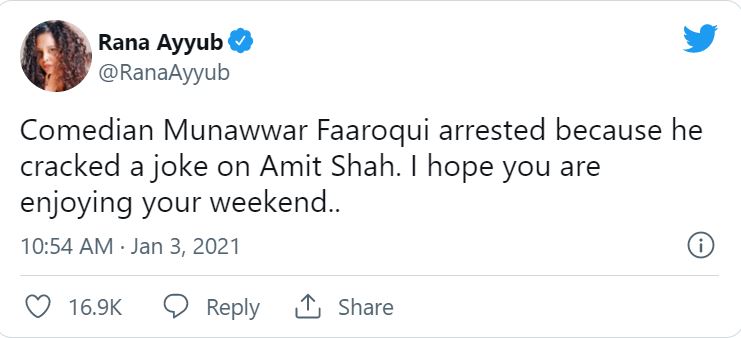
In January 2021, the Islamist propagandist concocted a fabricated story to sympathise with ‘comedian’ Munawar Faruqui, after he was sent to jail for mocking Hindu victims of the Godhra riots of 2002 in his shows. In an obvious attempt to vilify the BJP government at the centre and to portray them as intolerant, she tweeted that Munawar Faruqui was arrested only because he cracked a joke on Amit Shah.

Rana Ayyub’s Tweet posted on Jan 3, 2021

Ayyub’s tweet was quoted by a Pakistani journalist, who compared India and Pakistan and insinuated that freedom of expression is suppressed in both countries. Many such similar tweets were made where it was claimed that Faruqui’s arrest was sole because he mocked HM Amit Shah.

Her assertion was obviously completely devoid of facts and was solely intended to criticise the central government. The truth was that Faruqui was arrested for allegedly mocking and insulting Hindu deities. As per the complaint, indecent remarks were passed against Hindu gods and goddesses along with Amit Shah during Faruqui’s show. Ayyub had purposely omitted the bit about ‘Hindu deities’ in her tweet.

Rana Ayyub shares old picture of curfew defaulters being punished as that of migrant labourers

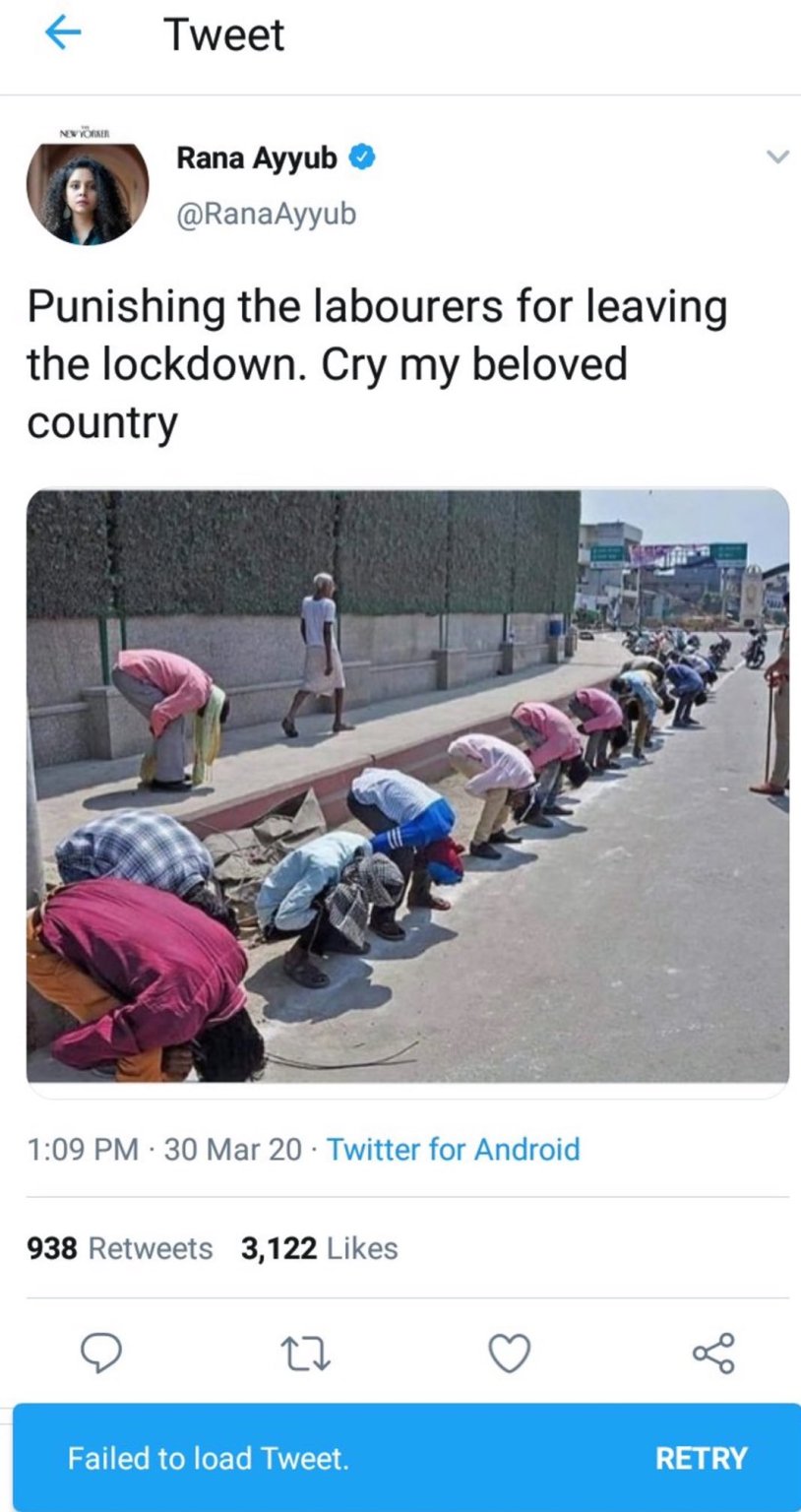
In 2020, when India was grappling with the first bout of the deadly Wuhan Coronavirus, the Islamist masquerading as a journalist attempted to discredit the government and the administration by sharing an image of some men made to squat and hold their ears as punishment. The men were standing on side of a road in a line.

Deleted tweet by Rana Ayyub

In her later Tweet that she deleted, Ayyub claimed that the labourers were being punished for leaving during the lockdown. However, it was proved almost immediately that the image was not of labourers being punished but of those who broke the curfew. A Twitter user @AttomeyBharti had then revealed that the image was from 24th March 2020 from Kanpur leaving the ‘journalist’ red-faced.

Rana Ayyub and her lies surrounding the central govt’s Citizenship Amendment Act

In September 2020, deliberated by her penchant to lie and spread misinformation, Islamist ‘journalist’ and habitual fake news peddler Rana Ayyub had again told the same lies on CAA, in an article about a Shaheen Bagh protestor in Time magazine.

Writing an ode to Bilkis, Rana Ayyub, in her article, has claimed that the 82-year-old ‘protestor’ was the ‘voice of the marginalized’ in India, who would sit at a protest site from morning to midnight.

Continuing her usual antics, Rana Ayyub blatantly lied that Bilkis, the 82-year-old anti-CAA protestor at Shaheen Bagh, was sitting as a mark of protests at Shaheen Bagh ever since Indian Prime Minister Narendra Modi’s government passed the Citizenship Amendment Act, which “could block Muslims from citizenship in the country”.

Ironically, Rana’s ode to Shaheen Bagh daadi had come days after the Delhi Police has submitted in court that the women at Shaheen Bagh were being paid to sit in protest, like daily wage workers.

Despite knowing the fact that Citizenship Amendment Act passed by the Indian parliament has nothing to do with Indian citizens, Muslim or otherwise, as it seeks to grant citizenship to persecuted religious minorities in Pakistan, Bangladesh and Afghanistan, Rana Ayyub has continuously resorted to openly peddling fake news on the Citizenship Amendment Act saying that the legislation “could block Muslims from citizenship in the country”.

Shockingly, the publications like ‘TIME’ which publishes such lies in its list of influential people across the world, failed to check the misinformation peddled by the likes of Rana Ayyub and instead provides a platform to push fake news on Indian laws.

Rana Ayyub outrightly lies that Muslims protested ‘peacefully’ against CAA

Continuing with usual antics to propagate outright lies regarding the anti-CAA riots that have been unleashed by Muslim mobs in the country, the Islamist troll masquerading as a journalist had gone on to make hysterical claims stating that PM Modi has driven Muslims of this country to a wall, to which the Muslims of the country have reacted by breaking their silence.

She then went on to make fake claims by stating that the Muslims who were opposing the Modi government was passive for the last six years, however, with Modi government taking decisive decisions on abrogation of Article 370 and passing of Citizenship Amendment Act have now made Muslims come out on streets to protest “peacefully” against the government.

However, Rana Ayyub’s claims that ‘protest’ march taken out by the Muslim mobs across the country against the CAA were ‘peaceful’ is an outright lie. In fact, the anti-CAA riots in which extreme violence and vandalism were recorded across the country have been instigated mostly by Muslim mobs. OpIndia complied with a list of violence perpetrated by Muslims across the country during the anti-CAA protests.

Likewise, after fanatic Muslims in Bangladesh unleashed hell on Hindus in Bangladesh attacking Durga puja pandals on October 14 last year, the terrorist apologist, instead of condemning the Hindu bloodbath by radical Muslims had used the opportunity to express her admiration for Muslims in India’s almost endless patience. Spewing hatred for Indians and Hindus, Ayyub stated that she had not stopped thinking about the incredible tolerance displayed by India’s 200 million Muslims in the face of daily attacks and humiliation under the Modi regime.

Basically, while Hindus have routinely come under attack by Muslim mobs, Muslim apologists like Rana Ayyub has continued to promote the myth of “Hindus murdering Muslims”. Rana Ayyub, who is an Islamist masquerading as a journalist had also called the Uttar Pradesh “Islamophobes” when they had taken action against the rioting mobs. It was almost as if she was saying that just because the rioters were Muslims, they should be allowed to riot on the streets of Uttar Pradesh.

When CRPF busted Rana Ayyub lies about young boys being tortured in Kashmir

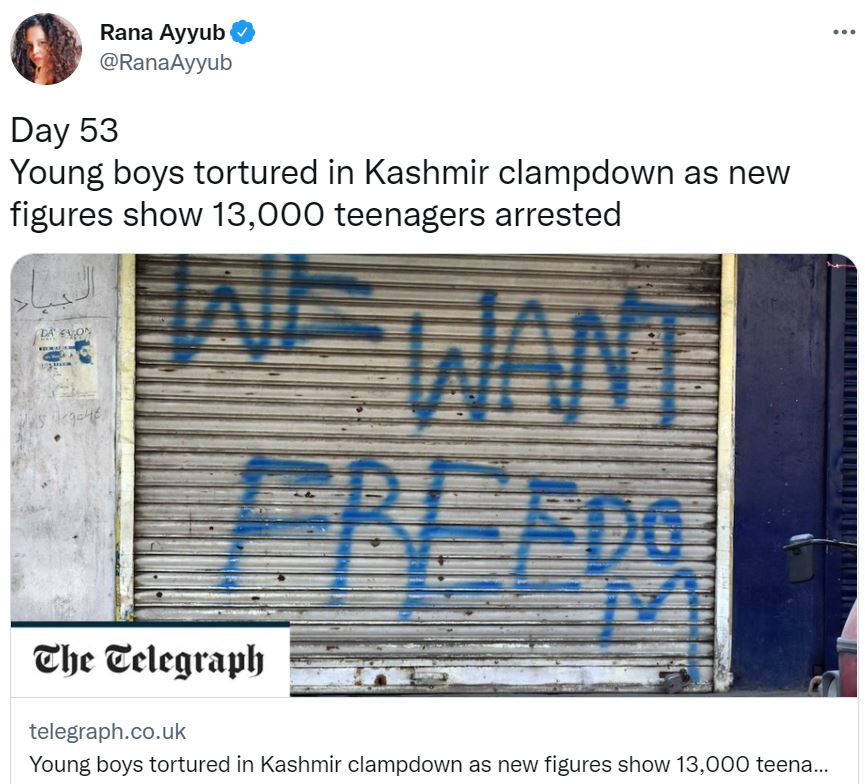
In 2019, the controversial journalist had tried to tarnish the Central government by making baseless claims about the situation in Kashmir. In a tweet, she alleged that the Kashmiri school children are being tortured and that there are 13000 teenagers arrested. She had shared a propaganda piece by UK daily The Telegraph to spread the brazen lies. 

Rana Ayyub’s Sepetember 26, 2019 Tweet

No sooner than she Tweeted, a CRPF officer named Kashyap Kadaguttar termed journalist Rana Ayyub’s allegations of young boys being tortured in Kashmir completely bogus. He slammed Ayyub’s conviction in the slanted reporting of the western media. He described the article provided by Ayyub as “baseless reportage.” He claimed that no one had been tortured in Kashmir and chastised her for refusing to believe Army and government statements.

Yet another lie from Rana Ayyub’s long list

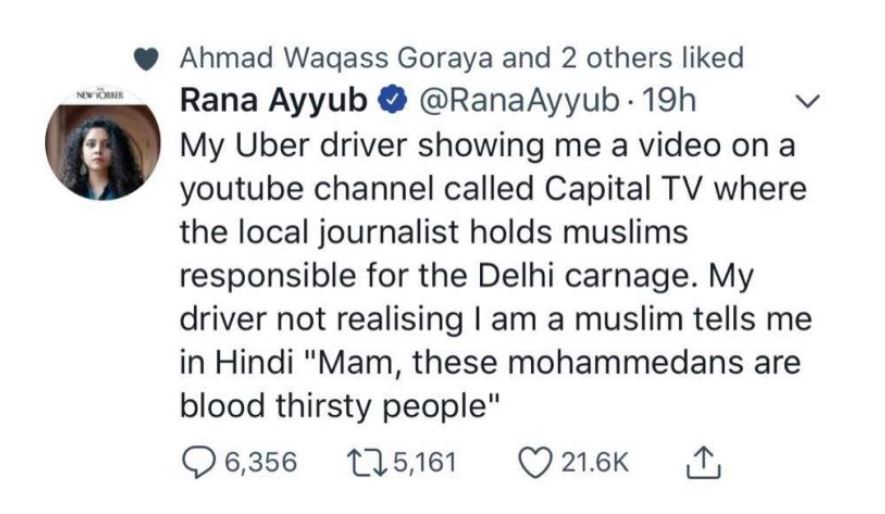
One of Rana Ayyub’s other acts was concocting an imaginary conversation designed to smear a TV channel covering the Hindu suffering of the Delhi riots.

The Uber driver, according to Rana Ayyub, was unaware that she is a Muslim. Rana Ayyub’s long litany of lies now included even another clear falsehood. Every Indian inhabitant knows how Uber works by now. The driver’s name is communicated to the passengers before we board the cab, and the passengers’ names are transmitted to the driver. Every time a passenger enters the cab, the driver verifies the passenger’s identity to verify he is picking up the correct individual. The passenger’s name stays glowing in large letters on the driver’s phone throughout the ride as the driver is driven to the passenger’s location using GPS.

When Rana Ayyub blamed RSS and ‘Hindu terrorists’ for 2015 Ranaghat nun rape

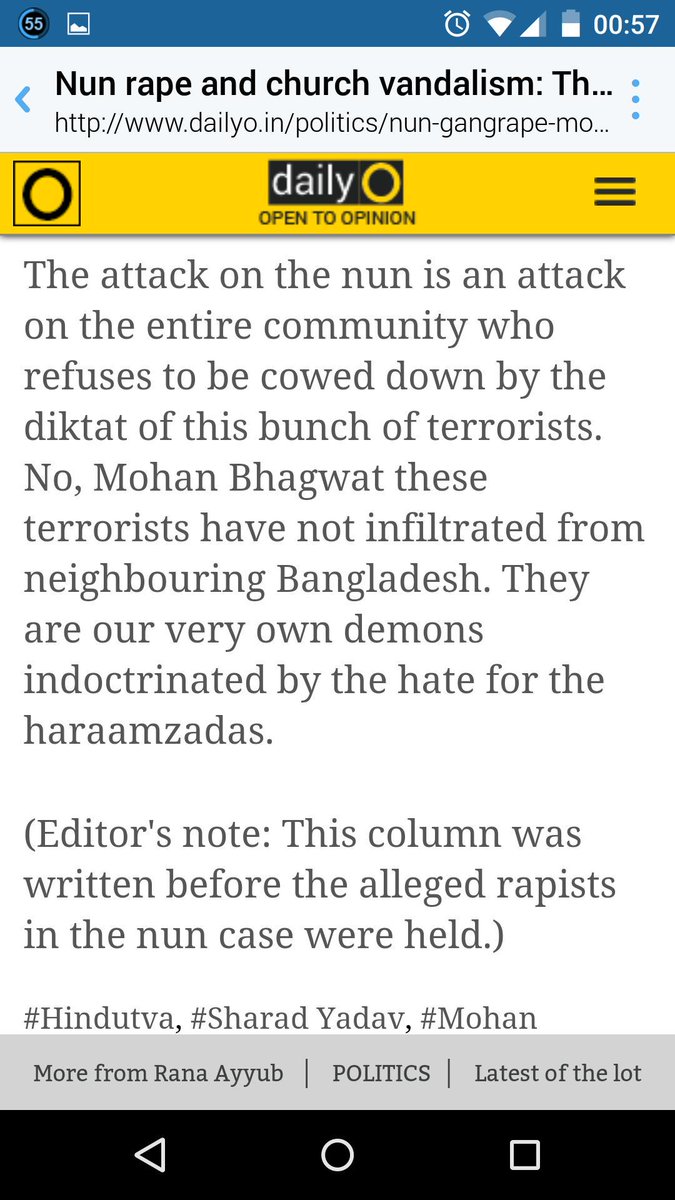
When in 2015, a nun was gang-raped by eight men who plundered a Catholic church in Ranaghat, West Bengal, Rana Ayyub, ecstatic at the prospect of blaming the terrible atrocity on her favourite punching bag, the RSS and “Hindu terrorists,” wrote a comprehensive account of the occurrence for DailyO.

“No, Mohan Bhagwat these terrorists have not infiltrated from neighbouring Bangladesh. They are our very own demons indoctrinated by the hate for the haraamzadas,” she wrote.

All of the accused in this case has turned out to be Bangladeshis, including Salim Sheikh, Khaleda Rahaman Mintoo, and Ohidul Seikh. They were accused of violating IPC sections 120B, 395, 397, 376, 376 D, 212, 216 A, and 109 in 2017.

Despite the truth being revealed, the Hindu-hating writer Rana Ayyub, who dragged the RSS through the mud and slandered Hindus as “terrorists” over the nun-rape case displayed no regret, shame, or need to apologise for her hate-filled article.

SC thrashes Ayyub’s book on Gujarat riots

Rana Ayyub, who has a long-standing agenda against Narendra Modi, was also humiliated by the Court when it threw her “investigative” book on the Gujarat riots out of the window. The court had said that her book was based on conjectures and surmises only proving that Ayyub’s relationship with the truth is complicated, to say the least, while her bond with radical Islamism seems all-pervasive.

One of the innuendoes in Ayyub’s book was that then Gujarat CM Narendra Modi had planned ex-Gujarat Home Minister Haren Pandya’s murder who was shot dead on March 26, 2003, in Ahmedabad during a morning walk.

A trial court found 12 Muslim men guilty of Haren Pandya’s murder, including the main accused Asghar Ali. According to the CBI investigation, the murder was carried out on the orders of a Muslim cleric named Mufti Sufiyan in order to avenge the Gujarat riots.

The men were cleared of murder charges by the Gujarat High Court, citing a “botched investigation” by the CBI, but they were nonetheless charged with criminal conspiracy and attempted murder.

CBI had challenged the High Court ruling in Supreme Court, which eventually upheld the original trial court verdict. The apex court trashed the use of Rana Ayyub’s book ‘Gujarat Files – Anatomy of a Cover-up’ by the defence, stating that it was predicated on suppositions, conjectures and surmises.  “The opinion of a person is not in the realm of the evidence,” had held the Supreme Court.

‘Journalist’ lies to draw false equivalence between convicted Indian Mujahideen terrorist Yasin Bhatkal and Sadhvi Pragya

The proverb ‘old habits die hard’ sits perfectly well with Rana Ayyub, a quintessential troll who masquerades as a journalist and often indulges in Hinduphobia and fake news. In 2019, Ayyub, in her new anti-Hindu propaganda, had attempted to equate convicted Islamic terrorist Yasin Bhatkal and Sadhvi Pragya Thakur the now Lok Sabha MP who was accused and not convicted in the Malegaon blast case of 2008.

Rana Ayyub had posted an image of Indian Express news reports, where one of the reports concerning Sadhvi Pragya Thakur, a victim of severe brutality and also, of Congress’ attempt to concoct fake ‘Hindu terror’ narrative, had been published adjacent to a report on dreaded Indian Mujahideen terrorist Yasin Bhatkal.

According to Rana Ayyub, a Hinduphobic troll who often masquerades as a journalist, the two reports depicted the ‘story of new India’. She went on to lament that the Indian Express report was on “two alleged terrorists, one with a Muslim name, another a Hindu name” insinuating, that Yasin Bhatkal was treated unfairly because he has a Muslim name or that Sadhvi Pragya is treated with kid gloves because she has a Hindu name.

Based on Ayyub’s theory of equivalence, there exists no difference between a convicted terrorist belonging to Indian Mujahideen and Sadhvi Pragya Thakur, who was accused and not convicted by any courts for her alleged role in the 2008 Malegaon case. In fact, the court had dropped MCOCA charges against Sadhvi and the NIA had given her a clean chit in the case.

When Rana Ayyub was called out by her own people

It is interesting how Rana Ayyub has been chastised by people across the political spectrum because of her proclivity for lying. It’s not just the right who believes Rana Ayyub is not worth being called a journalist, in fact, individuals on her side of the political spectrum also believe the same thing. It may be recalled how in October 2020, a little battle had brewed on Twitter between abusive troll masquerading as a journalist Swati Chaturvedi and conspiracy theorist masquerading as a journalist Rana Ayyub with the former rebuking the latter for plagiarising content.

She even revealed that the sexual harassment accused Tarun Tejpal had also referred to Rana Ayyub as ‘fraud and lazy reporter’. 

Swati then shared an old Facebook post by disgraced cop Sanjiv Bhatt where he had insinuated, without really naming Rana Ayyub, that she had “amorous” relationship with one IPS officer investigating the encounter cases and with an activist-lawyer who was fighting the 2002 riots victims’ case.

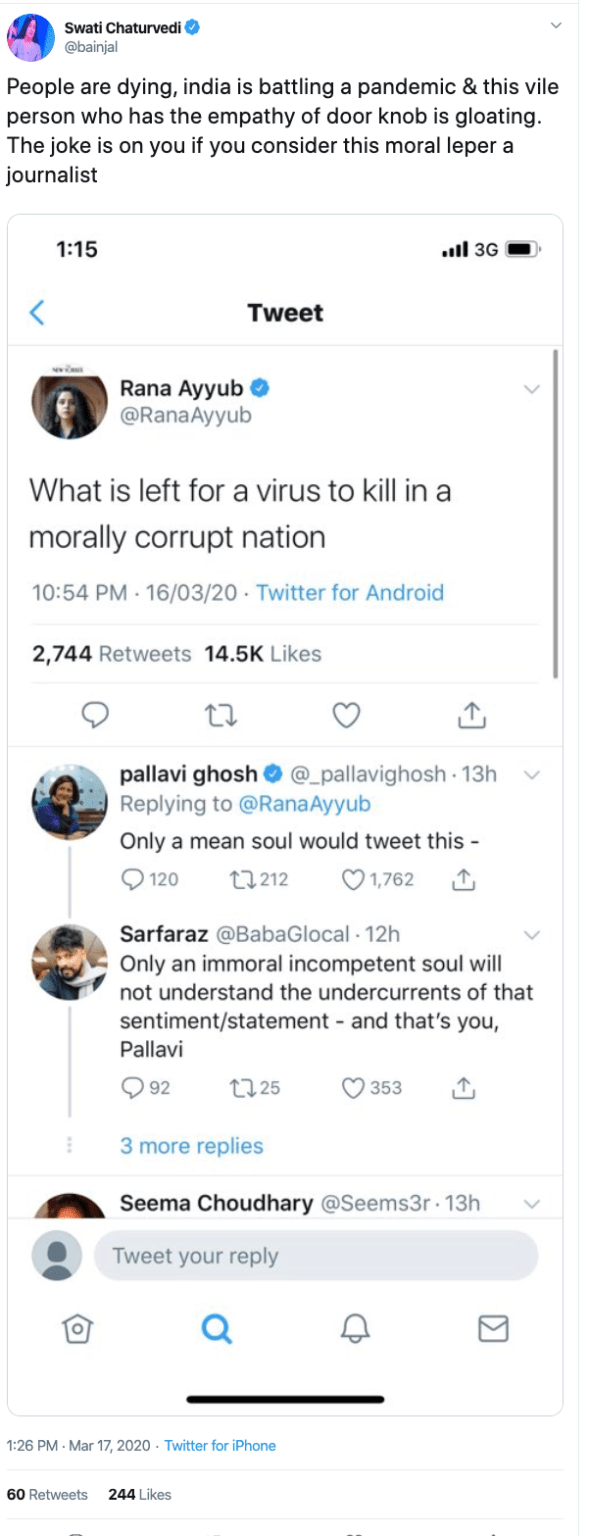
Prior to the, in March 2020, the duo came face to face when ‘journalist’ Swati Chaturvedi attacked Islamist Rana Ayyub for her insensitive tweet on the coronavirus outbreak in India. Amusing, Swati had then called Ayyub a ‘vile person’ and a ‘leper journalist’.

Tweet by Rana Ayyub

Since both Swati Chaturvedi and Rana Ayyub have consistently posted biased and misleading news to support their far-left narratives it was difficult to parse those accusations. But the exchange clearly reinforced one thing- it’s not only the right who believes Rana Ayyub isn’t a journalist; individuals on her side of the aisle believe the same thing.

FIR registered against Rana Ayyub alleging money laundering and cheating

While Rana Ayyub has often come under the fire for her malicious and fake reporting, she has also been accused of money laundering and cheating.

In September 2021, an FIR had been registered against controversial journalist Rana Ayyub over money laundering and fraud related to her fundraising campaign. The FIR was filed on 7th September at Indrapuram police station in Ghaziabad in UP in response to a complaint filed by Vikas Sakrityayan of the Hindu IT cell.

The complaint accuses Rana Ayyub of Money Laundering, Cheating, Dishonest Misappropriation of Property, Criminal Breach of Trust by illegally acquiring money from the general public in the name of charity. It says that Rana Ayyub happens to be a journalist by profession and was receiving foreign money without any kind of approval certificate/registration from the government, which is required as per the Foreign Contribution Regulation Act, 2010. Hence, she liable is also liable for violating the provisions of FCRA, the complaint had stated.

Based on this complaint, the FIR has been registered under sections 403, 406, 418, 420 or the Indian Penal Code (IPC), section 66D of the IT Act and section 4 of the Prevention of Money Laundering Act, 2002.

Former Zimbabwe cricketer Brendan Taylor discloses being ‘blackmailed’ by Indian businessmen to ‘spot-fix’ international matches, may face ICC ban

Former Zimbabwe cricket team captain Brendan Taylor has disclosed in a shocking accusation that he took money purportedly to spot-fix international matches from an anonymous Indian businessman after being blackmailed that a video of him consuming cocaine would be made public.

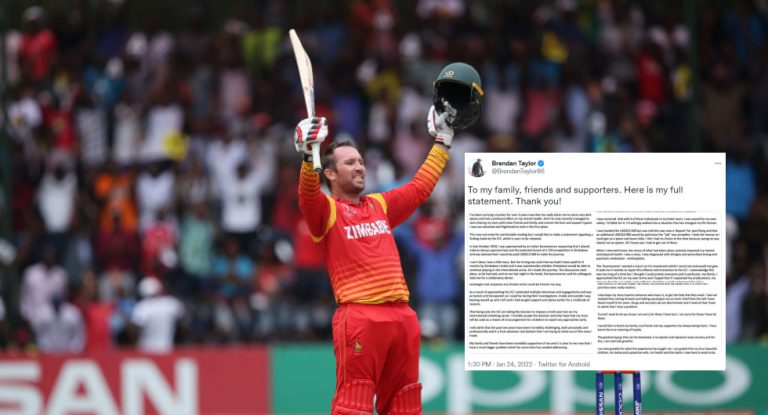
Taylor said in a comprehensive tweet posted on Twitter that he was asked by a businessman in October 2019 to travel to India to discuss sponsorship arrangements and the prospective introduction of a T20 league in Zimbabwe.

Taylor alleges that he agreed to the person’s request because of not being paid by Zimbabwe Cricket for six months. On the last day of his stay in India, however, he was brought for a celebration meal by the aforementioned businessman and his associates. Taylor claims he was compelled to consume cocaine at the event and that a video of it was later used to harass him. He states that he subsequently returned to Zimbabwe and did not report the episode to the ICC for four months, despite the fact that he “did not get engaged in any form of spot-fixing.”

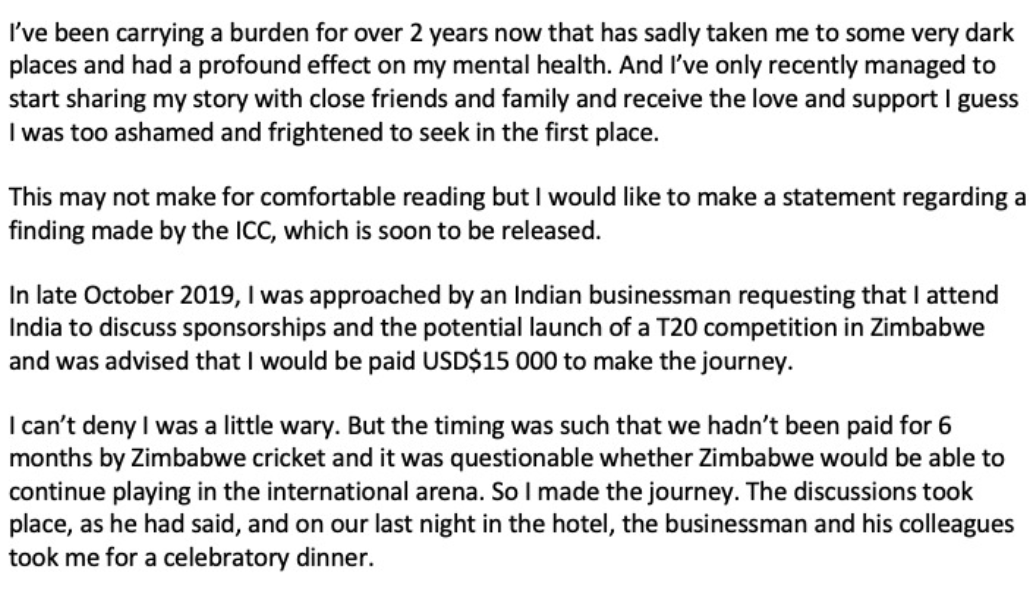
The statement of Taylor on Twitter Reads “In late October 2019, I was approached by an Indian businessman requesting that I attend India to discuss sponsorships and the potential launch of a T20 competition in Zimbabwe and was advised that I would be paid USD$15 000 to make the journey. I can’t deny I was a little wary. But the timing was such that we hadn’t been paid for 6 months by Zimbabwe cricket and it was questionable whether Zimbabwe would be able to continue playing in the international arena. So I made the journey…We had drinks and during the course of the evening they openly offered me cocaine, which they themselves engaged in, and | foolishly took the bait…”

A part of Page 1 of his statement

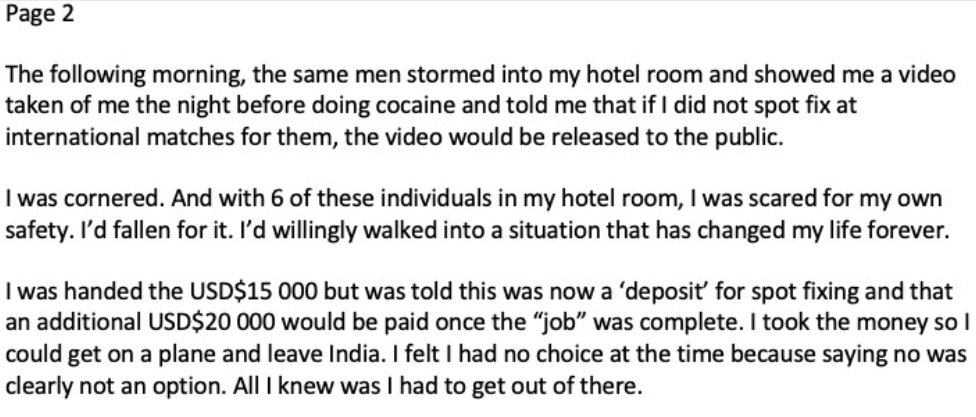
“The following morning, the same men stormed into my hotel room and showed me a video taken of me the night before doing cocaine and told me that if I did not spot fix at international matches for them, the video would be released to the public”, he said.

A portion of page 2 of the statement

Revealing the amount offered by the man he said, “I was handed the USD$15 000 but was told this was now a ‘deposit’ for spot-fixing and that an additional USD$20 000 would be paid once the “job” was complete. I took the money so I could get on a plane and leave India. I felt I had no choice at the time because saying no was clearly not an option. All| knew was I had to get out of there.”

“The ‘businessman’ wanted a return on his investment which I could not and would not give. It took me 4 months to report this offence and interaction to the ICC. I acknowledge this was too long of a time but I thought I could protect everyone and in particular, my family. I approached the ICC on my own terms and | hoped that if | explained my predicament, my genuine fear for our safety and wellbeing, that they would understand the delay.” Taylor added stating why it took time to report such an incident to the International Cricket Council.

He also explicitly said in his statement that he has “never been involved in any form of match-fixing“.

He stated that the ICC will issue an official announcement soon declaring a ban on Taylor’s cricket career. “That being said, the ICC is taking the decision to impose a multi-year ban on my international cricketing career. I humbly accept this decision and only hope that my story will be used as a means of encouragement for cricketers to report any approaches early,” he added.

Taylor had stated that he will be entering a rehabilitation center soon in order to improve the remainder of his life and get out of this mental turmoil.

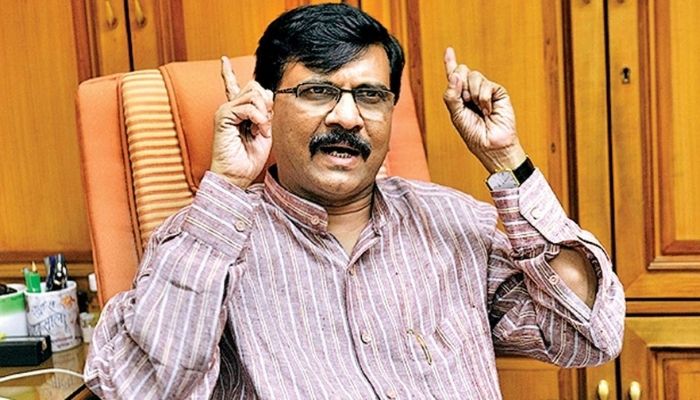
Sanjay Raut boasts about Shiv Sena Wave in North India after Babri Demolition. Facts, however, don’t match up

Shiv Sena leader Sanjay Raut on Monday lashed out on BJP accusing the party of using ‘Hindutva’ to gain power. While talking to the media, he said, “We took BJP from bottom to top in Maharashtra. After Babri, there was a Shiv Sena wave in Northern India, if we had fought polls at that time, there would have been our (Shiv Sena) PM in the country but we left it for them.”

In his recent statement, he has taken a stand alleging a supposed wave of Shiv Sena in North Indian states, after the demolition of disputed structure often referred to as Babri Masjid at Ayodhya on December 6, 1992. He also claimed that had his party fought election that time, there would have been a Prime Minister from Shiv Sena leading the country. His claims that it was Shiv Sena which helped BJP gain power in Maharashtra came a day after Maharashtra CM Uddhav Thackeray remarked that Shiv Sena had ‘wasted’ its time with BJP for 25 years.

Yesterday, Uddhav Thackeray, while speaking online at an event to commemorate the birth anniversary of late Shiv Sena Supremo Bal Thackrey had said, “Shiv Sena Pramukh had told us about Hindutva. We wanted power for Hindutva. What we are seeing now, the Hindutva that is practised by these people (BJP), is only a pretence. Their Hindutva is for power. They are only wearing a fake skin of Hindutva. People ask us whether we have left Hindutva. But we have left BJP and not Hindutva.” He added, “BJP does not mean Hindutva.”

It was in the 1990s during the Ram Mandir Movement that ‘Hindutva’ as a political ideology got acceptance among the masses. In the 1993 assembly elections of Uttar Pradesh, the Bhartiya Janta Party (BJP) emerged as the single largest party securing 177 out of a total of 425 seats. However, Mulayam Singh Yadav was sworn in as a chief minister as the face of his newly formed Samajwadi Party (SP) with an alliance with Mayawati’s BSP and support from Congress.

The strong undercurrents of Hindutva sentiments owing to the Babri demolition helped the BJP with a 33.3% vote share. Contrary to Raut’s claims, Shiv Sena as a regional party did participate in the Uttar Pradesh state elections but could bag only 1,38,919 total votes in the state. While Sena received a total vote share of only 0.28%, its candidates lost deposits from 179 out of 180 seats contested. Netizens were quick to point out the facts after Sanjay Raut’s statements emerged on Twitter.

Shiv Sena has announced to contest 50-100 seats in upcoming UP assembly elections without any alliance as Congress, its ally in Maharashtra, has decided to fight solo.

EV charging facilities at railway stations across country will help it become net-zero carbon emitters by 2030, says NITI Aayog

The NITI Aayog is in talks with the Indian Railways to set up Electronic Vehicle (EV) charging facilities across major railway stations in the country. The draft policy, with a view to promoting electronic vehicles among the masses, has been submitted to the Railways by the NITI Aayog.

The primary policy drafted by the NITI Aayog recommends putting up EV charging infrastructure powered by renewable energy resources with the aim of Indian Railways to become net-zero carbon emitter by 2030. Amitabh Kant, CEO of NITI Aayog, while talking about the policy has said that the facility can be immediately started at 123 newly redeveloped railway stations as a pilot project. The railways can thence scale up the policy across Railway stations in the country by 2030. “Railway stations are landmark locations and they play a unique role in the entire transport sector, which make them strategic locations for providing public charging solutions for EVs,” he added.

The decision is in recognition of the Central Government’s FAME-II (Faster Adoption and Manufacturing of Hybrid and EV) scheme which aims to foster quick adoption of EVs as a sustainable boost to the transport sector. Under the scheme, the central government aims to support 7,000 e-buses, 500,000 electric three-wheelers, 55,000 electric four-wheeler passenger cars and one million electric two-wheelers through subsidy. With a view to establishing a critical and accessible EV charging infrastructure network across the country, railway stations can provide secure and accessible charging infrastructure to city residents, NITI Aayog officials said. Responding to this move, Rajeev Jain, additional DG, PR, railway ministry, said, “We have very recently received the communication. We are working on it.”

Last week, The Central Ministry of Power had given nod to allow charging of EVs using existing electrical connections at homes, offices while issuing guidelines and standards. The new guidelines also enable individuals to set up public charging stations without the requirement of a license. Steps for laying out a critical EV charging network have come after India witnessed a 132% growth in the sale of electric two-wheelers in 2021.

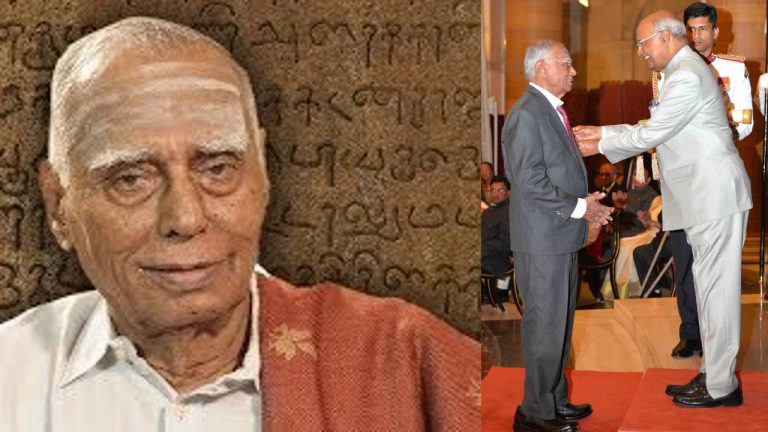
R Nagaswamy, the distinguished archaeologist who produced vital evidence in the Ram Janmabhoomi case, dies at age of 91, PM Modi expresses condolence

R Nagaswamy, the first director of the Tamil Nadu government’s Department of Archaeology, passed on Sunday. He was a renowned archaeologist, art historian, and Padma Bhushan awardee. He was 91 years old. His son-in-law Baskar Kailasam informed PTI that he died at 2.30 p.m. at his Chennai home after expressing unease.

Nagaswamy was a prolific writer who published a number of intellectual works as well as a strong proponent for cultural enlightenment. He established the Tamil Nadu Archaeology Department and was its director for 22 years before retiring.

Following his death, several people expressed their condolences, including Prime Minister Narendra Modi and Lok Sabha Speaker Om Birla. PM Modi tweeted on Sunday that future generations will remember Nagaswamy’s efforts to popularise Tamil Nadu’s vibrant culture.

A Guru for generations of archaeologists

Nagaswamy was fluent in both Tamil and Sanskrit. He graduated from the University of Madras with a master’s degree in Sanskrit. Pune University awarded him a Ph.D. in Indian Arts. Nagaswamy, who received the Padma Bhushan in 2018, is widely recognized as a mentor to a generation of Tamil Nadu archaeologists.

He also received a number of additional honours, including the ‘Kalaimamani’ Award from the Tamil Nadu government. He was a well-known academic, researcher, and art historian. He wrote over 40 books in English, Tamil and Sanskrit including “Masterpieces of Early South Indian Bronzes.” Nagaswamy’s articles have been translated into 23 languages and published in the journal of the United Nations Educational, Scientific, and Cultural Organization.

He was instrumental in the restoration of various archaeological monuments. In the 1980s, he was invited as an expert witness before the London High Court in the Nataraja case, based on his extensive knowledge and experience excavating temple towns in search of rare bronzes. His role in bringing back the Pathur Nataraja idol was hailed as a triumph. He was regarded by the court as an “unequaled expert in Chola bronzes.”

His contribution to the Ram Janambhoomi Case

He provided expert advice to the Allahabad High Court’s Lucknow bench, which heard the Ayodhya title suits. According to Nagaswamy, the earliest construction for which evidence was discovered dates back to the 3rd century BC. He stressed that artifacts discovered during archaeological excavations at the disputed site in Ayodhya proved that it was a sacred site rather than merely a human habitation.

While the ASI was excavating on the HC’s instructions in 2003, Nagaswamy delivered a report to the court that detailed the artifacts discovered by the ASI. “The artifacts demonstrated that they belonged to a sacred site, not just any human settlement.” “The existence of a shrine was one of the most important pieces of evidence presented to the judges,” Nagaswamy explained.

Nagaswamy made significant contributions to subjects such as architecture, paleography, numismatics, temple rites and philosophy, ancient law and society, music, dance, and South Asian art, in addition to archaeology and epigraphy.

China intrudes into air defence zone of Taiwan with 39 aircraft, largest incursion since October 2021

In yet another glaring example of Chinese aggression, 39 aircraft belonging to its airforce breached the air defence zone of Taiwan on Sunday (January 23), reported Reuters. The incident has been described as the largest Chinese incursion in Taiwanese territory since October 2021.

Reuters reported that the latest incursion involved 34 fighter jets, along with 1 bomber and 4 electronic warfare aircraft and was carried out in the northeastern zone of Pratas Islands. As per the Taiwanese Defence Ministry, missile systems were used to track the movement of the Chinese jets and combat aircraft were dispatched to fend off the enemy’s aircraft.

Although China has not yet commented on the development, the Communist regime had earlier justified its misadventures in the island nation as ‘drills meant to protect its sovereignty.’ Taiwan has repeatedly questioned air missions, conducted by China, in its Air Defence Identification Zone (ADIZ) near Pratas Islands.

The democratically ruled island nation has pointed out how China carried out military activities in the ‘grey zone’ to test the response of Taiwan and wear out its forces. The latest Chinese incursion comes at a time when the United States and Japan have been conducting naval exercises in the Philippine Sea.

Earlier in October last year, Taiwan informed that 148 Chinese aircraft entered the country’s air defence zone in the Southern and southwestern sectors. The island nation had emphasised that about its resolve for peace but cautioned that it would defend in case of attacks.

‘PRC has infiltrated almost all military ranks in Taiwan’

In December 2021, a retired Taiwanese Lt Commander Lu Li-shih had stated that China had infiltrated almost all ranks and levels in the Taiwanese military, including top-level generals. The officer stated that Chinese intelligence first approached the targeted officers with lavish gifts and meals, and offered handsome payment for information. After the first few exchanges, they started blackmailing the corrupt officers for more information, with smaller payments.

In July last year, even Taiwan’s former deputy defence minister was interrogated in a national security probe. Xie Xezhang, who had introduced himself as a Hong Kong-based businessman to Taiwanese military officers, actually reported to an office that functions directly under the PRC’s intelligence apparatus and served as a front for China’s Central Military Commission.