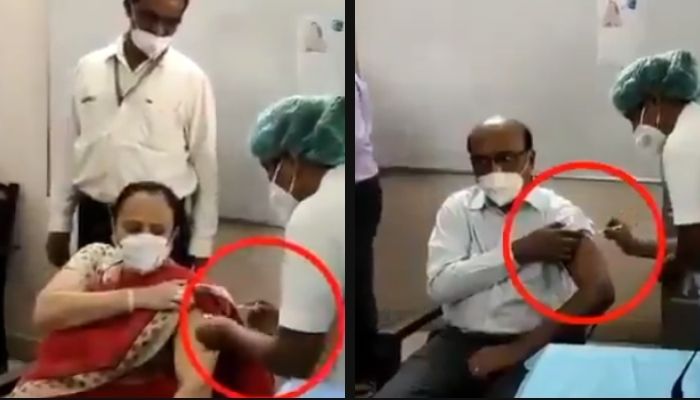
On Thursday, Congress MP Manickam Tagore had decided to peddle fake news to defame the BJP and the Rashtriya Swayamsevak Sangh (RSS) at the expense of Coronavirus frontline workers. He had retweeted a video of two medical officers being vaccinated in Tumakuru in Karnataka and insinuated that they were doing a photo op for the camera.
In the viral video, two medical officers, namely Dr Rajani and Dr Nagendrappa were seen posing for the pictures during the vaccination drive. In the first part of the video, Dr Rajani was seen sitting on a chair who then stood up as the nurse was about to administer the vaccine. Similarly, in the second part of the video, the nurse who administered the vaccine to Dr Nagendrappa was seen withdrawing immediately after the photo was taken.
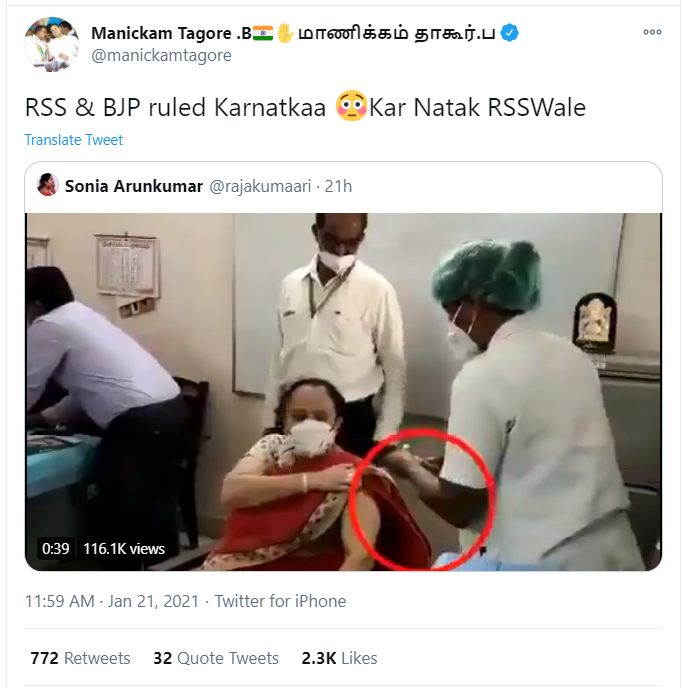
“RSS & BJP ruled Karnataka… Kar Natak RSSwale”, the Congress leader further alleged that it was being done on the behest of the BJP and the RSS. The video was originally shared by an ‘independent’ journalist named Sonia Arunkumar. Several other users on social media also claimed that the two medical officers seen in the video were ‘faking’ vaccination for the camera.
Screengrab of the tweet by the Congress leader
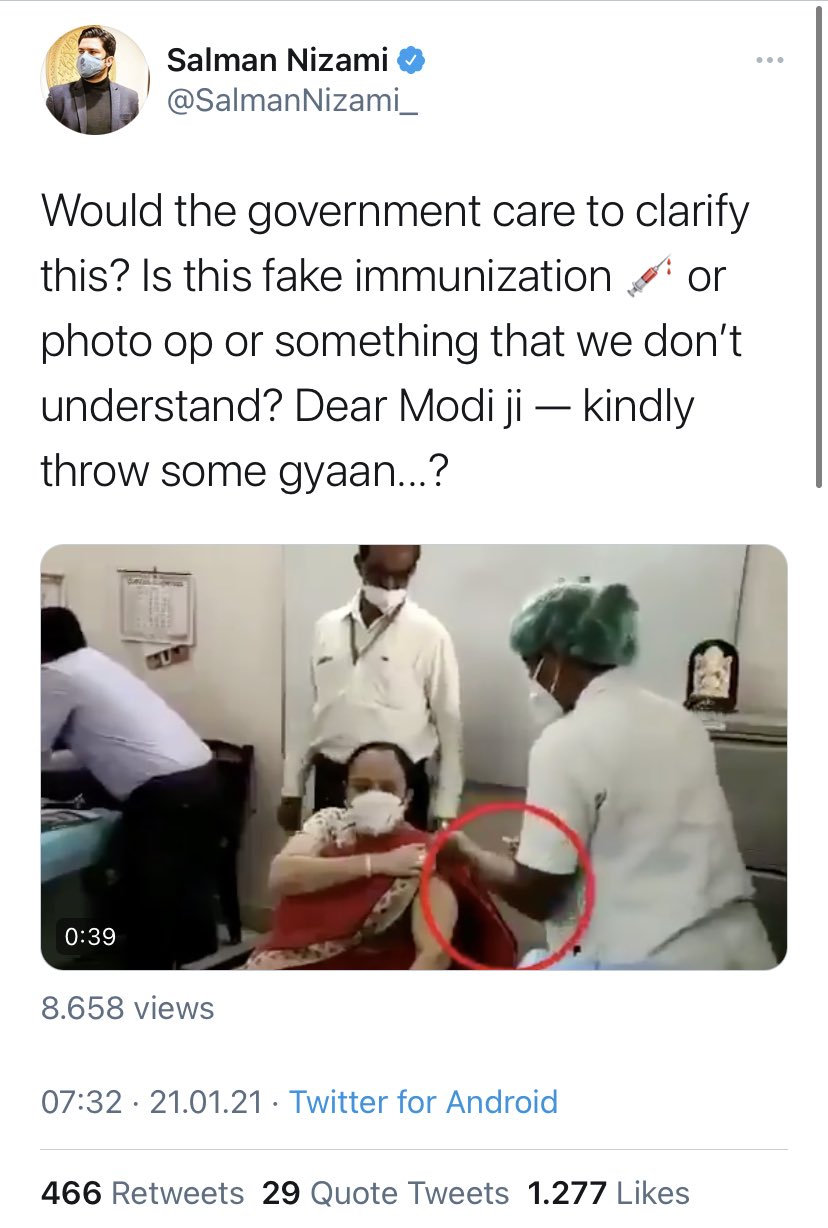
Other Congress leaders, who are famed to be low IQ also jumped on to the bandwagon and started questioning if the Modi government was holding fake immunisation drive.
Screengrab of Congress leader’s tweet
Karnataka Health Department debunks claims of ‘fake vaccination’ drive
While speaking about the incident, Dr Nagendrappa said, “This is not true at all. I found out about this when people began demanding our resignation. We did not do anything wrong.” After the false claims went viral on social media, the Karnataka Health Department took to Twitter to issue a clarification.
Dr Rajani, the woman seen in the video, is the Principal of the Government Medical College in Tumakuru in Karnataka. She was one of the first frontline workers to have been vaccinated with Bharat Biotech’s Covaxin on January 16. “I have seen videos trolling my vaccination. I want to clarify that I have taken the vaccine on 16th itself. My name was registered on the portal. In fact, my office was a vaccination centre”
“….Afterwards, when I was taking the vaccine and was about to get up, several media persons and individuals with mobile cameras requested for visuals,” Dr Rajani informed. She said that she, therefore, sat again on her chair and stood up only when she felt that the pictures have been taken. Dr Rajani further urged people to not resort to rumour-mongering, in these challenging times. She emphasised that the Coronavirus vaccine is safe and asked social media users to put out a good message to the society.
She was not pretending to take the vaccine, say cops
The misleading claims made on social media was also debunked by the Deputy Commissioner (Tumakuru) Dr Rakesh Kumar. He reiterated, “This is clearly a misunderstanding. Dr Rajani had been given the first dose of the vaccine on January 16. The press reporters had not got visuals of the vaccine being injected and asked her to pose for the pictures, which is what she did. She was not pretending to take the vaccine.”
After the Modi government announced a nationwide vaccination drive, starting with healthcare workers, miscreants on social media have been peddling fake news to discredit the government and undermine the fight against Coronavirus.
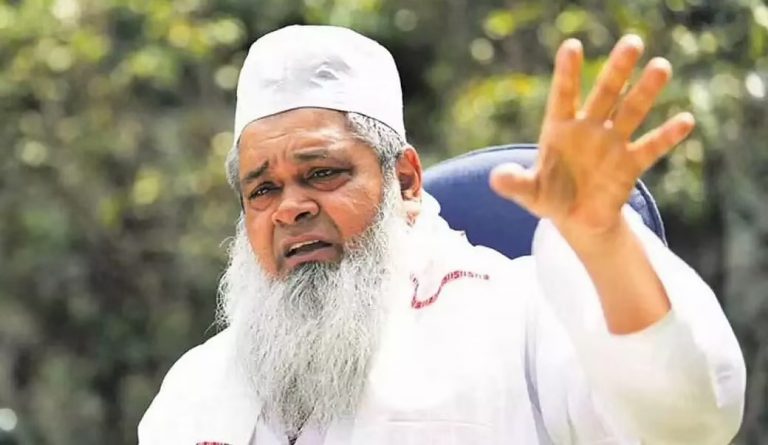
Just a day after Congress and the left parties formed an alliance with Badruddin Ajmal-led All India United Democratic Front (AIUDF) to defeat ‘communal’ BJP in the upcoming assembly elections in Assam, Ajmal removed the mask of secularism to reveal his true face. Ajmal gave a highly provocative and communal speech in Dhubri.
On Wednesday, addressing a rally in Gauripur in Dhubri district in Assam, the AIUDF chief tried to create fear among Muslims against the BJP by making some highly provocative remarks. He alleged that if BJP comes to power in the state again, it will destroy mosques, and put several restrictions on Muslims of the state. He said, “BJP is out enemy, the country’s enemy, India’s enemy, women’s enemy, enemy of mosques, enemy of beards, enemy of talaq, enemy of Babri Masjid”.
Badruddin Ajmal went on saying, “Will you vote a party like this? Now you need to be more careful. If you are not careful, then if BJP forms government in Assam again you won’t be allowed to come out wearing burqa, you won’t be able to come out of home with beard on the face, you won’t be allowed to wear a skullcap, you won’t be allowed to chant azan in mosques, we will be able to live in a place like this?”
Making further communally provocative remarks, the Lok Sabha MP said that BJP is made several mosques in Assam its target. He alleged that BJP has listed 3,500 mosques across the country, and if BJP comes to power again at the centre, the govt will demolish these mosques. ‘Modi govt abolished the process of triple talaq, constructed a temple by demolishing Babri Masjid’, Ajmal said in his speech.
The highly communal speech by Badruddin Ajmal came just two days after AIDUF, Congress, CPI, CPI (M), CPI (ML) and Anchalik Gana Morcha formed an alliance in an attempt to “save Assam” by defeating the Sarbananda Sonowal led NDA government.
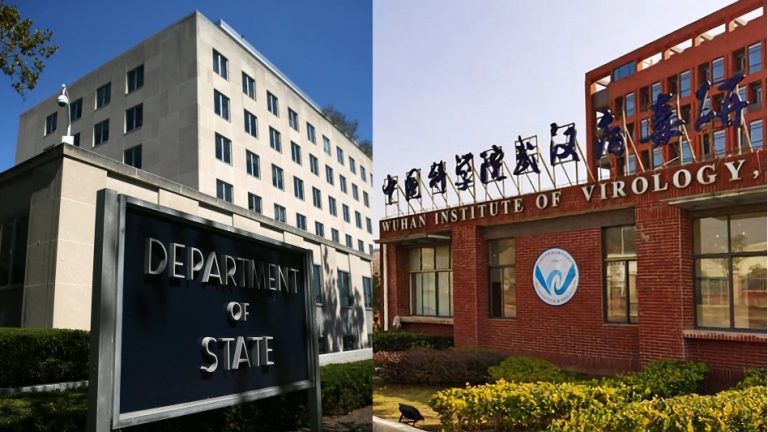
On January 15, the Department of State, United States, had published a Fact Sheet on the activity at the Wuhan Institute of Virology. In the report, the department under Michael R. Pompeo alleged that the virus might have originated in the said lab and demanded a thorough probe.
The sheet alleged that the Chinese Communist Party (CCP) has systematically prevented a transparent and thorough investigation of the COVID-19 pandemic’s origin, choosing instead to devote enormous resources to deceit and disinformation for over a year. It further added that the U.S. government does not know how the virus was initially transmitted to humans.
The case of the broken link
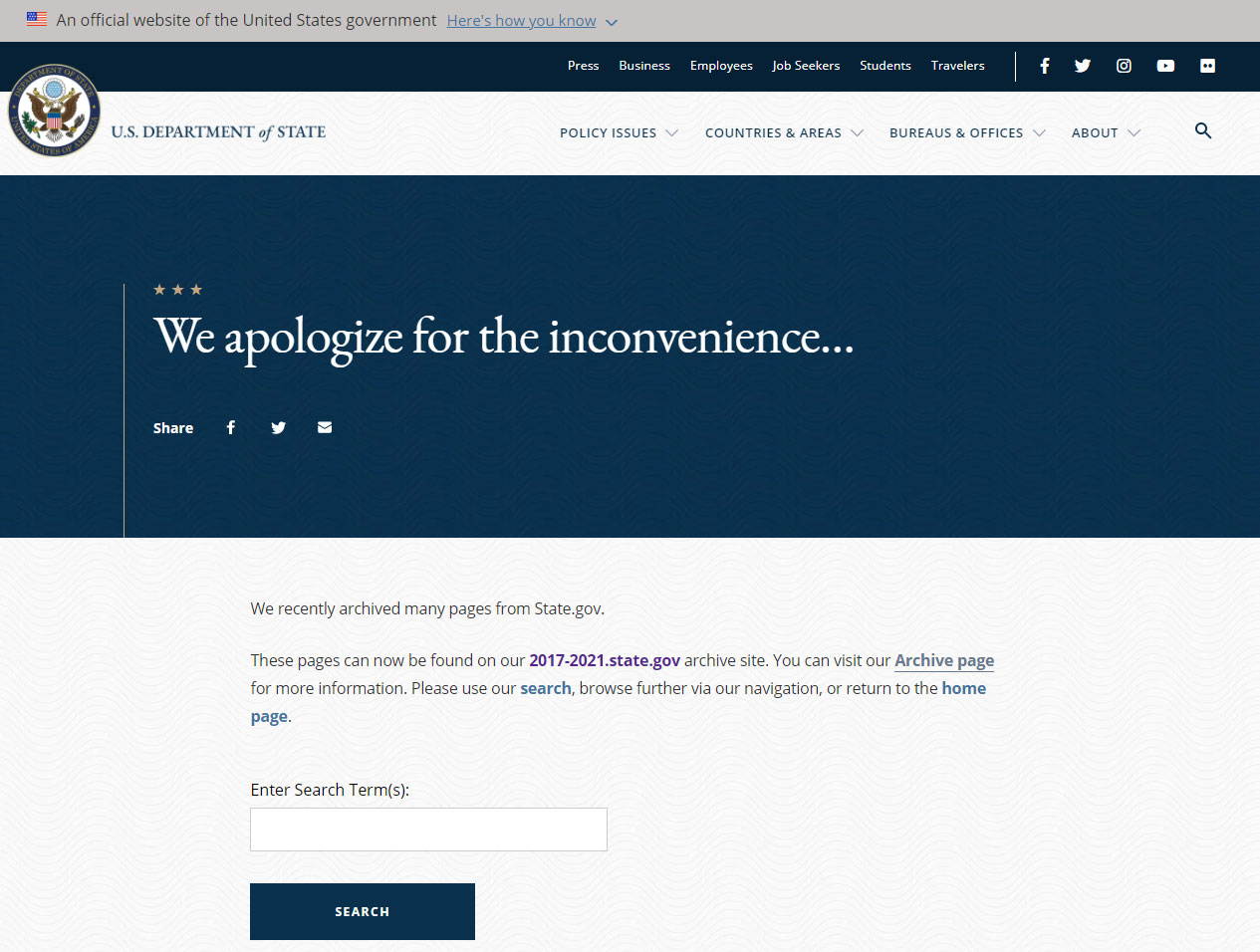
As Biden’s administration took control of the Departments under the United States Government, including the Department of State, people noticed some changes in the website’s structure and Twitter handles. One change that a few social media users noticed that the link to the above-mentioned report was missing. The URL of the page now takes the visitor to a broken link page showing a 404 error.
Error page that appears when someone tries to visit old link
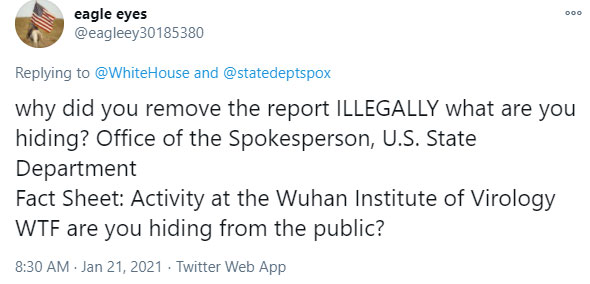
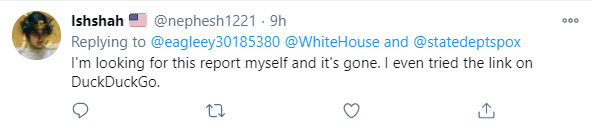
The alleged removal of the link made netizens curious if the new administration is trying to hide something about the coronavirus spread that originated from Wuhan, China. As Biden has hinted that he will try to alleviate the trade war between the U.S. and China, speculations may arise that removing fact sheet demanding probe may be part of the future policies.
Netizens questioned about removal of the reportNetizens questioned about removal of the report
Where is the fact sheet anyway?
It has to be noted that every time administration changes hands in the United States, all reports, press releases etc., by the old administration are archived. A message now appears on the 404 error page that the pages related to old administration can be found on a sub-domain.
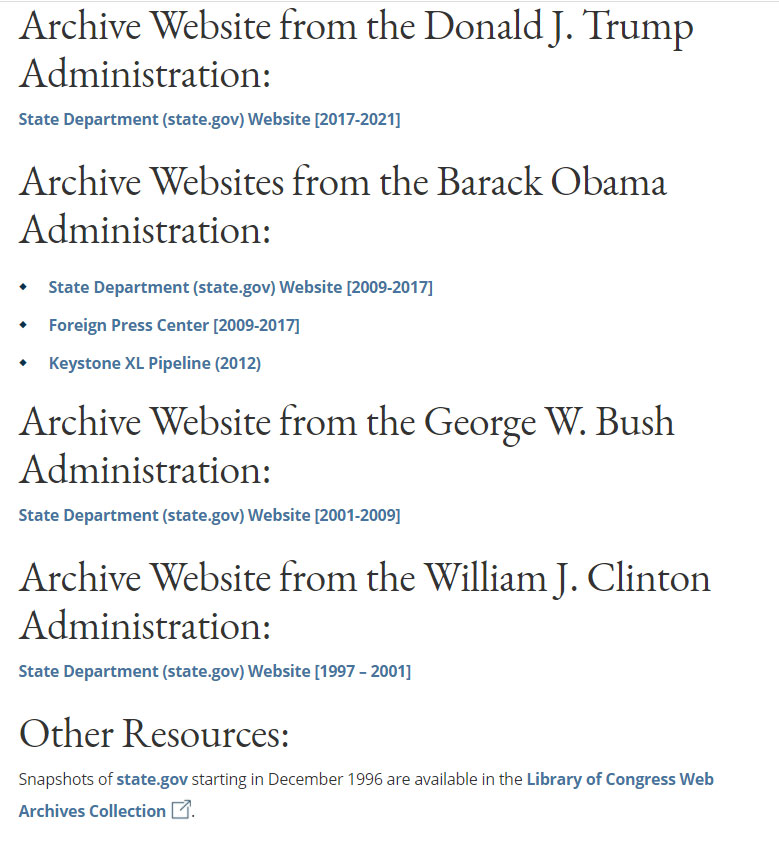
Therefore, the fact sheet has not been removed by the new administration. The page has been moved to the archive site of the state department for 2017-2011. The Fact Sheet is now available on this link.
The previous administrations took similar steps. Archives dating back to 1997 can be found on the U.S. Department of State Archive Websites, and older snapshots are available at the Library of Congress Web Archives Collection.
The archive websites on Department of State dates back to 1997.
Verdict: No, the U.S. Department of States DID NOT remove the Fact Sheet on the origin of Covid-19 from its website, it was only archived.
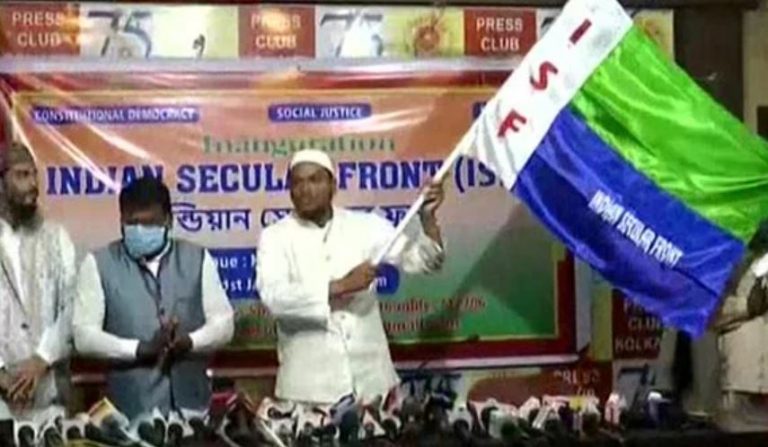
In what could be seen as fresh trouble for TMC supremo Mamata Banerjee, Islamic cleric Peerzada Abbas Siddiqui has floated a new ‘secular’ political party in Kolkata today. The launch comes ahead of the upcoming Bengal Assembly polls. Speculation surrounding whether Siddique would contest individually or join any existing political party had been circulating for the past month. Now putting all speculations to rest, the Muslim cleric finally floated his own new party- The Indian Secular Front (ISF).
West Bengal: Pirzada Abbas Siddique, the founder of Furfura Sharif Ahale Sunnatul Jamat, launches Indian Secular Front (ISF) in Kolkata. pic.twitter.com/rqwTYn1UJZ
It is pertinent to note here that for the last few months it was being speculated that Siddiqui is planning to enter politics and that Asaduddin Owaisi’s All India Majlis-e-Ittehadul Muslimeen (AIMIM) will be allying with Siddiqui’s group in the upcoming assembly elections in West Bengal. AIMIM will contest elections in the state for the first time, and it will be benefited by the existing grassroots support that Siddiqui enjoys.
Meanwhile, confirming that his newly launched ‘secular’ political outfit might contest state elections from all 294 Assembly seats, the Islamic cleric said at the launch of his political outfit at Kolkata Press Club: “We have formed this party to ensure that constitutional democracy is protected, everybody gets social justice and all of us live with dignity.” Heaping praises for AIMIM Chief Asaduddin Owaisi, Siddiqui said that he met Owaisi who has assured him his support.
Owaisi sahab (AIMIM Chief Asaduddin Owaisi) met me and we spoke elaborately. He told me that he will stand with us. Owaisi sahab also thinks about the Constitution & country and people say wrong things about him: Pirzada Abbas Siddique, ISF. https://t.co/gLfZ7GtQ9xpic.twitter.com/Jfc3AlRFz5
With this, the predicaments of Mamata Banerjee, who is already trying to deal with the new saffron wave in the state, will only increase. For years Mamata Banerjee has been thriving in West Bengal by appeasing her Muslim vote bank. Now, if a predominantly Muslim political outfit joins the fray, it is only obvious, that in all likeliness, it will consolidate the Muslims electorally, which means fresh trouble for the incumbent Trinamool Congress in the state of West Bengal.
The controversial Islamic cleric Peerzada Abbas Siddiqui
For the uninitiated, the Islamic cleric Peerzada Abbas Siddiqui is the same cleric who had recently made some bizarre claims. He had said that the Muslims constitute the majority in the State of West Bengal. He claimed that Adivasis, Matuas and Dalits do not fall into the Hindu fold.
Speaking at a rally in November last year, Siddiqui had tried to spread panic by saying things like: “If we do not come to power next time, they (Hindus) will rape our women in front of our eyes. Do you understand? You cannot do anything if you do not have power in your hands.”
The Islamic cleric had also courted controversy after he had demanded a virus from Allah that could kill 50 crore people in India in one go.
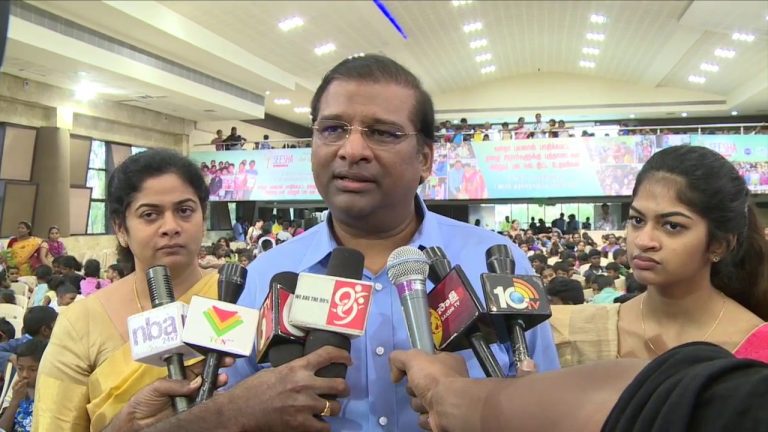
The Gujarat forest department has taken to Twitter to inform that it will be taking legal action against the controversial Christian Evangelist Paul Dhinakaran for unlawfully using the forest department logo on the web page of his organisation SEESHA (Samiti for Education, Environment, Social and Health Action). Taking to its official Twitter handle, the forest department clarified that it is in no way associated with this organisation named ‘SEESHA’. The clarification was issued after concerns about the same were raised on social media.
Gujarat Forest is not associated with any org.”SEESHA”.We have nothing to do with Paul Dinakaran or his associate. Misunderstanding if any is clarified.Unauthorized use of Dept. logo on SEESHA webpage being dealt with legally @CMOGuj@PMOIndia@drrajivguptaias@MNageswarRaoIPS
Tagging the Gujarat CM’s office, PMO, IPS Nageshwar Rao and the Additional Chief Secretary of Forest and Environment Deptt Dr Rajiv Kumar Gupta, the Gujarat forest department Tweeted: “Gujarat Forest is not associated with any org.”SEESHA”. We have nothing to do with Paul Dinakaran or his associate. Misunderstanding if any is clarified. Unauthorized use of Dept. logo on SEESHA webpage being dealt with legally”.
The Forest Department’s Tweet came in response to a Tweet by M Nageswara Rao, who is a serving senior IPS officer in the Government of India.
Rao had shared the Tweet by one social media user @Mahakrish, who was the first person to share a screenshot of the web page of this organisation owned by Paul Dhinakaran, with a fallacious claim that the “Forest department of Gujarat is associating with SEESHA in working with the tribal communities in the State as well as for conserving of the forest cover”. Rao raised an alert by tagging the Gujarat Forest Department, Gujarat CMO and the CM of the state to his Tweet.
Screenshot shared by Twitter user @mahakrish
This organisation named SEESHA is owned by Paul Dhinakaran. The official website of the organisation names him as the founder of the organisation who established it in the year 2003.
Information provided on the official website of Paul Dhinakaran owned organisation named SEESHA
The website also provides the same information as shared by social media users. It falsely claims of collaborating with the Gujarat Forest Department, a claim which has now been junked by the latter.
Website of SEESHA provides same fallicious claim of Gujarat Forest Dept collaborating with the organisation
IT raids at 28 locations belonging toChristian Evangelist Paul Dhinakaran
For the uninitiated, yesterday, the Income Tax department had carried out raids at 28 locations in Chennai, Coimbatore and other places connected to controversial Christian Evangelist Paul Dhinakaran and his Christian missionary organisation ‘Jesus Calls’. This missionary organisation run by Evangelist Paul Dhinakaran preaches Christianity across Tamil Nadu.
The IT raids were conducted based on complaints of tax evasion and foreign funds irregularities against Dhinakaran and ‘Jesus Calls’.
Paul Dhinakaran, who is the son of the late televangelist DGS Dhinakaran, has a large follower base among Christians in Tamil Nadu and runs several organisations.
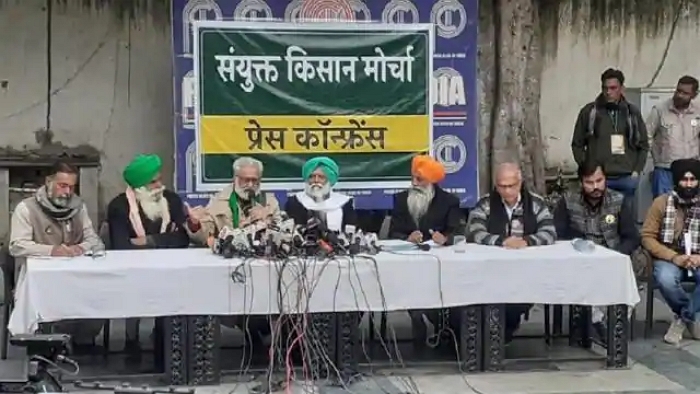
A day after the government of India propose to suspend the implementation of three farm laws in exchange for ending the ongoing the protests by some farmer unions, the unions have rejected the proposal. The decision was taken in a meeting of the protesting farmer unions today, saying that they only want the repeal of the laws.
The Samyukt Kisan Morcha, after the meeting to discuss the union govt proposal, said that they are sticking with demands for full repeal of the three farm laws, and a law ensuring Minimum Support Price (MSP) on farm produces. The Morcha said that they are not accepting the proposal to merely putting the laws on hold for 1-1.5 years. The unions are expected to officially convey the decision during the next round of meetings scheduled for tomorrow.
In a full general body meeting of Samyukt Kisan Morcha today, the proposal put forth by the Govt y'day, was rejected. A full repeal of 3 laws and enacting legislation for remunerative MSP for all farmers were reiterated as the pending demands of the movement: Samyukt Kisan Morcha pic.twitter.com/hf9AADeXOl
During the 10th round of meeting between the unions and the government yesterday, the union govt had placed the proposal to suspend the laws for 1-1.5 years, and form a committee to discuss the grievances the farmers may have with the new laws that the farmer unions were demanding for years. The Centre had also proposed to submit an affidavit in Supreme Court for suspending the three laws for a mutually-agreed period.
The Government had also noted that in all the meetings, no discussion took place on specific issues that the farmers have with farm laws, and they are just demanding to repeal them, without giving any specific reason for the same. Union Agriculture Minister Narendra Singh Tomars had aid that if the unions have any complaint against the laws or want to give any suggestions on them, they can submit the same with the ministry. He said that the issue can be resolved by addressing the specific problems with the laws they may have instead of repealing them. But the protesting farmers have been refusing to discuss the provisions of the laws.
It is notable that the Supreme Court has already stayed the implementation of the farm laws in view of the protests, but the unions were not satisfied with that and continued demand for repeal of the laws. The farmers have also refused to participate in discussions on the issue with the committee appointed by the apex court.
Liberalization is a double-edged sword. While improvement inflow of capital, possible rise in the rate of growth and control of price, increase in performance of stock markets, motivation for market-players to improve efficiency in their working, reduction of political risks to investors and greater opportunities for diversification in investors’ portfolio are some positives from liberalization, protection of interests of local players in the market-space, protection of rights of stakeholders (particularly workers), severe pressures on small-scale ventures to evolve quickly to compete with larger entities, possible increase in unemployment and unbalanced development of sectors in the economy are some negatives that may arise from liberalization.
In 1991, Dr. Manmohan Singh liberalized the Indian economy, when faced with an extremely serious economic crisis (with a twin deficit constituted by a deficit in India’s trade balance along with a significant fiscal deficit). In 2020, India’s agricultural sector was extensively liberalized with the introduction of the new Farm Bills 2020, which was posited the elimination of middlemen, attraction of investment into the agricultural sector and enhancement of technology used in the sector. The agricultural sector, which employs 58% of India’s population and adds Rs. 19.48 lakh crore of Gross Value Added (GVA), grew by 4% in 2020.
Agriculture marketing in most states of India is regulated by the Agriculture Produce Marketing Committees (APMCs) that are established by the state governments. The Standing Committee on Agriculture (Ministry of Agriculture and Farmers Welfare) chaired by Shri Hukumdev Narayan Yadav submitted a report in January 2019 titled Agriculture Marketing and Role of Weekly Gramin Haats, which highlighted the major problems faced by farmers especially small and marginal farmers, with regards to the existing framework around the APMCs in the states, which include issues such as long distances to nearest APMC markets, inadequate marketable surplus and lack of transportation.
The Committee highlighted that the provisions of the APMC Acts were not being implemented truly since there were limited number of traders in APMC markets thereby reducing competition and undue deductions in the form of market fees and commission charges. There was cartelization of traders observed by the Committee, which also spoke on the observed lack of access of farmers to government procurement facilities including APMC markets. It not only recommended the government to prioritize the establishment of alternative marketing platforms such as GrAMs, but also suggested widespread stakeholder consultations for reforms and implementation of reforms in the area of agricultural marketing.
The Committee noted that the state governments have had a lukewarm response to calls by the Centre to pursue reforms in their APMC Acts, and there are glaring problems such as the collection of market fees and commission charges not from the traders but the farmers, sometimes even when not applicable! The average area served by an APMC market was found to be around six times higher than the recommended area by the National Commission on Farmers chaired by Dr. M. S. Swaminathan in 2006, and therefore there was low availability of such markets for farmers. To make matters worse, the infrastructure and civic facilities in the available APMC markets are very poor. The Committee also recommended that the central government should increase the coverage of the Electronic National Agriculture Market (e-NAM) to states which do not have APMCs.
A glaring problem under the status quo, as it was in recent decades, is the manner in which lack of competition has led to consumers paying a lot and yet farmers not quite obtaining the benefits of this money, oft remaining underpaid for their produce and hard work. For instance, urban consumers are sold vegetables at around ten times the amount at which they are purchased from farmers! Moreover, price rise did not benefit the farmers but rather the middlemen. Also, thousands of farmers cannot travel to major townships and markets, which they are forced to do due to lack of access to APMC Mandis in many parts of a state, due to high costs of transportation. The current NDA government introduced the Farm Bills 2020 with the intent of addressing and resolving these glaring problems in the system. In this essay, I would like to study the nuances of the Bills, the arguments of those opposing it, and more broadly discuss the key point of balanced liberalization.
Farm Bills 2020
The Government of India proposed the Indian Agriculture Acts of 2020 in September 2020. These bills aimed to provide farmers with multiple marketing channels and provide a legal framework for farmers to enter pre-arranged contracts, among other things. The bills were passed by the Lok Sabha, Rajya Sabha and President Shri Ram Nath Kovind on 17 September 2020, 20 September 2020 and 27 September 2020 respectively. There were three acts introduced as part of these bills:
Farmers’ Produce Trade and Commerce (Promotion and Facilitation) Act, 2020
Farmers (Empowerment and Protection) Agreement on Price Assurance and Farm Services Act, 2020
Since the passage of these Acts, the response to the Bills have been polarized between immense praise and intense opposition from different sections of society. Protests against the Bills in Delhi, Haryana and Punjab came to the fore in September-October 2020, and this eventually led to the decision by the honorable Supreme Court of India to stay the implementation of the Bills on 12 January 2021.
The primary concern raised by the protesters is that of possible tampering with the Minimum Support Price (MSP) system in the country by the government, as raised by Rakesh Tikait – national spokesperson of the Bharatiya Kisan Union. The Minimum Support Price is the price of agricultural products set by the Union Government to purchase directly from the farmer, as a form of market intervention by the Government of India to insure agricultural producers against any sharp fall in farm prices.
To expand on the questions raised around this with regards to the Farm Bills, the question is that if selling in APMC Mandis becomes optional, will these mandis even exist and whether procurement at Minimum Support Price (MSP) will stop? The concern arises due to the recognition that the MSP system works well in states where the state government has made efforts to support it by levying taxes on the procurement that may provide for infrastructure and that if there are two markets, as will happen with the recent Bill, and one of them selectively has no barrier on traders (as under the Farmers’ Produce Trade and Commerce Promotion and Facilitation Act 2020), the trade will invariably move to the market that has no taxes levied.
In such a scenario, there is fear that states that do not have enough tax revenue and/or resources may discontinue the MSP system. Even though farmers themselves recognize that the skewed regional procurement patterns in states under the MSP system can cause environmental imbalances (such as with farmers in Haryana and Punjab who continue to grow rice even with water and soil depletion) which may be lessened under a more open market, the possibility of having the MSP system removed altogether is causing unease in certain sections of the agricultural sector.
Prime Minister Narendra Modi allayed doubts on whether the Farm Bills will affect the MSP system, highlighting that the system will continue, and Union Minister of Agriculture and Farmers Welfare Narendra Singh Tomar stating the same in both – the Lok Sabha and the Rajya Sabha. Given this assurance, it now seems to be a crisis of trust that has caused the rift and the continuing deadlock over the Bills.
While APMCs may have their fair share of problems, many farmers see the MSP system as a method of ensuring price guarantees on produce. To take an example of a state that has already abolished the APMC model, Bihar was the first state to abolish the APMC act over ten years back, thereby enabling the private players to procure directly from farmers. However, the results have not been entirely positive, with the erstwhile commission agents of the APMC model being replaced by the clout of private traders who now control the prices. This affected the poorer farmers with less landholding the most. With more than 86% of Indian farmers having less than 2 hectares of land as of 2018, the aforementioned possible adverse impact upon poorer farmers can become a major concern if the same trends are seen across the country.
It is of prime importance, in this context, that the Union government must work towards alleviating the concerns of farmers on this front, possibly with more than verbal assurance, maybe in the form of a written assurance on the continuation of the MSP model. I would go one step further in seeking to encourage the policy-makers to reform the existing MSP system, whereby only around 6% of farmers can sell their produce at the MSP with a major number of farmers having to undertake distress sales, as per the Shanta Kumar Committee Report 2015. In my view, while corporate-owned infrastructure such as factories and warehouses may help farmers earn better prices, complete disappearance of APMC mandis and regulated competition may lead to large companies obtaining complete monopoly over the market that may lead to price exploitation of farmers. Therefore, there has to be a balanced drive towards liberalizing the agricultural sector, in this specific direction, and I hope the government can reinforce and state more explicitly its commitment to doing the same.
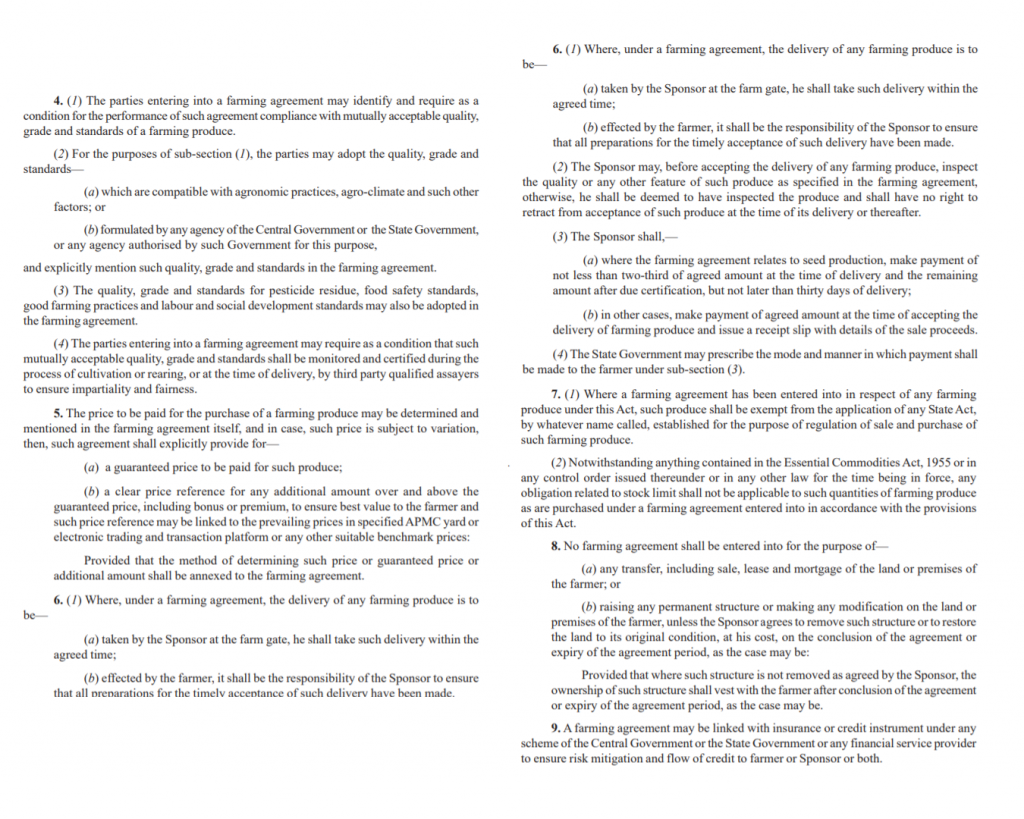
Another major aspect that has been discussed extensively is that of contract farming. There is a concern that under contract farming, farmers may be dictated to, by corporate entities, and that the farmers will not be able to fix prices according to their free will. Having read The Farmers (Empowerment and Protection) Agreement of Price Assurance and Farm Services Bill, 2020, I would like to highlight clauses 4-9 in Chapter II,
Clauses 4-9, Chapter II, The Farmers (Empowerment and Protection) Agreement of Price Assurance and Farm Services Bill, 2020
In this section, the extensive checks and balances for such contracts are given, along with comprehensive quality assurance measures during the contractual period. This includes the grade and standards for pesticides, food safety standards, good farming practices, social development standards and details on delivery and the restriction of the usage of insurance or credit instrument under any government-initiated schemes for the purposes of such an agreement. Under the provisions of this Act, farmers will have full power to determine prices for their produce as much as the buyer would do, and the farmers will have to receive a payment within 3 days.
On the question of how small farmers will be able to do contract farming when sponsors may not finance them, there are a number of Farmer Producer Organizations (FPOs) that have come into being and these will bring together small farmers and work to ensure a remunerative pricing mechanism for the agricultural produce. There has been quite a lot of work on FPOs under the aegis of the National Bank for Agriculture and Rural Development (NABARD), which is fully owned by the Government of India.
Currently, contract farming requires registration with APMCs in some states, with the contractual agreements being recorded with the APMCs, which can undertake conflict resolution between parties to an agreement. As per the Dalwai Committee report, only 14 states have issued rules to govern contract farming. I hope that the local dispute redressal system to be set up by the state government is effective since there has been a history of corporates steamrolling farmers when their corporate interests have been compromised, such as in the case of the PepsiCo lawsuit against farmers of Gujarat in 2019.
Balanced Liberalization: A Middle Path
The entire Farm Bills episode brings to the fore the importance of striking a balance when moving towards liberalization. In this context, the need of the hour is balanced liberalization. I do not believe that either blindly pursuing socialism dogmatically or promoting crony capitalism works. Recently having written on a new framework of transcending – Turiyavaad, an ideology that is paradoxically about moving beyond rigid ideologies, which puts emphasis on truth and transcending dogma, I feel a Turiyavaadi element can be helpful here. Turiyavaad is a system of evidence-based policy-making and decision-making based on ground realities.
While I understand the importance of liberalization and personally feel that the Farm Bills can bring in much-required capital inflow and infrastructure development, I stand for a hybrid approach. Not only should the MSP and APMC model be kept in place with an explicit assurance for the same, but there should also be specific systemic changes and reforms in the same, besides the private sector inflow as per the Farm Bills. To resolve how so, I think we must look at the manner in which farmers have been undertaking farming. Over the ages, farmers have planned season after season, deciding what crops to grow and in what area.
These decisions are made as per their needs, labour and capital available, and their knowledge of land and the available technology. Ceteris paribus, the price received by the farmers in previous cycles has been one of the primary factors in their decision to allocate areas under specific crops, which are mainly produced to be sold. The complexity of this analysis and problem increases manifold with more land and number of people involved in the farming process, and what is required is rigorous methods to accumulate information, to analyze and to plan.
Unwise land usage can be an encumbrance. This can include the adoption of unsustainable systems of farming on poor soil. It also has to be adjusted based on market dynamics. If prices of radish are about to crash and radishes have been produced in excess of demand, the government stepping to buy this will only burden the taxpayers. With water and land resources, along with fertilisers, being limited and having been spent in surplus production, the case for area planning gets only stronger. As population increases and these resources become even more scarce, optimal usage of the land and resources is of prime importance.
Area planning is a massive challenge for a large democracy like India, particularly with the population and acreage in agriculture. At the national level, the total demand of agricultural commodities will have to be made before the sowing season for effective planning. Upon assessing this demand, the demand will have to be divided among states based on proportion of land under cultivation of the specific crop as well as conditions such as soil that are appropriate for the same. This can further trickle down to more division between regions within a state.
But to bring this into action, what is most important is consensus among farmers and political will. While land reform and efficient allocation should be a broad aim we should move towards, even optimum usage and planning would go some way in helping the small landholders and farmers, and possibly in alleviating poverty. For developing consensus among farmers, good estimates about the programme required must be made followed by local discussions through grassroot consultations and workshops.
It is encouraging to see that farmers in Haryana and Punjab have themselves suggested the controlling of production under varied crops. Now, does it mean we completely move towards a state-controlled-and-planned model or the license model we have followed till now for all crops? No. We liberalize but for the protection given from the government’s side to those who do not feel either able or secure to avail this, we have a revitalized and improved MSP and APMC model. With regards to the extensive task of mapping resources, obtaining and analysing information on crop patterns and market dynamics, and planning, we can avail the power of the private sector again, albeit with government regulation (preferably through Public-Private Partnerships).
There are some aspects that must be developed for both these channels. Agricultural terms of trade, supply response and commodity prices can be improved only with greater public expenditure on technology development and distribution, rural infrastructure, human resource development and other support systems. Smallholder farmers depend more on public services, and even in a liberalized economic scenario, public expenditure for these varied elements can only stimulate agricultural development.
The capacity of producer organizations must be strengthened and enhanced to facilitate them to help with representation and risk management on behalf of their member-farmers. For risk management, there must be extensive studies to assess the price risk-bearing capacity of smallholder farmers and the role that farmer organizations, producer organizations and financial markets can play on this front. Farmers’ lobby groups and effective information systems that are run by the government (again possibly with a PPP model) are of prime importance to increase the control of farmers in a marketing chain and to address the information asymmetries that may be present in a completely liberalized system.
We must also put in place discretionary policy measures to improve the access of smallholder farmers to consumption and production credit to boost farming efficiency and productivity. Given the aforementioned dearth of APMC markets in various regions of India, there is a need to increase access to rural markets and APMC Mandis. Along with liberalization, all of these policy elements, particularly area-planning and resource optimization, focus on establishing institutional frameworks that are required to increase opportunities, improve access, reducing production and transaction costs and bringing farmers, particularly smallholder farmers, to resources and markets.
This model of balanced liberalization can be used for other sectors and areas of life as well, particularly in developing countries. While markets are opened up in this framework, there is a parallel robust and efficient public-sector regulated and planned system, which relies strongly on information-gathering, rigorous analysis and planning for resource optimization. In this manner, everyone is given equality of opportunities and a path for gradual movement up the economic ladder. When a government makes a policy for liberalization, they cannot just expect the entire populace to recalibrate and orient themselves to extreme market changes and expectations, particularly in a country like India where people live in highly precarious situations, economically.
I feel that would be highly unfair and even inhumane to an extent. An unchecked market and wanton capitalism has only helped materialistic tendencies to prevail and exploit the weak. The ideal of everyone ‘catching up’ never quite happens in that way. If tomorrow only private players remain in agricultural marketing in the country, what it is to stop them from changing prices dramatically to help fill their coffers? What makes them any better them neo-colonialists who, like the British did with Indigo farmers back in the Raj, monopolize agriculture and harass farmers to do their bidding? These are all glaring questions that remain to be addressed. The current Union Government’s drive to liberalize the agricultural sector is commendable, in seeking to bring in much-needed capital, energy and vigour into this sector.
What may be required as well maybe a parallel channel that is either public-sector driven or PPP-model driven that puts in place regulation and planning (particularly area planning), with strict checks against inefficiency, redundancy, wastage and corruption, and is based on the Turiyavaadi tenet of looking at what the truth of the matter, the actual ground-reality is. Truth is important as much if not more than liberty and equality – two ideals that are kept on a pedestal by the Right and the Left respectively.
It is in balance, and in this case balanced liberalization, based on the triad of truth, efficiency and compassion, that may find a better tomorrow!
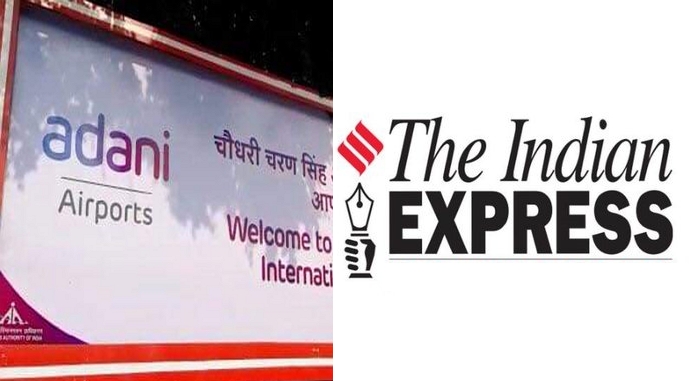
The civil aviation ministry has said that a report published by the Indian Express on 15th January alleging irregularities in Adani group winning bid for running 6 airports is factually incorrect and false. The minister has denied allegations made in the report that there were objections to one company winning all six bids, saying that the entire process was conducted in a transparent manner.
In the report published on 15th January, the Indian Express had alleged that the Finance Ministry and Niti Aayog had put on record objections regarding the 2019 airport bidding process, but those objections were over-ruled and Ahmedabad-based Adani group had made a clean sweep by winning the bidding for all six airports: Ahmedabad, Mangalore, Lucknow, Jaipur, Guwahati and Thiruvananthapuram.
The report claimed that during the bidding process, the Department of Economic Affairs has proposed to incorporate a clause to prevent a single bidder to win more than two airports. Quoting minutes of meeting that Indian Express has claimed to have accessed, the report said that the department had suggested this as the six airport projects are highly capital-intensive projects, and awarding them to different companies will facilitate yardstick competition.
The report said that NITI Aayog also raised a different concern regarding the matter, saying that a bidder without sufficient technical capacity can jeopardise the project and compromise the quality of services that the government is committed to provide. The report also notes that earlier when Delhi and Mumbai airport operations were privatised, GMR was not awarded both the airports despite emerging as winner in the bids for both the airports.
Responding to the report published a week ago, the civil aviation ministry has released a statement today dismissing all the allegations made in the report. It says that the report is factually incorrect as the bidding process was conducted in a competitive and transparent manner through e-tendering portal of the Government of India, in which 25 firms across the globe had registered and total 86 registration were received in the portal for 6 airports.
“Out of these registrations, 32 bids were received from 10 difference entities for 6 airports. As the bid process was completed transparently, none of the participating entity raised any concern or objection to the bidding process,” the ministry statement said.
The ministry informed that the bid parameter stipulated in the tender document was ‘per passenger fee’ quoted by the bidder and the entity whose bid is highest in terms of per passenger fee quoted would be declared as successful bidder. As the bid for Adani Enterprises Limited was highest in all the six airports, they group had won all six bids. The tender process of each airport was undertaken on individual basis, and the bid for the same bidder was found highest in all the six airports, therefore the same company won all six airports, the statement said.
The ministry has also said that the claim that the Finance Ministry and the NITI Aayog had raised objections to the process is incorrect, as an Empowered Group of Secretaries (EGOS) Chaired by CEO NitiAayog with Secretaries of Ministry of Finance (Department of Economic Affairs, and Department of Expenditure), and Civil Aviation as Members was given the powers by the Union Cabinet to decide on the matters outside the purview of Public Private Partnership Appraisal Committee (PPPAC). Accordingly, the terms and conditions of the transaction of the PPP were deliberated and decided by the EGoS in its meeting held on 17.11.2018 which were agreed by the PPPAC in its meeting held on 11.12.2018.
Responding to the earlier example of putting restrictions in bidding for Delhi and Mumbai airports, the ministry said that the Empowered Group of Secretaries took a conscious decision not to put any restrictions on the number of airports to be bid for or to be awarded to a single entity considering the fact that these 6 airports are smaller in size and handling only 9.5% of the passenger traffic, whereas Delhi and Mumbai airports accounted for more than 45% of the total passenger traffic in 2006 when they were brought under PPP and the decision to cap one airport to single bidder was necessary.
The ministry also says that the quantum of passengers handled by the private airport operators is more crucial and important than the number of airports handled by a single entity. The statement also informed that EGOS decided not to stipulate prior airport experience as a mandatory qualification to increase competition and avoid monopoly by those players having Airport experience, who would have an edge over others.
Moreover, both the EGoS and PPPAC comprises members from Ministry of Finance (Department of Economic Affairs & Department of Expenditure), NITI Aayog and the Civil Aviation ministry. Therefore, both the finance ministry and NITI Aayog were involved in finalising the contours of the bidding process. “Therefore the statement that the views of Ministry of Finance and NitiAayog were ignored is factually incorrect and based on assumption”, the ministry said, informing that views of both the entities are part of the established procedure.
The ministry statement also pointed out a factual error in the report which says that concession agreements for Guwahati, Jaipur and Thiruvananthapuram airports were signed by AAI in September, whereas, it has actually been signed on 19.01.2021.
It was also pointed out by the civil aviation ministry that the same allegations made in the Indian Express report were made in various petitions submitted with Kerala High Court opposing the PPP mode of operation of AAI airports, which were dismissed by the court.
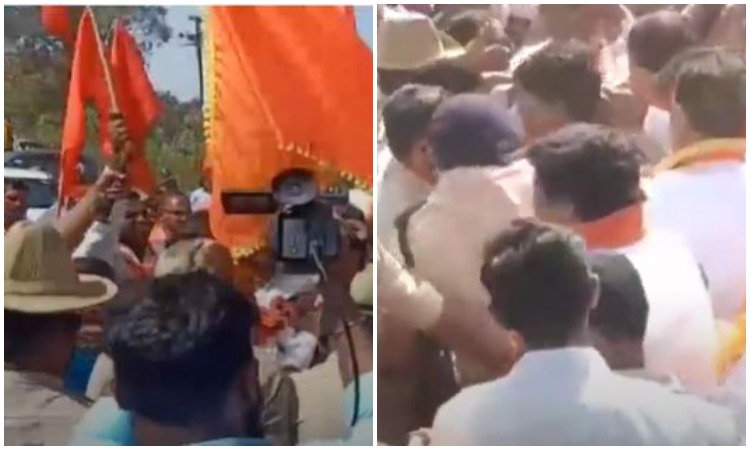
The Belagavi (Belgaum) police clamped prohibitory orders under Section 35 of the Karnataka police act, in order to impede Shiv Sena activists from entering the city. The police were forced to implement the ban after several Shiv Sena leaders created a ruckus in Belagavi openly threatening to remove the Karnataka flag hoisted atop the corporation building and hoist a saffron colour party flag instead.
The protest which was carried out by Maharashtra Ekikaran Samiti (MES), the outfit which has always claimed that Belagavi belongs to Maharashtra and not Karnataka, and Shiv Sena leaders, was also joined by several pro-Maharashtra outfits and a large number of Shiv Sena activists from Kohlapur who gathered in front of Belagavi City Corporation (BCC) and raised slogans, demanding the removal of the flag.
Speaking about the decision to impose the prohibitory orders, Police commissioner Dr K Tyagrajan said that the action was taken as a precautionary measure to maintain law and order in the city as Shiv Sena leader Vijay Dhavane had plans of delivering a provocative speech at Belagavi, which would have disrupted the linguistic harmony in the city.
Owing to this, Belagavi police had made elaborate security arrangement in and around the Belagavi City Corporation (BCC) campus and other sensitive spots in the city.
Despite the orders being in place, Shiv Sena activists-led by Vijay Dhavane tried to forcefully make their way into Belagavi through the Karnataka border near Shinoli village. This led to a confrontation between the Shiv Sena activists and the Belagavi police in the Kohlapur district around 20 km away from the city of Belagavi.
Shiv Sena protests in Belagavi over removal of Shivaji statue
This is, however, not the first time Shiv Sena activists have created a ruckus in the city. Last year, Shiv Sena party workers had staged a protest against with effigies of Karnataka CM Yediyurappa over the removal of a Shivaji statue in Belgaum’s Mangutti village.
Shiv Sena chief Uddhav Thackeray likens Belagavi to PoK
Earlier, Maharashtra CM and Shiv Sena chief Uddhav Thackeray, who has often raked up the border issue in the name of Marathi language and culture, had also stirred a controversy after likening Belagavi to ‘Pakistan occupied Kashmir’ (PoK).
On December 20, in a bizarre comment, Uddhav Thackeray said: “Like PoK, there was a Karnataka-occupied Maharashtra. People in Belgaum are not only Hindus but also Marathi-speaking people and wanted to be part of Maharashtra. However, they are facing oppression from the BJP-led government in Karnataka. Even for speaking the truth, the Belgaum mayor was booked for treason,” he said in the Assembly”. The Maharashtra Chief Minister made the Karnataka comment while referring to the Citizenship Amendment Act.
The Karnataka-Maharashtra border issue
The Karnataka-Maharashtra border issues go back to as many as 50 years. It involves a set of more than 800 villages along with Belagavi district being claimed by Maharashtra as a part of the state on linguistic grounds. Actually, Belagavi district, which was previously a part of the Bombay presidency was given to Karnataka after independence.
While several Maharashtra leaders including Senapati Bapat have fought to regain Belgaum, a government-appointed commission formed in October 1966, named Mahajan Commission under former Chief Justice Mehr Chand Mahajan had in August 1967 awarded Maharashtra 264 villages including Nandagad, Nippani Khanapur, but let Karnataka keep Belagavi (Belgaum), while Kasargod went to Kerala.
Though the then Maharashtra government vociferously rejected the recommendations terming it biased and illogical, the state of Karnataka accepted it and wanted it to be implemented. However, the matter remained unresolved as the Central Government left it open.
Later in 2005, the Maharashtra government filed a petition in the Supreme Court staking claim over Belgaum. The Supreme Court began its hearing on Maharashtra’s petition on 17 January 2007 and is still being heard in the apex court.
Last year after the Maha Vikas Aghadi government was formed in Maharashtra, Chief Minister Uddhav Thackeray appointed ministers Chhagan Bhujbal and Eknath Shinde as coordinators to oversee the state’s efforts to expedite the case related to the border dispute.
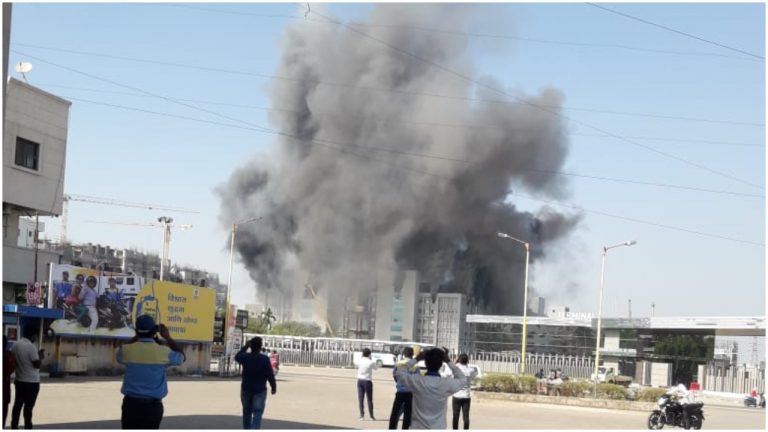
A fire broke out at the Terminal 1 gate of Serum Institute of India (SII) in Maharashtra’s Pune on Thursday. Earlier, SII head Adar Poonawalla had tweeted that there has been no loss of life. But after hours of firefighting efforts, it has now been reported that 5 people have lost their lives in the fire incident.
Adar Poonawalla had also confirmed a few minutes ago that some people have been killed in the fire. He did not specify the numbers. Pune police and fire fighters are still at the site trying to control the blaze.
ANI has reported that the fire at the under-construction building was perhaps caused by the welding work. Four workers were evacuated from the site. But when the blaze was controlled, five bodies were found at the site, Pune Mayor Muralidhar Mohol has informed.
Following the fire incident at the facility, eight fire tenders are on the spot to control the fire. As per reports, the fire incident happened at an under-construction building and it has not impacted any vaccine manufacturing units. Storage facilities are also safe.
The site where the fire broke out, is an under-construction building at Serum Institute of India, Pune. The vaccine and vaccine manufacturing plant are safe. More details awaited pic.twitter.com/oykxR3EBjA
Visuals of smoke billowing from several buildings at the site have gone viral on the internet. It is notable here that Serum Institute of India, the world’s largest vaccine manufacturer, is currently making the Covishield vaccine, prepared by Oxford-AstraZeneca and nit just India, but several nations world wide are dependent on this cheap vaccine to immunise their populations against the Wuhan Coronavirus.
The production of Covishield was also not reportedly being carried out at the Manjri plant of Serum Institute of India, as per reports.
A massive fire broke out at a plant of Serum Institute of India in Manjri area of Pune. 8 fire tenders on the spot. Oxford-AstraZeneca’s COVID vaccine Covishield is manufactured by @SerumInstIndia However production of Covishiled was not being carried out at Manjri plant. pic.twitter.com/gRlrUCAYeu
The fire incident at Serum Institute of India facility comes just a week after it rolled out the Oxford-AstraZeneca coronavirus vaccine – Covishield.
It is pertinent to note that SII’s Covishield is one of the first coronavirus vaccines in India to get restricted emergency-use approval. The Serum Institute of India Pvt Ltd was founded by Cyrus Poonawalla in 1966. It manufactures more than half of the world’s vaccines.
This is a developing story. We will update as more information is available.