Home Blog Page 499

How Jawaharlal Nehru aided the conversion of Hindus when he met USAID-funded World Vision’s founder & Evangelist Billy Graham, Indira continued his legacy

On the 3rd of February 2025, Elon Musk and US President Donald Trump decided to bring about a tectonic shift in world politics. In a Spaces session, Elon Musk said that he had a detailed discussion with Trump and they had decided to shut down USAID – the regime change arm of the US government that managed over $40 billion dollars in aid money to various nations across the world. Musk said the agency was ‘beyond repair’, calling it a criminal enterprise.

What followed was pandemonium – the Left was up in arms. At the same time, those with a functioning brain were deep diving into the shenanigans of USAID, the problematic programs they funded, the deep state operators and how, the agency had unleashed mayhem in several nations across the world.

India is no different. USAID and the US deep state took a special interest in India. From funding media entities to undermining any platform that did not agree with the radical left to funding religious conversions in India – USAID footprints seem to be everywhere.

OpIndia published an investigation into one such entity – World Vision International – one of the top recipients of USAID funds – to the tune of over $2 billion. World Vision India, in turn, received hundreds of crores every single year from the USAID-funded entity. While it pretends to be a humanitarian organisation, in reality, it is a Christian fundamentalist organisation that allies with other Christian fundamentalists, to convert unsuspecting Hindus, especially children and women. World Vision has been indulging in conversion activity in India for many years. It was first established in India in 1951. For over 70 years, World Vision received crores to convert Hindus and subvert Hinduism. It was only in 2024 that the Modi government revoked its FCRA license, denting its conversion activity in India.

A detailed deep dive into the organisation and its activity in India can be read here.

One does not have to look too far to realise that USAID-funded World Vision has been exploiting children to affect Christian conversion under the garb of humanitarian work for decades.

This 2002 IRS return filed by World Vision, for example, very plainly admits that World Vision is a Christian Ministry and its objective is to spread Christianity overseas. It also admits that its funded by USAID.
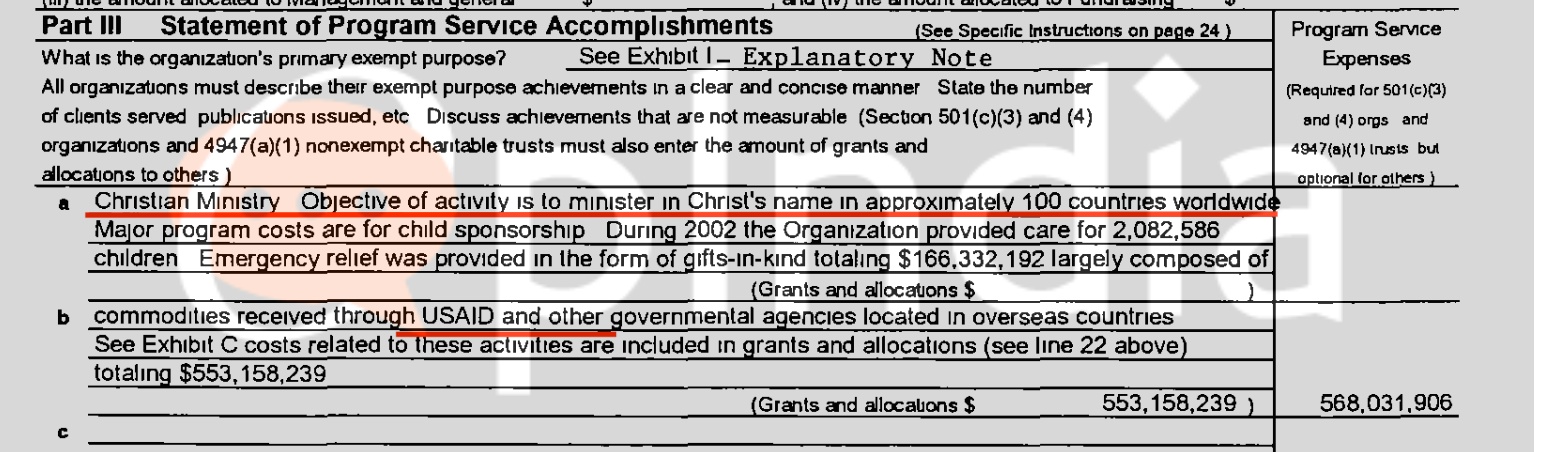
This means, therefore, that World Vision and USAID have been funding the Christian conversion of Hindus, using “aid” to their children, for decades.

USAID funded World Vision history: How it started with the conversion and brainwashing of a little girl in China

World Vision on its website says this about the organisation’s founding:

Bob Pierce founded World Vision three years after he came face to face with an abandoned child and chose not to look away. Determined the last $5 in his pocket wasn’t enough, he knew more people had to be involved for a long-term solution and broader impact. Initially based in the state of Oregon, the organisation focused on mission service for emergencies in East Asia. Today World Vision has become the largest Christian international non-governmental organisation working in nearly 100 countries worldwide.

The World Vision India website also puts out the ‘humanitarian’ version of its original story instead of revealing details. The website claims that Bob Pierce gave his last $5 to take care of a child in China who was abandoned by her parents, however, leaves out critical information about why that child was abandoned.
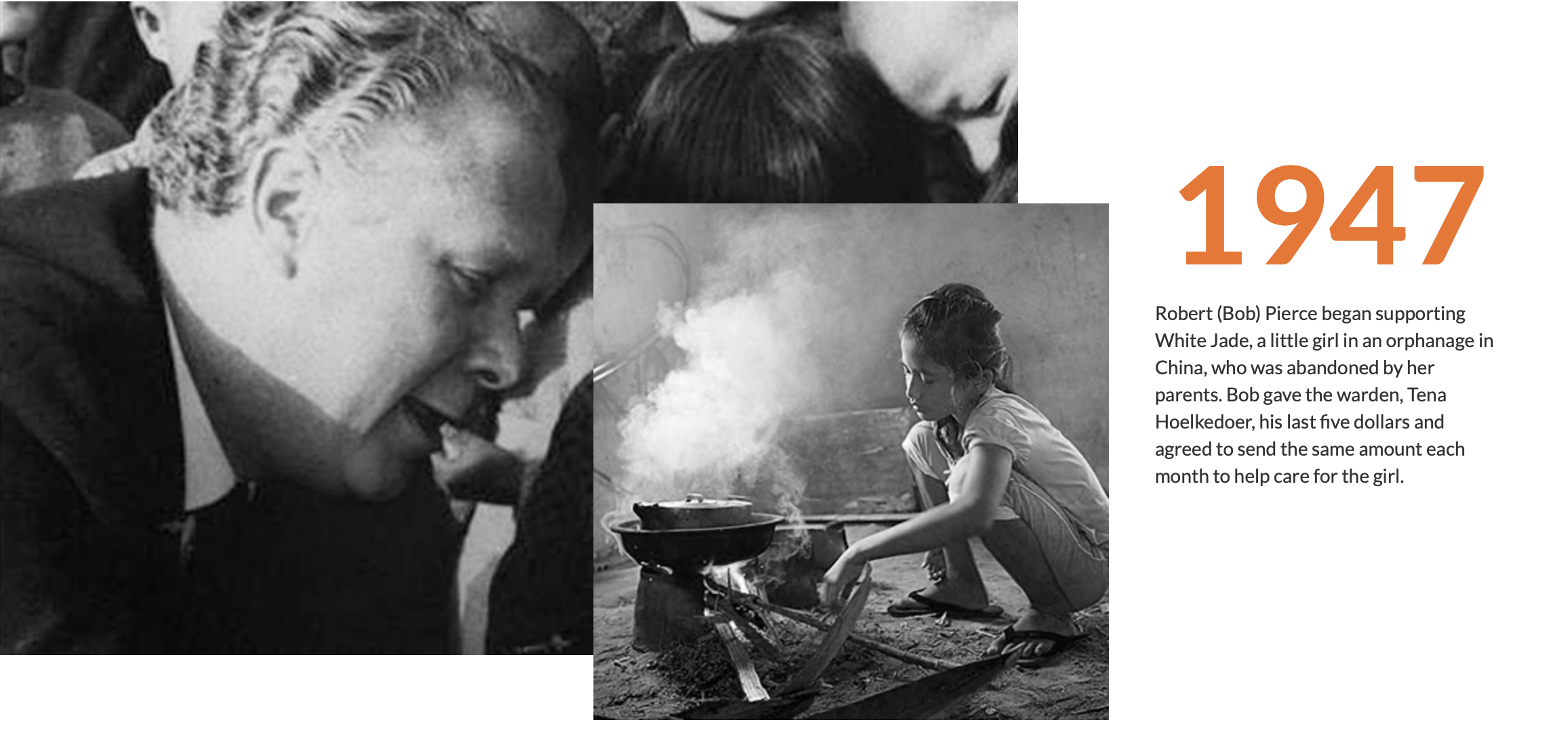
The explanation by World Vision makes it appear as though Bob Pierce, the founder of WVI and one of the foremost evangelists, simply wanted to help impoverished children and therefore, spent the last money in his pocket for the upliftment of the poor. However, this is not the full story. It is a sanitised version of the truth to further the humanitarian smokescreen.

In a book titled “Religion in Philanthropic Organisations” edited by Thomas J. Davis, the Dean and Professor of Religious Studies at the Indiana University School of Liberal Arts, the actual story is revealed. World Vision started when a little girl in China converted to Christianity after the sermon of evangelist Bob Pierce in the school she went to.

The book says:

The origin story of World Vision, as detailed in the book edited by Thomas J. David proves that there is far more than what World Vision wants people to believe from reading their website. The real origin story reveals that Bob Pierce was converting minors in China. Pierce was invited to a school to give an evangelical sermon, after which, a little girl converted to Christianity and was subsequently thrown out of her house by her family. It was to rehabilitate girls like her that World Vision was started.

The book states that in 1947, Bob Pierce, during his visit to China, converted 17,000 people to Christianity.

Conversion of minors falls squarely under the predatory proselytisation category. Hinduphobia Tracker defines ‘conversion by brainwashing’ as:

It is, therefore, evident that the very foundation of World Vision was that of predatory proselytisation where kids were being brainwashed to accept Christianity.

Bob Pierce himself has been classified as a “religious fundamentalist” in the book. The essay in the book says that Pierce started preaching at the age of 13 and went on to join a fundamentalist Christian organisation called “Youth For Christ” (YFC).

The book says:

One particular group, Youth for Christ (YFC), may best exemplify this reengagement. By 1944, as a travelling evangelist, Pierce had eagerly joined YFC and quickly became a vice president in the organization. Alongside other new voices such as Billy Graham, Pierce garnered national attention as politicians, preachers, and newspapermen promoted the rallies’ success. Throughout the 1940s, revivals of thousands of young people gathered in American cities each Saturday night. As its motto, “Geared to the times, but anchored to the rock,” claimed, YFC embraced popular culture, American civic faith, and potentially global outreach. Torrey Johnson, YFC’s first president, told Time magazine that his organization’s goal was the “spiritual revitalization of America and the complete evangelization of the world in our generation.” Youth for Christ sponsored hundreds of “world vision” rallies promoting the work of international missionaries.

The book further says that YFC had established “invasion teams” which worked towards “greater conquests for Christ”.

Further, the book reveals that Bob Pierce envisioned himself as the next Billy Graham – one of the most famous evangelists in America as well. This name will hold significance further in the article. Pierce, the founder of World Vision, became known as the “Billy Graham of Asia”.

Pierce further has been defined as a “Cold Warrior” – essentially – an enthusiast who aligned himself with the foreign policy of the United States of America. The book says:

As an ardent “Cold Warrior,” Pierce supported America’s global reach to contain communism in Asia. He became a field representative in the emerging International Christian Leadership (ICL) organization that networked with American politicians and international Christian leaders in efforts to strengthen both foreign relations and worldwide Christian revival.

USAID funded World Vision and its story in India

Here is what the World Vision India website says about its origin story:

  1. 1950: Bob Pierce started World Vision. The child sponsorship programme began in response to the needs of hundreds of thousands of orphans of the Korean War.
  2. 1951: World Vision started operations in India and subsequently set up a single-room office in Kolkata in 1958.
  3. 1960 – World Vision India started 6 childcare projects and worked with institutions for child well-being 

It goes on then, to talk about World Vision’s humanitarian work India.

However, as seems to be the norm with World Vision, the truth is far from it – and murkier than what they wish for people to know.

Before Bob Pierce came to India, he was proselytising people in Korea (after converting 17,000 in China). After his initial conversion stint in China, he couldn’t go back since the Chinese Communist Revolution, after which, missionaries were expelled from the country. His next stop was Korea, but even from there, after converting some, he fled since the Communist troops marched into North Korea.

Pierce, wasn’t to be deterred, though. He wanted to convert more Koreans. So after getting some articles placed in the press, he managed to go back to Korea as a “war correspondent”. There, he tended to Christians afflicted by the war.

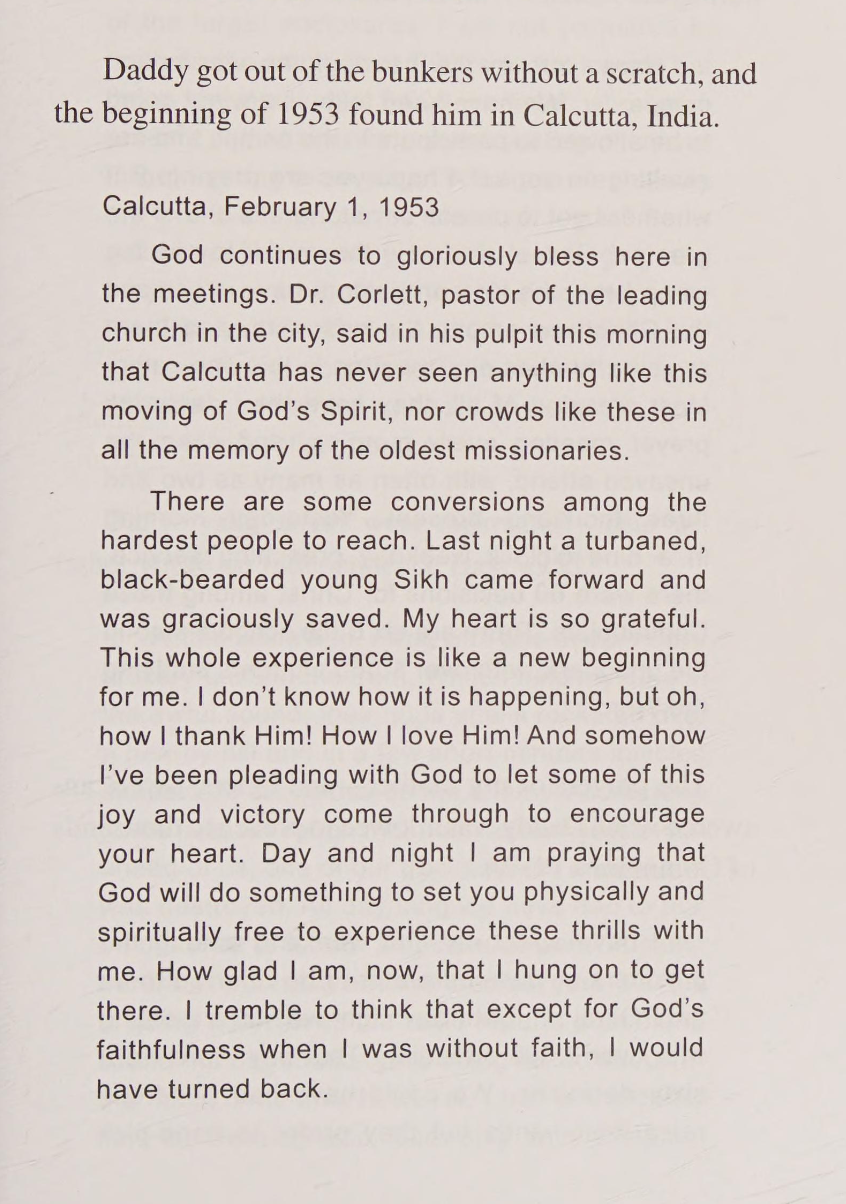
Pierce was in Seoul till 1952. But the book titled “Man of Vision”, written by Bob Pierce’s daughter places Pierce in India in 1953.
USAID funded World Vision converted Hindus for 70 years: How Jawaharlal Nehru and Indira Gandhi gave them a free run

In this letter by Bob Pierce in February 1953, he talks about how he was in Calcutta and was converting Hindus and Sikhs.

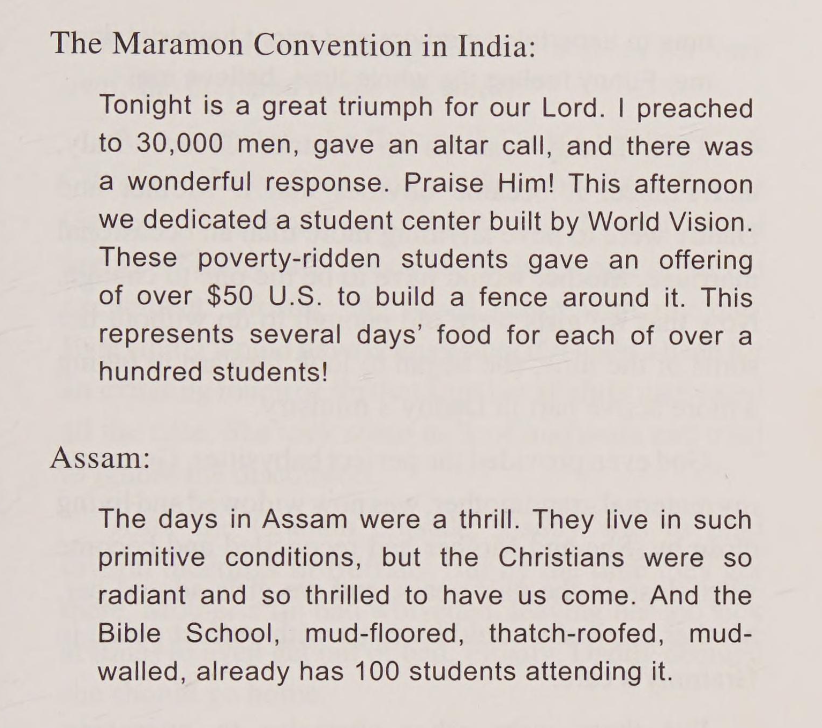
In 1956-1957 too, Pierce travelled to India to preach to Indian students – again – children.
USAID funded World Vision converted Hindus for 70 years: How Jawaharlal Nehru and Indira Gandhi gave them a free run

The World Vision website simply says that it started its operations in India in 1951 and subsequently, opened an office in Calcutta in 1958. However, it cleverly leaves out the travels of Pierce to India before that and his rampant conversion activity in India.

The meeting of Jawaharlal Nehru, Bob Pierce and Billy Graham: How Nehru gave permission for conversions and entertained US lobbying

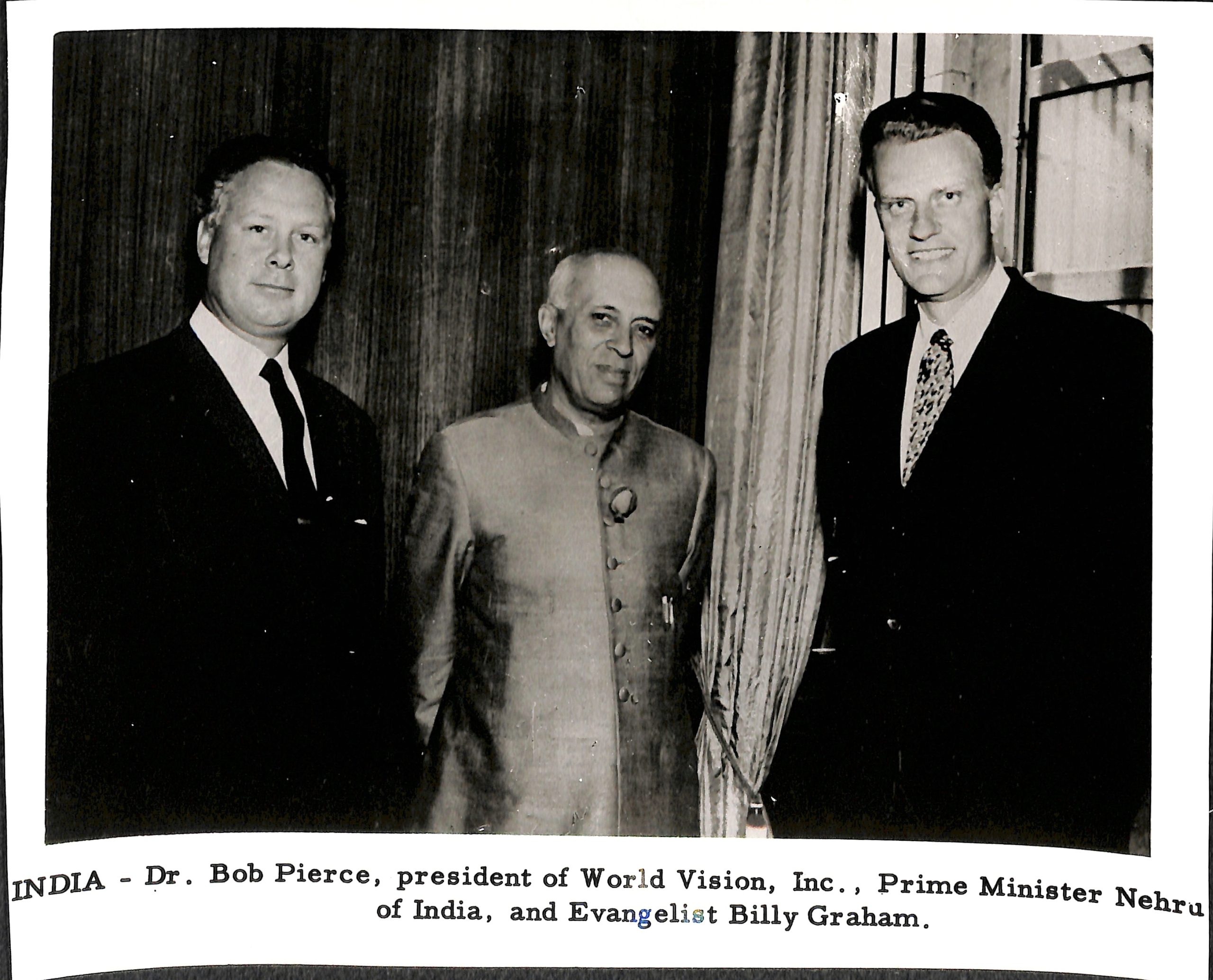
There is another crucial piece of information that the World Vision website summarily leaves out. In 1956-1957, while Bob Pierce was converting Hindus and Sikhs, he also had an interesting meeting with the then Prime Minister Jawaharlal Nehru.

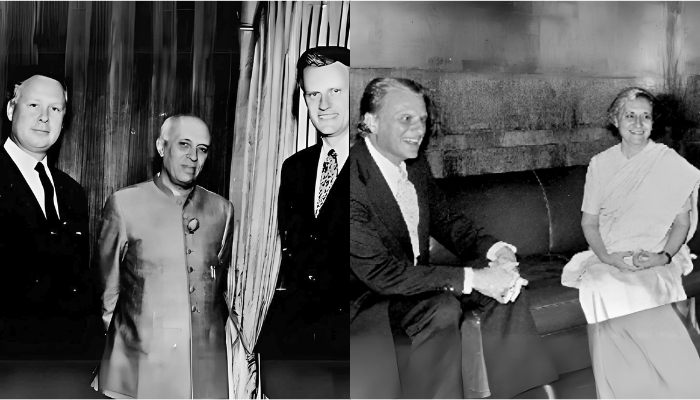
There exists a picture in the archives of George Fox University, where Bob Pierce met PM Nehru, along with another famous evangelist Billy Graham. An archived version of the image can be found here.
USAID funded World Vision converted Hindus for 70 years: How Jawaharlal Nehru and Indira Gandhi gave them a free run

To understand the implications of this picture, we must, along with Billy Graham, also understand who evangelist Billy Graham was.

William Franklin Graham Jr (Billy Graham) was an American evangelist and ordained Southern Baptist minister. In his years of preaching the gospel and converting people, Graham met several state heads and personalities. He was extremely close to several US Presidents. He famously said, “Everywhere I go I find that people … both leaders and individuals … are asking one basic question,” Billy Graham has said. “‘Is there any hope for the future?’ My answer is the same, ‘Yes, through Jesus Christ.’”

According to the Billy Graham website, After being encouraged by a key figure in the Evangelical Alliance in London, Rev. Graham scheduled Crusades in Bombay (now Mumbai), Madras (Chennai), Kottayam, Palamcottah, New Delhi and Calcutta (Kolkata).

His first visit to India has been documented on the website as 1956. “His 1956 visit was timely, as India was beginning to strengthen its ties with the Communist bloc, raising questions about the role of Western influence and faith in the area. Billy Graham, however, was well prepared, taking the initiative to meet with the current secretary of state for a briefing on relations between the U.S. and India”.

This trip appears to be a significant one not just from the point of view of Christian conversions, but also geo-politically. It was in this period that Graham and Bob Pierce met Jawaharlal Nehru as well.

In the book, “Billy Graham – His Life and Influence” written by David Aikman (former TIME magazine senior correspondent), there are details of the meeting which prove that Graham was furthering USA’ foreign policy goals.

The book states clearly that the US Government was using Billy Graham’s Christian crusades to further foreign policy goals and the first time they tried this was when Graham was visiting India.

President Dwight D. Eisenhower sent greetings to Graham before his trip to India and Secretary of State Dulles met Graham to impress upon him that he must not make any political mistakes during his trip to India and focus on furthering American interests.

The book says, “This was but the first of many occasions US administrations found it useful to capitalize or piggyback on Graham’s evangelistic activities and indeed his prominence as a worldwide evangelist. In decades to come, not only did his crusades have the indirect effect of helping to bring down totalitarian regimes, but, on occasion, Graham served as an unofficial emissary for American presidents to world leaders with whom the US government was unable otherwise to have direct contact”.

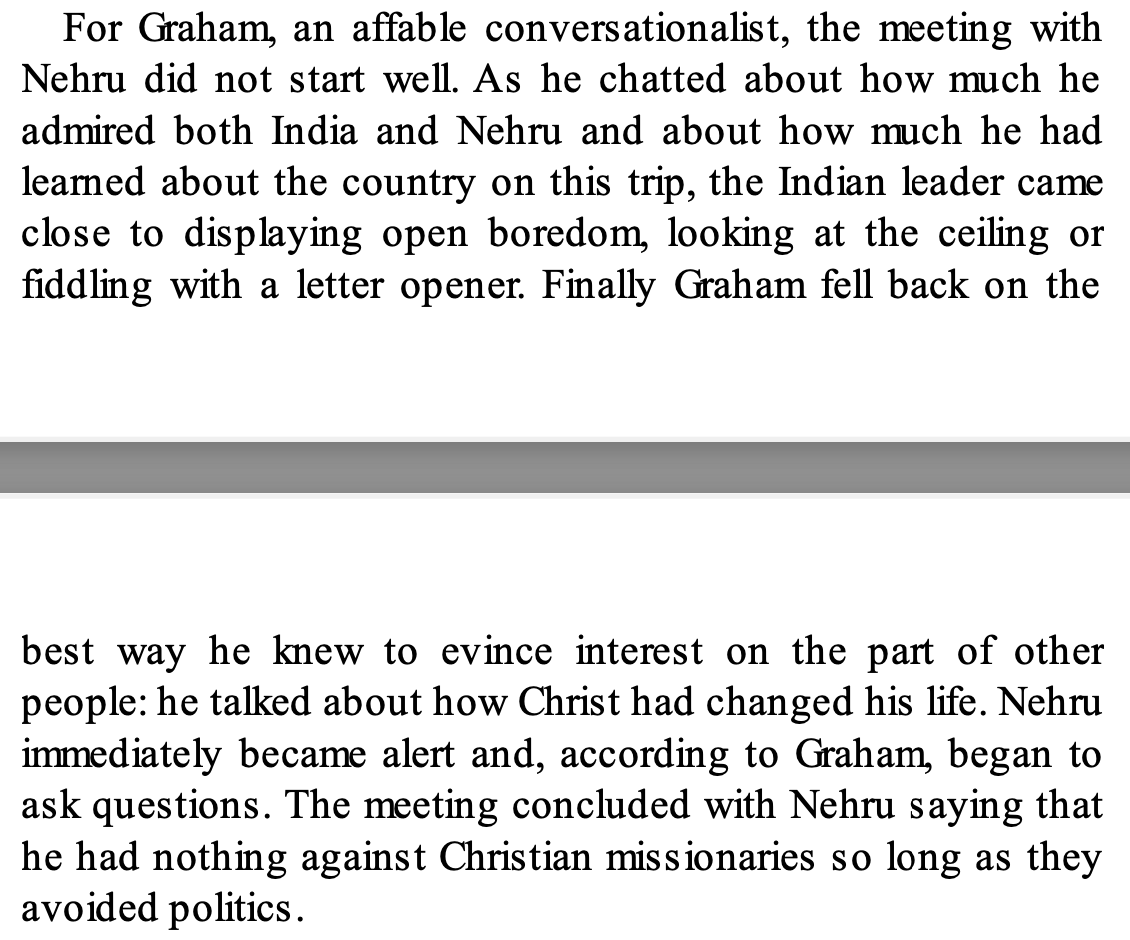
The book reveals that the US Ambassador to India John Sherman Cooper had “strongly” pushed Nehru to meet Graham. When they met, Nehru looked bored until Graham started talking about Christianity.
USAID funded World Vision converted Hindus for 70 years: How Jawaharlal Nehru and Indira Gandhi gave them a free run

In the meeting, it is said that when Billy Graham was talking to Nehru about how much he liked India, he displayed boredom and fiddled with a paper opener.

However, the situation evolved when Graham changed his strategy. Realising that Nehru was not particularly interested in talking about how much Billy Graham had learnt about India on his trip, he switched the conversation to Christianity.

“Nehru immediately became alert and, according to Graham, began to ask questions”, the book says. The book further makes a shocking revelation. Jawaharlal Nehru told Billy Graham that he had nothing against Christian missionaries so long as they avoided politics.

It is pertinent to note here that the image of Nehru, Billy Graham and Bob Pierce was ‘created on’ the George Fox University website in 1957. But, according to the records we can find, the actual meeting possibly took place in 1956. The account of the meeting finds its place in several books – one of them being the Autobiography of Billy Graham called “Just As I Am”. The book by Billy Graham does not mention Bob Pierce being present during this meeting, however, the book makes it amply clear that Graham and Pierce knew each other very well.

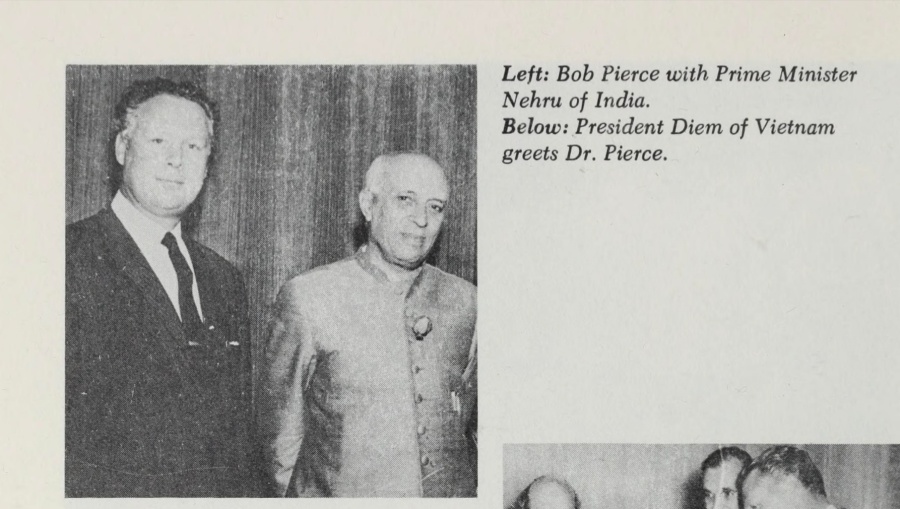
Interestingly, in the biographical book on Bob Pierce, “This One Thing I Do”, the introduction was written by Billy Graham. In that book, with a foreword by the Chaplain of the United States Senate, there is a picture of the same meeting with Jawaharlal Nehru.
USAID funded World Vision converted Hindus for 70 years: How Jawaharlal Nehru and Indira Gandhi gave them a free run

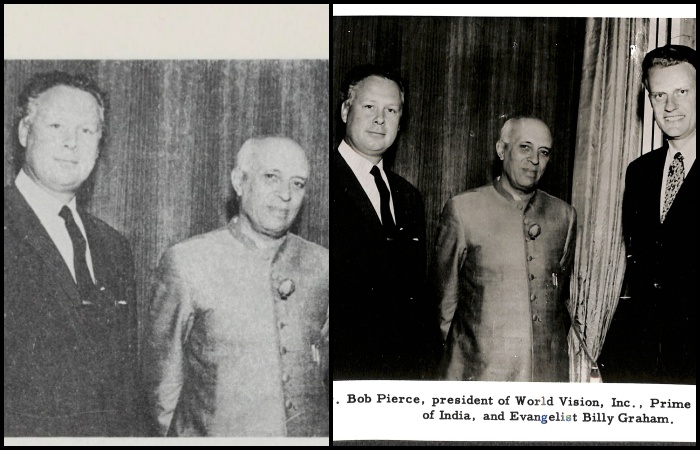
In the book itself, there is no mention of Jawaharlal Nehru or the meeting with him, along with Billy Graham. However, when one looks at the two pictures, it is evident that it is from the same meeting. It is rather strange why Billy Graham – who wrote the introduction to the book on Bob Pierce – has himself edited out of the picture.

Here are the two pictures side by side.
USAID funded World Vision converted Hindus for 70 years: How Jawaharlal Nehru and Indira Gandhi gave them a free run

From separate accounts, we also know that Bob Pierce was in India in 1956-1957 – the same time Graham was in India. It is therefore safe to assume that the meeting where Nehru told Graham that he was fine with Christian missionary activity was the one where Bob Pierce was also present. That assumption also seems accurate because this is the only meeting with Nehru mentioned by Billy Graham in his autobiography which spans over 800 pages.

Coming back to the meeting, Billy Graham in his autobiography writes this about the meeting with Nehru:
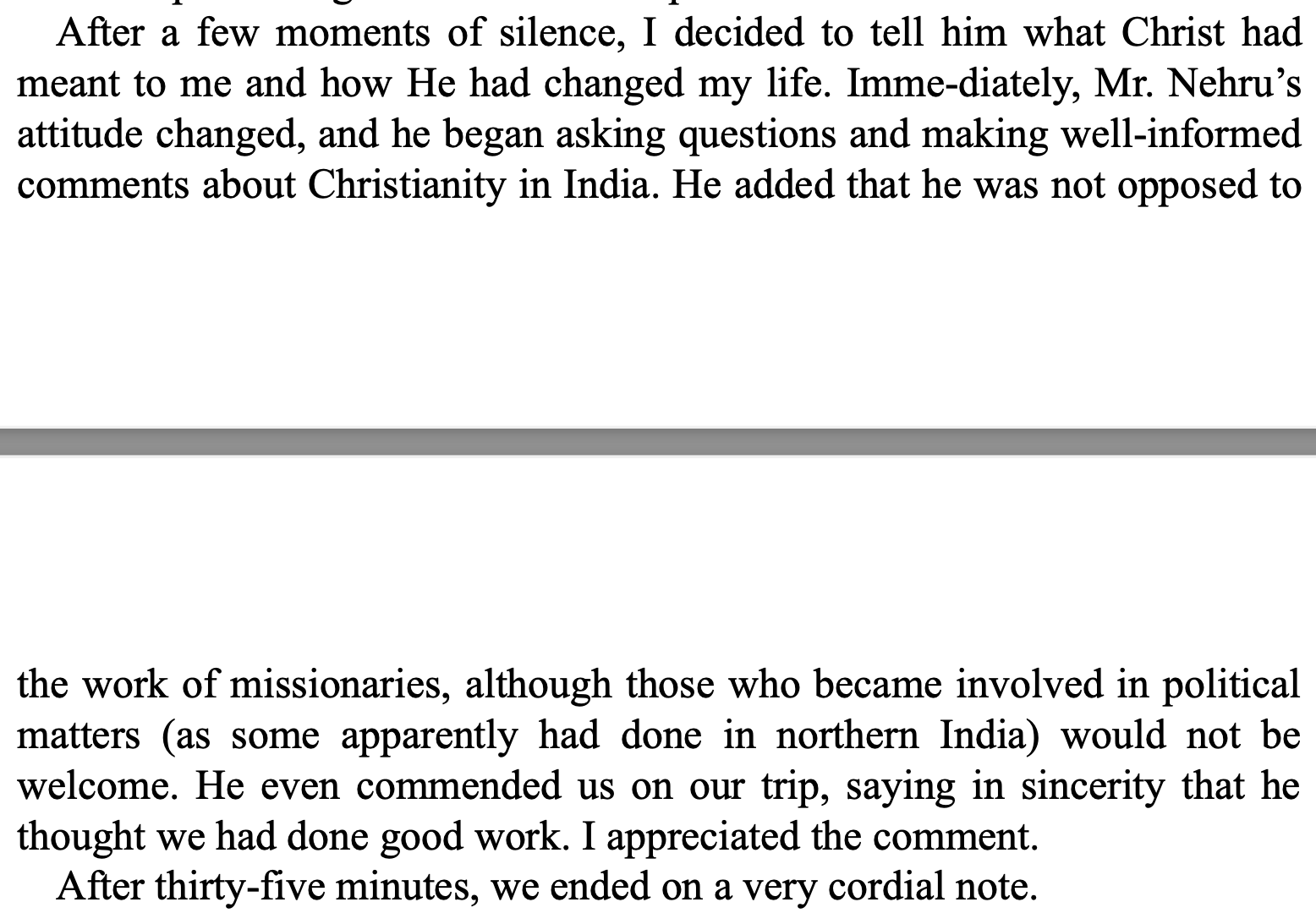
What “work” were Billy Graham and Bob Pierce doing in India, which Nehru appreciated and commended so deeply?

In the introductory para on India, Billy Graham in his book writes – “Billy Graham was cutting through India like Gabriel in a gabardine suit.” That was the way Time described me in the February 13, 1956, issue. It was nice to get some coverage in the Luce magazine, but I preferred the Associated Press wirephoto of me astride an elephant in Kottayam, looking far from angelic as I held on for dear life to the tough hide behind those huge floppy ears.

This is the tip in which Graham met Nehru, in which he appreciated his work.

The TIME magazine that Graham is titled “Religion: Billy in India” was published on 13th February 1956. An archived version of the article can be read here.

The same article in the magazine that Billy Graham talks about in his autobiography says (emphasis added):

“Many Indians seem to have the idea that Christianity is a Western religion,” he told them. “That is wrong. There were Christian churches in India before America was discovered.” And when he invited his audience to “make decisions for Christ,” they surged forward in record numbers. In three days, he spoke to more than 100,000 people, and received about 4,000 “decisions.”  In his book, Graham says that there could have been more converts but at least he made up for it by distributing 12,000 copies of the Bible.

TIME further says in the article (emphasis added):

Presiding over a gathering of 15,000 on the grounds of New Delhi’s Y.M.C.A. was an Indian Christian Princess, Rajkumari Amrit Kaur, who in 1930 renounced her father’s palace in Lucknow, became a Christian (Presbyterian), and is now India’s Minister of Health. “Billy Graham,” she said, “is one of those rare jewels who tread this earth periodically and draw, by their lives and teaching, millions of others closer to God.”

In his book. Graham writes about a conversation with the Secretary of State, John Foster Dulles.

“Billy,” John said, “you are on your way to India, a country that has no conception of God. You will need a special approach to break into people’s thinking, because they know nothing of the Bible or God. Do you have such an approach in mind?”

In essence, this would mean that Dulle was fully aware of the proselytising activity that Graham would undertake in India.

During the same trip, when Graham was in Madras, he writes of it, “I spoke to a student gathering of 7,500 out of which 250 responded to the Invitation to commit their lives to Christ. Many were from non-Christian backgrounds”.

In his writing, Graham also insults Hindus and their faith, weeping and praying for Hindus to accept Christ while standing inside a temple. He had visited Bombay and Madras before he visited Delhi to meet PM Nehru, and therefore, when Nehru appreciated and lauded the work Graham was doing and condoned his missionary work, he was also appreciating the vile, Hinduphobic practices that Graham detailed in his book.
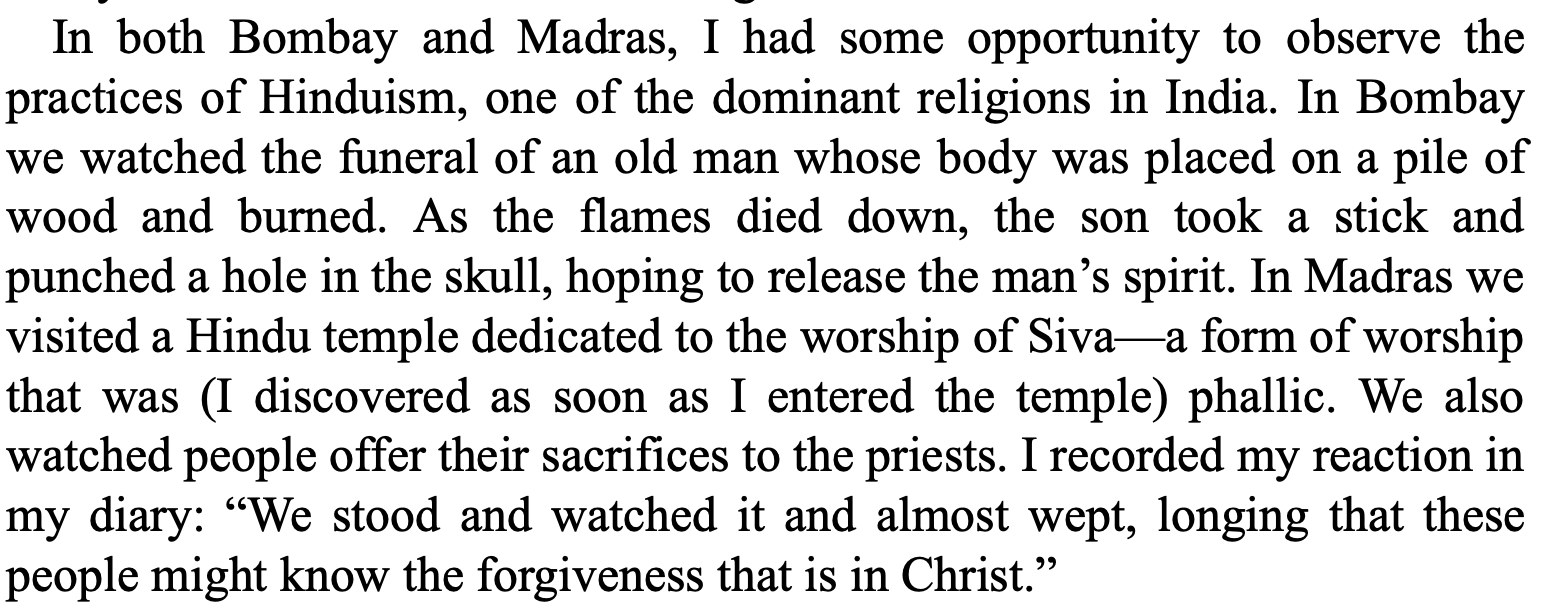
Graham explains that he stayed away from insulting Hinduism while talking to the masses in India and instead, mostly focussed on talking about Christianity. However, he does reveal that he would communicate to the people that only Jesus Christ was worthy of being worshipped, not the Hindu Gods and Goddesses.

Graham continued his evangelism in Kottayam and Palamcottah before he finally reached Delhi. In Delhi, he proselytised and converted at a gathering of thousands, introduced by Congress leader Rajkumari Amrit Kaur – the first health minister who was also a Christian. It was apparently through Kaur’s contact that Graham then met PM Nehru.

As for Bob Pierce, he was also indulging in widespread evangelism and conversion, as detailed above.

India revisited – Indira Gandhi continues the legacy of Jawaharlal Nehru

In 1972, Billy Graham returned to India. The Hindu on 24th November 1972 published a report that read as follows:

The noted American evangelist, Dr. Billy Graham, to-night expressed the hope that his visit to this country would help improve relations between India and the United States. Dr. Graham, who was talking to newsmen at the airport here on his arrival from Kohima, was asked if he was carrying any message from President Nixon for Mrs. Indira Gandhi. “I am sorry, I can’t answer that,” he replied. Dr. Graham, a close friend of Mr. Nixon, is scheduled to meet Mrs. Gandhi on Monday. Dr Graham said the Indian Government had gone out of the way in permitting him to visit Nagaland. “I am grateful for this,” he added. During his stay in the capital, he will also call on the President, Mr. V.V. Giri. Earlier, talking to newsmen at Calcutta airport, Dr Graham said he had talks with Mr Nixon twice before he left for India. “I love India and I want the United States and India to become very close friends. This is necessary because we need each other for our mutual interests,” he said.

There were certain operative parts of this short report that we must bear in mind:

  1. He said he could not tell the press the message he was carrying for Indira Gandhi from President Nixon.
  2. The Indian govt had gone “out of its way” to permit him to visit Nagaland.
  3. He wants a great relationship between the US and India.

The report by The Hindu would make it appear as though Graham was merely a Christian pastor, close to the President of the US, who was in India to improve ties and visit Nagaland. However, there was far more to the story – which The Hindu, of course, didn’t report.

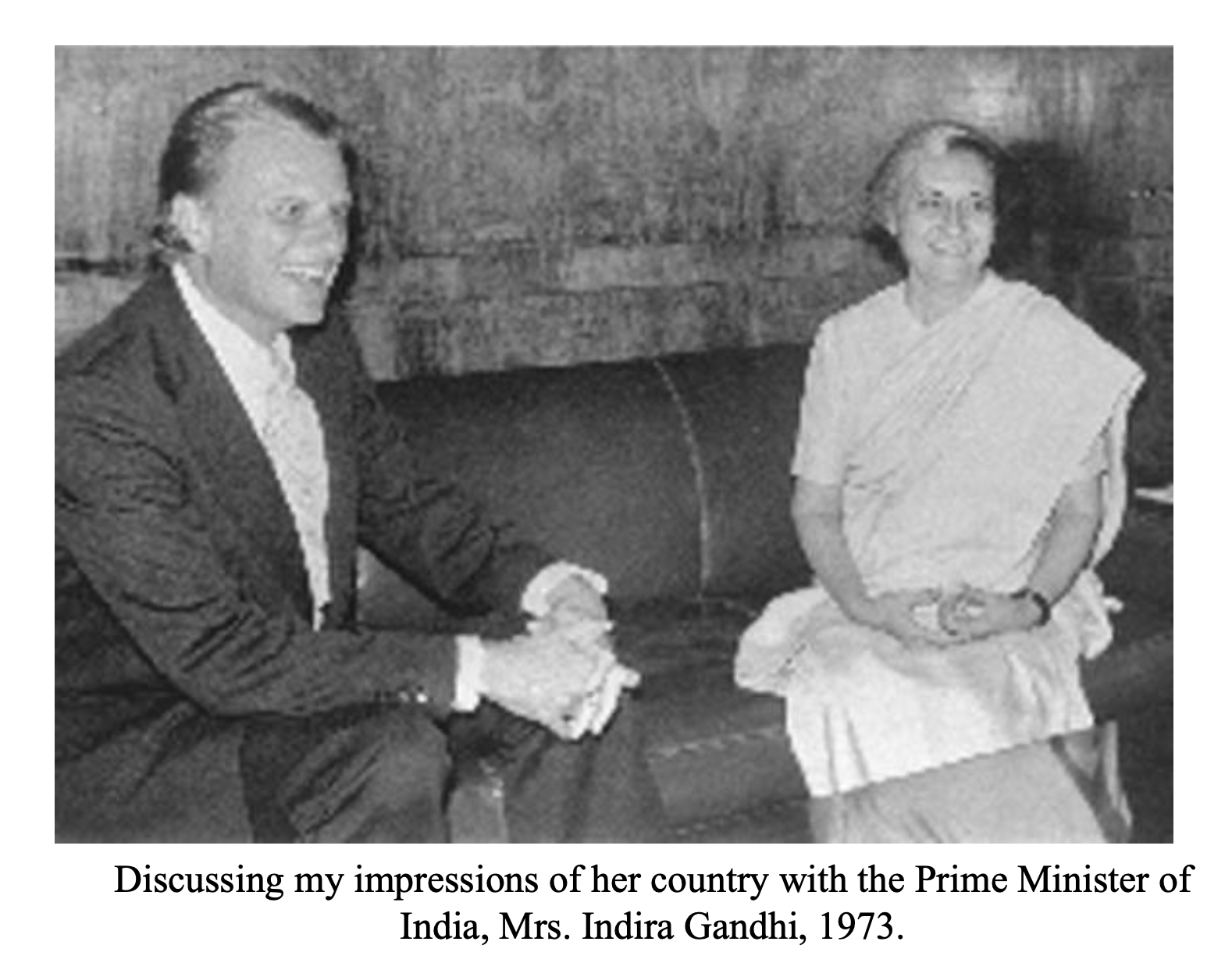
Billy Graham details his 1972 trip to India and his meeting with Indira Gandhi during that trip in his autobiography.

About his mandate to meet Indira Gandhi, Graham writes:

President Nixon, at the request of the American consul in New Delhi, had personally asked me to seek an interview with Prime Minister Indira Gandhi, in part to find out from her what kind of ambassador she wanted from America. He asked me to notice every single thing about her—the movement of her hands, the expression on her face, how her eyes looked. “When you’ve finished the interview,” he said to me, “go to the American embassy and dictate your report to me.” And so, when I visited with Mrs. Gandhi in the Indian capital, I put the question to her. She told me she wanted someone who understood economics, who had the ear of the President, and who had influence in Congress. This I reported to the President. He later appointed Daniel Patrick Moynihan. Whether my report influenced the President’s decision, I never learned.
USAID funded World Vision converted Hindus for 70 years: How Jawaharlal Nehru and Indira Gandhi gave them a free run

According to what Billy Graham wrote in his autobiography, it is evident that while Billy Graham was in India for a completely different reason, his mandate from the US government was to meet Indira Gandhi, observe her mannerisms and report back to the US. It is also evident that Billy Graham was close enough to the US dispensation to affect their decisions.

However, this mandate by the US government was essentially a pile-on. It was what the government wanted Graham to do, while he was visiting India for his real motive.

In his book, Graham makes it clear that he was visiting Nagaland for the purpose of evangelism.

Our purpose in going to India was to preach in Nagaland, an isolated area tucked in the mountainous, jungle-covered northeast corner of India near the Burmese border. The area was home to a dozen separate tribes, each with its own dialect and often with a history of headhunting“, Graham writes.

Graham writes that in late November 1972, it was almost miraculous that the Indira Gandhi government granted him a permit to visit Nagaland, since at that time, due to instability, foreigners were not getting the permission to visit the Indian state.

What becomes interesting is how Graham got the permit. He writes (emphases added):

This permission was in response to an appeal from a delegation headed by the Reverend Longri Ao and other church leaders from Nagaland. (Assisting them was a gifted young Indian clergyman named Robert Cunville, who was head of the North East India Christian Council and had been invited to be director of youth evangelism for the World Council of Churches; he later joined our Team as an evangelist and has had a wide ministry not only in India but in many other parts of the world as well.)

It becomes important here to remember what “World Council of Churches” is. In our previous report where we wrote about the USAID-funded World Vision, we investigated how World Council of Churches was a trusted partner of World Vision – the evangelical organisation which was founded by Bob Pierce.

In their own words, “The World Council of Churches is a fellowship of churches which confess the Lord Jesus Christ as God and Saviour according to the scriptures, and therefore seek to fulfil together their common calling to the glory of the one God, Father, Son and Holy Spirit. It is a community of churches on the way to visible unity in one faith and one eucharistic fellowship, expressed in worship and in common life in Christ. It seeks to advance towards this unity, as Jesus prayed for his followers, “so that the world may believe.” (John 17:21). The World Council of Churches (WCC) is the broadest and most inclusive among the many organized expressions of the modern ecumenical movement, a movement whose goal is Christian unity”.

World Council of Churches is funded by several governments across the world and also gets substantial funding from a German NGO called “Bread For The World”. Bread For The World funds and has connection to several anti-India NGO, Urban Naxals, Jihadis and nefarious elements like Harsh Mandar.

A full report on this can be read here.

Coming back to Billy Graham’s Nagaland trip, Graham writes that when he landed in Nagaland, he was received by American consul who was a good friend of Mother Teresa.

Interestingly, in another book about Bob Pierce – the founder of World Vision – the NGO was also paying money to Mother Teresa.
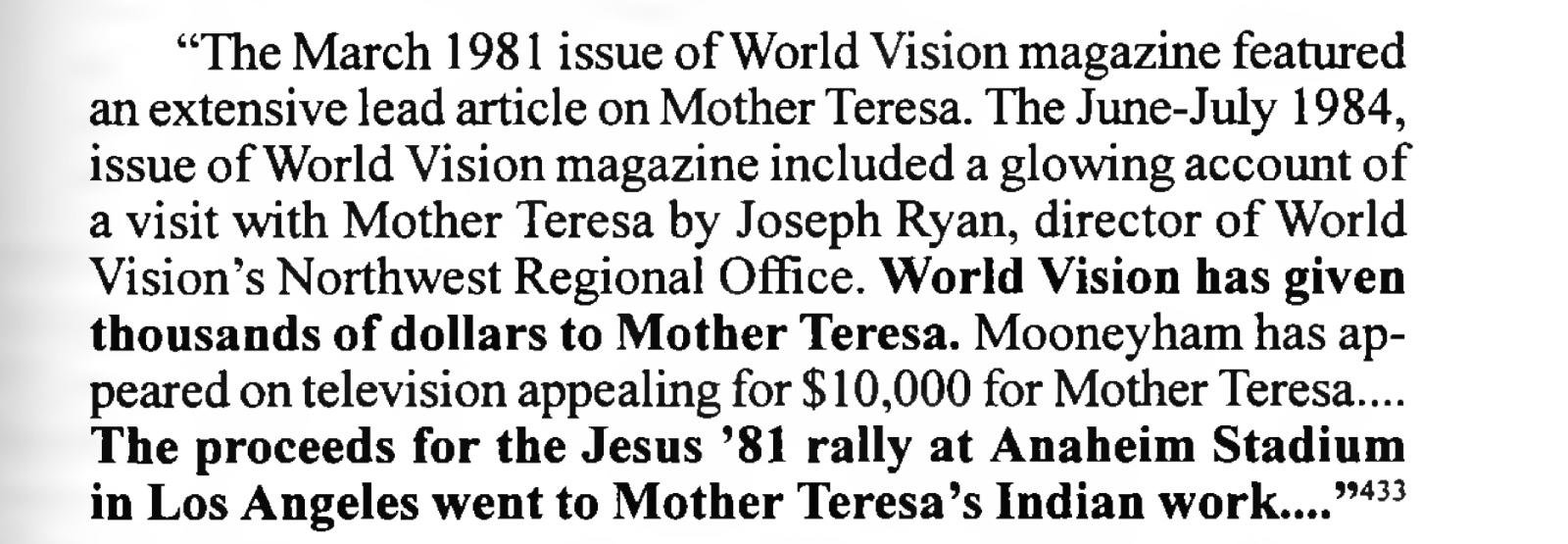
Billy Graham in his book writes that when he reached Nagaland, he started shaking hands with people when the police pulled him and made him sit in the car because they felt he was in danger. He says that he then arrived at the place to deliver the sermon to over 90,000 people. Thereafter, he was taken to the government house to stay.

“After that, we were taken to a government house to spend the night. The chief minister of the cabinet of Nagaland had arranged a dinner for us. At that dinner, the schedule for the next day was discussed”, Graham writes.

The website of Billy Graham says, “500,000 people attended Billy Graham’s Crusade from November 20-22, 1972. The crowd included many different tribes, each having their own interpreter. Mr. Graham took note of the attendees’ tribal dress, painted faces, and spears in hand as he preached from the platform, declaring God’s love for them”.

Other than the fact that the Indira Gandhi government had provided him police protection, a stay in the government house and his evangelism was entertained by the CM of Nagaland, Indira Gandhi had also arranged for helicopters for Graham and said that she would be following his trip with great interest.

“Mrs. Gandhi had told me that she would be following the trip with great personal interest and warned me of some particular dangers. She ordered two helicopters to pick us up at the conclusion of our meetings”, Graham writes.

This portion of Billy Graham’s writing reveals a few things:

  1. Indira Gandhi was keenly following Billy Graham’s tour of Nagaland.
  2. She gave him a permit to visit Nagaland when foreigners were not being granted permit due to the instability.
  3. She gave him the permission to visit Nagaland on the insistence of a priest associated with World Council of Churches.
  4. She gave Billy Graham police protection, government accommodation and private helicopters to travel.
  5. She went out of her way to ensure the evangelist Billy Graham – who was converting hundreds of thousands of non-Christians (predominantly Hindus) could visit Nagaland during instability to convert people.
  6. Billy Graham was extremely close to the US government and was carrying out their foreign policy goals when he met heads of state like Indira Gandhi – and reporting back to the US Government.

This is part 2 in the exclusive series investigating the activity of USAID funded World Vision. Part 1 can be read here.
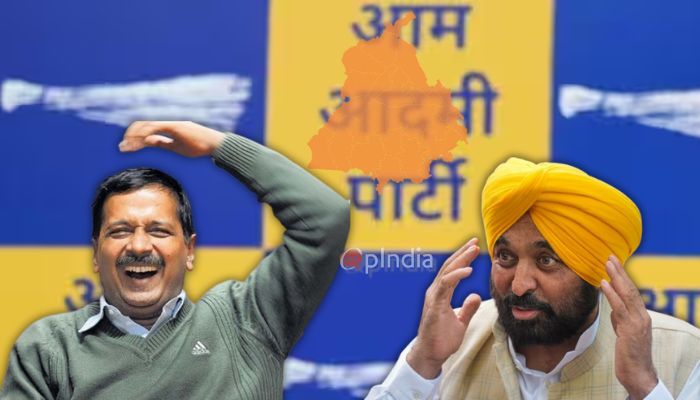
Punjab CM and AAP MLAs travel to Delhi after being summoned by Kejriwal: Is Bhagwant Mann Kejriwal’s puppet?

The crushing defeat in the Delhi assembly elections at the hands of the Bhartiya Janata Party has raised questions over the political survival of the Aam Aadmi Party. Although Delhi was AAP’s fort for over a decade the party also capitalised on the prevailing disdain for mainstream political parties in Punjab and won the state elections in 2022. While Aam Aadmi Party’s national convenor Arvind Kejriwal once said “Hum rajneeti badalne aaye hain” [we have come to change politics], his conduct and that of his party leaders showed that they are nothing but old wine in a new bottle.

For long, the opposition parties including AAP have been asserting that somehow BJP is a one-man show where the showman is Narendra Modi, suggesting that there is a lack of democracy within the party. However, the way the Aam Aadmi Party functions, it appears like unlike the BJP which has a robust intra-party democracy, Arvind Kejriwal is the “Sarve sarva” of AAP.

After the Aam Aadmi Party’s drubbing in the recent Delhi elections, Arvind Kejriwal summoned AAP-ruled Punjab’s Chief Minister Bhagwant Mann and all the 92 AAP MLAs to Delhi. Although AAP maintained that it was an “organisational meeting” and even Bhagwant Mann denied the claims by Congress that there is a rift within the Aam Aadmi Party, speculations are rife that after Delhi, AAP’s future in Punjab is also bleak.

After the Delhi debacle, all is not well for AAP in Punjab too

Recently, Punjab Congress leader and LoP Partap Singh Bajwa said that the Aam Aadmi Party might face a potential split. He said that around 30 AAP MLAs have maintained good relations with the Punjab Congress and have been in touch with the party for the past year. He also indicated that these MLAs are ready to switch sides. Besides, Bajwa also asserted that AAP Delhi and AAP Punjab are at loggerheads for seizing control of party leadership.

“Now, the AAP Delhi leadership will tighten its control on Punjab, and CM Mann will not tolerate it. A leadership battle will ensue in the AAP over controlling the government in Punjab, and this will lead to a split. AP MLAs have been in touch with me for a long time as after the Delhi debacle they know they are not coming back. The Punjab leadership is already at odds with Delhi, which is running the show in Punjab. A vertical split is on the cards,” Bajwa said and advised Bhagwant Mann to go the Eknath Shinde-way who parted ways from Uddhav Thackeray in Maharashtra citing ideological differences.

While Congress has claimed that there is a rift within AAP, the Bhartiya Janata Party (BJP) has claimed that Kejriwal is planning to sideline Bhagwant Mann and become the Chief Minister of Punjab. “It is being said that Kejriwal will declare Bhagwant Mann inefficient by highlighting that he has not fulfilled promises like Rs 1,000 each for women and controlling drug abuse. Then he will take charge himself…He is making AAP Punjab MLAs say that Kejriwal is a ‘good man’ and should be made Chief Minister instead,” BJP MLA Manjinder Singh Sirsa said.

Amidst the speculations and questions, Bhagwant Mann addressed the media on 11th February after meeting Kejriwal and gave standard answers to the questions regarding the alleged rift within the party, and ended up heaping praises on his government. “Arvind Kejriwal thanked the MLAs for their work in the Delhi elections… The Punjab government is working for the welfare of the people… Even today, the people of Delhi say that they have not seen such View ~ work in the last 75 years as the AAP has done in the last 10 years… We will use Delhi’s experience in Punjab… We will work together. Our party is known for its work… In today’s meeting, it was decided that in the coming two years, we will make Punjab a model that the whole nation will look up to… Punjab has always been forefront in all the fights…” CM Mann said even though just recently, the people of Delhi outrightly rejected the ‘Delhi model’.

It is very audacious of CM Mann to say that AAP will make Punjab a model that India would look up to, it’s been three years in power already and the AAP government has done nothing but worsen the economic crisis in Punjab. Amusingly, CM Mann said that he would replicate AAP’s ‘Delhi model’ in Punjab. Probably, he would want to look into whether there is a scope for replicating a Delhi-like liquor scam in Punjab. Interestingly, AAP Punjab has already replicated AAP Delhi’s “work-less-advertise-more” model. Besides, much like Kejriwal, for the Bhagwant Mann government as well self-care takes precedence over public welfare. It was reported last month that the AAP government in Punjab bought luxury cars for its ministers and security using taxpayers’ money that too at a time when the state’s coffers are almost dried up.

Notably, Punjab has been facing financial crises in the recent past. The RBI data indicated that Punjab’s debt-GSDP ratio and per capita debt are the highest in the country compared to other states. Punjab’s debt-to-GDP (%) in FY 2024-25 (budget estimate) has been reported to be 44.1% while the fiscal deficit 3.8%. While the state’s financial condition is worsening, the AAP government has been prioritising “image management” more than economy management. In March 2024, it was reported that the AAP government spent Rs 7 crore in the Ludhiana district alone on promotions.

While the state’s outstanding debt stands at Rs 3,43,626 crores, as of November 2024, and is likely to increase by Rs 4,50,000 crore by the end of the AAP government’s term in 2026-27, the Bhagwant Mann government has been squandering taxpayers’ money on advertisement polishing its own image and distributing freebies at the cost of drying up state exchequer. 

In addition to the economic crisis, Punjab also grapples with deteriorating law and order, drug menace, corruption and misgovernance, among others.

Much like in Delhi, the Aam Aadmi Party in Punjab also attracted voters through freebies and populist schemes without considering what its obvious impact would be on the state exchequer. On one hand, free electricity and other such schemes and dried up Punjab’s exchequer, on the other, the AAP government has failed to fulfil many of its poll promises including the one of giving Rs 1000 to women above the age of 18 per month. The situation is such that the Punjab and Haryana High Court recently slammed the Punjab government over the lack of basic facilities in Forensic Labs and its excuse of lack of funds while it spends huge amounts on advertisements and buying luxury cars.

While the AAP government’s pandering to Khalistani elements and allowing Khalistani separatists like Amritpal Singh among others to gain ground in Punjab under their watch might win them support from the secessionists, the people of Punjab might give a shocker to AAP in the coming assembly elections. If this happens, AAP’s ambitions to expand its tentacles across the nation would be reduced to a pipe dream and might also end Kejriwal’s political career. Probably, this fear has prompted Arvind Kejriwal who lost his New Delhi assembly seat, to assert his control over the party leadership.

Contrary to the expectations that AAP Punjab would ditch the usual poll plank of replicating the Delhi model in Punjab given the fact that in Delhi, AAP turned out to be everything it claimed to fight and in Punjab, the replication of the same model has made the people of Punjab understand that AAP is no different from traditional political outfits, Bhagwant Mann continues to boast Delhi model as some sort of success despite it being a monumental failure.

With a prevailing public resentment for the ruling Aam Aadmi Party in Punjab and the people punishing AAP in Delhi, there is scope for the BJP and Congress to regain the lost public support and trust. The last Lok Sabha election results wherein AAP won only 3 out of 13 seats indicate the mood of the people of Punjab which evidently is not in favour of AAP.

Who is ruling Punjab? Bhagwant Mann or Arvind Kejriwal?

There have been various occasions when Punjab CM Bhagwant Mann and his MLAs have rushed to Delhi on one summon by Arvind Kejriwal for what the party often described as ‘organisational meetings’. The question arises as to who is calling the shots, or rather making the calls in Punjab, the elected CM or the puppeteer from Delhi. It seems like Kejriwal has more influence over Punjab’s governance than Bhagwant Mann does. In fact, there have been allegations that the Bhagwant Mann-led government in Punjab is like a remote-controlled car. For Kejriwal, Punjab seems more to be an extension of his political playground than a state with its own issues. Not to forget, in 2023, Kejriwal used Punjab’s state aircraft for his election campaigns, the cost of which was borne by the Punjab government.

Back in 2022, BJP’s Manjinder Singh Sirsa, former Punjab CM Captain Amarinder Singh and others, accused Delhi Chief Minister Arvind Kejriwal of holding a meeting with Punjab bureaucrats in CM Bhagwant Mann’s absence on Monday. Ex-CM Singh called CM Mann a ‘rubber stamp’ and said the worst that was feared had happened. Questions were raised about in what capacity the then Delhi CM held meetings with Punjab bureaucrats by bypassing the Punjab CM. Congress, BJP and other opposition parties had back then called Kejriwal’s conduct a breach of federalism and a violation of constitution.

In 2022, the AAP governments in Punjab and Delhi signed a ‘Knowledge-sharing agreement’ empowering them to send and receive ministers, officials and other personnel to exchange knowledge. While Kejriwal called this an ‘experiment’, it apparently was an agreement to shift power from Punjab to New Delhi, to Kejriwal’s Sheeshmahal to be specific. It was criticised by the opposition as an “ undemocratic institutionalised interference”.

Alongside asserting his direct control over the AAP government in Punjab, Kejriwal has also installed his loyalists like Bibhav Kumar in the Mann administration, apparently to facilitate his functioning as Punjab’s “super CM”. Bibhav Kumar, a close aide of Kejriwal who also faces allegations of violence against MP Swati Maliwal was appointed as CM Mann’s Chief Advisor last year. He was granted Z+ security recently to sparked sharp criticism.

In October 2024, Kejriwal summoned Punjab cabinet ministers to Delhi to ‘review’ their performance. The same day, two CMO officials, directors of communication Baltej Singh Pannu and Manpreet Kaur were removed and some fresh appointments were also made. While a party leadership ensuring that its leaders in constitutional positions are doing their job efficiently is not wrong, however, Punjab government officials being removed and appointed alongside the cabinet reshuffle at the whims of the top leader of the ruling party in Delhi indicates that Punjab’s autonomy is more a decorative concept than a reality.

Other than meetings dubbed as ‘organisational’, Bhagwant Mann has also visited Kejriwal to discuss the implementation of policies in Punjab. Apparently, Kejriwal has been functioning as the de facto Chief Minister of Punjab so far and with power slipping out of his hands in Delhi, the AAP leader might consider contesting the vacant Ludhiana seat and formally entering the Punjab government. Given the fact that Kejriwal is the only AAP leader with a mass appeal, and Atishi may have won her seat and been a “temporary CM” as Kejriwal himself called her once, lacks mass appeal. In such a situation, Bhagwant Mann might emerge as the face of AAP, which may or may not be good for the party but will definitely be detrimental to Kejriwal’s political career.

Perhaps, the meeting of AAP Punjab leaders with the party leadership in Delhi was Kejriwal’s way of subtle messaging that Delhi may have routed him, but he still is the undisputed supreme leader within the party and that Bhagwant Mann is only a branch manager, not the CEO.

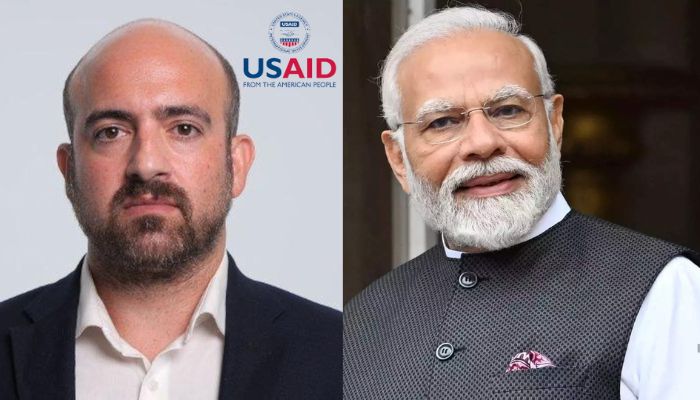
When former US diplomat exposed how USAID attempted to tarnish PM Modi’s image before 2019 Lok Sabha election

The United States Agency for International Development (USAID) has been involved in tarnishing the image of Prime Minister Narendra Modi along with the US State Department in the run-up to the 2019 Lok Sabha election.

The revelations were made by former senior diplomat Mike Benz in an interview with The Sunday Guardian in February 2023. He stated that besides the US agencies, influential think tanks and social media giants were involved in this campaign against PM Modi.

Mike Benz revealed, “If you are talking about US tech platforms interfering with the free flow of political information in India, that started before my time at the State Department. In late 2018/early 2019, the US-UK foreign policy establishment began a campaign to paint Modi’s political success as being the result of ‘misinformation’ online.

He further added, “When the US foreign policy establishment says a foreign country has a “misinformation crisis,” that is a cue to US tech companies to work with entities like the State Department’s Global Engagement Center or cut-out think tanks like the Atlantic Council’s Digital Forensics Research Lab or counter-misinformation USAID fundees to censor the “misinformation” in that foreign country.”

Mike Benz revealed that the US deep State censored WhatsApp and other chat apps that were used to spread pro-Modi messages.

The US foreign policy establishment leaned on Facebook, which owns WhatsApp, very heavily to limit the amount of WhatsApp messages that could be shared, which would therefore limit the amount of pro-Modi content that could circulate in India (Modi supporters disproportionately shared content on WhatsApp),” he pointed out.

He further highlighted, “When I was at the State Department, I saw all these same think tanks like the “Atlantic Council” were inundating me and my policy peers with recommendations to promote censoring “misinformation” abroad in so-called “nationalist” or “authoritarian” governments. Modi’s name was always circulated in lists that hit my inbox of places where US tech companies should be more aggressively engaged in “content moderation” (meaning censorship)“.

He told The Sunday Guardian to look up ‘counter-misinformation companies’ that propped up in India ahead of the 2019 election through the funding of USAID and US State Department.

The State Department keeps close tabs on social media influence of political parties and when they are hostile to a foreign leader, they tend to let US tech companies know early and often,” Mike Benz added.

USAID spent ₹1.6 crores to recruit ‘fact-checker’ in India

In July last year, OpIndia reported how the Public Diplomacy Section (PDS) of the US State Department set aside a whopping $2,00,000 (~₹1.67 crores) to recruit fact-checkers in India as part of its ‘Empowering Media Savvy Youth.’

The US State Department is implementing the project starting 1st September this year in 5 cities of India – Kolkata, Hyderabad, Chennai, Mumbai and Delhi.

This scheme of hiring ‘fact-checkers’ to promote its narrative in India has been shrewdly called a ‘targeted digital literacy and resilience program.’

In India, where social media usage is widespread among the youth population, recent research by Indian, European, and American think tanks has highlighted how manipulative content is amplifying societal polarization and erodes institutional trust. This consequently strains U.S.-India bilateral relations, threatening collaborative efforts and diplomatic ties,” the US State Department made its agenda crystal clear.

Coincidentally, USAID is now taken over by the same US State Department.

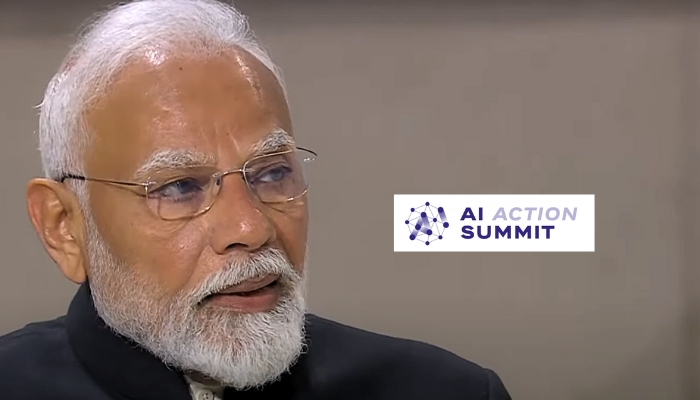
AI Action Summit: PM Modi emphasises AI can be used to enhance human potential, says work does not disappear due to technology

On Tuesday, 11th February, Prime Minister Narendra Modi addressed the AI Action Summit in Paris, where he emphasised that artificial intelligence should be used to enhance human potential rather than replace human labour. In his address, he stressed the importance of responsible AI governance and highlighted both the opportunities and challenges posed by the rapid expansion of artificial intelligence. US Vice President J.D. Vance echoed PM Modi’s views, stating that AI “will never replace human beings.”

AI as a tool for progress, not a threat

PM Modi co-chaired the summit alongside French President Emmanuel Macron. In his address, he underscored how AI is already transforming governance, economies, and societies. However, he cautioned against the risks associated with the technology, particularly its inherent biases, rapid proliferation, and high energy demands.

Prime Minister Narendra Modi pointed out that while AI has the potential to revolutionise sectors such as healthcare, education, and agriculture, it must be developed with a sense of responsibility. He said, “AI is writing the code for humanity in this century.”

PM Modi stated that while technological advancements in the past evolved gradually, AI is progressing at an unprecedented pace. Such rapid growth necessitates global cooperation to establish governance frameworks that uphold shared values, mitigate risks, and foster trust.

He also addressed concerns over the impact of AI on jobs. He dismissed fears of widespread job losses and argued that history has shown that technology reshapes work rather than eliminating it entirely. He said, “Loss of jobs is AI’s most feared disruption. But history has shown that work does not disappear due to technology. Its nature changes, and new types of jobs are created. We need to invest in skilling and re-skilling our people for an AI-driven future.”

The need for responsible AI governance

PM Modi called for AI governance that is not merely about mitigating risks but also about promoting innovation and making AI accessible to all, particularly in the Global South. In his address, PM Modi highlighted India’s leadership in AI adoption and the efforts it has made to build a digital public infrastructure that benefits over 1.4 billion people.

He noted that India has developed one of the world’s largest AI talent pools and is working on its own Large Language Model to cater to the nation’s diverse linguistic landscape. “India is ready to share its experience and expertise to ensure that the AI future is for good and for all,” he stated as he outlined India’s commitment to ethical AI development.

He also emphasised the environmental impact of AI, pointing out its high energy consumption. “AI’s high energy intensity needs to be looked into. This will require green power to fuel its future.”

Vance backs Modi’s stance on AI

Following Modi’s address, US Vice President JD Vance expressed agreement with the Indian prime minister’s position, stating that AI should be seen as a tool to enhance productivity rather than as a replacement for human labour.

“I appreciate Prime Minister Modi’s point. AI, I really believe, will facilitate and make people more productive. It is not going to replace human beings. It will never replace human beings,” Vance stated, criticising industry leaders who suggest otherwise.

The AI Action Summit was attended by global leaders, industry experts, and policymakers. The focus of the summit was on AI governance, accessibility, and responsible innovation. The event is being seen as a significant step towards establishing a consensus among international entities on harnessing AI for global good while evaluating and mitigating potential risks associated with it.

PM Modi and US Vice President JD Vance together at Paris AI Action Summit

0

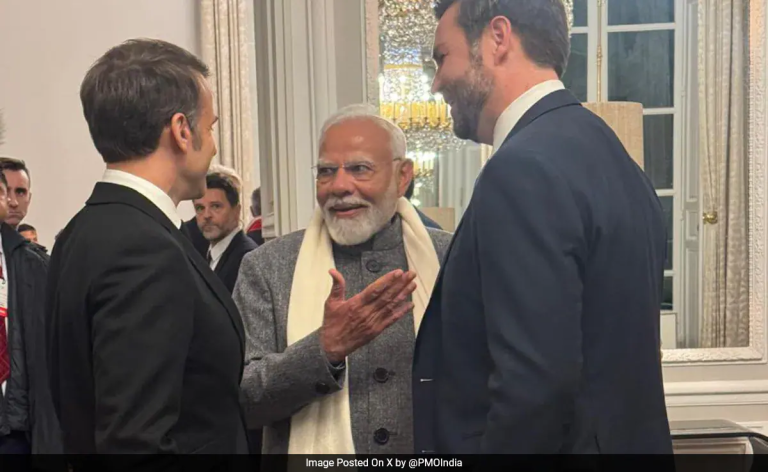
Prime Minister Narendra Modi and US vice president JD Vance who engaged in a brief informal interaction a day ago on the sidelines of the dinner for world leaders attending the AI Summit in Paris, were seen seated side-by-side on Tuesday as they listened to French President Emmanuel Macron talk about the future of Artificial Intelligence.

PM Modi is scheduled to head to Washington following his two-day visit to France, Earlier, the French president greeted the two leaders and expressed his enthusiasm for the AI Action Summit.

Sharing a post on X, Macron wrote, “Welcome to Paris, my friend @NarendraModi! Nice to meet you dear @VP Vance! Welcome to all our partners for the AI Action Summit. Let’s get to work!”

The X handle of PMO had shared pictures of PM Modi interacting with Marcron and Vance in Paris.

After a warm welcome from the members of the Indian diaspora too, both PM Modi and VC Vance attended a dinner for world leaders at Elysee Palace in the French capital.

Macron received Modi upon his arrival, and the two leaders shared a candid moment before heading into discussions.

Their meeting highlights the strong ties between India and France, with key issues expected to be on the agenda. Expressing his enthusiasm for the visit, PM Modi posted on X, “Delighted to meet my friend, President Macron in Paris.”

During his address at the summit, which he co-chaired with Macron, PM Modi said that AI can help transform millions of lives by improving health, agriculture, education etc, stating that AI can help create a world in which the journey to Sustainable Development Goals (SDGs) becomes “easier and faster” the Prime Minister called on the world to pull together resources and talent for AI.

“AI can help transform millions of lives by improving health, education, agriculture and so much more. It can help create a world in which the journey to sustainable development goals becomes easier and faster. To do this, we must pull together resources and talent. We must develop open-source systems that enhance trust and transparency,” the PM added.

Expressing gratitude to French President Emmanuel Macron for hosting the AI Action Summit and inviting him to co-chair the summit. He said that AI is developing at an “unprecedented scale and speed” and being adapted and developed even faster.

PM Modi is visiting the US at the invitation of President Donald Trump. His visit aims to further strengthen India’s global partnerships, with a particular focus on technology, defence, and economic cooperation

PM Modi highlights threat of deepfakes and disinformation, urges to democratize AI technology

0

 Prime Minister Narendra Modi on Tuesday highlighted the potential risk of Artificial Intelligence such as deepfakes and disinformation and urged world leaders to democratise the technology and re-skilling the people.

Addressing the AI Summit in Paris on Tuesday, PM Modi emphasised that the technology must be rooted in local ecosystem and should enhance trust and transparency making them more people-centric to tackle the concerns related to cyber security.

“We must develop open source systems that enhance trust and transparency. We must build quality data centres free from biases, we must democratize technology and create people centre applications. We must address concerns related to cyber security, disinformation and deepfakes. We must also ensure that technology is rooted in local ecosystems for it to be effective and useful.” PM Modi said.

The Prime Minister noted the threat of unemployment due to AI and urged that skilling and re-skilling of people is needed to tackle such issues.

“Loss of jobs is AI’s most feared disruption, but history has shown that work does not disappear due to technology, only its nature changes. We need to invest in skilling and re-skilling our people for an AI-driven future,” PM Modi said.

Moreover, the Prime Minister pitched to ensure access of AI to everyone noting that it can transform millions of lives and improve sectors like health, education and agriculture.

Noting India’s success in building digital public infrastructure, PM Modi said that the country leads in AI adoption and techno-legal solutions on data privacy.

“India has successfully built a digital public infrastructure for over 1.4 billion people at a very low cost. It is built around an open and accessible network. It has regulations and a wide range of applications to modernise our economy, reform governance and transform the lives of our people…Today, India leads in AI adoption and techno-legal solutions on data privacy…We have one of the world’s largest AI talent pools.”

PM Modi is co-chairing AI Summit in Paris along with French President Emmanuel Macron. PM Modi is on the visit to France till February 12. He will also visit the International Thermonuclear Experimental Reactor (ITER) project, a significant international collaboration in nuclear fusion research. In a tribute to historical ties, the Prime Minister will also visit the Mazargues War Cemetery to honour Indian soldiers who sacrificed their lives in the World Wars.

Following his visit to France, PM Modi will travel to the United States for a two-day visit at the invitation of US President Donald Trump.

(This news report is published from a syndicated feed. Except for the headline, the content has not been written or edited by OpIndia staff)

US Congressmen question Adani indictment under Biden Administration, warn it will strain ties with India

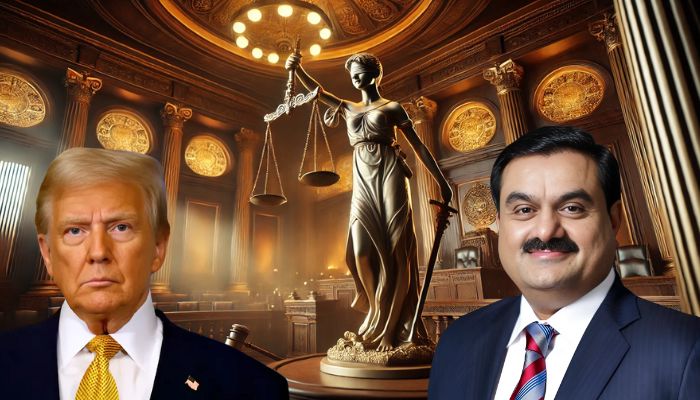
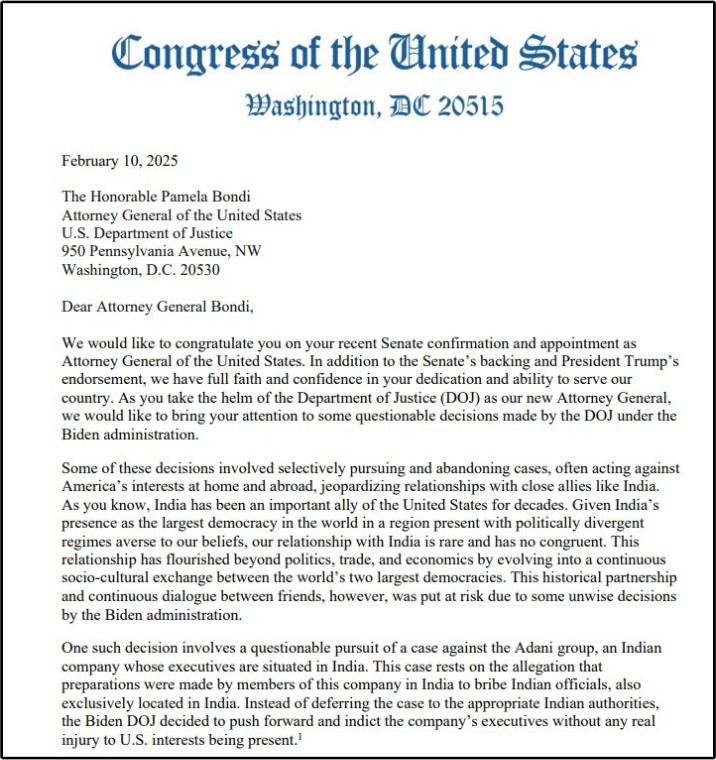
On 10th February, six US Congressmen wrote to newly appointed Attorney General Pamela Bedi, questioning the Department of Justice’s (DoJ) indictment of the Adani Group in an alleged bribery scandal. The lawmakers raised concerns over what they described as “questionable decisions” by the Biden administration and warned that such moves could strain relations with a key ally like India.

Excerpt of letter witten to Attorney General by US lawmakers

The letter, accessed by OpIndia, was signed by Lance Gooden, Pat Fallon, Mike Haridopolos, Brandon Gill, William R. Timmons, and Brian Babin. The Congressmen urged the Attorney General to reconsider the indictment and argued that it lacked clear US interests, risking damage to diplomatic and economic ties between the two countries.

Allegations against Adani Group

Notably, US prosecutors have accused Indian billionaire Gautam Adani’s conglomerate of being involved in a scheme to pay over $250 million (around ₹2,100 crores) in bribes to Indian officials in exchange for favourable terms in solar power contracts. They claimed that the information about the kickbacks was concealed from American banks and investors who provided funds for the project. However, the allegations were strongly denied by the Adani Group, maintaining that there was no wrongdoing on its part.

‘No compelling US interest in the case’

In the letter, the Congressmen expressed concerns that the case against Adani is based on allegations of activities that took place entirely in India, involving Indian officials and executives of an Indian company. They questioned the motive behind the Biden administration’s decision to indict Adani executives rather than defer the matter to the Indian authorities.

The Congressmen wrote, “There is no compelling reason to pursue a case in a manner that could complicate relations with an ally like India unless some external factors were at play.” They further accused the administration of selectively targeting cases, stating that such actions “often act against America’s interests at home and abroad.”

Warning of diplomatic fallout

In their letter, the Congressmen stressed that India has been a crucial partner to the US for decades. The ties between the two countries extend beyond politics and trade to a broader socio-cultural relationship. They warned that such politically motivated decisions by agencies influenced by left-wing megadonors could undermine diplomatic efforts that have been in place for years.

They pointed out that this case emerged just ahead of Donald Trump’s return to the White House, suggesting that the indictment could have broader political motivations. The letter stated, “This misguided crusade came at the risk of harming our relationship with a strategic geopolitical partner like India immediately preceding President Trump’s return to the Oval Office.”

The letter added, “America and India share a deep sense of mutual respect and appreciation—a sentiment reflected in the strong diplomatic ties between the two nations. Former President Donald Trump and Prime Minister Narendra Modi have consistently recognised the immense potential of a robust economic and military partnership between the United States and India. Trump actively worked with the Modi government to strengthen bilateral relations, fostering a strategic alliance that extends beyond trade and politics. In response, Modi has positioned India as a key ally of the US, particularly in countering the rising influence of China in the Asia-Pacific region. However, politically motivated decisions by agencies influenced by left-wing megadonors threaten to undermine years of diplomatic efforts. Any deterioration in US-India relations not only weakens a longstanding partnership but also plays into the hands of adversaries like China, which seeks to challenge the American economy and expand its global influence through initiatives like the Belt and Road Initiative (BRI).”

Caution against benefiting China

The lawmakers cautioned that any fallout in US-India relations would directly benefit adversaries like China, as India has a crucial role in countering China’s influence in the Asia-Pacific region. They specifically mentioned Beijing’s Belt and Road Initiative (BRI) and argued that undermining relations with India could aid China’s efforts to dominate global trade and economic control.

They further argued that discouraging investors who have contributed billions to the US economy would hurt America’s long-term economic prospects. The lawmakers wrote, “Needless pursuits against those who have created thousands of jobs deter and discourage investors from contributing to the US economy.”

Call for investigation into Biden administration’s motives

While concluding the letter, the Congressmen demanded an investigation into the Department of Justice’s actions and called for transparency regarding the motivations behind the indictment. They requested the Attorney General to share all records related to the case, suggesting that it could expose whether the previous administration had been compromised by outside entities over the past four years.

They wrote, “We request you investigate the Biden DOJ’s conduct and would appreciate you sharing with us all records pertaining to this case, for a coordinated effort in uncovering the truth.”

The letter is a clear indication that there is growing discontent among sections of US lawmakers over the Biden administration’s approach to handling relations with India. Some lawmakers view the Adani indictment as a politically charged move rather than a matter of legal necessity.

Case against Adani Group

In November 2024, a US court unsealed a five-count indictment against Adani Group Chairman Gautam Adani and others, alleging bribery and fraud. Prosecutors claim Adani, Sagar R Adani, and Vneet S Jaain misled investors while securing funds, and former executives of a renewable-energy firm conspired to violate anti-corruption laws. The indictment also accuses them of obstructing FBI, DOJ, and SEC investigations. US Attorney Breon Peace alleged they undermined global financial markets. The defendants remain presumed innocent. The accusations were denied by the Adani Group.

The charges were presented against them by Breon Stacey Peace, who was the 48th United States Attorney for the Eastern District of New York. Following the accusations, it came to light that Breon Peace had a connection to George Soros, hinting at a larger conspiracy to yet again damage the Indian industrialist’s reputation and business. OpIndia’s detailed report on it can be checked here.

With inputs from agencies.

Mahakumbh: Allahabad High Court dismisses plea against loudspeakers during the historic event

0

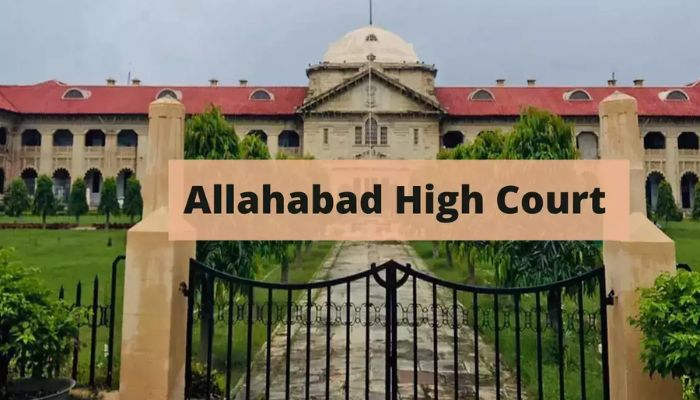
On Monday (February 10), the Allahabad High Court rejected a petition against the installation of loudspeakers in Mahakumbh. During the hearing, the High Court noted that there is no sufficient data to suggest that the public address system was causing noise above permissible limits.

The petition was filed by Brahmachari Dayanand Indian Inhabitant, who although are resident of Uttarakhand, however, claimed to be camping at Sector 18 at Mukti Marg in Prayagraj. The petitioners argued that other camps, which have been set up around the camp of the petitioners, are using public address systems and LCDs wherein, they are creating noise pollution and affecting the meditation etc. of the petitioners. Due to this, the petitioners demanded that the use of public address systems/loudspeakers and other noise-polluting devices and amplifiers be limited.

The court, however, noted that “except producing a few pictures of the loudspeakers, which apparently have been placed for announcements etc. and are also situated at the temporary roads created for the Kumbh Mela, the petitioners have not produced any material worth the name so as to indicate the nature of noise being created by the said public address systems and that the same are beyond the permissible limit in terms of relevant Act and the Rules.”

The bench comprising Justices Kshitij Shailendra and Arun Bhansali,while dismissing the petition, observed that the filing of the petition is based on an academic exercise undertaken based on the judgments of the Hon’ble Supreme Court and producing a few pictures of loudspeakers.

“Such a laconic petition cannot be countenanced. In view thereof, the petition is dismissed,” the court said.

Deeply religious and a devoted Krishna bhakt: Tablighi Jamaat connection? Attacked for his religious identity? What we know so far about the Kharghar murder case

In the latest development in the brutal murder case of the Hindu man Shivkumar Sharma in Kharghar, the police have nabbed one of the two accused Rehan Shaikh while the other, identified as Faizan Shaikh is still absconding. Both accused are residents of Nagpada and Agripada respectively. They were traced to BKC wherein the police managed to nab Rehan and Faizan managed to give a skip. As per reports, both the accused worked as delivery boys. The arrested accused Rehan Shaikh was the pilion rider and Faizan Shaikh who hit Shivkumar Sharma, is still at large.

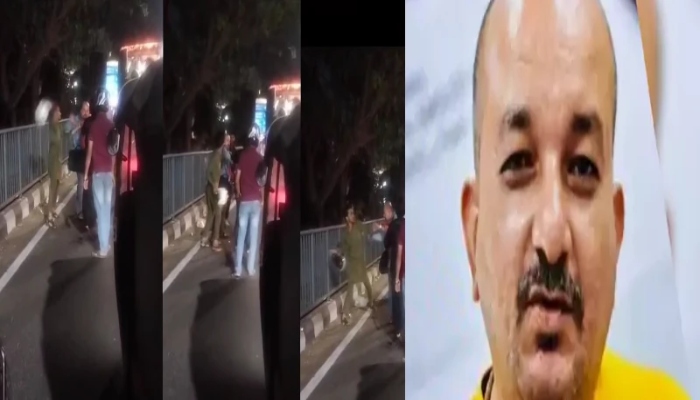
On February 2nd, the city of Mumbai in the state of Maharashtra was blown up after it witnessed the gruesome murder of an IT professional named Shivkumar Sharma. The two accused- Rehan Shaikh and Faizan Shaikh, both in their 20s, stopped the victim’s bike in the middle of the streets of Kharghar and bashed the head of Sharma with his helmet, eventually resulting in his death.

According to media reports, the incident is that of road rage where an altercation over an over-taking led to Sharma’s brutal murder. However, Vishwa Hindu Parishad alleged that Sharma was attacked for his Hindu identity.

It is being said that the two individuals who hit Sharma (45) to death on Sunday, 2nd February in Utsav Chowk were returning from the religious event of the Tablighi Jamaat called Ijtema and that they were associated with the Tablighi Jamaat.

Ijtema, a mass annual gathering of the Tablighi Jamaat, was organised as a three-day event in Kharghar. February 2nd, when the brutal murder happened was the last day of the event. Lakhs of Muslims had participated in the event.

Notably, Tablighi Jamaat was banned by Saudi Arabia in 2021, which called the Islamic organisation the ‘gate to terror’.

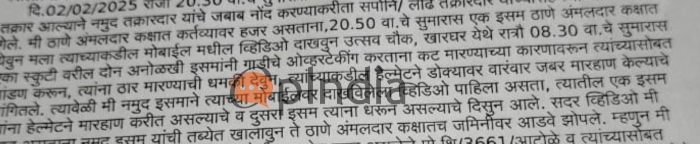
OpIndia managed to access an FIR copy of the incident, in which it has been mentioned that the unidentified accused persons argued with the victim over the bike overtaking issue amid the Mumbai traffic. As a result of this, the accused persons threatened the victim to death and within a few minutes grabbed his helmet and banged on his head several times.

Despite the injuries, Shivkumar went to the police station to file a complaint against the assailants. He collapsed there due to internal head injuries and was declared dead when police rushed him to the hospital.

The accused persons have been booked under section 103(1), 351(3), and 3(5) of the BNS Act, 2023. The Mumbai police have also accessed the CCTV footage of the incident and gathered photographs of the persons accused who are absconding at present. The authorities are making all the efforts to identify and nab the accused persons. The police are also trying to get the specific details of the blurred images of their vehicle’s registration number which can help the authorities in tracing the details of the accused persons.

Lord Shiva tattoo, Rudraksha mala: VHP says Shivkumar Sharma targeted for donning his Hindu identity

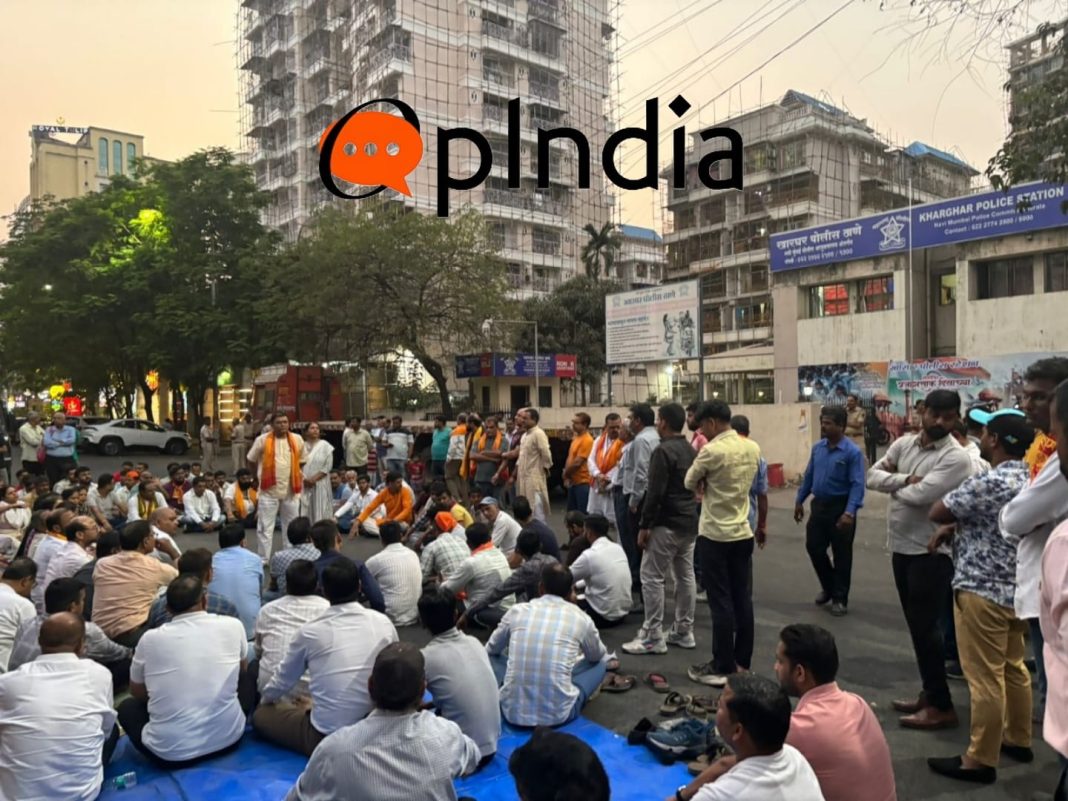
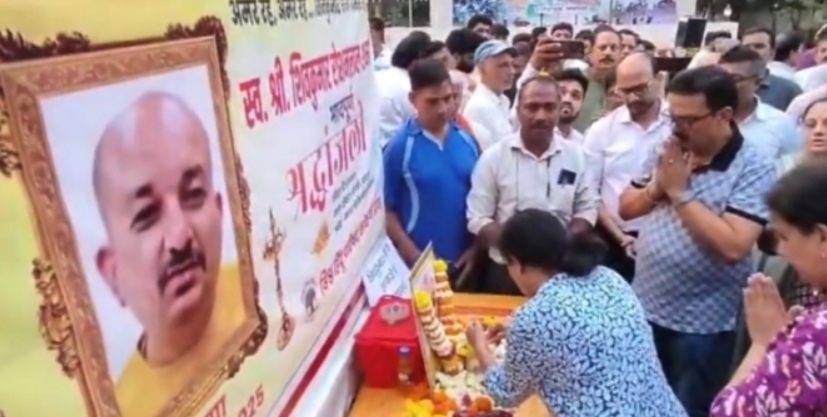
A week has passed since Shivkumar Sharma was mercilessly killed. After the attackers mercilessly killed the Hindu man, allegations surfaced that he was targeted for his Hindu identity. On the 10th of February, members of the Vishwa Hindu Parishad and the Sakal Hindu Samaj organised a protest demanding justice for Sharma and also to pay tribute to him.

The VHP members stated that Sharma was deliberately targeted by the accused persons who had allegedly arrived from Ijtema for owning a Hindu identity.

VHP organised a protest outside the Kharghar police station area on February 10th (MahaMTB)

As per members of the Hindu organisation, the Tablighi Jamaat members, who stopped Sharma’s bike over the overtaking dispute, noticed his Lord Shiva tattoo and the Rudraksha mala around his neck. Additionally, his bike displayed a “Jai Mata Di” sticker. These religious symbols, as per VHP, provoked the Tablighi Jamaat members, resulting in the brutal assault on Sharma.

While talking to the media, the VHP members also stated that the accused persons were influenced by the provocative speeches delivered at Ijtema (congregation of Muslims) that were conducted in Kharghar on the same day attracting more than lakh Islamists. As per the reports, Maulana Saad, a controversial leader of the Tablighi Jamaat addressed the Ijtema event on 2nd February in Kharghar where only around 50,000 addresses were expected. However, more than a lakh Islamists attended the event in which Maulana Saad allegedly delivered provocative speeches against Hindus. “Influenced by the speeches, the accused targeted Sharma over a minor road rage issue,” the VHP members said.

BJP leader Nitesh Rane raises concern over the brutal murder of the Hindu youth, calls for complete ban on Tablighi Jamaat in Maharashtra

Following the widespread attention on the brutal murder, BJP leader Nitesh Rane addressed a letter to Maharashtra CM Eknath Shinde, highlighting concerns over the growing presence of illegal Bangladeshi and Rohingya immigrants in the state. He urged authorities to identify and investigate any illegal immigrants who may have been involved in the attack. Additionally, Rane called for a complete ban on the Tablighi Jamaat in Maharashtra, citing its radical elements as a potential threat to communal harmony.

The BJP leader also visited the victim’s family, offering reassurance that justice would be delivered.

“This is not Pakistan. Whatever has happened is very disheartening. The state government is with you. I myself have come as CM’s representative. Whatever has happened here will be informed to the Home Department and state CM who will surely order strictest action against the accused persons. You people need not worry,” Rane said adding that he has written to the CM to look into the matter.

‘Kharghar has turned into mini-Pakistan’: Family member of the victim expresses concern

Meanwhile, speaking to Rane, one of the family members of deceased Shivkumar Sharma said that they had mentioned to the police while complaining that the Kharghar area in Mumbai has turned into a Mini-Pakistan.

“Is this Bangladesh? Hindus are brutally killed in Bangladesh. Today the police have assured that the accused will be arrested in two days,” he added while talking to the media.

Further, BJP’s Kirit Somaiya also met the family members of the victim and offered condolences. “Met 4 Sisters of #ShivkumarSharma who was Killed at Kharghar NaviMumbai by Muslim Fenatic Activist Police hopeful to arrest Killers soon,” he said on X.

The accused returned from Ijtema cannot be denied, no justification for hitting so brutally: Victim’s relative seeks justice

While speaking to the media, Hrishikesh Dhundre, a relative of the victim, confirmed that the accused had brutally beaten the victim to death. While he could not say with certainty who the attackers were or where they came from, he acknowledged the strong possibility that they were attendees of the Ijtema.

Meanwhile, OpIndia also got in touch with Dhundre. While speaking to us he reiterated that the fact that the accused persons were returning from Ijtema could not be denied. “I was in the area until the afternoon, and the entire place was overcrowded with Ijtema attendees. The number of people present was at least three to four times more than the expected capacity of 50,000,” he stated.

When asked whether he believed Shivkumar Sharma was targeted due to his religious identity, Dhundre did not explicitly confirm it but also did not dismiss the possibility.

‘Sharma was deeply religious and a devoted Krishna bhakt, this is definitely a cold-blooded murder’: The deceased’s relative speaks to OpIndia

“I cannot say this with certainty, but it is a fact that he was deeply religious and a devoted Krishna bhakt. He had a tattoo of Lord Shiva and wore a Rudraksha mala around his neck. He was a quiet, home-loving, and gentle person who would never engage in any confrontation. If you closely examine the video footage, he can be seen politely requesting his attackers to stop and talk instead, while they continue to assault him mercilessly,” the relative of the deceased said.

He further stated, “After the assault, Shivkumar Sharma went to the police station himself to file a complaint. I later learned that another eyewitness, who accompanied Sharma to the police station, confirmed that his bike was stopped at least three times by the accused. This clearly indicates that it wasn’t just a minor confrontation over overtaking. Who assaults someone so brutally over such a trivial issue? Even if there was an argument, under normal circumstances, people would approach the police—who resorts to such a ruthless attack instead?

It is evident from the video that Shivkumar did not hit or provoke anyone. One of the accused was restraining him while another repeatedly struck him on the head with a helmet, continuing the assault mercilessly, even as Sharma pleaded for a conversation. This is undoubtedly a case of cold-blooded murder. They attacked him with clear malicious intent,” Dhundre said, adding that the police have been cooperative and they remain hopeful that justice will be served.

In the given case, the Mumbai Police had launched a massive manhunt to look for the accused persons. 10 teams have been formed to nab the two unidentified men who hit Sharma to death. The incident notably happened in Kharghar on the road between Belpada and Utsav Chowk when the victim was returning from Vashi and the accused were allegedly returning from Ijtema. The police traced the toll naka timing of the accused entering Navi Mumbai and leaving the city. They have also submitted the blurred images of the bike of the accused persons obtained from the CCTV footage for lab testing to recover the bike registration number.

“We are not depending on the lab results, as even if one digit of the number goes wrong, the investigation will change its route. As of now, we are completely relying on technical analysis,” the police said.

‘Purely a case of road rage’: Police claims

The police eventually launched a massive investigation into the case and discovered the exact series of events that happened that day resulting in the death of the victim. “The victim had overtaken the accused twice which led to an argument between the two scooty-borne accused and victim Shivkumar Sharma. The argument escalated to a fight and during the fight, Sharma first kicked one of the duo, and then the accused assaulted Sharma with a helmet,” the police were quoted as saying.

“There had been no instance of mobile lynching or communal fight in this incident as it is purely a case of road rage,” the authorities added. As per the reports, the police checked the CCTV footage of the incident and discovered that the accused left Kharghar at around 10.30 pm, two hours after the incident happened that day.

A video of the incident had also gone viral over the internet. The video was captured by a passerby showing one of the accused persons holding the victim and the other one brutally beating the victim. Unfortunately, neither the evidential video nor the CCTV footage captured the registration number of the vehicle on which the accused persons arrived on the spot.

Elon Musk slams Federal Emergency Management Agency (FEMA) for funding hotels for illegal migrants, including Pakistan-owned hotel, despite Trump’s ban

On 10th February (local time), Elon Musk accused the Federal Emergency Management Agency (FEMA) of allocating $59 million last week to luxury hotels in New York City to accommodate illegal migrants. Musk’s accusations were based on a discovery made by the Department of Government Efficiency (DOGE), which is headed by Musk.

In a post on the social media platform X, Musk wrote, “The DOGE team just discovered that FEMA sent $59M LAST WEEK to luxury hotels in New York City to house illegal migrants.Sending this money violated the law and is in gross insubordination to the President’s executive order. That money is meant for American disaster relief and instead is being spent on high end hotels for illegals! A clawback demand will be made today to recoup those funds.”

Notably, the transfer of funds was in violation of the executive order signed by the President of the United States, Donald Trump, barring any such transfers.

One of the beneficiaries of government funding to accommodate illegal immigrants in NYC is the Roosevelt Hotel, which is owned by Pakistan International Airlines (PIA), a government agency of Pakistan. The Roosevelt Hotel signed a deal with New York City in which the city agreed to pay $220 million to rent the hotel to house migrants.

The hotel came under scrutiny after Indian-American entrepreneur Vivek Ramaswamy labelled the arrangement between the hotel and the state as “nuts”. In a post on X in December 2024, Ramaswamy wrote, “A taxpayer-funded hotel for illegal migrants is owned by the Pakistani government, which means NYC taxpayers are effectively paying a foreign government to house illegals in our own country. This is nuts.”

The hotel had been shut since 2020 following the COVID-19 pandemic. On 4th June 2023, then-Minister of Railways and Aviation f Pakistan, Khawaja Saad Rafique, said in a press conference that the hotel was leased out to the local city government for three years. He added that it would bring $220 million in revenue to Pakistan. For a cash-strapped country, it was big deal to get such amount coming from a previously shut hotel.

The agreement involved leasing all 1,025 rooms of the hotel to the city at price of over $200 per night. Initially, the contract was signed for one year but Rafique expressed hope that it would be extended for full three years. The hotel in question was built in 1924 and PIA had taken its control in 2000.

FEMA is facing heat not only because the funds were transferred despite orders against it by the President but also because it recently reported a lack of funds during Hurricane Helene. However, after the backlash, FEMA issued a statement claiming it was just a rumour and the agency had the required funds to support the victims.

President Trump has initiated process to clamp down government spending which included shutting down USAID. The action against USAID resulted in a massive outcry from the beneficiaries which further opened floodgates of expose on how the agency was pumping billions of dollars for regime change, censorship and other operations worldwide.