Home Blog Page 513

Delhi Assembly Elections: Over 92% eligible voters cast their votes through home voting, facility to continue till 4 February

0

The Chief Electoral Officer of Delhi on Saturday mentioned that 6,980 out of 7,553 eligible voters have cast their votes so far for the Delhi Assembly Elections under the home voting facility. The service commenced on January 24 and will remain available until Tuesday, February 4, a day before regular voting begins.

The initiative aims to facilitate voting for senior citizens above 85 years of age and persons with disabilities (PwDs), enabling them to participate more easily in the electoral process.

Additionally, 206 poll teams have been deployed across the 70 constituencies to facilitate home voting.

To facilitate the voting for elderly and PwDs who wish to cast their vote at polling stations, the Election Commission has arranged for 8,715 volunteers and 4,218 wheelchairs to be stationed at polling locations across the national capital.

“The Home Voting facility is being enthusiastically utilized by differently-abled individuals and senior citizens aged 85 and above in all 70 Assembly constituencies for the Delhi Assembly Election 2025. The home voting facility is available to voters above 85 years of age and PwDs offer them the option to cast their votes from their homes,” read a statement by the Chief Electoral Officer of Delhi.

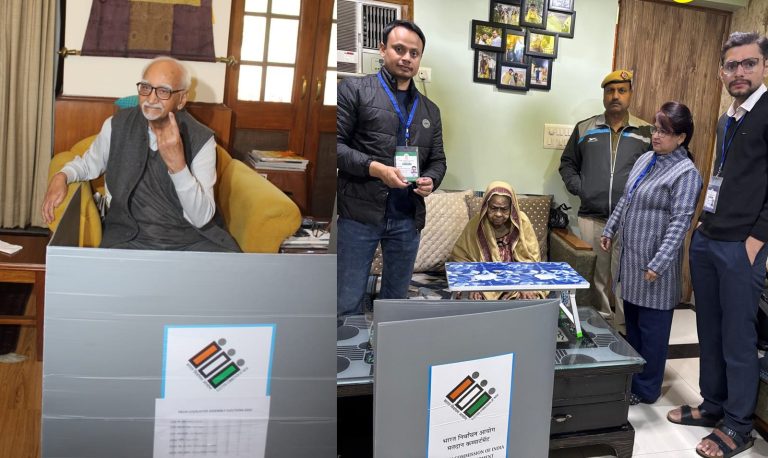
Earlier in the day, 93-year-old Satish Chandra availed himself of the home voting facility from the R K Puram constituency. He had been registered as an absentee voter in the senior citizen category (AVSC).

“I am very thankful for this support, otherwise I wouldn’t have been able to go (for casting vote),” the senior citizen expressed.

As of January 31, 92 per cent of total registered voters under the home voting facility have participated, with District West recording the highest turnout at 94 per cent.

Talking about the postal ballot facility, the Election Commission of India (ECI) has extended this facility to all personnel on election duty and security/police personnel who are electors in a particular constituency but are unable to vote at their designated polling stations due to their election duties.

Additionally, the ECI has also extended the facility of postal ballots to all private personnel and non-government staff, such as drivers, conductors, vehicle cleaners, videographers, etc., deployed on election duty on February 5, 2025.

“A total number of 16,984 Form-12 for issuing of Postal Ballot have been received from Delhi Police and Delhi Home-Guards. To facilitate voting of these police personnel, each of the 70 Returning Officers (ROs) have set up facilitation centres at their respective offices,” read the statement.


(This news report is published from a syndicated feed. Except for the headline, the content has not been written or edited by OpIndia staff)
‘Will benefit only 20-25 people’: Rahul Gandhi repeats clichรฉd tropes to attack Union Budget 2025 which entailed big tax cuts

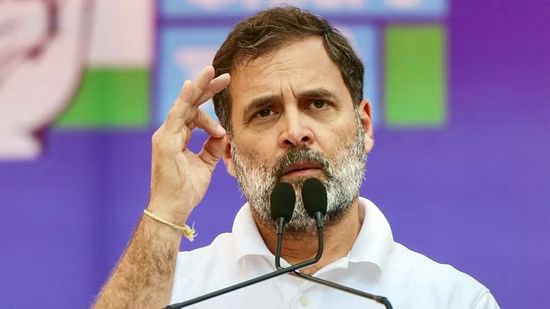
Congress leader and Lok Sabha Leader of Opposition, Rahul Gandhi, on Saturday criticized the Union Budget 2025, claiming it was designed to benefit only 20-25 individuals and enrich billionaires.

Dismissing the significance of the income tax exemption up to โ‚น12 lakhโ€”one of the budget’s key highlightsโ€”he remarked, “The budget presented today is aimed at benefiting 25 people. While they may offer minor tax relief, the real objective is to hand over India’s wealth to 20-25 billionaires. In India, 50% belong to the backward class, 15% to Dalits, 8% to tribals, 15% to minorities, and around 5% to the poor from the general category.” He made these remarks at a public meeting in Delhi’s Sadar Bazar.

He also pointed out the “lack of representation” of marginalized communities in key institutions nationwide. “Look at the owners of private hospitals, colleges, universities, large corporations, or even the judiciary. Where are the backward classes, Dalits, tribals, minorities, or poor general-category individuals among them? These positions are held by elected individuals and their associates,” he asserted.

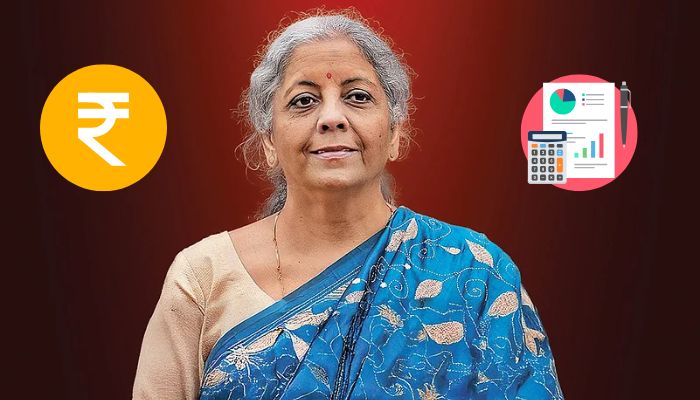
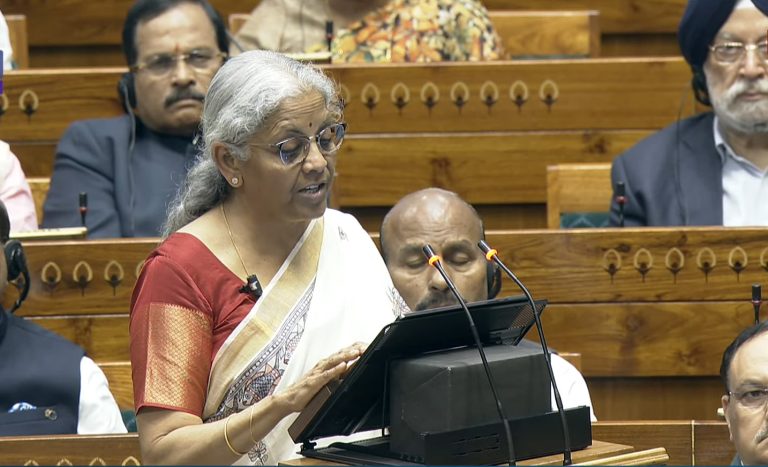
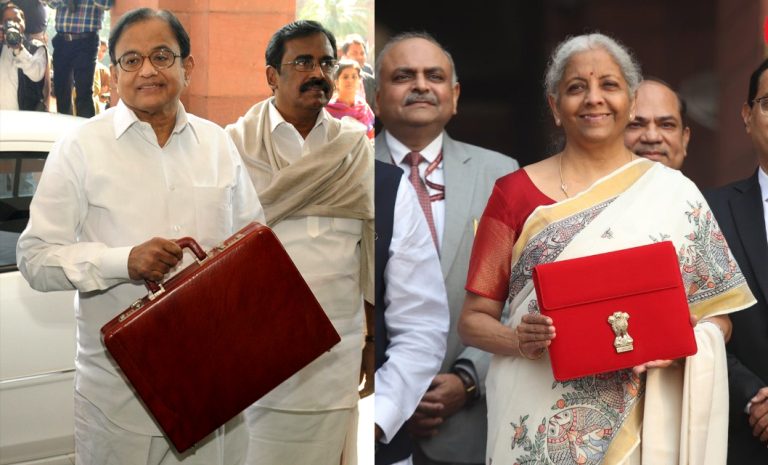
Earlier today, Union Finance Minister Nirmala Sitharaman presented the Union Budget 2025 in the Lok Sabha, outlining a roadmap for India’s economic growth, with a focus on agriculture, MSMEs, investment, and exports.

However, among a slew of announcements, what caught national attention was the significant revisions to the Income Tax slabs in the budget speech. Under the new tax structure, income up to โ‚น12 lakh will be exempt from tax under the New Tax Regime, while for salaried taxpayers, this exemption extends to โ‚น12.75 lakh.

Additionally, the highest tax bracket of 30% will now apply to income exceeding โ‚น24 lakh, up from the previous โ‚น15 lakh in 2024-25. The minimum taxable income has been increased from โ‚น3 lakh to โ‚น4 lakh. Furthermore, the โ€˜no taxโ€™ threshold has been significantly raised from โ‚น7 lakh to โ‚น12 lakh.

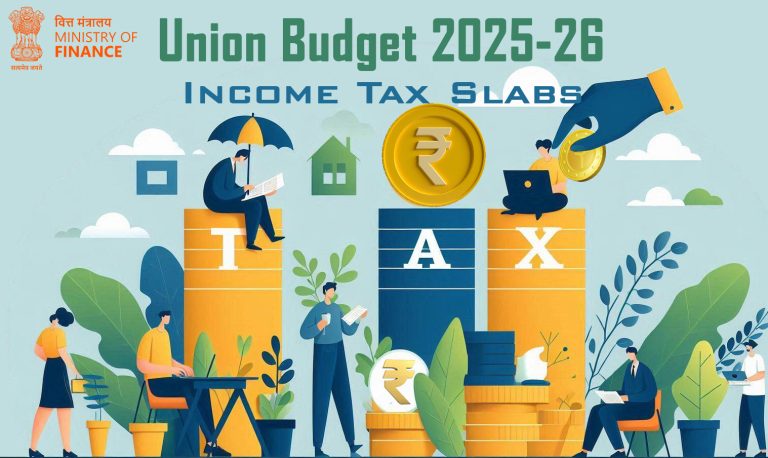
The new slabs for the Income Tax calculation are as follows:

  • Upto 4,00,000 โ€“ 0%
  • โ‚น4,00,000-โ‚น8,00,000 โ€“ 5%
  • โ‚น8,00,000-โ‚น12,00,000 โ€“ 10%
  • โ‚น12,00,000-โ‚น16,00,000 โ€“ 15%
  • โ‚น16,00,000-โ‚น20,00,000 โ€“ 20%
  • โ‚น20,00,000-โ‚น24,00,000 โ€“ 25%
  • Above 24,00,000 โ€“ 30%

In a major relief for taxpayers, Sitharaman announced that no income tax would be levied on earnings up to โ‚น12 lakh. “A tax rebate is being provided for incomes up to โ‚น12 lakh (excluding special rate income such as capital gains), ensuring no tax liability for taxpayers in this bracket,” she stated.

The announcement was met with enthusiastic desk-thumping from the treasury benches, led by Prime Minister Narendra Modi. It was widely hailed on social media and instantly became of talking point in newsroom discussions, with many economists and political observers lavishing plaudits on the Finance Minister for the big bonanza she announced for the middle class, besides the augmented overlay for the Defence spending and other decisions.

Gandhi’s latest remarks on the Union Budget follow a line that he had taken for years now, casting billionaires and wealth creators as corrupt and dishonest, without of course providing any proof for it, even though his party members continue to cut deals with them, while also trying to woo the marginalised and the poor by demonstrating token concerns for their sufferings. Last year, Mr Gandhi also indulged in similar rhetorics, attacking the Finance Minister for the caste composition of her Budget team instead of offering a more nuanced and in-depth critique of the financial plan she proposed.

Rahul’s recent tropes attacking the Union Budget, therefore, reveal the Gandhi scion has learned little from his past mistakes and continues to trot out his vociferous opposition just for the heck of it, without actually getting into the nitty-gritty of the budget or the provisions that could spell disaster for the economy, as against a broad section of the population cutting across the ideological and political line who have hailed it for being groundbreaking and a step in the right direction.

Income tax payable on same income has come down by over 50% since 2014: A comparison of the taxes across 11 years

The union budget for 2025-26 makes significant changes to the Income Tax regime, which is going to provide major relief to taxpayers. According to the new tax structure, there will be no income tax on income up to โ‚น12 lakh. Moreover, the slabs have been changed, ensuring that there will be lower tax outgo even for those who come under taxable bracket with income above โ‚น12 lakh.

This marks a significant increase in the minimum limit for taxable income from the current structure, and even more increase since 2014, when the Modi government assumed office. While now there is no tax on income up to โ‚น12 lakh, in 2014 it was in the highest tax bracket, which started at โ‚น10 lakh with a tax rate of 30%.

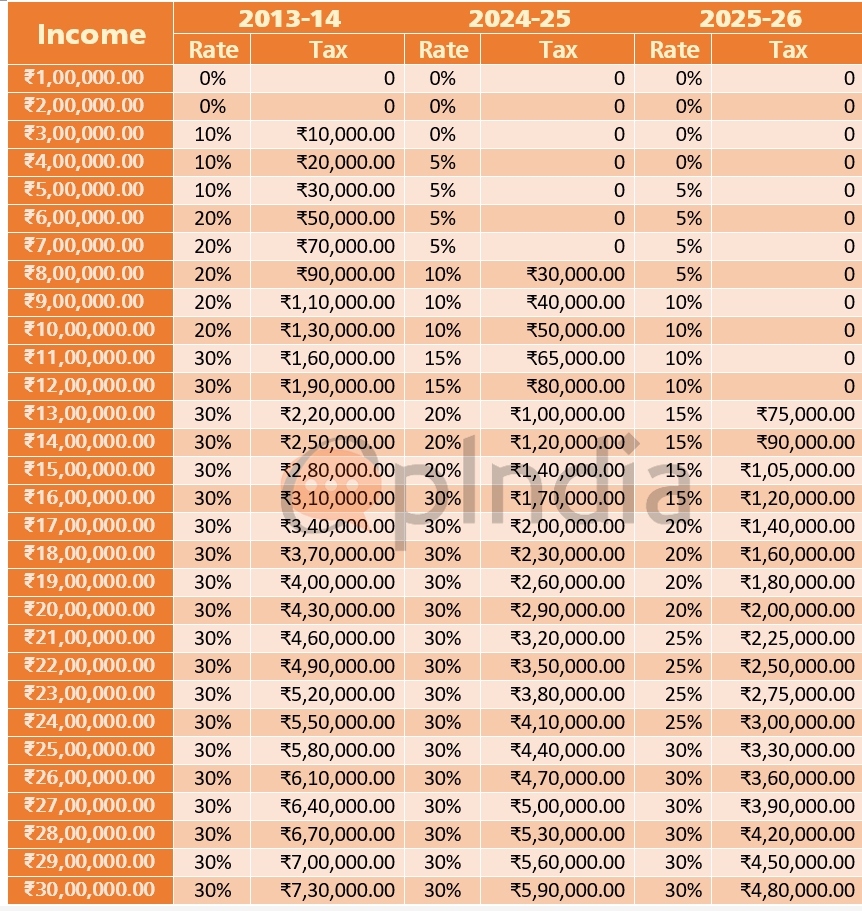
Here is a comparison of the three income tax structures for the years 2013-14, 2024-25 and 2025-26.

We have calculated income tax for income from 1 lakh to 30 lakh with a โ‚น1 lakh interval. The calculations do not include various surcharges imposed on income tax over the years.

First, let us have a look at the I-T slabs for these three years:

For 2013-14

Up to โ‚น2,00,0000
โ‚น2,00,000 – โ‚น5,00,00010%
โ‚น5,00,000 – โ‚น10,00,00020%
Above โ‚น10,00,00030%

For 2024-25

Upto โ‚น3,00,0000
โ‚น3,00,001 – โ‚น7,00,0005%
โ‚น7,00,001 – โ‚น10,00,00010%
โ‚น10,00,001 – โ‚น12,00,00015%
โ‚น12,00,001 – โ‚น15,00,00020%
Above โ‚น15,00,00030%

For 2025-26

Upto โ‚น4,00,0000%
โ‚น4,00,000 – โ‚น8,00,0005%
โ‚น8,00,000 – โ‚น12,00,00010%
โ‚น12,00,000 – โ‚น16,00,00015%
โ‚น16,00,000 – โ‚น20,00,00020%
โ‚น20,00,000 – โ‚น24,00,00025%
Above โ‚น24,00,00030%

Now, there is a comparison of income tax to be paid for various incomes in these three years.

This analysis shows that the tax to be paid on any income has come down by over 50% in the last 11 years. While an income of โ‚น10 lakh attracted tax of โ‚น1,30,000 in 2013-14, it came down to โ‚น50,000 last year and now this has become zero. For an income of โ‚น15 lakh, the tax has reduced to โ‚น1,05,000 from โ‚น2,80,000, and for โ‚น20 lakh it has come down from โ‚น4,30,000 to 2,00,000.

Please note that for 2024-25 and 2025-26, the new income tax regime has been considered.

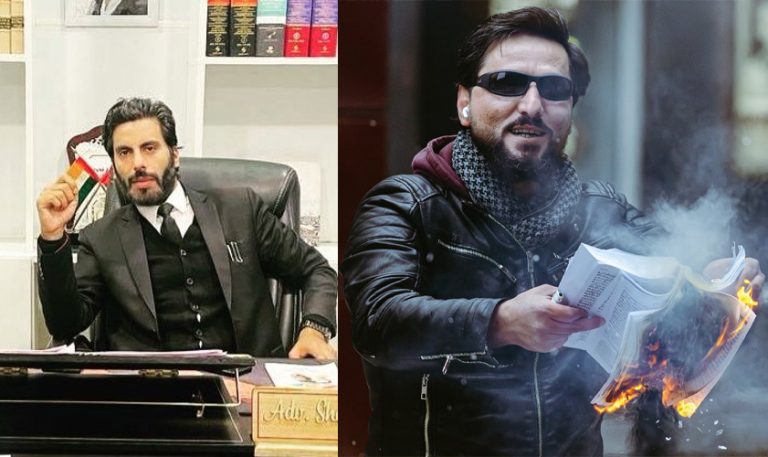
Congress spokesperson Sheikh Aamir celebrates murder of anti-Islam activist Salwan Momika, demands more brutal Islamic public execution

Two days after anti-Quran activist Salwan Momika was shot dead in Sweden, Indian National Congress spokesperson Sheikh Aamir defended and celebrated the murder. Not only that, he said that Momika should not have been just shot dead, but he should have been paraded naked on the streets and then stoned to death.

He also expressed regret that he could not see the brutal murder with his own eyes. The Congress spokesperson made the comments on X while replying to journalist Amy Mekโ€™s tweet with a link to er report on the assassination.

Salwan Momika, who had burned the Quran, was shot dead during a live stream at his residence in Sรถdertรคlje in Sweden. Amy said that it is an Islam problem, saying, โ€œI feel physically sick. The fact that I even have to report on this is beyond infuriating and heartbreaking! How many more need to be slaughtered before the world stops lying to itself and admits the truthโ€”we have an ISLAM problem.โ€

Sheikh Aamir. Congress leader from Jammu and Kashmir, replied to her post, saying โ€œI strongly condemn the killing of Salwan. He should have been paraded naked on the streets and stoned to death. Unfortunately I couldnt see him dying with my own eyes.โ€

Notably, Sheikh Aamir is a spokesperson of the Congress party and appears on TV debates on behalf of the party. He sarcastically said that he condemned the killing of Salwan, then went on to demand an even more gruesome killing by stoning to death, a method of public execution prescribed by Islamic Sharia law.

โ€œCold-blooded murder wasnโ€™t brutal enough for him. He wanted torture, humiliation, and a public spectacle. His chilling words?โ€ asked Amy Mek posting a screenshot of Aamirโ€™s tweet. The investigative journalist wondered whether Congress has completely abandoned secularism.

โ€œHas it transformed into a political arm enforcing Islamic blasphemy laws against non-Muslims? The implications for India’s future could not be more alarming,โ€ she said.

After Aamirโ€™s tweet triggered an outrage on X, the Congress leader deleted the tweet.

Notably, Sheikh Aamir mentions the wrong X handle of the party in the bio of his X account. While the Congress partyโ€™s X account is @INCIndia, he mentions @inc in his bio, which is the account of an American company.

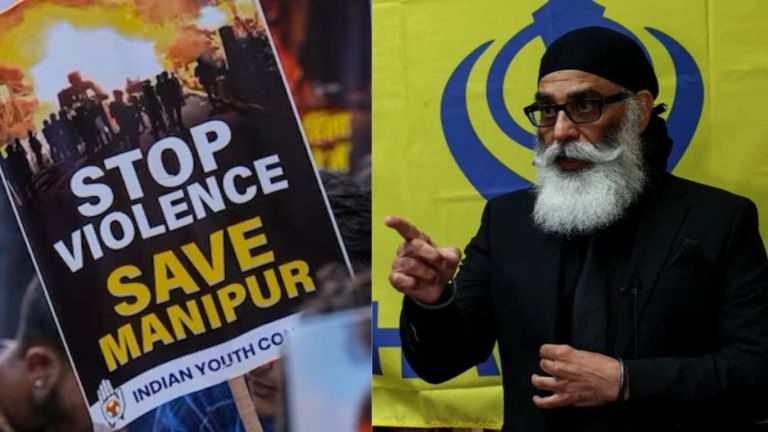
Khalistani outfit Sikhs for Justice inciting Christians in Manipur, Muslims, Tamils to secede from India: Home ministry tells UAPA Tribunal

0

In a submission made before an Unlawful Activities Prevention Act (UAPA) tribunal on Wednesday (26th January), the Union Home Ministry said that the Khalistani terrorist organisation Sikhs for Justice (SFJ) was responsible for inciting Muslim, Tamil, and Christian communities in Manipur to secede from India. The information on the SFJ was included in a background note prepared by the intelligence agencies which was part of the submission of the Union Home Ministry before the tribunal.

In its order passed on 27th January, the tribunal upheld the ban on the SFJ for another 5 years. The SFJ led by Khalistani terrorist Gurpatwant Singh Pannun was first banned in 2019 for five years. The ban was extended for another five years in July 2024. The note reportedly said that the SFJ planned acts of terror involving threats to Prime Minister Modi, Union Home Minister Amit Shah and National Security Advisor Ajit Doval.

The SFJ tried to incite Sikh soldiers in the Army and Punjab Police

“SFJ has been trying to provoke on social media, the Sikh Soldiers of the Indian Army for mutiny by asking them to leave the Indian Army and join SFJ. Pannun had urged Sikh Soldiers to join the SFJ movement and offered โ‚น5,000 more than the salary given by the Indian government. He also tried to provoke the Sikh soldiers posted in Ladakh not to fight for India against Chinese aggression. Pannun also tried to provoke the Punjab Police officials urging them not to stop farmers going to Jalandhar, Pathankot and Abohar and to stop the Prime Minister from his upcoming rallies,” the Union Home Ministry’s submission said.

“Dividing people on communal lines by provoking minority communities against the other communities has become a major tool for the SFJ to push up its anti-India agenda,” the note reportedly stated. The note further revealed that the SFJ, led by Gurpatwant Singh Pannun, had been ‘inciting the Christian community in Manipur to raise their voices for a separate country’ and provoking Tamils and Muslims to create a ‘Dravidstan’ and an ‘Urduistan’ respectively.

In 2023 railway tracks were tampered with at Pannun’s directions

The government also submitted that the SFJ activists and sympathisers were involved in at least two incidents of railway sabotage that happened in 2023 in Punjab. It revealed that on the directions of Pannun, clips of a track were removed in the Lehra Mahout village in Bhatinda on March 14, 2023. Some days later, around 50 clamps were removed from the railway track near Pathrala Railway Station on his directions. The government said that Pannun asked Pro-Khalistani Elements (PKEs) to “sabotage railway tracks in Punjab to cause derailment or accident of passenger and goods trains, particularly those ferrying migrant labourers to take revenge of recent killings of pro-Khalistani Elements based abroad”

In 2023, the Punjab Police registered a case against the SFJ for issuing death threats to Prime Minister Narendra Modi, Union Home Minister Amit Shah and Congress leader Rahul Gandhi. Since 2018, at least 122 cases have been registered against the SFJ by different state police forces and the National Investigation Agency (NIA).

In May 2023, violence erupted in the northeastern state of Manipur between the Meitei and Kuki tribal communities.

Education, Health, Infrastructure, Taxation and more: Here are the key highlights of Budget 2025 across 10 key sectors

On Saturday (1st February), Union Finance Minister Nirmala Sitharaman presented the Budget for the Financial Year 2025-2026. The budget, which has been framed to benefit the middle-class, highlighted key proposals and schemes for the betterment of several sectors. These include agriculture, health, education, law and order, finance, business, infrastructure and more.

Agriculture

  1. The Modi government has announced the โ€˜Dhan Dhanya Krishi Yojnaโ€™, which will be implemented in partnership with the States. The scheme will benefit a whopping 1.7 crore farmers.
  2. It also announced the constitution of a โ€˜Makhana Boardโ€™ in Bihar to enhance value addition and processing.
  3. The loan limit for farmers has been increased to โ‚น5 lakhs from the existing โ‚น3 lakhs under Kisan Credit Card (KCC).
  4. A urea plant of 12.7 lakh metric tonnes will be set up in Assam to benefit farmers.
  5. The Modi government also announced the launch of the โ€˜Atmanirbharta Missionโ€™ for pulses to ensure self-sufficiency in production.
  6. It has also strengthened India’s edible oil market through the ‘National Mission for Edible Oilseeds.’
  7. A National Institute of Food Tech will be established in Bihar to enhance income of farmers.

Health

  1. The Modi government has allocated โ‚น98,311 crore in the Budget for the Financial Year 2025-2026 for improving the healthcare system in India.
  2. It has also allocated โ‚น2,445 crore for the Production Linked Incentive (PLI) Scheme for the pharmaceutical industry.
  3. The government announced that it will establish 200 cancer centres in the country.
  4. It has also exempted Basic customs duty (BCD) on 36 life-saving drugs.

Taxation

  1. The Modi government provided significant relief to the middle class by making payable tax ‘zero’ for income up to 12 lakhs.
  2. The valuation of 2 self-occupied properties can now be marked as nil for tax purposes
  3. A new income tax bill will be introduced to rationalise both the Tax deducted at source (TDS) and Tax collected at source (TCS).

Law and Order

  1. The Modi government announced the introduction of the Jan Vishwas 2.0 bill to decriminalise more than 100 provisions in existing laws.

Finance

  1. To ensure better financial access, banks have been directed to maintain ‘Grameen Credit score’ for self-help groups
  2. To encourage Foreign Direct Investment (FDI), the Modi government will create a model Bilateral Investment Treaty.
  3. It has increased the FDI limit in insurance from 74% to 100%.

Business

  1. The Modi government has assured support to Micro, Small & Medium Enterprises (MSMEs) to tackle non-tariff barriers in exports.
  2. The Budget 2025 also made provisions for an increase in โ€˜credit guarantee coverโ€™ for micro-enterprises from โ‚น5 crores to โ‚น10 crores.
  3. Fund of Funds (FoF)ย for the startup ecosystem has received commitments of over โ‚น9 lakh crore.
  4. The Modi government has announced schemes to boost the footwear and leather industry and manufacture sustainable toys under the flagship โ€˜Make-in-Indiaโ€™ scheme.
  5. An outlay of โ‚น1.5 lakh crores has been announced for infrastructure projects to be completed via private-public partnership (PPP).
  6. โ€˜India Postโ€™ will be evolved into a major public logistics organisation. It will work as a catalyst for rural development.
  7. A Maritime Development Fund will be established with a corpus of โ‚น25000 crores for shipbuilding financial assistance.

Education and Jobs

  1. The Modi government has proposed to remove Tax collected at source (TCS) on education loans up to โ‚น10 lakhs from a specified financial institution.
  2. It announced 10,000 fellowships for tech research and innovation at IITs and IISc under the PM Research Fellowship Scheme.
  3. The government has announced an addition of 10000 medical seats. It has aimed to increase 75000 medical seats in the next 5 years.
  4. An outlay of โ‚น500 crores has been kept aside to establish a Centre of Excellence for AI in Education.
  5. The government will also establish 5 National Centres of Excellence for upskilling the youth.ย 
  6. All secondary schools will be equipped with broadband connection.
  7. The government will establish 50,000 Atal Tinkering Laboratories (ATLs) in schools within the next 5 years. ย 
  8. It will provide credit facilities and insurance to gig workers under the PM Swanidhi Scheme and issue identity cards through the e-shram portal. The facility will benefit โ‚น1 crore gig workers.

Tourism

  1. The Modi government will help develop 50 tourist destinations in partnership with respective State governments.
  2. It will partner with the private sector and promote medical tourism in India.
  3. The government has also extended Murdra loans to homestays in the country.
  4. It has assured to launch a new UDAN scheme to cater to 4 crore passengers and connect them to 120 destinations.

Infrastructure

  1. The government has assured financial assistance for the Western Kosi Canal Project in Bihar’s Mithilanchal region.
  2. It will create a โ‚น1 lakh crore Urban Challenge Fund to transform cities into growth hubs.
  3. The government will also extend the Jal Jeewan Mission, which aims to provide tap water to every household. The mission has been extended to 2028 to ensure 100% coverage.

Energy

  1. The government has set a target of achieving 100 gigawatts (GW) of nuclear energy by 2047 to ensure the transition to clean energy.
  2. A sum of โ‚น20,000 crore will be spent on Research & Development of small modular reactors.

Budget 2025-26: Hereโ€™s what will get cheaper and what will get costlier due to changes in basic customs duties

For the layperson, the highlight of the Union Budget has always remained on what all have become cheaper and which of them has got costlier to buy.

This year too the first full budget of Prime Minister Narendra Modi government’s third term in office has been no exception.

Finance Minister Nirmala Sitharaman as part of her Budget presentation proposed a host of tweaks in basic customs duty (BCD) for various products or items that are critical for manufacturing or for day-to-day needs. In some cases prices were raised to make domestic manufacturing robust.

Relief on import of drugs and medicines:

To provide relief to patients, particularly those suffering from cancer, rare diseases and other severe chronic diseases, Sitharaman proposed to add 36 lifesaving drugs and medicines to the list of medicines fully exempted from Basic Customs Duty (BCD).

She also proposed to add six lifesaving medicines to the list attracting concessional customs duty of 5 per cent. Full exemption and concessional duty will also respectively apply on the bulk drugs for manufacture.

Specified drugs and medicines under Patient Assistance Programmes run by pharmaceutical companies are fully exempt from BCD, provided the medicines are supplied free of cost to patients.

The minister has now proposed to add 37 more medicines along with 13 new patient assistance programmes.

Support to domestic manufacturing and value addition:

In the July 2024 Budget, the government had fully exempted BCD on 25 critical minerals that are not domestically available.

The government had also reduced BCD on two other such minerals to provide a major fillip to their processing especially by MSMEs (micro, small and medium enterprises).

Now, the government proposed to fully exempt cobalt powder and waste, the scrap of lithium-ion battery, Lead, Zinc and 12 more critical minerals.

“This will help secure their availability for manufacturing in India and promote more jobs for our youth,” the FM said.

Textiles:

To promote domestic production of technical textile products such as agro-textiles, medical textiles and geo textiles at competitive prices, the Finance Minister has proposed to add two more types of shuttle-less looms to the list of fully exempted textile machinery.

She also proposed to revise the BCD rate on knitted fabrics covered by nine tariff lines from “10 per cent or 20 per cent” to “20 per cent or Rs 115 per kg, whichever is higher”.

Electronic goods:

In line with ‘Make in India’ policy, and to rectify the inverted duty structure, she proposed to increase the BCD on Interactive Flat Panel Display (IFPD) from 10 per cent to 20 per cent and reduce the BCD to 5 per cent on Open Cell and other components.

In the 2023 -24 Budget, for the manufacture of Open Cells of LCD/LED TVs, the government has reduced the BCD on parts of Open Cells from 5 per cent to 2.5 per cent .

“To further boost the manufacture of such Open Cells, the BCD on these parts will now stand exempted.”

Lithium ion battery:

To the list of exempted capital goods, she proposed to add 35 additional capital goods for EV battery manufacturing, and 28 additional capital goods for mobile phone battery manufacturing.

“This will boost domestic manufacture of lithium-ion battery, both for mobile phones and electric vehicles,” she said.

Shipping Sector

Considering that shipbuilding has a long gestation period, she proposed to continue the exemption of BCD on raw materials, components, consumables or parts for the manufacture of ships for another ten years.

“I also propose the same dispensation for ship breaking to make it more competitive,” she said.

Telecommunication:

To prevent classification disputes, the government has proposed to reduce the BCD from 20 per cent to 10 per cent on Carrier Grade ethernet switches to make it at par with Non-Carrier Grade ethernet switches.

Export Promotion

Handicraft Goods:

To facilitate exports of handicrafts, the government proposed to extend the time period for export from six months to one year, further extendable by another three months, if required.

Besides, she also proposed to add nine items to the list of duty-free inputs.

Leather sector:

The government proposed to fully exempt BCD on Wet Blue leather to facilitate imports for domestic value addition and employment. She also proposed to exempt crust leather from 20 per cent export duty to facilitate exports by small tanners.

Marine products:

To enhance India’s competitiveness in the global seafood market, the government proposed to reduce BCD from 30 per cent to 5 per cent on Frozen Fish Paste (Surimi) for manufacture and export of its analogue products. She also proposed to reduce BCD from 15 per cent to 5 per cent on fish hydrolysate for manufacture of fish and shrimp feeds.

Domestic MROs for Railway Goods:

In July 2024 Budget, to promote development of domestic MROs (maintenance, repair and overhaul) for aircraft and ships, the government extended the time limit for export of foreign origin goods that were imported for repairs, from 6 months to one year and further extendable by one year.

“I now propose to extend the same dispensation for railway goods,” she said.

In Budget 2024-25 too, the government reduced the number of customs duty rates.


(This news report is published from a syndicated feed. Except for the headline, the content has not been written or edited by OpIndia staff)
If no income tax up to โ‚น12 lakh, why there are two tax slabs below it: Explained how Income Tax calculation works

Finance Minister Nirmala Sitharaman on Saturday major changes to the Income Tax slab in her budget speech. As per the new tax rates, there will be no Income Tax on income up to โ‚น12 lakh under the New Tax Regime. The same will be โ‚น12.75 lakh for taxpayers with salary income.

Under the new income tax slabs, the income tax for the highest tax bracket of 30% has been raised to โ‚น24 lakh from the existing โ‚น15 lakh in 2024-25 under the new tax regime. The minimum income has been raised to โ‚น4 lakh from โ‚น3 lakh. Moreover, the ‘no tax’ threshold has been raised from โ‚น7 lakh to โ‚น12 lakh, a substantial increase.

The new slabs for the Income Tax calculation are as follows:

  • Upto 4,00,000 โ€“ 0%
  • โ‚น4,00,000-โ‚น8,00,000 โ€“ 5%
  • โ‚น8,00,000-โ‚น12,00,000 โ€“ 10%
  • โ‚น12,00,000-โ‚น16,00,000 โ€“ 15%
  • โ‚น16,00,000-โ‚น20,00,000 โ€“ 20%
  • โ‚น20,00,000-โ‚น24,00,000 โ€“ 25%
  • Above 24,00,000 โ€“ 30%

Now, a question may arise, if there is no income tax for income up to โ‚น12,00,000, why does the slab show a tax of 5% for income from โ‚น4 lakh to โ‚น8 lakh and 10% for โ‚น8 lakh to โ‚น12 lakh.

The answer is, that it is for the calculation of tax once the taxable income exceeds โ‚น12 lakh. Income Tax is calculated on a slab basis, it is not calculated on a flat rate. This means, that if a taxpayerโ€™s income is โ‚น15,00,000, it will not attract the flat rate of 16% as per the new slab on the entire income. The tax will be calculated based on the slabs, with a lower rate of tax for the lower slabs.

Therefore, Income Tax for taxable income will be calculated as follows:

Up to 4,00,000 โ€“ 0%, therefore no tax on the income of the first โ‚น4 lakh.

โ‚น4,00,000-โ‚น8,00,000 โ€“ 5%, therefore 5% on the next โ‚น4,00,000, which will be โ‚น20,000.

After that, 10% on the next โ‚น4,00,000 from โ‚น8,00,000 to โ‚น12,00,000, which will be โ‚น40,000.

The tax is 15% for the slab โ‚น12,00,000-โ‚น16,00,000, so for the remaining โ‚น3,00,000 in the income โ‚น15,00,000, the tax will be โ‚น45,000. As a result, the total tax will be โ‚น1,05,000.

Even though the income is โ‚น15 lakh, it will not be calculated as 15% on โ‚น15 lakh, which would have been โ‚น2,25,000.

If the income exceeds โ‚น16,00,000 but less than 20%, the tax will be โ‚น1,20,000 plus 20% on the amount above โ‚น16 lakh. For income above โ‚น20 lakh, it will be โ‚น2,00,000 plus 25% on income above โ‚น20 lakh, and for above โ‚น24 lakh it will be โ‚น3,00,000 plus 30% on income above โ‚น24 lakh.

Tax SlabIncome Tax rate for the slabAmount in the slabTax for the slabTotal Tax
Upto 4,00,0000% โ‚น   4,00,000.00 โ‚น        –   โ‚น       –  
โ‚น4,00,000-โ‚น8,00,0005% โ‚น   4,00,000.00 โ‚น   20,000.00 โ‚น  20,000.00
โ‚น8,00,000-โ‚น12,00,00010% โ‚น   4,00,000.00 โ‚น   40,000.00 โ‚น  60,000.00
โ‚น12,00,000-โ‚น16,00,00015% โ‚น   4,00,000.00 โ‚น   60,000.00 โ‚น 1,20,000.00
โ‚น16,00,000-โ‚น20,00,00020% โ‚น   4,00,000.00 โ‚น   80,000.00 โ‚น 2,00,000.00
โ‚น20,00,000-โ‚น24,00,00025% โ‚น   4,00,000.00 โ‚น 1,00,000.00 โ‚น 3,00,000.00
Above โ‚น24,00,000 (assuming โ‚น30,00,000)30% โ‚น   6,00,000.00 โ‚น 1,80,000.00 โ‚น 4,80,000.00

As can be seen in this table, once the income exceeds โ‚น24 lakh, the income tax payable will be โ‚น3 lakh plus 30% tax on the income above โ‚น24 lakh. For income below that amount, the tax will be the total tax for the slab below income, plus the tax calculated on the remaining amount using the rate for that slab.

According to the finance ministry, the new structure will substantially reduce taxes of middle class and leave more money in their hands, boosting household consumption, savings and investment.

Jharkhand: Tribal woman found dead under suspicious circumstances, one Anwar Ansari accused of rape and murder

0

A 22-year-old tribal from the Sundarpahadi area of Godda district in Jharkhand was allegedly poisoned to death after rape by a man identified as Anwar Ansari on Thursday. The victim belonged to the Pahadiya community, a Particularly Vulnerable Tribal Group (PVTG) in Jharkhand.

Ansari allegedly raped the victim and intoxicated her to death

As per reports, the victim’s mother said in the FIR that on Thursday (30th January) the accused forcibly took the victim away from her house and brought her back later in an unconscious state. The accused was accompanied by his friend. When the woman’s family asked him about the victim’s condition, Ansari said that she would gain consciousness after some time. However, the victim died. The victim’s family alleged that the accused raped their daughter and intoxicated her to death.

A panchayat was called in the village following the incident. It is alleged that the victim’s family was pressurised to settle the matter. Upon receiving information about the incident, the police reached the spot and sent the body for postmortem. On 31st January, the body of the victim was cremated.

Ansari was forcing the victim to marry him, says the family

The victim’s family has accused Anwar Ansari of forcing the victim into marriage. The victim reportedly wanted to marry within her community which is why Ansari forcibly took her away on the day of the incident. The police have not been able to nab the accused but his two friends have been arrested. Provisions of rape have reportedly not been included in the FIR.

BJP leadership lashes out at the state government

Godda MP Nishikant Dubey lashed out at the state government regarding the incident. Calling out Chief Minister Hemant Soren, Dubey wrote on X, “The incident this from Barhet, the assembly constituency of our Chief Minister Hemant Soren Ji. Godda is my district as well. Due to the policies of the Congress, the entire Santhal Pargana has been filled by Bangladeshi infiltrators. Forced marriage of tribals woman, rapes and land encroachment are common”.

Attaching Soren, BJP State President Babulal Marandi wrote on X, “You cannot hide the atrocities committed against tribal daughters under the guise of providing โ‚น2500 assistance to the tribal woman. If you are fond of getting credits for tribal women’s respect then you only will be held accountable for their killings”.

Madhya Pradesh: Aman Sheikh slit the throat of an MBA student after she refused his advances

In a terrible incident that took place in Sanwer in Indore district, Madhya Pradesh, a woman was stabbed by a man identified as Aman Sheikh. The police reportedly arrested the attacker on Friday, January 31.

According to reports, Sheikh was putting pressure on the victim to talk to him. Disgruntled by the victim’s refusal to entertain him, Sheikh attacked the victim with a knife and slit her throat. The police shared that the victim, an MBA student, and the accused, graduated from the same college. The victim said that the 23-year-old accused used to stalk her and made attempts to talk to her.

The accused had been stalking the victim for three years

“The woman informed us that she and the accused graduated from the same college. She alleged that he would follow her and try to talk to her. When she refused to speak to him on the day of the incident, he argued with her and attacked her with a knife,” Deputy Superintendent of Police (DSP) Umakant Chaudhary said. The victim has been admitted to a private hospital and is in stable condition.

The victim, reportedly a resident of Chandrawatiganj, moved to her maternal uncle’s place in Sanwer to avoid harassment by the accused. However, the accused tracked her down and attacked her on Thursday, January 30, when she was standing outside her maternal uncle’s house. The accused later fled the spot. His bag was left behind as he fled the scene which indicated that he probably came from college.

The victim’s relatives said that the accused had been harassing her for three years. She hid the harassment by the accused from her family for a long time but told them when he did not stop. The accused was given multiple warnings by the victim’s family but he did not listen.

Local Hindu organisations staged protests against the incident and called for a closure of local markets for half a day. The police are investigating the matter.