Home Blog Page 5410

East Delhi: Liquor shops closed after people defy social distancing rules and huddle to buy alcohol

On Monday, Joint Commissioner of Delhi Police (Eastern Range) announced that all liquor shops that were operational for a few hours in East Delhi had to be shut down, owing to the violation of social distancing guidelines by people.

As the new MHA order applicable from May 4 amid the coronavirus lockdown allowed liquor shops to open, many shops were soon overwhelmed with huge crowds fighting to get their hands on liquor, an item that had been listed ‘non-essential’ till now.

As per guidelines, people are supposed to stand in queues while maintaining adequate physical distance from each other. Along with that, it was mandated that more than 5 customers will not be present in the liquor stores at one time.

Police had to lathi-charge

The cops had to resort to lathi-charge to tame unruly mobs in Laxmi Nagar, and Kashmere Gate areas area after people flouted social distancing rules since the sale of alcohol began at 10 am. Liquor shops had to be forced shut-in places such as Mayur Vihar and Krishna Nagar. Burari and Malviya Nagar also saw a footfall of massive crowds.

The Resident Welfare Associations (RWAs) has urged the government to review arrangements and stop the immediate sale of liquor in light of the violation of social distancing rules. A member of RWA in Greater Kailash, Rajes Kakria, suggested the idea of home delivery of liquor and implementation of odd-even formula to control unruly crowds.

Social Distancing Guidelines flouted in Delhi

A video from Chandra Nagar, Delhi shared by News 18 shows a large crowd creating chaos in front of a local liquor shop. People are seen falling over themselves, pushing shoving and completely ignoring social distancing norms as they fought to buy alcohol. Even if the shop had marked circles to ensure social distancing, the gathered crowd was not paying any attention to them, despite a police presence.

Another video shared by Times of India showed a similar crowd outside a liquor shop in Delhi’s Burari area. Though the people here were not fighting or falling over themselves, the crowd and the assembled vehicles clearly showed that social distancing is not something people have on their minds.

IMCT slams West Bengal Government, provides evidence of the state fudging data and discrepancies in the number of cases reported

The Inter-Ministerial Central Team (IMCT) has slammed the West Bengal government for its handling of the Wuhan Coronavirus crisis in its final observations regarding the state of affair. Team Leader and Special Secretary to the Government of India, Apurva Chandra, in his letter to the Chief Secretary of the state asserted that the government had taken an antagonistic approach towards the team and has not supported it in its pursuit to carry out its duties. He also said that the testing rate was not up to the mark and indicated that the government led by Mamata Banerjee was fudging data, an accusation that has been levelled by numerous other people across the board. The letter also said that adequate systems were not in place to conduct surveillance in containment zones.

The IMCT said in its letter that it could interact and obtain partial responses only from the principal secretary of the Health Department and there had been no interaction or response from any other department in the state. The letter also said that West Bengal has a mortality rate of 12.6% currently, which is “by far the highest in the country”. “This extremely high mortality rate is a clear indication of low testing and weak surveillance and tracking,” said the letter.

The final observations of the IMCT (Source: ANI)

Significantly, Apurva Chandra noted that a discrepancy in the cases reported by the state government. “The bulletin of 30.04.2020 showed active COVID cases as 572, discharged after treatment 139 and expired due to COVID 33 making a total of 744,” the letter says. On the same day, however, the Union Secretary for Health & Family Welfare was informed by the Principal Secretary for Health in West Bengal that the total number of cases were 931, a discrepancy of 187 cases. Furthermore, an additional 72 Coronavirus positive individuals were stated to have died of comorbidities by the state government, however, this number does not seem to feature in the figure of 744 stated earlier.

The bulletins of the first two days in the month of May do not even mention the total number of cases and deaths in West Bengal. “The State needs to be transparent and consistent in reporting figures and not down play the spread of the virus,” the letter states. The IMCT complimented the efforts undertaken by the Health Department to increase the testing rate from around 400 per day on the 20th of April to 2410 on the 2nd of May. At the same time, it was emphasised that the testing rate needs to be increased with continued momentum. It also expressed hope that its suggestions will be received by the state government in the right spirit.

The final observations of the IMCT (Source: ANI)

Tension between Mamata Banerjee and the Central Government

Mamata Banerjee decided to not give her approval to the Indian Airforce to shower petals over two Kolkata hospital on Sunday as part of a military gesture to show gratitude to the country’s corona warriors. The conflict has only risen between the Centre and the West Bengal government after the Mamata Banerjee-led government was angry over the centre for sending special teams to the West Bengal to take stock of the coronavirus ground situation.

The Modi government had sent the team after there were various reports stating that Mamata Banerjee-led state government was fudging coronavirus numbers deliberately to keep the numbers low. Further, medical experts had also claimed that the state government was not at all testing the coronavirus symptomatic patients to limit the numbers of positive cases from the state.

Allegation against the West Bengal Government of fudging data

On Sunday, it was reported that the authorities in West Bengal on the orders of the state government were secretly disposing dead bodies of Coronavirus patients. According to the reports, every night, special teams of cops and paramedics dispose of bodies of coronavirus victims across Bengal. A special incinerator has been created close to a highway that connects Kolkata with the Sundarbans where workers are disposing of a large number of bodies every day.

Earlier, health care experts had said that West Bengal was sitting on a ‘time bomb’. The health-care experts believe that the situation in Bengal is very grave as the Mamata Banerjee-led government has not been giving real data to assess the actual seriousness of the pandemic. From threats to doctors for whistleblowing against the state government against lack of facilities to allegations of state government illegally disposing of dead bodies, there have been serious allegations against the Mamata Banerjee government in Bengal.

Korean Industrialists seeking an exit from China, interested to invest in Uttar Pradesh: Reports

Korea Chamber of Commerce and Industry (KCCI) chairman Yongmaan Park, seeking to move investments out of China, has reportedly shown interest to invest in Uttar Pradesh, stated State MSME and Export promotion Minister Sidharth Nath Singh, amidst the Wuhan Coronavirus pandemic.

As per a report in Business Standard, Park added that other industrialists and electronic makers from Korea were also interested in exploring investment opportunities in the State. It is important to mention that KCCI is the oldest and largest business organisation in Korea and is a national member of the International Chamber of Commerce (ICC) and the World Chambers Federation (WCF).

Assurance by Uttar Pradesh Government

Over a video conference held between the Parks and Singh, the latter assured that the Uttar Pradesh Government would provide the required assistance to help set up their factories in the State. The Government has planned to build a logistics park in UP and has promised to resolve the issues faced by the existing industrialists in the State.

The MSME Minister further conceded that the migrant crisis that arose amidst the Coronavirus lockdown was a major challenge in resuming economic activities. Moreover, state polices are also being reviewed to ease the financial stress faced by industries at the time of the pandemic.

Yogi Adityanath woos US Companies

On Wednesday, Yogi Adityanath held a high-level meeting in the presence of MSME Minister Sidharth Nath Singh and Industrial Development Minister Satish Mahana.

After the meeting, Singh was quoted by news agency ANI as saying: “Companies including big names from logistics, scientific instrumentation, electronic, automobile industries. They already have investments in China. I’m hopeful we’ll be able to bring them to UP, given how we’re working by making changes in our industrial and sectoral policy. 

He said that the Prime Minister and UP Chief Minister Yogi Adityanath want to use the opportunity where industries are moving out of China and see how they can be brought to India. He confirmed that video-conferencing was held with over 100 American companies yesterday in a webinar and they have shown interest.

Mumbai: Doctor booked for sexually assaulting a male Coronavirus patient in ICU

A 34-year-old male doctor working at the Wockhardt hospital in Mumbai Central was reportedly booked by the Agripada police for “inappropriately touching” a 44-year-old male Coronavirus patient at the Intensive Care Unit (ICU) ward of the hospital on May 1.

The accused had joined the said hospital on April 30, a day before the incident, after the management decided to hire young doctors and keep 60+ years old doctors with co-morbidities at home.

The complainant testified to the police that the doctor made sexual advances towards him in the ICU ward, despite the patient’s resistance. The man even tried to raise an alarm during the assault, post which the hospital staff entered the room.

A police case was registered against the accused under Indian Penal Code (IPC) Sections 269 (negligence), 270 and 271 (malignant act to spread infection) and 377 (unnatural offences). The cops have not arrested the doctor out of fear for contracting the deadly Coronavirus infection. He has been quarantined at his house in Thane.

After the victim complained about the incident to the hospital authorities, they informed the BMC and the police. In a statement, the hospital said, “The doctor was on his first day of duty, having joined on the previous day. Following the receipt of information of misconduct and as per protocol, the administration immediately informed the police. The services of the doctor were terminated.”

On migrant workers, ticket prices and bureaucratic language

The convoluted language in this circular from the Home Secretary on movement of migrant workers was mocked all around social media yesterday.

Untitled
MHA notification

The mocking was well deserved. Communicating in simple language would never work for our babus, who don’t have many skills anyway.

But there is a deeper point here, which most people probably missed. Why did the sentence have to be so long and convoluted? The difficulty in constructing the sentence came from the fact that it was trying to define “migrant,” a term which has essentially no meaning. Who is a migrant and who is a local? It’s hard to differentiate these terms because they are both one and same.

Indeed, Indians anywhere in India are at home everywhere. A guy who boards a train from say Bihar and arrives in Mumbai looking for work is not in any particularly different category from anyone else in Mumbai. That is in the Fundamental Rights in the all important Part IIIA of the Constitution: right to reside and settle in any part of India.

In fact, India’s voter ID procedures make this absolutely clear. Even if you have nothing to your name and you sleep on the pavement, the BLO is supposed to verify where you sleep at night. If you are an Indian and you habitually sleep there, you are a local. There is no such thing as a “migrant.”

This may seem like a sterile academic matter, but it is not. It is at the heart of all the misconceptions that have come up around the issue of so called migrant workers, which has now become a political hot button issue.

When the lockdown began, lakhs of workers nationwide, daily wagers, those in unorganized sector, etc, found themselves out of a job. Within days, reports emerged that some of these so called migrants were trying to walk “home,” despite the impossibly long distances involved.

This should never have happened. They were Indians living and/or working in a place of their choice within India.  The migrant worker crisis began precisely because several state governments and media saw these people as some kind of outsider. When the crisis came, it was the duty of the respective state governments to take care of their needs. No, they didn’t need to go “home” because they were already at home! And no, Mr. Kejriwal, giving them one meal and dropping them off at the Uttar Pradesh border doesn’t count as taking care of them. They were not in Uttar Pradesh: they were in Delhi. Just because they may have family members in Bihar or UP or Jharkhand doesn’t mean Delhi government does not owe them anything.

Yes, we understand that times are tough and everyone has finite resources. And the last thing that should happen is richer states forcing people to move to poorer states.

Which brings us to the issue of who pays for the Railway to ferry “migrant” workers back “home”.

These people shouldn’t have had to go at all! In times of lockdown, large numbers of people migrating, that too in crowded trains, is a very bad idea. That too when most of them will be traveling from the worst affected areas to poorer states.

And if at all, these so called “migrants” had to be sent “home,” the least that the government of the “host state” can do is pay for their tickets. The reason this even became a dispute is because people seem to think there is such a thing as “host state” and “home state.”

And there is absolutely no justification for states asking the so called migrants to pay for tickets back “home.”

Of course, there are things here that the Central Government could have done better. The Railway is not selling tickets at stations, only transporting people brought by state governments. For example, the Railway could have sent a consolidated bill to states some days down the line.

For now, it is satisfying to know that the political firestorm has ensured that the affected people, already worst hit by the crisis, will not have to pay anything. In this firestorm, there is an important lesson in how an alert media can hold a government accountable for the slightest slip ups, thus serving the public interest.

Which is why it is so disturbing to see how some of the media has been so shy to hold  ‘secular’ Chief Ministers accountable during the crisis. This is making us less safe as a nation, not more. Only today, there was a media portal which carried, in all seriousness, an article mentioning Uddhav Thackeray as one of the best performers.  Apparently, because “it’s not about the extent of the spread of the infection.” Their words, not mine. Let that sink in.

After Indore, Malegaon sees surge in burials in Muslim graveyards despite reported low coronavirus related deaths

There has been a unusual spike in burials in Muslim graveyards in Malegaon, Maharashtra. According to an Indian Express report, despite a lower death toll due to Chinese coronavirus in Malegaon, there has been an unusual increase in number of burials in Muslim graveyards. In April 2020, the civic records show burials of 580 people, which was 277 in 2019. This figure also shows a jump of 48% as compared to March figures.

Bada Kabrastan, Malegaon’s biggest burial ground, saw highest number of 457 burials in April 2020. This figure stood at 140 in April 2019. Last Thursday, Indian Express counted 9 bodies were brought in at Bada Kabrastan within two hours only. According to the burial ground administration, there are 6-7 burials on a normal day. However, since past few days the Bada Kabrastan saw over 30 burials each day. The number of cremations, on the other hand, have remained more or less stable at 26 in April 2020 as compared to 22 in April 2019. It is estimated that almost 80% of Malegaon population consists of Muslims.

Health officials have decided to randomly check family members of the ones who were buried for coronavirus to see if they are carrying possible infection.

Coronavirus in Malegaon

The first case of coronavirus in Malegaon was reported on 8th April. As per ABP News, 27 new cases were reported from Malegaon, taking the total figure to 325. Nashik has total coronavirus positive figure at 360. As per reports, Malegaon has registered 12 coronavirus-related deaths till now.

Mass graves in Malegaon

On April 23, Dainik Bhaskar reported that Muslim burials at the Bada Kabrastan in Malegaon had tripled more than the average since April 15. Usually, 7-8 burials take place in a day at the said cemetery. But, the cemetery administration had observed an increase of masses. Until April 23 when 8 cases of Coronavirus deaths were reported, burials had been conducted for a whopping 221 people.

Dr Shafiq Ansari who serves as the Councilor of Malegaon Municipality has however claimed that the increasing number of deaths is that of high blood pressure and diabetes patients who could not seek immediate medical care, owing to the Coronavirus lockdown.

Surge in Muslim Burials in Indore

Earlier, a steep rise in the number of dead bodies brought for burial in Muslim graveyards was witnessed in Indore. Between April 1-6, 127 dead bodies were buried in four graveyards. The same figure was 130 for the whole of March. While there were dead bodies cremated in Hindu crematoriums, the figures have been consistent with previous months with no abnormal increase.

According to a Dainik Bhaskar report, the register maintained at the graveyards mention cause of death such as blood pressure, diabetes, etc, the comparison with March figures were quite alarming. The Mahu Naka Muslim graveyard had reported 46 burials in March while the figure was 42 between 1-6 April. The Bhaskar report further reveals that in the case of deaths, despite travel history and symptoms, the samples were not taken of the deceased.

Members of Tablighi Jamaat create ruckus yet again, this time in Alwar, Rajasthan: Here is what happened

On Sunday, around 40 members of the Tablighi Jamaat who were earlier quarantined by the Rajasthan Health Department for 28 days reportedly created ruckus at a shelter home in Kedalganj in Alwar, shortly after they were transferred there by the district administration. This had prompted BJP MLA Sanjay Sharma, to sit on a ‘dharna’ with his supporters, seeking their removal from the shelter home.

The decision by the district administration was taken keeping in mind that the Jamaatis did not belong to Alwar and that they could not travel to their respective homes due to the Coronavirus lockdown. Unperturbed, the Tablighi Jamaat members continued to create a nuisance even in the presence of the police.

BJP MLA sits on a ‘dharna’

As the Jamaatis continued to create a ruckus, local BJP MLA reached a spot. As per reports, the mayhem created by the Jamaatis had scared the local residents in the area. Seeking strict action from the police to restrain the Jamaatis, BJP MLA Sanjay Sharma reportedly sat on a Dharna at the spot.

BJP MLA Sanjay Sharma has warned that the protest would continue until the Tablighi Jamaat members are taken away. He has also held the Jamaatis responsible for the spread of the deadly Wuhan Coronavirus in the country and made it clear that any attempts to do so in Alwar will be foiled.

Sharma was also accompanied by State president of Shiv Sena Raj Kumar Goel and BJP leaders Dinesh Gupta and Ashok Gupta. He further said that the shelter home did not have the capacity to house 40 people. Moreover, he added that the shelter-in-charge and the locals have also faced inconvenience due to the ruckus created by the Jamaatis.

Tablighi Jamaat members create ruckus in Ahmedabad

Earlier, Tablighi Jamaat attendees at Ahmedabad Sola Civil Hospital created a ruckus and refused to take medicines or injections claiming that the government wants to kill them. As reported by Divya Bhaskar, the Jamaatis accused that they were being held against their will and gathered around in a corner.

26 Tablighi Jamaat attendees were brought from Dariyapur to Sola Civil Hospital on Friday and were kept in an isolation ward. When the medical team tried to test them, they refused and created a ruckus. Following this, the hospital’s superintendent had to call a Muslim doctor. After five hours of high voltage drama, the Jamaatis relented after being counselled by the Muslim doctor.

India asks Pakistan to immediately vacate illegal occupation of parts of Jammu and Kashmir

India has demarched senior Pakistani diplomat and registered a strong protest against Pakistan’s Supreme Court’s order on the ‘Gilgit-Baltistan’ area which is under illegal occupation of Pakistan. Last week, the Supreme Court of Pakistan had ‘permitted’ conducting elections in Gilgit-Baltistan area.

The Ministry of External Affairs has said that it was clearly conveyed that the entire Union Territories of Jammu & Kashmir and Ladakh, including the areas of Gilgit and Baltistan, are an integral part of India by virtue of its fully legal and irrevocable accession. “Govt of Pakistan or its judiciary has no locus standi on territories illegally and forcibly occupied by it. India completely rejects such actions and continued attempts to bring material changes in Pakistan occupied areas of the Indian territory of Jammu & Kashmir,” The MEA said in a statement.

The MEA further stated that Pakistan should immediately vacate all areas under its illegal occupation.

Pakistan sponsored terrorism in Kashmir

Pakistan has time and again indulged in sponsoring terrorism activities on Indian soil. On Sunday, five security personnel of Indian Armed forces were martyred in an encounter in Handwara where two terrorists were also eliminated. One of the two terrorists was identified as Haider, a Pakistani terrorist and a top Lashkar-e-Taiba leader.

Liquor over life: People throng to buy alcohol as shops open, lockdown norms go down the drain

As the new MHA order applicable from May 4 amid the coronavirus lockdown allowed liquor shops to open, many shops were soon overwhelmed with huge crowds fighting to get their hands on liquor, an item that had been listed ‘non-essential’ till now.

When the lockdown was enforced on March 24, the sale of liquor and opening of liquor stores were prohibited by order from the central government. While the government extended the lockdown till May 17 by an order a May 1, the liquor shops were allowed to open ensuring strict social distancing norms.

However, as visuals from across the nation suggest, obeying social distancing is not something that most alcohol starved people have in their minds while rushing to liquor shops.

A video from Chandra Nagar, Delhi shared by News 18 shows a large crowd creating chaos infront of a local liquor shop. People are seen falling over themselves, pushing shoving and completely ognoring social distancing norms as they fought to buy alcohol. Even if the shop had marked circles to ensure social distancing, the gathered crowd was not paying any attention to them, despite a police presence.

Another video shared by Times of India showed a similar crowd outside a liquor shop in Delhi’s Burari area. Though the people here were not fighting or falling over themselves, the crowd and the assembled vehicles clearly showed that social distancing is not something people have on their minds.

In Karnataka’s Mandya, police reportedly had to lathi-charge to control the crowd gathered outside liquor shops. It is reported that in many areas of Karnataka, people had carried umbrellas, raincoats and were waiting outside liquor stores since as early as 3 am today.

It is notable here that the May 1 order by the central government has specified that the liquor shops cannot have more than 5 persons gathered at a time. The visuals emerging from across India clearly says the social distancing norms are being openly flouted and there is not much that the police can even do.

After it is clarified that passengers don’t need to pay for Shramik Special train, Sonia Gandhi says Congress will pay, but how?

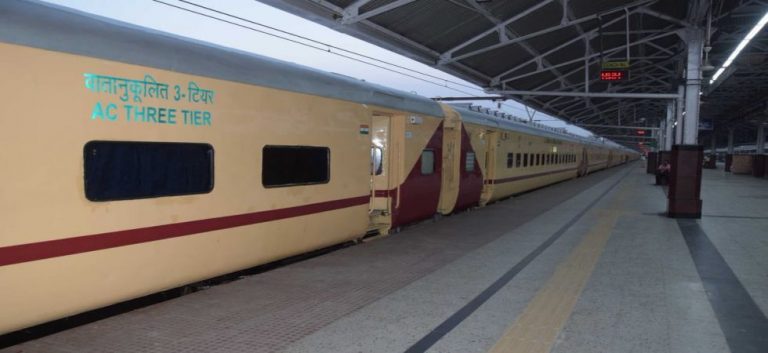
On Monday, Congress leaders took to Twitter to claim that since government is charging money for the railway fare of the stranded migrants going back home on Shramik Special trains, the party will chip in and bear the expenses for the same. This offer to pay for the migrants’ fare came two days after the Railway Ministry had clarified that the state and central governments are facilitating the movement of migrants through Shramik Special trains.

On May 2, 2020, the Ministry of Railways had clarified that no tickets will be sold at the railway station and that the movement of migrants is being arranged by the state governments.

State governments request special train for migrants

Initially there was confusion regarding whether the state governments were to charge the fares. However, senior ministry officials had clarified that the passengers will not be paying for the tickets. “As these are not regular trains, but special trains which will run on the request of state government, there is no provision to buy tickets for those trains. The respective state governments will book the trains by making the payment as charged by the Indian Railways, and the passengers do not have to pay anything,” the official had clarified.

The state governments like Bihar, Punjab and Telangana had earlier requested the Centre for special trains for movement of the migrants as the 40-day quarantine period was coming to an end. Hence, since the state governments themselves had been involved, it was expected that they’d handle the operations.

Soon after the initial confusion, some state governments too clarified that they will bear the fare. On Sunday, 3rd May, 2020, Madhya Pradesh Chief Minister Shivraj Singh Chouhan took to Twitter to clarify Madhya Pradesh State Government will bear their expenses.

“In time of difficulty, the migrant workers should not worry. I am standing with you. State government is working with central government and railways ministry to bring you back home. Your fare will be borne by us,” he had tweeted.

Clarification by Railways

On Monday, the Indian Railways official speaking to news agency ANI clarified that the railways is charging standard fare for the special trains which is just 15% of the total cost incurred by the railways. This has to be borne by the state governments.

Till now 34 such Shramik Special trains are run where food and water is also provided for free to the migrant workers.

Congress offers to pay when there’s nothing to pay

Soon after it was clarified that the fares are not to be borne by the migrant workers, Congress decided to step in and offered to pay non-existent fare the migrants are ‘charged’.

Former Congress President and senior leader Rahul Gandhi took this opportunity to score a few political brownie points.

After Sonia Gandhi instructed state Congress unites to bear the non-existent fares for migrants, Rahul Gandhi again alleged that the Railways is recovering fares from the stranded migrants. He then questioned the Railways Ministry for donating Rs 151 crore to the PM-CARES fund.

Senior Congress leader and Rajya Sabha MP Ahmed Patel too requested state units of Congress to help migrants with ‘purchasing’ tickets.

Here it is again important to reiterate that the Congress is offering to pay for fare for tickets which are already borne by the government and migrants are not charged for the same. So if migrants are not paying for the railway fare, what exactly is Congress offering to pay?