Home Blog Page 5409

Ayodhya: Museum needed to preserve memory of oppressed generations

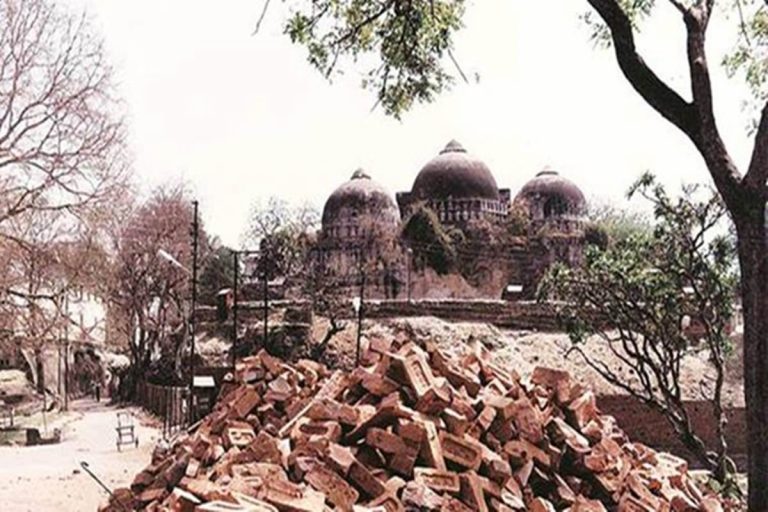
In Ayodhya, the hallowed ground is now being dug up and readied for construction. After being buried under ‘Ganga Jamuni Tehzeeb’ for five hundred years, India’s real history is speaking up.
Untitled
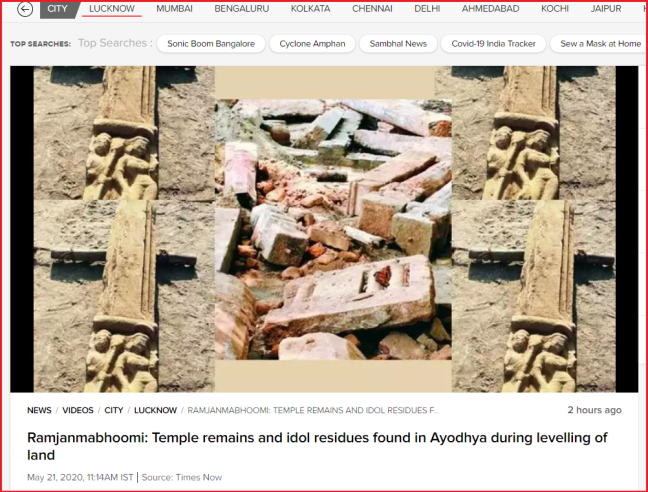
Temple remains and idols found at Ram Janmabhoomi site during excavation

For 70 years after independence, a powerful lobby of leftist historians and archaeologists tried to keep a lid on these voices. But they failed. For everyone who believes in justice and truth, it is a moment of triumph.

However, it is important to remember that the victory is not complete simply with the verdict from the Honorable Supreme Court. Victory is not simply in building a grand Ram Temple at Ayodhya.

Real victory lies in establishing a full documented history of what happened to generations of oppressed Hindus in India. For this, the evidence has to be curated, preserved and presented in compact fashion for the whole world to see and remember.

The lobby of leftist historians may have lost this round after 70 years, but they are not done yet. Their much bigger plan was to bury the history of how Hindus were oppressed for hundreds of years. This bigger plan is still very much up and running. That is why they are creating canards accusing the Supreme Court of deciding on sentiments instead of facts. They are trying to relate the victory to the political success of the BJP and its “Hindu nationalism” which they have defamed across the world.

In other words, leftist historians want the world to think that oppression of Hindus never happened.

Undoubtedly, this has parallels with holocaust denial. And as in many other spheres, we can learn from the Jewish people how to effectively counter such propaganda.

The generation of Jewish people that survived the holocaust vowed two things to themselves. First, they would build a great and glorious Jewish nation. Second, they would make sure the world never forgets what happened to them.

Towards the second aim, they made sure every bit of evidence about the holocaust was carefully collected, documented and preserved. That holocaust memorial museums were opened all across Europe. That every generation of school kids would go to these museums and see for themselves what happened. So that the great atrocity against Jewish people would forever prick the conscience of humanity.

They anticipated that holocaust deniers would eventually appear and try to work their propaganda. Public memory is never particularly good. With time, there is a danger of real history getting lost in a battle of narratives. So you have to keep the documented history fresh and real and before the eyes of the public.

In India, we Hindus face a similar threat. A lobby of left wing propagandists works non stop to deny all historical evidence of Hindus being oppressed in this land. They impose on us the fantasy of ‘Ganga Jamuni Tehzeeb.’ Because they know they are lying, they wouldn’t let us dig up the ground in Ayodhya.

The historical evidence is everywhere. But they wont let us talk about it or use the correct words for it.

I’ll explain how it works. If the evidence is buried below the ground, then they will say that your stories about the place being a temple are just legends not worth believing in. But don’t you dare dig. If it is recorded clearly in some text that a temple was destroyed, they will say the real purpose was plunder and not religious imposition. If the record says that the purpose was to crush the idol worshipers, they will ask what about some Hindus who were appointed as officers? If you can actually see the remains of the old temple at the spot, they will say it is a unique style of Indo-Islamic architecture that is part of Ganga Jamuni Tehzeeb!

So how do we defeat the propaganda? We do exactly what the Jewish people did to keep holocaust deniers away. We start collecting, documenting and preserving. We start with a museum alongside the Ram Temple in Ayodhya where the world can see the evidence that was unearthed.

And then we have to scale this up to a global network. We need museums and exhibitions and school trips to learn about Hindus and the terrible oppression they faced. We need a global day of remembrance for what the Hindu people suffered in their own land. In Germany even today, there are traveling railway coaches that go from station to station, reminding people about what happened in the holocaust. The world never forgets because the Jewish people make sure they don’t.

In India, we Hindus face twice as much of a problem. I dare say most Hindus have forgotten as well. First, we have to teach Hindus about what their ancestors faced. Then, we have to tell the world. It is a huge challenge. But a museum in Ayodhya is a good beginning.
Wuhan: City authorities officially ban eating, hunting wild animals, certain aquatic animals for 5 years

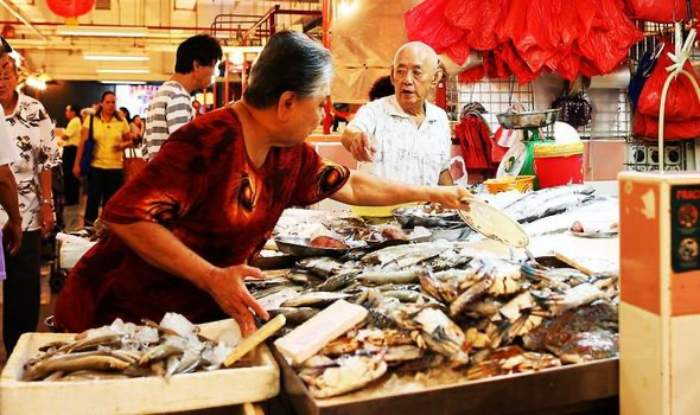
Authorities in the Chinese city of Wuhan, from where the coronavirus was originated, have reportedly banned the hunting and consumption of wild animals. As per reports, the new regulation was released on the official website of the Wuhan government on Wednesday.

Animals that are included in banned list

The regulation stated that wild animals, including all terrestrial wildlife, wildlife animals that are on the national and Hubei provincial preservation lists cannot be consumed or hunted by the residents.

It also added that animals that naturally grow and reproduce in the wild environment and artificially bred and propagated wild animals also cannot be consumed or hunted henceforth.

Certain aquatic animals, including precious aquatic animals and the aquatic animals that currently under national key protection list and endangered aquatic animals are also included in the list of animals the people of Wuhan are now prohibited from hunting or eating.

Ban for 5 years

The new policy was released on May 13. The current ban on the consumption and hunting of the wild animals is to stay for 5 years as of now, as per the orders.

Wuhan coronavirus

The coronavirus pandemic that is currently wreaking a havoc around the world was first reported from the wet markets of Wuhan. Experts had then stated that it is likely that the virus jumped from a wild animal to human body in the wet market of the city.

A 55-year-old woman from China’s Hubei province may have been the first person to have contracted COVID-19 through one such wet market. Huanan Seafood Market in China’s Wuhan is believed to be the epicentre of coronavirus. Though the wet market was shut in January after the initial spread of the disease was reported, the markets were reopened on March-end.

China’s wildlife trade

China’s illegal wildlife consumption trade is suspected to be worth over 125 billion yuan, roughly 18 billion USD. Millions of wild animals are illegally hunted, procured and transported to China every year to meet the growing demand of consumption of wild, exotic animals and their so-called medicinal value. The illegal wildlife trade has been driving many species of wild animals to the brink of extinction in recent years.

A paper published by scientists years ago predicted the reemergence of such viruses. The paper published by Cheng VC, Lau SK, Woo PC and Yuen KY in 2007 warned, “The presence of a large reservoir of SARS-CoV-like viruses in horseshoe bats, together with the culture of eating exotic mammals in southern China, is a time bomb.” It added, “The possibility of the re-emergence of SARS and other novel viruses from animals or laboratories and therefore the need for preparedness should not be ignored.” 

Ultimately, we are all in this together: Psephologist Pradeep Bhandari talks about his month long ground reporting on coronavirus and migrant crisis

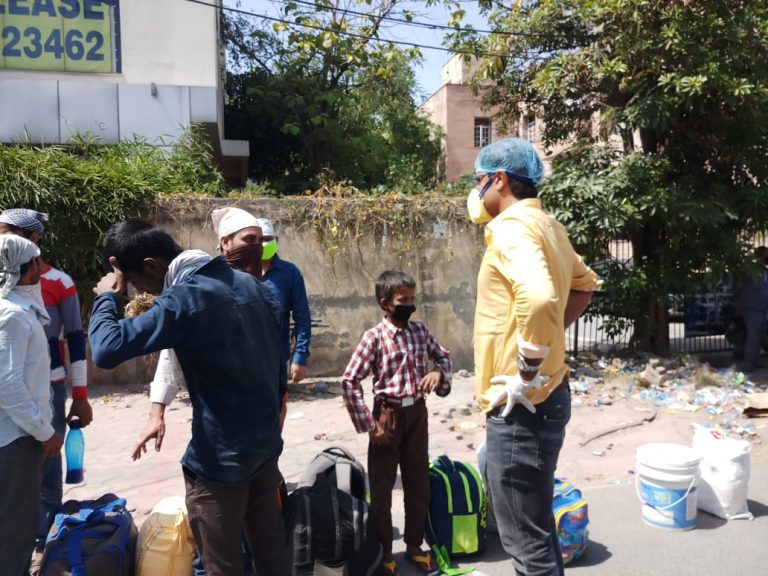
Ever since the Chinese coronavirus pandemic hit the world, our lives have changed drastically. There have been millions of people infected worldwide, and while many have recovered, thousands have lost their lives. In wake of the outbreak, India, like many other countries, announced lockdown to contain the spread of virus and save lives. For a population of over a billion, India had its own set of challenges. While while stay at home was a luxury for many, thousands of migrants across India left the places they were working to go back to their villages. The heartbreaking migrant crisis was as unprecedented.

Psephologist Pradeep Bhandari traveled for over a month to understand and get to the bottom of the ground realities of the migrant crisis. In conversation with OpIndia, Bhandari talks about how the governments fared and what more they could do to mitigate the crisis.

Q: You have traveled for 38 days, what is your reading about situation of migrants on the ground?

I had roughly travelled more than 14,000 kms across 8 states, in my journey on the ground. During my journey I had hardly met an individual who opposed lockdown. Even amongst the migrants, the general sentiment was in favour of lockdown. However there was also a sense of despair which was visible on their faces. There is a thin line between despair and anger which the migrants displayed.

Migrants who were patient and could board the train were happy to go back home, however those who had lonely family back in their village, and had stopped receiving wages from their contractor had no other choice but to leave for home on foot or cycle. The manner in which the returning migrants, will be provided temporary employment will determine that state of the migrants in coming months.

Q: Have migrants turned anti Modi government?

Majority of migrants I spoke to in hindi heartland did not display an anti Modi sentiment. In fact many were of their opinion if Modi was not the PM situation would have been worsen.

The migrants on foot were frustrated and expressed the sense of helplessness on their journey while those who waited and got the train returned with sense of satisfaction. The coming 3 months will determine whether the migrants will remain pro Modi or not depending on delivery of welfare services.

Q: What more needs to be done for the migrants to improve their situation?

It will be extremely critical for state governments to engage with the migrants in the coming months. Caring for the migrants economically, socially, and health wise will be a continuous exercise. On their return to their home states they should be quarantined first.

I remember meeting a group of migrants on cycle from Noida to Mahoba (UP). When I enquired about what they will do on return, the first thing they said -“quanrantine for 14 days”. Level of awareness and voluntary responsibility, resilience in migrants has helped India contain COVID till now. It is extremely imperative that in the coming days food and shelter is taken care of. Home states need to make a state migrant database and centre should also have their details in a single database. With time giving them direct financial benefits should be looked at. Increasing MNREGA will benefit them. They need to be engaged in more public work. It has never happened historically that such huge proportion of migrants have returned back. States should utilise this opportunity to come with state centric model of development which is labour intensive.

Q: Which states fare well and poorly in your state-wise ranking?

Odisha, Telangana, Kerala and Uttar Pradesh fare well while Bengal, Bihar and Maharashtra need to improve. Gujarat and Madhya Pradesh also need to keep track on containing COVID-19 spread. Rest others have performed above average in public perception to the response.

Q: How has the Rs 20 lakh crore economic package received on the ground?

The government has announced a big package focussed on MSME sector, farmers and reforms. It needs to communicate the specifics of the package on the ground in the coming days. The people are aware that government has announced a package, but are yet to gather the specifics of the package to gain benefit.

Q: What are reports from Bengal telling?

The reports from bengsl are worrying. Speaking to people there reflect a sense of worry, lack of clarity in the mind of the residents vis a vis the spread of COVID-19 in the state. As per ground reports, Bengal also did not enforce the lockdown in letter and spirit. Centre needs to minutely track the COVID-19 situation in Bengal as residents to not have complete confidence in state government to fight the pandemic on its own.

Q: How has been the ground travel on migrant crisis? How is the level of awareness? Is social distancing followed?

My approach in my 14,000 km travel was not to reflect the voice of the people or to spread panic. My objective was to help those who are suffering. So if a migrant on the highway was barefoot, apart from documenting his ordeal, I would will also connect the migrant to relevant authorities to help. If sanitisation help is needed we distributed sanitisation kits. In this way we are very fortunate to help many on the roads.

I remember some of them had lost their way to Uttar Pradesh and reached Roorkee in Uttarakhand from Ludhiana, Punjab. We ensured the locomotive passing by could drop them till Meerut from where they could reach their home in East UP. We also used to share the number publicly so that the authorities could reach out to them and help. I would have done injustice to my conscience had I just focused on pain, not making effort to alleviate pain. Ultimately every Indian is in it together.

In villages there is a sense of self confidence that they are more COVID-19 resistant. They had barred outsiders to enter village, even produce was locally sourced in the village. They used gamcha to cover face.

Social distance was not strictly followed at all places. For the migrants on the road, they were anxious to reach back home. Traveling hundreds of kilometres made them impatient and their first preference was not social distancing, but reaching home at the earliest. However, they were self aware of quarantining voluntarily on reaching back. I think migrants are doing best in the given circumstances. Fortunately every day situation is improving as less number of migrants are on the road than before. More than 15 lakh migrants have already reached back, and with increase in Shramik trains and change in the rule needing the permission of state govt to run the Shramik train situation will stabilise in the coming days.

“Young cobras inside my house and coronavirus outside. Where do I go?” Madhya Pradesh villager asks as over 100 baby cobras slither inside his house

A family in a village in Bhind district of Madhya Pradesh had to leave the place as more than a hundred baby cobras have started to come out of the nest after dawn and slither around the house. As per reports, around 123 venomous cobras use to crawl around an area in Madhya Pradesh’s Ron village. The tally is also increasing day by day. The villagers are extremely scared and also believing it as a sign of bad luck.

The house belongs to Jeevan Singh Kushwaha. Due to continuous hissing threat from the baby cobras, the family has shifted to another village while Kushwaha stayed back to guard his property. Kushwaha sits on a chair during the night as he fears that if falls asleep, his leg may dangle onto the floor. He spends the night awake and keeps a watch on his house and those crawling baby cobras. He revealed that as the sun sets they come out of their nest and slither in and around the house. “There are these young cobras inside my house and coronavirus outside. Where do I go?” Kushwah asked.

Young Cobras are deadlier than adults

The forest department officials are making attempts to track down the nests. A cobra lays 20-40 eggs at a time, so it is estimated that there may be an entire colony of cobras under the house. 

As per officials, the baby cobras slithering around the house have hatched out within two-three days. Young cobras are more toxic than the adult ones as they don’t have instincts to conserve the poison, and they eventually release the complete poison in the host body in a single bite.

Kushwaha said that they found hundreds of snakes under the floor. They caught fifty-one snakes but every day five-six more baby cobras are coming out. “Hundreds of baby cobras were found bundled up under the floor. We tried catching them, and caught 51 in one day. Five to six snakes are coming out every day. We haven’t slept properly for the past week. One of us sits on a chair to keep watch on these baby cobras,” Kushwah said. Kushwah and his friends are trying to catch the snakes and release them at a distant place.

In a similar incidence two years ago, more than 100 baby cobras were found in a house in Odisha. Over 100 babies of monocled cobras and two common kraits, along with 21 eggs were found the in the thatched house of a daily worker in Shyampur village in Bhadrak district.

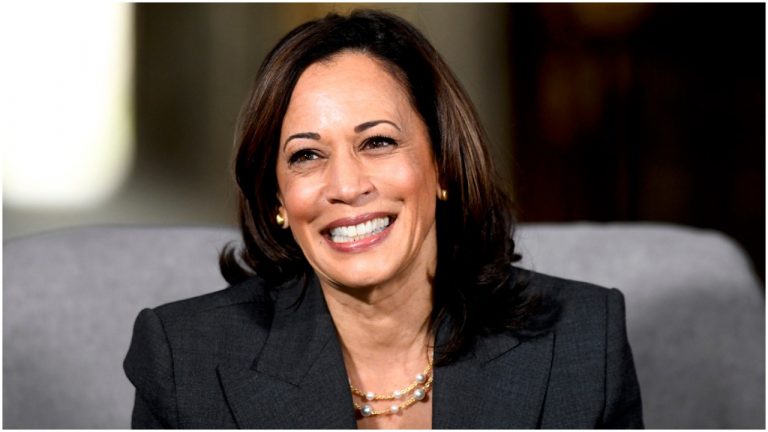
US Senator Kamala Harris and other Democrats introduce resolution against terms ‘Chinese Virus’ and ‘Wuhan Virus’ to describe coronavirus

Controversial US Senator Kamala Harris and a group of other Democratic senators have introduced a resolution condemning of the use of terms such as “Chinese Virus” or “Wuhan Virus” to describe Novel Coronavirus describing it as racist.

According to the reports, Harris, who failed to win the Democratic party nomination to take on President Donald Trump in the November presidential race, has introduced the bill on behalf of a number of Democrats which calls on all public officials to condemn “all manifestations or expressions of racism, xenophobia, discrimination, anti-Asian sentiment, scapegoating, and ethnic or religious intolerance”.

Investigate hate crimes against Asians

The resolution also called to expeditiously investigate and document all credible reports of hate crimes, incidents and threats against the Asian American and Pacific Islander community in the United States. The resolution also called the US to “recommit” to building an inclusive society by prioritizing language access and inclusivity in communication practices.

The resolution claims a study found that over 400 cases of anti-Asian discrimination related to coronavirus have occurred in the United States between February 7 and March 9.

The resolution specifically cited the use of phrases such as “Wuhan virus”, “Chinese virus” and “Kung-flu”. Harris’s resolution was also endorsed by other Democratic senators Tammy Duckworth of Illinois and Mazie Hirono of Hawaii.

Republicans blame China for the global epidemic

The democratic party’s attempt to absolve China of its crimes by bringing a resolution comes at a time when Republicans have sought to hold China accountable for withholding information in the early days of coronavirus. US President Donald Trump has been at the forefront of holding Chinese responsible for the global epidemic coronavirus. President Trump has time-and-again blamed the communist country China for its deliberate act of withholding information regarding the spread of the pandemic.

Trump has in the past called coronavirus as “Chinese Virus” soon after rumours began circulating among Chinese officials that coronavirus found its origin in the US Army. The US President has also rejected objections from the media that the term might be “racist”.

Meanwhile, Republican Senator Josh Hawley has introduced a bill that would allow Americans to sue the Chinese government over its coronavirus handing. “They suppressed the evidence. They suppressed the doctors. They jailed the doctors even. And now we’re dealing with this terrible disease,” the senator said.

He added, “So the victims of this disease in our country ought to be able to go to our courts and sue the Chinese government to hold them accountable and to get damages for it.”

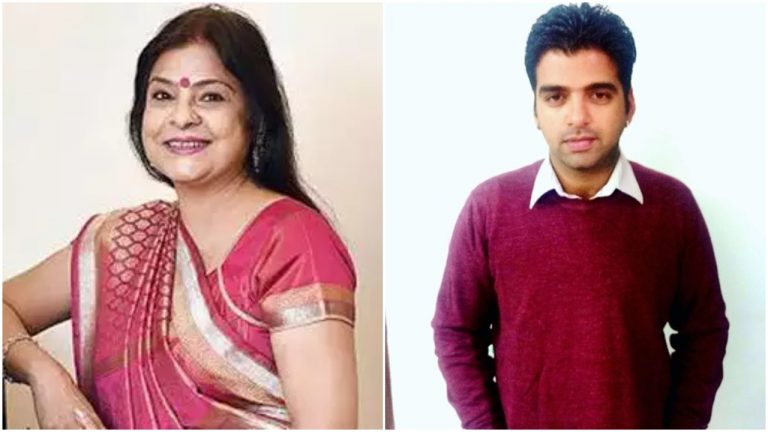
Renowned Folk Singer Malini Awasthi sends defamation notice to Congress IT cell worker for slandering her and family, demands unconditional apology

A day after Congress IT cell worker Gaurav Pandhi had resorted to personal attacks against renowned folk singer Malini Awasthi and her husband, the singer has sent a legal notice to him. The notice on defamation has been sent to Gaurav Pandhi for slandering her husband Awanish Awasthi who is a senior IAS officer and currently the UP Additional Chief Secretary managing the coronavirus crisis in the state.

Taking to Twitter, Malini Awasthi shared the defamation notice being sent to Congress IT cell worker Gaurav Pandhi. Earlier, she had also warned Pandhi to either unconditionally apologise or face legal action after the Congress party worker had called her husband a ‘BJP Shakhaboy’.

In her legal notice sent through Advocate on Record Namit Saxena, Malini Awasthi has stated that Pandhi’s tweet belittles the hard work put in by her in last 4 decades where she has performed in India and abroad while making the nation proud. The tweet which is defamatory and is a blatant attack on her reputation had alleged that she has earned crores from the BJP government.

The notice stated that Gaurav Pandhi’s tweet had carried separate pictures of Malini Awasthi and her husband without obtaining their consent.

“Your tweet which has been in public domain has been authored by you with the sole intent and purpose to cause harm and injury to my client and her reputation which has been built up over the years,” the notice sent by Advocate Namit Saxena on behalf of Malini Awasthi sent to Gaurav Pandhi reads.

Refuting the claim for being baseless, the renowned folk singer Awasthi, in her notice, stated that this is not the first time where Pandhi has attacked a woman’s achievements by demeaning her using the social media platform of twitter. This shows his stigmatic mindset that a woman cannot achieve something independently through her hard work, the notice read. Last week, Pandhi had tweeted a similar tweet targetting Smriti Irani, when he had called the ‘dumbest and unintelligent parliamentarian’ in the history of India. as well.

Calling this a primitive mindset, Awasthi has asked Pandhi to tender an unconditional apology immediately and delete the tweet failing which she will trigger criminal machinery.

Gaurav Pandhi defames Malini Awasthi and her husband over Priyanka Gandhi’s fake ‘list’ controversy

On Tuesday, after Gandhi-scion Priyanka Gandhi had stoked a political controversy with her fake list of buses, the Congress party and its trolls had targetted individuals in an attempt to deflect from the real issue.

In such an act, Congress IT cell worker Gaurav Pandhi had personally attacked Malini Awasthi and her husband Awanish Kumar Awasthi, who is currently Uttar Pradesh’s Additional Chief Secretary. Pandhi said that senior IAS officer was behaving like ‘BJP’s Shakhaboy’ against the poor migrant workers.

Pandhi had shamefully dragged Malini Awasthi into the migrant crisis controversy, insinuated that her husband was acting in such a way because the folk singer has done hundreds of shows for the Uttar Pradesh government and earning crores from the BJP govt. Pandhi had said that bank accounts of Awasthis will not be surprising, implying that senior IAS officer Awanish Awasthi had amassed huge wealth from favouring the BJP.

Following personal attacks against her family, the renowned folk singer had asked the Congress IT cell worker to provide proof for the allegations he made against her family, or else get ready for legal action.

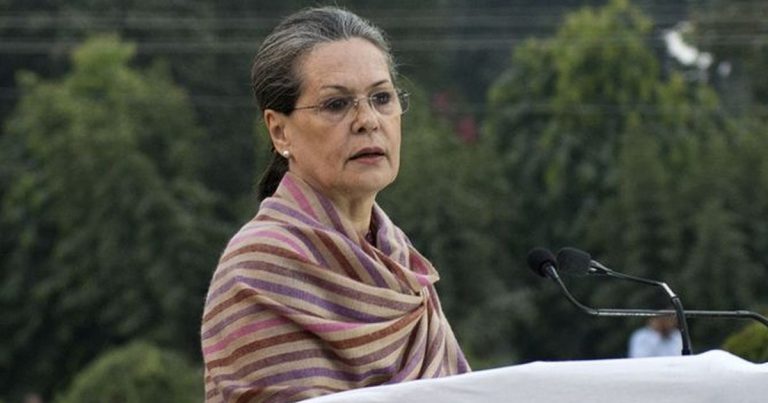
Karnataka: FIR filed against Congress interim president Sonia Gandhi for misleading tweet by party on PM-CARES Fund

An FIR has been registered against Congress interim president Sonia Gandhi in Shivamogga, Karnataka over Congress party’s tweet against PM-CARES Fund.

According to the reports, the FIR identifies the Congress interim president as the handler of the social media account. The complaint accused Sonia Gandhi of misleading people about PM-CARES Fund.

Reportedly, the Congress party had shared a tweet on May 11 which gave wrong information about the fund. The FIR was registered by an advocate named K V Praveenin Shivamogga district, Karnataka.

Earlier, Sonia Gandhi had asked the Prime Minister to transfer all the funds received under PM CARES, that was set up to fight the coronavirus pandemic, to the Prime Ministers National Relief Fund (PMNRF). Meanwhile, it is not yet clear against which tweet the complaint has been lodged.

PM-CARES Fund spent on coronavirus epidemic

PM-CARES Fund Trust was formed on March 27 this year to receive public donations to fight emergencies or distresses like the current coronavirus pandemic. Prime Minister is the Chairman of this trust, and its members include Defence Minister, Home Minister and Finance Minister.

From the PM-CARES Fund, the government of India had announced to spend Rs 3100 crore to the fight against coronavirus. Out of Rs 3100 crore, a sum of approximately Rs.2000 crore was earmarked for the purchase of ventilators, Rs 1000 crores will be used for the care of migrant labourers and Rs.100 crores will be given to support vaccine development. 

A statement was issued by the central govt said that 50000 ‘Made-in-India’ ventilators will be purchased from using the money collected at PM CARES Fund at a cost of approximately Rs. 2,000 Crores. These ventilators will be provided to government-run coronavirus hospitals in all States/UTs, for better treatment of the critical coronavirus cases. This will help in augmenting the infrastructure to tackle the coronavirus cases across the country.

India and Bangladesh start five new ports of call and two more protocol routes to enhance connectivity and trade between the two countries

Indian high commissioner to Bangladesh Riva Ganguly Das along with Bangladeshi counterpart and the Secretary of the Ministry of shipping Government of Bangladesh Mohammad Mesbah Uddin Chowdhury signed an addendum to the protocol on Inland Water Transit and Trade in Dhaka on Wednesday.

A press release issued by the Indian High Commission in Bangladesh stated that the number of Indo-Bangladesh Protocol (IBP) routes are being increased from 8 to 10. This includes the Sonamura-Daudkhandi stretch of the Gumti River. It also includes the operationalization of Rajshahi-Dhulian-Rajshahi routes with the extension up to Aricha.

Chief Minister of Tripura, Biplab Kumar Deb thanked the Prime minister Narendra Modi and Bangladeshi PM Sheikh Hasina for approving the Sonamura-Daudkhandi stretch as an Indo-Bangladesh protocol route.

He stated that the Sonamura-Daudkhandi route will help in strengthening the economy. This will also help in improving the connectivity of Tripura and adjoining states. The Rajshahi-Dhulian route is expected to increase the infrastructure and decrease the transportation cost of stone chips to Bangladesh.

Few new ports will also come into operation due to this agreement between India and Bangladesh. The newly added ports include Dhulian, Maia, Kolaghat, Sonamura, and Jogigopha on the Indian side while Rajshahi, Sultanganj, Chilmari, Daudkandi and Bahadurabad on Bangladesh side.

Two more ports of call have been extended are Tribeli (Bandel) and Badarpur on the Indian side and Ghorasal and  Muktarpur on the Bangladesh side. With this, the total number of ports of call increased to eleven while two extended ports of call in both the countries. Currently, there are six ports of call each in Bangladesh and India.

The Jogigopha in India and Bahadurabad in Bangladesh is expected to provide connectivity to Meghalaya, Assam, and Bhutan. The two nations have also agreed to commence trade between Chilmari in Bangladesh and Dhubri in India through the shallow draft mechanized vessels.

Read- India-Bangladesh water transit project: Bangladesh approves dredging of Jamuna river

The step will allow the export of stone chips and other Bhutanese and North-east cargo to Bangladesh. That will also provide the traders with easy access to the hinterland of Bangladesh. It is expected to boost bilateral trade between both countries.

The agreement will allow inland vessels of both the countries to strengthen the designated protocol route and dock at Ports of Call in each country, notified for loading and unloading of cargo. This decision was taken in October 2018 which has now been operationalized.

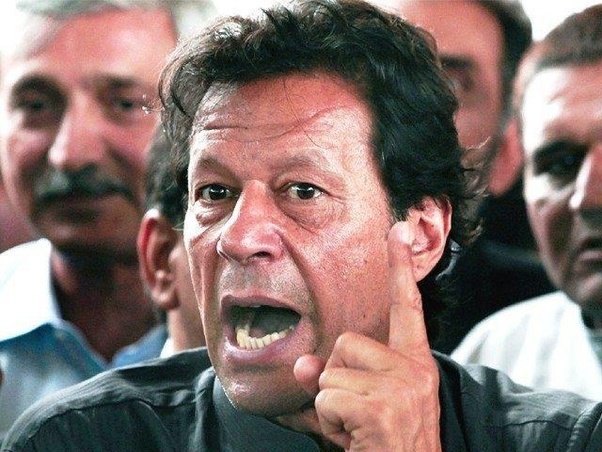
Imran Khan’s tweets reveal that Pakistan has been trying a terror attack in Kashmir since 9 months, but security forces have frustrated them

Research Fellow at South Asian Heritage Foundation, Jeff M. Smith today pointed out that Pakistani Prime Minister Imran Khan has till now tweeted six time since abrogation of Article 370 that India is preparing to launch a ‘false flag’ operation in Kashmir. Curious, we looked it up. The Union Government on August 5, 2019, abrogated Article 370 and made the erstwhile Jammu & Kashmir state an integral part of India without any riders attached. Pakistan, obviously hasn’t been too thrilled about the step.

The first such “India attempting false flag operation” tweet by Khan was out as early as 23rd August 2019, days after the abrogation of Article 370.

He had claimed that he has read claims in Indian media that “Afghanistan” terrorists have Kashmir to carry out terror attacks and that these claims are to divert attention. He tried to warn the international community that India will attempt a ‘false flag’ operation to ‘divert attention’ from ‘human rights violation’. Then, just after India passed the Citizenship Amendment Act, fasttracking Indian citizenship for persecuted religious minorities from three Islamic countries Pakistan, Afghanistan and Bangladesh and there were widespread protests across the country fuelled by misinformation, Khan again tweeted about ‘false flag’ operations.

He talked about ‘false flag’ operation by India in light of the CAA. And again warned the international community about India trying to ‘divert attention’ from domestic chaos.

The third time he raised the ‘false flag’ bogey was in January this year.

It is important to note here that he has been ‘warning the international community’ about false flag operation by Indian side and that he had promised Pakistan would retaliate if Indian Army carries out ‘false flag’ operations since August last year, none of these have materialised. On the contrary, Pakistan continues to indulge in cross-border terrorism and sends its terrorists on Indian soil.

After January, it was time for US President Donald Trump’s visit. It was around that time that anti-Hindu riots broke in national capital when Trump was here which was followed by worldwide Chinese coronavirus outbreak. As Khan tried to tackle the pandemic back home, the ‘false flag’ operations were perhaps temporarily out of picture.

However, in May when everyone made up their minds that we will have to learn to live with the virus and the world slowly opened up, Khan was back to ‘false flag’ operations. It has been only 20 days in May but Khan perhaps had djinns whispering to him about the ‘false flag’ operations as weekly reminders.

And while Khan was busy claiming ‘false flag’ operations, Pakistan-backed terrorists were carrying out terror activities in India. Earlier this month, one of the two terrorists killed by security personnel in Handwara was identified as a top Pakistani commander of Lashkar e Taiba.

False Flag operations

‘False Flag’ operations are deceptive tactics used by enemies where a perception is created that something is an ‘inside job’. To explain what Pakistan perhaps means by raising the ‘false flag’ operation bogey is that firstly, Pakistan will ‘warn’ international community about ‘false flag operations’ by India. Then it will carry out terror attack on Indian soil. When India calls out Pakistan sponsored terrorism, Pakistan will shrug of responsibility by claiming the terror attack was an ‘inside job’ as they have been warning since long.

Pakistan has termed almost every terror attack on India by terrorists trained by Pakistan as ‘false flag’. After the 26/11 terror attack in Mumbai, Pakistan had claimed that Ajmal Kasab was actually a Hindu man named Amar Singh. This theory was later picked up and by many in India including Congress leader Digvijaya Singh who had launched a book blaming the RSS for the 26/11 terror attack. Even the recent Pulwama terror attack on February 14, 2019 was widely alleged as an inside job, including by many in Indian political and media circles. This despite the fact that Jaish-e-Mohammad, Pakistan-based terror group had claimed responsibility for the same.

Even Khan’s May 6, 2020 tweet on ‘false flag’ operation comes just days after the Handwara encounter where a Pakistani terrorist associated with Lashkar-e-Taiba was killed by security forces.

So essentially, Imran Khan is building base for terror attack on Indian soil and blaming India for the terror activity it may carry out. But it seems the Indian security forces have managed to frustrate Khan by foiling all attempts.

Sorbonaash hoye gachhe: Mamata Banerjee says several districts are totally devastated as cyclone Amphan batters Odisha and WB

On Wednesday, Cyclone Amphan battered the coastal districts West Bengal, Odisha with heavy rain and storm causing huge damage to properties and lives. The cyclone blew away thatched houses, trees, electric poles and flooded low lying areas including various cities.

According to the reports, the storm hit the east coast at 2:30 pm on Wednesday, with a wind speeds of 155-165 kmph raising up to 185 kmph. The storm weakened as it moved ahead and is currently centred over Bangladesh.

The cyclone has killed 12 people in West Bengal, while seven others have reportedly died in neighbouring Bangladesh. At least three people have lost their lives due to Cyclone Amphan in Odisha.

Severe damage in Odisha

In Odisha, the Cyclone Amphan hit with a maximum wind speed of 120 km per hour due in Dhamra coast in Bhadrak district while in Paradip it was around 100 km per hour. Severe damage has occurred in the state of Odisha. Trees have been uprooted trees and bent electric poles in coastal Odisha districts of Kendrapara, Jagatsinghpur, Bhadrak and Balasore. 

Hundreds of acred of farmlands are now under saline water in the northern districts of Odisha. Plantations of betel leaves, and coconut have been destroyed, causing huge losses to farmers.

Prior to the landfall of the cyclone, officials had evacuated more than 1.5 lakh people from the coastal and adjoining districts into cyclone shelters till Tuesday evening. Around 1,585 pregnant women were also brought to safe locations by authorities in the coastal districts.

West Bengal severely impacted

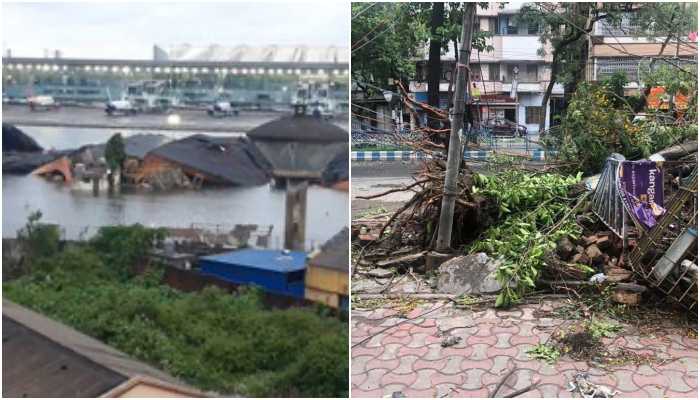
The continuous winds of Cyclone Amphan’s have damaged many structures in Kolkata airport addition to the area being flooded. At least 12 people have lost lives in Bengal as winds at 120 km/hour and heavy rain caused havoc in the eastern state.

Amphan slammed into Bengal around 2.30 pm on Wednesday, uprooting trees, damaging power lines and destroying many buildings in Kolkata and other parts of the state. The cyclone passed mainly over North and South 24 Parganas, Midnapore, Hooghly, and Kolkata.

Meanwhile, Bengal Chief Minister Mamata Banerjee said that the Cyclone Amphan has caused a catastrophe in the state. “Sorbanaash hoye gachhe (everything has been ruined),” said Mamata Banerjee.

Mamata Banerjee said the impact of Amphan was worse than the coronavirus pandemic and claimed the cyclone could have caused damage worth Rs 1 lakh crore.

On Thursday morning, the Indian Meteorological Department (IMD) said that the super cyclonic storm ‘Amphan’ has moved north northeastwards with a speed of 27 kmph during last few hours, further weakened into a cyclonic storm, thus indicating that the worst is over.

Cyclone Amphan is considered to be the fiercest cyclone over the Bay of Bengal, and also the first super cyclone since 1999, which had killed more than 10,000 in Odisha then.